I have spent a few hours of this good Friday reading the diary of my Great Aunt Dora. The story begins all full of the hopes of a young 18-year-old first-generation Australian girl whose parents had migrated from Germany to South Australia around 1877. I know her story, I knew and loved my great Aunt Dora. She will never marry. One of many women of her time, when, after World War 1, there were not enough men to go around. I imagine this is what life in the 1920’s was like for her, a maiden aunt caring for her parents.
Dora
She had one once. Before the war.
He came from Hamburg. A distant relative from the family.
But the Great War intruded. He was the enemy.
Interned. Never to return.
She perched on the bench in the Royal Botanical Gardens. Watching. Men promenading in pale pinstriped suits, on their arms women in their frilly-white Sunday best, giggling.
Easy for the men, she thought. Pick and choose. Pick and choose. Even the damaged men, the cripples, have a chance.
She sniffed.
What about me? Is that my future? Caring for my aging parents? No choice but to be an old maid?
The sun’s rays filtered through the dust motes of the church hall near the seaside. The air conditioner thrummed pumping out the sticky 40-degree Celsius heat that Monday afternoon in January.
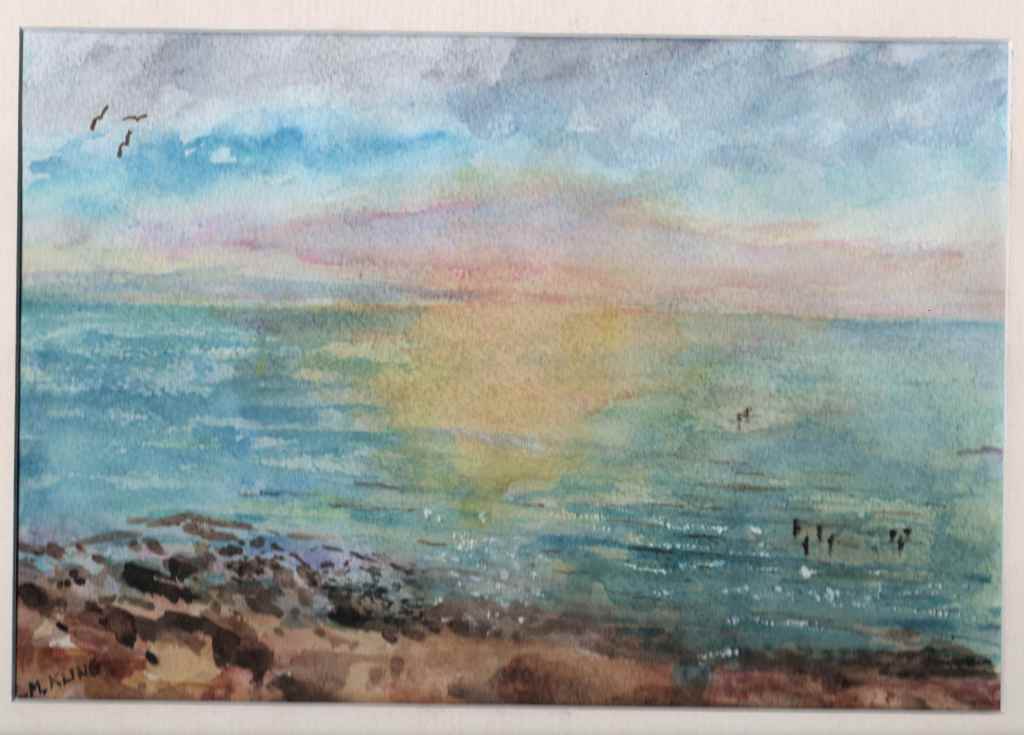
Eloise Delaney unloaded her motley collection of watercolour palettes, colour-splattered former honey jars and 300-gsm paper framed with masking tape. She then arranged her brushes. Thick sable, round and soft, like the tip of her tabby cat, Spike’s tail. Great for that initial wash of sky, sea and sand.
She had lined up the thinner brushes in order of detail as the painting progressed. She stroked the finest brush, the one used for her flourish of a signature; the one more than 70-years old from her maternal grandfather’s collection salvaged after the bombing of his home in Nördlingen, Bavaria 1945. It was premium quality being made in Germany.
She sighed, ‘Must do this so nothing is lost.’
‘Talking to yourself already?’ a voice sang. ‘Sign of madness, ya know.’
‘Consequences of early retirement, I guess.’ Eloise laughed. ‘Least I had a social life when I was working.’
‘What do you call this?’ Eloise’s pear-shaped friend flicked a wiry lock of henna tinted hair from her freckled face. ‘Is this seat taken?’
‘Nah, go ahead. I could do with the company, Fi.’
Fifi settled herself on the plastic chair diagonally opposite Eloise, and after fumbling in her tote-bag, produced a mini flask. The thin mauve cannister wobbled on the newspaper that covered the trestle table. ‘I’m economising today; made my own brew.’
‘I’m celebrating,’ Eloise said and held up her takeaway cappuccino from the café down the road. ‘The “Rabbit hole” beareth fruit.’
Fifi pulled out her sketch pad, set of Derwent pencils and three scrunched up tissues. Then she leaned forward ‘What? Oh, your family history. Any noble? Kings and queens? Or, let me guess, some royal fruit from the other side of the royal bed?’
‘Well, actually, sort of…’ Eloise dipped her brush in the former honey pot full of water. ‘France, actually. And a bed of his ancestor’s made long, long ago.’
‘Well, I could have told you that, him being French, I mean.’ Fifi wiggled her generous behind on the chair, and then smoothed a fresh page of her sketchbook. ‘Do tell.’
El opened her mouth to spill forth all the juicy gossip about tracing her husband’s tree, a royal line stretching way back beyond Charlemagne and to Julius Caesar—all done without the help of DNA, but hours of research—when the leader stood and welcomed the small art group back from the holiday break.
Plus, there was that strange woman sitting behind them who was listening to every word El spoke. That woman, Sharon Katz, nicknamed Shatz, with the mouse-brown hair and the poisonous mushrooms (picked from the forest and dried) she foisted on El just before Christmas—insisted she take them. Lucky for El, her husband, Francis Renard, as a keen gardener and scientist, warned her of the dangers and she threw the suspect fungi into the bin. The next week, Shatz made a point of asking how El how she was feeling. All holidays El puzzled over Shatz. Had she had a run-in with this Shatz in times past while doing her duty as a police officer? Or was Shatz one of Francis’s former lovers?
‘Tell you another time,’ El whispered. ‘Probably should get Francis’ permission first.’
‘Oh, okay, then.’ Fifi sighed. ‘So, how was your Christmas?’
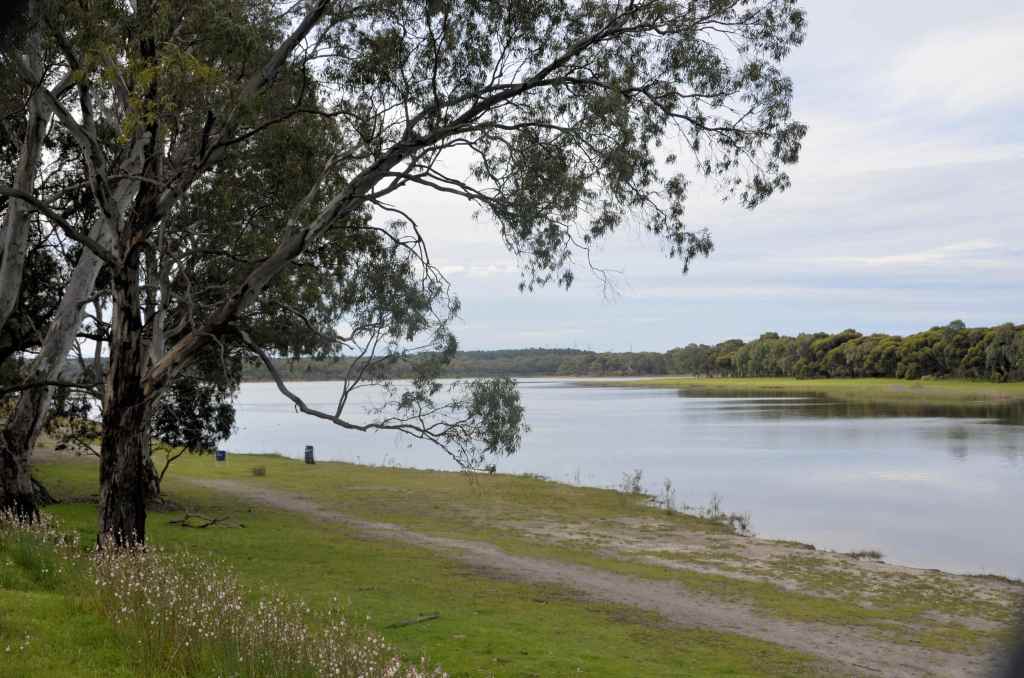
‘Meh! Glad it’s over for another year, Fi.’ Eloise smiled. ‘Francis and I had a quiet one on the actual day, then we all went to my cousin’s in Flagstaff Hill on Boxing Day. It was a disaster. You know, in the middle of Christmas lunch, which I might add, was leftovers from their Christmas day, someone, not mentioning any names, just had to bring up the latest controversy circulating on Fox News. Next thing, arguments all round. Renard and I left early and walked around the newly opened Happy Valley Reservoir. At least that part of Boxing Day was enjoyable.’
‘Well, my Christmas Day, thanks for asking, Eloise,’ Fifi’s lips tightened for a moment, ‘I don’t know why we bother and make such a fuss about the whole thing.’
‘Yeah, I know, the novelty wore off years ago. I just wish we could get back to the basics, the real meaning of Christmas and celebrate that.’
Fifi nodded. ‘Yeah, who needs another voucher? All we do is exchange money and vouchers these days. Where did the love go? Although, in my family, even with all those kids my parents had, there wasn’t much love.’
‘Really? I always envied your big family.’
Fifi sniffed. ‘If you really knew my family and what went on behind closed doors, you wouldn’t be envious.’
‘Why?’ Eloise may have been taking time out from her job as a detective, but she had not lost her inquisitive nature. ‘What went on behind closed doors?’
‘My dad, when he was around, was a pompous twat.’
‘How so?’ Eloise asked. She noticed Shatz, lifting her head, looking at them and listening again. Her curiosity annoyed El and she turned around and glared at the woman. Shatz dropped her eyes down to her sheet of paper and pretended to work on her pastel rendition of a bullfrog.
Shatz’s eavesdropping didn’t bother Fifi who continued, ‘He was hard on us kids. If we did the slightest thing wrong, he’d thrash us. Typical of his generation and background, European, you see. He thought you hit kids into submission. And, as for girls, they were to be seen, but not heard. He treated us girls like slaves.’ Fifi thumped the table. ‘I hated him.’
Fifi’s cannister of coffee toppled from the table and rolled on the floor.
Shatz picked up the cannister and handed it back to Fifi. ‘My dad was the same,’ she said before El’s frown drove her back to her seat to resume painting.
El then said, ‘He didn’t mellow in his old age?’
‘He left and…’ Fifi paused, ‘…and I was glad. Life improved after he was gone.’
Eloise studied Fifi and the freckles that danced on her face as her eyes blinked and her mouth twitched. ‘I sense that your father did more than just leave, Fi.’
Fifi’s eyes widened. ‘How did you know that?’
‘Part of the job, Fi. So, what did he really do?’
‘It was the strangest thing, Eloise.’ Fifi took a deep breath. ‘One day, my friend Lillie, and Jimmy my brother and I went for a hike up to Mount Lofty. On the way down, we did a bit of exploring. I can’t remember whose idea it was. Anyway, I go looking at this culvert. I had in mind that this hole in the side of the hill could be some disused mine and that I could find gold there. But, when I go down there, I see this body. Just bones and leathery skin over the bones like…but I recognised the boots. Those boots. I had lost count of the times those boots had kicked me…I knew it was my dad. But at the same time, I didn’t want it to be true. I just hoped they, whoever they were, were somebody else with the same type of boots.’
‘Oh, right, when was that?’ Eloise had turned over her paper and had begun to take notes with a piece of charcoal. ‘How long ago, did you say?’
‘Over forty years.’ Fifi replied softly. ‘He’s been gone since January 1978.’
‘Forty-four—exactly.’
‘How did he end up in a ditch? Near an old mine?’
Fifi shrugged. ‘Not sure, but he had enemies.’
‘I see.’
‘You see, we did report it to the police. But nothing happened. Forty years, and nothing. I mean, I know he was a creep and often rubbed people up the wrong way, but he was still my dad. And I just wanted to…you know, find out why he ended up there. Why anyone would. Dead. And no one seems to care.’
Silence for a few minutes. Fifi sipped her coffee while Eloise studied her notes. The happy chatter from fellow artists provided background noise. The air conditioner continued to thrum.
‘Mm,’ Shatz began in a soft voice, ‘my brother was killed in a motorbike…’
El turned and narrowed her eyes at Shatz. Was this woman trying to get attention? she thought.
‘Sorry,’ Shatz said. ‘But I knew Mr. Edwards, he was a real…’
‘Well, of course you did,’ Fifi huffed, ‘we went to the same church, remember?’
‘Never mind, sorry,’ Shatz mumbled.
Another pause.
After the pause, Eloise looked up. ‘Would you like me to follow this up?’
‘I don’t know.’ Fifi wiped her eye. ‘I guess. But isn’t it a bit awkward for you now that you’re…?’
‘No trouble. I can call Dan, my partner, or should I say, my ex, or whatever he is now that I’m on leave. I can still use the phone.’
‘Thanks.’
‘I’ll see what I can do. No promises. But it’s worth a try, don’t you think?’
The rest of the afternoon, Eloise and Fifi occupied their thoughts with painting and sketching. The cheerful chatter of the other artists continued, none the wiser of Fifi’s loss and childhood trauma. Except for Shatz. El wished that woman who attempted to poison her wouldn’t be so nosey and would mind her own business.
The air conditioner kept on thrumming until the rush for pack up and departure. Then as the last person locked up the building, they turned off the infernal humming machine and the heat of late afternoon in Adelaide seeped into the empty hall.
Letters from our forebears give us today a rich picture of them, their personalities and their lives. As it’s my maternal grandmother’s birthday tomorrow (March 16), I am sharing the first part of a circular letter written by Elsa of the family’s relocation from the Murray Riverland to the desert Centre of Australia back in October 1939. My grandpa, Sam, Elsa’s husband had been called to be a missionary pastor in Hermannsburg, Northern Territory. Note the timing of this adventure. World War Two had just broken out, but no mention in this letter.
Well, here we are at Hermannsburg at last, our long journey is at an end. We have a home again, although till now our goods haven’t arrived – we are anxiously waiting for them to be able to pack away our things – but – this is the land of ‘wait-a-while’ – so we will just have to wait until they come.
We had a very pleasant journey up from Adelaide. Went as far as Port Augusta in my father’s car, after having stayed overnight at a cousin’s place in Murraytown. It was very nice going up by car, it saved changing twice and with all our luggage it would have been quite a picnic. We had arranged to meet Karl in Port Augusta, but when we arrived there we discovered he had German Measles, so we could only speak to him from the other side of the room; he was in bed, and he couldn’t even come to see us off, which was quite disappointing.
Anyhow, at 4.30am on Thursday 28th we steamed out of the Port Augusta station. We had sleeping berths, the children and I with 2 other ladies in the one compartment, 4 berths in each, and Sam & 3 other men in the next compartment. During the day we were mostly alone in Sam’s compartment, the other men went on the other part of the train and just came back to sleep. It was very nice because then the children had room to romp around a bit. The sleeping berths were very comfortable, 2 at the top and 2 at the bottom. We all had bottom ones, Ruth & Marie in one, I in the other one and Margaret between in her basket. During the day the beds are just ordinary seats and for the night they put the back-leans down and it makes a comfortable bed. The children stood the travelling very well, they were very excited of course to go in the train. The end of the second day (Friday) they got a bit tired of it, but soon got over that. The only one who didn’t enjoy it too much was Margaret, she was running a temperature most of the time and was particularly grizzly on Saturday afternoon. The next morning we could see why – she had German Measles, but the rash didn’t last long, and now she is just about right again. Now we are wondering if Ruth and Marie will get it, they have colds, so we are keeping ourselves isolated out here, we don’t want to give it to the natives, they always get things so much worse than the whites. One of the ladies in our compartment had them too, she was very miserable, was in bed for most of the trip.
Well, to go on with our trip. From Port Augusta to Oodnadatta, which we reached at 9 o’clock on Friday night, there wasn’t much to see, flat deserty-looking country, a lot of it covered with stones, not nice smooth ones, were like broken bits, it makes a person wonder where they all came from — no hills, just these plains covered with stones. We also passed a lake, but that looked as dreary and dead-looking as all the rest of the country. That was to Oodnadatta, when it was night. But when we woke the next morning it was different, grass and trees and ranges and wild flowers. One advantage about this trip is, that they stop at every station or siding, sometimes there are just one or 2 houses, other places a few more. One place we stopped at, Anna Creek, by name, the 2 or 3 railway houses had lovely gardens and lawns, such a contrast to all the surrounding country. We saw something similar at Rumbalara , where the police station is. At this place we had to wait for nearly 2 hours as our engine had broken something and they had to steam up another one. This long stay enabled us to see some of the wild flowers growing along the line. They are altogether different to the ones in the south, and such a variety, too, and they appeared to be past their best too. It must be a wonderful sight when they are all out. This delay at Rumbalara made us late, of course, at Alice Springs. We arrived there at quarter to 5 instead of 2.15. Missionary Albrecht arrived to meet us a few minutes after the train was in, and took us and our host of luggage to Johannsens, where we slept.
After we had had tea Missionary Albrecht took us out to the little church which they have in Alice Springs. It was presented by Mr Materne of Nuriootpa as a Thank offering. It is a nice little church with a fairly large vestry and a sleep-out, so that anyone coming in from the mission station has somewhere to stay. At the church we met some of the natives of Alice Springs, they are being cared for by the evangelist Martin, who holds services twice every Sunday, when there is no missionary there and also gives baptismal instruction. He is a very fine man. Here the children met the first natives. They had seen some from the train already and were greatly excited. To our amazement they weren’t at all afraid of them, and not any more shy, if as shy, as with white children. They shook hands with them much to the natives delight.
The next day services were held there, in the morning it was in Arunda, but during the service Missionary Albrecht welcomed Sam and he then spoke a few words to them in English. In the afternoon Sam conducted the service and preached the sermon, in English of course. There were about 60 natives there for the services, not as many as usual so they said, some were away working. Several whites came to the afternoon service, Johannsens and others. Unfortunately I wasn’t able to go as Margaret was sick, I was so sorry I had to miss it.
On Monday Sam and Missionary Albrecht had quite a lot of business to see to, and then on Tuesday morning we set off for Hermannsburg at about 11 o’clock, Sam and Marie on the back of the loaded truck with a native man, and Missionary Albrecht and Ruth, Margaret and I in the front seat. It was a fairly hot day but not unpleasant. We called in at “The Jay”, 25 miles from “The Alice”, the home of Mr & Mrs T. Strehlow. They persuaded us to stay there for dinner. They have a nice little home, 3 rooms, with a lovely wide verandah, made of cement bricks. They also have a refrigerator. It was just lovely to have the nice cool water and also ice cream, a real luxury way out in the bush. At about 3 o’clock we went on. It wasn’t quite so hot then. Up to the Jay the road had been fair, it had been made some time ago for the Governor General. After we left the Jay it wasn’t quite so good, it had been washed out by the heavy rains and that meant driving fairly slowly with the loaded truck. We had to cross over so many creeks and of course there were no bridges, but stones and sand instead. The truck had to pull and pant and bump to get across in some places. The scenery was quite nice though. Before we came to the Jay we were travelling right in the ranges, but after passing there the country was more open, a plain, with ranges along both sides. But there is nothing like a desert around here. It is more like one of the back roads in the mallee, only of course more creek beds to cross.
I quite forgot to mention that after we left the Jay we drove around the native camp, where blind Moses is the evangelist. These natives live in grass huts. They were very pleased see us and of course we had to shake hands all around. Then they sang a hymn, after which Missionary Albrecht offered up a prayer and they all then recited the Lord’s Prayer, all in Arunta of course. It was wonderful to think that out there in the bush, underneath the gum trees, those natives praying and singing praises to their Saviour just as the white people do in their Churches. The natives were very interested in our children, and of course our children were very interested in them too. Before we left Missionary Albrecht had to take orders for the different ones, they had a few pennies to spend, one wanted a hair clasp, another some lollies and so on. Next time somebody from here goes to Alice Springs the things have to be taken to them from the store here.
[In this bite-sized chapter, we meet Zoe Thomas who makes a discovery that will change her life and unbeknown to her at the time, unearth a more than 40-year-old mystery. This will ultimately open the proverbial pandora’s box and cause chaos to a number of now-settled individuals and their families. In future episodes, this revelation, for our Detective Inspector Dan Hooper, will add to his workload as the chief investigating officer, and force his partner in crime-fighting, Eloise Delaney to cut short her long-service leave and return to work.]
Who do ya think ya woz?
Monday January 17, 2022, 10:00 hours
Huon Valley, Tasmania
Zoe Thomas
While the mourners and well-meaning well-wishers and the like gathered in the church hall, loading their plates with condolences and their mouths with egg sandwiches, Zoe Thomas slipped out. Unnoticed, she slid around the corner away from the toilets and then leant up against the whitewashed wall warmed by the summer sun.
‘Oy!’ her dad called. ‘Y’ all right?’
She sighed. ‘Yeah, fine for a girl who’s just lost her mother, if you could call her that.’
‘What do ya mean by that?’ Dad rolled out a cigarette, flicked his lighter to flame, then cupped his hands to gently start the smoking ritual. Then with the cigarette hanging from his mouth said, ‘Don’t speak ill of the dead.’
‘You’re not my father, so how do I know that she’s my mother?’
‘Oh, what makes you think that I’m not ya pa?’
Zoe pulled a folded piece of paper, a computer printout, from her little black handbag. She opened it up and while he puffed away, she held it in front of him. ‘This says that a Francis Renard is my closest relative, my father, most probably. How do you explain that, Dad? I mean Greg.’
Greg blanched. ‘Oh, yes, well.’
‘Well? Did mum have a fling with this Francis Renard forty years ago? In 1981?’
Her father looked away before taking another drag on his cigarette. ‘She said neva to tell ya this. Ova ‘er dead body, she did. Well, now the bosses gone, I need to get somethink off me chest.’
‘What?’
‘Ya mutha woz not ya mutha.’ Greg coughed, a hacking cough.
‘What are you saying, Dad?’ She punched Greg softly on the arm. ‘You need to quit smoking before it…I don’t want to be staring down at you in a coffin or organising your funeral so soon after mum’s.’
Her dad cleared his throat. ‘Yeah, I know. Must give up.’ Then in a husky voice. ‘You woz adopted, luv.’
‘Oh, that explains it. You don’t mind if I chase up my birth parents, then? Which adoption agency did you go through?’
‘We didn’t. You came out of the apple orchard, ‘n paid for like.’
‘Huh? Come again?’
‘The truth woz, you wozn’t exactly a legal adoption.’ Greg sighed. ‘More like an arrangement between friends. Well, what I mean to say is that we ‘elped a girl who got ‘erself into trouble, out of ‘er trouble.’
‘For her financial benefit,’ Zoe said.
‘Yeah, but please don’t tell anyone. The missus, your mum didn’t want any trouble for us or the girl. She had a sad life and we just wanted to make sure she got off on the right foot and could make a go of it. And well, we couldn’t ‘ave children, so it was well, an arrangement that suited both parties.’
Zoe looked at Greg. ‘Do I know my birth mother? Did you stay connected with her?’
Greg shook his head. ‘It’s a long time ago, pet. Mum thought it best we didn’t. We didn’t want the townsfolk asking too many questions or the cops getting involved. And losing you.’
‘What was her name?’
Greg shrugged.
‘Do you know where she came from, at least?’
‘From the mainland, I think.’ Greg threw the spent stub on the pavement and ground it with his foot. ‘Came here for the apple picking season when we ‘ad the orchard in the Huon Valley. Stayed on in a caravan in the paddock till you woz born.’
‘You must’ve got to know where on the mainland?’
Greg rolled another cigarette. ‘All I know woz, she had a posh accent, like from England. It was a long time ago, luv. A long time…all under the bridge, now.’
[I never actually finished the story of the T-Team, Next Generation’s adventures in Central Australia in 2013. So, here is the final chapter in the series. Next month, I will commence the journey at the beginning, as I revisit our journey to scatter my dad’s ashes in Central Australia eleven years ago.]
Woomera II and the Final Leg of our Journey
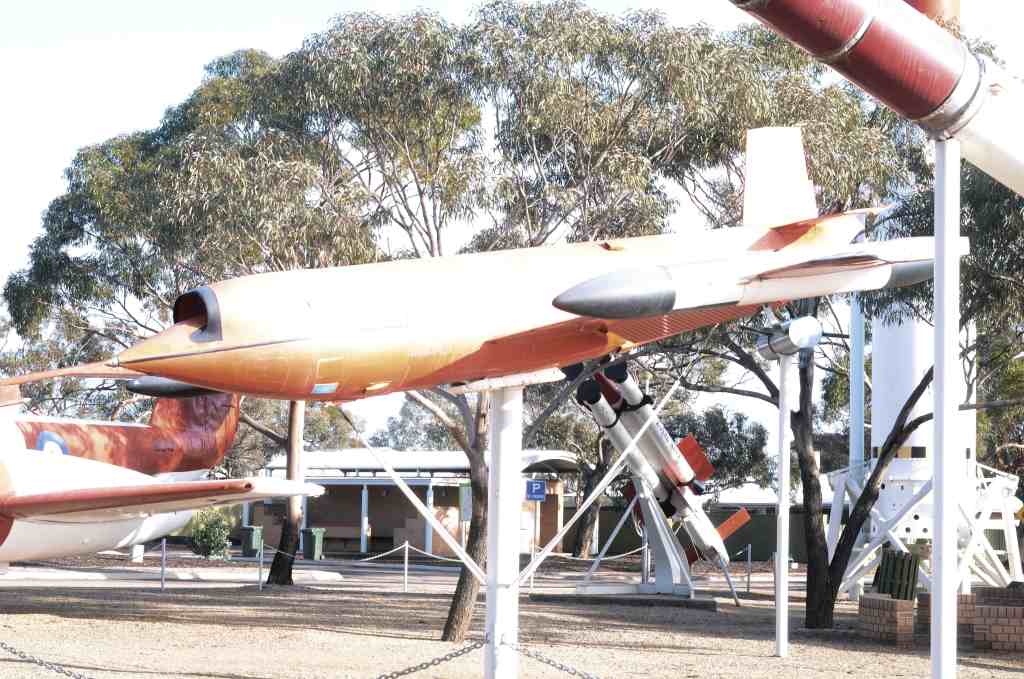
In the cool crisp morning, sun shining lemon yellow rays but not much warmth, we strolled around the Woomera Rocket Museum. Rockets of all shapes and configurations stood in the open-air, testimony of what once was. This RAAF Base and village was once a lively town in the 1950’s and 60’s, as an Anglo-Australian Cold War defence project. On this day Saturday July 20, 2013, the place seemed a mere shell of its former self, a cemetery of what once was, rockets rising like giant tombstones to the sky.
We meandered around the rockets, reading signs, eulogies from the past when threats from enemy nations was imminent. I was reminded of older friends telling me of a time when they practised drills of hiding under their school desk in the event of enemy attack.
My mother recalled when on February 19, 1942, Darwin was bombed. She was a girl in Hermannsburg at the time and whenever a plane flew over, the Aranda women would wail, fearing disaster.
Now, Hermannsburg was a mission set up by German missionaries in 1877. Although, by the 1940’s the mission was fair dinkum Australian having existed in Australia for all that time, with the advent of World War II and the conflict with Germany, the name, being German, raised the suspicions of the Allies. Hence, Mum remembers British Officers* drove into Hermannsburg to check the place out. They had to make sure there were no German spies. My grandpa, Pastor Sam Gross and his wife (my grandma) hosted these officers and put on a lovely spread of lunch for them.
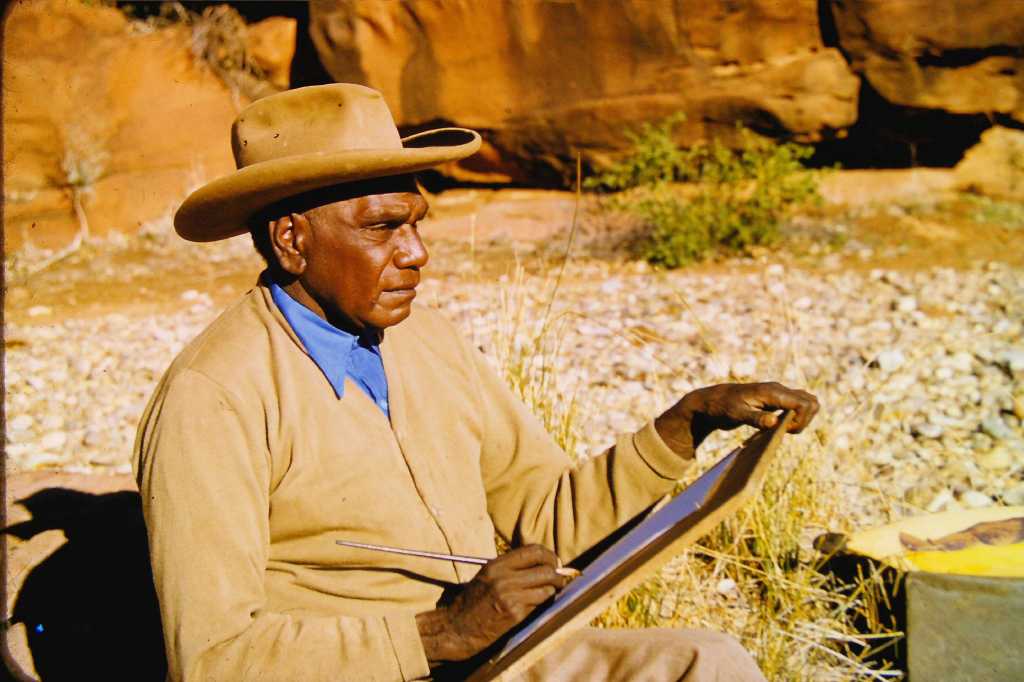
After investigating any mitigating threats, the British Officers* drove away in their propeller plane satisfied that Hermannsburg was no threat. Never-the-less, they confiscated the one and only link to civilisation, the community pedal radio. Just in case they really were spies, I guess. Further, to make sure that no threat to the allies arose from this humble mission, they sent Rex Batterbee, a world War I veteran, to oversee the mission in the role of “protector of the aborigines”. As he had visited and then lived in Central Australia since the mid-1930’s, Rex taught Albert Namatjira to paint watercolours and helped him launch his career as a renowned artist.
Needless to say, in 2013, such threats of foreign enemies seemed in the distant past. But, being only 446 km from our home town, Adelaide, we were reluctant to linger amongst the rockets. Having packed, and checked out of our overnight accommodation, we were eager to start our journey home.
At a steady 90 km/h, we made progress down the highway that split the gibber plains in halves.
‘I bet the T-Team (my brother’s family) are home by now,’ I said. ‘No hanging around of taking time to look at any more places for them.’
‘Why don’t you ring them just to see where they’re at,’ my hubby said.
I texted my niece. The time was 10:30am.
“We are in Port Augusta,” she replied by text.
‘There’s no way we’ll catch up to them,’ I said, and then texted back, “Have a safe trip home.”
Clouds and rain descended on the land the further we drove south. By the time we reached Port Wakefield, the cold had seeped into the car. I put my parka on my legs to keep warm. Yet, for lunch Hubby insisted we eat alfresco in the rotunda at Port Wakefield. After all, despite his aversion to the cold, he needed to stretch his legs. Plus, it seemed no café existed in the town.
The rain and cold became more intense as we approached Adelaide. After driving through the grey, sodden streets, we arrived home, just as darkness fell at 5:30pm.
What disaster awaited us?
Hubby opened the door and we trod inside. Son 1 played a computer game on the PC in the dining/living annex. He ignored us. We tiptoed through the family room. Not too much mess and the carpet remained visible, and clean.
We found Son 2 all rugged up and cosy in his room playing World of Warcraft. He said, “Hello” and then asked for a coffee, then followed the conversation up with, “I’m hungry, what’s for tea?”
In the kitchen, as I prepared a drink, I noticed the dishes had been done and the cats fed. I thanked Son 1 for the effort. He took all the glory and remarked that his brother had done nothing.
The Aftermath
There’s always casualties that follow every holiday. And this one was no different. Two paintings which I had planned to exhibit in the upcoming Marion Art Group exhibition had gone AWOL. I’d like to think they were stolen…but I reckon they would be found in some odd place sometime in the future.
Eleven years hence as I write this final chapter, I wonder what paintings they were.
Oh, and the other casualty, Hubby, who proudly exalted that he had taken thousands of photos of the Central Australian trip on his mobile phone, can no longer find where those photos went. It would seem those photos went AWOL too.
As for the T-Team, they actually arrived home after us, having spent a night at Port Germaine. They decided to treat themselves after roughing it for the past two weeks.
Note: *My mum, Mrs. T checked this and questioned whether they were British. She thinks they were more likely to be Australian. However, I have read a letter written by these officers and the words they used made them sound British. When I find the letter, I will investigate the background of the visiting officers and plan to write a more detailed account of my grandparent’s experience.









 Tru-Kling Creations