Dee adjusted her mask. Deep in the bowels of the records office, layers of disturbed dust and mould spores conspired to afflict her sensitive sinuses. Dee wasn’t about to give these enemies of her overactive immune system the pleasure of making her life miserable, so on with the filtering mask.
She wiped her foggy reading glasses and peered at the details from the 1980 file of Mr. Katz’s unfortunate accident.
10pm on Saturday, November 29, 1980, Mr. Rex Ackers finds Mr. Milo Katz (17). Katz slumped near a Stobie pole, on the Esplanade, Sellicks Beach. The motorbike found some thirty meters distance from the victim, landing in Ackers’ front garden. Ackers was not impressed that his freshly planted petunias had been destroyed by the motorbike. He complained that he was quote, “sick and tired” of the thoughtless hoons who roared up and down the Esplanade like it was a speedway and kept him up at night with all their shenanigans”.
Although he had a motive, Mr. Ackers and his 1966 Ford Cortina Mark 1 were ruled out as suspects to having collided with Katz and his motorbike. The Ford Cortina was a pastel green colour whereas the scrape marks on the motorbike were from red paint. Red paint from a red car, Dee concluded.
Dee leafed through the crash report. Motorbike was estimated to be travelling in a northerly direction along the Esplanade at 60km/h, the red car clipped the front wheel of the bike sending it spiralling out of control. The rider was flung from the bike and into the Stobie Pole while the bike careered to a stop thirty metres away in the front yard belonging to Mr. Ackers.
Dee rubbed her itchy nose through the mask. The date bothered her. Why did it seem so familiar? November 29, 1980…What was so special about that particular Saturday night? Sure, it’s forty-two years ago. Dee tried to think. Remember…
1980, the year Dee matriculated. Yes, that’s what graduating from high school was called back then. Dee relived that feeling of her last exam. Once it was over and she stepped out of the school grounds. Relief. Freedom. Liberty. The weight of nose to the grindstone, endless study, cramming all that information into her skull…over. No more books, no more teachers with dirty looks. No more performing.
She walked with a skip in her step down the driveway, past the chapel that looked like rocket ready to launch. No more religion forced down our throats, she thought. I’m free to do as I want.
‘I’m going to have an end of school party,’ she told a friend who was walking with her. Can’t remember who. ‘I’m going to invite everyone in our year.’
Then she spotted the slim blonde, the brainy blonde wheeling her bike out from the bike racks.
‘But I won’t be inviting her,’ she said. ‘Not Lillie. No drips allowed.’
She remembered another time when she and that same friend — darn, what was her name? And why, oh why do names escape her who was almost 60? — laughed at Lillie. “Swatvac”, and somehow, the blonde brainiac was swanning past them. Dee remembered being particularly annoyed by the fact that her nemesis had both intelligence and beauty. So, as Lillie brushed past their desk, Dee remarked, ‘Bet Lillie’s still a virgin; how sad!’
Her friend, who she remembered was quite “loose” with her love with the fellas, joined in. ‘Heh, no one wants poor Lillie.’
Dee watched and laughed with her friend as Lillie walked away hurt and confused.
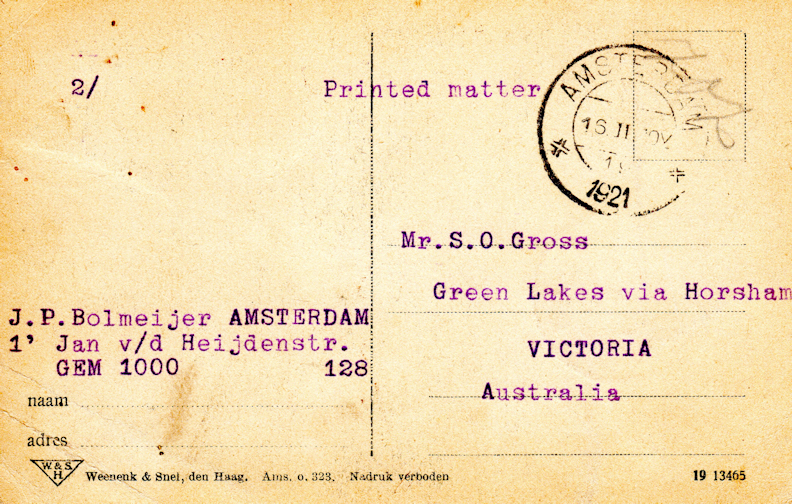
Remember the humble postcard? My maternal grandfather used to collect them…100 years ago. This week, I’m embarking a journey into K-Team history as well as glimpsing life in the past from a postcard taken 100-years ago.
I am amazed at what one can glean from a simple card. Imagine, a postcard in 1921 cost 1-cent to post from the Netherlands! On the flip side, a tiny little script in the middle reads “nadruk verboden”(copying is forbidden). I’m hoping from my understanding of copyright laws, that this restriction has long since expired. That being said, I acknowledge the publishers “Weekenk and Snell, den Haag” and have shared this postcard for historical and educational purposes.
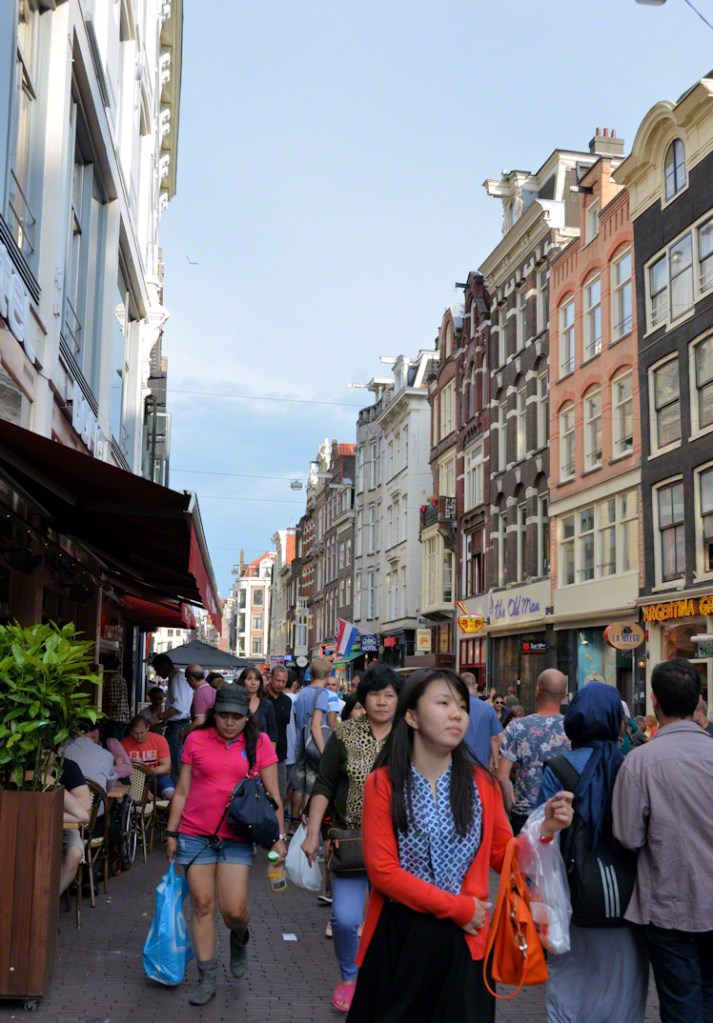
So, we travel forward in time, when my husband and I visited Amsterdam at the start of our European adventures in 2014.
We arrived in Amsterdam and after breezing through customs, Hubby rang up Renault to get someone to pick us up and drive us to the Renault office to pick up the leasing car, the Duster. ‘You’ll recognise us,’ the Renault guy promised. We waited half an hour. No guy, no van. Dragging my big red suitcase, Hubby paced back and forth along the front entrance and I trailed behind him, his smaller suitcase bumping over the pavement. After 45 minutes of no joy, no guy, and no Renault van, Hubby rang Renault again. Apparently, the pickup guy had made several laps of the Airport pick up area searching for us. Hubby suggested we rendezvous by a well-known hotel near the overpass. We waited there for a couple of minutes before Hubby got itchy feet and off he went a-wandering. I began to follow and then looked back. The Renault van rolled around the corner. I ran, and with my free hand I waved at the driver getting out of the van.
I apologised for my husband’s impatience and then we waved at him as he approached.
After picking up the Duster from the office, Hubby embarked on the challenge of driving in Amsterdam on the right side of the road. He took a little while to adjust to not over-compensating and bumping into the kerb on the right. Which he did a few times.
We gingerly drove the short way to the service station and after parking and hunting through the French instructions, found how to open the fuel cap. Hubby had learned French at school, so was able to decipher the information without spending too many hours trawling through the tome of a manual. So, we filled up with fuel and began our journey to our apartment. Our navigation system, a Tom-Tom which we named “Tomina” since it had a pleasant, if not slightly passive-aggressive female voice, lead us to the highway and then off the beaten track, then told us to turn around. Back where we started, Tomina said, ‘Turn right.’
‘Turn right,’ I said.
Hubby obliged by tuning left and into the highway. Cars coming from our right tooted us as we entered the highway. We had to go ‘round the block to get back on track. Then we saw that where Hubby turned was a sign that read, “No Left Turn”.
We found the apartments and since check-in was only from three o’clock, we had the staff hold our luggage while we explored the local station. We admired the rainbow-coloured flags that decorated the apartment block and surrounds, thinking they looked so pretty and decorative. Hungry by this time, we ate lunch, then bought a card, wine and flowers for his aunt Ada who had her birthday on the 30th July. A highlight of the trip for Hubby was visiting his aunts and cousins that afternoon. Had a lovely time meeting and getting to know his father’s relatives over coffee and cake. Some of his aunts Hubby hadn’t seen for 40 years.
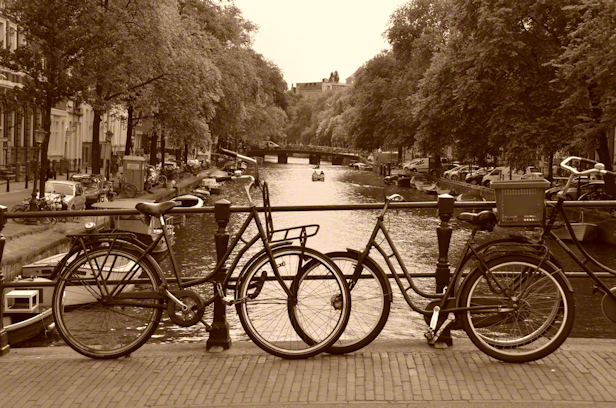
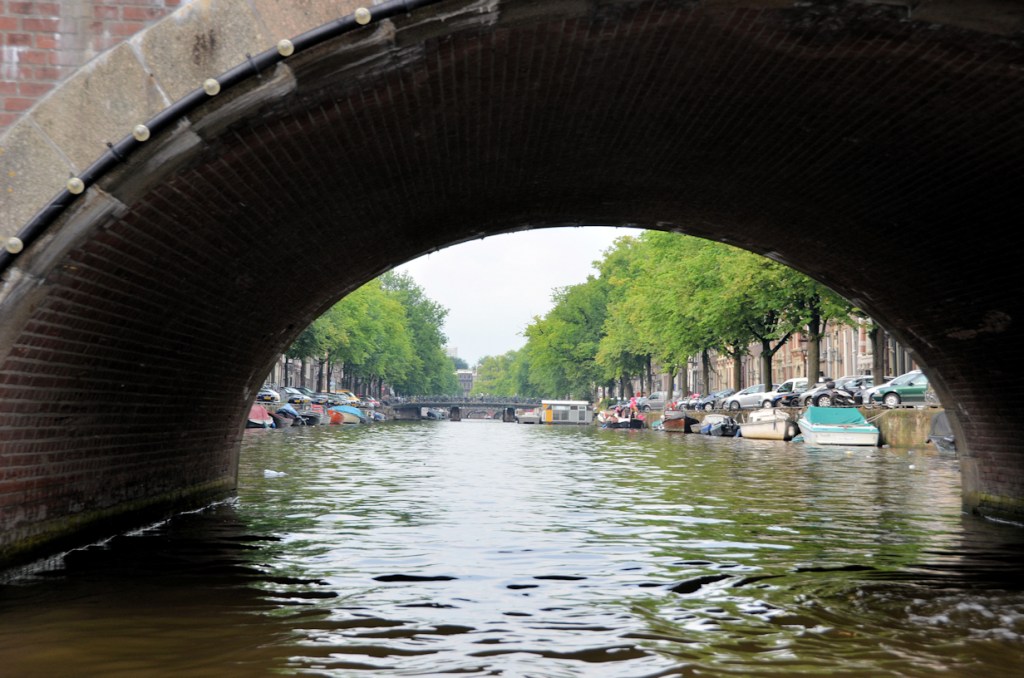
The next three days in Amsterdam we spent walking. Hubby had taken it upon himself to become my personal trainer. We must get fit. We walked the roads of Amsterdam absorbing the summertime atmosphere, admiring the canals, the graceful architecture, the boats and hundreds of bikes—everywhere people riding bikes. The town was packed with people, tourists, and revellers, eating, drinking and shopping. As it turned out, we had chosen unwittingly, I might add, to spend the weekend when Amsterdam was celebrating the Rainbow Festival. We did see some unusual sights as well as the usual antics common to drunken behaviour. My foot suffered blisters as it adapted to new hiking sandals. Good thing we had a first aid kit and some blister pads from Rogaining a couple of years ago.
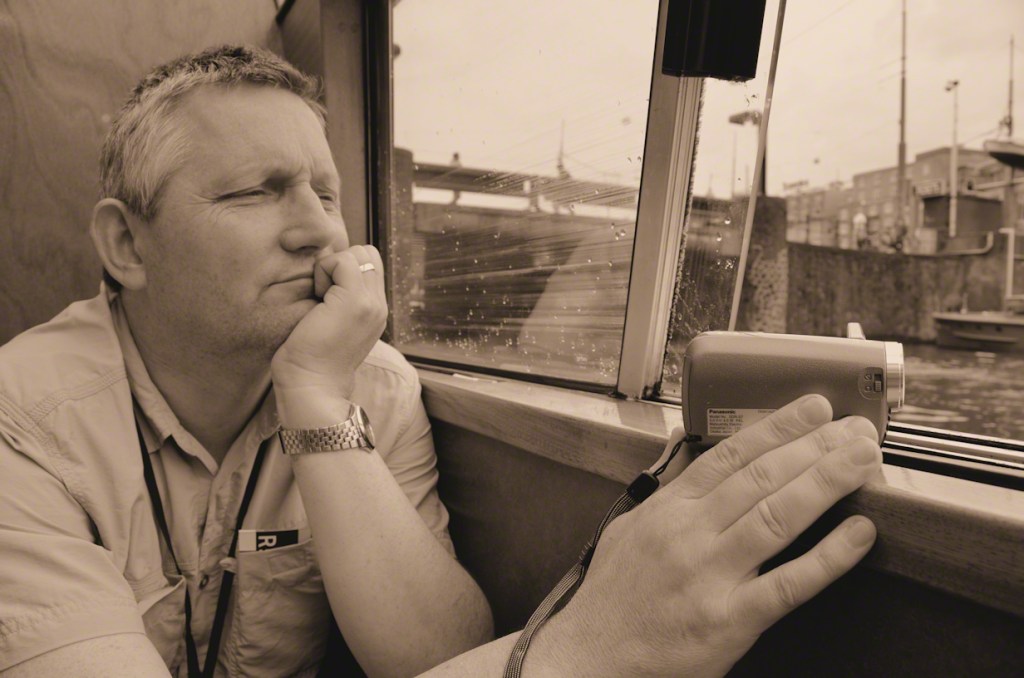
We did the usual tourist stuff, one day five hours in the Reich Museum, next day lining up and herding through the Van Gough museum-art gallery, and then an hour cruise through the canals. We had a 24-hour pass so we could hop on and off certain trams around the city. One tram though, decided to close its doors on me as I tried to get off leaving Hubby abandoned on the footpath. I alighted at the next tram stop around the corner and walked back. What joy to see my husband walking towards me.
Although we mostly ate at our apartment, the last day in Amsterdam we enjoyed pancake with apple and honey for lunch, and for dinner Argentinian steak—tender juicy steak. I’m not sure what it is about Argentinian steak houses, but in Amsterdam, they’re everywhere.
‘We had another one of those exchanges with “Karen” on What’s App over the weekend,’ Fifi said. She then, with her brush, spread a blob of paint over the canvas.
‘Karen?’ Eloise asked while detailing the finer bits of her work. Tree branches. ‘Who’s she when she’s at home?’
‘Code word for you know, she who must be obeyed.’
‘Huh? Can you be more specific?’
Fifi sighed and whispered, ‘Lillie, my sister-in-law.’
‘Ah, she who must be obeyed. The,’ cough, ‘controller.’
‘Yes, her.’
‘You see, Easter is upon us, and she who is high and mighty just had to have a rant on What’s App,’ Fifi said. ‘Like “I hope we aren’t all going to just scoff down hot crossed buns and soft drink. And let’s consider our dear 85-year-old Aunty Gracie and not sit back and let her do all the work and have a free lunch. And, to top it all off, “It’s about time we think about healthy food and not eating all this junk”.’
‘Must be going on a diet, do you reckon?’
‘Yeah, well, she has her 60th coming up and wants to look her best, I guess.’ Fifi snorted. ‘Last time I was there, she’d bought a new exercise bike. There she was, peddling away to the tune of the latest detective series streamed on the tele.’
‘Good for her,’ Eloise said and dipped her brush in her paint cup of water. ‘Tell her, if she wants a walking buddy and a stroll by the beach, I’m up for it.’ Then thought, Nothing like a spot of fishing of the family history kind. Although, after all that Fifi had divulged about her prickly sister-in-law and old friend, she just couldn’t imagine what Francis Renard had seen in the girl. Perhaps he was drunk, she mused.
‘I’ll tell her that. Doubt that she’ll appreciate the offer. But I’ll ask.’ Fifi dabbed a cluster yellowy-green blobs with her raggedy basting brush, ‘Can I join you? On these walks, I mean.’
Eloise pursed her lips. She really wanted to see Lillie on her own. To interview her. Informally. Can’t exactly do that with her sister-in-law around. But then she’d have more a chance of meeting this Lillie Edwards if Fifi came too. Such potential interviews of the informal family kind do take their sweet little time.
So, El smiled and replied, ‘Yes, of course. With you coming, she will be more willing to join my fledgling walking group and make it a regular thing.’
‘Oh, sounds wonderful. I’ll give it a go. Can’t promise. We’re not exactly close. I mean, over the last few years she has been a bit frosty. But walking together might thaw things out.’
Eloise was tempted to introduce the idea of the “aunty” compliments of Fifi’s sister-in-law Lillie, but decided such information may be too hot, too wrong, too complicated to put out there for Fifi to consider. Any mention might put her plans to get to know Lillie in jeopardy.
Instead, Eloise said, ‘Say, Fifi, you told me once that Lillie had spent time in Tasmania, um, around 1981. Do you think, considering what happened during the summer, you know, when you discovered the bones, that there might have been another reason she went there?’
‘I thought it was just for the apple picking,’ Fifi said. ‘And she was having a gap year.’
‘When did you see her again?’
‘I’m not sure. The next year, after travelling a bit overseas, she went to teachers college. I saw her around the neighbourhood, but I was married to Sven and wrapped up with my baby, and you know, we drifted apart.’
‘Why do you think you drifted apart? Sven’s her brother.’
‘It’s like, she had her study, her teachers college friends and like she looked down on me for getting in the family way and married so young. I was only 18.’
‘How did she feel about you marrying her brother?’
‘I don’t know. It’s so long ago. But Lillie and Sven were close. Come to think of it, I reckon she did resent me taking her brother away.’
Zoe perched on her stool in the workshop and stared at the blank screen on her laptop. The week before Easter and Strahan put on a cracker of a day. A warm breeze from the north, the sun shining, and boats bobbing on the shimmering blue waters of Macquarie Harbour. Pity that tourism was down.
After taking compassionate leave from her demanding work as a lawyer, Zoe Thomas was helping a friend selling souvenirs at this woodcraft shop in Strahan. She enjoyed the laid-back pace, and the stunning scenery that the wild west of Tasmania offered after the mad task-driven world of trying to make her mark as an up-and-coming barrister in Melbourne. She had only returned to the “Island” for her mother’s last days and funeral.
Then, after her “ancestry” discovery, Zoe stayed on in Strahan with her father. He needed her support. And she needed to process this information that her father and mother were not her biological parents, but one Francis Renard and an unknown woman were her blood relatives.
Thus, here she sat. Computer screen blank, begging her to send a message to this Francis Renard. All sorts of thoughts raced through her mind. Will he accept me? Does he want to know? What about my birth mother? Who is she?
“Dear Dad,” she typed. Delete.
“Dear Francis.” Delete.
“Hey there, Mr. Renard.” Delete.
Screen remained blank.
Check emails. Notification from “My Family History”.
The shop doorbell tinkled.
Zoe sighed. Star by notification. Close laptop.
She looked up at the tall, tanned gentleman with a long thinning mane of grey hair. He looked familiar. Ah, yes, one of the regulars from the mainland. Regular as in once a year, usually around this time, in autumn. The luthier and guitarist from a band in Adelaide. What’s his name? Ah, yes, Jim Edwards. Over the last few years, Zoe had made a habit of helping the local wood-turner out with sales when she came to visit her father in Strahan. She liked wood. She loved the scent of Tasmanian timber. The heady thrill of freshly cut Huon Pine. The subtlety of Sassafras. The boldness of Blackwood.
Zoe smiled. ‘Hey there, Jim, how’s it going?’
‘Great! Yeah, good. Good,’ Jim replied with a wave. He kept looking beyond Zoe. The grandfather clock cabinet constructed out of Huon Pine had caught his eye. ‘One day, I’m going to buy that.’
‘It’s not for sale, I don’t think. How would you transport it?’
‘Oh, you know, in my Hilux. My wife’s big zero birthday is coming up.’ Jim stood nodding at the clock. ‘I wonder…’
‘Dream on,’ Zoe said with a chuckle.
Jim shrugged and sighed. ‘Might make one like that for her next big birthday, I guess.’
‘That amount of Huon Pine is getting scarce, you know. You can’t cut down the trees anymore, so the only pieces are the ones loggers source from drifting down the river, the Franklin-Gordon.’
‘I know. The missus would probably complain its more junk cluttering up her house. Seriously, I reckon she’s got a chronic case of minimalism. Into decluttering, she is. I don’t know how many G-sales we’ve had over the years.’
‘She must love your business.’
‘She tolerates it. I have my man-cave, the garage, that is, and she has the house. No one touches my garage, except me. And me mates. And of course, me band. Been a bit slow, but we’re still jamming.’
‘Yeah, slow everywhere now, but I reckon it’ll pick up. Must,’ Zoe said while shuffling brochures advertising the local play, The Ship that Never Was.
‘My thoughts exactly,’ Jim said. ‘Keep positive. Anyway, I’m looking for some Sassafras for my neck. I mean the neck of my next guitar I’m building.’
‘I’ll see what we have out the back,’ Zoe replied and left Jim standing at the counter while she hunted through the stores of timber in the shed. She trusted Jim. She pictured him hauling the clock away and fixing it onto his Toyota Hilux tray. But he just didn’t look like someone who would take without paying.
Then, an idea. Did she dare ask if he knew Francis Renard? Worth a try, she thought. But then decided that divulging such a personal truth of her being his long-forgotten daughter to a virtual stranger was not worth the risk.
She found a suitable sized block of Sassafras wood, about 1500mm by 500mm by 50mm and returning to the desk, presented it to Jim Edwards.
‘Perfect,’ Jim grinned, ‘you wouldn’t believe how impossible it is to get timber anywhere in Australia at the moment. I’d almost given up on building guitars at this present time.’
‘I know,’ Zoe said. ‘It’s like gold.’
They negotiated a price that was more than Jim had paid for specialty timber such as Sassafras in the past, but Jim, Zoe and her boss were happy with the arrangement. For this piece, she didn’t have to wrap it up and post it.
After Mr. Jim Edwards left the shop, Zoe resumed her perusal of the emails. She opened the one she had started to read.
“Dear Zoe,” it read, “this is your Dad, Francis. I hope you don’t think I’m being too presumptuous but when I saw in My Family History, that you are a close relative, and possibly, no, my daughter, and that you were open to making contact, I just had to write to you.
You see, I have always wanted a family, children, but it never happened for me. Or so it seemed. And now, I am delighted to discover I have you. After all these years. I think the mother, who ever she was (confession, I was quite the lad, you see, sowed my wild… you get the picture), never told me. So, I never knew.
Dear Zoe, I would love to meet you.
Please let me know if meeting would be okay with you.
Love your Dad,
Francis Renard.”
Zoe collapsed onto the stool. Lightheaded. ‘Wow! My Dad!’
Then, before even replying, she googled “Flights to Adelaide” and began the process of booking the first available flight to South Australia.
[Over ten years ago, the T-Team, Next Generation embarked on their pilgrimage to Central Australia. Purpose: to scatter Dad’s ashes in his beloved Central Australia, in Ormiston Gorge.
Over the next few weeks, I will take you on a virtual trip to relive and rekindle memories of our travel adventures. This time again to the Centre and memories of that unforgettable holiday in 2013, with my brother and his family; the T-Team Next Generation.]
Yulara
Sunday 7 July 2013
Creature Comforts
Anthony tore off the tarpaulin and then, armed with the foldable shovel, stomped off in the direction of the bushes.
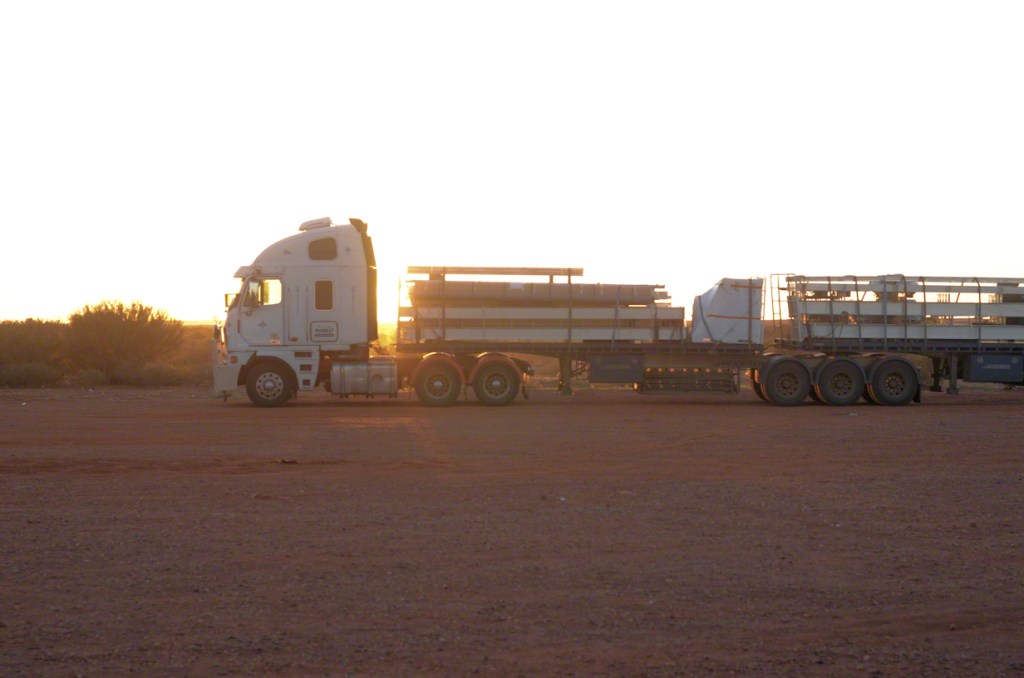
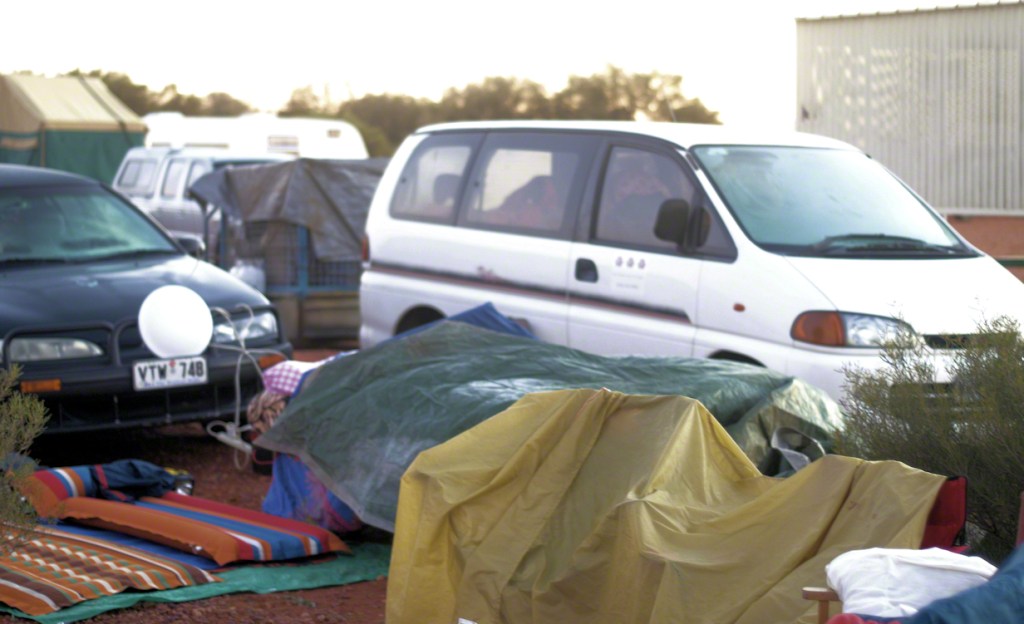
In the harsh light of morning, the scene into which we were brought under the shroud of darkness last night, was revealed. Road trains thundered past on the nearby Sturt Highway. On the opposite side of the road, a couple of these road-monsters basked in the golden rays of the rising sun. Camper vans and caravans crowded the free camping area.
I pottered around the wire fence that protected us from the Adelaide to Darwin rail line. I did not fancy an oncoming Ghan crushing me. Toilet paper littered the stony ground, shreds of it caught in the barbed wire of the fence, and nests of it rested under the salt bush. I gingerly picked up an armful of wood scraps. Hope it wasn’t contaminated.
Anthony returned from his morning adventure; a frown fixed on his face.
‘Not good, I didn’t sleep a wink.’ He pointed his shovel at the quiet mound resembling my brother and wife. ‘I had a chorus of snorers keeping me awake all night.’ He then glared at my pitiful gathering of sticks. ‘What’s that?’
‘Sticks for a cooking fire.’
My husband rolled his eyes. ‘And where are you going to put that?’
‘Where there’s a clear space.’
‘Good luck.’ He sniffed. ‘There was nowhere even to do my business. I had to walk miles.’ Anthony loves to exaggerate. ‘I can’t believe people don’t cover their mess.’
My nephew came jogging up to us. ‘I want a fire. Where’s the campfire? It’s freezing.’
I glanced around. Spying a clear patch of ground, I announced, ‘Here, I’m getting it started now.’
‘Watch out for any poo. This place is full of it,’ Anthony said.
My nephew chuckled. ‘We’ll use it as fuel, Uncle Anthony.’
Anthony shuddered. ‘Won’t be eating anything from that fire, then.’
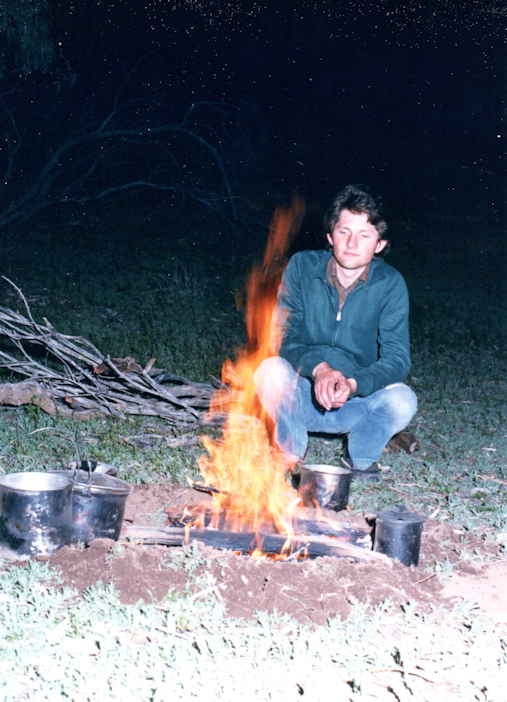
I bent down, then cleared stones away to create a shallow basin to make the fire. Soon a small but functional campfire crackled away. Perched on top of the coals, a billy bubbled with boiling water.
Anthony sat some distance from the fire munching on his cereal. There was no way he’d get close to the fire. After all, who know what lies beneath or nearby, on the ground in this part of the world, unregulated by OC Health and Safety.
My nephew fried eggs on a frypan on that small but adequate fire.
The free camping site slowly emptied itself of vehicles. First, the trucks disappeared. Then, the Grey nomads, and their luxury on wheels vanished. I imagined they had left once the sun had peeped over the horizon. The caravans had gone too. Just us, the not so grey T-Team stumbled around the parking bay, slowly packing up bedding, wandering beyond in search of a bush in lieu of a toilet, and then gulping down breakfast.
I picked up a stray piece of wood for the fire. A poopy looked up at me. I recoiled. ‘Ee-yew!’
To avoid the inevitable “told you so” from Anthony, my nephew and I announced the fire a success, doused it and covered the remains with dirt.
‘Time to go!’ Mrs. T yelled. ‘Next stop Marla.’
‘What?’ Richard, my brother asked. ‘That’s only about twenty kilometres away.’
‘There’s no way I’m squatting anywhere ‘round here. It’s a tip!’ his wife replied.
So, after a day of driving with the quick toilet stop at Marla, an obligatory exploration and photo stop at the South Australian—Northern Territory border, and then a petrol pause at Erldunda, we turned down the Lassiter Highway to Uluru.
We travelled in convoy on this perfect sunny day. Anthony’s mood seemed to thaw, and he was happy to take the wheel while I filmed parts of the drive with my Dad’s digital movie camera. The bold purple mesa, Mt Conner emerged above the rusty-coloured sand dunes.
We parked at the viewing station to take a photo of this spectacular landform. Some of the T-Party took advantage of the facilities. I had in mind to follow them. But as I approached the wooden huts, the stench and surrounds thick with flies buzzing, made me turn back to the car. I decided to hold on until we reached the Yulara camping ground.
We reached the Yulara Camping Ground which lies just outside the Uluru-Kata Tjuta National Park. Then, we had to wait in line to register and pay for our camping allotment.
Anthony drummed his fingers on the steering wheel and muttered, ‘Unbelievable! Hope we’re not too late.’
‘No wonder the grey nomads left early,’ I joked. ‘Anyway, I thought we’d booked.’
‘You know what thought did.’
Yep, after no sleep and all the driving, Anthony was not happy. Fortunately, though, our sites were still there and after tolerating the queues, we paid our fees and were directed to our adjoining grassy patches near the edge of Yulara. Not too distant were the toilet/shower blocks. As soon as we had parked, I made a beeline for these creature comforts.
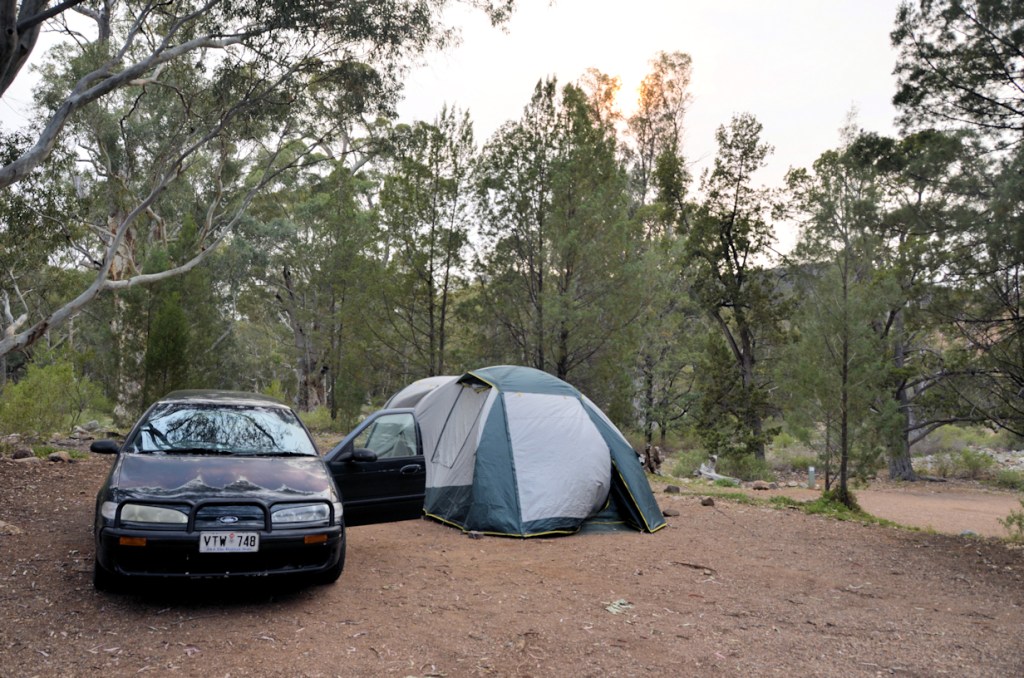
Anthony set up our barely used 4-man tent with only the bare minimum help from me. Must remember that the thick pole has to go at the front and the thin pole next in line. While Anthony hammered in the tent pegs to secure the tent, I stood holding the pole and watching my brother’s family battle in the construction of their new tent. Five of them, twisting and turning, standing and sitting, lifting walls and dropping them, labouring at snail’s pace to build their tent.
‘Amazing,’ I remarked, ‘Their tent needs five people to build it and you’ve put ours up by yourself, Anthony.’
Anthony looked over at the T-Team and grunted, ‘Well, since I put up the tent, you can cook tea.’
This I did, using our portable camp stove. Signs all about the camping ground warned that there would be consequences, a fine for making one’s own personal campfire. The BBQ facilities opposite our campsite were monopolised by other campers.
As I stirred the spaghetti sauce, Anthony walked up to me and narrowed his eyes. ‘What are you using that for? Can’t you see?’ He pointed at the now vacant BBQ stands.
‘They weren’t available when I started,’ I replied. ‘Too late now, tea is almost ready.’
Later, I tried boiling water on the stoves that Anthony preferred. I stood, hovering over the billy of water, watching and waiting for something to happen for twenty, then thirty minutes.
We waited another twenty minutes in the icy cold darkness. ‘Seems that it’s too cold for the water to boil,’ I concluded.
Anthony and I sauntered over to the T-Team’s camp. Richard invited us to play cards and enjoy a hot drink. My brother had hooked up lights and electric cooking facilities courtesy of an inverter/generator which he had brought along for the trip. My brother connected the inverter to a spare car battery which was charged as the car travelled, and voila, the T-team had light, and their own personal electric cooking facilities.
Beyond, on route to the shower block was a communal fire pit. But on our first night in Yulara, no one was taking advantage of that.










 Tru-Kling Creations