Toilets, bathrooms, latrines, bog or “dunnies” as they’re called in Australia, have surfaced as topics of conversation in the last week. How they have changed over the centuries. How they vary from place to place, country to country. But one thing remains constant to being human. When you gotta go, you gotta go.
100-Word Challenge: When You Gotta Go
He stood up and wandered to the door.
‘Get back to your seat!’ I snapped.
‘Gotta go to the toilet, Miss.’
‘No, you don’t.’ I pointed at his desk. ‘Sit down!’
This version of Denis the Menace crossed his legs and grinned. ‘Yes, I do.’
‘You can wait.’
‘Please, Miss,’ his voice mocking, ‘I have to go.’
Sniggers rippled throughout the classroom.
I stood, pointing like a fool at his chair. Afternoon sun streamed through the dusty windows, ripening adolescent body odour.
[In 2013, the T-Team, next generation embarked on their pilgrimage to Central Australia. Purpose: to scatter Dad’s ashes in his beloved Central Australia, in Ormiston Gorge.
Over the next few months, once a month, I will take you on a virtual trip to the Centre and memories of that unforgettable holiday in 2013, with my brother and his family; the T-Team Next Generation.
This time, the T-Team leave camping in the desert behind and tackle the complexities of civilisation—Alice Springs … All on a Sunday.]
Must Register
By the time our family and Mum drove the streets of Alice Springs in search of a hotel to eat, night had fallen, and a blanket of darkness surrounded us. As a convoy of Mum’s rental and the Ford, we wended through the few short streets to the nearby hotel which had been recommended by the caravan park.
Our family of five filtered through the front entrance and into an expanse of dark green carpet and pastel green walls and fronted up to the black topped counter.
‘Do you have a table for five?’ Mum T asked.
‘You need to register,’ the man at the counter said.
Anthony and I glanced at each other. ‘Register?’
‘We need to see your identification; a drivers’ licence will be okay.’
‘That’s normal for me,’ Son 1 said, ‘They always ask for my ID. They don’t believe I’m over 18.’
Son 2 snorted, ‘And here I was getting into hotels when I was under 18, no problem.’
While the boys quibbled and joked, the T-K Team, good citizens that we were, unquestioningly showed our respective licences and registered to enter the hotel.
As we sat at our designated table, we observed the predominance of people of Anglo-Saxon extraction and the lack of First Nation people. There was one Indigenous family way down the other end of the dining hall, but… They seemed happy enough.
Over dinner, roast meat, and smorgasbord, (your average fare for an Aussie hotel at that time), I mused, ‘What’s the deal with registering?’
Anthony waved a hand around the room. ‘Isn’t it obvious? Didn’t you read the sign at the entrance?’
‘What sign?’
Anthony rolled his eyes and shook his head.
Then again, I understood, without further explanation, what my husband meant.
Back at the campsite, I used the communal kitchen to prepare a hot chocolate for Anthony and me. While the kettle took its time boiling, I watched a pair of German tourists and their Australian friends Skyping on a laptop to Germany.
Then, soporific from the effects of warm chocolaty milk, hubby and I snuggled into our sleeping bags and it was lights out for us…only, it wasn’t that much light out—we still had the toilet block light beaming into our tent…all night. And on our minds wondering who were the T-Team imposters?
In the previous tale, I mentioned a certain friend attached pride to the superiority of the Aussie farmer—a pragmatic soul, jack-of-all-trades and survivor of harsh outback conditions. So, with pride, I wrote about my maternal grandfather, Sam Gross.
My paternal grandfather was none of that. He was a “city slicker” as the “cockies” called them, born and bred in the city and not the farm.
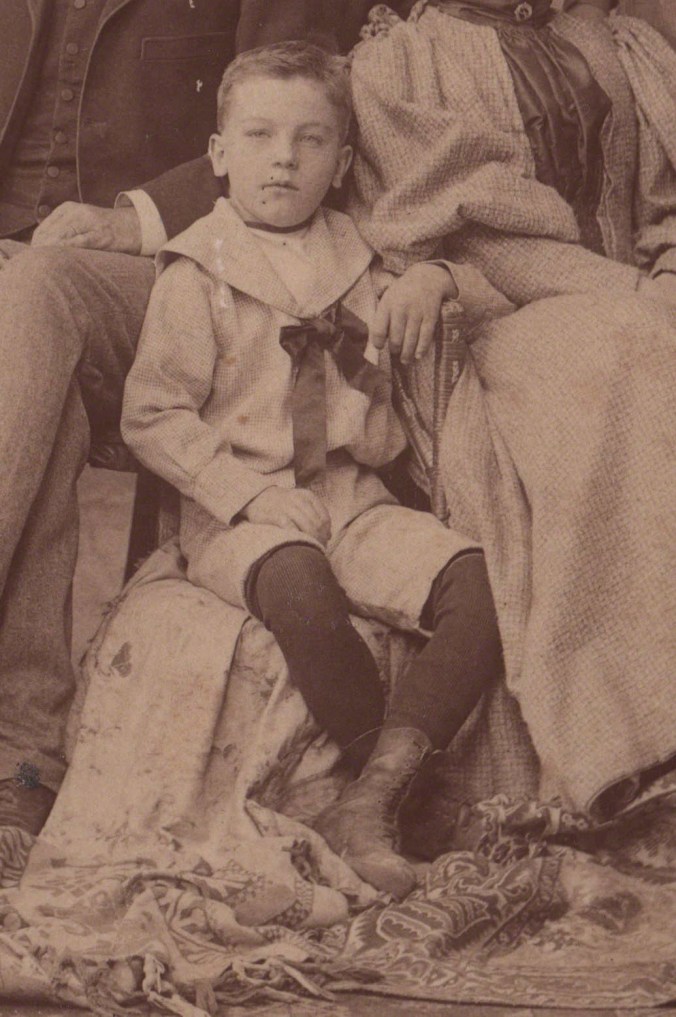
Ronald Trudinger was the first in his family to be born in Australia in August 1886.
His father, Karl August Trudinger, was born in Nördlingen, Bavaria, while his mother, Clara Theresa, was born in Kleinwalka, Saxony. His parents first emigrated to Bradford, Yorkshire, where they lived for about twenty years and became British citizens. They didn’t like Bismarck and his ideas of unifying Germany. The first twelve of Karl’s and Clara’s children were born in England.
Karl August was a textile merchant; hence, living in towns or cities worked best for him. Ronald’s mother, Clara Theresa, grew up in the Moravian Brethren community in Saxony. Faith in God and education were her values. She had yearned to be a missionary, but that door was closed to her at the time. As a result, she prayed for her children that they would become missionaries. Eight out of her thirteen offspring did.
One of them was my grandpa, Ronald, who became a missionary in Sudan.
So, although he wasn’t the venerated Aussie icon of tough “cocky” farmer, his calling was different but just as valuable. He became an intrepid missionary in Sudan, based in Melut on the White Nile. He spent decades translating the New Testament into Dinka and other African languages.
How thankful I am to My Heritage and the links to news articles matching Dr. Ronald Trudinger—100 at least. In the early 1900s until the late 1950s, he appeared as a local celebrity, especially in church circles. His deputation talks on the “Soudan” and the Muslims, and the risks and challenges the family faced in Africa, particularly during the War in the 1940s, were a source of fascination, if not entertainment, for the public of that time.
Ronald Trudinger grew up in Norwood, a suburb of Adelaide, South Australia. From what I can gather, again from various news articles about the family, he may have lived in Kapunda and Broken Hill. His father, new to Australia and a merchant, had to go to where the work was. When they first arrived in Australia, according to Ronald’s birth certificate, his father was a greengrocer. Humble beginnings after being a wool merchant in Yorkshire.
A few years later, news reports have Karl August working in a jewellery store in Kapunda. Then, as I mentioned, there was a time the family was in Broken Hill, where Ronald’s eleven-year-old older sister died of typhus.
Eventually, so the family narrative goes, they settled in Marryatville, a subdivision/estate in Norwood, and father, Karl August, teamed up with a Mr. Zimmermann to manage a textile store in Adelaide city. While his father supported the family as a merchant, and some of his older siblings set off for China as missionaries with China Inland Mission, Ronald became highly educated, attending Adelaide University and becoming a Doctor of Medicine.
As a child, Ronald was exceptionally gifted, and by the age of four he was reading the Bible, and at five, Homer’s Odyssey, so my father says. Apart from these fragments of information passed down the generations by word of mouth, Ronald’s childhood remains a mystery.
News reports at the time have helped fill in some of the gaps in Ronald’s interests as he grew up. One of these was tennis competition reports. Although Ronald was born with one arm shorter than the other, he still enjoyed a hit of tennis and played in competition. He was described as a fierce competitor.
Ronald grew up in a God-fearing family, and from all the Sunday School prizes he won (recorded in the local newspapers), I imagine he came to faith in his Lord Jesus as a young child. His family attended Maylands Presbyterian Church. Although they were from a Moravian Brethren background, there was no such church in Adelaide. There was one in Bethany in the Barossa—too far to travel from Norwood. Anyway, the family probably chose a church and congregation that would support missionaries. When Ronald began his missionary work, he and Lina joined the Burnside Christian Church, which faithfully supported their work in Sudan.
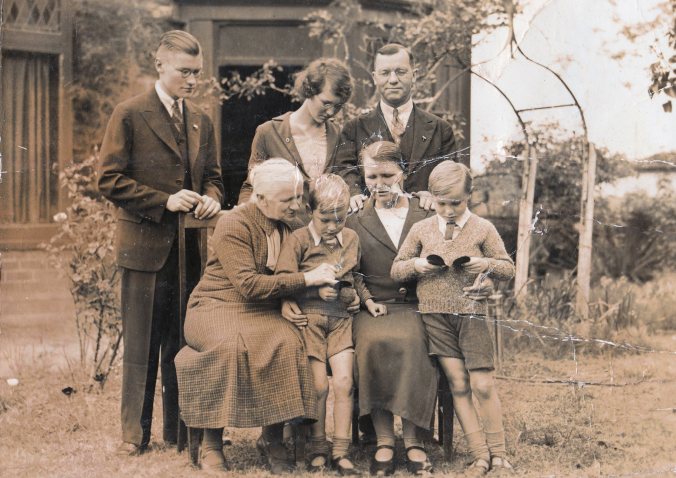
Meanwhile, back at the family home base in Norwood, youthful Ronald Trudinger enjoyed evenings with the family playing games—a tradition passed down to the current generation of the T-Team. This never included playing cards, as such cards were deemed “sinful” and associated with gambling. Games my father taught us were taught to him by his maiden aunts, who had learnt them from their parents. A parlour card game called “Chook Chook” was certainly one game the Trudinger family had and loved playing. “Chook Chook” is all about egg farming, teaching the player the different breeds of chickens, trading and negotiating, and accounting. Other games that Ronald would’ve been familiar with were word games and story games, which his mother created for the education of her children.
My father remembers his dad’s fondness for chess. Even in my grandpa’s old age, my father never could beat his dad at chess. Another relative recalled Ronald taught her mother to play the piano. So, I gather another of Ronald’s interests was music, a love which he passed down to his children.
After completing his Bachelor of Science degree from 1908 to 1912, Ronald studied to become a Doctor of Medicine at the University of Adelaide. The University student magazine has him attending the Evangelical Union Christian group there, which would become EU, the Christian group I joined eighty years later.
While at university, Ronald won awards and scholarships for his outstanding results. He even won a scholarship to study tropical infectious diseases in Queensland.
During this time, around 1908, he met a young nurse called Lina Hoopmann. They fell in love and privately became engaged. However, they had to wait many years before they were able to marry. She was Lutheran, and he was not. Her father, a staunch Lutheran minister, refused to give his blessing for the union; he called Ronald a heretic as he wasn’t Lutheran and had come from a Moravian Brethren heritage.
So, they had to wait until Lina was 30. She would’ve been legally able to marry without her father’s consent at this time. I doubt, though, being God-fearing folk, they would’ve shown such dishonour and break the third commandment to honour thy parents. I imagine that her father finally gave his blessing, and the marriage went ahead on December 11, 1917. That being said, the family photo of the wedding doesn’t have Lina’s father present. I’d like to give him the benefit of the doubt that he took the photo.
Others of Lina’s family, such as her sister Dora, had no problem with the Trudinger family. In her diary, she enjoyed many visits to the Trudinger’s in Norwood. Plus, she was overjoyed when Ronald and Lina became engaged and then were able to marry.
From 1912, Ronald commenced his calling to be a missionary doctor in Sudan. He returned on furlough in 1917 to marry Lina. Ronald worked as a doctor at the Royal Adelaide Hospital during this time. By 1918, Ronald, together with his wife, had returned to Sudan. His first two children, Ronald Martin and Agnes Dora, were born in Africa.
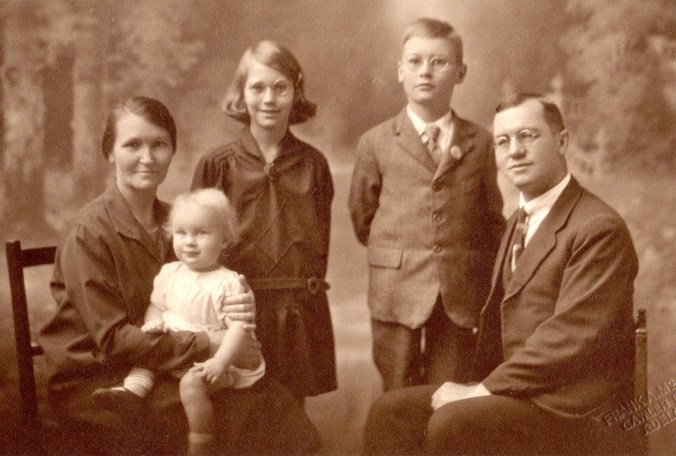
In 1927, Ronald and Lina, with Ron junior (9) and Agnes (7), returned to Australia on furlough. They came back for their children to start their education in Australia.
This time, Ron accepted work as a physician and locum in Macclesfield, taking on the challenging task of coronial duties, including being a witness for a high-profile murder case.
My dad, Clement David Trudinger, was born on January 13, 1928, in Norwood. By May 1929, Ronald and Lina, with their young baby son, were on the ship steaming back to Sudan. Dad’s younger brother Leonhard Paul was born in Melut, Sudan.
As with their first two children, the younger sons must return to live with their maiden aunts in Adelaide for their education. Ronald and Lina returned to Adelaide, South Australia, in 1935. The plan was to stay a year, and then off to Sudan once again. However, it didn’t go as planned. Agnes, their daughter, became gravely ill with meningitis early in 1936. She survived but had to learn to walk and talk again.
Consequently, later in 1936, Ronald set off for Sudan alone after Agnes had recovered.
In Agnes’s memoir, their mum took the boys to live with her family in Yorktown for a year in 1938 while their dad was away on mission in Sudan.
In 1939, Lina joined her husband in Sudan while my dad and Paul stayed with the maiden aunts. During the war years, from 1939 to 1944, Ronald and Lina were on mission in Sudan.
The values of this era were self-sacrifice and obeying God’s calling before family. Plus they considered their children’s educational needs would be better served in Adelaide, South Australia rather than Sudan. Hence, Ronald’s and Lina’s decision to once more venture back to Sudan without their children—a decision the future wives of David and Paul (the dear aunts preferred David to Clement, and Paul to Leonhard), had an issue with. David, Clement by nature, and just that little bit older, took the separation from his mother with a stiff upper lip and in his stride. Dad had fond memories of staying with his maiden aunts. But Paul, being younger, was more of a feisty character and suffered from a sense of abandonment as a child.
Ronald then took two more mission trips to Sudan; 1946 to 1950, then 1951 to 1954. During his time on furlough in 1950, he visited Ernabella where his eldest son Ron was teaching the Pitjantjatjara people, and also Hermannsburg where my Grandpa Sam Gross was pastor at the time. This was before my dad and mum had met each other. It shows the connections in Christian circles and across denominations.
Lina stayed in Adelaide for the 1946 —1950 stint to Sudan but joined Ronald for his final 1951—1954 visit.
In 1954, Ronald had “retired” from the mission field and had taken up a position as a doctor at Hillcrest Psychiatric Hospital. He made an indelible impression there, remembered fondly by former patients.
Even in his golden years of real retirement, furthering the cause of Christ remained the driving force of his life. He never stopped witnessing and sharing the gospel whenever the Lord provided opportunities. In the last years of his life, after his dear wife died, he moved up to Alice Springs to manage a Christian bookshop.
However, this venture didn’t last as he became ill with leukemia. He returned to Adelaide and moved into a flat in the Lutheran Homes Retirement village in Payneham.
Illness didn’t stop him from being a missionary on home soil. In the months before he died, he bought an Italian dictionary so that he could share God’s love and the good news of salvation with his Italian gardener.
I remember my grandpa as a kind man who had a smile with his one remaining tooth in his mouth. He would make a joke about the Trudinger trait (pronounced tray) of twiddling thumbs. He taught my brother Richard to make bird calls with a leaf.
By the time I was born, Ronald and Lina were living in Walsall Street, Kensington Park, in the Norwood area. At three, I remember getting bored with all the people around for a big T-Team family gathering. I went off exploring, and mum found me sleeping under the bed on a pair of shoes.
I know where I was when Grandpa died. I was five. We were in the FJ Holden driving up to “see” Grandpa. Well, I thought we were. Then Dad announced that Grandpa had died. I was confused why we’d been going to see Grandpa if he had died. Hadn’t he gone to Heaven? After all, he was one of the most God-loving people I knew. Upon reflection, perhaps Dad needed to visit Grandpa’s flat to sort out some paperwork with the Lutheran Homes.
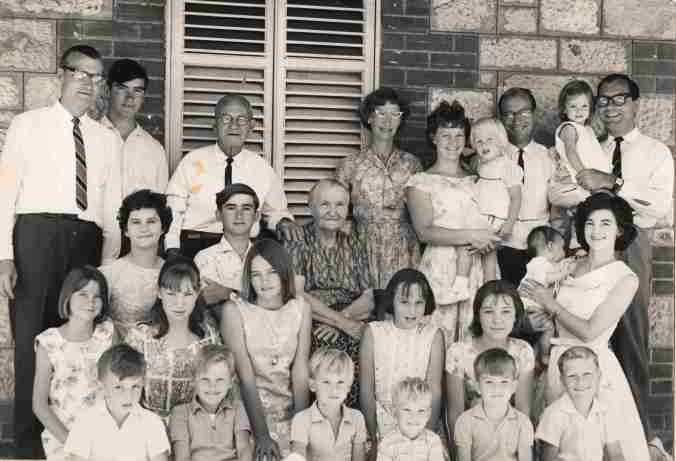
Ronald Trudinger died December 21, 1968. He had lived a full and productive life and with his missionary heart had spread the good news of Jesus Christ, his Lord and Saviour.







 Tru-Kling Creations