[In 2013, the T-Team, next generation embarked on their pilgrimage to Central Australia. Purpose: to scatter Dad’s ashes in his beloved Central Australia, in Ormiston Gorge.
Over the next few weeks, I will take you on a virtual trip to the Centre and memories of that unforgettable holiday in 2013, with my brother and his family; the T-Team Next Generation.
This time, the T-Team go their separate ways…]
Monday Morning
After a fitful sleep and then early rise, I looked forward to coffee with mum and the boys. With the sun peeping over the horizon, shining in the watery blue winter sky and reflecting golden on the gum trees surrounding the campground, the frigid desert air slowly began to thaw.
First, though, after a warming shower and filling breakfast, the tent had to be packed up. Hubby needed my help with that. Then, he spent an eternity repacking the station wagon. While waiting, I jogged on the spot and puffed out steam of my breath into the below ten-degrees air.
As if a surgeon performing a delicate operation, he punctuated his packing with commands. ‘Bags!’ So, I passed over the bags which he grabbed and pushed into the boot of the car. Then, ‘Tent!’ I hauled over the packed tent to him. Then, ‘Esky!’ I lugged the cool box (esky) to him. Then, waving his hand while head stuck in the boot of the car, ‘Box!’
‘What box?’ I asked.
‘Kitchen box!’
‘Huh?’ I glanced at the piles of stuff still waiting a home in the Ford. Finding the green crate with breakfast cereals, bread and cans of beans, I passed that one to him.
‘No! No! No!’ he snapped and pointed at the red crate, same size but with cooking utensils. ‘That box!’
Apparently, the green crate must go under the back seat with a blanket covering it.
Finally, with Hubby’s version of luggage-tetris complete, we drove the short distance in the caravan park to mum’s cabin.
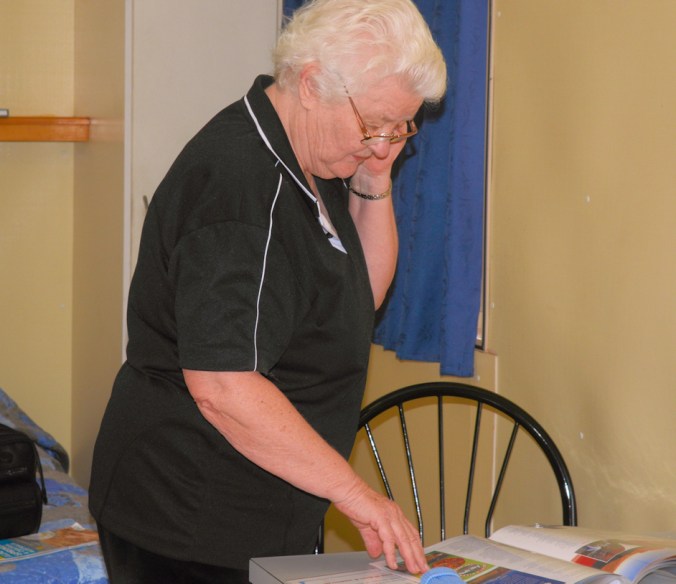
Again, we found Mum T glued to the phone. On the small pine table, she had spread out a brochure opened to camel farms. In between phone calls she muttered, ‘Mrs. T has asked me to find a camel farm for them to visit.’ She was not having much luck finding a camel farm or someone from the camel farms advertised, to answer her calls.
While Mum T remained occupied with the phone, Hubby and I popped next door to visit our boys. The first words out of their Dad’s mouth when he entered was, ‘Have you packed?’
Son 1 and 2 duly showed Dad their packed luggage waiting by the door.
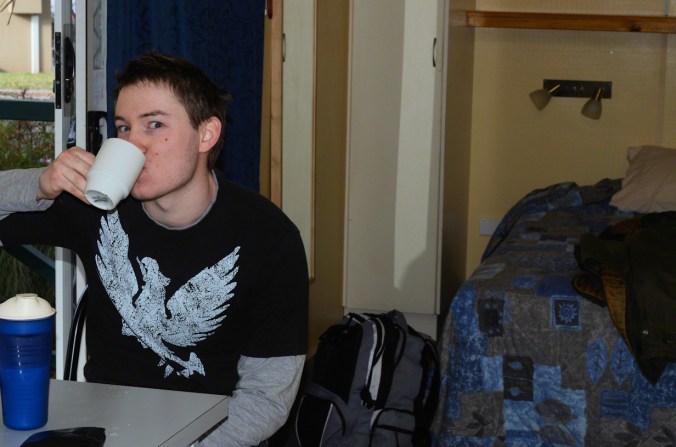
Satisfied that the lads were ready to depart Alice Springs and not miss the flight, we sat down to enjoy a coffee with them.
Mum joined us. ‘Oh, by the way,’ she said over her much-needed coffee to wake up, ‘the park manager came over. They were most apologetic about the mix up yesterday. Apparently, whoever took my booking assumed the people were T’s, because when they asked them, the lady didn’t hear clearly and just nodded and said “Yes”.’
‘You mean the guy behind the counter assumed the lady was you?’ I asked to clarify.
‘Apparently, the guy asked the lady, ‘Are you Mrs. T?’ and she said, ‘Yes.’’
We shook our heads.
‘Maybe the lady who took our cabin had a hearing problem,’ I said.
‘Oh, well, it all worked out in the end,’ Mum T concluded.
After visiting the Strehlow Centre and its Art Gallery again, we travelled to the airport to see our sons safely, and in time, board the plane back to Adelaide. Then a brief stop at Woolworths for Hubby to buy some shorts, before commencing our return to Hermannsburg.
[So, if you could go back and talk with your 5-year-old self, what would you say? What would your 5-year-old self say to your future self? Here’s a story where I imagine just that.]
MESSAGE FROM MY FUTURE ME
“Grandma, can I excuse the table?” I asked.
Grandma chuckled. “You mean, be excused from the table, dear.”
I nodded and then pushed my chair from the old wooden table.
“Yes, you may, but don’t go too far,” Grandma said. “Go only to the end of the road and then you must turn back.”
I escaped out the back door and down the gravel driveway. The street spanned before me, begging adventure. Sunday lawns green, pungent with fresh Saturday clippings piled behind an assortment of fences.
“Go away, will you,” she said in her grimy blue dress. She leaned over the stone wall and pushed me.
I brushed off her greasy prints and walked on, leaving the willow tree and that girl snarling in the shade behind me. As I strolled into the sun, I ran my hand over cracked rendered walls, rattling cyclone fences and peering through the oleander bushes for signs of life in quiet houses.
“Don’t go over the road,” Grandma’s voice warned in my head.
No, I won’t. I rubbed my bottom in memory of the Belair Sunday school picnic adventure when my brother lost me. Promise! Careful not to step on the lines in the pavement. Bad luck. I tiptoed and danced along the pavement in my pink ballerina shoes.
A shadow wriggled over the pavers. Stobie pole to my right, plastered its stunted midday image on the asphalt. I halted. Casting my focus up, I spied this big girl. I squealed and clapped my hands over my mouth. This lady-girl was dressed all in lace and brown velvet as if in Grandma’s clothes.
“Hello, you must be Lee-lee.”
“Why did you know my name?” I pointed at her; rude, I know. “Ha, ha! Why are you wearing funny clothes?”
She blushed and rubbed her stubby fingers over the velvet. “They’re trendy where I come from.” She smiled and straightened her long dress that swept past her ankles. “Actually, where I come from, I know a lot about you.”
“Why?”
“Because I have the same name as you.”
“So? I know more than you do. You’re dumb. So there, ner!” I planted my hands on my hips and poked out my tongue.
“That’s no way to talk about yourself.”
“Huh?” I pulled at my pigtail and chewed the ends of my hair.
“Elementary girl.” She flicked her long blonde strands and smirked. “I am the future you. In fact, I know more than you do because I know what’s going to happen to you.”
“Future me?” I scratched my cheek and screwed up my nose. “What does future mean?”
“Oh!” I wiggled a loose tooth. “Does that mean your teeth all fell out? Did you get grown-up teeth or did you get them all pulled out and get false teeth like Grandma’s?” I zoomed up to Future Me’s face and ogled at her mouth. “Come on, show me your false teeth.”
She bared her perfect row of pearly whites and nudged me back. “They are real. Orthodontically corrected, but real.”
“Arthur—what?”
“I had braces on my teeth.”
“Why? Were they crippled?”
“No, they were crooked.”
“Ugh! Crooked teeth.” I turned from her and poked stones with the point of my shoe. “I don’t think I like being you. Grandma clothes, crooked teeth that need Arthur’s braces. I’ll never be like you. You’re just pretending. ‘Sides, how could I be you?”
I squinted at this tall slim blonde who transferred her weight from one leg to the other. I noticed the worn back-pack groaning full of books, straps straining to pull the load from her waist. Future Me stroked her chin between her thumb and forefinger. “Well, it’s hard to explain to someone as little as you. You’re in Prep, aren’t you?”
“Yes, I’m a big schoolgirl, now.” I thrust my chest forward and with hands each side of my tummy, swung my hips.
“Well, big schoolgirl, Lee-Lee, to put it simply, it’s called T.T.T—thought, time, transportation.”
“What then?” I watched my pink dress swish as I swayed.
“You just think and instead of thinking time as moving forward, you make it move backward for you.”
“Just like that?”
“Well, actually, it’s more complicated than that—a kind of scientific experiment that my big brother Warwick invented. He put electrodes on my head and well, something happens that I can’t fully explain.”
“Oh, did you have a brother, Warwick too? Does your Warwick snort when he laughs?” I cupped my hand over my mouth and tittered.
The lady-girl raised her lace sleeve to her mouth and giggled. “Yes, he does.”
“You must be me.” Repressing the urge to gnaw my fingernails before my future-self, I clasped my hands together and looked in her eyes. “So, me, what’s going to happen to me?”
She avoided my gaze. “That’s for me to know and you to find out.
“That’s not fair! Why can’t I?” I grabbed at her, but she slipped through my fingers and drifted from me. “Plee-ease!”
“I can’t!”
I watched her move further away and shimmer in the sunlight.
“But why not? Please! Just a little bit.” I chased her and swiped at her. “Just a tincy-wincy-little bit. I won’t tell! Promise!”
“Alright, if you insist.” She floated above the greying plaster fence. “But I must be leaving soon.”
She faded, blending in with the oleander and honeysuckle bushes. I strained to see her. I attempted to touch her, but my hand passed through her.
The wind whistled through the bushes. “Have a good time with Jilly.”
“You didn’t tell me! You lied, me!” I cried.
I hunched over and plodded back towards Grandma’s house. Shouts and squeals from a yard on my left, caught the corner of my eye. A girl my age bounced on an old double-spring bed.
“Hello, my name’s Lee, what’s yours?”
“Hello, my name’s Jilly. Do you want to play on the trampoline with me?”
“For I know the plans I have for you,” declares the Lord, “plans to prosper you and not to harm you, plans to give you hope and a future.” Jeremiah 29:11
***
Dreaming of being transported to another world?
Time for some weekend reading?
Take a break and journey to another world, another time to …
Toilets, bathrooms, latrines, bog or “dunnies” as they’re called in Australia, have surfaced as topics of conversation in the last week. How they have changed over the centuries. How they vary from place to place, country to country. But one thing remains constant to being human. When you gotta go, you gotta go.
100-Word Challenge: When You Gotta Go
He stood up and wandered to the door.
‘Get back to your seat!’ I snapped.
‘Gotta go to the toilet, Miss.’
‘No, you don’t.’ I pointed at his desk. ‘Sit down!’
This version of Denis the Menace crossed his legs and grinned. ‘Yes, I do.’
‘You can wait.’
‘Please, Miss,’ his voice mocking, ‘I have to go.’
Sniggers rippled throughout the classroom.
I stood, pointing like a fool at his chair. Afternoon sun streamed through the dusty windows, ripening adolescent body odour.
[In 2013, the T-Team, next generation embarked on their pilgrimage to Central Australia. Purpose: to scatter Dad’s ashes in his beloved Central Australia, in Ormiston Gorge.
Over the next few months, once a month, I will take you on a virtual trip to the Centre and memories of that unforgettable holiday in 2013, with my brother and his family; the T-Team Next Generation.
This time, the T-Team leave camping in the desert behind and tackle the complexities of civilisation—Alice Springs … All on a Sunday.]
Must Register
By the time our family and Mum drove the streets of Alice Springs in search of a hotel to eat, night had fallen, and a blanket of darkness surrounded us. As a convoy of Mum’s rental and the Ford, we wended through the few short streets to the nearby hotel which had been recommended by the caravan park.
Our family of five filtered through the front entrance and into an expanse of dark green carpet and pastel green walls and fronted up to the black topped counter.
‘Do you have a table for five?’ Mum T asked.
‘You need to register,’ the man at the counter said.
Anthony and I glanced at each other. ‘Register?’
‘We need to see your identification; a drivers’ licence will be okay.’
‘That’s normal for me,’ Son 1 said, ‘They always ask for my ID. They don’t believe I’m over 18.’
Son 2 snorted, ‘And here I was getting into hotels when I was under 18, no problem.’
While the boys quibbled and joked, the T-K Team, good citizens that we were, unquestioningly showed our respective licences and registered to enter the hotel.
As we sat at our designated table, we observed the predominance of people of Anglo-Saxon extraction and the lack of First Nation people. There was one Indigenous family way down the other end of the dining hall, but… They seemed happy enough.
Over dinner, roast meat, and smorgasbord, (your average fare for an Aussie hotel at that time), I mused, ‘What’s the deal with registering?’
Anthony waved a hand around the room. ‘Isn’t it obvious? Didn’t you read the sign at the entrance?’
‘What sign?’
Anthony rolled his eyes and shook his head.
Then again, I understood, without further explanation, what my husband meant.
Back at the campsite, I used the communal kitchen to prepare a hot chocolate for Anthony and me. While the kettle took its time boiling, I watched a pair of German tourists and their Australian friends Skyping on a laptop to Germany.
Then, soporific from the effects of warm chocolaty milk, hubby and I snuggled into our sleeping bags and it was lights out for us…only, it wasn’t that much light out—we still had the toilet block light beaming into our tent…all night. And on our minds wondering who were the T-Team imposters?
In the previous tale, I mentioned a certain friend attached pride to the superiority of the Aussie farmer—a pragmatic soul, jack-of-all-trades and survivor of harsh outback conditions. So, with pride, I wrote about my maternal grandfather, Sam Gross.
My paternal grandfather was none of that. He was a “city slicker” as the “cockies” called them, born and bred in the city and not the farm.
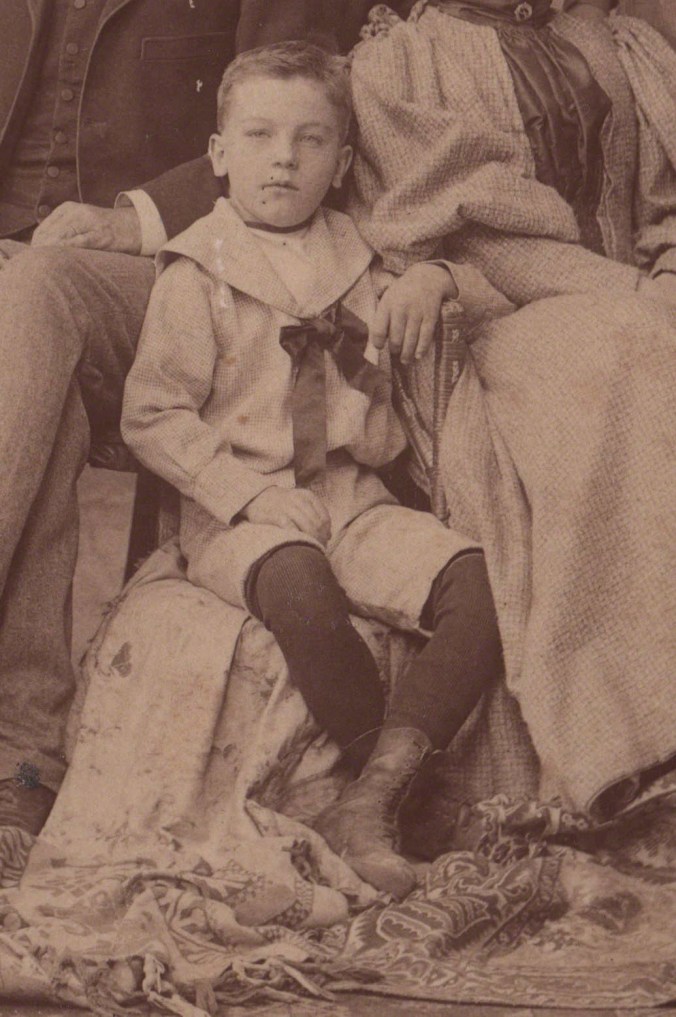
Ronald Trudinger was the first in his family to be born in Australia in August 1886.
His father, Karl August Trudinger, was born in Nördlingen, Bavaria, while his mother, Clara Theresa, was born in Kleinwalka, Saxony. His parents first emigrated to Bradford, Yorkshire, where they lived for about twenty years and became British citizens. They didn’t like Bismarck and his ideas of unifying Germany. The first twelve of Karl’s and Clara’s children were born in England.
Karl August was a textile merchant; hence, living in towns or cities worked best for him. Ronald’s mother, Clara Theresa, grew up in the Moravian Brethren community in Saxony. Faith in God and education were her values. She had yearned to be a missionary, but that door was closed to her at the time. As a result, she prayed for her children that they would become missionaries. Eight out of her thirteen offspring did.
One of them was my grandpa, Ronald, who became a missionary in Sudan.
So, although he wasn’t the venerated Aussie icon of tough “cocky” farmer, his calling was different but just as valuable. He became an intrepid missionary in Sudan, based in Melut on the White Nile. He spent decades translating the New Testament into Dinka and other African languages.
How thankful I am to My Heritage and the links to news articles matching Dr. Ronald Trudinger—100 at least. In the early 1900s until the late 1950s, he appeared as a local celebrity, especially in church circles. His deputation talks on the “Soudan” and the Muslims, and the risks and challenges the family faced in Africa, particularly during the War in the 1940s, were a source of fascination, if not entertainment, for the public of that time.
Ronald Trudinger grew up in Norwood, a suburb of Adelaide, South Australia. From what I can gather, again from various news articles about the family, he may have lived in Kapunda and Broken Hill. His father, new to Australia and a merchant, had to go to where the work was. When they first arrived in Australia, according to Ronald’s birth certificate, his father was a greengrocer. Humble beginnings after being a wool merchant in Yorkshire.
A few years later, news reports have Karl August working in a jewellery store in Kapunda. Then, as I mentioned, there was a time the family was in Broken Hill, where Ronald’s eleven-year-old older sister died of typhus.
Eventually, so the family narrative goes, they settled in Marryatville, a subdivision/estate in Norwood, and father, Karl August, teamed up with a Mr. Zimmermann to manage a textile store in Adelaide city. While his father supported the family as a merchant, and some of his older siblings set off for China as missionaries with China Inland Mission, Ronald became highly educated, attending Adelaide University and becoming a Doctor of Medicine.
As a child, Ronald was exceptionally gifted, and by the age of four he was reading the Bible, and at five, Homer’s Odyssey, so my father says. Apart from these fragments of information passed down the generations by word of mouth, Ronald’s childhood remains a mystery.
News reports at the time have helped fill in some of the gaps in Ronald’s interests as he grew up. One of these was tennis competition reports. Although Ronald was born with one arm shorter than the other, he still enjoyed a hit of tennis and played in competition. He was described as a fierce competitor.
Ronald grew up in a God-fearing family, and from all the Sunday School prizes he won (recorded in the local newspapers), I imagine he came to faith in his Lord Jesus as a young child. His family attended Maylands Presbyterian Church. Although they were from a Moravian Brethren background, there was no such church in Adelaide. There was one in Bethany in the Barossa—too far to travel from Norwood. Anyway, the family probably chose a church and congregation that would support missionaries. When Ronald began his missionary work, he and Lina joined the Burnside Christian Church, which faithfully supported their work in Sudan.
Meanwhile, back at the family home base in Norwood, youthful Ronald Trudinger enjoyed evenings with the family playing games—a tradition passed down to the current generation of the T-Team. This never included playing cards, as such cards were deemed “sinful” and associated with gambling. Games my father taught us were taught to him by his maiden aunts, who had learnt them from their parents. A parlour card game called “Chook Chook” was certainly one game the Trudinger family had and loved playing. “Chook Chook” is all about egg farming, teaching the player the different breeds of chickens, trading and negotiating, and accounting. Other games that Ronald would’ve been familiar with were word games and story games, which his mother created for the education of her children.
My father remembers his dad’s fondness for chess. Even in my grandpa’s old age, my father never could beat his dad at chess. Another relative recalled Ronald taught her mother to play the piano. So, I gather another of Ronald’s interests was music, a love which he passed down to his children.
After completing his Bachelor of Science degree from 1908 to 1912, Ronald studied to become a Doctor of Medicine at the University of Adelaide. The University student magazine has him attending the Evangelical Union Christian group there, which would become EU, the Christian group I joined eighty years later.
While at university, Ronald won awards and scholarships for his outstanding results. He even won a scholarship to study tropical infectious diseases in Queensland.
During this time, around 1908, he met a young nurse called Lina Hoopmann. They fell in love and privately became engaged. However, they had to wait many years before they were able to marry. She was Lutheran, and he was not. Her father, a staunch Lutheran minister, refused to give his blessing for the union; he called Ronald a heretic as he wasn’t Lutheran and had come from a Moravian Brethren heritage.
So, they had to wait until Lina was 30. She would’ve been legally able to marry without her father’s consent at this time. I doubt, though, being God-fearing folk, they would’ve shown such dishonour and break the third commandment to honour thy parents. I imagine that her father finally gave his blessing, and the marriage went ahead on December 11, 1917. That being said, the family photo of the wedding doesn’t have Lina’s father present. I’d like to give him the benefit of the doubt that he took the photo.
Others of Lina’s family, such as her sister Dora, had no problem with the Trudinger family. In her diary, she enjoyed many visits to the Trudinger’s in Norwood. Plus, she was overjoyed when Ronald and Lina became engaged and then were able to marry.
From 1912, Ronald commenced his calling to be a missionary doctor in Sudan. He returned on furlough in 1917 to marry Lina. Ronald worked as a doctor at the Royal Adelaide Hospital during this time. By 1918, Ronald, together with his wife, had returned to Sudan. His first two children, Ronald Martin and Agnes Dora, were born in Africa.
In 1927, Ronald and Lina, with Ron junior (9) and Agnes (7), returned to Australia on furlough. They came back for their children to start their education in Australia.
This time, Ron accepted work as a physician and locum in Macclesfield, taking on the challenging task of coronial duties, including being a witness for a high-profile murder case.
My dad, Clement David Trudinger, was born on January 13, 1928, in Norwood. By May 1929, Ronald and Lina, with their young baby son, were on the ship steaming back to Sudan. Dad’s younger brother Leonhard Paul was born in Melut, Sudan.
As with their first two children, the younger sons must return to live with their maiden aunts in Adelaide for their education. Ronald and Lina returned to Adelaide, South Australia, in 1935. The plan was to stay a year, and then off to Sudan once again. However, it didn’t go as planned. Agnes, their daughter, became gravely ill with meningitis early in 1936. She survived but had to learn to walk and talk again.
Consequently, later in 1936, Ronald set off for Sudan alone after Agnes had recovered.
In Agnes’s memoir, their mum took the boys to live with her family in Yorktown for a year in 1938 while their dad was away on mission in Sudan.
In 1939, Lina joined her husband in Sudan while my dad and Paul stayed with the maiden aunts. During the war years, from 1939 to 1944, Ronald and Lina were on mission in Sudan.
The values of this era were self-sacrifice and obeying God’s calling before family. Plus they considered their children’s educational needs would be better served in Adelaide, South Australia rather than Sudan. Hence, Ronald’s and Lina’s decision to once more venture back to Sudan without their children—a decision the future wives of David and Paul (the dear aunts preferred David to Clement, and Paul to Leonhard), had an issue with. David, Clement by nature, and just that little bit older, took the separation from his mother with a stiff upper lip and in his stride. Dad had fond memories of staying with his maiden aunts. But Paul, being younger, was more of a feisty character and suffered from a sense of abandonment as a child.
Ronald then took two more mission trips to Sudan; 1946 to 1950, then 1951 to 1954. During his time on furlough in 1950, he visited Ernabella where his eldest son Ron was teaching the Pitjantjatjara people, and also Hermannsburg where my Grandpa Sam Gross was pastor at the time. This was before my dad and mum had met each other. It shows the connections in Christian circles and across denominations.
Lina stayed in Adelaide for the 1946 —1950 stint to Sudan but joined Ronald for his final 1951—1954 visit.
In 1954, Ronald had “retired” from the mission field and had taken up a position as a doctor at Hillcrest Psychiatric Hospital. He made an indelible impression there, remembered fondly by former patients.
Even in his golden years of real retirement, furthering the cause of Christ remained the driving force of his life. He never stopped witnessing and sharing the gospel whenever the Lord provided opportunities. In the last years of his life, after his dear wife died, he moved up to Alice Springs to manage a Christian bookshop.
However, this venture didn’t last as he became ill with leukemia. He returned to Adelaide and moved into a flat in the Lutheran Homes Retirement village in Payneham.
Illness didn’t stop him from being a missionary on home soil. In the months before he died, he bought an Italian dictionary so that he could share God’s love and the good news of salvation with his Italian gardener.
I remember my grandpa as a kind man who had a smile with his one remaining tooth in his mouth. He would make a joke about the Trudinger trait (pronounced tray) of twiddling thumbs. He taught my brother Richard to make bird calls with a leaf.
By the time I was born, Ronald and Lina were living in Walsall Street, Kensington Park, in the Norwood area. At three, I remember getting bored with all the people around for a big T-Team family gathering. I went off exploring, and mum found me sleeping under the bed on a pair of shoes.
I know where I was when Grandpa died. I was five. We were in the FJ Holden driving up to “see” Grandpa. Well, I thought we were. Then Dad announced that Grandpa had died. I was confused why we’d been going to see Grandpa if he had died. Hadn’t he gone to Heaven? After all, he was one of the most God-loving people I knew. Upon reflection, perhaps Dad needed to visit Grandpa’s flat to sort out some paperwork with the Lutheran Homes.
Ronald Trudinger died December 21, 1968. He had lived a full and productive life and with his missionary heart had spread the good news of Jesus Christ, his Lord and Saviour.
[Remembering my dad, Clement David Trudinger 13-1-1928—26-8-2012
Extract from Trekking with the T-Team: Central Australian Safari 1981]
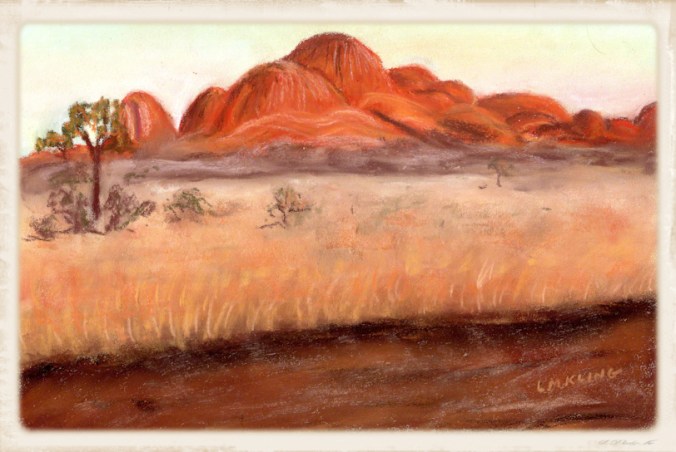
Way before the sun had even thought about rising, we gulped down our porridge and then set off for the Eastern Side of Kata Tjuta. Dad was on a mission to capture the prehistoric boulders at sunrise. We arrived at the vantage point just as the sun spread out its first tentative rays, touching the spiky tips of spinifex and crowning the bald domes with a crimson hue as if they’d been sunburnt.
I dashed a hundred metres down the track to photograph the “Kangaroo Head” basking in the sun. We stood in awe as the glow of red on the rocks deepened.
Every few minutes Dad exclaimed, ‘Ah, well, that’s it, that’s as good as it’s going to get.’ He packed the camera away, only to remark, ‘Oh, it’s getting better,’ then retrieve the camera from the bag and snap Kata Tjuta flushed with a deeper, more stunning shade of red. The rest of the T-Team, waited, took a few shots, waited, mesmerised by the conglomerate mounds of beauty, before taking more snaps of the landscape.
Water and Theft are the prevailing themes this week. On Tuesday I was rudely awoken from my slumber by Hubby rampaging through the bedroom in search of his transport pass. With a sigh, I got up and helped in the search. After scouring the house, Hubby looked online and discovered someone had used his card the previous Sunday. Not him. The card had indeed been stolen. Hence the process of cancelling the card and transferring the funds to a new one. I’d like to see the disappointed expression on the face of whoever nicked the card when they try to use it next.
Meanwhile, Adelaide’s seawaters have been plagued by a nasty algal-bloom; the worst in the world—ever in all history, apparently. Dead sea creatures have been washing up on shore in apocalyptic proportions. Mum’s neighbour is putting in a swimming pool. No swimming in the beach waters this summer, or many to come. Mum and I lunched by the beach at Glenelg curious to see how discoloured the water would be and how many dead fish and other creatures we’d spot on the shore. We’re still alive. Didn’t notice any discolouration of the sea. Saw some birds skimming the water and diving for fish. Good luck to them, I say.
August is almost over, and Adelaide has been enjoying the SALA festival, I thought this cheeky little piece, a 100-word challenge might fit the bill, so to speak. The actual incident of imagined “water-theft” took place several years ago, but I believe the gallery involved still takes their rules very seriously.
100-word Challenge
Stolen…Almost
‘Where can we get some water?’ my friend asked.
I pointed at the casket of spring water languishing in the gallery. ‘There’s some just there.’ A glass wall confined the well-watered and wined gallery guests. We had been guests, but this gallery was devoid of seats. We wanted to sit. And eat.
‘Sign there bans wine not water.’
I stowed into gallery, collected cups of water and walked to the door.
‘Where do you think you’re going?’ self-appointed wine-police snapped.
I placed the stolen water back on the table and left.
Transubstantiation. My first virtual miracle; turning water into wine.
[In 2013, the T-Team, next generation embarked on their pilgrimage to Central Australia. Purpose: to scatter Dad’s ashes in his beloved Central Australia, in Ormiston Gorge.
One Friday a month, I will take you on a virtual trip to the Centre and memories of that unforgettable holiday in 2013, with my brother and his family; the T-Team Next Generation.
This time, the T-Team leave camping in the desert behind and tackle the complexities of civilisation—Alice Springs … All on a Sunday.]
Imposters
Less than one hour later after leaving Hermannsburg, we checked into the Stuart Caravan Park on the edge of Alice Springs. The reception, cast in long shadows, signalled the fast-approaching night and uncertainty that comes with not booking a site. Would there be one for us?
Fair point. Why book a cabin and campsite if you can stay with friends and save money?
‘Looks like someone impersonated our mum and snaffled up her cabin,’ I said.
‘Mmm! That’s a bit rough,’ Mrs T said, ‘Hope she can get her money back. She can stay with us if she likes.’
I looked to Mum T. ‘You can stay with the T-Team at their friend’s.’
Mum T smiled. ‘It’s okay, the manager has given me another cabin free of charge.’
Glad that we had decided to return to Alice Springs and had been there to support Mum. Still, rather ironic that, Mum, who had been the first to book her cabin way back in March or April to ensure she had a booking and not miss out, was the one who almost did. Still, she got hers free.
In the golden tones of late afternoon, Anthony and I set up our tent and then took a leisurely stroll around the caravan park and onto mum’s cabin. Fortunately, her cabin was near our sons’. On the way we “happened” to pass the cabin containing the fake T-Team. There they sat, out on the front porch, an elderly couple and a younger couple. Didn’t appear to be your average criminal type or distant relatives even.
Visited the boys’ cabin. Son 1 and 2 had settled in for the night, happy with the comfort that the rooms afforded. Son 1 particularly pleased that he wouldn’t have to hear our snoring.
Son 2 however asked, ‘What are we doing for tea?’
‘Maybe we can go to a hotel to eat,’ I said.
My husband frowned. ‘What? Are we made of money?’
‘You want to cook?’ I questioned. ‘Anyway, it’s Mum’s and the boys’ last night up here, they leave for Adelaide tomorrow.’
Anthony sighed, ‘Oh, alright!’
Sprinted over to mum’s cabin and knocked on the door. Mum, holding the phone, ushered me in. Then I stood in the small lounge area while Mum sat at the tiny wooden table, phone glued to her ear.
I waited.
Mum, with phone at her ear and silent, waited.
‘What…?’ I began.
Mum batted her free hand at me to be quiet.
So, I waited.
And waited.
Might as well do something while waiting for goodness knows what. Must be something to do with the imposters, I thought.
‘Yes…’ finally, mum gets a response, ‘yes, right…nine o’clock tomorrow…be there half an hour before…no, we don’t have any luggage; only hand luggage…Right, thank you.’
‘Not news about the T-Team imposters, then?’ I laughed.
‘No, just had to do the check in with Qantas for the boys’ return trip tomorrow,’ Mum replied.
Only then, was I able to discuss with mum about going out for tea. Of course, the suggestion was fine by her.
Günter hobbled up the path to his house. His feet squashed into shoes now too small for him. Just before he entered, Günter examined his reflection in the window. He touched his pink cheeks and admired the sculptured perfection—the high forehead with no acne, the strong chin with no spots but a beard like a man, and hair straight, golden and manageable. He patted the top of his head. ‘Hmm, a bit thin on top,’ he mumbled. ‘Oh, well, now I can be happy that not even my brother Johann was perfect.’
Grandmother flung open the door. Günter slammed against the window. The wood panel blocked her view of Günter. ‘Now what am I going to do? The dinner is burnt,’ she said. ‘Where is he?’
Boris peeped around the corner of the house. ‘Forgotten something?’
He handed Günter a pile of folded clothes.
‘Can’t go around the village dressed like a boy, now, can you?’ Boris said, then vanished into the night.
Once Grandmother withdrew back into the house, Günter tiptoed to the outhouse and changed into Johann’s dapper tights, striped breeches and white shirt with the obligatory lacy sleeves. As he strolled to the front door, he heard screams and then a slap. Then he saw Anna run down the path, and a gangly looking fellow in underclothes loping after her.
Günter pushed open the door and walked into the kitchen. Grandmother continued her waltz with the broom, sweeping the cracked black and white tiles. A cloud of dust chased her around the room as she swept.
‘Your soup is on the stove, Johann,’ she announced in a sing-song voice, much like a yodel.
Salome leaned on the balustrade of the stairs, her blonde locks pasted to her perspiring temples.
She shook her head and stated, ‘At the inn again, I presume.’
Günter tugged at the hem of his shirt as Johann always did and said what Johann always said, ‘A man has got to do what a man has got to do.’
The door burst open, and his brother stumbled in, sporting a red welt on his cheek.
Salome launched into him like a fishmonger’s wife on an errant husband. ‘What have you been doing? How hard is it to find your brother? No supper for you. Off you go—bed—go on!’ She grabbed Grandmother’s broom and chased Johann in the form of Günter into his sleeping quarters, with Johann crying protests all the way.
Günter hid his urge to smile behind his hand.
After helping himself to pumpkin soup and bread, Günter yawned and mumbled his excuses for an early night and trotted upstairs to the bed he shared with his older, now younger brother. Oh, what a night it would be, sleeping on the less lumpy side for once, hogging the quilt and tormenting his brother. It was payback time.
The benefits of being Johann did not stop there. The next day, as he strolled in the village streets, men tipped their hats, women weaved out of their way through the crowd over to him and gifted him with fruit, home-made honey biscuits and apple cake. Milk maids, those same ones who reviled him the day before, this time, fluttered their lashes, blushed and shot him sideways glances. The tallest of the three sidled up to him as he stood talking to the tailor while they discussed his jacket for the May Day dance, and she pressed a note into his hand. Mein Gott, what a life!
Meanwhile, his brother languished under the whip of Grandmother’s broom when she heard he’d been expelled from school—again. Ah, sweet revenge.
Then the icing on the kuchen—lunch with Anna. He arranged a picnic by the river. Blue skies, tulips blooming, green grass, the birds singing and the bees humming. What a picture! What a day with is maiden in his arms. Anna talked non-stop the whole two hours. Günter as his brother, held his tongue when she prattled on about how she detested Johann’s younger brother, especially after the prank he pulled the previous night.
‘He’s creepy,’ she said and shuddered, ‘he tried to grope me. Ugh!’
Her words stabbed at his insides. He realised as Günter he never had a chance.
After Günter walked Anna back to the school where she helped her father who was the school master there, he spent the afternoon brooding, drinking beer at the Bier Haus until he was almost sick. Then he tramped through the forest alone. The novelty of being Johann had worn off and revenge didn’t seem as sweet anymore.
At the dinner table Johann as Günter raged. ‘I’m not Günter,’ he yelled and stabbed the table with his fork. ‘What is wrong with you people?’
Their mother made one of her rare appearances downstairs, but she seemed far away and unmoved by Johann’s tantrum.
Günter decided he had to leave. His face tingled as he slipped out of the house and hastened to the clearing with the moss-covered log; the meeting place appointed by Boris.
The ground glowed with warped and weird shapes under the strange luminous disk that hovered over the hill. No frogs croaked. No birds chirped. The air was still and cold. Even the cows refrained from braying.
Günter sat on the log and waited. Time seemed to stop in the silence.
A beam shimmered from the disk. Günter rubbed his eyes and blinked. Boris materialised in the centre of the beam. He appeared cockroach-shaped, then, as he strode toward Günter, he morphed into human-form.
‘Well, now, Herr Fahrer, have you decided?’ Boris asked.
‘Yes, I have.’
‘Well, then.’
‘More than anything else, I want to be handsome, brave, attractive to the ladies like my brother Johann. But I want to be myself, not someone else.’
Boris raised one side of the hairy eyebrow that spanned his forehead. ‘Very well, then.’
‘And one more thing, you know, like a package?’
‘Yes?’
‘Could I, with this new face, have a new life, say like in the Great South Land?’
‘Hmm,’ Boris nodded, ‘that can be arranged, if you wish. But…’
‘What?’
Boris coughed and flapped his wings. ‘You’re not going to fit in with the people who live there at the moment. I’d say wait until I’ve finished with Great Britain …’ He paced the clearing with his hands tucked behind his back. ‘In the meantime, I could take you on an adventure up there, into the far reaches of the galaxy. Consider it an added bonus, seeing what no man on this planet has seen before. What do you say?’
‘Ja, voll!’
‘Just sign here.’
Boris presented Günter with the tablet, its screen chock full of tiny black lines. ‘Don’t worry,’ he said, ‘it’s all routine. Just basically says you take responsibility for your decisions. Just covering my back and yours. You know, some civilisations can be quite litigious.’ Boris handed a fine pointy stick to Günter. ‘Use this pen to sign your name.’
Günter signed his name using the fine script he had learnt at school, and within seconds, he sat in a velvet-covered chair on the bridge of Boris’s ship. The walls shone with fresh white paint, the silver instruments gleamed, and the furnishings were scented with potpourri. He studied the sun as it shrank to just a speck of light amongst many specks of light.
Boris reclined on his seat, fully armoured, fully cockroach. ‘You should notice the changes in your form soon, my fellow.’
Günter tingled all over and he glanced at his hand. His warm, fuzzy sensation turned to cold hard panic.
‘My hand!’ he cried wriggling his three elongated fingers. ‘I’m turning grey!’
‘So, there you go,’ Boris said as he adjusted his light shields. ‘Right on schedule.’
Günter picked up a looking glass placed at his side and his hand trembled. He glared bug-eyed at his reflection. ‘I’m turning into a praying-mantis.’
‘You didn’t specify you wanted to be human.’
‘But a stick-insect? I’m hideous!’
Boris folded his four hands over his barrel chest. ‘So? Most Greys are females. So, you, as a male, will be most attractive to them.’
Günter unstrapped himself and jumped from his seat. He ran to the viewing screen. With his long fingers he traced the planets and sun of his solar system. ‘I have changed my mind. I want to go home.’
Boris smacked his lips and readjusted his bottom’s position on his seat. ‘Too late. You’ve signed the contract. Didn’t you read the fine print? All choices are final and cannot be changed.’
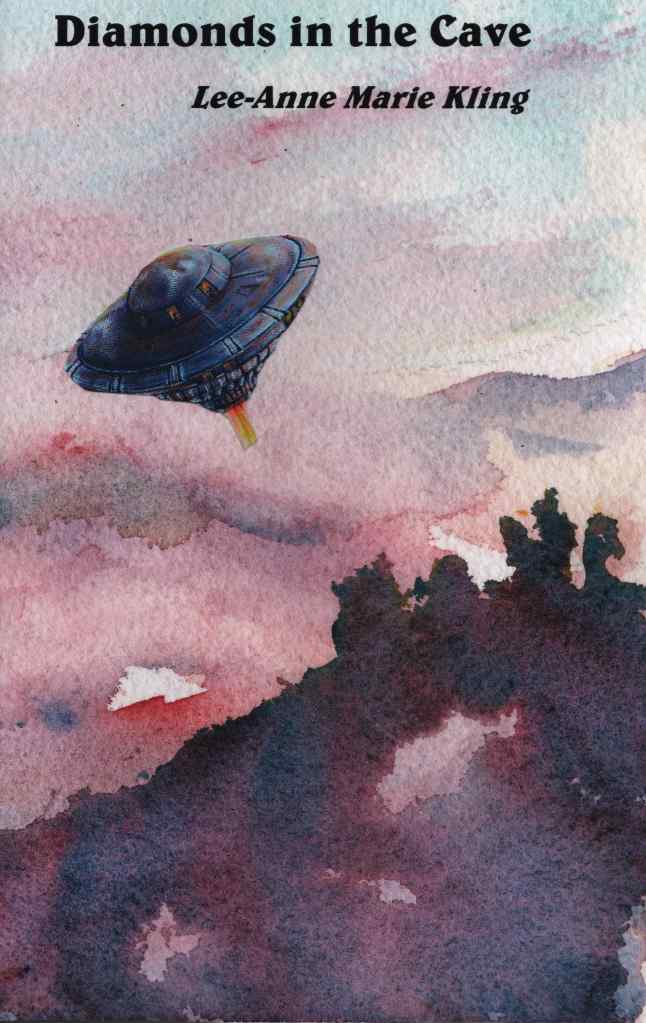
Read more of the consequences of Günter’s choices, the adventure, the war against Boris. Discover the up close, personal and rather awkward relationship between Günter and that nasty piece of cockroach-alien work Boris in my novels …
How could a most pleasant bunch of Wends turn so nasty? Witch-hunting nasty.
Click on the link above and find out.
Or for more Weekend Reading…
Go on a reading binge and discover the up close, personal and rather awkward relationship between Günter and that nasty piece of cockroach-alien work Boris in…






















 Tru-Kling Creations