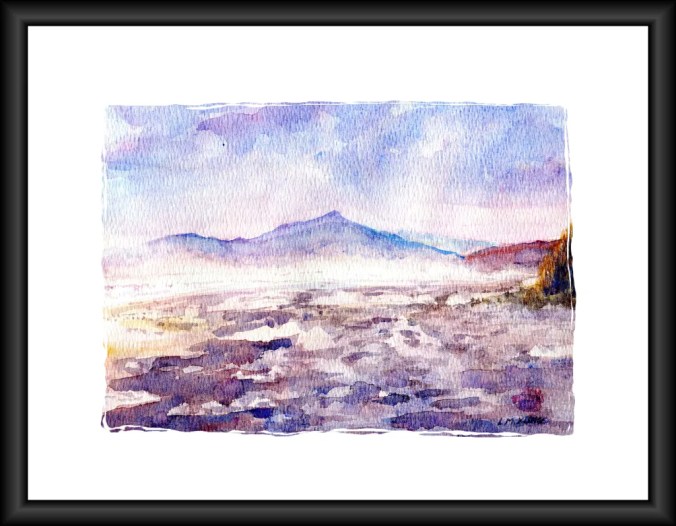
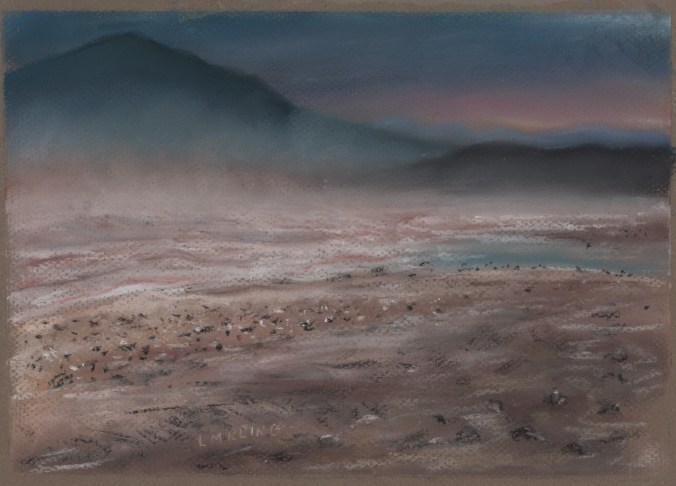
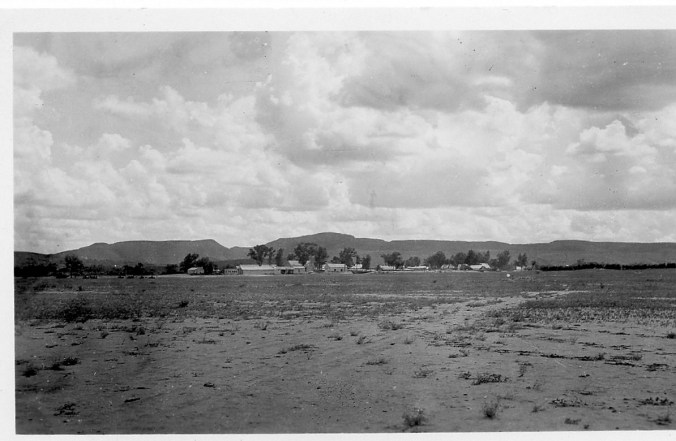
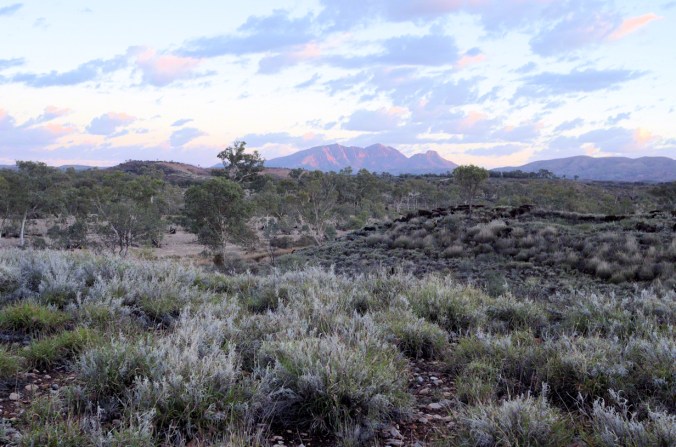
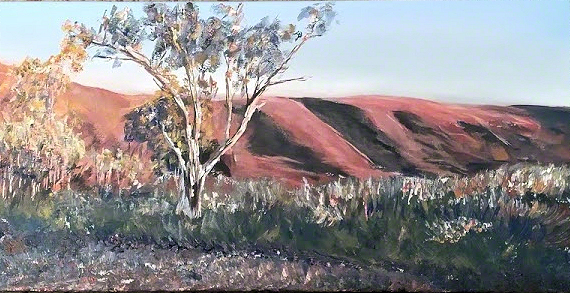
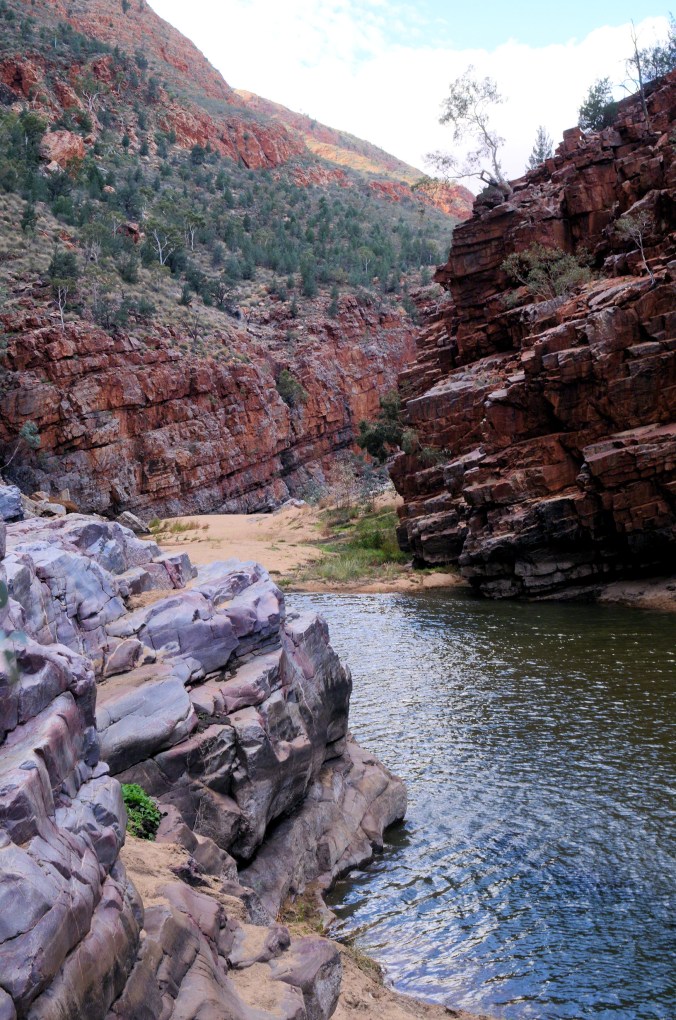
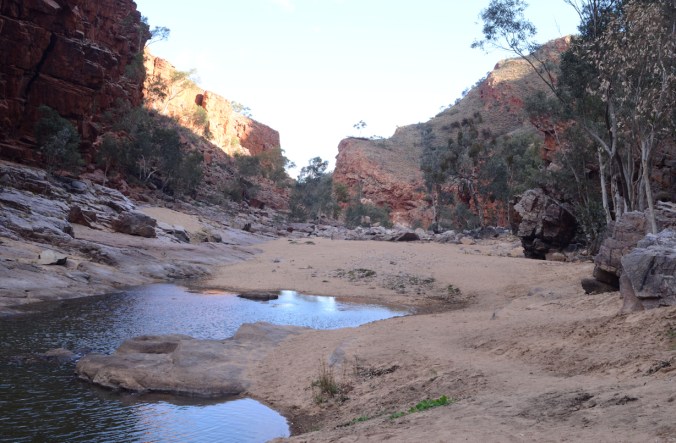
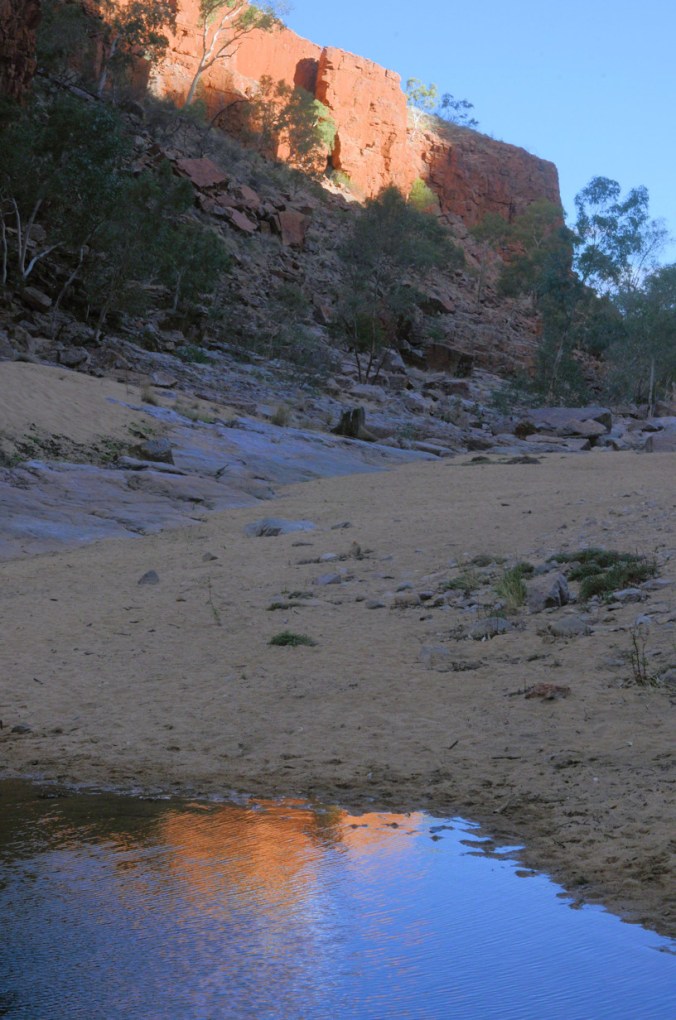
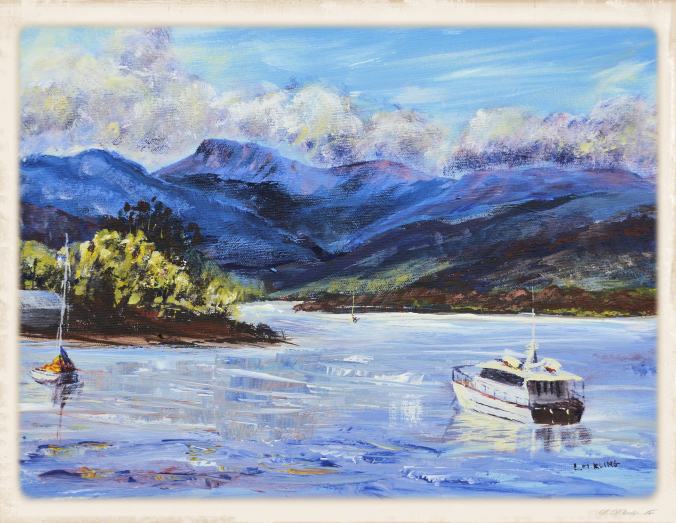
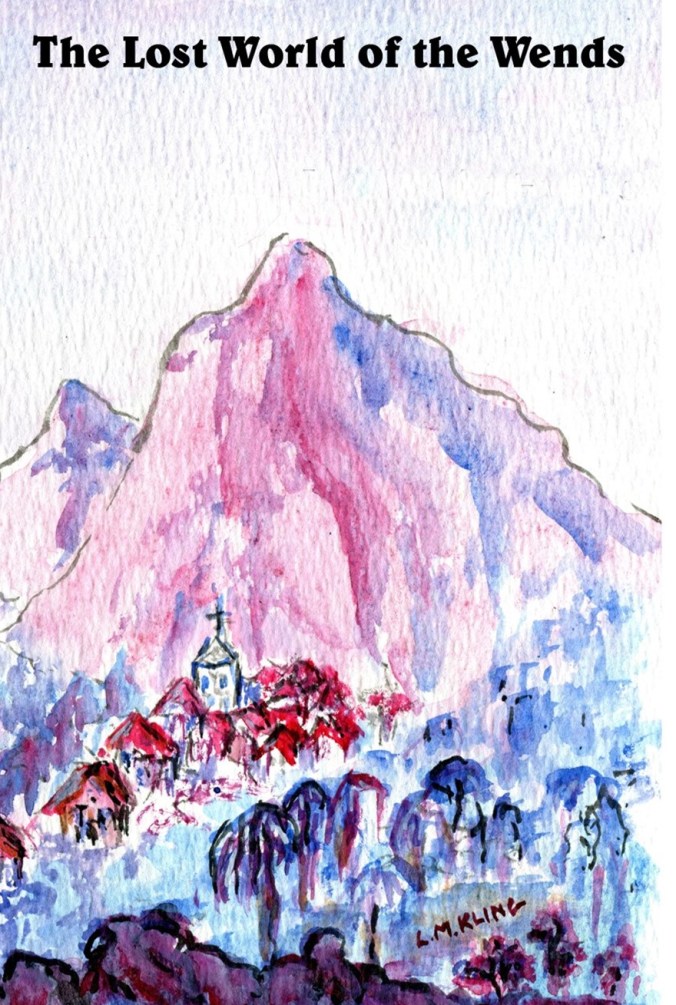
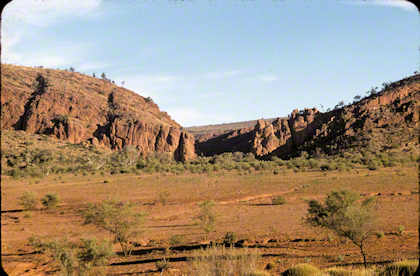
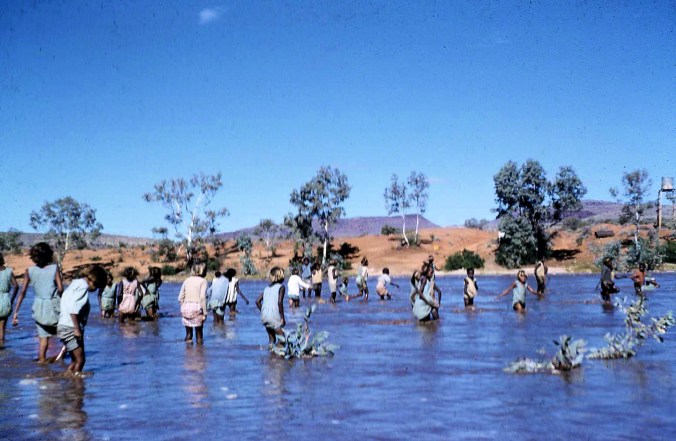
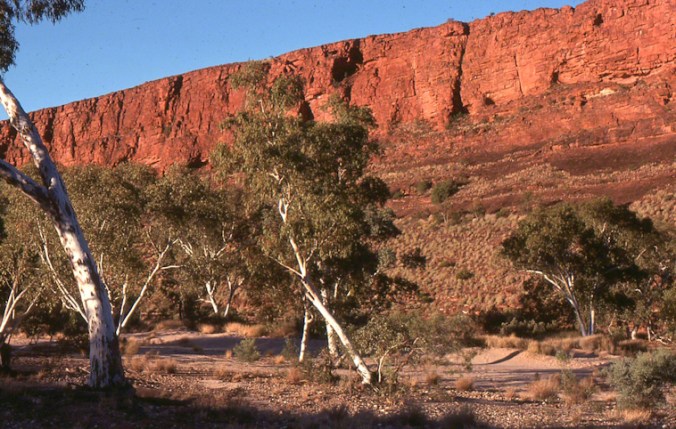
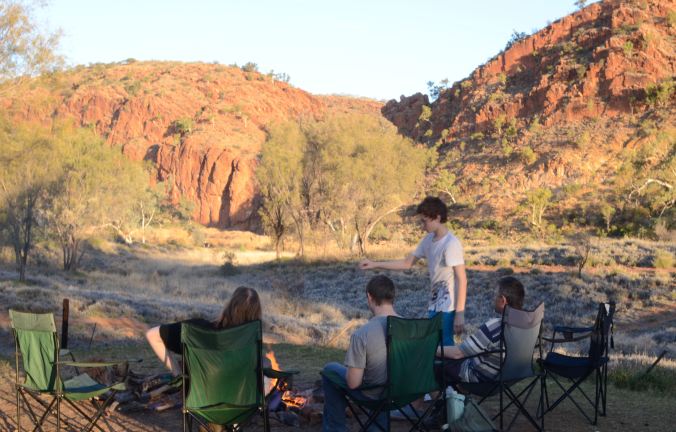
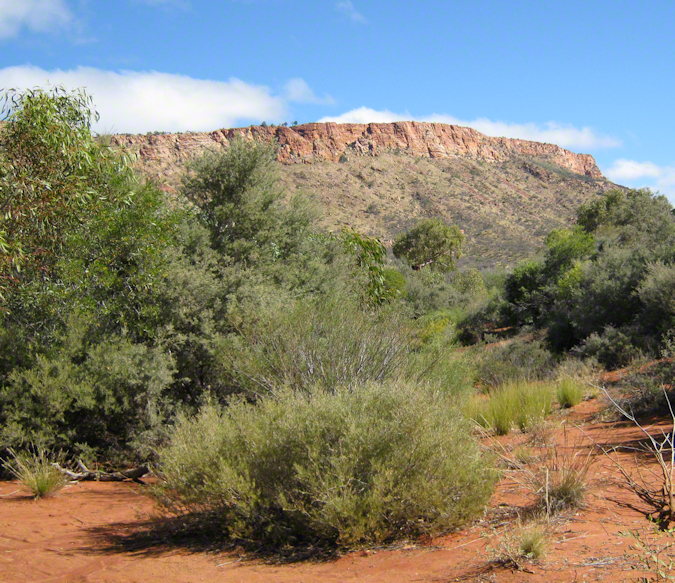
For the last few years promoting my artwork has taken a back seat to my novels. About time I moved the art to the front seat again. So, for a start, here’s a story combining both memoir and art in the story behind the painting of Mt. Giles in the MacDonnell Ranges, Northern Territoryand the T-Team’s intrepid adventures climbing it.
[Twelve years ago, the T-Team, next generation embarked on their pilgrimage to Central Australia. Purpose: to scatter Dad’s ashes in his beloved Central Australia, in Ormiston Gorge. Over the next few months, I will take you on a virtual trip to the Centre and memories of that unforgettable holiday in 2013, with my brother and his family; the T-Team Next Generation. This time, the T-Team farewell Glen Helen, then struggle with the concept of driving in convoy.]
The sound of boots scuffling in the boys’ section of the tent woke me. I wormed my way out of the sleeping bag, careful not to wake Hubby. He still puffed out the sweet dreams while softly snoring while I crept next door to investigate.
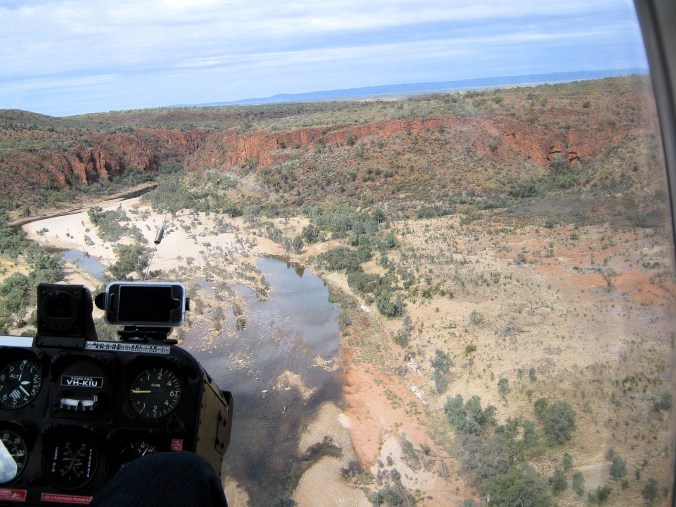
Captured more of Mt. Sonder at sunrise; this time in blue and mauve hues rising above helicopter landing pad. In 2010, Mum and her sister had splashed out and taken this helicopter ride over the MacDonnell Ranges. In some ways an easier way to have a birds-eye view of the ranges without all the huffing and puffing and effort climbing a mountain.
Mum had been there and done that in her youth when she climbed Mt. Sonder with my dad and other Hermannsburg friends. Mum shared just recently, that one of the friends was a rather luscious looking fellow. She puzzled why there seemed to be no photos of this chap in Dad’s slide collection of the occasion.
On my return from this venture down memory lane, I collected some firewood from an old campfire. Hubby narrowed his eyes and growled, ‘We’re not making a fire.’
‘Okay.’
I approached my nephew who squatted by a campfire which he had lit. ‘We’re not making a fire,’ I said and then dumped my wood collection into the fire. ‘We’re not having a fire?’
My nephew laughed. ‘I was just playing with my stick and it broke and went in the fire.’
‘And my pieces of wood just fell into the fire,’ I added.
We watched the flames grow, both chuckling at our insurrection to his Lord-ship’s ban on fire.
After a toilet break, I filled a billy can with water and it made its way onto the coals. The family gathered, enjoying its warmth and relative scarcity of flies and other insects. But for some, like my younger niece, the fire failed to ward off all the flies; especially those tiny little sticky flies that crawl in one’s eyes, nose and mouth. For her, the only solution was to put a re-usable cloth shopping bag over her head.
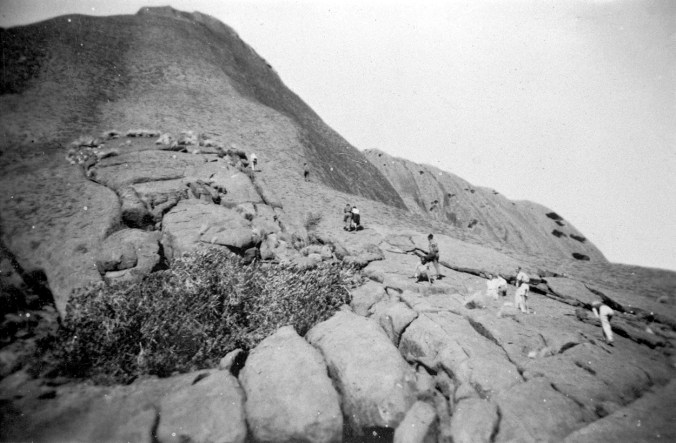
Following breakfast by the fire that my husband said we weren’t going to have, I washed and packed up my bedding and stuff in the tent. Having done as much as I could to pack the Ford, I walked up to the restaurant with Son 2. He wanted an iced coffee. There, while Son 2 drank his iced coffee, I bought a book about Uluru, and then had a coffee with Mum. We talked with the owner and Mum shared that she had visited Ayers Rock (Uluru) in 1953.
‘We were the only ones there,’ Mum said.
‘Was Dad there that time?’ I asked.
‘Yes, but I was much younger, and we weren’t going out then.’ Mum laughed. ‘One of the ladies lost the sole of her shoe when we were climbing, and Dad gallantly lent his shoes to her and walked down the rock barefoot.’
‘Just like my brother did in 1981 with his cousin. Only they did it as a dare.’
‘Must be in the genes,’ Son 2, who had been quietly listening to the conversation, snorted.
By 10.30am, the T-Team convoy had left Glen Helen, its red cliffs, its flies and the doused and covered fire in a distant mirage and we headed for Ormiston Gorge, again. My sister-in-law wanted to buy a souvenir magnet at the Ormiston Gorge information centre.
We parked at the turn-off, where Mum, Son 2 and I waited in Mum’s hire car for the Ford containing Hubby and Son 1 to arrive, and the T-Team in their white van to appear.
‘What’s taking them so long?’ Son 2 asked.
‘Maybe the Ford won’t start.’ A definite possibility, I thought.
‘Don’t say that,’ Mum said.
‘What about the T’s? They’re late too.’ Son 2 grumbled. ‘We’ve been waiting twenty minutes!’
I sighed. ‘Perhaps the Ford has broken down and brother is under the bonnet trying to fix it up.’
‘Should we go back then?’ Mum asked.
‘Yes, I think we should,’ I sighed again while starting up the engine. I rolled the car forward, performed a U-turn and then headed back to Glen Helen.
Just as we reached the road to Glen Helen, the Ford appeared and sailed past us on its way to Ormiston Gorge.
Down the valley we travelled until we could safely do a U-Turn, at what we had coined the “U-Turn Crossing”. This was the place where a couple of nights ago, Son 1 had collected firewood while I collected photos of Glen Helen’s iron-red cliffs bathed in the golden rays of the setting sun.
Then, stepping on the accelerator, we chased the Ford. Upon catching up to the Ford, we beeped the horn and flashed the lights of our rental car.
‘What the…?’ Son 2 pointed at a white van on the opposite side of the road, heading back towards Glen Helen.
‘No,’ Mum said, ‘we’ve all missed the turn off to Ormiston.’
More sighs. A brief park by the side of the road, our car with the Ford, and then exchange of information with Hubby and Son 1. Then with my brother who had also missed the turn off to Ormiston and had to retrace his tracks back. We turned around (in our cars) and in convoy, bumped our way down the rough track to the Ormiston where we waited for Mrs. T to buy her fridge magnets.
Transactions done, we began our journey to Hermannsburg. This time, the T-Team in their white van, waited for us to catch up. Again, this time in convoy, to Mum T’s childhood home.
Recently I shared how my dad relied on the Readers Digest “How to Fix” book to tackle DIY jobs. Having a double mortgage, and money being tight, Dad didn’t have much cash to splash on the “experts” in such fields as plumbing, electricity and general home maintenance.
The response met with a hint of dismissal from my older friends who prided themselves on their pedigree of farmer fathers. These, they boasted were real men, Aussie men, who fixed all things by pragmatic problem solving without the help of a book. The wisdom of their farming forebears imparted to them by osmosis, apparently.
In contrast, my father was a lesser being, a city dweller who had to refer to a book, of all things. My dad was a much-loved teacher, gifted in music, art and sport. He coached a winning football team of Indigenous players from Hermannsburg, Northern Territory in his youth, led a choir of Indigenous singers, and later school student Anklung bands for the South Australian Festival of Music. No flies on my dad. But I must admit, when it came to DIY, his forays into such exploits would rival the character Frank Spencer in the British sit-com, “Some Mothers do ’ave ‘em”. Still, I’m proud of my dad and love him. But then I realised that these superior beings who were my friend’s fathers, were from my grandparents’ era.
So, I cast my mind and research back to my two grandpas: Reverend Sam Gross (my mother’s father) and Dr. Ron Trudinger (my father’s father).
Now these friends held up their ties to the land as superior. Although both my grandfathers are highly educated with Reverend and doctor between them, I can claim a link to the land too, through my maternal grandfather, Sam. His family were farmers with I imagine generations of farmers before them from Horsham Victoria in the 1850’s and extending back to Prussia.
Sam was born in 1905 and grew up with all that practical knowhow bred into his being. I never met Sam, he died before I was born, but I remember my mum saying he was good at fixing things like cars. He could’ve been an engineer, but he became a Lutheran pastor. I reckon my brother inherited some of Sam’s traits—he’s a jack of all trades—the ideal DIY man.
As a child, Sam suffered rheumatic fever which affected his heart. Consequently, he got the education with the view of becoming a minister and wasn’t expected to continue with the farm like his brothers. The doctors told Sam he wouldn’t live past the age of thirty. But being extremely fit and maintaining his health, Sam defied those expectations.
After ordination to become a minister, and then a few years posted to Berri, in the Riverland of South Australia, Sam with his wife, Elsa (my grandma) and three young daughters (one my mother), ventured to Hermannsburg, Northern Territory. There God had called them to be missionaries to the Arrernte people.
Sam’s pragmatic skills, bred and imparted to him from generations who had lived and struggled on the land as poor subsistence farmers in Germany, then as pioneer farmers in the Victorian Western districts in Australia, came to the fore in the harsh isolated conditions in Central Australia.
Sam had to venture to even more remote places in the desert west of the MacDonnell Ranges—Haast Bluff for instance. One trip in 1942, the truck broke down. Despite putting his mechanic hat on and trying to fix the car, an essential part of the engine was kaput and the much-needed part not available. Sam’s problem-solving prowess kicked in, donkeys were found and the car towed by donkey-power back to “civilisation”—Hermannsburg.
A year or so after their arrival in Hermannsburg, the supervising pastor, F.W. Albrecht was stuck in Adelaide as a result of the war. Hermannsburg came under suspicion, as it was a mission set up by German missionaries back in the 1880’s, and as such with ties to the Lutheran church, had a German name and tradition. The British Army being paranoid of anything that hinted of German, was suspicious of Hermannsburg. They feared German spies were hiding out there. So, they sent officers to check out Hermannsburg.
On one of these visits, without their chief, Pastor Albrecht, Sam and Elsa had to entertain these one-eyed wary characters. How did Sam survive their investigation? My mum says her father had the gift of the gab. My grandma had the gift of hospitality. In “A Straight-Out man” by F.W. Albrecht, I remember reading the Arrernte said that Sam would be alright, he’s so Aussie they won’t suspect him. Besides, the name Gross is found in England too. Also, Sam’s first language was English and when at school, he had trouble learning German. Although German was spoken at Hermannsburg and in the family, Mum can’t remember what they did when these British Intelligence Officers came, but thinks the children were kept out the way. Maybe someone took the kinder (children) on a picnic…
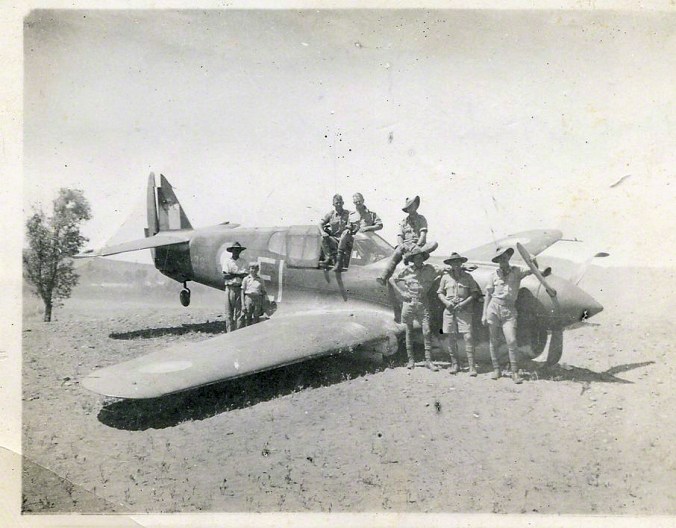
Sam and his family survived the officer’s interrogation. However, the pedal two-way radio was confiscated, and later Rex Batterbee was appointed to keep an eye on the mission. This Rex did and taught Albert Namatjira to paint.
There’s much more to Sam’s story. I think this post gives a glimpse into his generation and German farming ancestry, migrants making good, living in isolation, making do, thinking on one’s feet and problem-solving.
Did I mention Sam still found time to indulge (as the Mission Board put it—another saga) his passion for photography? He used these photos of Central Australia for deputations to garner support for the mission. Many of his photos are now stored in the Strehlow Centre in Alice Springs.
[In 2013, two members of the original T-Team, actually, my brother and I with our families embarked on a convoy to Central Australia in memory of our Dad…and so began the story in the making of the T-Team Next Generation that follows my memoir: Trekking with the T-Team: Central Australian Safari 1981 available on Amazon.]
A Place to Remember
‘What? A camel race? There’ll be a fight on their hands if they insist.’ Words actually spoken by Mum when confronted with even the suggestion of a change of plans. ‘We didn’t fly all the way up to Central Australia for the weekend to watch a camel race.’
Most of the T-Team, minus the one who’d made the suggestion (they were absent), nodded. ‘We are going to Ormiston Gorge, and that’s final.’
The camel race idea slid into obscurity. We spent Saturday morning lazing around at Glen Helen, fighting off flies. One T-Kid resorted to wearing a cloth shopping bag over their head while other T-members bought flynets from the store. The T-Team explored the waterhole at Glen Helen, before having lunch with the congregation of flies. Then we travelled to Ormiston Gorge.
The road to the gorge, though unsealed was in better condition than I remembered it in 1981. More tourists, I guess. No. 2 Son and I travelled with Mum (I drove), while Hubby drove the Ford with No. 1 Son, and my brother’s family piled into their van for the trip. So, we wound our way in convoy to Ormiston Gorge. 3pm and we were spoilt for choice of parks.
‘Most of the tourists have probably moved on or gone back to Alice for the camel race,’ I remarked to Mum.
I swung into a park and then we jumped out of the car.
Mum fumbled with some sealed containers. ‘Now, how shall we do this?’
‘Just divide the ashes evenly in the containers,’ I said.
She divided up the containers and began filling them with ashes.
‘They should be here soon,’ I gazed through the tee-tree bushes. ‘They were right behind us.’
‘Better not’ve gone to Alice for the camel races,’ Mum muttered.
‘I don’t think they would. The kids wanted to swim in the water-hole.’
No. 2 Son bolted. Now that we were at Ormiston, he wanted to see what it was about the place that Grandpa found so attractive.
Mum continued to doll out the ashes. Takes time to doll out ashes into containers.
No.2 Son returned. ‘They’re here, just around the corner.’
Mum and I followed him.
‘What happened to you?’ my brother’s wife, Mrs. T yelled. ‘We’ve been waiting here for ages. Could’ve gone to the store, bought souvenirs and come back.’
‘Can we swim now?’ one T-Kid asked.
‘Not yet,’ my brother replied.
Mum offered her boxes of precious cargo to them. Our T-Children weren’t sure about taking them, but Mum persuaded them. They’d be honouring Grandpa’s memory.
As the T-Team Revisited, we trooped into the gorge. In late afternoon, the cliffs rose somber and dusky-pink casting a shadow over the waterhole. The T-Kids gazed at the expanse of water and kept on walking. Just past the waterhole we climbed up a ridge. When we reached the top, Mum stumbled. Mrs T caught her and steadied her. Mum sat down with the announcement:
‘That’s it. I’m not going any further. But the rest of you can.’
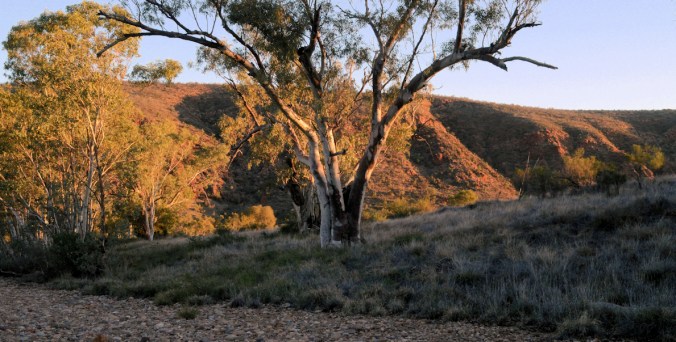
The sun caught the cliff-wall opposite, causing it to glimmer a golden orange. A ghost gum sprouting from a tumble of rocks attracted my attention. ‘I remember that tree,’ I said. ‘Dad’s favourite tree in Ormiston.’ After taking a photo, I scrambled down to the tree and scattered Dad’s ashes there.
Up and down the immediate locale of the gorge, the rest of the T-Team Revisited, wandered, silently reflecting on Dad and scattering him where he had many times trekked.
Some hikers tramped past and glanced sideways at us. The T-Team ignored them. Mum watched us from her vantage point. I climbed back up to her to check how she was.
One of the T-kids joined us. ‘The hikers asked us what we were doing, and I said we were scattering Grandpa’s ashes. They said, ‘Oh,’ and walked away all quiet. Which was awkward!’
I counted the members of the T-Team who crawled over the rocks and the other side of the rock-hole. ‘Where’s No.2 Son?’
‘I think I saw him go further down the gorge with his Dad,’ Mum said.
Down the ridge, and around the golden wall I hiked. I found No.2 Son marching towards me. ‘I want to see what’s around the bend.’
I glanced at my watch. 4pm. ‘Why not?’
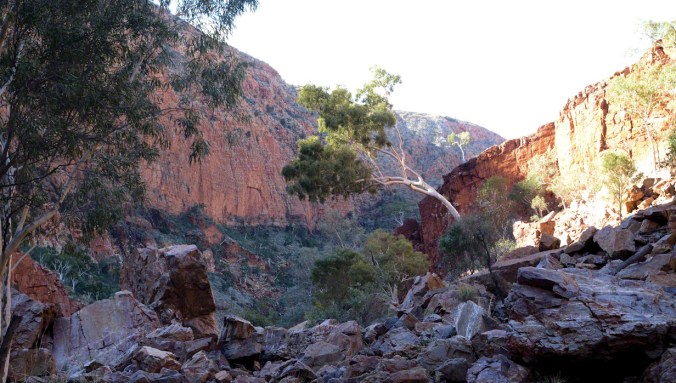
We strode down the gorge and around a corner or two. Cliffs in hues of blue and purple with just the tips splashed with orange. Perfect reflections in pools.
‘What’s around the next corner?’ No.2 Son was had found his hiking mojo and was keen to explore more of Ormiston Gorge.
‘Let’s see.’
We stormed around the next corner. Ormiston with its majestic cliffs, even in shade of the late afternoon, spurred us onward to explore.
‘Let’s go on. I want to see more.’
‘Let’s.’ I’d never seen such enthusiasm from No.2 Son to explore nature.
On we tramped, the sand firm under our boots. The gorge cast in hues of mauve enticed us further. More reflections in still pools caught the sun-capped heights of the eastern cliffs.
As we dragged our feet back to Ormiston’s entrance, No. 2 Son grumbled. ‘Just as I’m getting into this exploring, Dad, you have to spoil it. You want me to get outdoors and then you call me back.’
‘It gives you a taste for another time when we’ll have more time to hike through the gorge to the Pound, okay?’ I said thinking, And perhaps climb Mt Giles one more time…
We passed the T-kids drying off from their swim in the waterhole.
MB waved from the damp depths. ‘Come on, have a dip!’
‘Too late,’ Hubby called back. ‘We have to get back to camp. I don’t want to be cooking in the dark.’
I was glad Hubby moved us on. Wasn’t in the mood for swimming. Like No. 2 Son, I yearned to explore the dreams and secrets, the twists and turns of Ormiston Gorge.
After the phone call to Fifi, Dee leaned back in her chair. ‘Gotcha, Mr. Renard. Gotcha!’ She couldn’t believe her good fortune in Fifi. Didn’t take that “Rannga” much to turn against her former friend.
However, youth group rumours were not enough to “hang” Lillie, she needed hard facts—evidence. She started with the local council office at Glen Huon. After all, most apple picking happened in the Huon Valley, Tasmania. So, a good place to commence digging dirt on her nemesis.
Thankful that she woke up the sleepy young man in the office before the council chambers closed, she trawled through the files he sent her. She was glad that such information about payrolls and workers in the area in 1981, had been digitised. Lillie von Erikson was listed as working for apple orchard owners, Greg and Janine Thomas. However, no mention of a baby or her being pregnant. Dee puzzled over the fact that Lillie, according to Fifi, seemed to have been in Tasmania long after the apple-picking season was over.
What was she doing there after apple picking? Dee wondered.
She moved onto Trove, an online digital archive, that has recorded historic newspaper articles and publications. Searched Lillie’s name in the local and state newspapers from the day.
Nothing.
She calculated when the baby would arrive if conceived in November. Then scrutinized state and also national papers for a birth in the personal pages. August—September 1981, in particular. Nothing. Still, all is not lost. Perhaps she didn’t put the birth in the paper if she adopted the child out.
But a quick check of newspaper dates available revealed that Trove only published papers up to 1950. What a disappointment!
A visit to the South Australian State Library was the next step in the search. There she trawled through the microfiche files for the Tasmanian newspapers, concentrating on births around August and September.
After an unsatisfactory August, she scanned the first week in September.
‘Ah! That looks more like it,’ Dee murmured.
She zoomed in on the notice of a daughter, Zoe, born to Lillie’s apple picking bosses, Greg and Janine Thomas. Detective Dee Berry smiled while resting her clasped hands on her belly. September 1, right in the timeframe too.
‘Interesting,’ she murmured. ‘Did the moll stay to help Mrs Thomas? Or did she give the baby to Mrs. Thomas?’
A check of the births, deaths, and marriages register, and confirmed. Mrs. Janine Thomas was over 40 when she had her first child, Zoe.
‘Not impossible, but suspicious,’ Dee muttered. ‘I think a little trip to Tasmania is what I must do.’ After saving the information onto a file labelled “Moll”, she put in an application for a visit to Tasmania courtesy of the government. After all, it was an enquiry into a murder investigation.
Who knows, Dee smirked, my enemy may be a suspect that needs to be eliminated; one way or another I’ll get her.
Dee gripped the leather-bound steering wheel of Toyota Corolla hire car as it rumbled up the unsealed road. Won’t tell the hire company about that little detour, she thought. From the Council records, the Thomas farm was hidden way out west, close to the “Great Western wilderness”. The further west she drove, the thinner and rougher the road became.
She passed a tiny town with houses painted in gaudy orange and pastel greens. A purple house stood sentinel at a fork in the road. Dee took the left track hoping to reach her destination soon. She’d given up on the Sat Nav. The designated voice, named Jilly was vague and hadn’t a clue where to go.
Dee was proud that she could still read maps and follow the directions of an old local manning the service station at Glen Huon. He said he’d remembered someone like Lillie 40-odd years back. Strangers were a rarity in a small town of fifty-odd people from where he had come. He said Lillie had walked into the church, and all twenty heads turned to size up the blonde from the mainland.
‘It wasn’t long before rumours were flying,’ the station owner said, ‘pregnant, just like the lady who lived in that purple house you’ll see when you get to the town up there. Rumour has it, she’s got a child from ten different men. Anyways, that’s a lifetime ago now. Back then, if someone sneezed across the valley there, everyone in town would know about it and the person who sneezed would have died from pneumonia. Not much better now.’
Dee must have given him a strange look, because the station owner added, ‘Oh, er, don’t believe the rumours. Them folk up there are all related, married cousins and what not, but they don’t have two heads.’
‘Didn’t think they had,’ Dee replied, ‘I just want to know how to get to the Thomas farm.’
‘Don’t know why you want to go there; the family left years ago.’
‘Do you know where they went?’
The man shrugged. ‘The missus died, so I heard. Daughter’s become some big shot lawyer in Melbourne. Something not right there, she never fitted, you know what I mean. She wasn’t one of us.’
‘Did she look like Lillie, the blonde?’ Dee showed the man a photo she had scanned to her phone of 17-year-old Lillie.
The man paused, squinted and then nodded. ‘Yeah, there were rumours. But we could never prove it. Janine, Mr. Thomas’s missus, always insisted the baby was hers.’
Sometimes characters spring from real life, Sometimes real life is stranger than fiction. Sometimes real life is just real life. Check out my travel memoirs, And escape in time and space To Central Australia.
[In 2013, the T-Team, next generation embarked on their pilgrimage to Central Australia. Purpose: to scatter Dad’s ashes in his beloved Central Australia, in Ormiston Gorge. Over the next few months, I will take you on a virtual trip to the Centre and memories of that unforgettable holiday, with my brother and his family; the T-Team Next Generation. This time, the T-Team gather and multiply as we greet our adult sons and our mother (Mum T also known as Mrs T senior) for the day, and the expanded T-Team of us set off to camp at Glen Helen.]
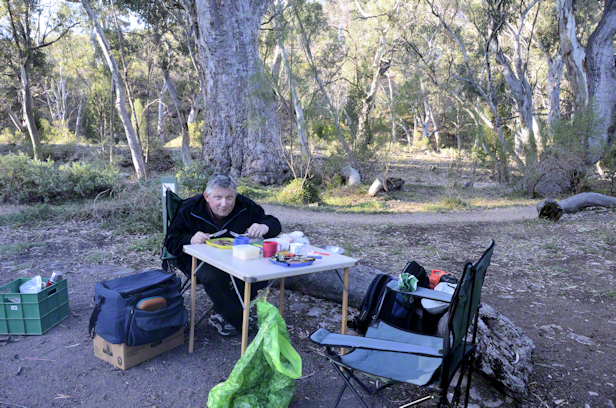
The T-children wanted a campfire. My brother had promised them a campfire. But bushfires in the past year had made campfires, even in the middle of winter in the middle of Australia, almost extinct. On our trip up north this time, each camping ground up until Glen Helen, had restricted fires, and denied the children the pleasure of a campfire. That’s not to say the T-Team Next Generation missed out entirely of some sort of fire to cook our food. We did spend one night in one of those free parking “camps” 30 kilometres south of Marla where we attempted to make a campfire. However, the area was so well picked over for firewood, the few sticks we did scrounge together barely made enough flames to boil a billy. So, no satisfaction regarding campfires. That is, until Glen Helen.
Even far out in the bush, the Glen Helen camping grounds had strict conditions and regulations controlling the operation of campfires. In the Glen Helen camping grounds, there was a designated place for the fire, and we had to provide our own wood. Again, dead wood around the immediate camping site was scarce.
So as the sun sank towards the Western horizon, golden rays blessing the cliffs in hues of pink and scarlet, and the humps of spinifex glowing like lumps of gold, my son and I set out in Mum’s Ford station wagon, down the road in search of a creek offering dead branches for firewood.
As the setting sun deepened the walls of the gorge into hues of crimson, I hobbled down the dry creek filled with smooth rounded river stones. Hard to imagine the creek gushing with water in flood, rushing over those stones, smoothing them to the size and consistency of bocci balls threatening to twist my ankles.
With my camera, a constant companion and permanent fixture hanging from my neck, my focus was not only on dry sticks and logs, but on the scenery. While my son snapped off armfuls of tinder from uprooted river gums that had become casualties of former flooding, I collected snapshots in time of the setting sun, blood-red cliffs, ancient eucalypts towering above the banks and the dry river-bed of stones. Night stole the thin grey-blue light of dusk. With the station wagon stacked full of wood for the fire, and my camera’s memory card full of brilliant photos for my art, we returned to camp.
What joy the T-Team Next Generation family had. Well, apart from their schnitzels that had gone off. Thankfully, we were able to share the extra and expensive lamb chops we had bought the day before at the supermarket. We gathered around the fire. The fire that cooked our dinner, then warmed us and the conversation late into the cloud-free night frozen with a sky packed full of stars.
In the past, a fire would burn slowly all night, keeping animals away from camp. The rules of the camping ground forbade that strategy. Conscious that the local fauna may come foraging, my husband packed away all the foodstuffs and loose items back in Mum T’s station wagon.
Some of the T-Lings were not so concerned about the threat of such animals. During the night, though, a half-full cereal packet would prove fair game for a roving dingo.
So, stories told, marshmallows burnt and eaten, most of the T-Team Next Gen retreated to their tents and snuggled into their sleeping bags. Mum T had gone to her cabin way before the rest of us. She hoped to rise early, with my help, to catch the sunrise on Mt. Sonder.
My brother and his son stayed chatting around the campfire. A dingo howled. Freaky. An eerie haunting cry. My nephew was sure he’d come face-to-face with the dingo when he’d taken a trip to the toilets. I left my brother and his son to their conversation around the fire and with the responsibility of waking mum before dawn, I headed to the tent to join my husband and sleep.
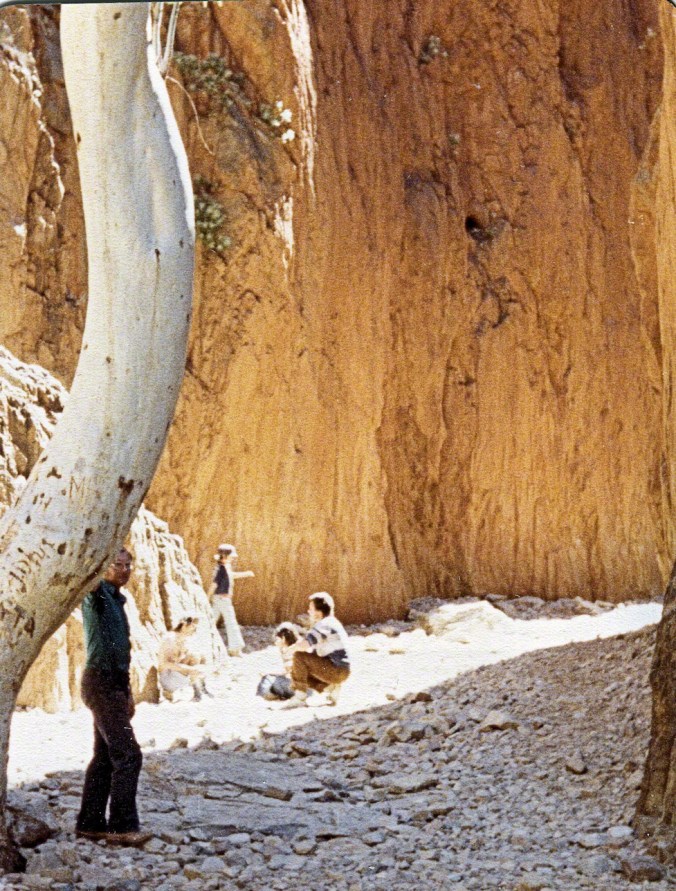
[Twelve years ago, the T-Team, next generation embarked on their pilgrimage to Central Australia. Purpose: to scatter Dad’s ashes in his beloved Central Australia, in Ormiston Gorge. One Friday every month, I will take you on a virtual trip to the Centre and memories of that unforgettable holiday in 2013, with my brother and his family; the T-Team Next Generation. This time, the T-Team part ways for the day, and two of us set off to explore Standley Chasm.]
Bonus! An all-you-can-eat breakfast greeted us at the Chifley the morning after. The same can’t be said about the T-Team. Richard had slept in and not much was happening in my brother’s “camp”. Meanwhile, we had made the most of the morning, walking to the town centre.
‘Gotta get tyres for the trailer, ‘n nothing’s open yet,’ Richard mumbled on the other end of my mobile phone.
‘Having a quiet day, then,’ I replied gazing around the near-empty local Big-W department store. Anthony held up a pair of cargo pants and indicated that he’d try those on. Then he began rifling through the bargain rack for more pairs to try.
‘Not exactly,’ Richard sniffed, ‘gotta get tyres.’
‘Oh, well, we’re thinking of going to Standley Chasm. Maybe we can all go together in the afternoon if your tyres get sorted.’
‘Hmm, will let you know.’
‘Okay, will hear from you then.’ I clicked off the phone and said to Anthony, ‘He doesn’t sound optimistic on the tyre-issue. Might be busy all morning.’
By noon, the T-Team still weren’t ready; Richard still had to take the car to get the new tyres. ‘At least I’ve found a place that can do our tyres,’ my brother mumbled to me on the phone before he left on his tyre-mission.
So, Anthony and I travelled alone on our quest to explore Standley Chasm. Actually, we’d barely left the outskirts of Alice Springs travelling west on Larapinta Drive to the MacDonnell Ranges before Anthony piped up, ‘How far is it to Standley Chasm?’
‘Not far,’ I replied, then retrieving the map from the glove box, I hunted for the chasm’s location and then calculated the distance from Alice Springs. ‘It’s 50km, so about half an hour’s drive.’
‘Oh, you sure?’
‘Yes.’
‘Cos, if it’s further, we’ll miss the red cliffs, or getting in, or we’ll be home after dark.’
‘Already have,’ I sighed. ‘But I’m sure the chasm will still be spectacular. And the hike there will be good exercise.’
‘Oh, I don’t know.’
‘Anyway, it’s not far. Besides, there’s plenty of other gorges to explore.’
Before Anthony could voice any further misgivings or regrets that we should’ve left earlier and not waited for the T-Team, the sign for Standley Chasm appeared to our right. We parked in the carpark shaded by a gathering of majestic eucalypt trees and then followed the path to the kiosk.
While waiting in line to pay the entry fee, we read the sign which assured us that we had plenty of time before the park closed at 5pm.
I nodded at the notice board and remarked, ‘All that worry for nothing.’
‘Depends how long the walk takes,’ Anthony said while nibbling a nail.
‘Doesn’t take long,’ I said. ‘I’ve been here before. Takes less than an hour.’
‘I hope so.’
I shook my head. ‘Look, we’ll walk for an hour and then turn back, okay?’
Just to be sure, when we paid for our entry tickets, I asked pleasant Irish man who ran the kiosk, how long the walk should take. He explained that it was mostly easy and would take the average hiker about half an hour.
So, rather than waste precious Anthony-time having lunch first, we set out on the adventure to the chasm. Anthony raced ahead. I wandered along the meandering path taking note of various scenes I would snap on our return. Who knows, we may make it in time for the spectacular red cliffs on both sides. Although the lack of tourists hiking either way, made me suspect that, that time had passed.
Twenty minutes later, Anthony and I beheld the awesome cliffs of the chasm; one side glowed golden orange, while the other side was a dark sienna. We sensed the peace and serenity of the place.
I scrambled over the tumble of boulders in the chasm and made my way to the pool. Beyond the rockpool, a sign prohibited us from venturing further. The deep water caught a perfect reflection of the boulders and cliffs.
Upon our return to the entrance, we munched on our sandwiches and observed a group of aspiring hikers pitch their tents and then pull them down again. What’s that about? we wondered.
Then, a group of tour guides sat to eat their lunch on a picnic bench below us on the other side of the creek. Anthony had to comment, ‘There’s seven of them and only one of them is Indigenous.’
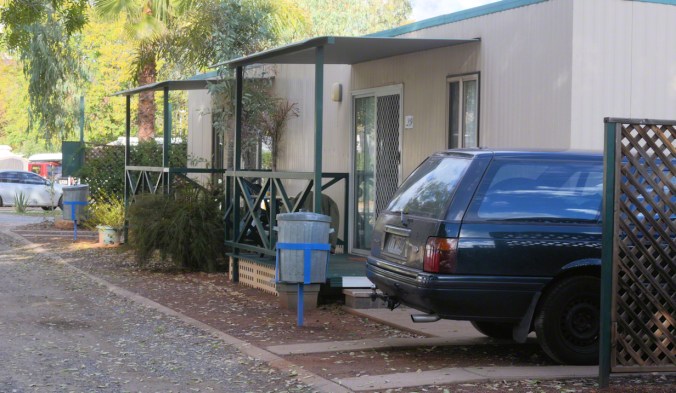
On our return to Alice Springs, we stopped by the caravan park where I booked our sons in. We had already booked ourselves into a cabin at the caravan park and had originally thought they could stay with us. And Mum, all concerned about missing out, had her cabin organised months ago. Even so, we had no problem arranging a separate cabin for our grown-up sons who we felt would be happy with more space.
With late afternoon casting the long shadows of the approaching night, we made our way to where the T-Team were staying. We had been in touch with Mrs. T and had arranged to meet there. When we arrived at the appointed time, no T-Team. Calling Mrs. T on her mobile phone yielded no joy, nor answer.
‘’Not again!’ Anthony groaned.
‘Let’s go to the shops and buy some meat for a BBQ. Then we can find a picnic area and cook up our meat.’
My suggestion sounded reasonable to Anthony, so, off we drove to the local IGA supermarket. Just around the corner. Won’t be long. Maybe the T-Team will be back by the time we return.
‘That’s funny,’ I pointed at some bushes on the traffic island, ‘there’s a cop car hiding.’
‘I didn’t see anything,’ said he who was concentrating on driving.
I ducked into the shops to by some lamb chops and bread. Not much choice; I wanted to snag some sausages but couldn’t see any around. So, armed with the purchased, at some expense, meat and bread, I hopped back in the car.
‘While you were in the shops, a bikie guy was arrested right next door in front of the bottle shop.’ Anthony fired up the engine with the characteristic roar of the Ford. ‘I wonder what he was up to?’
Just then, Mrs. T rang back. ‘Sorry we weren’t there when you came. We was down the street and bought tea for all of us.’
So, with the chops saved in the ice box for camping at Glen Helen, we joined the T-Team for dinner, followed by a raucous game of “Chook Chook”, an educational card game trading poultry.
Afterwards, Mrs. T joined her friends on the back deck for a drink or two, the T-Lings continued with another round of card-playing with their father, while Anthony and I returned to another night of luxury at the Chifley Hotel.
[Eleven years ago, the T-Team, next generation embarked on their pilgrimage to Central Australia. Purpose: to scatter Dad’s ashes in his beloved Central Australia, in Ormiston Gorge.
Over the next few months, once a month, I will take you on a virtual trip to the Centre and memories of that unforgettable holiday in 2013, with my brother and his family; the T-Team Next Generation. This time, the T-Team arrive, and again for us, rather precariously, in Alice Springs.]
The remaining 160km to Alice Springs progressed through sundown and twilight uneventfully…
Except for the car towing a camel trailer who decided to overtake us. An oncoming truck caused it to swerve back into our lane; the camels’ heads struggling to catch up with their necks at the force of the turn.
‘Missed the truck by that much,’ I remarked holding my fingers in pincer mode.
‘What the —! How do you get the thing to record?’ Hubby fiddled with the video camera. ‘Too late. Missed it.’
We watched the camel trailer disappear around a bend. ‘Bet that’s another event the T-Lings missed being too absorbed on their phones.’
Hubby pouted. ‘I should’ve been driving, then you could’ve caught it on video.’
6:30pm and a thick blanket of darkness had set in by the time we reached Alice Springs. By some miracle we’d managed to stay in convoy with the T-Team and had followed them through Heavitree Gap and into streets of the town. The blackness of night seemed to suck the glow out of the streetlights.
It was not long before, the T-Team too, were absorbed into the darkness after we missed the first set of traffic lights.
‘We’re stuffed now,’ Hubby grizzled. ‘Where’s the map?’ He turned and groped around the baggage on the back seat. A fruitless search.
‘There’s Richard.’ I flashed the car’s lights and he remained parked as I overtook the van.
‘Why didn’t you stop?’ Hubby started to panic. ‘You can’t stop now. You’re embarrassing everyone.’ This all said on the quiet and empty streets of Alice Springs. ‘Hey! Where are you going?’
‘There’s nowhere to park,’ I finally managed a word in edgewise as my hubby took a breath in between his hysteria and panic. I then stopped near the entrance to the Chifley Hotel. I glanced at the enticing amber lights leading to luxury and comfort. ‘You did mention staying at a hotel.’
‘Oh, you’ve lost them!’ Hubby snapped. ‘I’ll take over. You have no idea!’
I allowed Hubby to take control of the car. We wandered around the hotel resort carpark, and then out onto the road. We meandered around some more streets until we ended up on a dead-end road near a backpacker’s hotel.
I rang my brother, Richard and he instructed us to drive to a road with a name and stay put. We were to tell Richard the name of the road, and with the help of his Sat-Nav, he’d find us.
More driving round, and round…until we chanced upon a road with an actual name attached to it. Stott Street. There we parked. And waited. And waited…and waited.
‘You better get out that road map for a list of motels,’ Hubby said. ‘Can’t wait around here all night.’
I hunted in the dark for my bag, then finding that little treasure, I fumbled around its clutter for the road map. Under the dim glow of the streetlight, I scanned the pages. You would think that such a brochure would have a handy list of hotels and motels…but no. ‘There’s no list of accommodation I can see.’
‘Oh, that’s just great!’ Hubby sniffed.
‘I’m sorry, I made a mistake. I should’ve stopped near Richard, even if it had been an illegal park,’ I said. ‘Would you forgive me?’
‘Oh, all right,’ he sighed. ‘Sorry for snapping.’
Just at that moment, the T-Team van appeared, and we followed them, very slowly and carefully to their friend’s home.
Although their house was huge, by this time Hubby and I were not sure about setting our tent up in the dark, in their back yard. We had been warned of visiting or possibly resident wildlife, namely dingoes.
While drinking a most welcome cup of tea, we discussed and scanned the phone book for hotel accommodation. Our hostess was fine about us staying in a hotel as she wasn’t sure about the wildlife in her backyard either, or whether we’d be able to secure our tent as the ground was quite hard. She suggested a couple of hotels, but they had already closed their bookings for the night.
By this time, it was about 7.30pm, and our stomachs were rumbling. The T-Lings insisted on Hungry Jacks as our nephew had accrued some vouchers. So, Richard drove us all in the van to this venue for burgers.
The line-up was long, and the service was, to say the least, slow; partly because a certain T-Ling was very particular about getting value for his voucher. By the time my nephew had finished his order, I had eaten my chips. I think the African girl who was serving looked relieved after such voucher discussions with my nephew. Making the discussions and our orders understood were not helped by the fact that both girls serving struggled to comprehend what we said, as English was not their first language.
Then, as we waited for our nieces to receive their orders, a group of Indigenous people piled out of a bus and walked in. I noticed that they wore T-shirts with Areyonga written on them. I smiled at them and silently remembered the special time we, as the T-Team, had there in 1981; the oasis, the beautiful singing of the Indigenous who lived there and the hospitality shown to us.
When we left the burger shop and had piled into our van, my older niece said, ‘Now I know what it feels like to be a minority.’
Hubby and I managed to book a room at the Chifley Hotel. The receptionist apologised to Hubby that they only had a standard room available. But for us, the standard room was most acceptable; it even had a print of Mt. Hermannsburg on the wall.
We flopped down on the bed and relished in our comfort and luxury.
[Have you ever been to a place and had an immediate affinity with it? Well, that’s how it was for me when the T-K Team on their Swiss adventures visited Murten. Loved the place. I’m sure, now, that it wasn’t just the perfect weather, the picture postcard views of the lake and the charming medieval architecture so perfectly preserved. There was something more, which I was to discover recently.
Of course, my younger son would insist on putting a dampener on my dreams—’How can you be related? You’ve got no Western German in your ethnicity,’ he harps on and on about that point. Anyway, we will put that matter aside and I’ll take it up with My Heritage.
All I can say, is that there must be something in the connection I felt with the place. While doing my family history, I came across some ancestors, the De Bons, who lived in Murten, my five times great-grandfather was a protestant pastor in Murten. There were Huguenot connections in the family. And note the museum, where I mention that the Celts lived in Murten. According to my DNA results from My Heritage, my ethnicity is 25% Celt.]
Murten/Morat
Thursday, August 21, 2014, even earlier up as we planned to drive across the country to Bern and beyond, near the French part of Switzerland. Granny excused herself as the last two days had exhausted her and besides, she really needed to catch up with her uncle and auntie.
I might add here that Granny and her family, being Swiss German, were not fans of the French part of Switzerland. The feeling, I’ve heard, is mutual. (Thanks to Nepoleon, the French part of Switzerland only became thus in the early 1800’s. So, when my ancestors were living there in the 1700’s, they would’ve identified as French.)
In Murten, the people speak French. So, when P1 spoke Swiss German to the Museum attendant, she was not amused. We almost didn’t get a Museum pass.
Back to the timeline, and some photos.
Despite Tomina’s (Tom Tom) and my under par navigational performance (early morning—yawn), we arrived at 11.30am in Morat/Murten and relished a day of summer, eating lunch by the lake, exploring the Old town and its buildings garnished with flowers, the museum of Stone Age, Celtic, Roman and Medieval relics spanning 10,000 years of human settlement around Murten. Followed by a visit to the Roman ruins in Avenches, the ancient capital of the Roman province of Helvitica.
On our return, we suffered the frustration stuck in peak hour traffic, and Granny suffered stress worrying about our late arrival “home”.
[Eleven years ago, the T-Team, next generation embarked on their pilgrimage to Central Australia. Purpose: to scatter Dad’s ashes in his beloved Central Australia, in Ormiston Gorge. In “Ready for the Weekend Friday”, I will take you on a virtual trip to the Centre and memories of that unforgettable holiday in 2013, with my brother and his family; the T-Team Next Generation. This time, the T-Team make their way, rather precariously, to Alice Springs.]
Rest Stop at Curtain Springs
We paused for lunch at the rest stop just outside Curtain Springs. There we sat and ate our sandwiches and watched the passing parade of tourists, trundling through in their RVs, and caravans. They’d park, snap a few photos of Mt Conner, walk stiff-legged to long-drop toilet, then stagger out waving the flies away before climbing back into the comfort of luxury on wheels and trundling away down the road to Uluru.
A big bus roared into the rest stop and a young Indigenous family alighted. The wife and children joined the queue for the toilets. Meanwhile, the husband gazed at the view of Mt Conner. As he walked back to his bus, he gave a nod and greeted us. He was the only one of the passing multitudes who did.
After our lunch, Anthony and I climbed up the sand hill opposite the rest stop. At the top, we viewed a salt lake in the distance. Maybe, I assumed, it was the tail-end of Lake Amadeus.
‘Wow!’ I said, ‘and all those tourists just go past and never bother to climb this hill and see the lake.’
No answer.
I turned. Where was Anthony? I scrambled around the scrub in search of my husband. ‘Anthony? Where are you?’
No Anthony in sight, I assumed he had returned to the car. Upon my return to the car, I discovered he was not there either. After checking the toilets and discovering only flies and the stink, I traipsed up the hill again. Where was he?
Just as I was about to give up on him and call in a search party, I almost stumbled over Anthony. He was squatting on the sand, sifting the grains through his fingers. ‘I can’t believe how red the sand is,’ he said.
At Erldunda we filled up the car with gas and I took over driving. As we headed for Alice Springs, I remarked, ‘The T-Team must almost be in Alice Springs.’ ‘Mrs. T will like that,’ Anthony replied, ‘she was in a hurry to get there.’ ‘Do we know how to get to her friend’s place where we are staying?’ My husband shrugged. ‘Guess we’ll have to call my brother and get directions. Haven’t got their friend’s address,’ I said. ‘Or we could stay in a motel.’ ‘That’s an option, if we can’t contact them.’ Anthony sighed, ‘Yeah, but, how easy will it be to find accommodation if we haven’t booked?’
We hadn’t travelled more than 40 km when we spotted a family on the side of the road and in distress. Maybe we should stop and help them, I thought.
As I slowed down, I noted that a lady stood at the edge of the road waving her arms. ‘What the heck?!’ Anthony exclaimed. ‘I think they’re in trouble,’ I said, and as we drew closer, ‘It’s Mrs. T waving her arms about.’ I braked. ‘Hey! Not so hard!’ Anthony screamed. Took my foot off the brake and then eased the car to a stop by the side of the road. All the while the T-Team grew smaller and smaller in our rear vision mirror.
‘What! Stop! What are you doing? Stop! Brake hard!’ I slammed my foot on the brake and jolted to a stop on the dirt. ‘Why did you stop so far away? Reverse back to them,’ Anthony snapped. ‘No!’ I retorted. ‘We can walk. Who knows what junk is lying in the dirt ready to puncture our tyres.’
In a huff, my husband raced ahead of me to where Richard was operating on the trailer. As I approached the T-Team, I noticed that my brother was pulling off one tyre carcass and proceeding to mount the spare.
‘The tyre got staked,’ Mrs. T held up what looked like an antenna, ‘by this metal thing.’
‘And we’d just changed a tyre at Erldunda; one that got shredded,’ Richard pointed at some rubber remnants on the verge, and then shook his head. ‘The mechanic didn’t do anything about wheel-balancing. The tyres got so worn they came to pieces. The other tyre was nearly worn through, so I changed them around.’
‘Why do we have such bad luck?’ Mrs. T cried. ‘It’s the curse of the Rock,’ my older niece said. ‘Who stole a rock from the Rock?’ my nephew asked. The T-Lings had been sitting in the van playing their phone games, but they emerged to join in the family conversation.
‘What d’ya mean?’ Mrs. T said. ‘I bought this rock as a souvenir!’ ‘Yeah, but, my brother did run down the Rock barefoot some twenty years ago,’ I laughed. ‘Perhaps the Rock remembers.’ ‘Well, one thing for sure,’ Richard rubbed his hands, ‘first thing tomorrow, I’m ringing the mechanics who did our wheel balance…’ ‘It’s just not safe,’ I said. ‘I know,’ my older niece held up her hands as if holding a steering wheel at an angle, ‘I told them something was not right and that I had to hold it like this all the time. But they wouldn’t believe me.’
With tyres fixed and resolution to acquire replacements in Alice Springs, plus promises to catch up in the same town, the T-Team disappeared down Stuart Highway in the late afternoon haze.
But our ordeals reaching our next place of accommodation were not over yet. [To be continued…]