[In this bite-sized chapter, we meet Zoe Thomas who makes a discovery that will change her life and unbeknown to her at the time, unearth a more than 40-year-old mystery. This will ultimately open the proverbial pandora’s box and cause chaos to a number of now-settled individuals and their families. In future episodes, this revelation, for our Detective Inspector Dan Hooper, will add to his workload as the chief investigating officer, and force his partner in crime-fighting, Eloise Delaney to cut short her long-service leave and return to work.]
Who do ya think ya woz?
Monday January 17, 2022, 10:00 hours
Huon Valley, Tasmania
Zoe Thomas
While the mourners and well-meaning well-wishers and the like gathered in the church hall, loading their plates with condolences and their mouths with egg sandwiches, Zoe Thomas slipped out. Unnoticed, she slid around the corner away from the toilets and then leant up against the whitewashed wall warmed by the summer sun.
‘Oy!’ her dad called. ‘Y’ all right?’
She sighed. ‘Yeah, fine for a girl who’s just lost her mother, if you could call her that.’
‘What do ya mean by that?’ Dad rolled out a cigarette, flicked his lighter to flame, then cupped his hands to gently start the smoking ritual. Then with the cigarette hanging from his mouth said, ‘Don’t speak ill of the dead.’
‘You’re not my father, so how do I know that she’s my mother?’
‘Oh, what makes you think that I’m not ya pa?’
Zoe pulled a folded piece of paper, a computer printout, from her little black handbag. She opened it up and while he puffed away, she held it in front of him. ‘This says that a Francis Renard is my closest relative, my father, most probably. How do you explain that, Dad? I mean Greg.’
Greg blanched. ‘Oh, yes, well.’
‘Well? Did mum have a fling with this Francis Renard forty years ago? In 1981?’
Her father looked away before taking another drag on his cigarette. ‘She said neva to tell ya this. Ova ‘er dead body, she did. Well, now the bosses gone, I need to get somethink off me chest.’
‘What?’
‘Ya mutha woz not ya mutha.’ Greg coughed, a hacking cough.
‘What are you saying, Dad?’ She punched Greg softly on the arm. ‘You need to quit smoking before it…I don’t want to be staring down at you in a coffin or organising your funeral so soon after mum’s.’
Her dad cleared his throat. ‘Yeah, I know. Must give up.’ Then in a husky voice. ‘You woz adopted, luv.’
‘Oh, that explains it. You don’t mind if I chase up my birth parents, then? Which adoption agency did you go through?’
‘We didn’t. You came out of the apple orchard, ‘n paid for like.’
‘Huh? Come again?’
‘The truth woz, you wozn’t exactly a legal adoption.’ Greg sighed. ‘More like an arrangement between friends. Well, what I mean to say is that we ‘elped a girl who got ‘erself into trouble, out of ‘er trouble.’
‘For her financial benefit,’ Zoe said.
‘Yeah, but please don’t tell anyone. The missus, your mum didn’t want any trouble for us or the girl. She had a sad life and we just wanted to make sure she got off on the right foot and could make a go of it. And well, we couldn’t ‘ave children, so it was well, an arrangement that suited both parties.’
Zoe looked at Greg. ‘Do I know my birth mother? Did you stay connected with her?’
Greg shook his head. ‘It’s a long time ago, pet. Mum thought it best we didn’t. We didn’t want the townsfolk asking too many questions or the cops getting involved. And losing you.’
‘What was her name?’
Greg shrugged.
‘Do you know where she came from, at least?’
‘From the mainland, I think.’ Greg threw the spent stub on the pavement and ground it with his foot. ‘Came here for the apple picking season when we ‘ad the orchard in the Huon Valley. Stayed on in a caravan in the paddock till you woz born.’
‘You must’ve got to know where on the mainland?’
Greg rolled another cigarette. ‘All I know woz, she had a posh accent, like from England. It was a long time ago, luv. A long time…all under the bridge, now.’
[I never actually finished the story of the T-Team, Next Generation’s adventures in Central Australia in 2013. So, here is the final chapter in the series. Next month, I will commence the journey at the beginning, as I revisit our journey to scatter my dad’s ashes in Central Australia eleven years ago.]
Woomera II and the Final Leg of our Journey
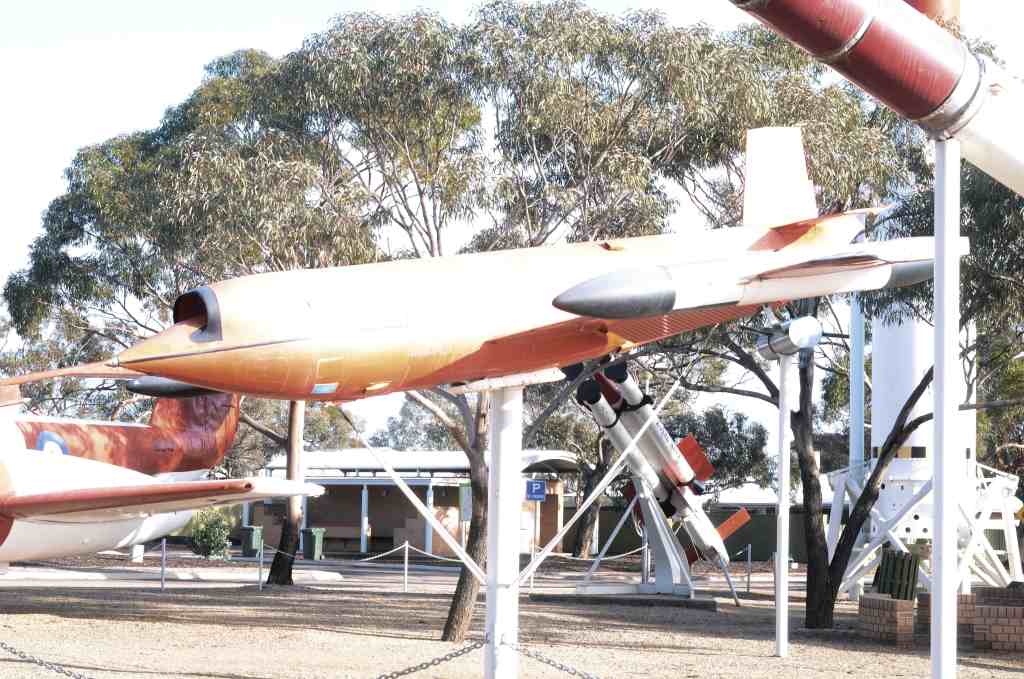
In the cool crisp morning, sun shining lemon yellow rays but not much warmth, we strolled around the Woomera Rocket Museum. Rockets of all shapes and configurations stood in the open-air, testimony of what once was. This RAAF Base and village was once a lively town in the 1950’s and 60’s, as an Anglo-Australian Cold War defence project. On this day Saturday July 20, 2013, the place seemed a mere shell of its former self, a cemetery of what once was, rockets rising like giant tombstones to the sky.
We meandered around the rockets, reading signs, eulogies from the past when threats from enemy nations was imminent. I was reminded of older friends telling me of a time when they practised drills of hiding under their school desk in the event of enemy attack.
My mother recalled when on February 19, 1942, Darwin was bombed. She was a girl in Hermannsburg at the time and whenever a plane flew over, the Aranda women would wail, fearing disaster.
Now, Hermannsburg was a mission set up by German missionaries in 1877. Although, by the 1940’s the mission was fair dinkum Australian having existed in Australia for all that time, with the advent of World War II and the conflict with Germany, the name, being German, raised the suspicions of the Allies. Hence, Mum remembers British Officers* drove into Hermannsburg to check the place out. They had to make sure there were no German spies. My grandpa, Pastor Sam Gross and his wife (my grandma) hosted these officers and put on a lovely spread of lunch for them.
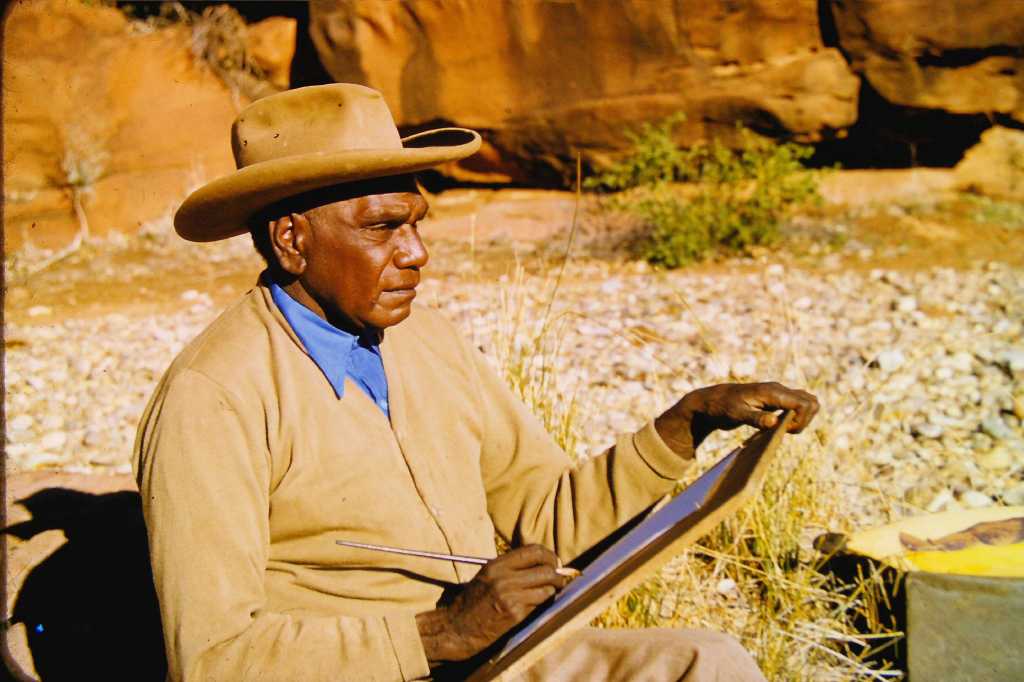
After investigating any mitigating threats, the British Officers* drove away in their propeller plane satisfied that Hermannsburg was no threat. Never-the-less, they confiscated the one and only link to civilisation, the community pedal radio. Just in case they really were spies, I guess. Further, to make sure that no threat to the allies arose from this humble mission, they sent Rex Batterbee, a world War I veteran, to oversee the mission in the role of “protector of the aborigines”. As he had visited and then lived in Central Australia since the mid-1930’s, Rex taught Albert Namatjira to paint watercolours and helped him launch his career as a renowned artist.
Needless to say, in 2013, such threats of foreign enemies seemed in the distant past. But, being only 446 km from our home town, Adelaide, we were reluctant to linger amongst the rockets. Having packed, and checked out of our overnight accommodation, we were eager to start our journey home.
At a steady 90 km/h, we made progress down the highway that split the gibber plains in halves.
‘I bet the T-Team (my brother’s family) are home by now,’ I said. ‘No hanging around of taking time to look at any more places for them.’
‘Why don’t you ring them just to see where they’re at,’ my hubby said.
I texted my niece. The time was 10:30am.
“We are in Port Augusta,” she replied by text.
‘There’s no way we’ll catch up to them,’ I said, and then texted back, “Have a safe trip home.”
Clouds and rain descended on the land the further we drove south. By the time we reached Port Wakefield, the cold had seeped into the car. I put my parka on my legs to keep warm. Yet, for lunch Hubby insisted we eat alfresco in the rotunda at Port Wakefield. After all, despite his aversion to the cold, he needed to stretch his legs. Plus, it seemed no café existed in the town.
The rain and cold became more intense as we approached Adelaide. After driving through the grey, sodden streets, we arrived home, just as darkness fell at 5:30pm.
What disaster awaited us?
Hubby opened the door and we trod inside. Son 1 played a computer game on the PC in the dining/living annex. He ignored us. We tiptoed through the family room. Not too much mess and the carpet remained visible, and clean.
We found Son 2 all rugged up and cosy in his room playing World of Warcraft. He said, “Hello” and then asked for a coffee, then followed the conversation up with, “I’m hungry, what’s for tea?”
In the kitchen, as I prepared a drink, I noticed the dishes had been done and the cats fed. I thanked Son 1 for the effort. He took all the glory and remarked that his brother had done nothing.
The Aftermath
There’s always casualties that follow every holiday. And this one was no different. Two paintings which I had planned to exhibit in the upcoming Marion Art Group exhibition had gone AWOL. I’d like to think they were stolen…but I reckon they would be found in some odd place sometime in the future.
Eleven years hence as I write this final chapter, I wonder what paintings they were.
Oh, and the other casualty, Hubby, who proudly exalted that he had taken thousands of photos of the Central Australian trip on his mobile phone, can no longer find where those photos went. It would seem those photos went AWOL too.
As for the T-Team, they actually arrived home after us, having spent a night at Port Germaine. They decided to treat themselves after roughing it for the past two weeks.
Note: *My mum, Mrs. T checked this and questioned whether they were British. She thinks they were more likely to be Australian. However, I have read a letter written by these officers and the words they used made them sound British. When I find the letter, I will investigate the background of the visiting officers and plan to write a more detailed account of my grandparent’s experience.
Raindrops stung the frozen tips of Lillie’s fingers. ‘There’s no way I’m staying it’s raining, now,’ she said rubbing her numb digits then taking a few steps along the path. The further she could get from her guilt the better. No one need know. But what if they found out? What if Fifi showed the necklace and the detectives linked her to the man’s death? Lillie trembled. She’d never get a job, a boyfriend; she’d lose everything—possibly even her freedom.
Fifi blocked her. ‘There’s a cave. You can shelter in that.’
‘What?’ Lillie recoiled. ‘With the body?’
‘It’s dead – just bones, it can’t harm you,’ Fifi said.
‘I’ve got a bad vibe, man! Bad vibes.’ Jimmy paced back and forth, swaying his flowing locks. ‘I’m not staying.’
‘I won’t be long, just thirty minutes at the most.’ Fifi stomped further up the track. The rain intensified, drops pummeling their parkas. She whipped around and pointed at Lillie and Jimmy. ‘You two stay here!’
‘No!’ Jimmy strode a few steps towards her and stopped. ‘Look, I really have a bad feeling about this.’ He looked back at Lillie.
Lillie froze to the spot like an ice-sculpture. A flock of black parrots shrieked above in the violet clouds. The birds dipped and whirled on the wind currents. Fifi’s words rang in her head. You have to tell. She knew deep in the emotion curdled base of her stomach, no one would miss that man, that horrible man. Wasn’t my fault, he deserved it. She reasoned and focussed on Jimmy shaking his pink fist at Fifi. The parrots circled above their heads, and as if bored with the rain, darted in formation south. With a dull throb of resignation, Lillie made her decision. ‘I’ll go,’ she said. ‘Fifi, Jimmy, you stay here.’
‘I’ll come with you, Lillie,’ Jimmy offered.
‘No, it’s alright. Fifi looks brave, but she needs company,’ Lillie said.
Lillie forced her stiff legs to move, one foot in front of the other, each step she believed closer to a life with no future; her living death. She paced through the driving rain, down the path by the falls leading to the carpark below.
Lillie hopped in the car and hurtled down the winding road to Greenhill Road and then home. She had no intention of reporting to police. What if they suspected her?
Mum was out cold, stone asleep on whiskey and an afternoon of television serials. Good, Lillie thought as she rushed to her room, pulled her sports-bag from under the bed, collected two drop-waist dresses, a pair of jeans and large tee-shirt from her wardrobe and stuffed them in the bag.
‘Bad timing,’ she muttered.
Winter had rolled into spring, exams, end of school celebrations and choices made that she had begun to regret. Like the body of that man, her friends’ father, who festered just beneath the surface of her conscience, another secret silently grew…
But she didn’t want to spoil Christmas, then New Year and plans for travel and seasonal work in Tasmania. She’d missed three periods.
She fobbed off her friends telling them, ‘Yes, I did go to the police, but…you know, they have to keep it under wraps so as to not scare off the killer.’
However, she knew they’d figure it out and her image would be ruined. Francis Renard, the man involved in her bad choices and situation, wouldn’t want her in that condition. And she wouldn’t want him till death do us part—he was too much like her dead-beat father who abandoned the family long ago. She had to get away.
She moved the bed and pushed her fist through a hole in the wall; a hole hidden by an old Sherbert, the band, poster. She fished around before latching onto a small tin and pulled it out. Lillie opened the tin and then scraped out the notes and coins. ‘I have a ferry to catch,’ she said as she inserted the money into her purse. ‘All I wanted to do was have a quiet life with my friends. How dare that creep rear his bony head.’
She sat down at her desk, picked out a pale pink sheet of paper. She wrote, taking care to avoid the crimson rose in the corner:
‘Dear Fifi and Jimmy,
I have to go away for a while. I have a job in Tasmania. None in Adelaide, ha-ha.
I went to the police station again and reminded them of the bones under the bridge. The nice policeman took down my details—AGAIN! and accepted my statement and said he’d deal with it. So don’t worry, it’s in the hands of the police. They are going to keep it quiet because they already have their suspicions who did it, and they don’t want to scare them off. They reckon they’re getting close. So don’t tell anyone, promise, please.
Take care of yourselves. And look after my brother, Sven while I’m away. I will miss you, my friends.
Lillie sealed the letter in the envelope and pressed the stamp of the queen in the top right-hand corner.
Moe, her black cat scuttled under the table as Lillie raced past and out the door. She headed for the cream and red Kombi parked around the corner at the end of her street. A man with dark curls and a pair of square, black-rimmed glasses, opened the passenger door. ‘Are you ready for a road-trip to Melbourne?’
Lillie panted and then caught her breath. ‘Yes, Francis,’ she said as she scrambled in. ‘Just need to drop by the letter box.’ She stared at the letter addressed to Fifi and Jimmy Edwards. She had another one for Francis Renard. And her mum and Sven, of course. She left that note on the kitchen table.
She planned to travel on the ferry from Melbourne, Victoria to Devonport, Tasmania, alone.
This last week, Hubby and I have received our DNA results. Dear Hubby received his last Friday, but mine only arrived today.
So, the last week I have been familiarising myself with the process and slowly building our family trees. Early on, I discovered a truth, you could say a “skeleton” in one of our ancestral lines. I added the details to see if anything further came up. My Heritage, call this a “smart match”. Nothing did, but I left it there.
For certain family members this truth appeared absurd, and too difficult to comprehend. Surely, that ancestor wouldn’t. Didn’t. Noone told us that. You have it all wrong, Lee-Anne.
Hence, Lee-Anne (me) being a good person only wanting the best for the family, deleted the suspect members from that branch of the family.
Then, curiosity set in. Who was that ancestor’s mother? Father? My husband suggested we go down the line to the descendants and put in a particular name.
This I did.
You wouldn’t believe it, but the same results, only this time verified by the official birth and marriage records. My original hunch had been correct. Moreover, in the spirit of Sherlock Holmes, I managed to crossmatch the added, yet odd family members with DNA and behold, a match.
Now, the reason I’m being so vague about the whole ancestral situation, which I might add, is responsible for our existence, is because out of respect for some people, the details of such conceptions are to remain private/personal; too personal to be published.
Isn’t it interesting that for people who want to protect their reputation, the unacceptable behaviour of other members of their family, ancestors or close relatives, must remain hidden, buried and plainly, not discussed. Such individuals may even be ostracised from the family.
Yet, such flawed individuals can still be, in other circles, a valued and much-loved member of the community.
My dad’s cousin, Dr. Malcolm Trudinger for instance. The story goes that he had a problem with alcohol. Legend has it that he couldn’t do surgery without a nip or two before the operation.
Malcolm’s alcohol addiction was too much for his immediate family who it would seem distanced themselves from him. Maybe it was the other way around and he felt not good enough for them. Whatever…
According to articles about Malcolm on Trove, he was regularly in trouble with the law. Infractions that in the 21st century, we’d consider a nuisance, or minor, but in the 1940’s and 50’s were serious. For example, his car engine making too much noise at night in town. Or even one time, merely driving his car late at night. Another time he was charged for making a scene at a function.
Despite these misdemeanours, as I see them (glad my brother and I didn’t live in those times—my brother loved doing “donuts” and “burnouts” in his car like in Top Gear at night with his mates in his youth), the folk on the West Coast of South Australia, loved Dr. Malcolm Trudinger. He was their hero. He once helped rescue people from a shipwreck off the coast during a storm. He cared and was always there for the sick and injured.
I remember my mother telling me the story how a person upon meeting my father, and learning his name was Trudinger, sang high praises for his cousin Malcolm. The sad thing was, that although he was still alive when Mum and Dad were first married, Mum never got to meet Malcolm.
Dr. Malcolm Trudinger was such a vital part of the West coast community, they established a rose garden was in his honour after he died in the early 1960’s. We have heard that rose cultivation was his passion and his roses were prize-winning. My niece discovered the garden when she and her partner were on a road trip passing through Elliston. She couldn’t have been more chuffed having found a Trudinger with a rose garden to his name. It showed Malcolm was a loved member of the community despite his demons.
This is what, I believe, grace is all about—valuing and loving people as they are. We are all flawed. Rather than hide the imperfections, celebrate the person, their life and goodness they bring or have brought to the community. It’s our pride and wanting to look good to others that makes us cover up our sins or those of our kin. But also, we may be protecting their reputation too, which is a reasonable thing to do.
The reality is, we are all fallen and we all struggle. No one is perfect. We are all cracked pots. Yet like in the Japanese art of Kingsugu (the repairing of broken pots), there is beauty that shines out through the cracks.
And so, it is with our imperfect ancestors. When you think about it, it’s the ones whose stories are different and colourful that we find most interesting.
[Hey, I had planned a profile of an ancestor, but somehow time got away and it never happened. Still more digging and researching must be done. So, in the meantime, here’s the beginning of my attempt at Crime fiction. (I stress that the following tale is fiction, the characters are fiction, and I’m writing under the name of my alter-ego/crime-fighting name, Tessa Trudinger). I’d love to know what you think as I tackle this challenge to develop my Detective Dan series.]
Chapter 1
Part 1
The Guilt of Omission
Saturday June 27, 1981
2pm
Hiking Trail enroute to Mt. Lofty
Lillie
Fifi’s voice echoed through the steep gully, ‘Hey, what’s this? Some cow carcass!’ The blackberry bushes around her rustled in the icy breeze. ‘Come on, Lillie! Have a look! It’s gross! I nearly slid right into it.’
Lillie brushed past the liquorice plants and tottered down the slippery clay of the embankment. ‘I really don’t want to see a dead cow.’ She held out the billy while hunting for clear running water from the storm water pipe. ‘I hope the water’s not diseased.’
‘Nah, you’ll be right.’ Fifi poked her auburn curls above the bush and beckoned. ‘Looks like it’s been there for years – it’s just bones.’ Her russet crown disappeared. ‘Just wait.’
Lillie stepped forward. The clattering of the stream over stone was louder here. She stood still and drew in the sweet, scented blend of rain-soaked eucalypt, liquorice and mud. The aroma awakened a memory. I’ve been here before. She thought. The sun’s golden rays parted a curtain of thick cumulous clouds, causing the droplets on the leaves to sparkle like a million diamonds.
‘Hey, Lillie! A chain.’ Fifi held up a blackened necklace, a tear-drop pendant with a quartz stone shimmering in the light. The hand and chain vanished behind the tangle of mint-coloured leaves and thorny branches. ‘Just a minute.’
Lillie’s heart galloped, slamming against her rib cage as if in a desperate attempt to escape. She wanted to run, straight up the hill back to the campsite, back to the comfort of the fire and Jimmy Edward’s, arms. No, that wouldn’t be proper. He’s just a friend. Fifi’s brother. Her legs turned to jelly and froze. ‘What?’ She squeaked through a constricted throat. She had been here before. Summer, five years ago when she was twelve. The landscape dusted in tan and yellow. The moist green of mid-winter had lulled her into a false sense of ignorance.
A scream pierced the winter silence. ‘Oh, my God!’ Fifi ripped through the tangled bush, her freckly face flushed and green eyes wide as saucers. ‘It’s not a cow! It’s – It’s…’
‘What?’ Lillie rasped puffing out plumes of breath into the frigid air. Blood rushed through her head, roaring, while remembering the hike she preferred to forget.
January 1975: She’d only gone to the creek to fill her canteen. On a 38-degree Celsius day, hiking with her friends, the same friends plus her brother Sven, she was thirsty and needed water; they all needed water. That day Fifi had already fainted from dehydration. What was the harm in getting water from the storm water drain? What was his problem? That man?
At that single word, the ball of anxiety swirling into Lillie’s chest converged in the sickening centre and dropped, thudding to the base of her stomach. ‘Oh, dear!’ she said as a blizzard of shock swept over her mind blanking out any thought.
Fifi scrambled up to Lillie and grabbed her hand ordering her to see the skull, commanding her to check out the leather coat, demanding she follow her to under the drain bridge to view the grisly find. Her best friend pulled her down to the creek, to the cavity under the bridge, her body meekly following like a frightened lamb to the slaughtered, her mind viewing the sequence of events as if from above in the clouds.
At first the sight before her resembled a side of beef at the abattoir, except the remains of him lay half sheltered at the base of the sand-stone bridge, and melted into years of silt, moss and sour-sobs. The leather hide of dry skin had sunk into the ribcage, and a disjointed hand of bones reached into the subterranean cave.
That time, when she was twelve, Lillie intended to explore up the creek in search of water. She thought she heard the water rushing. She was sure she did. The creek proved disappointing. Just a trickle. The hot northerly breeze had gypped her. She listened. A faint mewing. A kitten? A poor little kitten mewing from further up. Tracking through the dry creek bed crowded with brittle sticks of shrivelled saplings and prickle bushes laden with green unripe berries, she discovered the man-sized drainpipe. Water dribbled out into a stinky puddle surrounded by a cracked clay pan and rocks, broken tree branches and salt bushes caked in white like plaster of Paris. The kitten’s cries echoed in the black hole that penetrated deep into the hillside.
‘There you are! Ripe for the picking.’ A man’s hot breath stung the back of her neck. Cold hard metal gouged into her shoulder-blade. She turned and caught the look in his eyes, glazed, pupils dilated. He looked like a hungry wolf.
Lillie pushed him away and ran, scampering up the slope like a frightened rabbit.
‘I remember you,’ says a lady from church, my mum’s age, ‘you couldn’t keep still. I felt sorry for your poor mother.’
Another lady nods. ‘She had her hands full, your mum.’
‘Ooh, there was the time you escaped and ran up to the altar—oh, your poor mother!’
I smile and nod. So different now.
***
Back then, mid 1960’s…
The Children’s Carol service Christmas Eve—the bag full of sweets and honey biscuits stacked under the live Christmas tree, an incentive to stand in front of the congregation, singing my little three-year-old heart out. I love singing. Then when the Pastor preaches, the Sunday School teacher, Mrs. S, tells me to sit still, be quiet and don’t sin. Be good if you want your bag of lollies.
So, unless I’m told, I sit, am quiet and I don’t sin. Being good means not singing unless told to sing. I thought that’s what Mrs. S meant. And, being good means the reward of sweets at the end of the service. Oh, dear! How long is the pastor going to preach! I try not to wriggle. Everyone’s looking at me. But it’s so hot and stuffy in the church. Poor baby Jesus born in the middle of summer when it’s so hot! My halo’s itching my head. I take it off and scratch my head.
Mrs. S holds up her hand to me. ‘Lee-Anne! Be still! You want your sweets, don’t you?’
I try and put the halo on my head. It’s crooked and slips over my ear.
Mrs. S snatches the halo off my head. She has a cross look in her eyes.
Oh, dear, I hope I haven’t been naughty. I wasn’t sinning, was I? I hunch over and hold my fidgety hands tight. Must be still. Must be quiet. Must not sin. Want those sweets.
Mrs. S gestures for us children to rise. Goody, I can sing! I stand, take a deep breath of pine-air. ‘Joy to the World!’
The service ends. We wait by the tree. I marvel at the white “crismons”, the symbolic decorations from our great-great Grandfathers from Germany. These white shapes made out of Styrofoam and sprinkled with glitter make me wonder, is this what snow looks like? I’ve never seen snow. Snow is for cold places and Adelaide is always hot. Except in winter when it’s cold enough to have the kerosene heater going in the kitchen. But Adelaide’s not cold enough for snow, mummy says.
I go up to the tree and she hands me my bag of sweets and a children’s book with my name in it.
‘This is for attending Sunday School every week and learning all your bible verses,’ Mrs. S says. ‘Good girl.’
I take the gifts in my arms and careful not to drop my cargo, I take one step at a time out the church as if I’m a flower girl in a wedding. I know about weddings. My Aunty K was married in this church and I wore a new pink dress that my mummy made. And I had this lacy hat, and everybody took photos of me.
I’m in the courtyard, lost in a forest of legs. I search for mummy’s legs. She has ones under her pretty aqua dress with frills at the bottom. That’s her new dress for Christmas. My mummy’s a dressmaker and she always makes a new dress for her and me at Christmas. I mean, what are daughter’s for but to be dressed up in the prettiest, frilliest dresses at Christmas?
I can’t see mummy’s dress, or legs. I weave through the legs and scamper down the gravel drive to the back of the church to the car park. She’s in the car, our FJ Holden, Bathsheba, surely. I look in the car. No, she’s not there.
Tramping behind me. A roar. ‘Naughty girl!’ Dad all red-faced. ‘You know not to go down the drive on your own!’ Dad smacks me on the back of my legs.
‘But I was looking for mummy!’ I howl.
Mummy comes running. ‘Ah, you found her. I was getting worried.’
My always-good-brother strolls up to the car. He rolls his eyes and mutters, ‘Lee-Anne, always getting lost.’
‘Now get in the car,’ Dad snaps.
I adjust my load. A biscuit drops onto the dirt. I bend to pick it up. Can’t waste good food.
‘I told you!’ Dad says with another stinging slap to the legs. ‘Get in the car! Behave yourself, or else!’
I climb in and assume “or else” means another smack on the legs. Dad crushes the biscuit with his shoe and then slams the door behind me.
‘Doesn’t matter how much you smack her,’ Mummy mumbles. ‘She never seems to learn to be good.’
As Dad drove down the road he glances at me and says, ‘We’re off to Grandma’s now, so be good, or else.’
Be good, what does that mean? I pondered in my three-year-old mind. I thought it had something to do with not getting into trouble or getting a slap on the legs. I still hadn’t worked it all out, this “being good” business. It had something to do with following my older brother’s and cousins’ example. Something to do with being still. Being quiet and not upsetting the big people. But I don’t know, just when I think I’ve got it worked out, I do something I’ve no idea is wrong and the next thing, I get a smack. All I know is sitting still and being quiet means I’m being good.
Our car tyres crunch on the stones in Grandma’s driveway. We climb out of Bathsheba and enter the house through the back door and greet Grandma who’s piling plates with honey biscuits. We side-step around the table in the dining area and into the lounge lined with couches, dining chairs, and a piano. The lounge room is filled with the smell of pine tree. Pinned in the corner another real Christmas tree, all lit with electric candle lights and decorated with colourful baubles. I move to the tree to touch the pretty decorations. I must be careful not to step on the presents wrapped in red and green paper under the tree.
‘Now, Lee-Anne, you sit on the floor,’ Mum says. ‘The chairs are for grown-ups.’
I sit cross-legged by the fireplace.
‘You better sit still and be quiet,’ Dad warns, ‘or else.’
Cousins, aunts and uncles, and the odd, lonely soul from church crowd into Grandma’s lounge room.
I try hard to follow my cousins’, all older than me, example. Sit still and don’t make a sound. I must be good. I watch the grown-ups all chatting, getting up and down, laughing and joking. Must be fun to be a grown-up.
Clothed in her purple swirly dress and beige apron, Grandma settles her generous backside on the piano stool. ‘Let’s sing some carols,’ she says and begins hammering on the keys.
In joyous and rousing strains, we sing our way through the black hymn book’s carols.
I like singing and can’t help but join in. Then I remember. Be still. Be quiet. Maybe only big people can sing. I glance at Dad. He’s singing, eyes closed. My brother next to me barely opens his mouth. He fidgets. Not a good sign. I’m meant to follow my brother’s example, aren’t I?
But I love singing. I love Christmas carols. I raise my voice and sing. Everybody’s happy. Everybody, except Richard sings. I check my cousins. They’re singing. Must be alright to sing if my cousins are singing. So, I keep singing.
Mum pipes up. ‘Well, surely that’s enough singing. The children want to open their presents.’
‘What’s wrong with singing some more Christmas carols?’ the odd, lonely guy from church asks.
Mum points at the mantelpiece clock from the Fatherland. ‘I just think it’s getting late for the children.’
Dad blushes and cleares his throat while the other grown-ups look from my mum to Grandma.
Grandma looks down and wipes her hands on her apron.
Was my mum being naughty?
I reckon they’ve got the wrong person being the naughty one. Who’s the one who’s always told to sit still, be quiet and not sin? Me, of course.
I stand up and say, ‘It’s alright. I like sinning.’
Everyone laughs.
‘She means “singing” carols.’ Grandma’s tummy jiggles up and down as she chuckles. ‘Yes, it is getting late. Let’s open the presents. And Lee-Anne, since you are the youngest, you can help your mother hand out the Christmas presents.’
[As a child, I frequently had dreams where I was locked up in a prison cell and couldn’t get out. When, through family history research, I discovered the plight of my young (at the time) great-great Grandfather, I realised the origins, genetic or spiritual, of those dreams.]
My “Convict” History
I admire a former convict, an ancestor of mine. Okay, you may think, yeah, of course, she’s an Australian—these days they wear their convict heritage like a badge of honour.
No, actually, my great-great grandfather Friedrich Schammer lived in Silesia which is now part of East Germany or Poland today. Rubber borders, you see. His crime was trivial by our standards today in the West. But then, so were the crimes of shiploads of convicts who were transported from Britain and Ireland to Australia in the early nineteenth century. (For this reason, I have included photos from my visits to convict settlements, Port Arthur and Sarah Island, Tasmania, as my two-times great grandfather, was living his life in Silesia around the same time, in the early nineteenth century.)
My great-great grandfather Friedrich spent less than three months in prison for this crime he did not commit, but I admire the way he handled his dire situation.
How did he get into this trouble?
According to the family history book of this particular branch of the family, in the town in which my great-great grandfather studied as a medical student in the 1820’s, the military came to power and enforced strict and arbitrary rules. I might add here that my ancestor had already endured hardship, having been orphaned as a child, suffered poverty and then, his older brother who was his guardian, died from typhus. I imagine, these events spurred him on to be a doctor.
Anyway, in this university town of Jena, the students protested against their restrictions to their liberty by reacting against the ridiculous laws the military had brought on the town. Some of these laws were that there be no singing in the streets, no wearing of caps and waving of flags. The students protested by marching in the streets to the town square, singing and waving flags. All went smoothly and peacefully with no trouble from the authorities.
Then some of the young men, probably after drinking a few beers, became bolder as young men do tend to become. They threw rocks at windows; action that got the authorities’ attention.
The military swooped and arrested many of the protestors. My great-great grandfather was walking past the action and was in the proverbial wrong place at the wrong time.
Arrested and tried, though otherwise of exemplary character as a good Christian belonging to the Moravian Brethren, Friedrich was convicted and sentenced to prison for six months. I might add here that I have learnt recently that in Europe, the judge or judges determine the fate of the defendant. Whereas in the United Kingdom, United States and in Australia a jury (twelve randomly selected citizens) under the decide the fate of the accused.
It seems by his account and letters, a certain beadle in town had it in for my great-great grandfather Friedrich.
Yet Friedrich accepted his time in prison and made the best of the situation both for himself and others. He studied, enjoyed the view of the valley from his prison room (I think he was in a low security prison) and used his medical knowledge and skills to help those around him.
Great-great grandfather Friedrich’s quiet conduct and enrichment of the prison community was noticed by the authorities, and they released him less than three months into his term.
Released, Friedrich’s ordeal was not over. The university where he’d been studying banned him from returning to study there. His reputation tarnished, the villagers shunned Friedrich.
However, Friedrich did not give up. He moved to Berlin and keeping a low profile, completed his studies at The Charite University Hospital and graduated as a Doctor of Medicine. He had a heart for the poor, having been poor himself, and would treat those in need without demanding payment.
My great-great grandfather demonstrated those godly qualities I admire—justice, mercy and compassion. And perseverance, even in the face of adversity.
Philippians 2:14-15—Do everything without complaining or arguing, so that you may become blameless and pure, children of God without fault in a crooked and depraved generation, in which you shine like stars in the universe…
Note: Port Arthur housed what British authorities considered the worst of the convicts transported to Australia in the early to mid-nineteenth century. I visited this convict settlement in 1981, 1995 and 2009. A place well-worth visiting to learn from the mistakes made from the past (how not to treat fellow human beings). Although the place appears serene, the presence of the tortured ghosts of the convict past can still be felt.
Sarah Island situated in the Macquarie Harbour on the west coast of Tasmania, imprisoned the worst of the worst convicts transported to Australia in the early nineteenth century.
I have visited Sarah Island as part of the Gordon-Franklin River Cruise, both in 2001, and 2011. I highly recommend this cruise—a bucket list for travellers—history, wilderness, rare beauty of unspoilt rivers and rainforest and…excellent food. And not to mention entertainment. After your cruise I highly recommend that you see the historic play, The Ship that Never Was. It’s about convicts who build a ship to escape their prison island to make their way to South America. In January in 2024, this play celebrated 30 years of performances in Strahan.
Resource: Historyof theSchammer Family, Based on the work of Dr. A.H. Francke and J. Gemuseus, Written by Reinhold Becker, Herrnhut, 1922, Printed Gustav Winter, Herrnhut in Saxony and Translated from German by Rebecca Gnüchtel 2009
***
Virtual Travel Opportunity
For the price of a cup of coffee (takeaway, these days),
Click on the link and download your kindle copy of one of my travel memoirs,
Experience Historic Australian outback adventure with Mr. B
I’m still trying to figure out where we went off track. Were we off track? Was I that slow that the whole trek was taking twice, perhaps three times as long as the initial map instructions suggested? Four hours they promised us. Only 8.9 km, the sign said.
Mistake number 1: The map of Alligator Gorge my dear husband had printed from the internet was then forgotten to be loaded into his backpack.
Six hours into the hike, deep in some tributary of Alligator Creek (according to the map-less husband), and no sign of the Terraces, nor the steps, nor the Narrows. Did we miss a turn off? Did we stray into a neighbouring gorge? Signs to direct our path were ominously absent. So were people…except us, the K-Team comprising of his brother P1, two Swiss relatives (Mother A and Daughter E), Hubby and me with my bung knee.
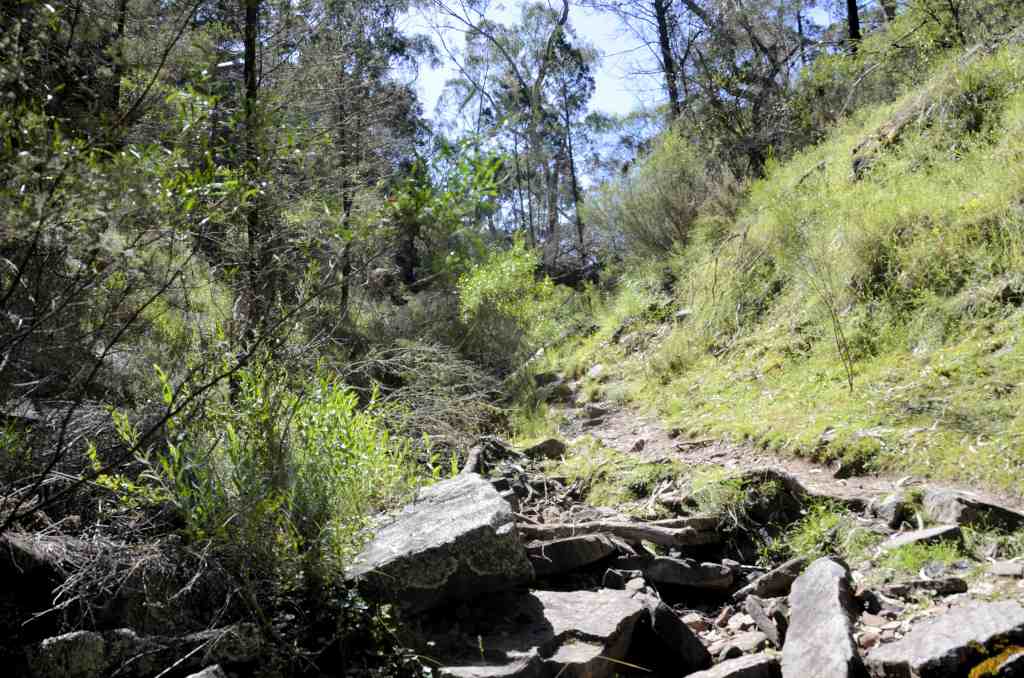
Now that we’d descended into the gully, I had kept up with the Able-Bodied four. My knee no longer hurt, but for some weird reason, although we walked along a narrow path and negotiated the stony creek, at a fair pace, we seemed to be getting nowhere fast. The red slated walls to our left, and occasionally to our right, just kept on going.
Four-thirty in the afternoon and we stopped by a bend in the dry creek.
‘I reckon if we keep on going, we’ll get there; this gorge will eventually lead us to the start of Mambray creek,’ I said. ‘What does the map say? Oh, that’s right, my hubby’s forgotten the map.’
The K-Team decided to send Hubby and E down the creek for any signs that we were on the right track. Off they went at a cracking pace now that they weren’t hampered by the “cripple” (me).
The remaining three, P1, A and me, waited in the cool of the native pine trees common in these parts of the Flinders Ranges.
P1 was not impressed with Hubby’s, much boasted and legendary navigational skills. In silence, I began to reflect. I had been this way, surely. Way back, some forty years ago with my friends from youth. The landmarks, the endless rock walls, the keeled-over gum trees, and the native pines resonated faint familiarity. Even the trek that seemed to take for eternity took me back to when our youth group had hiked from Alligator Gorge to Mambray Creek starting with the same ring route.
I had asked the same question to one of the leaders, ‘When is this going to end?’
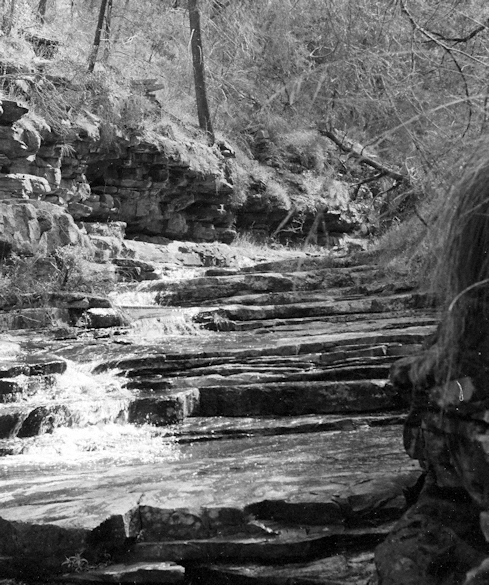
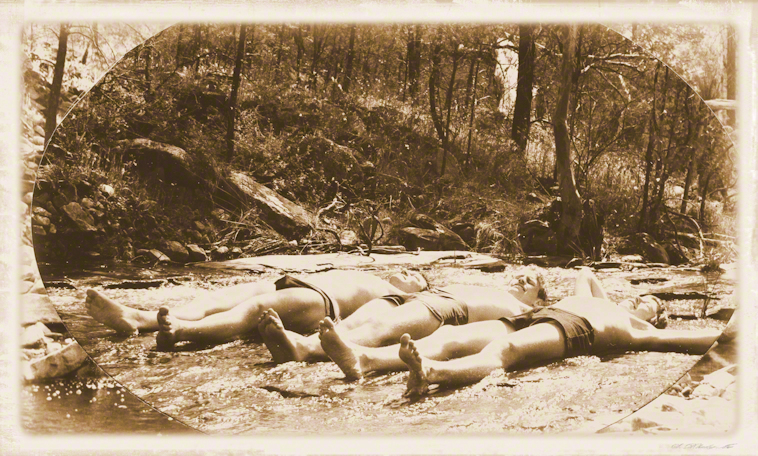
‘Soon,’ he replied and as if by magic, we reached the Terraces. My brother, and his friends lay in the creek and cooled their tired muscles.
I began to wonder if we hadn’t been swallowed up in some dimensional impasse. Had our trek led us into a parallel universe where Alligator Gorge has no Terraces nor Narrows and we’d be lost on some distant and forgotten planet? Or had we stepped into the past before the Terraces and Narrows had formed?
Either way, my phone had no signal.
Hubby and E were taking eons to return. Had some errant neutrino activity swallowed them up into another place and time?
The hike had begun in a mundane fashion. Hubby strode ahead up the fire track from the Blue Gums campground.
I marched behind the Able-Bodied K-Team like a demented zombie with trendy hiking poles. The Able-Bodied stopped at the sign, the first of many waits for their knee-challenged companion.
I glanced at the sign, and remarked, ‘This way is an8.9-kilometre ring route.’ Nothing wrong with my eyesight.
‘Yes,’ Hubby sniffed with an air of arrogance. He implied that if I didn’t like the distance, I could sit back at the car in the campground and wait for them.
Glad I didn’t.
So onwards and upwards on the fire track we trekked. Judging by the position of the hills, the terrain and the fact that we’d left the Mambray Creek-Alligator Creek junction, and behind, (Mambray Creek running to our left and Alligator Creek to our right), I summised that we were walking the route clockwise.
Hence Mistake Number 2.
So, for the next two and a half hours we (or should I say, me with the group having to make frequent stops for me) laboured up the rise. I don’t do uphill at the best of times and had to stop and rest for my breathing to catch up. The Able-Bodied with their superior fitness would wait for me, and then as soon as I caught up, they were off. Like racehorses.
On the way we encountered a couple, smiles wide on their faces, tramping down the fire track.
As they approached, I asked, ‘Are we there yet?’
‘Not far now,’ they replied.
Another couple, Grey Nomads, also with grins rivalling Alice In Wonderland’s Cheshire cat’s, passed us.
‘How far to the top and then into Alligator Gorge?’ I asked.
‘Nearly there,’ the man said.
‘But the walk is quite difficult,’ the lady said. ‘It’s more like nine kilometres.’
‘Yeah, thanks.’ I remembered the dodgy distance estimations from the previous hike 40-years ago. Seems as though nothing had changed in Alligator Gorge.
By this time, we had stopped at a Eaglehawk Dam campsite where we ate our lunch and rested for thirty-minutes. An oasis after a long hot thirsty uphill hike.
Ten minutes from the dam, we reached our goal, the long-awaited sign; the virtual “top” and fork with directions. Signs and map indicators were scarce on this ring route. One sign pointed to a path leading to Alligator Gorge, about 3.1km hence. The other to the lookout.
We opted for the gorge. After all, it was only 3km away, an hour’s walk at the most.
Confident we were on the “homeward” stretch, we trundled down the slope and into the gorge. The time, around 2pm. Now that we hiked downwards and the path appeared well-worn, I kept up with the Able-Bodied. In fact, they held up my progress by stopping to photograph lizards, flowers, and birds.
An hour and a half later, we still hadn’t reached the Terraces. Nor had we completed the circuit that would have taken us back to Blue Gums Campground. Hubby was adamant that we were in a tributary of Alligator Gorge and thus missed all the interesting features. There was talk of camping the night in this so-called tributary. After all, we did have an emergency blanket. However, the fire-danger season having commenced, we would be banned from lighting a campfire. Hubby had stressed that even lighting a match was “verboten” (forbidden).
Hubby and E emerged through the growth that glowed emerald and gold in the late afternoon sunlight.
‘The creek just goes on forever,’ Hubby said.
‘Best to go the way you know,’ I said. ‘We’ll just have to go back the way we came, to be safe.’
This we did. Uphill again, but this time steep rises. Hubby helped me negotiate the uneven path and rocky terrain. He pulled me up and over fallen logs and big boulders. He told me off for hampering the progress of the group.
‘I feel faint,’ I replied, and he softened. Besides, he needed to pace himself too. Hubby looked pale and exhausted.
Within an hour we’d reached the signpost and were hiking with happy faces down the fire track. I named the tributary we’d been lost in, “Deviation Gorge” as it had led us astray.
We arrived back at Blue Gums Campground just as the sun set at 7:30pm. The back tracking taking us just two and a half hours to complete.
Most of all, by the end of what we calculated to be a twenty-kilometre hike, my knee didn’t hurt at all. My feet did, but not my knee.
***
Friday, we revisited Alligator Gorge. This time, we parked at the more populated carpark and took the steps down into the gorge.
I wasn’t going to do the two-kilometre circuit with the Able-Bodied through the Narrows. But I just had to know, just had to discover for myself what went wrong the previous Tuesday.
So, after a slow descent owing to my knee, I hobbled over the stony creek bed and down the narrow gorge. My frequent cries of “Ouch!” heralded my presence to all and sundry. Hubby marched ahead oblivious to my defiant presence and will over pain to be there and see for myself.
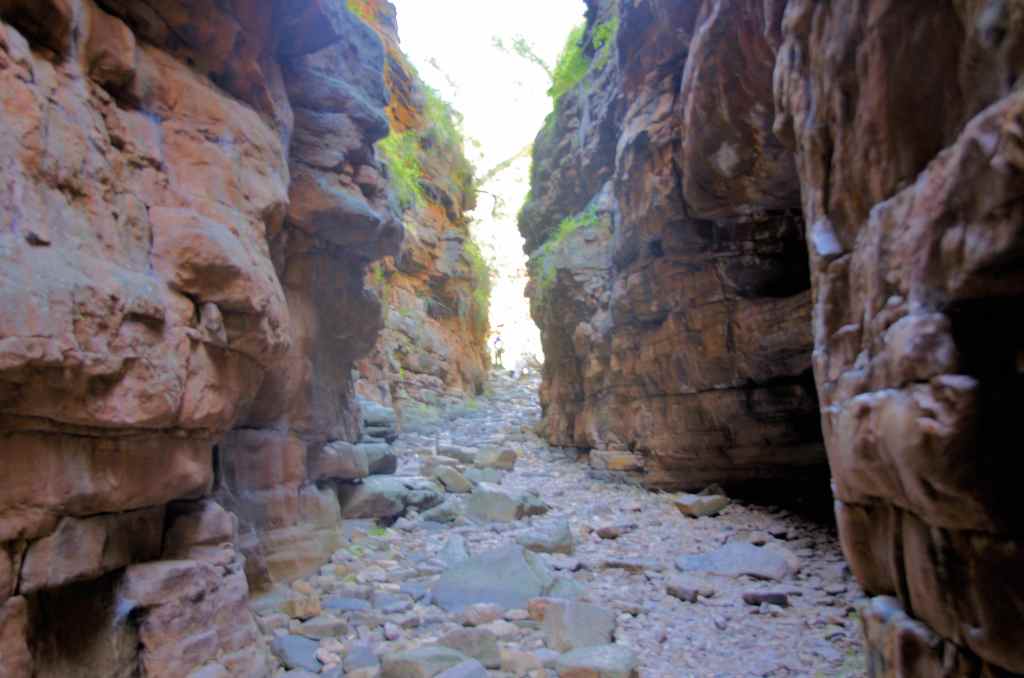
The drama of the Gorge was rewarding. Red rock walls and stunning reflections all in this ancient peaceful setting. Another pair of Grey Nomads sat in a shallow cave, absorbing the tranquillity and beauty.
Hubby and the Swiss relatives tramped through the Narrows as if it were a race.
P1 rested at the Narrows’ entrance and said, ‘I don’t know what the rush is.’
Once through and on the short, I stress, “homeward” and upward trail to the road, Hubby scolded me for holding up the group. In his estimation, “cripples” like me are not allowed to attempt the two-kilometre circuit of Alligator Gorge. ‘Now we’ll be late getting back to Adelaide,’ he warned.
Just so I wouldn’t impede the Able-Bodied further, I parked myself at Blue Gums Campground, and waited for them to return with the “royal” Toyota Hilux Carriage to pick me up.
While waiting for the Able-Bodied crew, I discovered a sign that directed the ring route in the anti-clockwise direction—through the Narrows and onto the Terraces. If only we’d ventured this way, we could have seen the most interesting parts of Alligator Gorge first and then decided to return the way we came…or not. To this date, Hubby has never witnessed the Terraces. At least we would’ve had happy, smiling faces walking down the fire track and taken less time.
[While Mr. B and his son, Matt stayed back at camp,three of the T-Team faced the challenge of climbing Mt. Liebig. And finding their way down. After a successful climb (except for the lost quart can) to summit Mt. Liebig, (Read Part 1 of this adventure), the T-Team lose their way…]
We also diverged. Dad was confident that all gullies lead to the big one at the base of the slope. ‘Ah, well! We will meet Rick in the gully below,’ he assured me.
But contrary to Dad’s prediction, we did not meet Rick. I could not help thinking, this was not the first time as far as Rick was concerned. We’d already lost him in the sand dunes near Uluru. Almost.
Dad continued to search for his quart can. But that little friend Dad had cherished since the fifties, eluded him also.
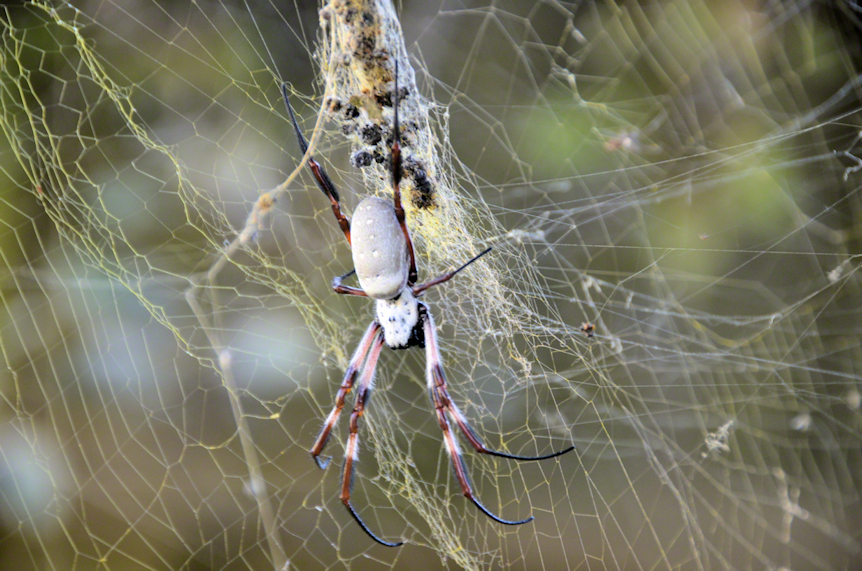
We weaved our way down the main gully for about an hour. A huge spider in a web spanning the width of the gully confronted us. The spider, the size of a small bird, appeared uninviting, so we backtracked and decided to hike up and down the ridges.
For several hours, we struggled over ridges. Up and down, we tramped, yet seemed to make little progress; the rise and dips went on forever. The sun sank low, and so did our water supplies.
The heat drained me. My tongue stuck to the roof of my mouth. But we had to ration water.
Dad slumped on a slab of rock at the bottom of a gully. ‘Drink?’
I took the canteen from him and filled my cup. Then I spooned in some Salvital. I chugged down the water as it fizzed. So refreshing!
‘Oh, Lee-Anne!’ Dad quibbled. ‘You didn’t leave much for me!’ He poured the last drops of water from his canteen into his mouth and gazed in despair at the lengthening shadows of the mountain.
‘Oh, but Dad! It’s not fair! We will never get out of this place! We are lost forever.’ I had visions of future hikers coming upon our dried-up old bones thirty years later. ‘What are we going to do?’
‘Well, um, perhaps we better pray God will help us.’ Dad bowed his head and clasped his hands. ‘Dear Lord, please help us find our way back to the truck. And forgive me for growling at Lee-Anne.’
‘Forgive me too. Help us not to run out of food and water, too.’
‘Bit late for that,’ Dad muttered. ‘Ah, well.’
We had barely finished praying, when an idea struck me. ‘Why don’t we climb up a ridge and walk along it. Surely if we go high enough, we’ll see the landmark and the land rover.’
‘Oh, I don’t know. We need to conserve our energy.’
‘Just one ridge won’t harm us.’
Dad sighed. ‘Okay, it’s worth a try.’
I raced up the hill and strode along the ridge. I climbed higher and higher. I glanced towards the east expecting, hoping, willing the Rover to appear. But with each stride, each hopeful gaze, nothing. I resolved to climb further up the slope before turning back.
After a few more steps, still nothing. With the heaviness of defeat, I turned to climb down. Then I saw it. The Land Rover sat at the base of the mountain, glistening in the last rays of the setting sun.
‘There it is!’ I jumped up and down over-reacting with excitement.
‘Praise the Lord!’ Dad’s shout echoed in the valley.
With renewed energy, we attacked the last mounds that lay between the vehicle and us.
‘Rick will probably be sitting there waiting for us wondering what has happened,’ Dad said puffing as we strode up to the land rover. ‘Can’t wait to have a few gallons of water.’
We rambled over to the rover. Dad circled the vehicle and returned to me shaking his head. ‘He’s not here.’
[In response to today’s prompt, a friend is someone you can trust as they trust you. They are there for you, as you are there for them. You can share almost anything about yourself with them, and they can share anything with you and feel safe. You can be yourself with them and they can be themselves with you. With some friends, no matter how long it has been between seeing each other, you pick up the conversation with them from where you left off the last time you saw them.
This story is about the future and friendship.]
MESSAGE FROM MY FUTURE ME
“Grandma, can I excuse the table?” I asked.
Grandma chuckled. “You mean, be excused from the table, dear.”
I nodded and then pushed my chair from the old wooden table.
“Yes, you may, but don’t go too far,” Grandma said. “Go only to the end of the road and then you must turn back.”
I escaped out the back door and down the gravel driveway. The street spanned before me, begging adventure. Sunday lawns green, pungent with fresh Saturday clippings piled behind an assortment of fences.
“Go away, will you,” she said in her grimy blue dress. She leaned over the stone wall and pushed me.
I brushed off her greasy prints and walked on, leaving the willow tree and that girl snarling in the shade behind me. As I strolled into the sun, I ran my hand over cracked rendered walls, rattling cyclone fences and peering through the oleander bushes for signs of life in quiet houses.
“Don’t go over the road,” Grandma’s voice warned in my head.
No, I won’t. I rubbed my bottom in memory of the Belair Sunday school picnic adventure when my brother lost me. Promise! Careful not to step on the lines in the pavement. Bad luck. I tiptoed and danced along the pavement in my pink ballerina shoes.
A shadow wriggled over the pavers. Stobie pole to my right, plastered its stunted midday image on the asphalt. I halted. Casting my focus up, I spied this big girl. I squealed and clapped my hands over my mouth. This lady-girl was dressed all in lace and brown velvet as if in Grandma’s clothes.
“Hello, you must be Lee-Lee.”
“Why did you know my name?” I pointed at her; rude, I know. “Ha, ha! Why are you wearing funny clothes?”
She blushed and rubbed her stubby fingers over the velvet. “They’re trendy where I come from.” She smiled and straightened her long dress that swept past her ankles. “Actually, where I come from, I know a lot about you.”
“Why?”
“Because I have the same name as you.”
“So? I know more than you do. You’re dumb. So there, ner!” I planted my hands on my hips and poked out my tongue.
“That’s no way to talk about yourself.”
“Huh?” I pulled at my pigtail and chewed the ends of my hair.
“Elementary girl.” She flicked her long blonde strands and smirked. “I am the future you. In fact, I know more than you do because I know what’s going to happen to you.”
“Future me?” I scratched my cheek and screwed up my nose. “What does future mean?”
“Oh!” I wiggled a loose tooth. “Does that mean your teeth all fell out? Did you get grown-up teeth or did you get them all pulled out and get false teeth like Grandma’s?” I zoomed up to Future Me’s face and ogled at her mouth. “Come on, show me your false teeth.”
She bared her perfect row of pearly whites and nudged me back. “They are real. Orthodontically corrected, but real.”
“Arthur—what?”
“I had braces on my teeth.”
“Why? Were they crippled?”
“No, they were crooked.”
“Ugh! Crooked teeth.” I turned from her and poked stones with the point of my shoe. “I don’t think I like being you. Grandma clothes, crooked teeth that need Arthur’s braces. I’ll never be like you. You’re just pretending. ‘Sides, how could I be you?”
I squinted at this tall slim blonde who transferred her weight from one leg to the other. I noticed the worn back-pack groaning full of books, straps straining to pull the load from her waist. Future Me stroked her chin between her thumb and forefinger. “Well, it’s hard to explain to someone as little as you. You’re in Prep, aren’t you?”
“Yes, I’m a big schoolgirl, now.” I thrust my chest forward and with hands each side of my tummy, swung my hips.
“Well, big schoolgirl, Lee-Lee, to put it simply, it’s called T.T.T—thought, time, transportation.”
“What then?” I watched my pink dress swish as I swayed.
“You just think and instead of thinking time as moving forward, you make it move backward for you.”
“Just like that?”
“Well, actually, it’s more complicated than that—a kind of scientific experiment that my big brother Warwick invented. He put electrodes on my head and well, something happens that I can’t fully explain.”
“Oh, did you have a brother, Warwick too? Does your Warwick snort when he laughs?” I cupped my hand over my mouth and tittered.
The lady-girl raised her lace sleeve to her mouth and giggled. “Yes, he does.”
“You must be me.” Repressing the urge to gnaw my fingernails before my future-self, I clasped my hands together and looked in her eyes. “So, me, what’s going to happen to me?”
She avoided my gaze. “That’s for me to know and you to find out.
“That’s not fair! Why can’t I?” I grabbed at her, but she slipped through my fingers and drifted from me. “Plee-ease!”
“I can’t!”
I watched her move further away and shimmer in the sunlight.
“But why not? Please! Just a little bit.” I chased her and swiped at her. “Just a tincy-wincy-little bit. I won’t tell! Promise!”
“Alright, if you insist.” She floated above the greying plaster fence. “But I must be leaving soon.”
She faded, blending in with the oleander and honeysuckle bushes. I strained to see her. I attempted to touch her, but my hand passed through her.
The wind whistled through the bushes. “Have a good time with Jilly.”
“You didn’t tell me! You lied, me!” I cried.
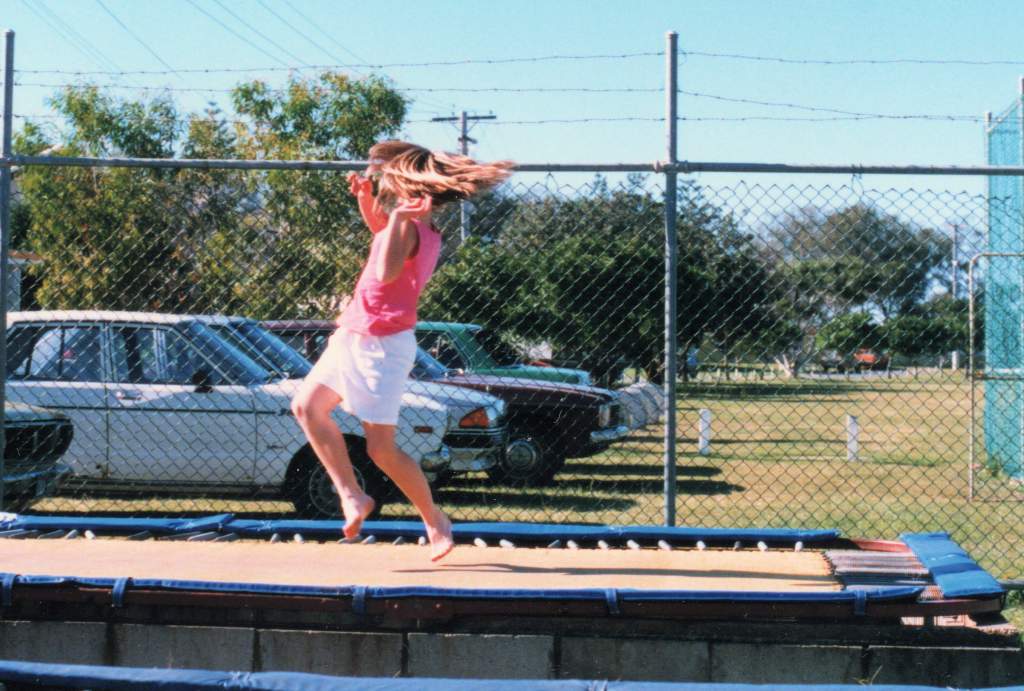
I hunched over and plodded back towards Grandma’s house. Shouts and squeals from a yard on my left, caught the corner of my eye. A girl my age bounced on an old double-spring bed.
“Hello, my name’s Lee, what’s yours?”
“Hello, my name’s Jilly. Do you want to play on the trampoline with me?”
“For I know the plans I have for you,” declares the Lord, “plans to prosper you and not to harm you, plans to give you hope and a future.” Jeremiah 29:11
***
Dreaming of being transported to another world?
Time for some holiday reading?
Take a break and journey to another world, another time to
























 Tru-Kling Creations