‘Why not?’ Adam pushed the gate. ‘I’m game if you are.’ He ran towards the historic church.
Amie hissed. ‘Get back here!’
Adam shouted. ‘But I want to see the ghost.’ His small frame blurred in the darkness.
‘You’re trespassing.’
Amie bolted past the open gate. She was trespassing too, now. She chased Adam’s retreating figure. ‘There’s no such thing as ghosts.’
She heard footsteps near the whitewashed walls of the church. She followed the footsteps and the yellow hair that shimmered in the moonless night. ‘Adam, this is not funny. Come back now!’
No answer.
Footsteps crunched on the gravel. ‘This is not a joke, Adam. Where are you?’
A cold rush of air barged past her. Hairs pricked up on the back of Amie’s neck.
‘Adam?’ Amie called. She traced her fingertips along the rough wall of the church as she worked her way to the rear. ‘Adam? Where are you?’
She thought she saw him by the little building behind the church. Was that construction a toilet block? Or did she hear someone, Walter perhaps. Was that building the morgue?
The pale stick figure drifted towards that little building and vanished into it.
A Story where the past and present, and vast distances in space intersect…and Boris does what he always does…
Eastern Europe, 1848
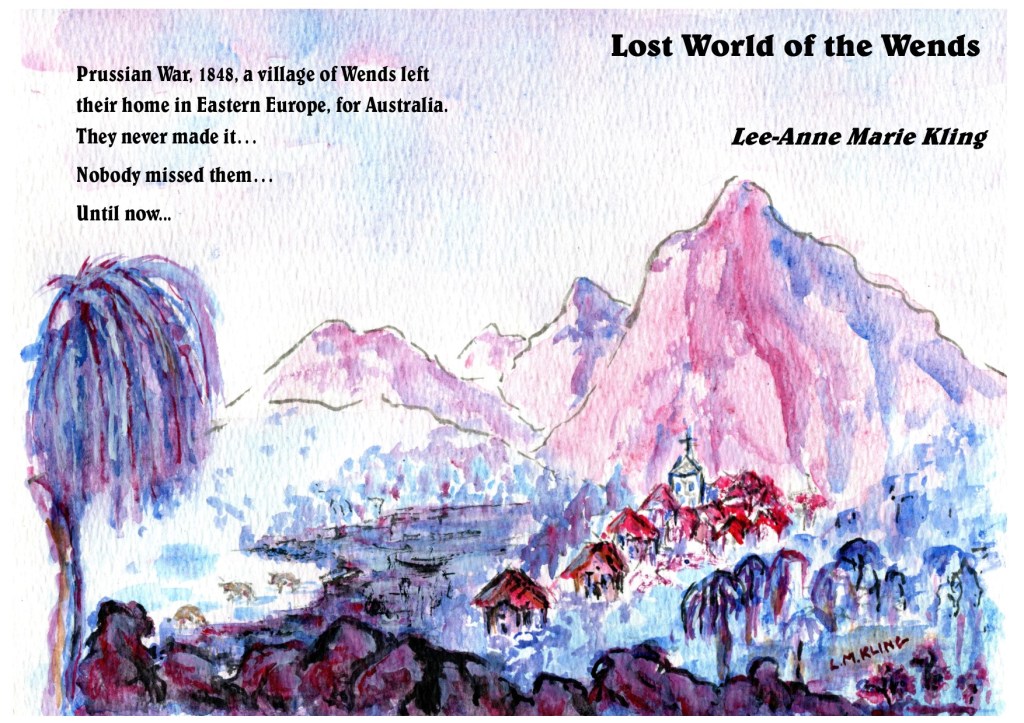
Prussian War raged, and the Wends as a village, left their homeland, with plans to set sail for Australia. From the Eastern edge of Prussia, they journeyed on a barge destined for Hamburg’s port, where they hoped to catch a cheap fare in the cargo-hold of a ship destined for the Promised Great South Land.
These villagers, never made their Australian destination. No one ever noticed, nor missed them. The neighbouring villagers assumed they had arrived in the Great Southern Land, and considered them so far away, and too distant to maintain contact. In Adelaide, also, the city for which they headed, the inhabitants were blissfully unaware of their existence. Migrating Prussians had taken their place in the over-flowing cargo-hold and were sailing across the Atlantic to Australia.
On this barge, headed by a man, Boris Roach, the Wends sang hymns of praise to God for their liberation from religious persecution, and the war. They looked to the promise of prosperity and freedom to worship God according to the Word. Their hope that their children and their descendants may thrive in their faith in the Promised Land of South Australia.
I go to the shops as I do every second day. At the checkout, the girl asks, ‘And how has your day been?’
‘Busy,’ I say.
‘That’s good,’ the girl says with a sage nod as if involved in some conspiracy to keep me on the hamster wheel of busyness.
In the Twenty-first century world “busyness” is good. Not being busy, then, is undesirable. Our Western Protestant work ethic touts, ‘Idleness is the devil’s workshop’. The state of “idleness” is to be avoided at all costs. These days, we equate idleness with boredom.
‘I’m bored,’ say your children (so did mine, when they were children many years ago, back in the good ol’ 1990’s), and terror strikes at the heart of each mother when they hear these words. Bored? We can’t have our children bored—idle—just imagine what devils will come to play if we allow boredom to fester. First, the grizzling, then, the niggling at each other, and before long, World War Three amongst the siblings and the house ends up looking like the Apocalypse.
So, in my quieter times now, I reminisce the days as a young mother, structuring each day, every hour—especially during the holidays, to avoid boredom—any strategy to avoid my tribe from becoming restless.
‘What’s wrong with a bit of boredom,’ my mother would say. ‘They need to learn to entertain themselves, you know, use their imagination. Nothing wrong with being still for a while, I say.’
Mum should know, she grew up in the Centre of Australia on a mission in the 1940’s and ‘50’s. Those were the really good ol’ days with no shopping centres, no electronic games, nor television. They did have radio, but her minister father only allowed the news to be heard from it. Heaven forbid they listen to modern music. During the War, even the radio was confiscated by the allies. So all my mum as a girl had to entertain herself were books. Even so, the Protestant work ethic was a major value in mum’s family as her mother, when she found her daughter reading would say, ‘Isn’t there some housework you should be doing?’
As expected, then, I grow up in a world that values industry, productivity and filling each day to the full. The schools I attend are hot on producing good grades, projects and students who go on to university and become wealth-producing citizens.
Then, at sixteen, I have a revelation. We sing a chorus at church, “Be Still and know I am God”.
Being still…forget the homework…forget the housework…put aside my racing head of worries…centre my thoughts on God and his greatness. Pause for a moment and remember, God is God and He’s in control.
So at sixteen, I do just as the chorus bids. I hop on my deadly treadly (bike), and pedal down to the beach. I figure that’s the best place to be still; the waves lapping the sand, the sun on my back as I comb the shore for shells. Or on a sunny afternoon, I lie in the backyard and sunbake, think and ponder.
The result? Wow! Those mountains? School and pedantic teachers going on about uniform—my socks, my hair? Boyfriends or lack of them? Life and my future? …All my concerns become molehills.
December 1979, I write a poem “Be Still”. Perhaps not the greatest work of literature, but the values stick with me…until I embark on university, work, and then a family. The poem hides in a book of my teenage missives. Ten years ago, I pull it out for a devotion. I preach being still, but I fail to apply the principles. I must keep busy. If I stop, even for a few minutes, what will others think? There’s just too much to do. Everyone’s depending on me as wife, mother, bible study leader, committee member …to produce the goods. I can’t let them down.
The culture to keep moving is ingrained. Go to meet people for the first time and they ask, ‘What do you do?’ The doing has to have a dollar sign attached to it. Not enough to do all the above as a mother. Must produce money to have status in the group. Without status, I am not heard. Ironic how the under-valued creative arts of writing and painting, though, afford status. I am creating. I am producing.
Even so, in this creative phase of my life, if I stand still, I feel guilty. Now, there are novels to write and art to produce. My “work”. I’m on the hamster wheel, but I can’t get off.
However, in all the busyness expected of me, the cogs of my life are unravelling. I drive to a cafe to meet a friend. She’s not there. I’d forgotten my mobile phone. I drive the thirty-minute return home and check my phone and then ring her. I’d gone to the wrong place. A misunderstanding. If I had taken the time to listen and ask the right questions…
The voice of my sixteen-year-old self still convicts me. ‘Be Still’.
For over forty years, I’d not been following my own advice. After the misunderstanding of the other day, I give myself permission to have time each day to rest…Time to be still…time to know God.
If you’d like to polish your writing skills or find out more about our new project, a self-publishing collective, click on the link to Indie Scriptorium…
Or…
Catch up on the exploits of Boris the over-grown alien cockroach, and Minna and her team’s attempt to subdue him.
For good holiday reading click on the links below…
Friedrich was sure it was his fault. He was always getting smacks or the belt from his father—usually for not polishing his boots perfectly. Or for spilling milk on the floor. But when he saw the blue line in the air, the urge to escape, was too great. This was not the first time he’d ventured beyond the thin blue line under the outhouse. He just had to go through the light—for Wilma…
Then bang. Everything went black…
Friedrich put out his hands and shuffled forward. He groped for a wall, a surface, anything to orient himself.
He tripped over some bulk. He fell onto it. It groaned.
Friedrich scrambled to his feet. His mouth went dry. It was like his heart, lungs and guts were in his mouth. Oh, no! I’m on an alien world without light and with groaning monsters.
The thing at his feet moaned. It sounded like a man.
Friedrich gulped. He knelt down. He held out his shaking hand. He touched something soft and greasy. Was that hair under his fingertips?
‘Who are you?’ he asked in his Silesian language. ‘What’s your name?’
The man-thing with hair moaned again and then mumbled what sounded like forbidden words in another language. He’d heard Joseph use such words when angry.
‘My name’s Friedrich,’ the boy said. ‘And you?’
‘Oh, the pain! The pain!’ the man-thing said in that strange language. It did sound like the tongue Joseph and Amie used. They spoke using similar sounds when they were together.
Friedrich presumed the man spoke English. But he knew few English words, so he still hoped the man understood his native language. ‘How are you?’
‘Oh, the pain! My stomach! My head!’
Friedrich traced the head, the shoulders, arms and distended stomach. ‘You’re a man, aren’t you?’ He patted the spongy surface in the middle.
The man groaned and squirmed.
‘You’re a sick man,’ Friedrich said using the word in his language “krank”.
‘Too right, I’m cranky!’ the man straightened up. He grabbed Friedrich’s wrist. ‘And who the heck are you?’
‘Huh?’
‘What?’
‘Huh? What?’
‘What? Huh?’
Friedrich shook his hand free from the man. How was he to make sense of this man in the dark? How was he to make this man understand him? Joseph and Amie could speak his native tongue, Silesian, but this man couldn’t, apparently. Friedrich rubbed his hand.
‘Who are you?’ the man asked. ‘Where the frick are we?’
Revenge is best served with a side-salad of Schadenfreude
I have been doing some “housekeeping”, on the computer, that is, searching for files, and sorting them. I came across this tale from my high school days. Wish it were true, but more likely it’s wishful thinking from an over-active imagination.
However, as is the case with so many authors’ works, the following is based on real events, but the names have been changed to protect the not-so-innocent.
Sowing and Reaping
She perched on the kerb waiting. The minutes stretched, ticking into what seemed to her, an eternity. Cars whizzed past. With each car that emerged around the corner, the hope—her mum’s car. That battered blue FJ Holden, had suffered many knocks in its fifteen years of life. Like me, same age and having suffered hard knocks, she thought. But cars with anonymous drivers passed by and so did her hope…until she just sat…waiting…expectations drained…waiting.
A mixture of gloom and uneasiness had shadowed her all day. Ever since the first period, home class, when Dee, yes, that’s right, Dee, her arch enemy, had sidled up to her and hissed, ‘He’s mine, Lillie. He’s mine. He never liked you. He likes me.’
Dee slithered into her seat; pink lips pursed in a smile. She flicked her brown mane, and then glancing at Lillie, she smirked and then rubbed her hands together. ‘Mine!’ she mimed. ‘All mine.’
Lillie imagined Dee at that moment morphing from the budding model she was, into a female form of Gollum, bent on possessing the ring offered by her latest conquest—Danny. Why else was Dee gloating?
Lillie’s heart plummeted to the pit of her stomach. A drop of rain plopped on the pavement and sizzled. Lillie sighed. She’d seen him—Danny—that morning. Lofty, blonde hair tousled, framing his high cheek-bones, strong jaw and his face all tanned. But Danny hadn’t seen her. He never saw her.
On the way back from chapel, Danny had been walking behind her and she’d worried about her uniform. Was her dress hitched up in her regulation stockings? Autumn and the school demanded girls wear the winter uniform with the awful scratchy woollen skirt. The month of May in Australia, that day, hot and all steamed up, clouds billowing with purple bellies, threatening a storm, but not before all the students at College were fried having to wear their blazers as well as their uniforms woven in wool. The principal threatened suspension if they shed any part of their school attire.
Plop! Another drop. A rumble of thunder.
During the day, her usual foes added to her discomfort. She was already hot, sweaty, and itchy, and then they had to weigh in. On the way to English class, Dee and her clutch of fiends attacked from behind. They threw verbal abuse; the usual “stones” of “loser”, “dog” and “no one wants you, Lil”.
Lillie fixed her eyes ahead even as the heat rose to her cheeks. She trod up the stairs to Dee chanting, ‘Poor Lil, poor Lil, what a dill.’
As Lillie turned the corner of the stairs, she glanced down. Danny leaned against the rail. Dee slid up to him and pointed. ‘Hey look! She’s got a hole in her stocking. Poor Lil, poor Lil. Too poor to buy new stockings, Lil.’
Dee laughed and her gang joined in.
Lillie turned and continued plodding up the stairs.
‘Charge!’ Dee yelled.
At her command, Lillie quickened her pace. She knew what was coming. The thudding, the cries and the horde as her foes surged upon her. They crowded in and jostled her. Big beefy Twisty jammed her into the lockers and then bumbled down the corridor.
As Lillie straightened herself, Dee strode up to her and poked her. ‘He’s mine, understand?’ She then waved her hand in front of her nose. ‘Phew! You stink! B.O.!’
Danny lingered behind Dee. She minced into English class, then turned and blew him a kiss. Lillie’s stomach churned, and with her gaze riveted to the floor, she followed Dee into class. Her scalp prickled with the sense that the eyes of every class member had set upon her. Her orthodontic braces took on astronomical proportions and her pigtails drooped like greasy strips of seaweed.
Then Scripture class. Just her luck! Lillie picked Dee’s name out of the Encouragement Box. So she had to find a verse from the Bible to encourage Dee. Dee? What sort of blessing could Lillie bestow on her worst enemy? The girl who had everything—popularity, beauty and a boyfriend.
Lillie opened up her Bible and picked out the first verse that caught her attention. She wrote down the verse from Galatians 6:7: “…for whatsoever a man soweth, that shall he also reap.” She plopped the note for Dee back into the box. From what she could tell, Dee seemed happy with her note, if not mildly miffed by the message.
After school, as she sat on the kerb waiting, Lillie reflected on the verse she received. Matthew 5:3: “Blessed are the poor in spirit…” She nodded and mused, That’d be right, Dee had me. Still, it does say I’m blessed.
A flash of lightning. A crack of thunder. Fat dollops of rain splatted on the footpath. Lillie sighed and muttered, ‘I’ll just have to risk getting laughed at. My mum’s car. What a relic! How embarrassing!’
She shrugged her bag full of books over her shoulder and sauntered to the shelter of the chapel. Rain pelted down on her and she sought refuge in an alcove hidden behind a diosma bush. There, she drew her knees up to her chin and sniffed. The rain and then the tears had melted her mascara. Her vision blurred. She drew a soggy tissue from her blazer pocket and wiped her eyes.
The downpour stopped. Fellow students emerged from shelter and straggled along the road to the carpark where their cars or parents in their shining white Commodores awaited them.
Lillie examined her calloused knees that had broken through the holes in her stockings. When would mum be able to afford new stockings? Dad and mum barely scraped together the school fees. ‘We go without for your education,’ Mum says. Lillie had begun to understand how that worked in a posh school like this one. No friends, no choice but to study and get good grades.
A car screeched. Lillie looked up. She saw them. Dee and Danny. They held hands. Dee nestled into Danny’s side as he held an umbrella over her, even though the sun now shone casting an eerie golden glow over the gum trees and oval. Lillie winced.
The couple perched on the chain fence where they swung back and forth and whispered into each other’s ears. Lillie parted the diosma bush. She watched and cursed them as wrapped in each other’s arms they consumed each other’s lips.
‘Ugh! How could they? In public!’ Lillie muttered. ‘I hope the principal catches them and puts them on detention.’
Lillie heard a familiar roar. She stepped from the bush and strode towards the carpark.
The FJ Holden raced up the driveway, it’s wheels crushing the carpark’s gravel in its rush to meet Lillie. Dee and Danny remained oblivious in their passion on the chain fence.
Mum’s car cut through a large puddle. Water flew high in the air and then dumped on the couple.
Dee shrieked. They stood like two drenched rats, their legs and arms spread in their sodden clothes.
Now Dee really does look like Gollum, Lillie thought. Her nemesis’ mascara streamed down her face and made her eyes look like a panda’s and her hair was pasted on her head.
The couple glared at the FJ Holden as it screeched to a stop in front of Lillie. She smirked as she jerked open the white door of the mostly blue car and then scrambled in.
‘How was your day, dear?’ Mum asked.
‘You’re late,’ Lillie snapped.
As the FJ Holden with Lillie and her mum merged with the crowd of cars on the main road, Lillie glanced back and smiled. Revenge is best served cold…and wet.
[Triggered today by all these shifty and inconsistent rules by which we must abide in this day and age, reminds me of some traumatic experiences concerning rules playing golf with my beloved late father.
This story is based on those experiences, but the characters and situation have been changed. As so often happens with us writers, life experiences can be good material for a short story, or even a chapter in some future novel.]
TRUE LOVE
Polly
Australia Day, and the last vestiges of a less-than-perfect summer holiday wilt in the sweltering heat in the foothills of Adelaide. A blowfly beats against the window, in time to the droning of the radio, doom and gloom, global warming, and politics. Nine in the morning and thirty-four degrees Celsius—already!
I sit at the kitchen table. I’m the sitting-dead, the zombie of no sleep after a hot night, no gully breeze and me sticky and sweaty, tossing and turning and Mum’s chainsaw of snoring filling the house.
Mum enters the family room and I recoil. ‘Ugh! Mum! How could you!’
‘It’s our family day, Polly, dear. I’m wearing my lucky golf shorts.’
‘Those legs should not be seen in public! Oh! How embarrassing!’ I cover my eyes shielding against the assault of mum’s white legs under cotton tartan shorts. At least she wears a white T-shirt; better than nothing. Matches the legs, I guess.
Dad drifts into the family room. He’s looking at the polished cedar floorboards while tying up his waist-length hair in a ponytail. He wears his trademark blue jeans and white t-shirt with a logo of some rusty metal band. That’s Dad. He’s a musician.
I look to Dad. ‘Dad, why do we have to play golf? Why can’t we just have a barbecue by the beach like my friends?’
‘Because, this is what Mum wants to do,’ Dad says. ‘We’re having a family day together before Mum gets all busy with work, and you get all busy with Year 12.’
‘But, Dad, we always play golf. And it’s not family-building, it’s soul destroying.’
‘We’re doing this for Mum.’
‘That’s right, Polly.’ Mum strides down the hallway and lifts her set of golf clubs. ‘Ready?’
Dad and I follow Mum to the four-wheel drive all-terrain vehicle. The only terrain that vehicle has seen is the city, oh, and the only rough terrain, pot holes.
‘The person who invented golf should be clubbed,’ I mutter.
‘Polly!’ Dad says. ‘Mum loves golf. We play golf on Australia Day because we love Mum, okay?’
I sigh. ‘Okay.’
***
‘What a way to ruin a pleasant walk!’ I grumble as I hunt for that elusive white ball in the bushes. Rolling green hills all manicured, a gentle breeze rustles the leaves of the gum trees either side. My ball has a thing for the trees and bushes and heads for them every time I hit the ball. And if there’s a sandbank, my ball plops in it like a magnet. And don’t get me started on the artificial lake.
Dad and Mum wait at the next tee ushering ahead groups of golfers.
My ball doesn’t like the green and flies past it. I’m chopping away at the bushes near Mum and Dad.
Mum smiles at me and says, ‘Are you having a bad day, Polly?’
Understatement of the year. I swing at the pesky white ball.
‘Remember to keep your eye on the ball,’ Mum says.
I fix my gaze on Mum and poke my tongue at her.
***
It gets worse.
I straggle to the tenth after twenty shots on the ninth. Mum and Dad sit on a bench sipping cans of lemonade.
‘Well done! You’ve finally made it halfway,’ Mum says.
I stare at her. The cheek! Now she’s got white zinc cream over her nose and cheeks. ‘You look stupid, Mum. Like a clown.’
‘You look sunburnt, dear,’ Mum offers the sunscreen, ‘come and put some on. There’s a pet.’
I glance at my reddening arms. ‘Can I stop now?’
‘You may not,’ Mum says. ‘We’re only half way. Now, come and I’ll put some sunscreen on. You don’t want to get skin cancer.’
‘I won’t if I stop.’
‘Come now, Poll, it’s our family day,’ Dad says.
‘Oh, alright.’
Mum pastes me with sunscreen. ‘Where’s your hat? Have you lost it? You need your hat.’ She finishes covering me with a bottle-full of sunscreen and offers me her tartan beret. ‘Here, you can wear mine.’
I jump away. ‘No! Ee-ew!’
‘Come on!’ Mum thrusts her hat in my face.
‘No!’ I say. ‘I’m not wearing any hat! It gives me hat hair.’
Mum shakes her head, replaces the beret on her bleached bob before placing her ball on the tee. As she stands, legs apart, eyes on the ball, the wooden club raised ready to strike, I watch her behind; not a pretty sight, I might add.
Mum turns slowly, her eyes narrowed at me. ‘Would you please stand back? You’re casting a shadow. Don’t you know that it’s against golfing etiquette to cast a shadow?’
I step aside. ‘No, I seemed to have missed that one.’
Mum swings her club back. She stops again. She rotates her body and glares at me. ‘You’re still casting a shadow.’
‘This isn’t the Australian Open and you’re not the “Shark”. Have I missed the television crews?’
‘Don’t be sarcastic,’ Mum says. She’s acting like a shark.
‘Sorry!’ I say with a bite of sarcasm and then retreat behind a nearby Morton Bay Fig tree.
Mum arches back her polished wood, then stops a third time. She marches over to me and snarls, ‘You are in my line of vision. Take that smirk off your face!’
Dad shakes his head while tossing his golf ball in the air and catching it.
‘It’s not for a sheep station,’ I say and then edge further around the thick trunk.
Mum stomps her foot and rants. ‘Now, that’s just ridiculous! Over-reacting! You haven’t changed. You always over-react. Grow up, Polly!’
I slink over to Dad and stand next to him. ‘Am I in your way, now, Mum?’
Mum shakes her club at me. ‘I’m warning you.’
Dad tosses the ball higher in the air and says, ‘Ladies, calm down.’
Mum puffs, lowers the club and strolls back to the tee. She swings.
‘She’s not in a happy place, Dad,’ I say, ‘she can’t be enjoying this family day. Next Australia Day we’re having a barbecue. And we’re using her golf sticks for firewood.’
Mum looks up. The club having shaved the top of the ball, caused it to dribble a few centimetres from the tee. Mum’s fuming.
I snigger and then say, ‘Good shot!’
Mum points at the ball. ‘Pick it up! Pick it up, Polly!’
Dad hides his mouth and giggles.
‘What’s your problem, Mum? I’m the one losing here.’
‘Oh, stop being a bad sport and pick up my ball!’
‘Don’t tell me what to do.’ I stride up to the ball. ‘I’m not one of your students.’
‘Do it!’
‘Get a life!’ I say and then grind the ball into the recently watered earth.
Dad claps.
Mum sways her head and clicks her tongue. ‘You have seriously lost it, Polly.’ Then she places another ball on the tee. ‘Oh, well, I was just practising, considering the circumstances.’ She swings and lobs the ball into the air. Shading her eyes, she watches the ball land on the green.
‘That’s cheating!’ I say.
‘It’s just a game,’ Dad says with a shrug.
‘Mum’s psycho,’ I say taking my place at the tee.
A crowd has banked up behind us. I chip the silly white ball and watch it hook into the thick the pine tree forest. Mum and Dad head down the fairway and I commence my next ball-hunting expedition.
***
I catch up with my parents on the eleventh. I’d given up forcing the ball in the hole.
Mum holds a pencil over a yellow card. ‘Score?’
‘Twenty,’ I fib.
Mum says, ‘I don’t believe you.’
‘Thirty, then.’
‘Oh, come on!’ Her beret flops over her left eye. She looks ridiculous.
I wave. ‘Whatever!’
We reach the circle of smooth green grass. Mum races up to the flag and lifts it. She grins at the sound of a satisfying plop. She stands still, her eyes fixed on the hole. Then she raises her arms and dances a jig on the spot. ‘I did it! I did it!’
‘Is she okay?’ I ask Dad.
‘Hole in one, Polly. Hole in one.’
I gaze at Mum performing a River Dance, trampling over the green in her tartan shorts and white legs. She still looks ridiculous. How embarrassing, there’s an audience gathering, watching her performance. Now she’s hopping and clapping away from us.
I sigh. ‘Just my luck! Now she’ll be gloating for the rest of the game.’
‘It has been her day,’ Dad says. He waves at Mum. ‘Well done, dear.’
‘She’s demented,’ I turn to Dad. ‘I don’t know how you put up with her.’
Dad pulls out a handkerchief and wipes his eyes. ‘It’s called love, Poll. You put up with the good, the bad and the ugly.’
‘I say you’re putting up with ugly most of the time.’
‘Your mum’s been through a lot. She had it tough growing up. That’s what love is about. You don’t throw it away, just because it’s not perfect all the time. I mean, none of us are perfect.’
‘But Mum?’
‘You’ll see,’ Dad says and then he taps my back. ‘Come on, it’s our family day. Better get on. I reckon Mum’s danced her way to the thirteenth already.’
‘We had that one!’ That’s what my brother would say when mum read him the same story when he was young.
“We had that one!” maybe was the cry from readers all over the world, as this is what I have done with the Out of Time project. For four weeks. How did I not notice?
Anyway, I think I know how it happened. I changed the sequence of chapters as one does in the editing process. Then up came that particular chapter and it was repeated. All part of the editing process.
So, in the spirit of the day, here’s a post from the past on feedback, which also is about a vital part of refining our work and making our stories the best they can be.
Feedback
I like to celebrate. As a child, when I received full-marks for a spelling test, Dad rewarded me with a Kitchener Bun from the Fish ‘n Chip shop/Bakery which in the good ol’ days of my childhood was situated opposite Glenelg Primary School. A few years ago, when I used to drive my son his course in Magill, my mum and I treated ourselves to lunch at the local hotel.
Every so often, I check my Amazon account. I wipe off the virtual cobwebs of neglect, and dig deep in the files of my mind, retrieving the password to enter. I expect nothing much to have changed.
I’ve been busy with my blog and the rewards, small, though they are, compared to the rest of blogging world, but the steady trickle of views, likes and comments, satisfies me. Over the years, the number of followers has steadily grown.
Once long ago, now, I made a daring move, and posted my short story, Boris’ Choice—not for the faint-hearted or while one eats breakfast…After the post, I checked for results on Amazon with my War on Boris Series books?
Then, I checked the reviews. Now, I don’t know how other writers have fared with reviews, but for many months since my books were published, I had received no reviews. Yes, I asked my readers to do the deed and tick the star-boxes and comment, with no results. Yes, they’d say and the weeks went by and nothing. Were they just being polite? I have no illusions and the reality is that art and literature are subjective—what one person likes another won’t.
Anyway, back to checking the reviews…I looked again at one of the countries one of my books sold. The page appeared different. A yellow bar, and a comment. Genuine feedback. Not a great appraisal, but an appraisal all the same. I knew the person responsible for this first-ever comment for my book, but was not surprised at their response. I did wonder at the time how my novella would work for them—not well—just as I imagined when they informed me they’d bought the book on kindle. As I said before, Boris and his antics are well…not for everyone.
That being said, and for fear my works may be misunderstood, I would describe the over-riding theme of my stories are the classic fight of good against evil. How evil, like Boris, can creep into our lives. And when for whatever reason, usually when we maintain and enhance our self, and to avoid discomfort, we allow evil to stay. This evil, however subtle, will drive us to isolated places in our lives, much like Boris does in The Hitch-hiker; places we never wanted to go. I want young adults and people young at heart, to make choices and use their energy for goodness and to fight evil, so they can live a full life and also be an agent for good in their community and the world.
[The continuation of the Survivor Short Story “project” in the War On Boris the Bytrode series. This time, back in time, 1967, following the adventures of middle-aged mum, Letitia…Now, being a project of sorts, over the summer holidays, I have pieced together the story from beginning to end, and then revised it. A main thread has evolved. Something to do with murder and Letitia’s unfortunate involvement in it.
This week, it became obvious to me that something had to be done with my time-travel mechanism in this story. Let’s face it, a black box is just a bit lame and over-used. Then the idea came to me, what about a box of chocolates? What assortment of adventures one could have with chocolates laced with the time travel microbiol mud from a cave on the *Pilgrim Planet? In this episode (14.3), I begin to explore how these chocolates might work. Unlike Forrest Gump’s famous phrase, ‘Life is like a box of chocolates…”, in Out of Time it is: “Time Travel is like a box of chocolates, you may not know when you’ll end up.”]
Meeting with Mutti
‘I thought you would never make it.’ A woman’s voice floated over his head.
He recognised that voice. ‘Mutti?’
‘Ah, Gans, immer spaet! (Ah, Goose, always late).’
‘What are you doing here?’
A slight woman, aged somewhere in her thirties, flaxen hair tied in a bun, locked eyes with him. ‘To rescue my future grandsons, naturally. Why else would I ask you to come here?’
‘Yes, I know.’ Gunter stood, dusted himself and sneezed. ‘But, I was expecting someone else…’
‘Have you got the chocolate box? You know, the time travel bon-bon thing. I left it here last time.’
‘Oh, Mutti! Always leaving your stuff wherever you go! We could trace you through time and space the trail of chocolate boxes and their wrappers you leave.’
‘Just as well I did, or I’d be lost forever.’
‘Ja, natuerlich.’ Gunter paced down the hall. ‘Let’s do it!’
‘Hey, not so fast.’ His mother caught his sleeve. ‘What do you think you’re doing?’
‘Saving the boys.’
‘Ja, aber, I have the matches and the bomb is all set up.’
‘Bomb? What bomb?’
‘The one to blow Boris into a million itty bits. You know, kaboom.’
‘But, but you can’t just go around killing people. Besides, a million itty bits would make a million itty Borises that would grow up into a million big Borises.’ Gunter shrugged. ‘Besides, look what happened to Letitia because of you.’
‘Hmph! What is she? Your papa’s second child? With that woman? Hmmm? How could he do that to me? Tossing me aside because I’m…I’m…’
‘I’m sorry, Mama, but we thought you were…’
‘Tot? (Dead?)’
‘So, then how is the bomb going to work?’
‘Oh, the bomb will work very well, indeed.’ She grabbed her son’s hand and dragged him out to a courtyard and onto a patch of lawn.
‘But, but, how are we going to save the boys, then? I cannot believe I will be the father of boys.’
‘Simple.’ She struck a match and tossed it onto the porch. The flame flared and then fizzled.
‘Yeah, right! And your point is?’
‘The point is, Gans, that the flame is a signal.’
Gunter stood scratching his head. ‘I don’t understand. I thought you were after your chocolates.’
‘Come on.’ His mother sighed and tugged at her son’s shirt. ‘You must get back to the house before they notice you are missing. I think Mrs. C is cooking you Bratwurst, your favourite sausages, you know, and fried onions on her outdoor barbeque.’
Gunter gazed back at the house. The weatherboard with its untamed cottage garden. The driveway concreted but cracked. He realized that since the flame throwing, the night had morphed into midday. A fine summer’s day. An afternoon southerly breeze cooled the air slightly. The smell of BBQ sausages wafted, making Gunter’s stomach growl.
‘How did that happen?’ Gunter asked.
‘Come,’ Wilhelm Thumm nudged him. ‘You can introduce me to the famous Mrs. C.’
As they approached the house, a slender blonde leapt from the Aston Martin parked in front of the boarding house. She slammed the door and marched down the street, away from the house.
‘Who is that?’ Gunter asked.
‘My wife,’ Wilhelm replied. ‘Frieda, remember her?’
‘She has not changed.’ Gunter stared at the gravel on the footpath. ‘She saw me, and she does not like me.’
‘Don’t be so hard on yourself.’
‘She blames me for what happened to Letitia.’
‘She’ll get over it.’ Wilhelm patted his back. ‘You’ll be friends, one day.’
‘Yeah, sure. Pigs fly, as they say here in Australia.’ Gunter locked eyes with Wilhelm. ‘And another thing, if I may ask, how did you…? Where’s my…?’
‘Don’t ask.’ Wilhelm burped and tossed a chocolate wrapper in the gutter. He flashed a shiny black box at Gunter. ‘I’d offer you one, but, um, we need you here and now, not some random time in the future or past. By the way, do you have the money?’
Gunter nodded and handed Wilhelm the wad of notes. ‘I don’t see why you need so much.’ He watched Wilhelm toss the box into the front seat of his Aston Martin. ‘You look like you are…’
‘All for a good cause. Besides, that greedy brother of yours can do with a bit less. So, I hear.’
As they walked up the rose-lined path to the front door of the house, Gunter said, ‘Won’t they melt? The chocolates?’
[The continuation of the Survivor Short Story “project” in the War On Boris the Bytrode series. This time, back in time, 1967, following the adventures of middle-aged mum, Letitia…Now, being a project of sorts, over the summer holidays, I have pieced together the story from beginning to end, and then revised it. A main thread has evolved. Something to do with murder and Letitia’s unfortunate involvement in it. I have worked on developing some of the other characters. In this episode (14.2), we obtain some character insights with the interaction between Gunter and his mother.]
Change of Plan
Gunter
Gunter sat bolt upright in his bed. He was determined and focused on what he must do. He tiptoed into his absent brother’s room to “borrow” some of his money, hidden in a jar behind his H.G. Wells collection in the bookshelf. Mrs. C down the hallway, was asleep; he could hear her snoring like a band saw as he passed by her room. He gritted his teeth and hoped that the door would not creak. It did.
With a fist full of dollars, Gunter slipped out of the boarding house and then pelted across the road, the solitary streetlight witness to his race. He paused as he reached the solid wooden doors of the local church. The suburb had paused to sleep at three in the morning, but Gunter’s heart was thumping. He decided that this front entrance was too risky, so edged around the side of the church until he found a side door. Actually, a metal gate.
He fumbled with lock. It was not budging. He groped around in his trouser pocket for old faithful, his mama’s hair pin. Mama’s pin had not let him down yet. With the pin, he poked around the keyhole until the click and the gate sprang open. In the moonlight, another door, challenged him.
Nervously he maneuvered the pin around the wooden door lock and hoped that it wasn’t a deadbolt. As if a mantra for luck, he chanted under his breath, ‘Dumkopf! Open!’ The words made him feel less anxious if nothing else.
The door fell away from him, and he lurched, then tripped, sprawling on the rug covering the jarrah floor. ‘Sheisse!’ he cried. He was sure that he had been found out and that his life was over.
‘I thought you would never make it.’ A woman’s voice floated over his head.
He recognised that voice. ‘Mutti?’
‘Ah, Gans, immer spaet! (Ah, Goose, always late).’
‘What are you doing here?’
A slight woman, aged somewhere in her thirties, flaxen hair tied in a bun, locked eyes with him. ‘To rescue my future grandsons, naturally. Why else would I ask you to come here?’
‘Yes, I know.’ Gunter pulled himself from the floor, dusted himself and sneezed. ‘But, I was expecting someone else…’
‘Have you got the chocolate box? You know, the time travel bon bons? I left it here last time.’
‘Oh, Mutti! Always leaving your stuff wherever you go! We could trace you through time and space the trail of chocolate you leave.’
‘Just as well I did, or I’d be lost forever.’
‘Ja, natuerlich.’ Gunter paced down the hall. ‘Let’s do it!’
‘Hoi, not so fast.’ His mother caught his sleeve. ‘What do you think you’re doing?’
‘Saving the boys.’
‘Aber, I have the matches and the bomb is all set up.’
‘Bomb? What bomb?’
‘The one to blow Boris to little pieces. You know, kaboom.’
‘But, but you can’t just go around killing people. I mean, look what happened to Letitia because of you.’
‘Hmph! What’s she? Your papa’s second child? With that woman? Hmmm? How could he do that to me? Tossing me aside because I’m…I’m…’
‘I’m sorry, Mama, but we thought you were…’
‘Tot? (Dead?)’
Gunter shrugged. ‘So, then how’s the bomb going to work?’
‘Oh, the bomb will work very well, indeed.’ She grabbed her son’s hand and dragged him out to a courtyard and onto a patch of lawn.
‘But, but, how are we going to save the boys, then? I cannot believe I will be the father of boys.’
‘Simple.’ She struck a match and tossed it onto the porch. The flame flared and then fizzled.
‘Ja! And your point is?’
‘The point is, Gans, that the flame is a signal.’
Gunter stood scratching his head. ‘For what?’
‘Come on.’ His mother sighed and tugged at her son’s shirt. ‘You must get back to the house before they notice you are missing. I think Mrs. C is cooking you Bratwurst and fried onions on her outdoor barbeque.’
Gunter gazed back at the house. The weatherboard with its untamed cottage garden. The driveway, concreted but cracked. He realized that since the flame throwing, the night had morphed into midday. A fine summer’s day. An afternoon southerly breeze cooled the air slightly. The smell of BBQ sausages wafted, making Gunter’s stomach growl.
‘How did that happen?’ Gunter asked.
‘Come,’ Wilhelm Thumm nudged him. ‘You can introduce me to the famous Mrs. C.’
‘How did? Where’s my…?’
‘Don’t ask. By the way, do you have the money?’
Gunter nodded and handed Wilhelm the wad of notes. ‘I don’t see why you need so much.’ He clocked the Aston Martin parked in front of the boarding house. ‘You look like you are…’
‘All for a good cause. Besides, that greedy brother of yours can do with a bit less. So, I hear.’
As they approached the house, a slender blonde leapt from the car, slammed the door and marched down the street, away from the house.
‘Who is that?’ Gunter asked.
‘My wife,’ Wilhelm replied. ‘Remember Frieda?’
‘She has not changed.’ Gunter stared at the gravel on the footpath. ‘She saw me, and she does not like me.’
‘Don’t be so hard on yourself.’
‘She blames me for what happened to Letitia.’
‘She’ll get over it.’ Wilhelm patted his back. ‘You’ll be friends, one day.’
Gunter locked eyes with Wilhelm. ‘Yeah, sure. Pigs fly, as they say here in Australia.’
[The continuation of the Survivor Short Story “project” in the War On Boris the Bytrode series. This time, back in time, 1967, following the adventures of middle-aged mum, Letitia…In this episode (12.4) Once her most annoying visitor has gone, Letitia gets down to work…]
A Time to Work
With Monica absent, Letitia trawled over the mess, room by room, section by section in the vain hope of finding the elusive keys; the ones that worked. As she hunted, she systematically dusted, wiped, sorted and cleaned. She was sure that the owner would not recognise the place when he returned. ‘I hope they don’t curse me,’ she mumbled.
Three o’clock and Letitia had progressed to scrubbing the shower alcove, followed by hospital grade disinfection regime on the toilet. The tiles in the shower were so coated with mould that their original white was no longer visible to the naked eye. She used a full bottle of Ajax toilet powder on the toilet bowl before she was satisfied that the brown streak down the back of the bowl was scrubbed away.
At four in the morning, with the home unit sorted and sparkling, and the bathroom overloaded with the smell of bleach, Letitia flopped onto the main bed of renewed clean and ironed sheets, to sleep. She still had not found the keys. With a cool breeze flowing from a slightly open window, she sank into a satisfying dreamless slumber. After all, she figured, If worse comes to worse, I will be able to climb out the window.
Rest only lasted a few micro-seconds, however. As soon as Letitia was still, she became cold, very cold. Groaning from stiff joints and aching back, she hoisted herself from the bed and edged past the bed end to close the window. The wind howled. Moments later, a flash of lightening and a loud bone jarring bang of thunder. She peered outside through the curtains. A bolt of lightning hit the unit at the end of the driveway and accompanying that was the clap of thunder.
Letitia jumped. Heart thumping. Goosebumps rose on her skin. ‘Goodness, it’s like an Antarctic blast,’ she said. ‘Need to find more blankets.’
She tried the lights. They wouldn’t work. In semi-darkness, with the first shades of morning light beginning to seep through the cracks of deep-purple brooding clouds, she could see just enough to stand on the bed and reach for the top shelf of the built-in robe. ‘I hope there’s a blanket there, maybe a torch.’
Success! Letitia touched something soft but scratchy; something very blanekety. With a sense of achievement, she pulled the blanket from the shelf and onto the bed. A thin piece of paper fluttered to the floor. She picked it up and tried to scrutinize it in the non-existent light. A brief lightening flash lit up the images. They appeared strangely familiar. But all too soon, the light was gone, and the picture became indistinguishable. She placed the photo on the bedside table and nestled under the itchy woollen rug. The sky was putting on a show, but she was too weary to enjoy it. Comfortable at last, Letitia fell sound asleep to flashes of lightening and rumbles of thunder as the storm travelled over Melbourne.
Meanwhile in Tasmania, the grass was dry and the weather about to heat up for the start of school.







 Tru-Kling Creations