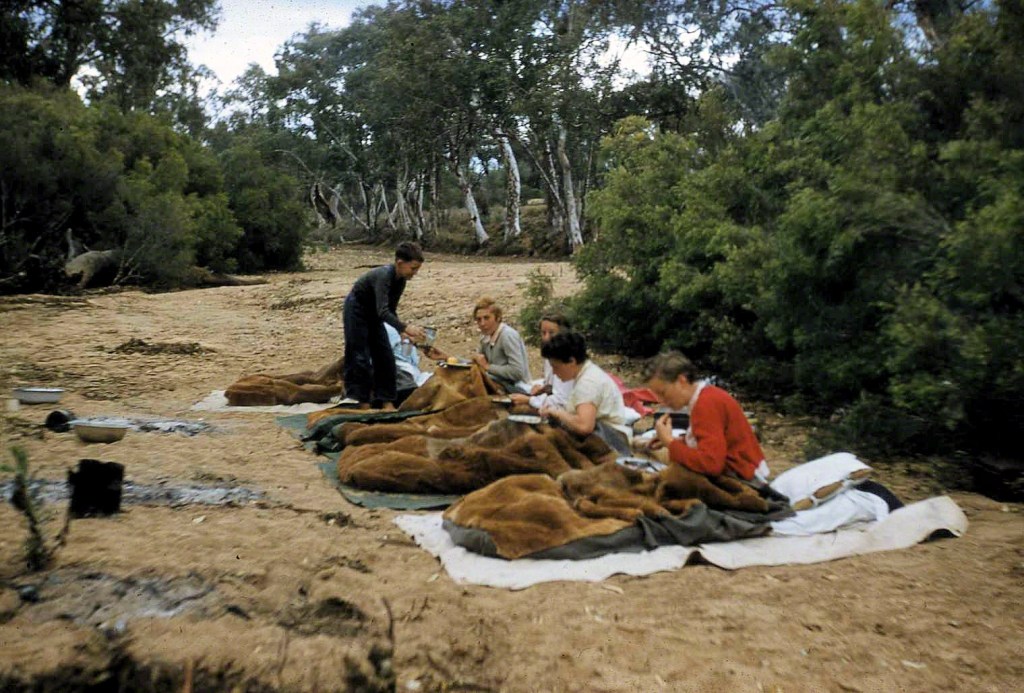
Fat dollops of rain struck my sleeping bag, waking me.
‘Oh, al-right!’ I mumbled before peeling the sleeping bag from me. I slipped on my shoes and as I was already fully clothed, I shuffled to the campfire.
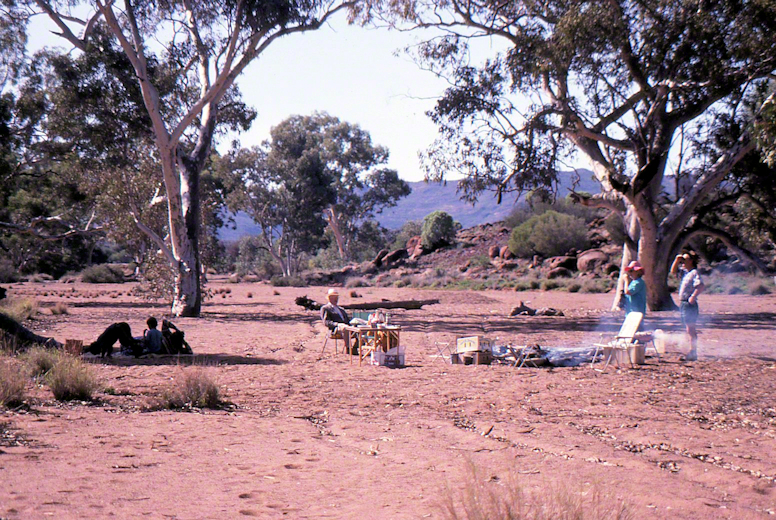
Hours dragged as we struggled to eat our cereal, drink beverages, answer the call of nature, and then pack our bags.
My older cousin, C1 was missing for what seemed an eternity. Younger cousin, C2 commented that his brother liked to read on his “business” ventures.
I laughed, ‘Our toilet is inaccessible for hours when my brother goes. He doesn’t like books, so I don’t know what he does when he goes.’.
‘Well, at least it’s only twice a week,’ my body-building brother said.
Dad’s eyes widened. ‘What? You only go twice a week?’
‘Yeah? How often do you go, Dad?’
‘Two or three times a day,’ he replied.
‘What?’
‘Yeah, that’s normal.’ Dad poked the coals and flames leapt into action. ‘Sure you’re not constipated? I’m not sure your Protein diet is a good idea.’
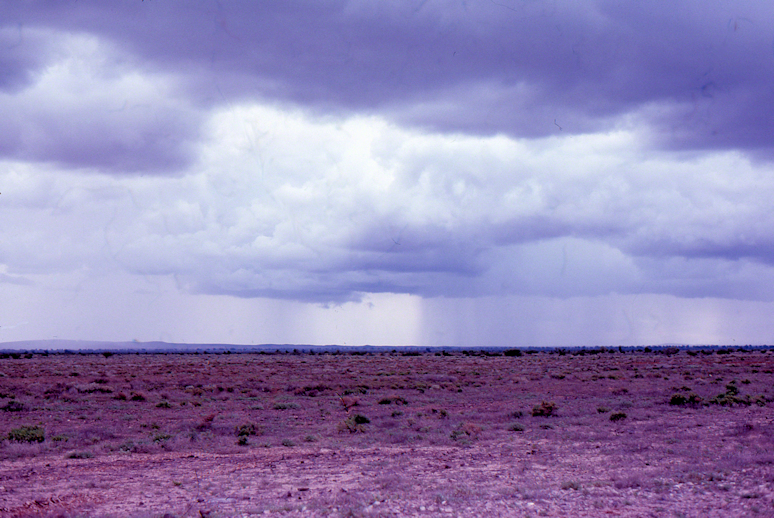
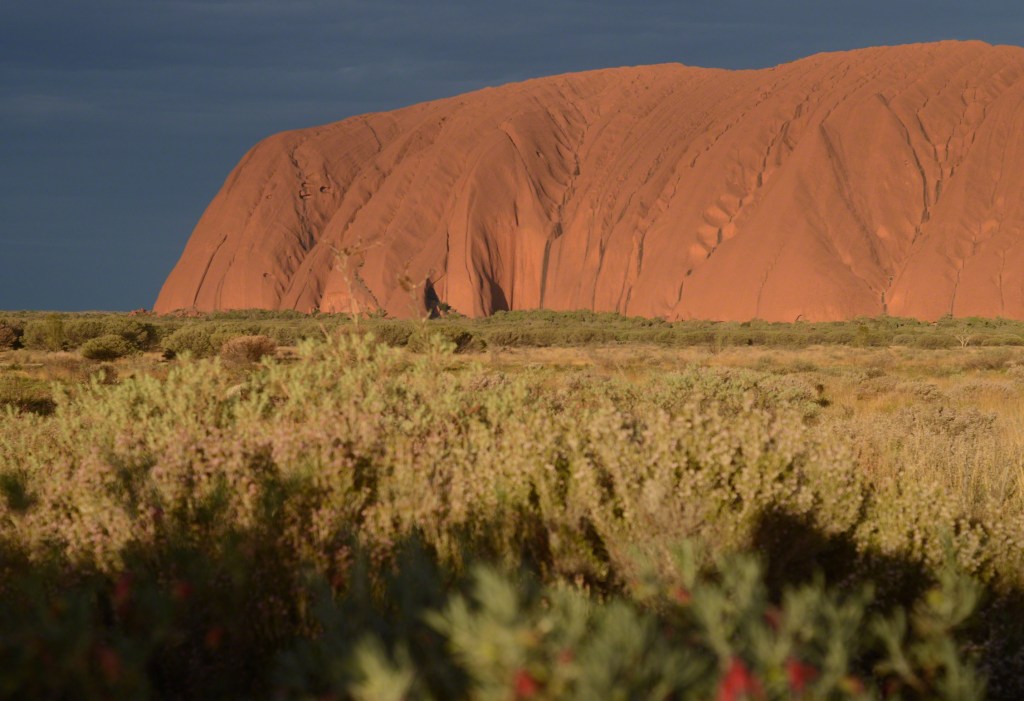
[Photo 2: Desert Storm (c) C.D. Trudinger 1981]
Richard shook his concoction and examined the plastic Tupperware containing Protein-powder mixture. ‘Nup, it’s fine.’ With a teaspoon, he stirred the raw egg floating on top of the bubbles, and then swallowed his liquid breakfast in three gulps.
C1 returned shovel in hand and a grin spread between his over-night shadow. ‘Ah! That’s better!’
Dad grabbed the shovel and toilet paper and disappeared into the bush. As we waited for each member to do their “nature-walk”, rain plopped into the sand.
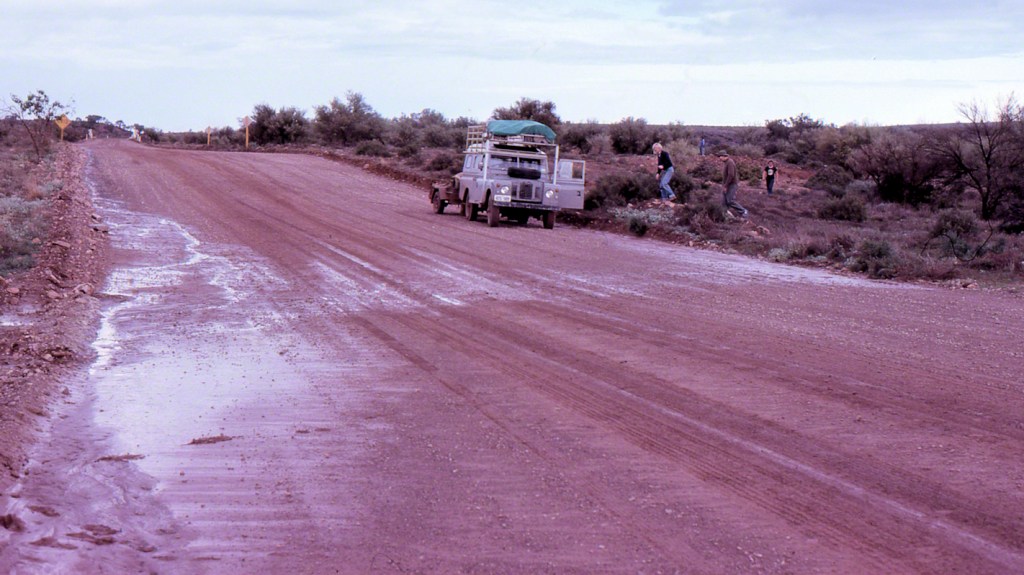
We left the Flinders camp mid-morning in the rain, then rattled over corrugations and lumbered through water-washed floodways. An hour into our journey, we stopped at Hawker where the boys selected lollies, and chewing gum to occupy their bored mouths for the hours of travel to come.
C1 and C2 picked out miscellaneous items they’d forgotten to pack. C1 placed his purchases on the weathered bench and reached for his back pocket. He patted it, and his eyes widened. He jammed his fingers into his pocket, patted his side pockets, and pushed his hands into them and pulled out the lining. He glanced around his feet. ‘Oh, oh! I think I left my wallet behind in the creek,’ he said. While he continued to search the floor, and his pockets, we pooled our money to cover C1’s expenses.
Despite C1’s lamentations that his wallet contained his driver’s license, passport, visa, and thirty dollars, a wall of steady rain threatening floods, discouraged us from returning to the camp. Dad was sure it was too late to find it. ‘The floods would’ve washed it away,’ he said.
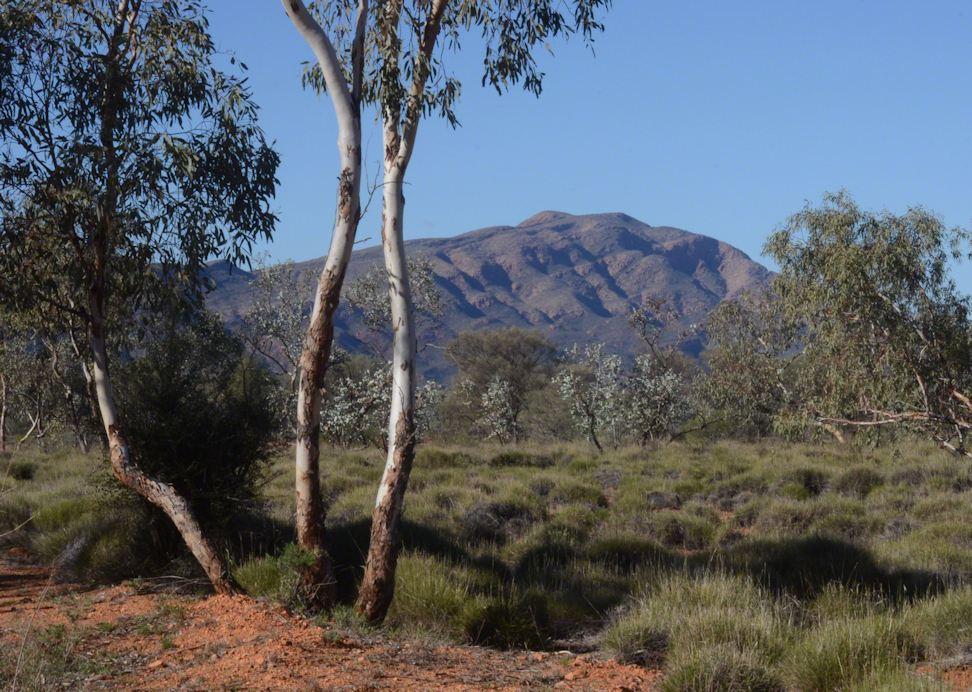
On the road through the Flinders Ranges, Dad stopped driving for us to photograph the ranges cloaked in mist. On one of our photo stops, the boys discovered the sport of rock-throwing.
Our family friend, TR tracked us with his film camera as we all tried to smash beer bottles with rocks.
Further north, rain pelted our vehicle and lightening flashed. At the bridge near Leigh Creek, we passed a car, bonnet jacked up, and a couple peering at their dead engine.
Richard, came to the rescue and within thirty minutes, resolved their engine issues and sent them on their way. I wish he could have been that efficient with the Rover’s pack-rack!
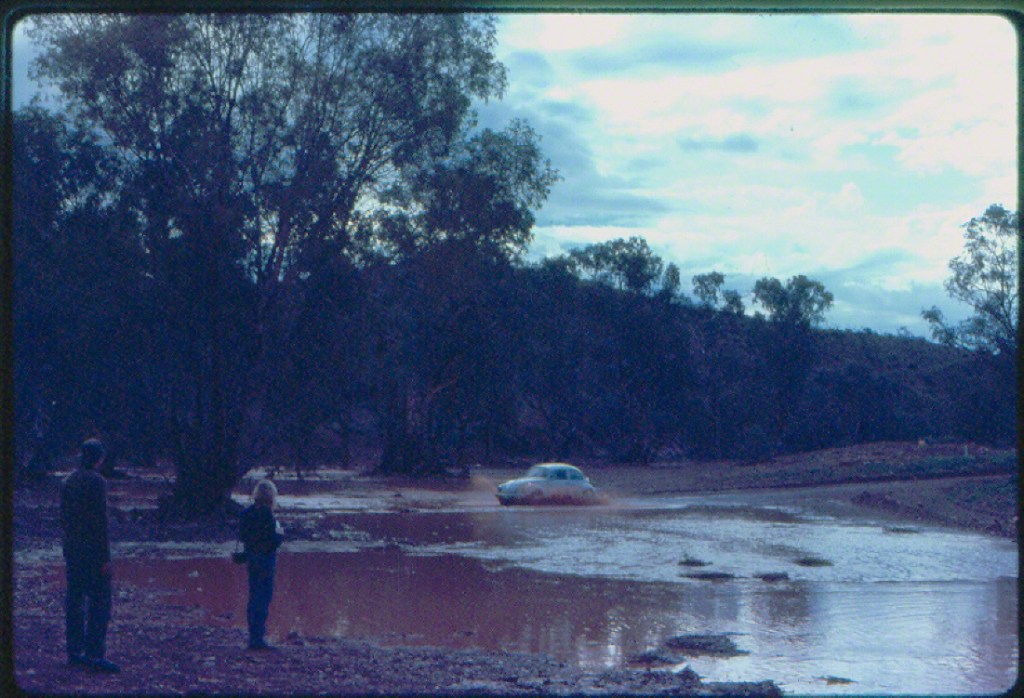
While Richard was repairing the car, we inspected the railroad track, the bridge of the over-flowing creek, and then watched a Volkswagen splashing through a pool of muddy water.
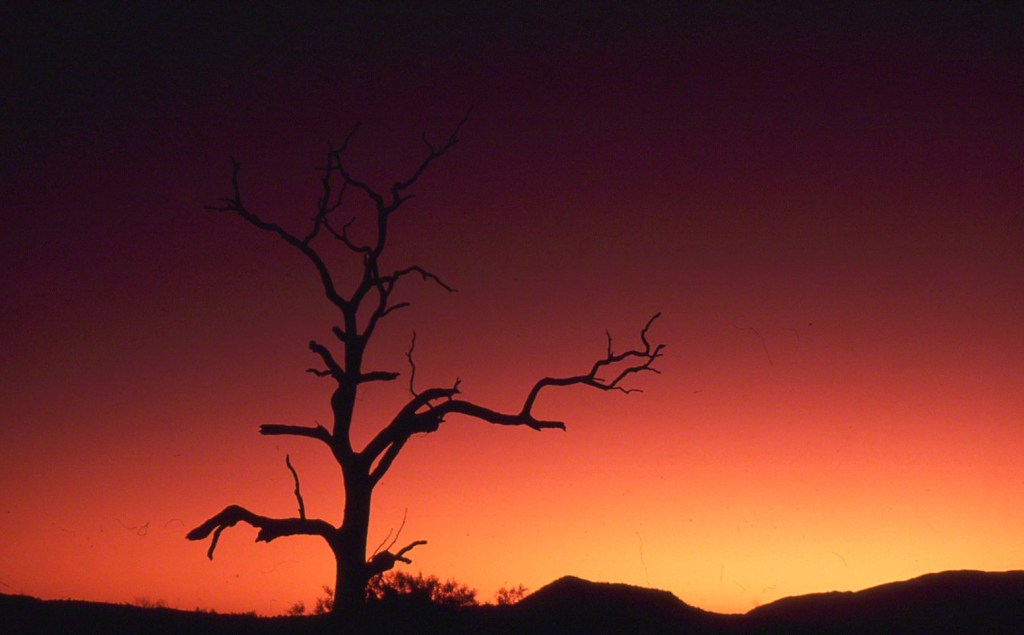
At Lyndhurst, we filled up with petrol. Twelve miles out from there, we camped by a disused train track. We used some of the sleepers for firewood. Birds gathered in a cluster of She oak and eucalyptus trees. Stratus and high cumulous clouds gave rise to a stunning sunset of gold, orange and flares of red.
Christmas Holidays are approaching. For me it’s been party time this week. One party after another, especially yesterday with three parties, all in one day. I’m hoping that once the rush and busyness is over, I can rest, relax and start planning our next holiday. Perhaps it’s the same for you.
In the meantime, here’s a revisit to Central Australia and the T-Team. This time when my brother and I became lost on our descent from Mt. Giles.
[As a child, I frequently had dreams where I was locked up in a prison cell and couldn’t get out. When, through family history research, I discovered the plight of my young (at the time) great-great Grandfather, I realised the origins, genetic or spiritual, of those dreams.]
My “Convict” History
I admire a former convict, an ancestor of mine. Okay, you may think, yeah, of course, she’s an Australian—these days they wear their convict heritage like a badge of honour.
No, actually, my great-great grandfather Friedrich Schammer lived in Silesia which is now part of East Germany or Poland today. Rubber borders, you see. His crime was trivial by our standards today in the West. But then, so were the crimes of shiploads of convicts who were transported from Britain and Ireland to Australia in the early nineteenth century. (For this reason, I have included photos from my visits to convict settlements, Port Arthur and Sarah Island, Tasmania, as my two-times great grandfather, was living his life in Silesia around the same time, in the early nineteenth century.)
My great-great grandfather Friedrich spent less than three months in prison for this crime he did not commit, but I admire the way he handled his dire situation.
How did he get into this trouble?
According to the family history book of this particular branch of the family, in the town in which my great-great grandfather studied as a medical student in the 1820’s, the military came to power and enforced strict and arbitrary rules. I might add here that my ancestor had already endured hardship, having been orphaned as a child, suffered poverty and then, his older brother who was his guardian, died from typhus. I imagine, these events spurred him on to be a doctor.
Anyway, in this university town of Jena, the students protested against their restrictions to their liberty by reacting against the ridiculous laws the military had brought on the town. Some of these laws were that there be no singing in the streets, no wearing of caps and waving of flags. The students protested by marching in the streets to the town square, singing and waving flags. All went smoothly and peacefully with no trouble from the authorities.
Then some of the young men, probably after drinking a few beers, became bolder as young men do tend to become. They threw rocks at windows; action that got the authorities’ attention.
The military swooped and arrested many of the protestors. My great-great grandfather was walking past the action and was in the proverbial wrong place at the wrong time.
Arrested and tried, though otherwise of exemplary character as a good Christian belonging to the Moravian Brethren, Friedrich was convicted and sentenced to prison for six months. I might add here that I have learnt recently that in Europe, the judge or judges determine the fate of the defendant. Whereas in the United Kingdom, United States and in Australia a jury (twelve randomly selected citizens) under the decide the fate of the accused.
It seems by his account and letters, a certain beadle in town had it in for my great-great grandfather Friedrich.
Yet Friedrich accepted his time in prison and made the best of the situation both for himself and others. He studied, enjoyed the view of the valley from his prison room (I think he was in a low security prison) and used his medical knowledge and skills to help those around him.
Great-great grandfather Friedrich’s quiet conduct and enrichment of the prison community was noticed by the authorities, and they released him less than three months into his term.
Released, Friedrich’s ordeal was not over. The university where he’d been studying banned him from returning to study there. His reputation tarnished, the villagers shunned Friedrich.
However, Friedrich did not give up. He moved to Berlin and keeping a low profile, completed his studies at The Charite University Hospital and graduated as a Doctor of Medicine. He had a heart for the poor, having been poor himself, and would treat those in need without demanding payment.
My great-great grandfather demonstrated those godly qualities I admire—justice, mercy and compassion. And perseverance, even in the face of adversity.
Philippians 2:14-15—Do everything without complaining or arguing, so that you may become blameless and pure, children of God without fault in a crooked and depraved generation, in which you shine like stars in the universe…
Note: Port Arthur housed what British authorities considered the worst of the convicts transported to Australia in the early to mid-nineteenth century. I visited this convict settlement in 1981, 1995 and 2009. A place well-worth visiting to learn from the mistakes made from the past (how not to treat fellow human beings). Although the place appears serene, the presence of the tortured ghosts of the convict past can still be felt.
Sarah Island situated in the Macquarie Harbour on the west coast of Tasmania, imprisoned the worst of the worst convicts transported to Australia in the early nineteenth century.
I have visited Sarah Island as part of the Gordon-Franklin River Cruise, both in 2001, and 2011. I highly recommend this cruise—a bucket list for travellers—history, wilderness, rare beauty of unspoilt rivers and rainforest and…excellent food. And not to mention entertainment. After your cruise I highly recommend that you see the historic play, The Ship that Never Was. It’s about convicts who build a ship to escape their prison island to make their way to South America. In January in 2024, this play celebrated 30 years of performances in Strahan.
Resource: Historyof theSchammer Family, Based on the work of Dr. A.H. Francke and J. Gemuseus, Written by Reinhold Becker, Herrnhut, 1922, Printed Gustav Winter, Herrnhut in Saxony and Translated from German by Rebecca Gnüchtel 2009
***
Virtual Travel Opportunity
For the price of a cup of coffee (takeaway, these days),
Click on the link and download your kindle copy of one of my travel memoirs,
Experience Historic Australian outback adventure with Mr. B
I’m still trying to figure out where we went off track. Were we off track? Was I that slow that the whole trek was taking twice, perhaps three times as long as the initial map instructions suggested? Four hours they promised us. Only 8.9 km, the sign said.
Mistake number 1: The map of Alligator Gorge my dear husband had printed from the internet was then forgotten to be loaded into his backpack.
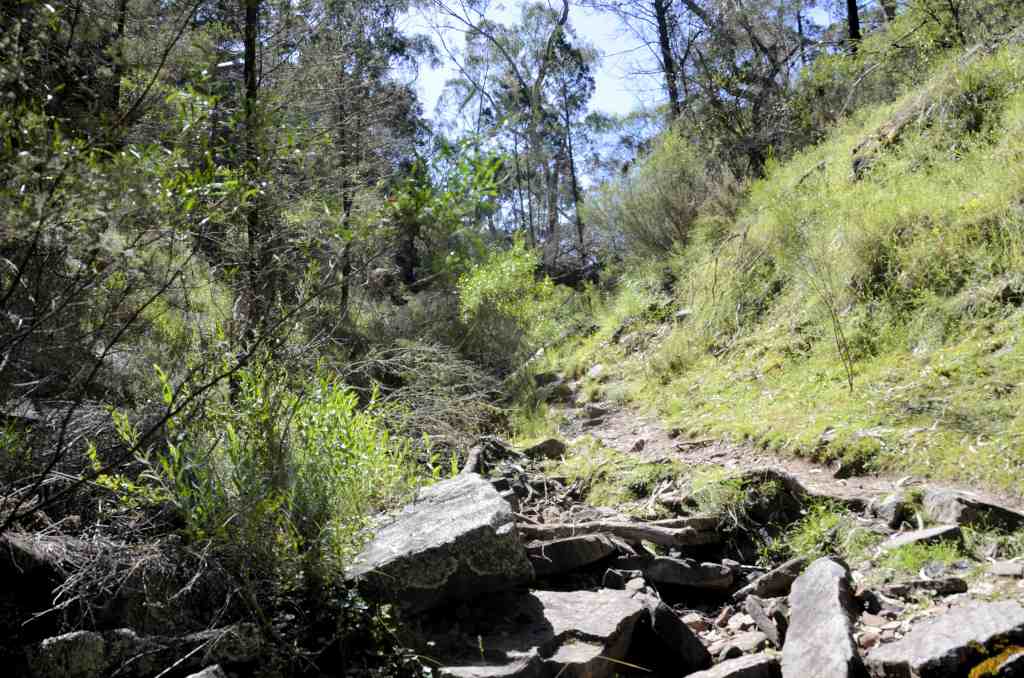
Six hours into the hike, deep in some tributary of Alligator Creek (according to the map-less husband), and no sign of the Terraces, nor the steps, nor the Narrows. Did we miss a turn off? Did we stray into a neighbouring gorge? Signs to direct our path were ominously absent. So were people…except us, the K-Team comprising of his brother P1, two Swiss relatives (Mother A and Daughter E), Hubby and me with my bung knee.
Now that we’d descended into the gully, I had kept up with the Able-Bodied four. My knee no longer hurt, but for some weird reason, although we walked along a narrow path and negotiated the stony creek, at a fair pace, we seemed to be getting nowhere fast. The red slated walls to our left, and occasionally to our right, just kept on going.
Four-thirty in the afternoon and we stopped by a bend in the dry creek.
‘I reckon if we keep on going, we’ll get there; this gorge will eventually lead us to the start of Mambray creek,’ I said. ‘What does the map say? Oh, that’s right, my hubby’s forgotten the map.’
The K-Team decided to send Hubby and E down the creek for any signs that we were on the right track. Off they went at a cracking pace now that they weren’t hampered by the “cripple” (me).
The remaining three, P1, A and me, waited in the cool of the native pine trees common in these parts of the Flinders Ranges.
P1 was not impressed with Hubby’s, much boasted and legendary navigational skills. In silence, I began to reflect. I had been this way, surely. Way back, some forty years ago with my friends from youth. The landmarks, the endless rock walls, the keeled-over gum trees, and the native pines resonated faint familiarity. Even the trek that seemed to take for eternity took me back to when our youth group had hiked from Alligator Gorge to Mambray Creek starting with the same ring route.
I had asked the same question to one of the leaders, ‘When is this going to end?’
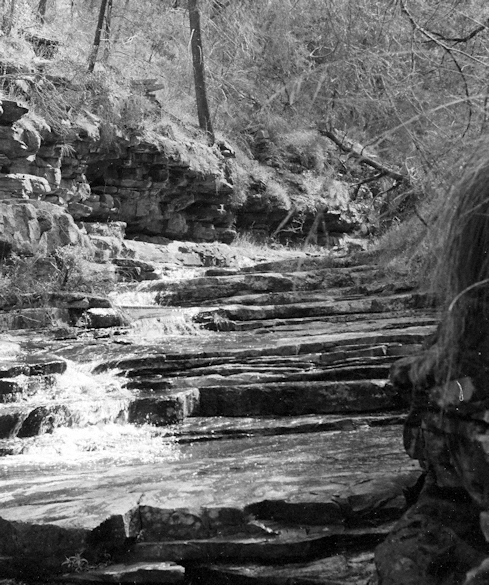
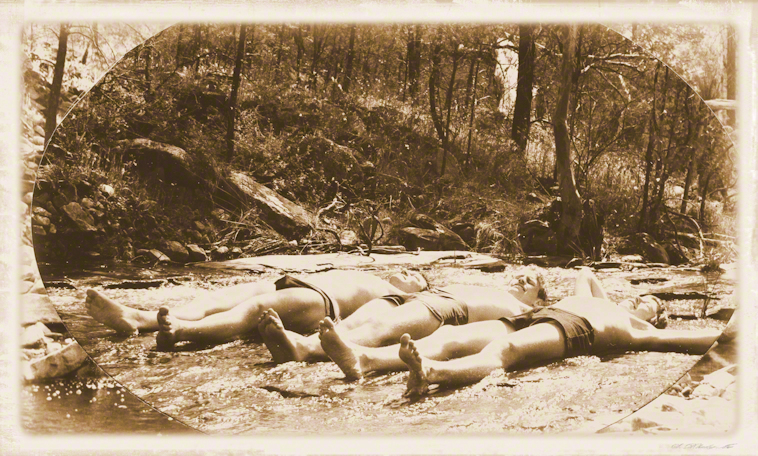
‘Soon,’ he replied and as if by magic, we reached the Terraces. My brother, and his friends lay in the creek and cooled their tired muscles.
I began to wonder if we hadn’t been swallowed up in some dimensional impasse. Had our trek led us into a parallel universe where Alligator Gorge has no Terraces nor Narrows and we’d be lost on some distant and forgotten planet? Or had we stepped into the past before the Terraces and Narrows had formed?
Either way, my phone had no signal.
Hubby and E were taking eons to return. Had some errant neutrino activity swallowed them up into another place and time?
The hike had begun in a mundane fashion. Hubby strode ahead up the fire track from the Blue Gums campground.
I marched behind the Able-Bodied K-Team like a demented zombie with trendy hiking poles. The Able-Bodied stopped at the sign, the first of many waits for their knee-challenged companion.
I glanced at the sign, and remarked, ‘This way is an8.9-kilometre ring route.’ Nothing wrong with my eyesight.
‘Yes,’ Hubby sniffed with an air of arrogance. He implied that if I didn’t like the distance, I could sit back at the car in the campground and wait for them.
Glad I didn’t.
So onwards and upwards on the fire track we trekked. Judging by the position of the hills, the terrain and the fact that we’d left the Mambray Creek-Alligator Creek junction, and behind, (Mambray Creek running to our left and Alligator Creek to our right), I summised that we were walking the route clockwise.
Hence Mistake Number 2.
So, for the next two and a half hours we (or should I say, me with the group having to make frequent stops for me) laboured up the rise. I don’t do uphill at the best of times and had to stop and rest for my breathing to catch up. The Able-Bodied with their superior fitness would wait for me, and then as soon as I caught up, they were off. Like racehorses.
On the way we encountered a couple, smiles wide on their faces, tramping down the fire track.
As they approached, I asked, ‘Are we there yet?’
‘Not far now,’ they replied.
Another couple, Grey Nomads, also with grins rivalling Alice In Wonderland’s Cheshire cat’s, passed us.
‘How far to the top and then into Alligator Gorge?’ I asked.
‘Nearly there,’ the man said.
‘But the walk is quite difficult,’ the lady said. ‘It’s more like nine kilometres.’
‘Yeah, thanks.’ I remembered the dodgy distance estimations from the previous hike 40-years ago. Seems as though nothing had changed in Alligator Gorge.
By this time, we had stopped at a Eaglehawk Dam campsite where we ate our lunch and rested for thirty-minutes. An oasis after a long hot thirsty uphill hike.
Ten minutes from the dam, we reached our goal, the long-awaited sign; the virtual “top” and fork with directions. Signs and map indicators were scarce on this ring route. One sign pointed to a path leading to Alligator Gorge, about 3.1km hence. The other to the lookout.
We opted for the gorge. After all, it was only 3km away, an hour’s walk at the most.
Confident we were on the “homeward” stretch, we trundled down the slope and into the gorge. The time, around 2pm. Now that we hiked downwards and the path appeared well-worn, I kept up with the Able-Bodied. In fact, they held up my progress by stopping to photograph lizards, flowers, and birds.
An hour and a half later, we still hadn’t reached the Terraces. Nor had we completed the circuit that would have taken us back to Blue Gums Campground. Hubby was adamant that we were in a tributary of Alligator Gorge and thus missed all the interesting features. There was talk of camping the night in this so-called tributary. After all, we did have an emergency blanket. However, the fire-danger season having commenced, we would be banned from lighting a campfire. Hubby had stressed that even lighting a match was “verboten” (forbidden).
Hubby and E emerged through the growth that glowed emerald and gold in the late afternoon sunlight.
‘The creek just goes on forever,’ Hubby said.
‘Best to go the way you know,’ I said. ‘We’ll just have to go back the way we came, to be safe.’
This we did. Uphill again, but this time steep rises. Hubby helped me negotiate the uneven path and rocky terrain. He pulled me up and over fallen logs and big boulders. He told me off for hampering the progress of the group.
‘I feel faint,’ I replied, and he softened. Besides, he needed to pace himself too. Hubby looked pale and exhausted.
Within an hour we’d reached the signpost and were hiking with happy faces down the fire track. I named the tributary we’d been lost in, “Deviation Gorge” as it had led us astray.
We arrived back at Blue Gums Campground just as the sun set at 7:30pm. The back tracking taking us just two and a half hours to complete.
Most of all, by the end of what we calculated to be a twenty-kilometre hike, my knee didn’t hurt at all. My feet did, but not my knee.
***
Friday, we revisited Alligator Gorge. This time, we parked at the more populated carpark and took the steps down into the gorge.
I wasn’t going to do the two-kilometre circuit with the Able-Bodied through the Narrows. But I just had to know, just had to discover for myself what went wrong the previous Tuesday.
So, after a slow descent owing to my knee, I hobbled over the stony creek bed and down the narrow gorge. My frequent cries of “Ouch!” heralded my presence to all and sundry. Hubby marched ahead oblivious to my defiant presence and will over pain to be there and see for myself.
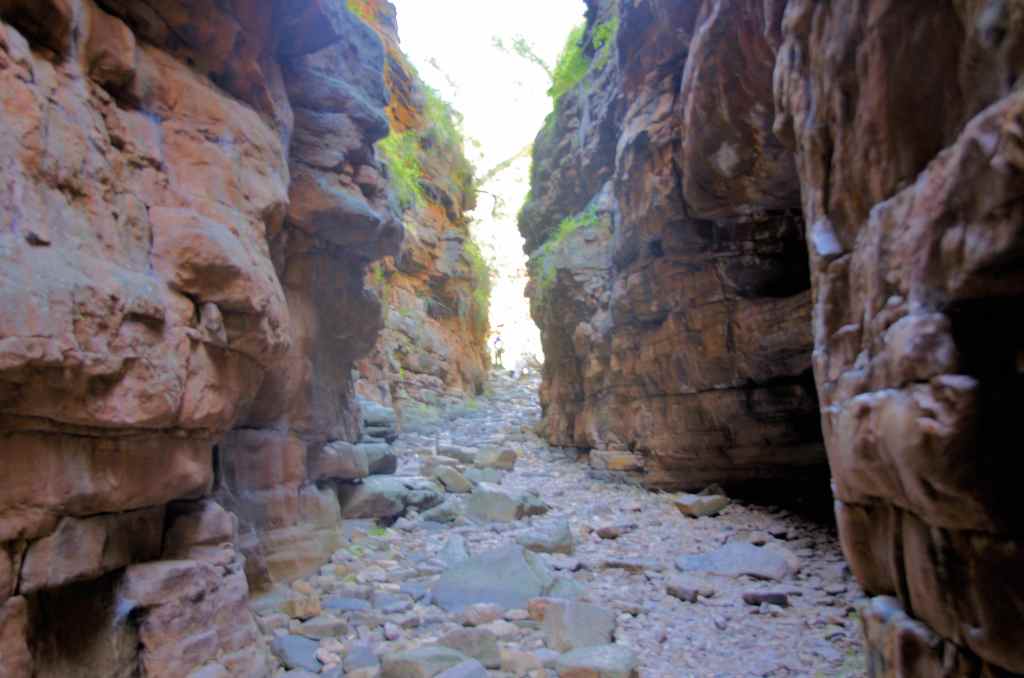
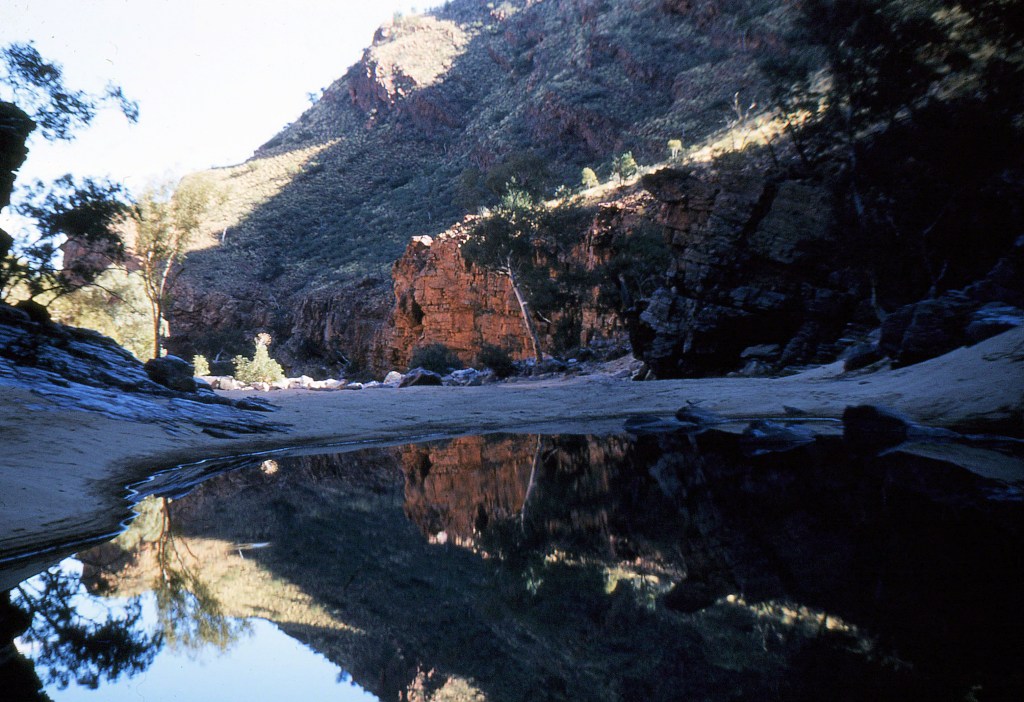
The drama of the Gorge was rewarding. Red rock walls and stunning reflections all in this ancient peaceful setting. Another pair of Grey Nomads sat in a shallow cave, absorbing the tranquillity and beauty.
Hubby and the Swiss relatives tramped through the Narrows as if it were a race.
P1 rested at the Narrows’ entrance and said, ‘I don’t know what the rush is.’
Once through and on the short, I stress, “homeward” and upward trail to the road, Hubby scolded me for holding up the group. In his estimation, “cripples” like me are not allowed to attempt the two-kilometre circuit of Alligator Gorge. ‘Now we’ll be late getting back to Adelaide,’ he warned.
Just so I wouldn’t impede the Able-Bodied further, I parked myself at Blue Gums Campground, and waited for them to return with the “royal” Toyota Hilux Carriage to pick me up.
While waiting for the Able-Bodied crew, I discovered a sign that directed the ring route in the anti-clockwise direction—through the Narrows and onto the Terraces. If only we’d ventured this way, we could have seen the most interesting parts of Alligator Gorge first and then decided to return the way we came…or not. To this date, Hubby has never witnessed the Terraces. At least we would’ve had happy, smiling faces walking down the fire track and taken less time.
So, if you’ve read my books and would like to give a review on any of them, please feel free to share in the comments section of my blog.
I am pleased to share a review from one of my followers, Lynne on The T-Team with Mr. Bwho writes:
“An excellent memoir that takes the reader to some of the most beautiful and remote areas of the Northern Territory. Fourteen-year-old Lee-Anne, a budding artist and writer describes the colours, sights and people with fresh eyes. Uluru, the Olgas and Hermannsburg are covered but it’s the exploration of Haast’s Bluff, Talipata Gorge and Mount Liebig, places off the popular tourist trail that make this book exceptional. All are brought alive by wonderful prose and authentic pictures in the book. Her descriptions of characters and situations provides humour and interest. A must for people who intend to visit the Red Centre.”
To whet your appetite, here is an episode from the book where Mr. B and Dad have a disagreement about lunch…]
The T-Team with Mr. B–Episode 6
Fruitless Foray
Again, we raced at 50 miles per hour along the highway boldly going where too many trucks had gone before. The graded road was a sea of corrugations. As we travelled along the road at high speed, our Land Rover juddered over the sand waves. Dad was on a mission to reach Ernabella and not even corrugations on the unsurfaced road were going to get in his way.
We paused at Indulkana, an Indigenous settlement, where we topped up the tank with petrol from one of the Gerry cans.
‘Only fifty miles or so to go to Ernabella,’ replied Dad with a sniff. He could smell his Holy Grail, and he was bent on reaching his destination. ‘Pity, there’s a school here I’d’ve liked to visit. Ah, well!’
Mr. B spread out the map on the bonnet of the Rover. He adjusted his glasses on his nose and then pointed at Indulkana. ‘Are you sure it’s only fifty miles, David?’
Dad cleared his throat and then glanced at the map. ‘Er, um, I think so.’
‘It looks a damn lot further to me. Are you sure we’ll get there? I mean to say, it’s past one o’clock and we still have to have lunch.’
‘We’ll eat when we get there.’
‘Really?’ Mr. B gazed at the fibro houses scattered like abandoned blocks in the red landscape. ‘Damn! No place to shop in this shanty town.’
I gazed at the mirage shimmering, reflecting the khaki bushes on the horizon of ochre. This tiny Indigenous settlement seemed more heat-affected and miserable than Oodnadatta. A dingo skulked across the road in search of shade. The town seemed empty—except for the flies.
I swished several of the pests from my eyes and searched for a toilet block. We had stopped, so I considered it timely to make a comfort stop. ‘Where’s the loo?’ I asked.
‘I don’t know,’ Dad said.
As far as we could see, public toilets didn’t exist in Indulkana.
A kangaroo hopped through the spinifex. Rick grabbed his rifle and aimed.
‘Hoy!’ Dad said. ‘Stop! You can’t be shooting so close to the town.’
Rick lowered his gun.
‘I say,’ Mr. B said. ‘Why don’t we go down the road a bit. We can find a few accommodating bushes for our business and the boys can do a spot of shooting. Besides, we need a break and some lunch.’
Dad sighed. ‘Very well, then.’
We piled back into the Rover and trundled several miles down the road where some trees and bushes were clumped close to the road. We all made use of the improvised “bush” facilities. Then Dad pulled out the tucker box and made a simple lunch of peanut butter sandwiches.
‘Do you want to have a go shooting?’ Rick asked me.
‘Okay,’ I replied.
My brother handed me the .22 rifle and we walked into the scrub.
Dad called after us. ‘Shoot away from the Rover, we don’t want anyone getting hurt.’
‘What do I shoot?’ I asked Rick.
‘Rabbits. Kangaroos. Birds.’
I looked at the lemon-coloured grasses dotting the red sands. ‘Where are they?’
Rick shrugged.
Matt aimed his rifle at a stump of a mulga tree. A galah had settled there. But not for long. Matt pulled the trigger and at the sound of the bullet hitting the sand, the bird fluttered into the air.
Some white cockatoos decorated the skeleton of a dead tree. I aimed and pulled the trigger. ‘Bang!’ The butt hit my shoulder and knocked me to the ground. ‘Ouch!’ I cried.
The flock of parrots squawked and scattered.
‘I wasn’t expecting that to happen,’ I said rubbing my bottom.
Rick grabbed the rifle off me. ‘Watch where you point that thing.’
‘Oh, sorry.’
Rick and Matt stalked further into the scrub in search of more prey. I was glad my hunting time was over as it was not as much fun as I thought it would be. At least no one was hurt.
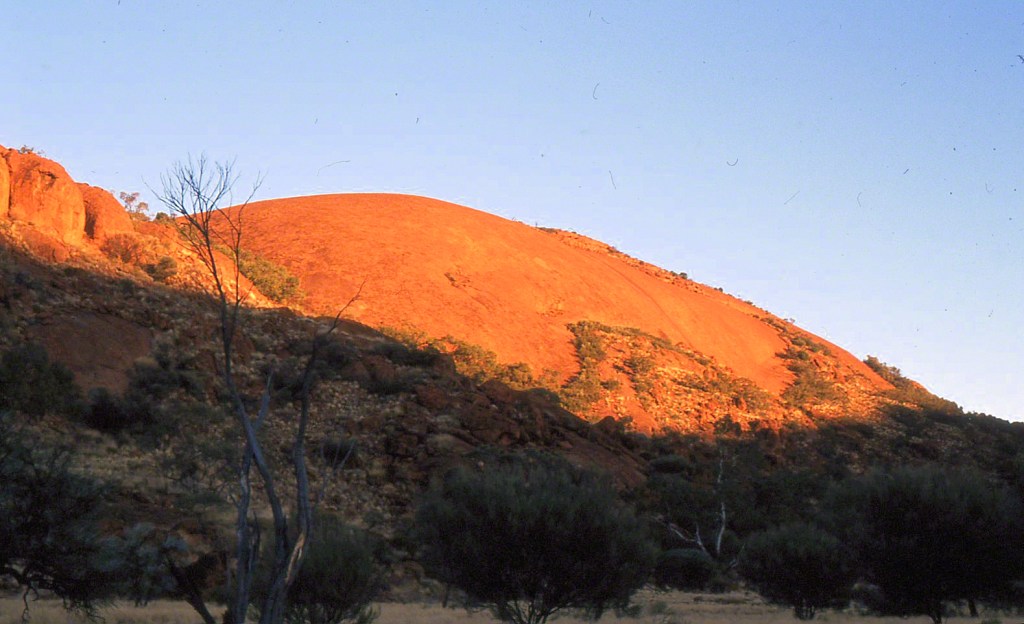
The break and the lads’ fruitless hunting foray caused the night to catch up with us. After a couple more hours of driving, we camped near Mimili. A hill close by served as adventure for us young ones in this otherwise flat desert. I climbed the small rise and explored, while the boys went shooting as usual. The hill was little more than an outcrop of rocks and I imagined, something of a smaller version of Uluru. From the top, I scanned the terrain. The setting sun’s rays caused the grasses in the plain to sparkle like gold glitter and a cool breeze hinted at the freezing night ahead. I climbed down from my vantage point and ambled back to camp. As darkness descended upon us and stars flooded the night sky, the boys returned empty-handed, except for their rifles.
While Dad stirred a billy can of stew, Mr. B warmed his idle hands by the fire, his mouth busy whining at the prospect of sleeping on a bed of stones.
Dad tapped the wooden spoon on the edge of the billy can and said, ‘We are camping in the desert, aboriginal style. What we do is make up one fire for cooking, and then have our individual fires.’
So, we did in the nights to follow. Although we all had blow-up mattresses and cotton sleeping bags, we still hunted for the softer ground, and prepared it for the bedding by clearing the area of rocks. Each of us would scout around for sticks and logs in preparation for our personal fires. By bedtime, our fires were crackling away, and we only woke from our slumber to poke the coals to keep the small flame going. Still, I slept fully clothed, as the clear nights were freezing.
But did this arrangement satisfy Mr. B? Apparently not. Every night he complained of his unsatisfactory sleeping arrangements. And his back, oh, the pain in his back. Oh, for a decent bed and a warm night’s sleep. And oh, the pain, oh, the discomfort! And then, just as he sank into a deep slumber, dawn broke with Dad clattering around the campsite preparing breakfast once again.
‘Why do we have to get up so early?’ Mr. B would ask each morning.
‘It’s my mission to get…somewhere,’ Dad would reply.
In this episode, the T-Team valiantly explore as many gorges in the MacDonnell Ranges as they can…in one afternoon. The challenge, avoid the crowds of tourists while keeping Mr. B entertained.
The T-Team with Mr B — In 1977 Dad’s friend Mr Banks and his son, Matt (not their real names), joined Dad, my brother (Rick) and me on this journey of adventure. I guess Dad had some reservations how I would cope… But it soon became clear that the question was, how would Mr B who was used to a life of luxury cope? And how many times would my brother lose his way in the bush?]
With our two Indigenous guides, Dad drove the Rover along the rough dirt track (probably a “short cut”) to the road that parallels the MacDonnell Ranges, Namatjira Drive. These days, the main roads are sealed, but not back then. Dust billowed into the cabin as we drove on a road that parallels the MacDonnell Ranges.
Mr. B frowned. ‘Just long enough to take a few snaps like the tourists, I expect.’
‘You sure you don’t want to start at Serpentine to our right? We could hike up while the morning’s still cool.’
‘What morning? It’s already past noon.’ Mr. B flicked his map flat. ‘Ellery Creek, I say, for lunch.’
Dad sighed, ‘Very well, then, Ellery Creek.’
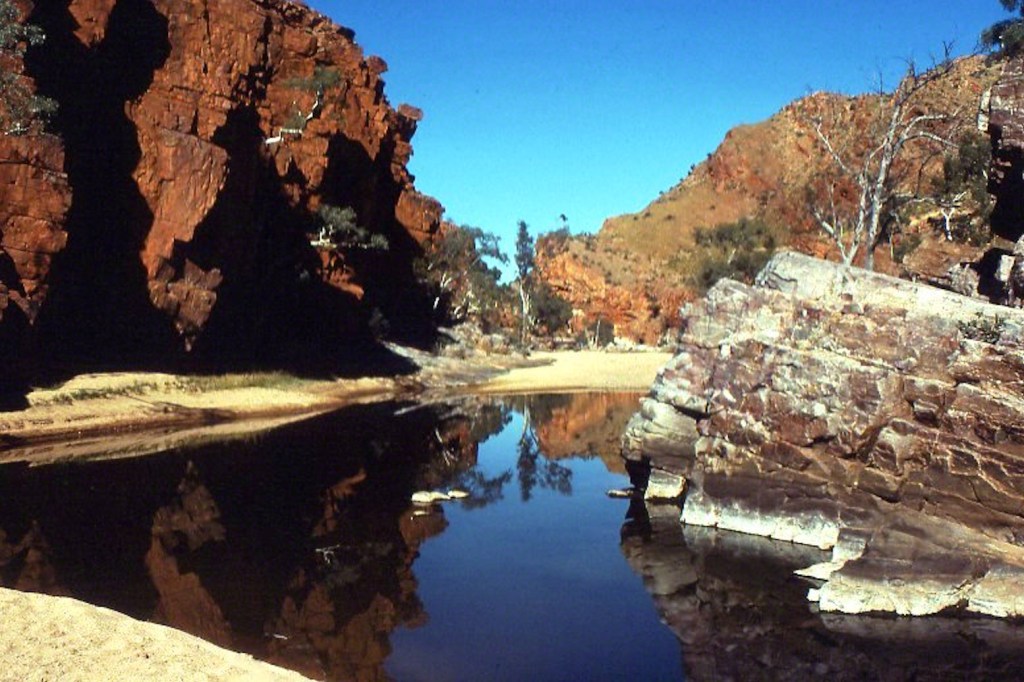
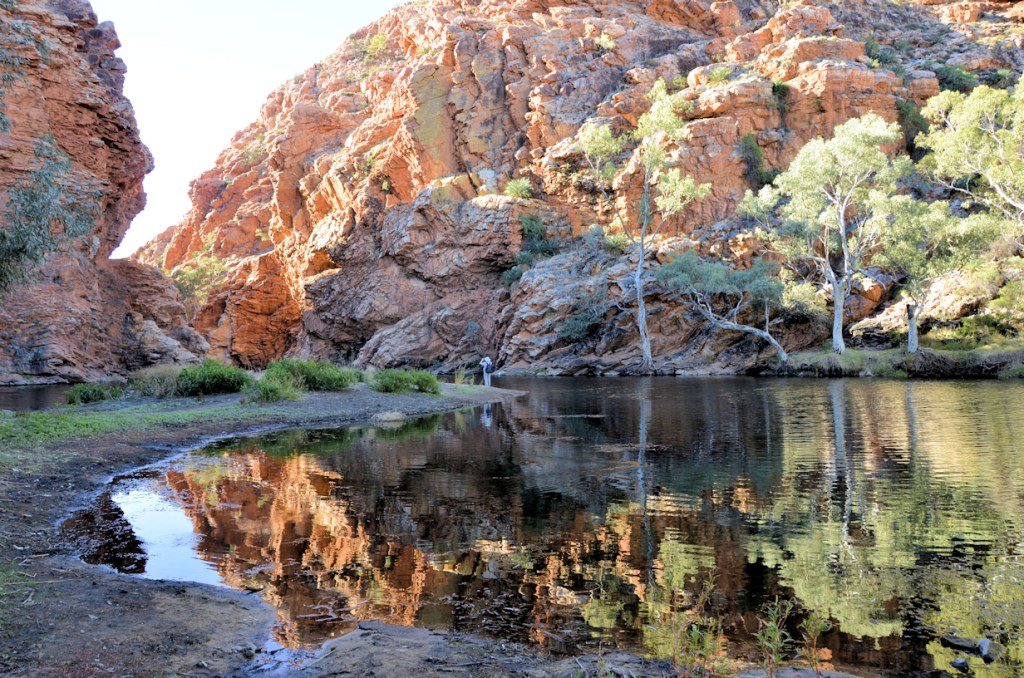
Ellery Creek
After lumbering along the wider but corrugated road, Dad turned into the barely discernable trail that led to Ellery Creek. After entering the clearing for parking, we hunted for a car park. Not an easy feat as the car park was full; even the spaces in between swarmed with tourists.
Dad squeezed the Rover into what seemed the last remaining gap, and the T-Team piled out.
As he turned the Rover left so heading east towards Alice Springs, Dad smiled. Mr. B pouted and folded the map. He insisted we have lunch before we start on the hike up the gorge. Dad went one better announcing that, since it was Sunday, we’d have lunch AND a Sunday Service.
Mr. B’s response was to shake his head and mumble something not-so-polite into his red dust-stained handkerchief.
Serpentine Gorge
Less populated, Serpentine Gorge begged to be explored. Our Indigenous guides were not interested in joining us, so we bravely set off on our own adventure. To get to the narrowest part of the gorge, we had to cross a deep pool of water on our air mattresses and then walk along a rocky creek barefoot. We had forgotten to bring our shoes. Not that it concerned the men, they raced ahead leaving me behind hobbling on tender feet over sharp stones.
Then, disaster. Mud and slime replaced jagged rocks. In the shadows of gorge, I trotted on the path near creek. My heel struck a slippery puddle lurking by a pool of sludge. Next, I skated, feet flew from under me, and I landed bottom-first in the murky depths of the Serpentine Creek.
‘Ah, well,’ Dad sighed. ‘We better get back to the Rover. We need to find camp before it’s dark.’
As we hobbled back in the fading light, I mumbled, ‘Sure it’s not dark already?’
Other Gorges for Another Day
Dad endeavoured to distract me from my discomfort with descriptions of the many other gorges in the MacDonnell Ranges and tales of adventures exploring them. His stories whetted my appetite to view these wonders myself one day, on this trip, or perhaps in future journeys to Central Australia.
[While Mr. B and his son, Matt stayed back at camp,three of the T-Team faced the challenge of climbing Mt. Liebig. And finding their way down. After a successful climb (except for the lost quart can) to summit Mt. Liebig, (Read Part 1 of this adventure), the T-Team lose their way…]
We also diverged. Dad was confident that all gullies lead to the big one at the base of the slope. ‘Ah, well! We will meet Rick in the gully below,’ he assured me.
But contrary to Dad’s prediction, we did not meet Rick. I could not help thinking, this was not the first time as far as Rick was concerned. We’d already lost him in the sand dunes near Uluru. Almost.
Dad continued to search for his quart can. But that little friend Dad had cherished since the fifties, eluded him also.
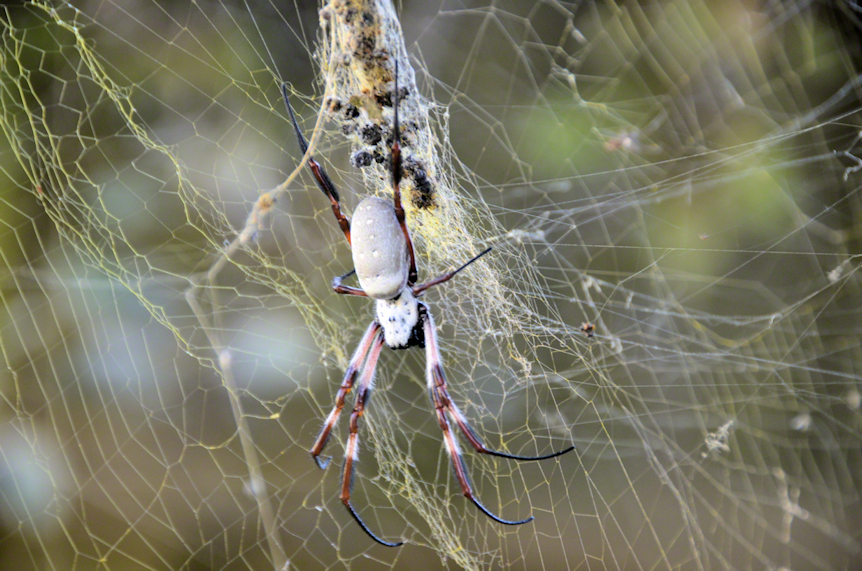
We weaved our way down the main gully for about an hour. A huge spider in a web spanning the width of the gully confronted us. The spider, the size of a small bird, appeared uninviting, so we backtracked and decided to hike up and down the ridges.
For several hours, we struggled over ridges. Up and down, we tramped, yet seemed to make little progress; the rise and dips went on forever. The sun sank low, and so did our water supplies.
The heat drained me. My tongue stuck to the roof of my mouth. But we had to ration water.
Dad slumped on a slab of rock at the bottom of a gully. ‘Drink?’
I took the canteen from him and filled my cup. Then I spooned in some Salvital. I chugged down the water as it fizzed. So refreshing!
‘Oh, Lee-Anne!’ Dad quibbled. ‘You didn’t leave much for me!’ He poured the last drops of water from his canteen into his mouth and gazed in despair at the lengthening shadows of the mountain.
‘Oh, but Dad! It’s not fair! We will never get out of this place! We are lost forever.’ I had visions of future hikers coming upon our dried-up old bones thirty years later. ‘What are we going to do?’
‘Well, um, perhaps we better pray God will help us.’ Dad bowed his head and clasped his hands. ‘Dear Lord, please help us find our way back to the truck. And forgive me for growling at Lee-Anne.’
‘Forgive me too. Help us not to run out of food and water, too.’
‘Bit late for that,’ Dad muttered. ‘Ah, well.’
We had barely finished praying, when an idea struck me. ‘Why don’t we climb up a ridge and walk along it. Surely if we go high enough, we’ll see the landmark and the land rover.’
‘Oh, I don’t know. We need to conserve our energy.’
‘Just one ridge won’t harm us.’
Dad sighed. ‘Okay, it’s worth a try.’
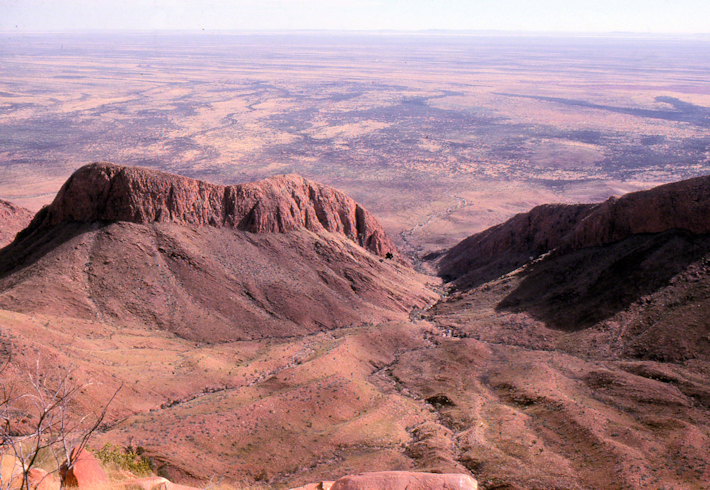
I raced up the hill and strode along the ridge. I climbed higher and higher. I glanced towards the east expecting, hoping, willing the Rover to appear. But with each stride, each hopeful gaze, nothing. I resolved to climb further up the slope before turning back.
After a few more steps, still nothing. With the heaviness of defeat, I turned to climb down. Then I saw it. The Land Rover sat at the base of the mountain, glistening in the last rays of the setting sun.
‘There it is!’ I jumped up and down over-reacting with excitement.
‘Praise the Lord!’ Dad’s shout echoed in the valley.
With renewed energy, we attacked the last mounds that lay between the vehicle and us.
‘Rick will probably be sitting there waiting for us wondering what has happened,’ Dad said puffing as we strode up to the land rover. ‘Can’t wait to have a few gallons of water.’
We rambled over to the rover. Dad circled the vehicle and returned to me shaking his head. ‘He’s not here.’
[The T-Team with Mr. B— Dad’s friend Mr. Banks and his son, Matt, joined Dad, my brother (Rick) and me on this journey of adventure. I guess Dad had some reservations how I would cope…But it soon became clear that the question was, how would Mr. B, a middle-aged man who was used to a life of luxury, cope?]
We stopped in at Fregon, another Indigenous settlement much like Mimili; a row of tin sheds and deserted. Then at about 2.30pm we arrived at Ernabella.
A teacher friend of Dad’s invited us into his home for refreshments and each of us had a hot shower. I enjoyed the warm cascade of water on me. My treat for the week. Below rivers of red mud spun into the drain hole of the bath. I scrubbed my hair with shampoo. The soap refused to lather. I scrubbed and scrubbed.
‘Lee-Anne!’ Dad called. ‘Don’t take all day, the boys need a wash too.’
‘Oh, alright.’ I turned off the tap. I guess the boys did need to wash, probably more than me. They were getting quite ripe at close quarters in the Rover. After all, it had almost been a week since we had a proper wash.
All showered and smelling sweet again with soap and deodorant, we trailed after Dad who gave us a tour of the settlement, including the school. Ernabella lies at the foot of the Musgrave Ranges, south of the South Australian and Northern Territory border. The land belongs to the Pitjantjara people. The mostly prefabricated buildings were neatly arranged around a random collection of unsealed roads.
Dad guided us around the school which appeared empty. We followed him circling the white building. ‘Must be closed,’ Dad said.
‘School holidays, I guess,’ I remarked.
Dad scanned the transportable blocks and then screwed up his nose. ‘We need to find someone to fix up the trailer.’
We walked through the settlement. The white buildings stood sentinel to the roads void of human activity and traffic. The crunching of stones under our feet was magnified by a town suffering from a bad case of abandonment.
‘Where are all the people?’ Mr. B asked.
‘Wow! The place is tidy and look how clean the streets, are,’ I said.
‘Except for the gravel,’ Richard mumbled.
Matt sniggered.
We wandered after Dad who was having a hard time finding someone to fix our trailer. Anyone…No one seemed to be around. I wondered if Ernabella was a ghost town.
Mr. B suggested we wait by the store that seemed closed and suffering a severe case of neglect. This we did.
‘The reason the settlement is so tidy,’ Dad explained, ‘is because everybody, I mean the aborigines, have a job to do here. They don’t get their welfare payment unless they do their job. They probably have someone cleaning the streets of rubbish and all sorts of other jobs.’
‘Not the store, apparently,’ Mr. B said.
‘Ah, well, they have to get the stock from down south, from Adelaide. Perhaps they’ve run out.’ Dad coughed.
Dad strode to meet the man and he guided him to the trailer still perched on top of the Rover.
While the trailer was being repaired, I climbed a hill. I figured the trailer would take ages to be fixed so I had time to sun bake. I wanted a tan. Treading up the hill, I noticed Matt running after me.
I stood and sighed. Great! Just when I wanted space to myself.
I photographed Matt proudly holding a corroboree stick. The Musgrave Ranges behind were cast in hues of gold from the rays of the late afternoon sun. When we had descended the hill and found Dad, he told us that the “mountain” we had climbed was named “Mount Trudinger” after his brother who had been a teacher in Ernabella.
Near evening, we visited an Indigenous pastor. As the Musgrave Ranges is sacred to the Pitjantjatjara People, Dad and the pastor discussed the possibility of getting a couple of guides to be our companions as we climbed Mt. Woodroffe.
For the night we camped in Two Mile Creek which is not far from Ernabella. Dad conceded to camp not alongside, but right in the dry creek bed on the soft sand. This arrangement made Mr. B very happy. ‘For once I get to sleep on soft sand,’ he said.
‘Just remember, if we have even a hint of rain, we pack up and go to higher ground,’ Dad answered.
Mr B chuckled. ‘No chance of that, the weather’s been as dry as the bones of that deceased camel we saw on the side of the road.’
‘The water comes rushing down if there’s a storm,’ Dad said.
‘Oh, of course, Captain.’ Mr B then turned over and snored.
Rick muttered, ‘The only storm will be if Mr B doesn’t get a good night’s sleep.’
[The T-Team with Mr. B — Dad’s friend Mr. Banks and his son, Matt, joined Dad, my brother (Rick) and me on this journey of adventure. I guess Dad had some reservations how I would cope…But it soon became clear that the question was, how would Mr B who was used to a life of luxury cope?
*A story based on real life events but some names and how those events have been remembered have changed.]
Our Indigenous guide, Sammy jiggled his knee. He clutched the paper-bag containing his pie, his fingers curled tight scrunching the top of the bag.
‘Aren’t you going to eat it?’ I asked.
The T-Team had just left Papunya; our first contact of “civilisation” since the trek way out west to Mt Liebig and Talipata Spring. Sammy’s first meat pie for at least a week, I reckon, and all he did was hold it in the bag like a prized souvenir.
Dad promised us barbeque beef steak and sausages at Gosse Range before travelling onto Areyonga. Mr. B, our family friend who with his son Matt, had accompanied us on this trip, seemed pleased with this proposal.
‘I dare say, David,’ Mr. B said, ‘I can’t help having a certain satisfaction eating steak after what one of their sort did to us, there, camping near Mt Liebig. I mean, that beast of a bull terrorized Matt and me while you and your son and daughter hiked up the mountain.’
Dad sighed. ‘It is cattle country and we did camp on their territory.’
‘Hmm, I thought you would’ve checked that out, mate. Most uncomfortable.’
With the mention of uncomfortable, I glanced at our Indigenous guides, Sammy who I’ve mentioned, and Harry. As the Rover lurched and rumbled along the corrugated road to the Gosse Range, Sammy fidgeted, twisting the top of the paper bag in his fist, while Harry sat relaxed, rolling with the bumps.
I nudged my brother, Rick. ‘Why isn’t he eating his pie?’
Rick shrugged. ‘Perhaps he’s being polite, not eating in front of people.’
‘I don’t mind.’ I gestured to Sammy. ‘It’s okay, you can eat it.’
I watched Sammy pull the meat pie from the bag and bite into it. He chewed each piece as if a cow chewing cud. He grimaced. He looked like he was eating a pie full of worms. With each bite and grimace, I giggled.
Sammy persevered, his mouth downturned. Every so often, he muttered to Harry in their Aranda language. Harry nodded.
‘I reckon he doesn’t like the pie,’ I muttered to Rick.
‘Probably cold,’ Rick mumbled.
I snorted. ‘He took long enough to start eating it.’
A glimpse of the jagged peaks of the Gosse Range flitted past through the dusty Rover windows. I peered past Sammy who had finished his pie to catch more views of the range.
‘Hey, Rick, look!’ I pointed. ‘The Gosse Range, it’s just like the painting Grandma’s got in her lounge room.’
From the front of the Rover Mr. B asked, ‘Did you say, David that you met the famous Albert Namatjira when you lived up in Hermannsburg?’
‘Oh, of course. My father-in-law was a great supporter of Albert’s art.’
‘How did the Gosse Range come about?’ I asked my audience from the back of the Rover.
Rick sniffed. ‘A meteor, I think.’
‘Or comet?’ I added. ‘What do you think, Sammy?’
Sammy wiped his mouth and didn’t respond.
‘Harry?’
Harry smiled and also remained mute on the subject.
I sighed and said, ‘Another thing I have to look up in the encyclopaedia.’
Harry looked in my direction. ‘Sammy wants to leave before we go to Areyonga.’
‘Why?’
‘He doesn’t want to go there. No friends. Not his family.’
‘Oh, that’s a funny reason.’
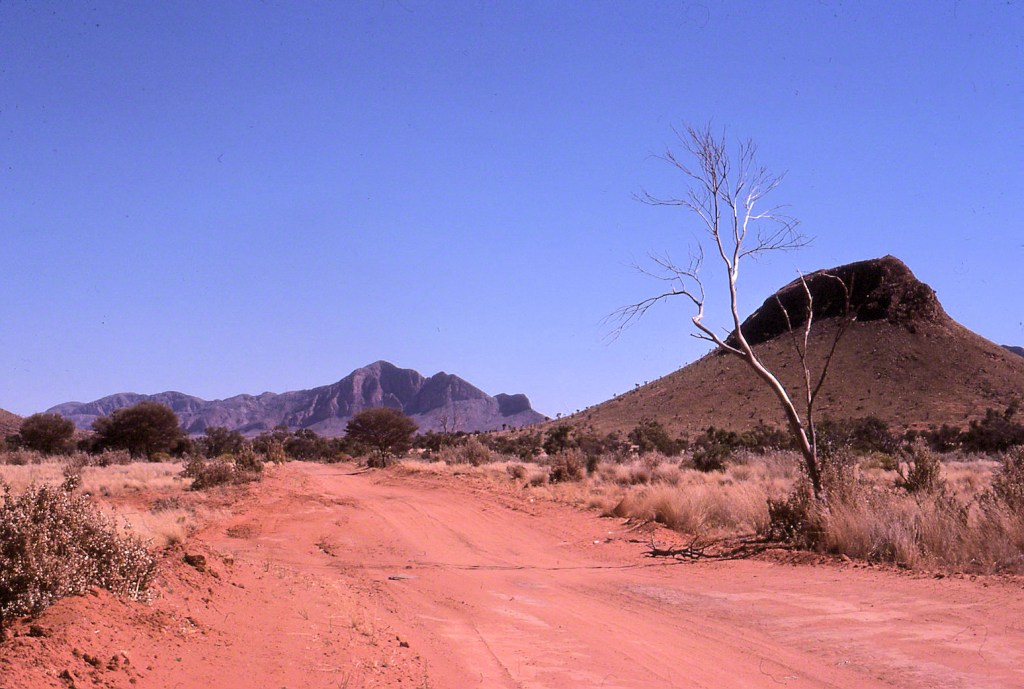
The Rover began to jerk and rumble over rocks and ditches. The jagged walls of the Gosse Range towered above us as the T-Team navigated the track leading into the middle of the range.
Sammy glanced left and right and wrung his hands together. Beads of sweat collected on his forehead and temples.
Once inside, Dad built a fire for the barbeque. Rick and Matt dangled sausages on sticks over the yellow flames. I gazed around the plain, its dry flat surface dusted with red-tinted sand and golden grasses. The range in shades of salmon pink surrounded this paddock. There seemed to be one lonely tree in the vast field that spanned several kilometres, and this was the tree we found to picnic under. While Mr. B and Harry set up picnic essentials on the tarpaulin, I watched Sammy pace back and forth.
‘Lee-Anne, can you select your beef steak, please, and put it on the grille?’ Dad called.
I turned and picked out a smaller portion to add to the sizzling pieces of meat on the grill on top of the coals. Then I looked up to track Sammy’s progress. Sammy had vanished.
‘What’s the matter with Sammy? Where’s he gone?’ I asked Harry.
Harry nodded. ‘The real reason Sammy no want to go to Areyonga—there’s a big initiation ceremony, a corroboree going on there.’
‘Ah, yes,’ Dad said. ‘He’s scared.’
‘Sammy’s not from that tribe,’ Harry explained.
‘Would he get killed if they saw him?’ Dad asked.
Harry nodded. ‘Even if he didn’t see the ceremony, they’d kill him just for being there.’
‘Really?’ I said. ‘No wonder Sammy wasn’t himself. He’s usually laughing and so funny. But not today.’
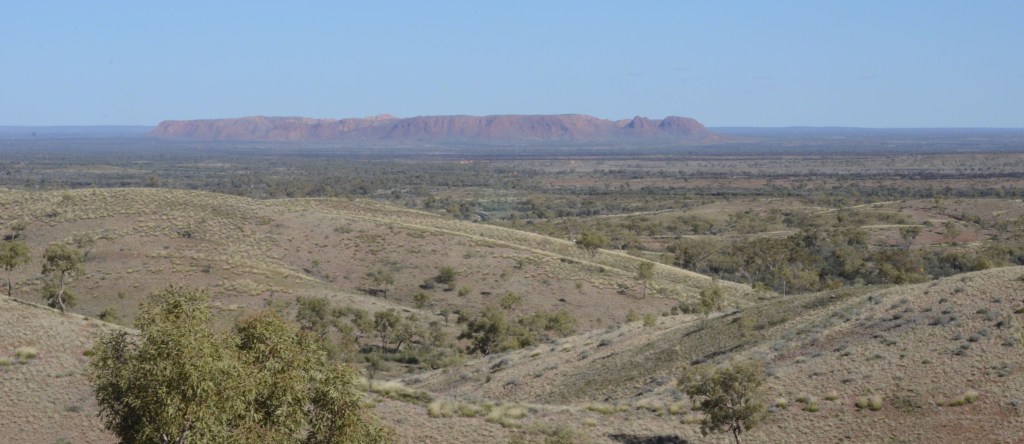
Munching on my steak, I absorbed the expanse of dried grass, and the ochre range that’s eroded, yet the mystery of the rites and customs of the Indigenous of this land on this day at least, fascinated me more than a crater created by a meteorite thousands of years ago. Still, I did wonder at the devastation and effect on the Earth such an impact would’ve had. The crater spans 4.5km in diameter, so must’ve been one big rock.
This time, the customary viewing of an icon of Australia, doesn’t quite go to plan.]
Dad meant what he said; he believed we, as the T-Team were travellers, not tourists. So, when the sun began its journey to the other side of the earth, and edged towards the western horizon, Dad drove further west and far away from the popular tourist haunts for the sunset on the Rock.
‘Don’t go too far,’ Mr. B said as he glanced back at the diminishing size of the Rock. ‘I want a red rock of considerable size.’
‘I know what I’m doing,’ Dad replied.
But every vantage point that we considered photo-worthy, so did clusters of tourists. The ants may have been heading for bed, but the road west of Uluru swarmed with sightseers scrambling over the landscape to capture that momentous event of the sunset on Uluru.
‘I hope we’re not going to miss Uluru turning red, ‘cos that’s what I came here to see,’ Mr. B said.
‘Plenty of time,’ Dad said. ‘Trust me.’
‘I’ll hold you to that promise, mate.’
Dad sighed and then turned into the next available place to park the Rover.
Mr. B glanced at his gold watch. ‘I mean to say, it’s nearly six o’clock. The sun sets at six, doesn’t it?’
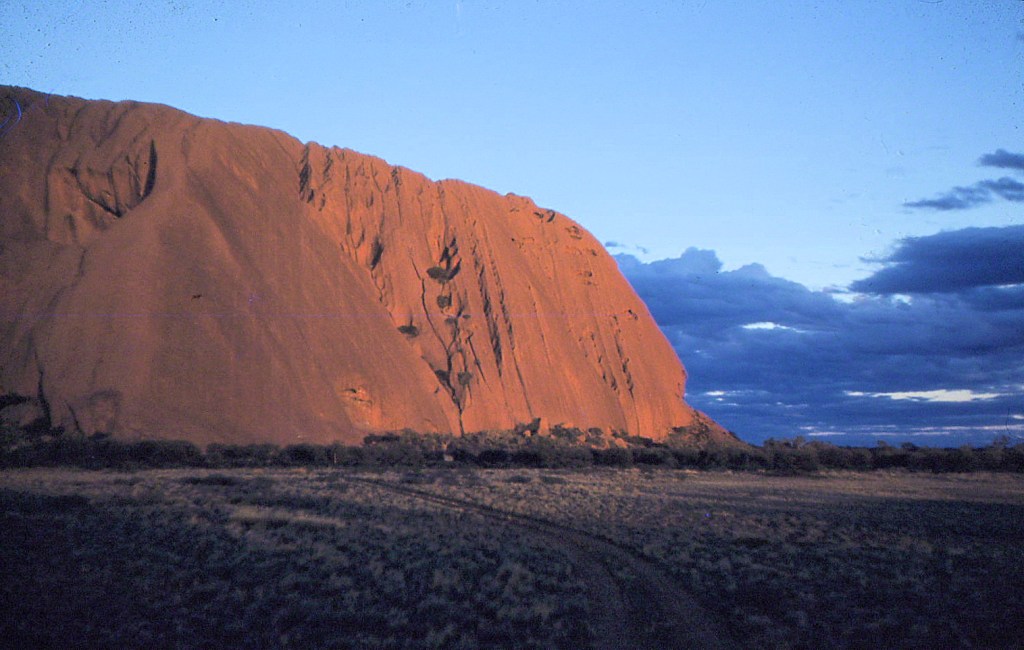
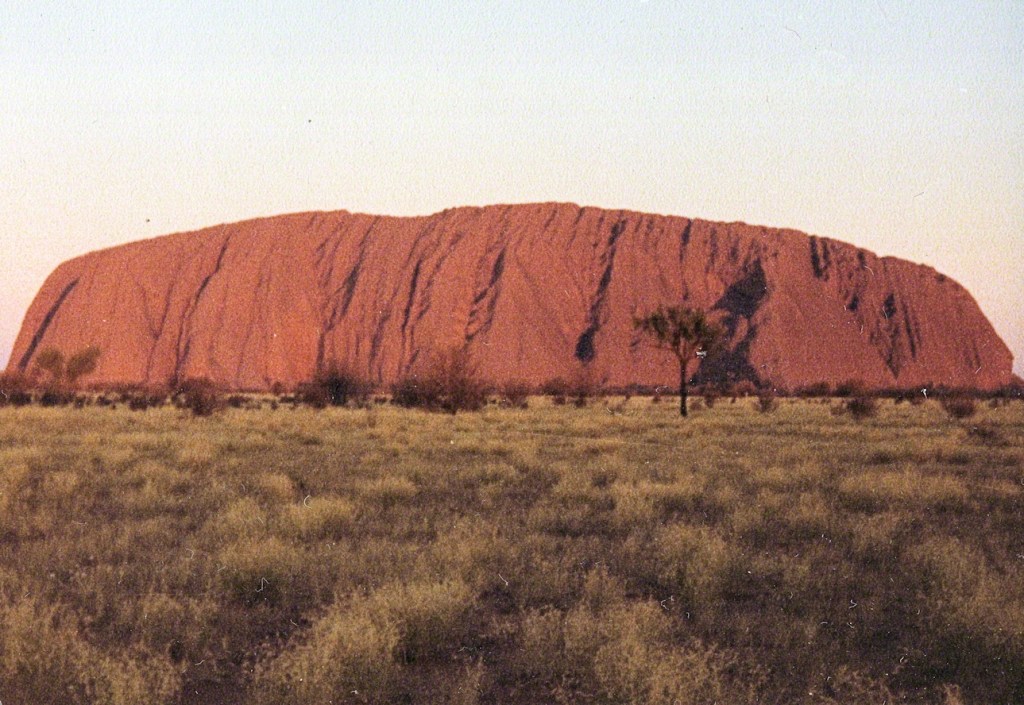
We joined the tourists in the small clearing to take the Uluru-at-sunset-photos. There’s one snap I took of two travellers admiring the Rock as it deepened in colour, more a rusty-red, than the scarlet I’d seen on calendars. So, it’s taken with an instamatic camera and the quality is pitiful compared to the chocolate-box number my grandpa took in the 1950’s, but I reckon it captures the atmosphere.
‘Enough of these tourists,’ Richard grumbled. Clutching his polaroid camera, he stormed up the nearest hill.
‘Wait!’ I called and raced after him.
My brother ignored me and quickened his stride. I tried to catch up but soon tired of his fast pace. I watched him vanish behind some spinifex bushes and decided his quest for tourist-free photos was pointless. I gazed at the Rock squatting behind waves of sand-hills and bushes. The view’s going to be just as good, if not better by the road and the masses, I thought and rushed back to Dad before the sun went down too far and the Rock had lost its lustre.
Uluru faded from clay-red to a dull grey and the tourist congregation thinned, trickling away in their cars and buses towards the camping ground situated east of the Rock.
‘Is that it?’ I quizzed Dad. The Uluru at sunset in my mind had been spectacular in its failure to deliver. ‘Why didn’t it turn bright red?’
‘You need clouds for that. Clouds make all the difference,’ Dad said, his lips forming a beak. ‘Glad my camera’s out of action and I didn’t waste film on it.’
‘But the photo of a red Ayres Rock taken by Grandpa had clouds around it.’
‘Yeah, well, there would’ve been clouds in the west too,’ Dad explained. ‘See, the sky is clear tonight, so that’s it for the Rock.’
‘Disappointing! A very poor show, ol’ friend.’ Mr. B sauntered past us with Matt tagging behind. ‘Come on, we better get to camp. Don’t want to be cooking in the dark. Don’t want the likes of egg soup again.’
Dad peered into the distant black lumps of hills. ‘Where’s Richard?’
I stared into the thickening darkness. No Richard. ‘Dunno, went into the sand-hills,’ I said with a shrug.
‘Oh, well, I guess he’s gone for a walk,’ Dad said.
The Rock became a dull silhouette on the horizon. We packed away our cameras and waited. And waited for Richard. Darkness settled on the land. We waited some more. The icy cold of the night air seeped into our bones. We waited but he did not appear.
‘Where could he be?’ Dad said and then stormed into the bush.
Minutes later, Dad tramped back to us waiting at the Rover. His search in the nearby scrub was fruitless.
Each one of us stood silent; silent sentinels around the Rover.
‘I hope he’s alright,’ my comment plopped in the well of silence. A chill coursed down my spine. What if an accident had befallen my lost brother? The dark of night had swallowed my brother up.
Dad grabbed the torch from the glove box in the Rover, and then marched back up the sand-hill.
I paced up and down the road. Mr. B folded his arms across his chest and scrutinised the shadows of bush that had now consumed Dad. Matt gazed up at the emerging mass of the Milky Way.
‘I hope they’re okay. I hope Dad finds Richard.’ My chest hurt with the pain of losing my brother.
Mr. B sighed. ‘Probably just a—’
‘What?’ I asked.
‘There they are,’ Mr. B said. ‘All that worry for nothing. You’ll get grey hairs if you keep worrying like that.’
I pulled at my hair and then raced up to my brother. ‘Where were you?’
‘I went out along the dunes. I kept walking and walking trying to find a good spot,’ Richard said.
Dad chuckled. ‘And when he did, he waited for the Rock to turn red.’
For the night we camped in an aboriginal reserve seven miles out of the Uluru—Kata Tjuta Reserve. In preparation for the trip, Dad had successfully applied for permission to camp there. This time Dad and I had two fires going each side of us as the previous night was so cold that I had little sleep. We hoped that two fires would be better than one to keep the chills away. Mr. B and his son Matt on the other hand, settled for one shared fire and superior fibres of their expensive sleeping bags to keep the cold out.
And Richard, after all his effort to scare us by almost getting lost, buried himself in his rather ordinary cotton sleeping bag, next to his single fire, and was the first one, after our rather simple rice dinner, to be snoring away, lost in the land of nod.



























 Tru-Kling Creations