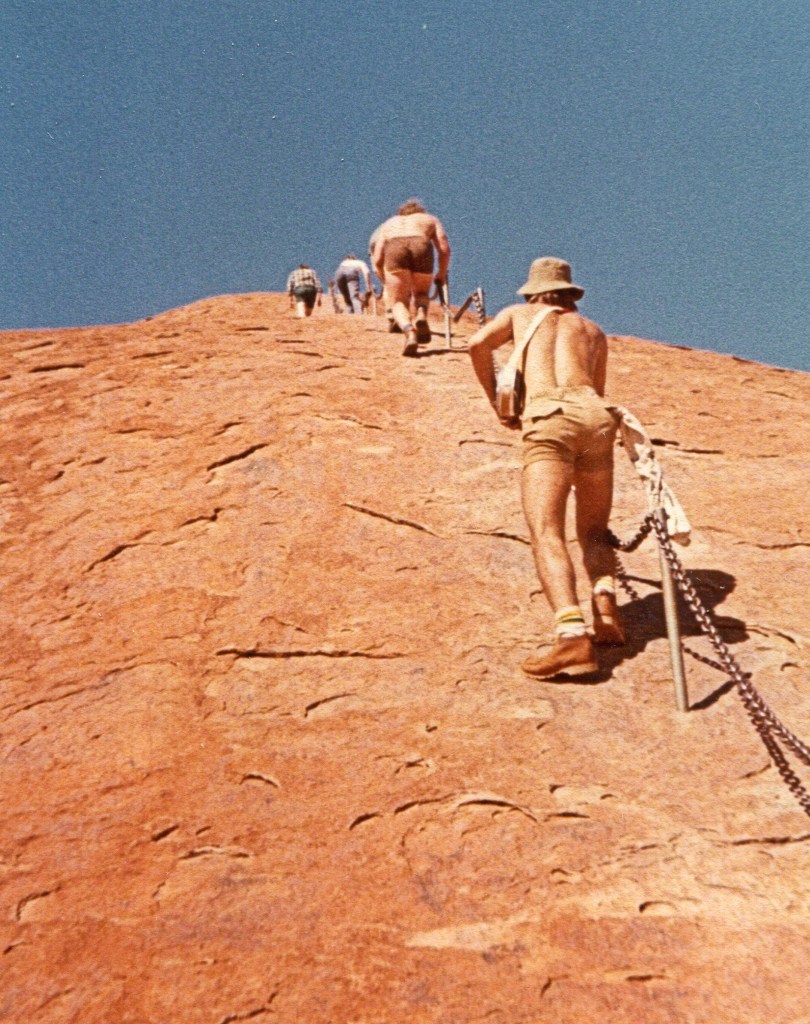
Travelling Thursday–The T-Team with Mr. B: Uluru

ULURU SUNSET—Lost

 [Finally, The T-Team with Mr. B: Central Australian Safari 1977 is published on Amazon Kindle.

This time, the customary viewing of an icon of Australia, doesn’t quite go to plan.]

Dad meant what he said; he believed we, as the T-Team were travellers, not tourists. So, when the sun began its journey to the other side of the earth, and edged towards the western horizon, Dad drove further west and far away from the popular tourist haunts for the sunset on the Rock.

‘Don’t go too far,’ Mr. B said as he glanced back at the diminishing size of the Rock. ‘I want a red rock of considerable size.’

‘I know what I’m doing,’ Dad replied.

But every vantage point that we considered photo-worthy, so did clusters of tourists. The ants may have been heading for bed, but the road west of Uluru swarmed with sightseers scrambling over the landscape to capture that momentous event of the sunset on Uluru.

*[Photo 1: Two blokes waiting for Uluru to turn © L.M. Kling (nee Trudinger) 1977]

‘I hope we’re not going to miss Uluru turning red, ‘cos that’s what I came here to see,’ Mr. B said.

‘Plenty of time,’ Dad said. ‘Trust me.’

‘I’ll hold you to that promise, mate.’

Dad sighed and then turned into the next available place to park the Rover.

Mr. B glanced at his gold watch. ‘I mean to say, it’s nearly six o’clock. The sun sets at six, doesn’t it?’

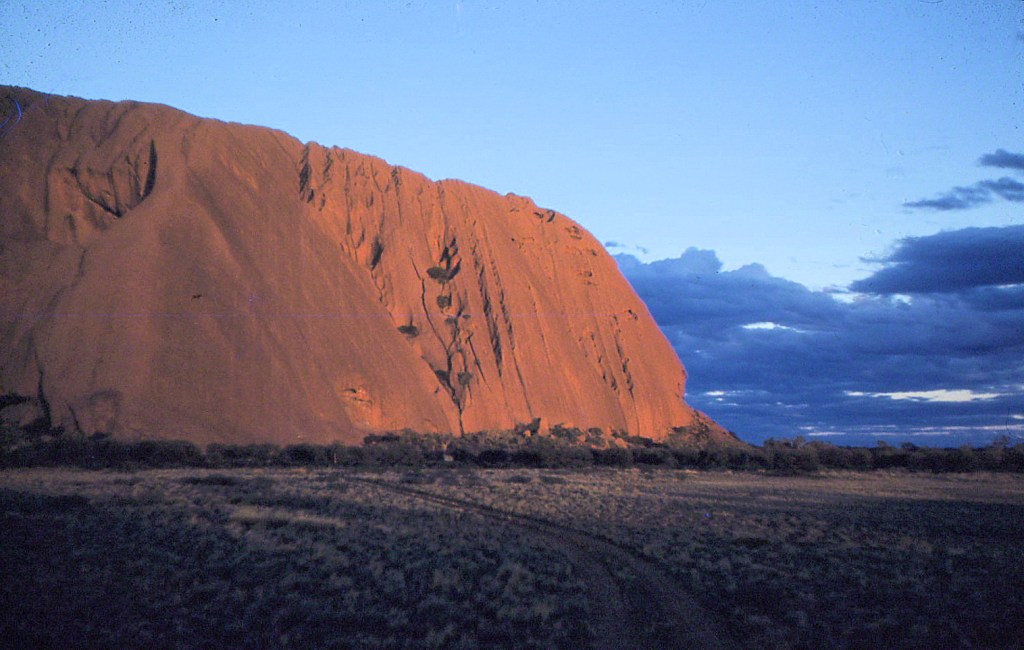
We joined the tourists in the small clearing to take the Uluru-at-sunset-photos. There’s one snap I took of two travellers admiring the Rock as it deepened in colour, more a rusty-red, than the scarlet I’d seen on calendars. So, it’s taken with an instamatic camera and the quality is pitiful compared to the chocolate-box number my grandpa took in the 1950’s, but I reckon it captures the atmosphere.
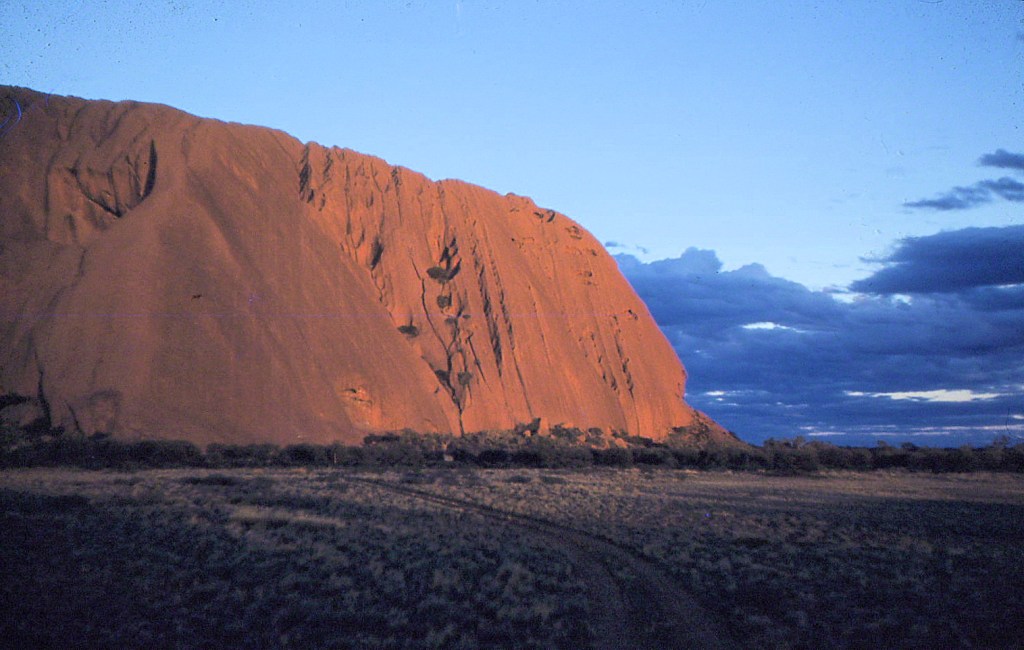
*[Photo 2: Nothing like the Uluru sunset my Grandpa took © S.O. Gross circa 1950]

‘Enough of these tourists,’ Richard grumbled. Clutching his polaroid camera, he stormed up the nearest hill.

‘Wait!’ I called and raced after him.

My brother ignored me and quickened his stride. I tried to catch up but soon tired of his fast pace. I watched him vanish behind some spinifex bushes and decided his quest for tourist-free photos was pointless. I gazed at the Rock squatting behind waves of sand-hills and bushes. The view’s going to be just as good, if not better by the road and the masses, I thought and rushed back to Dad before the sun went down too far and the Rock had lost its lustre.
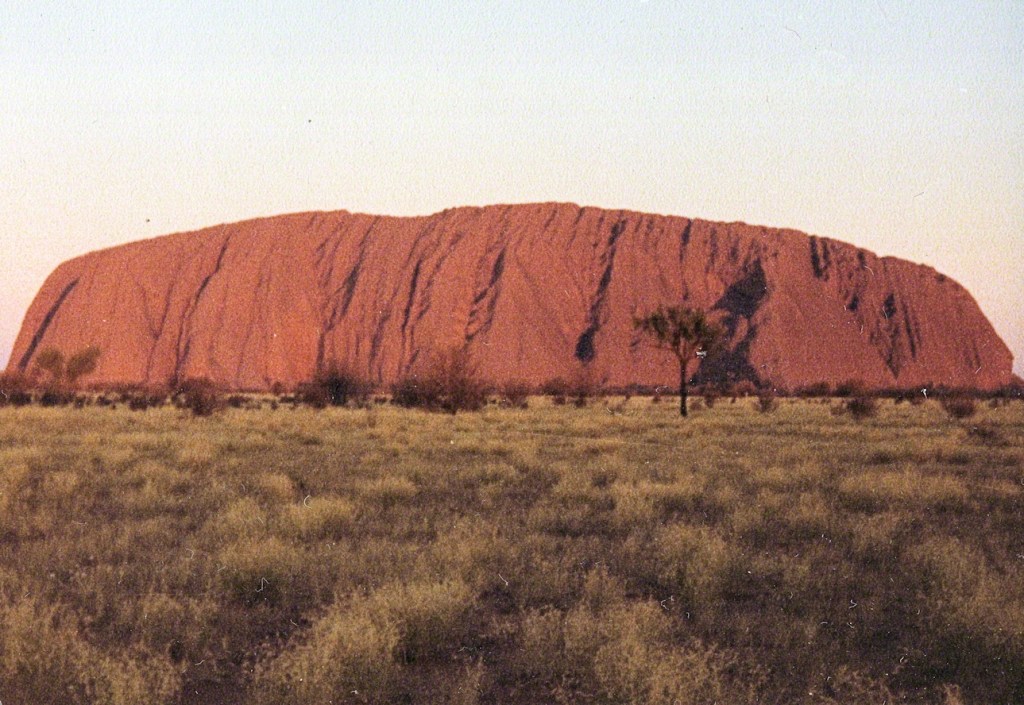
*[Photo 3: I mean, where’s the colour?? © L.M. Kling (nee Trudinger) 1977]

Uluru faded from clay-red to a dull grey and the tourist congregation thinned, trickling away in their cars and buses towards the camping ground situated east of the Rock.

‘Is that it?’ I quizzed Dad. The Uluru at sunset in my mind had been spectacular in its failure to deliver. ‘Why didn’t it turn bright red?’

[Photo 4: You mean, like this? Picture perfect, chocolate box in 2013 © L.M. Kling 2013]

‘You need clouds for that. Clouds make all the difference,’ Dad said, his lips forming a beak. ‘Glad my camera’s out of action and I didn’t waste film on it.’

‘You mean, the Rock doesn’t always turn red?’

‘No, it’s the clouds that make the difference.’

‘What on the Rock?’

‘No, to the west, where the sun sets.’

*[Photo 5: Yeah, clouds like the ones we had in 2013 © L.M. Kling 2013]

‘But the photo of a red Ayres Rock taken by Grandpa had clouds around it.’

‘Yeah, well, there would’ve been clouds in the west too,’ Dad explained. ‘See, the sky is clear tonight, so that’s it for the Rock.’

‘Disappointing! A very poor show, ol’ friend.’ Mr. B sauntered past us with Matt tagging behind. ‘Come on, we better get to camp. Don’t want to be cooking in the dark. Don’t want the likes of egg soup again.’

Dad peered into the distant black lumps of hills. ‘Where’s Richard?’

I stared into the thickening darkness. No Richard. ‘Dunno, went into the sand-hills,’ I said with a shrug.

‘Oh, well, I guess he’s gone for a walk,’ Dad said.

*[Photo 6: So different in 2013—All golden © L.M. Kling 2013]

The Rock became a dull silhouette on the horizon. We packed away our cameras and waited. And waited for Richard. Darkness settled on the land. We waited some more. The icy cold of the night air seeped into our bones. We waited but he did not appear.

‘Where could he be?’ Dad said and then stormed into the bush.

Minutes later, Dad tramped back to us waiting at the Rover. His search in the nearby scrub was fruitless.

Each one of us stood silent; silent sentinels around the Rover.

‘I hope he’s alright,’ my comment plopped in the well of silence. A chill coursed down my spine. What if an accident had befallen my lost brother? The dark of night had swallowed my brother up.

Dad grabbed the torch from the glove box in the Rover, and then marched back up the sand-hill.

I paced up and down the road. Mr. B folded his arms across his chest and scrutinised the shadows of bush that had now consumed Dad. Matt gazed up at the emerging mass of the Milky Way.

‘I hope they’re okay. I hope Dad finds Richard.’ My chest hurt with the pain of losing my brother.

Mr. B sighed. ‘Probably just a—’

‘What?’ I asked.

‘There they are,’ Mr. B said. ‘All that worry for nothing. You’ll get grey hairs if you keep worrying like that.’

I pulled at my hair and then raced up to my brother. ‘Where were you?’

‘I went out along the dunes. I kept walking and walking trying to find a good spot,’ Richard said.

Dad chuckled. ‘And when he did, he waited for the Rock to turn red.’
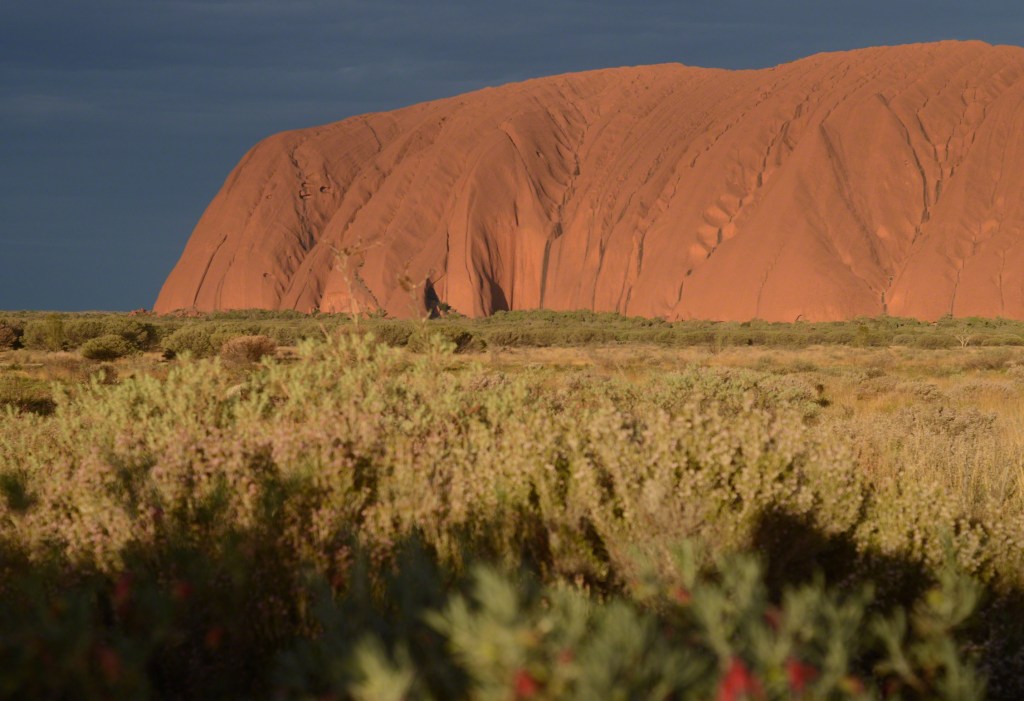
*[Photo 7: More of the “Red” Rock close up © L.M. Kling 2013]

For the night we camped in an aboriginal reserve seven miles out of the Uluru—Kata Tjuta Reserve. In preparation for the trip, Dad had successfully applied for permission to camp there. This time Dad and I had two fires going each side of us as the previous night was so cold that I had little sleep. We hoped that two fires would be better than one to keep the chills away. Mr. B and his son Matt on the other hand, settled for one shared fire and superior fibres of their expensive sleeping bags to keep the cold out.

And Richard, after all his effort to scare us by almost getting lost, buried himself in his rather ordinary cotton sleeping bag, next to his single fire, and was the first one, after our rather simple rice dinner, to be snoring away, lost in the land of nod.

© Lee-Anne Marie Kling 2016; updated 2018; 2022; 2023

*Feature Photo: Sunset on the Rock © Lee-Anne Marie Kling (nee Trudinger) 1977

***

Find out how the adventure with Mr. B progresses.  

Click on the link, The T-Team with Mr. B

And join the journey back in time to the 70’s and into the Centre of Australia.

T-Team Series–Climbing Ayers Rock

The T-Team With Mr B (16)

 [The last few months I have revisited The T-Team with Mr. B: Central Australian Safari 1977 which is a prequel to Trekking With the T-Team: Central Australian Safari 1981. In preparation for its release later this year, I will be sharing posts of this adventure.

In this episode we climb Uluru/Ayers Rock and Mr. B startles us with his dream for the Rock…]

Mr. B’s Dream for the Rock

Tourist buses lined the carpark. They looked like caterpillars all in a row ready for a race. People swarmed like ants around the base of the Rock and a steady stream of them marched up and down the slope.

Dad slowed the Rover to a crawl and slotted into a space at the end of the carpark. ‘Well, there’s the tourists,’ he said.

‘And what are we?’ Mr B asked.

‘I like to think we are travellers.’

‘What’s the difference?’

‘Tourists come to a place like the Rock, they climb it, snap a few photos and then they move on,’ Dad said. ‘Travellers take their time. They explore. They get to know the people who live here. They appreciate the culture and history of the place.’

‘So we’re tourists then,’ Mr B remarked, his expression dead-pan.

Dad scratched his brow. ‘Oh, no, I wouldn’t say that.’

‘I’m climbing the Rock,’ Matt said and then bolted out the back door.

Richard and I chased after Matt. We scrambled up the slope following the painted white line. Further up several tourists inched their way grasping chain rails that were secured into the rock.

*[Photo 1: Open at Last to climb the Rock © L.M. Kling 2013]

‘Hoy!’ Dad yelled. ‘Wait! We all go together.’

‘You forgot your water-bottles and lunch for the top,’ Mr B said.

‘Come on Matt,’ Richard called out to Matt who’d sprinted ahead, ‘better get our packs and stuff.’

Matt, Richard and I plodded back to Dad and Mr B where we collected our backpacks of supplies from them. Then as a group we recommenced our haul up the monolith.

The first part was treacherously steep. Before I even reached the rails, my shins ached from the gradient. We followed the broken white line. Deviation from the nominated path could be fatal. A plaque at the base of the Rock was a solemn reminder that several people had fallen to their deaths.

And yet, while climbing, I recall my mum telling me that when she climbed Ayers Rock back in the 1950’s, there was no white line, and not rail to clutch onto. Then she told me a funny story about an earlier time when a filmmaker took footage of the climb up the Rock with a local Indigenous guide. I have seen this film where at the top of the rock, there were pools from recent heavy rain, and the guide can be seen splashing in the water. Perhaps life and the way the Rock was viewed was different back then in the 1940’s and 50’s.

*[Photo 2: No rails or white line back in the 1950’s © S.O. Gross circa 1953]

Richard and Matt scampered ahead of me. I puffed my way up the slope behind them and soon lost sight of them. Dad and Mr B laboured behind me. Mr B rested every few steps. He swore he’d die of a heart attack before he fell to his death. Dad stayed with him and encouraged him to keep on going.

*[Photo 3: Climbing with Help © L.M. Kling (nee Trudinger) 1981]

Tourists passed me as they descended the Rock. They nodded and said, ‘G’day’ and remarked that the climb was well worth the effort.

Spurred by these recent Uluru conquerors, I took a deep breath and continued the climb.

The steep slope eased into endless ridges. Up and down. Up and down. At least my shins experienced some relief. But I seemed to be hiking over these rocky hills and dales forever, as if Uluru was the Tardis of distance. I glanced at my watch. I’d been hiking over an hour. Was the Rock that big?

*[Photo 4: Those undulations © R.M Trudinger 1981]

I stopped, took a swig of water from my canteen and surveyed the plain beneath. The Olgas shimmered like mauve marbles above the land striped in sienna and gold in the afternoon sun.

‘You’re almost there,’ Richard called. He raced up to me and then pointed. ‘The cairn is just over there.’

‘Where?’

‘Are you blind?’

‘I can’t see it.’

‘Come on.’

Richard led me to the pile of stones set in concrete. Half a dozen tourists plus Richard and Matt milled around the cairne, posing for photos and pointing at the various landmarks below. Richard, Matt and I conformed to the way of the tourists taking turns photographing each of us standing next to the cairn with Kata Tjuta behind us.

*[Photo 5: The Young Ones On the summit © L.M. Kling (nee Trudinger) 1977]

As we waited for our fathers, we admired the awesome scenery; the land below bathed in waves of pink, purple, blue and yellow. The boulders of Kata Tjuta changed from deep purple to blue with the movement of the sun as it travelled west. ‘Wow!’ I exclaimed. ‘This climb was well worth it.’

Other tourists summited, stayed a few minutes to snap a few shots and then trooped away down the Rock.

After Richard, Matt and I had eaten our sandwiches, signed the log book on the cairn, explored some bushes that grew out of the Rock and then watched the third lot of people arrive and disappear, Dad and Mr B staggered to the summit. Their faces glowed with perspiration.

Mr B clutched his chest and slumped down by the cairn. ‘I thought those corrugations would never end!’

Dad patted Mr. B on the back. ‘Ah, well, we made it.’

Mr B slurped water from his canteen, then standing up, he paced around the cairn while scrutinising the landscape with his binoculars. Dad pointed out the landmarks, Mt. Conner to the east, Kata Tjuta to the west and the Musgrave Ranges to the south, and so directing Mr B’s binocular-gaze.

*[Photo 6: The Oldies finally reach their goal © L.M. Kling (nee Trudinger) 1977]

After several minutes admiring the view, Mr B remarked, ‘Amazing! Certainly well worth the climb, ol’ boy.’ He then sidled up to Dad and put his arm around his shoulders. ‘I dare say, ol’ chap, the experience could be improved.’

‘What? A cable-car up to the top?’

‘Oh, hadn’t thought of that. No, I suggest there should be a fast food restaurant up the top here. The place needs refreshments. I mean to say, all these people have spent two hours climbing up here. They need some refreshments, don’t you think?’

Dad cleared his throat. ‘Er, um…’

Is this man for real? I thought. On the climb and also when we visited the cave, I sensed the Rock was holy, sacred. How could Mr B even contemplate building anything on its surface? ‘I reckon there should be less people climbing the Rock, not more,’ I said.

‘And another thing,’ Mr B was not finished, ‘the Rock needs a swimming pool halfway up. I’ve already picked out the perfect location. You see, while I was resting and contemplating during that terrible steep climb, I saw it, the perfect place for a pool. What do you say, ol’ chap?’

‘The Indigenous owners will never agree,’ Dad replied.

‘Well, I have some advice for the natives,’ Mr B said. ‘They need to get with the times. I mean, look at all the tourists. Look at all the opportunities.’

‘I doubt it,’ Dad shook his head, ‘come on, we better get down.’

After Dad and Mr B signed their names in the log book, we made our way down the Rock tracking along the white line. We nodded at the people climbing up and said, ‘G’day’ to them and advised them that the climb was well worth the effort.

*[Photo 7: Uluru rest finally at sunset © S.O. Gross circa 1953]

© Lee-Anne Marie Kling 2016; updated 2022

*Feature Photo: Uluru Climbers Like Ants © Lee-Anne Marie Kling 2013

***

Want more but too expensive to travel down under?

Why not take a virtual travel with the T-Team Adventures in Australia?

Click below:

Trekking With the T-Team: Central Australian Safari 1981

And escape in time and space to the Centre of Australia 1981…