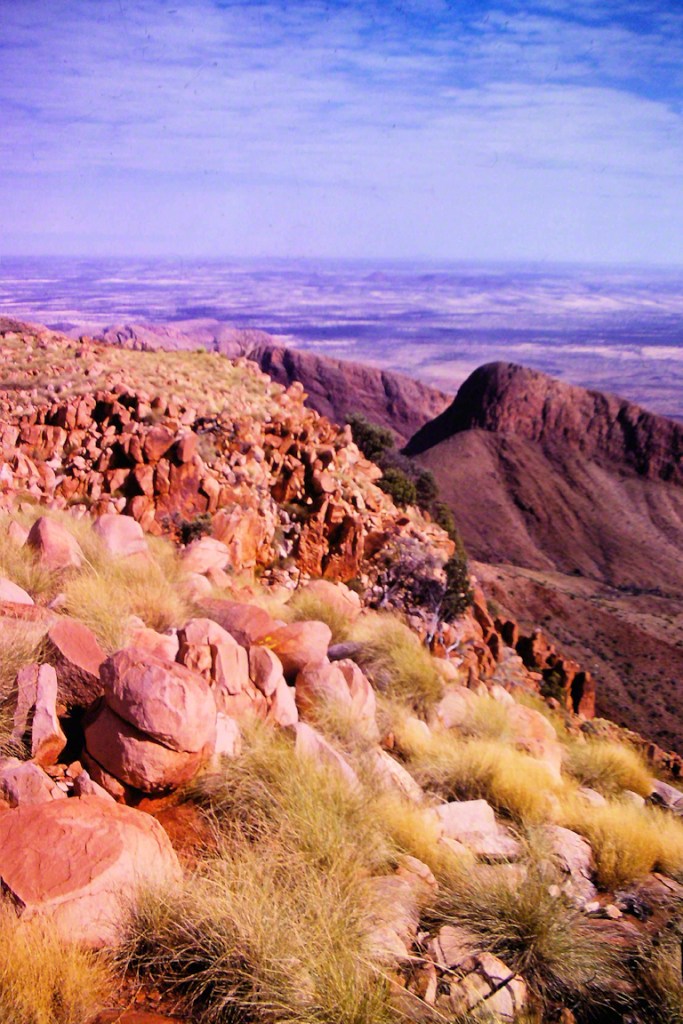
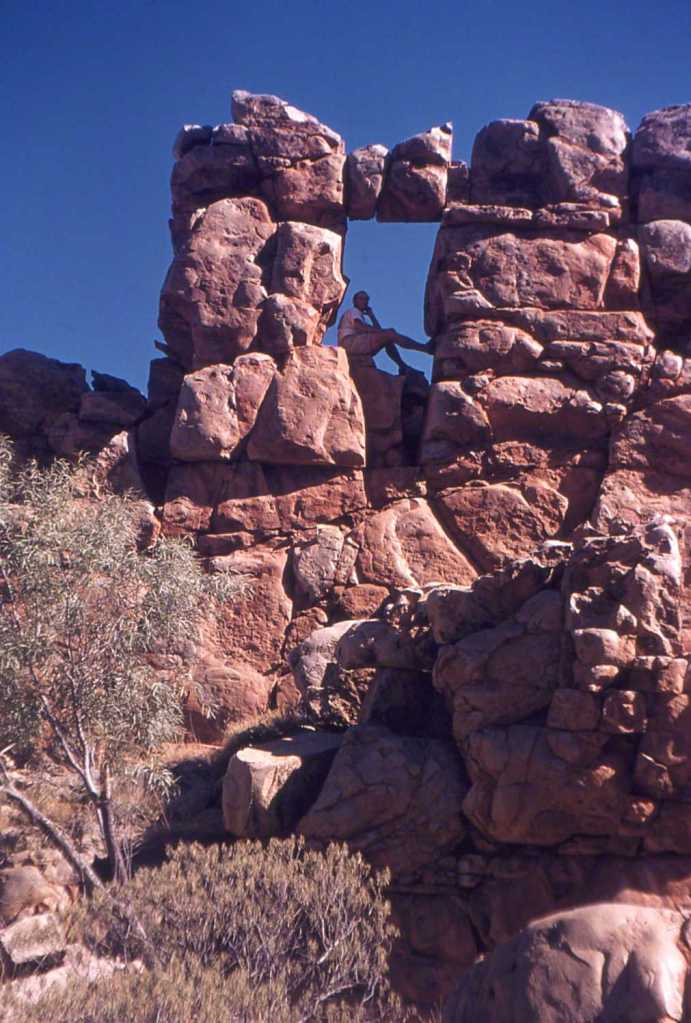
All alone, I fidgeted. How long were they going to be? Where have they all gone? I edged towards the height of the gully and looked over. A loose stone skittered down the cliff. I retreated to the safety of the gully and waited. I bit my nails. Had they all fallen to their deaths? Do I join them? I stuck my head through the gap, then my shoulders, and finally my whole body. I placed my hand on the granite. How did they get up here? My height-challenged frame failed to reach the footholds and niches necessary to climb this rock wall. How did they do it? I stood on tiptoes, trying to reach a notch. Just too high. Just my luck, I’ve been left here all alone.
‘I don’t know. Splattered on the rocks at the foot of the mountain.’ I reached for my brother. ‘Where have you been? Where are the others?’
‘At the top,’ Richard, my brother said.
‘But what about me?’
‘Don’t worry, I’ll help you.’ My brother scrambled down. ‘Now climb on my shoulders and David will pull you up. Then you’ll be right. This is the hardest part.’
I did as I was told. I steadied myself on my brother’s shoulders and from there David grabbed my wrist and pulled me to the next level. Then I negotiated the rock-pile obstacle course on my own and made it to the summit of Mt Liebig a second time. My arrival recorded at 9:28am.
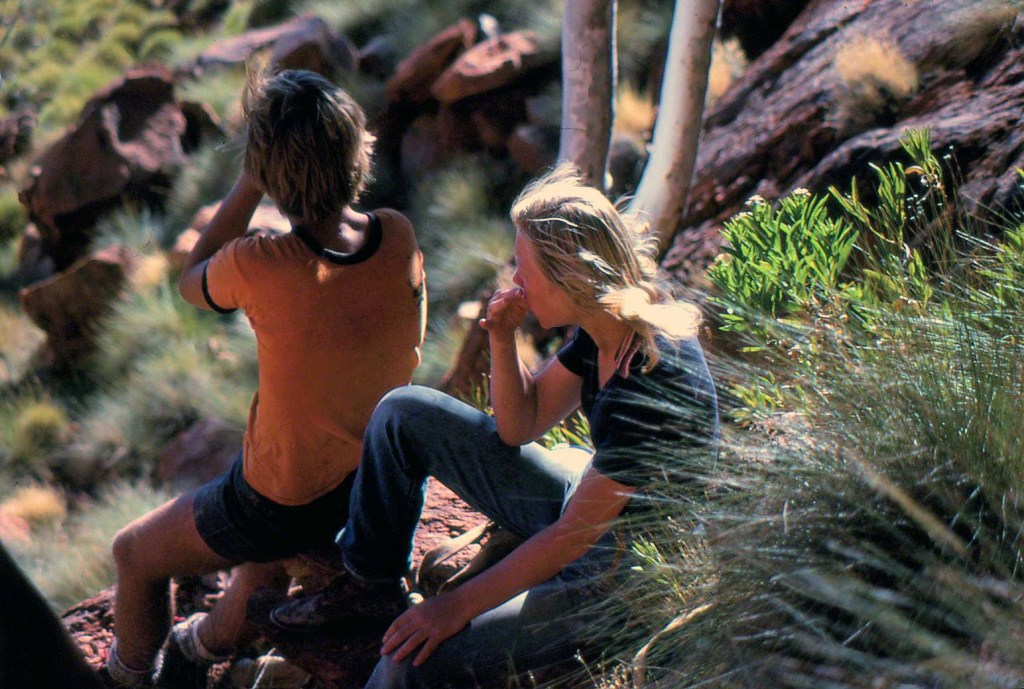
Older cousin (C1) perched himself on a flat stone and wrote his diary. Rick fiddled with his spinifex shin guards and muttered, ‘Fat lot of use they were.’ He picked at cunning spikes that had slipped past the guard. Younger cousin (C2) munched on an apple. Dad peeled an orange and with hearty slurps sucked its juices. David wandered around the summit, gazing at the land below, and then examining the cairn of stones.
‘We are on the right peak, aren’t we?’ Dad wiped the orange drips from his beard. He pointed at the other peak. ‘There’s a cairn of stones over there.’
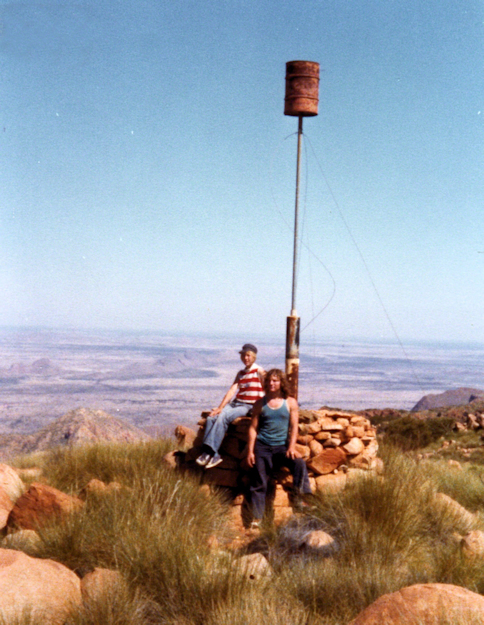
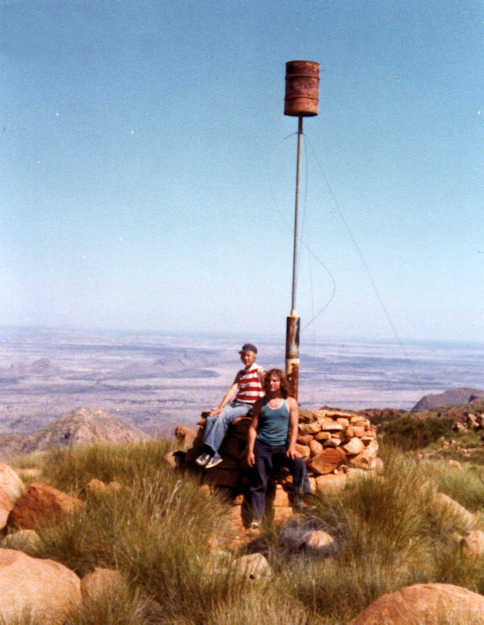
‘Hmmm.’ David stroked his beard. ‘I think so. That one’s used for surveying.’ He picked up a rock and then as if by magic, extracted a rusty old can from the cavity. Without saying a word, he pulled out a roll of paper. He unfurled the paper and his eyes darted from right to left over the page.
C1 ran his finger along the top of the page. ‘The 27th of August 1981.’
Dad counted on his fingers and then said, ‘Well, fancy that! Exactly four years to the day.’
‘Must be the date to climb Mount Liebig,’ C1 said and returned to scribing in his journal.
We remained at the summit at least an hour, engraving our names with the amazing date onto a stone, and celebrating our Liebig conquest with fruitcake for morning tea.
[Note from the author: We ascended to the summit, not two weeks before that Dad had calculated, but one day before Mr. MacQueen and Smith summited. We climbed Mt Liebig on August 26, 1977. Read our adventures in the series Travelling with the T-Team: Central Australia 1977, particularly our previous venture climbing Mt. Liebig, “We almost Perished”.]
Dad looked at his watch and said, ‘The time is 7:05 am.’ I imagined him continuing with “Captain’s Log, Star Date the 27th of August 1981…” But Dad’s focus switched to negotiating the lumps and bumps of the make-shift road ahead.
We parked near the foot of the range and then hiked through the second gully from the north-eastern edge of mountainous waves jutting up from the plain. We trekked up and down four ridges until we arrived at the base of the gully nearest Mt. Liebig. The lads bounded up the gully while I lagged behind with Dad.
My father seemed to be dragging his feet. He looked left and right, and every so often screwed up his nose.
‘You won’t find it,’ I said.
Dad kicked a spinifex clump. ‘No harm in trying.’
‘You lost the quart can last time we climbed four years ago, way before the gully leading to the summit. Besides, we went a different way.’
‘Oh, I thought it was around about here… You never know.’
Dad scanned the prickle bushes, loose rocks and red sand for his beloved quart can. How Dad survived the intervening years between 1977 and now, without his quart can, I’ll never know.
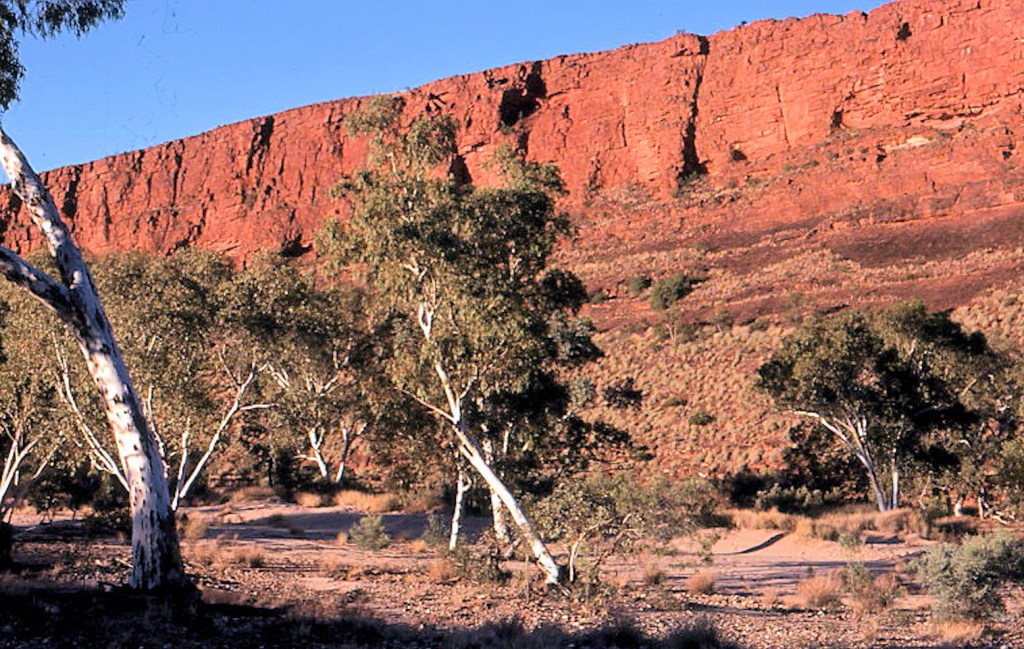
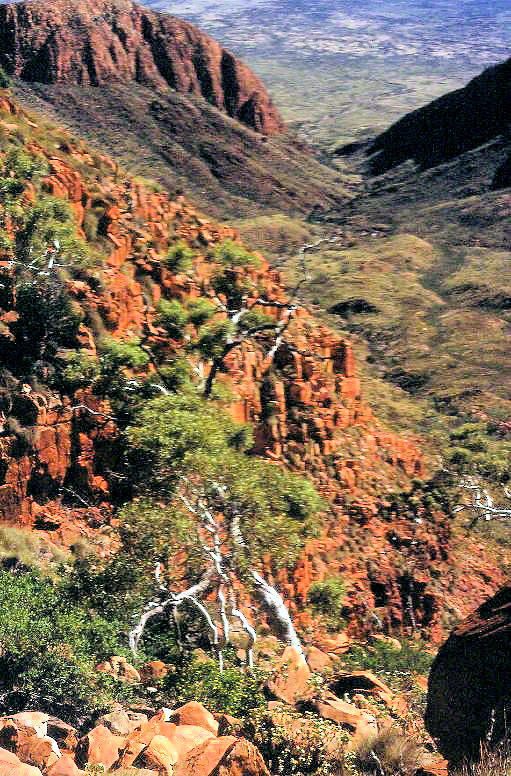
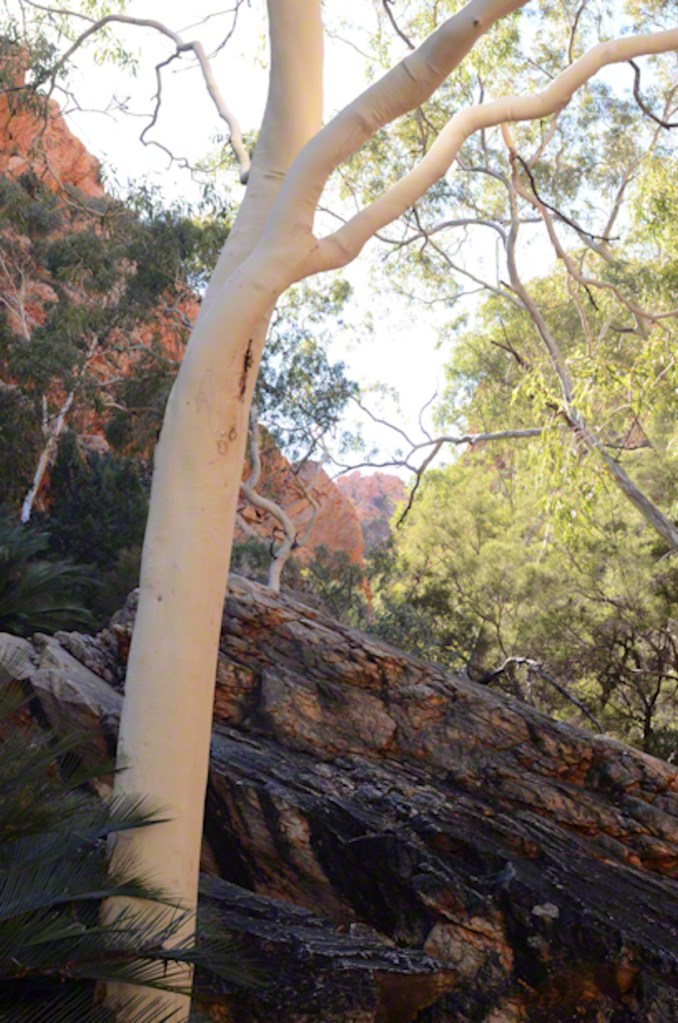
‘I remember that ghost gum,’ Dad said and pointed at the gum as if its pure white bark set against the blend of purples in the cliffs shadows held special powers to cause Dad’s quart can to materialise.
We rested under the ghost gum, eating apples, sucking lemons to find strength to continue, but we failed to locate Dad’s trusty old quart can. Dad gazed over the valley of silver slopes of grass, his mouth downturned, and his glasses fogged over. He missed that quart can. He stood and patted his pockets. ‘Ah, well! We better keep on going.’
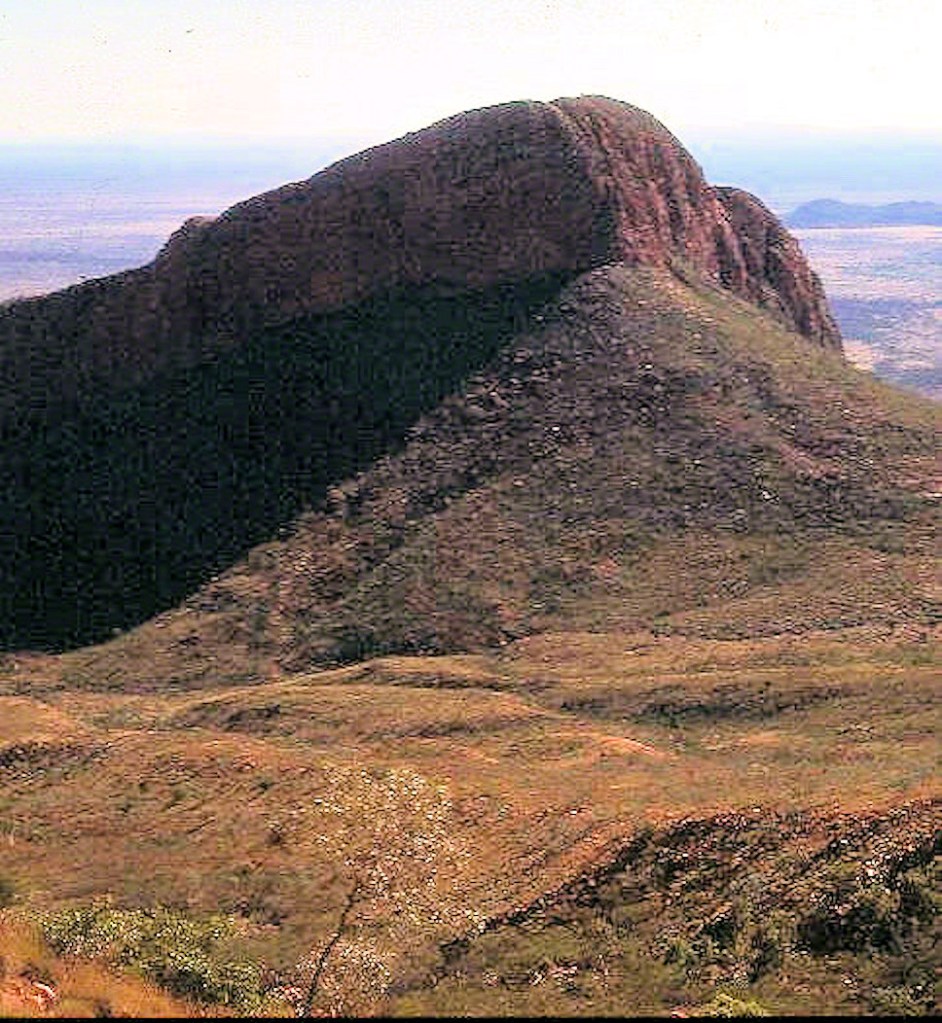
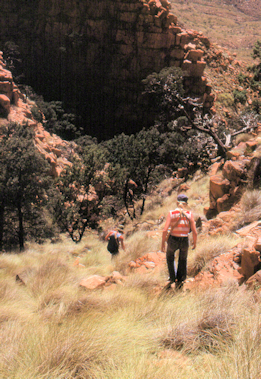
One by one we hauled our packs on our backs, and loaded up as pack animals, we picked our route over rocks, loose stones and sharp spinifex spears. My brother wore home-made vinyl shin guards. Much had changed since we last hiked up here in 1977; boulders had fallen down, the spinifex grew in more abundance, and effigies of burnt trees dotted the terrain. Single-file we mounted the steep ascent until we reached the pair of five-metre-high walls at the top of the gully.
Dad shaded his eyes and squinted up the barrier of rocks to the west. ‘I don’t know,’ he said. Some of the ledges on the cliff had crumbled.
My brother sprinted up through a gap in the boulders. We waited for his return and signal to proceed.
The wind whistled through the alley of cliffs. I looked through the crevice between the rocks. No sign of My brother.
‘I hope he’s alright,’ I said.
More minutes passed. We sat poised to move at any moment as if sitting on spinifex, yet we remained calm, mesmerized by the emptiness of the landscape, and the silence.
I looked through the gap again and asked, ‘What’s taking him so long?’ Then I slumped onto a large stone. Visions of my brother falling off the cliff plagued my imagination.
‘I’ll go up and have a look,’ David R (our guide) said, and then he disappeared through the hole.
More minutes ticked by. I glanced at the hole that had swallowed up David. ‘What’s happened?’
‘Just be patient.’ Dad seemed content to sit staring at the scenery. ‘They’ll come back.’
But they didn’t. Instead, the hole drew in older cousin (C1), followed soon after by younger cousin(C2). I peered into the tunnel of no return.
Dad hovered at my back. ‘Don’t go up there.’
‘Why not?’ I replied. ‘Everyone else has.’
‘Let me see,’ Dad said as he nudged me away. He crawled further in the hole and traced the granite wall inside with his fingers.
‘Don’t you leave me behind.’ I saw Dad place his foot in a crag and lever his way up to a ledge. ‘You tell someone to come back and help me, you hear.’
Dad called back. ‘Don’t you move.’
Easy for him to say. ‘Yeah, okay, but don’t forget about me.’
Have been reviewing The T-Team with Mr. B, the prequel to my first travel memoir, Trekking With the T-Team: Central Australian Safari 1981. The updated manuscript has been resting long enough for me to revisit Mr. B and his intrepid adventures with the T-Team. Ready to publish…Maybe in the new year.
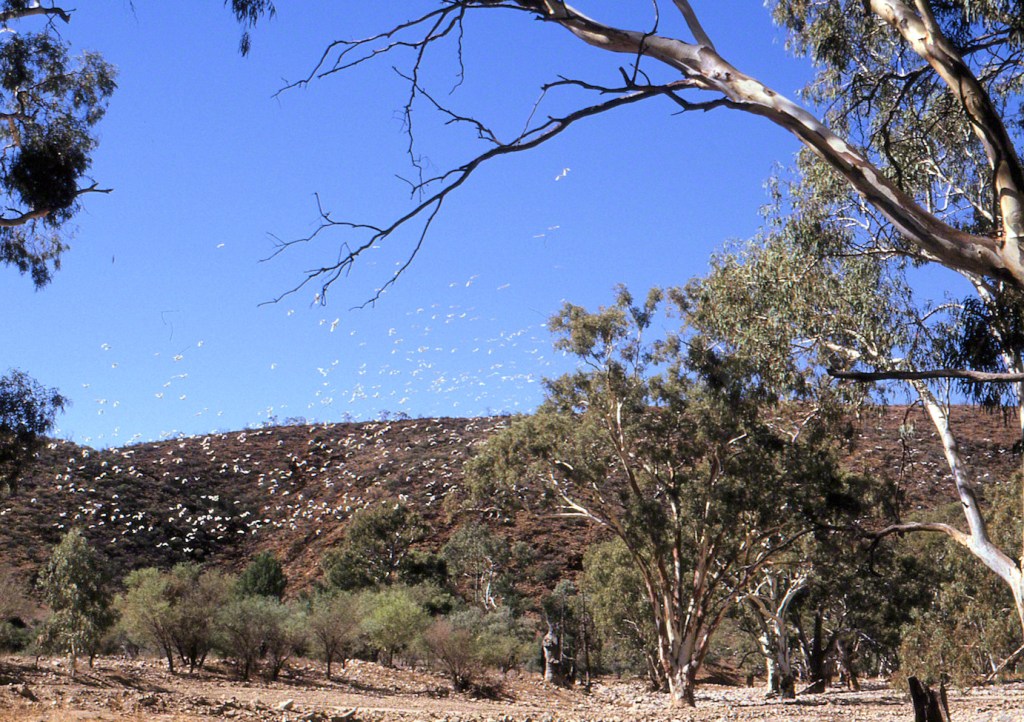
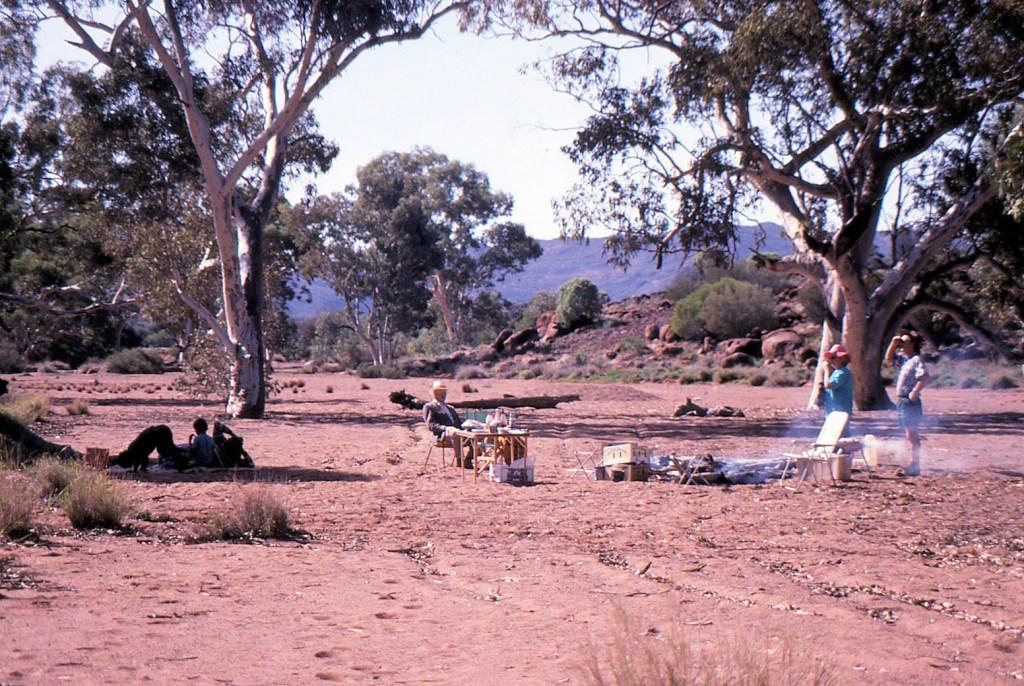
The sun sparkled through the gold-green leaves of the river gums, and a flock of white cockatoos chattered in the branches. The air hinted warmth and enticed me out of my sleeping bag to explore. Dad had mentioned we’d be probably camping near Curtain Springs on our journey to Ayers Rock (now called Uluru). But this morning I wanted to check out a spring closer to camp.
I ambled down the soft sands of the creek bed, past Mr. B wrapped up in his sleeping bag of superior fibres for warmth. He smacked his lips and snored as I trod to the side of him. Matt and Richard stood like the risen dead warming the cold blood in their veins by the fire, offering no help to Dad who stirred the porridge.
‘You sure that’s porridge?’ I asked Dad.
‘Of course it is!’ Dad snapped and then peered into the billy to be sure.
‘Can never be too sure, after egg soup last night,’ I said and kept on walking.
Richard and Matt laughed. First sign of actual life from the boys I’d seen that morning.
Dad called after me. ‘Er, Lee-Anne, where are you going?’
‘For a nature walk.’
‘Oh, don’t be too long, breakfast is almost ready.’
I patted my camera bag. ‘Yes, Dad.’ Just after I’ve checked out the spring to see if the scene was worthy to be photographed. No need to tell Dad that information. He’d just try to persuade me to have breakfast first and then I’d miss the not so early morning photo opportunity.
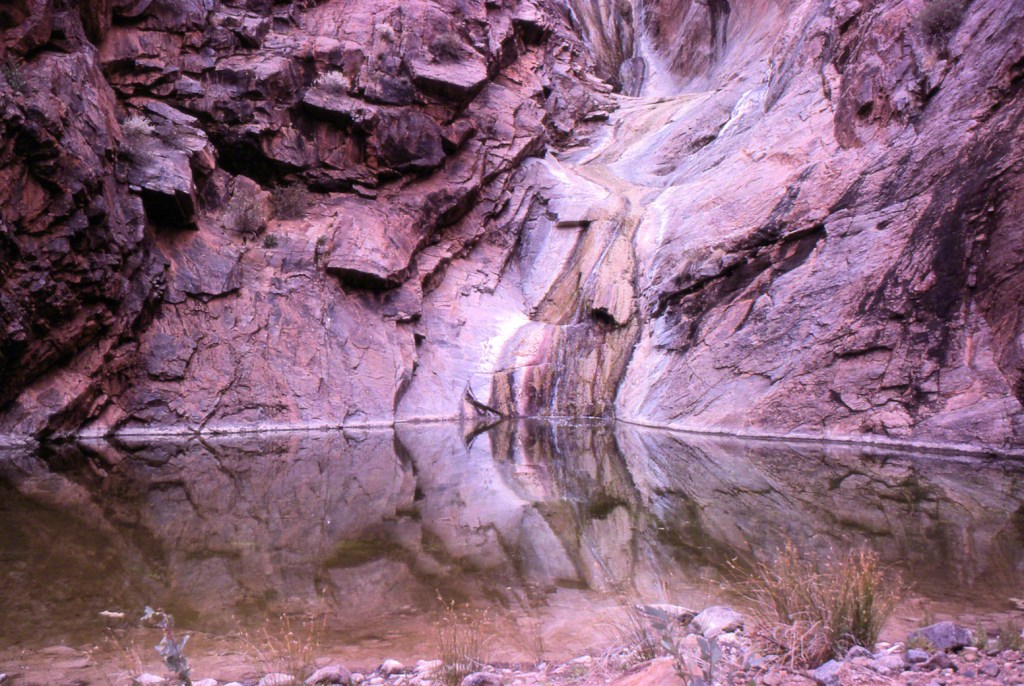
The creek narrowed, and I scrambled over rocks, pushed through reeds to the spring. Anticipating a pretty pond, with waterlilies, ducks and a kangaroo or two drinking the fresh clear water, I was disappointed. The spring, if you could call it a spring was little more than a pit of slime. A puddle at the end of our driveway at home was more photogenic than this hole filled with muddy water.
After a glance at the so-called spring, I tramped back to camp and ate cold porridge for breakfast.
After our “business trip” to civilisation, Ernabella, where we collected the trailer, had a shower, filled up with petrol, water and replenished our supplies from the store, we began our travels to Uluru.
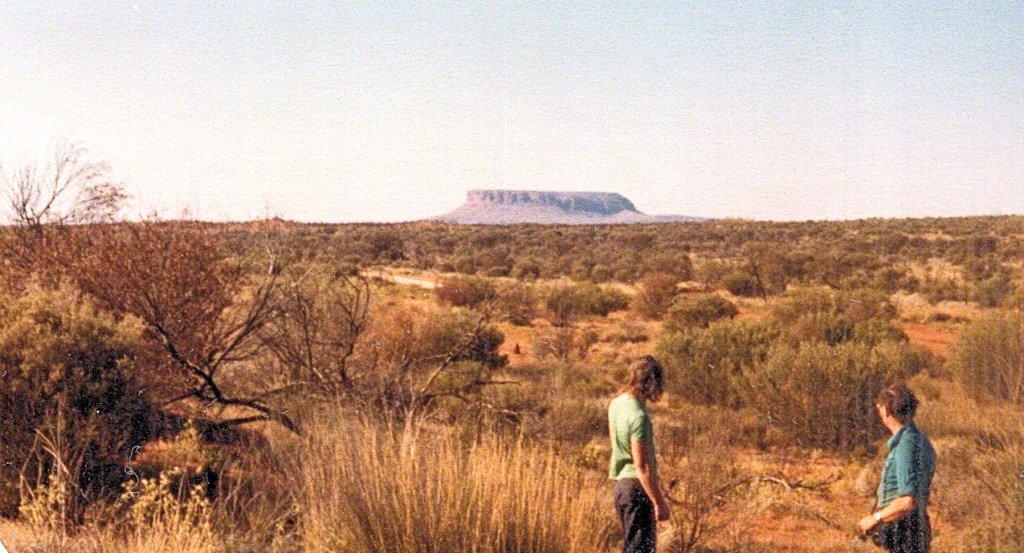
On the way a large flat-topped mountain emerged through the red sand dunes.
‘It’s Mt. Conner. Remember we saw it from Mt. Woodroffe?’
‘How come it’s higher than the land around it?’
‘In Central Australia’s prehistoric past,’ Dad explained, ‘this piece of land kept its integrity while the surrounding area had eroded away. It’s called a mesa.’
I was fascinated by this monolithic plateau. ‘Can we stop and get a photo of it?’
‘When I find a good place to stop,’ Dad said.
He kept on driving up and down the red waves of sand hills, winding left and right, the mesa appearing and disappearing, never quite the perfect view or park for our Rover. We rolled onto the plain and in the distance, Mt. Conner rose above the dunes. Dad parked the Rover at the side of the road and we jumped out. I hiked further up the road. The flat-topped mountain looked so small in the viewer of my instamatic camera.
‘I’m afraid so,’ Dad said. ‘Can you fix it, Richard?’
The men gathered around the trailer, once again sinking into the ochre sand and leaning on its side.
‘It’s the springs.’ Dad circled it like a shark. ‘Can’t take the rough track.’
‘Hmmm,’ Mr. B grunted, his hands on hips and elbows akimbo.
Richard lay down on the ground and peered up into the trailer’s underside.
Dad sighed. ‘We better unload the trailer, I suppose.’
While the men relieved the ailing trailer of its load and bound up the fissure with some rope, I scaled a small rise and took several shots of Mt. Conner. Then as the males in the T-Team stuffed most of the luggage into the back of the Rover and then with the light left-overs, reloaded the trailer, I gazed at the mesa, this top-sliced mountain in an expanse of yellow grass and sienna dunes. Boring! My photos needed a human figure to add interest. Richard and Matt, having completed their trailer-duties, wandered up the road.
I ran down the hill and chased after Richard. ‘Take a photo of me.’
Richard gazed up at the cobalt blue sky. ‘Oh, alright.’
Positioning myself on the side of the road, I looked at Richard. ‘Come on, I’m ready.’
‘Just wait, move to the right,’ Richard said.
I did and then noticed Richard’s finger hovering over the camera lens. ‘Move your finger.’
He shifted it, but as he snapped the photo, I thought his digit remained too close for comfort to the lens.
To ensure I acquired at least one good shot, I photographed Matt, then Dad and Richard as my humans in the foreground of my mesa muse.
[Last week safety in South Australia was threatened by that all too familiar nemesis Co-vid, and again restrictions were put in place. Many activities were “verboten”, including singing. Having weathered the latest threat, I recalled forty years ago in the remote centre of Australia where trespassing on the “verboten” could spell disaster…]
[Extract from Trekking With the T-Team: Central Australian Safari 1981]
The Consequences of Changing One’s Mind
Back at in Hermannsburg, Mrs. R presided over the kitchen bench.
‘How did the ice-cream-making go?’ I asked.
She flitted to the fridge and opened the freezer section. ‘C1 and that nice girl, J have both gone, but not together.’ She sounded far-away in the land of the fairies.
As if I wanted to know what my older cousin, C1 was up to. ‘Did it work out,’ I asked.
‘Hmm, maybe.’ She remained distant, still in fantasy land. ‘Possibly, give it time.’
‘I mean, the ice-cream, are we going to have fried ice-cream for dessert?’ I rose, walked over to the fridge and peered over her shoulder. ‘Is there fried ice-cream in there?’
‘Oh, no,’ she spoke with a dead-pan expression. ‘We ate all that. Just ice-cream for you folks, I’m afraid.’
I believed her and assumed we’d have plain old ice-cream for dessert. J returned unannounced. ‘Oh!’ She put her hand to her mouth. ‘Just stay there, don’t go away.’ She vanished out the door.
Lamenting the loss of the fried ice-cream experience, I comforted myself with a cup of tea. Dad buzzed around the kitchen, chopping vegetables, boiling rice, deep frying shrimp crackers and splattering oil all over the walls. I knew I should help but I just sat, sipping tea and wishing I had stayed behind. Now I’ll never have fried ice-cream. Anyway, Indonesian fried rice is Dad’s domain, his glory, and heaven help anyone who offers to help. Our job was to taste its wonders and compliment him. I could do that.
J reappeared with a small postcard-sized paper in hand. ‘It’s a photo of you.’ She handed me the image of me looking shocked by the camera flash at the sing-sing. ‘I think it’s a rather nice one of you. Don’t you think?’
Not particularly. I accepted the picture of me appearing ghost-like on a bad-hair day. Never did like pictures of me. The camera picks out all my faults. ‘Yes, thank you.’ I rose and then headed for the room holding my luggage. ‘I’ll put it in my diary straight away.’
While Mrs. R departed for business with J, and Dad slaved over a hot stove of many fry pans and saucepans creating his Indonesian meal, I wrote my diary and then retreated into the world of Wuthering Heights.
‘Dinner is ready!’ Dad rang the brass hand-held bell. ‘Come and get it.’
I left my Heathcliff to brood on the moors, and drifted into the kitchen-dining area for the auspicious Indonesian meal. Seven o’clock and three young ladies, two pretty blondes and a stunning brunette, accompanied C1 and C2 to the round white table decorated with knives, forks and plates. The atmosphere bubbled with excited chatter and introductions. In one corner, the fellers, my brother, C2 and C1 fidgeted and grinned, and the girls giggled and squealed as they stood in the other corner and checked out the talent. I sat in the middle like the referee at the table. I clutched my knife and fork upright in each hand and glared at Dad bustling at the sink.
The young people gathered and selected seats at the table. Dad presented his massive bowl of Indonesian fried rice to a chorus of ‘oohs’ and ‘aahs’. The girls’ eyes widened at the sheer enormity of the rice project. The boys licked their lips and breathed in the aroma of cumin, cardamom, turmeric and chilli. Dad had excelled himself. He puffed up his chest, and strutted around the kitchen.
C1 charmed the ladies with his dry humour and subtle flirting. Stuck in their own shyness, MB and C2 remained spectators, while C1 did all the entertaining with the girls. I sat back in my chair observing the interactions, piling my plate full of rice, and shovelling the stuff down like I hadn’t eaten in weeks. The ladies opposite me, picked at miniscule portions of the fair. So what! I can make a pig of myself! No one for me to impress. Not like I had to diet. Someone’s got to show Dad his food is good, not just tell him with platitudes. Besides, got to make the most of it, only boring old ice-cream for dessert. The young lassies each passed up offerings of seconds while I was on my thirds. I bet they were full from eating all the fried ice-cream. Well, serves them right. Polishing off the plate, I felt full and bloated. There was a lull in the conversation. C1 had run out of things to joke about.
The boys joined Dad in dumping brick-tonnes of scalding and jesting at my expense. C1 played the condescending parent and elicited a laugh from the girls. ‘Now, there’s no need to make a drama out of it.’
‘You should see her when she plays games like ‘Chook-Chook’, almost breaks down the house with door-slamming,’ my brother chuckled, followed by more roars of laughter.
‘She did nothing the whole trip, just eats all the food in the camp,’ C2 snorted. More roars of mirth. As if on a roll, he added, ‘And she’s always changing her mind.’
‘A woman’s prerogative,’ I muttered.
‘Not in this household,’ Mrs. R pointed at me. ‘My three-year-old behaves better than her.’
As they all scored points at my expense, I went off in my mind to Austria and The Sound of Music and the trouble with Maria. Perhaps one day I’ll go off into the Alps with my Count von Trapp. For the moment I was trapped, demonised by the perpetuation of false perception of my image. I felt like no one knew who I really was. Glad there weren’t any eligible males for me to witness my humiliation. I held my tongue and my position at the table. Anything I said would be held and used against me.
Mrs. R served up the fried ice-cream. A bowl appeared before me.
‘Thank you,’ I whispered. I kept my head down and eyes fixed on the ball of fritter. I waited for further remarks and comments about how undeserving I was of this peace-offering, but they had moved on.
After relishing the sweet crunch of cornflakes for breakfast, the T-Team drove back to Ormiston Gorge. We hiked through the gorge admiring the red cliffs, ghost gums and mirror reflections in the waterholes, and took less than an hour to reach the end with the view of Mt. Giles, lumpy and sapphire blue.
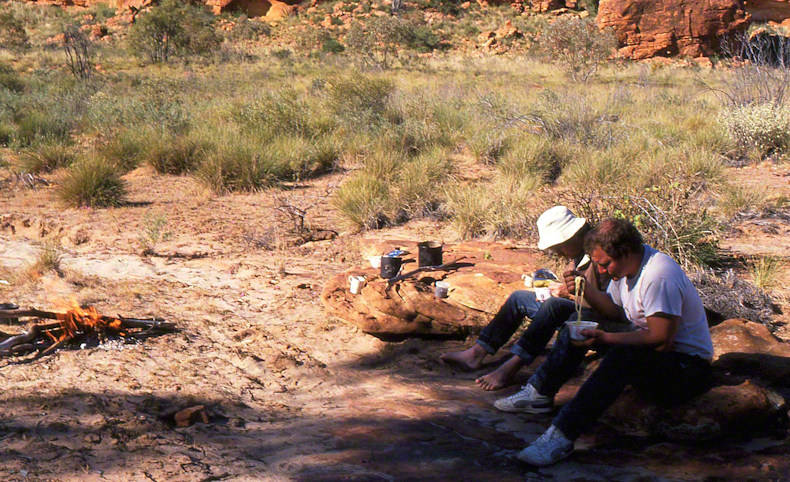
Settling near a waterhole framed by reeds, Dad built up a fire on the coarse sand while our family friend, TR rolled up his trousers and dipped his toes in the pool. ‘Hey!’ He pointed and did a little dance. ‘A fish! I see a fish!’
Our cousins, C1 and C2 raced over to TR. ‘Where?’ They peered into the pond. I trailed after them, hunting for fish through the plumes of muddied water near TR’s white calves.
‘There!’ TR waved his finger at the middle of the waterhole.
C1 squinted. ‘Oh, yeah.’
C2 waded into the water and peered. ‘I don’t see anything.’
Richard hunted and fossicked through the cooking equipment Dad had scattered around the campfire. ‘You got a sieve? A net? Anything?’
‘What for?’ Dad asked.
‘The fish.’
‘Ah, you know, those fish can lay dormant in the dry creek bed for years and when the rain comes, they spawn.’ Dad just had to tell us.
‘Well, this little fishy is going to be our lunch.’ Richard snapped his fat fingers together like crab claws. ‘I’ll catch it with my hands if I have to.’ He strode into the pool with such force the waters parted like the Red Sea. ‘Now where’s that fish?’ He said as he sank up to his waist.
Richard glanced, his smile faded. ‘Oh, is that all? It’s just a piddley little thing. Not enough for lunch.’ He was neck deep in the water and prepared to swim. He shot up. ‘Ouch! Something bit me!’
‘Better watch out, might be Jaws,’ I said.
‘You didn’t tell me there were yabbies.’ Richard bobbed up and down, then reached down to catch his feet. ‘Ouch! It bit me again!’
‘Why not yabbies?’ C1 said.
‘Now that’s an idea.’ Richard replied.
‘Ah! Shrimp!’ C2 waded towards his cousin. ‘I love the taste of shrimp.’
‘Hmm, yabbies,’ Richard said. ‘We used to catch yabbies all the time when we were young.’ With an explosive splash, he submerged in search of the yabby that had bitten him.
Dad, TR and I waited for the damper scones to cook and watched Richard and C1 turn bottoms up like ducks in the water in their quest for yabbies. C2 waded in the shallows of the pond, a roughly sharpened stick in hand ready to skewer any hapless water-creature.
Soon we breathed in the sweet aroma of baked scones. Dad flipped the foil wrapped balls out of the coals. ‘Lunch is ready!’ He clustered the silver spheres together using a small branch as if they were balls on a snooker table. Empty-handed the lads dragged their soaked bodies from the waterhole and schlepped to the fire place to collect their consolation prize of damper scone.
Richard held his stubby index finger and thumb in the form of the letter “C”. ‘I was this close to getting a yabby.’
[Extract from The T-Team with Mr B: Central Australia 1977, a prequel to Trekking With the T-Team: Central Australian Safari 1981.
The T-Team with Mr B — In 1977 Dad’s friend Mr Banks and his son, Matt (not their real names), joined Dad, my brother (Rick) and me on this journey of adventure. I guess Dad had some reservations how I would cope… But it soon became clear that the question was, how would Mr B who was used to a life of luxury cope? And would my brother survive?]
Our truck lumbered over the designated four-wheel drive track-come-dry Finke Riverbed to Palm Valley.
Dad turned to Mr. B and chuckled. ‘How would you like to sleep on this riverbed?’
Mr. B pouted, folded his arms and looked out the window.
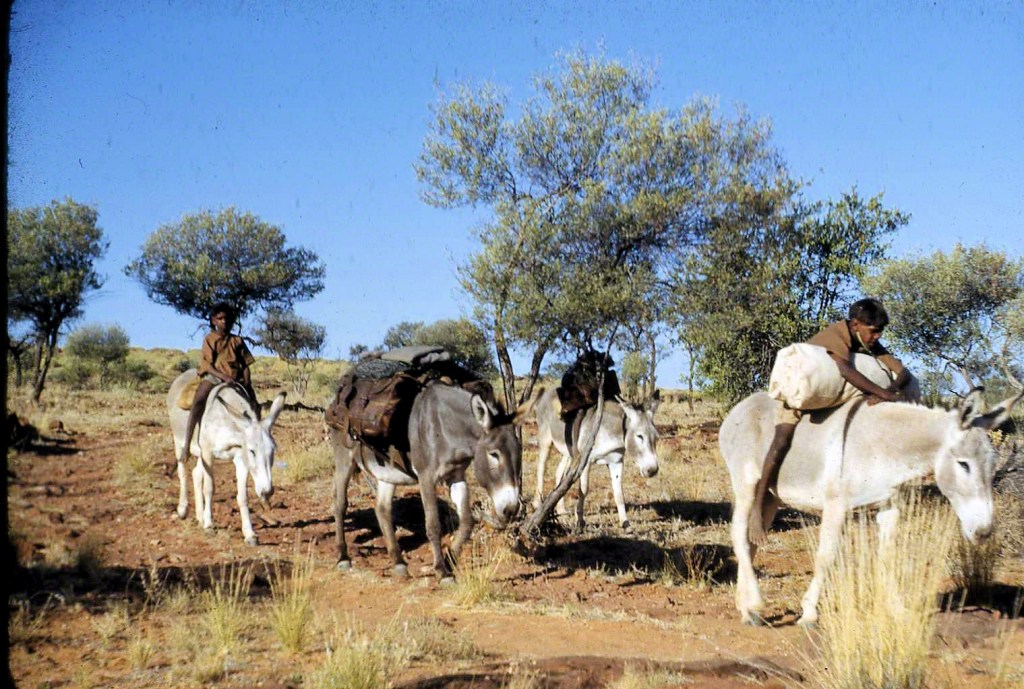
We continued to bump over the rocks and sand where two-wheel drive vehicles fear to tread. Dad recalled his days travelling by donkey along this same track when he explored Palm Valley with his Arunda students.
‘O-oh!’ Dad uttered as the Rover’s underside scraped over some boulders. When our vehicle continued to move, though slowly, we all sighed with relief.
‘O-oh!’ Dad gritted his teeth and sucked air through the gaps in them. The Rover jolted to a stop. The engine screamed. The body rocked. The wheels spun. ‘O-oh! I think we’re bogged.’
Mr. B groaned, ‘I hope that doesn’t mean we’re sleeping on this god-forsaken creek tonight.’
‘Okay—oh, better put it into four-wheel drive. Now, for one more try.’
Dad readjusted the grip of his fingers on the steering-wheel and pressed his foot on the accelerator. The Rover leapt out of the bog-hole.
‘Good thing you remembered that the Land Rover has four-wheel drive,’ Mr. B muttered.
We crawled along the creek bed for a few more minutes, until confronted with formidable boulders where we were forced to stop. Dad reckoned we were a mile or two from the valley, so we had to hike the rest of the way.
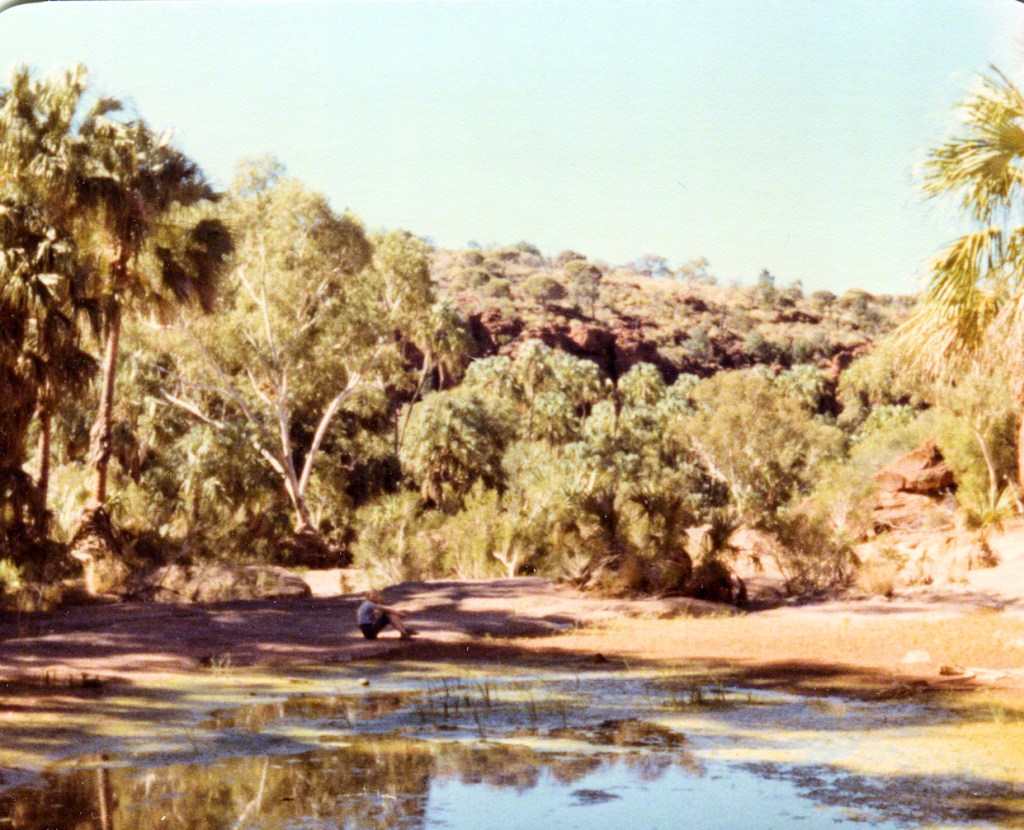
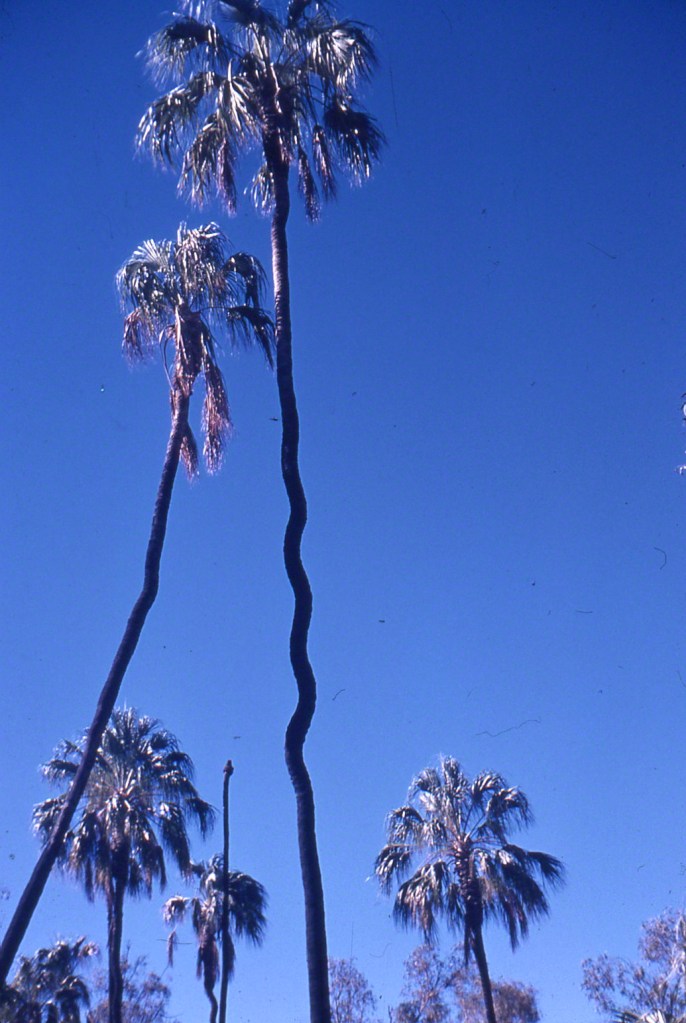
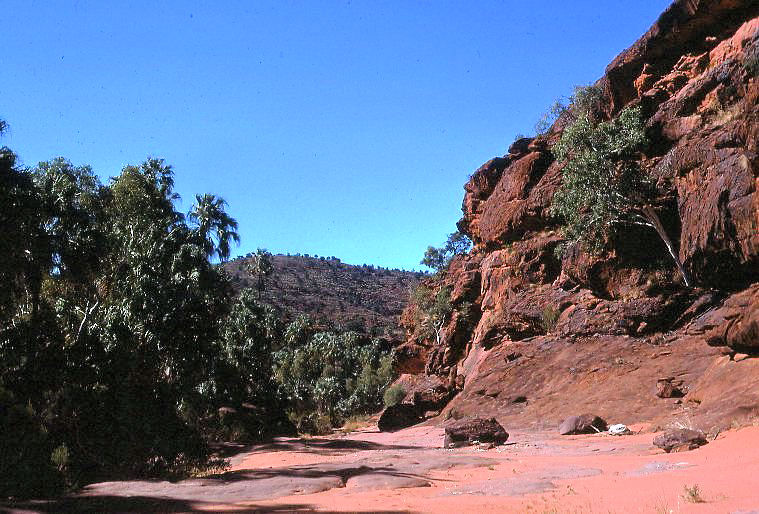
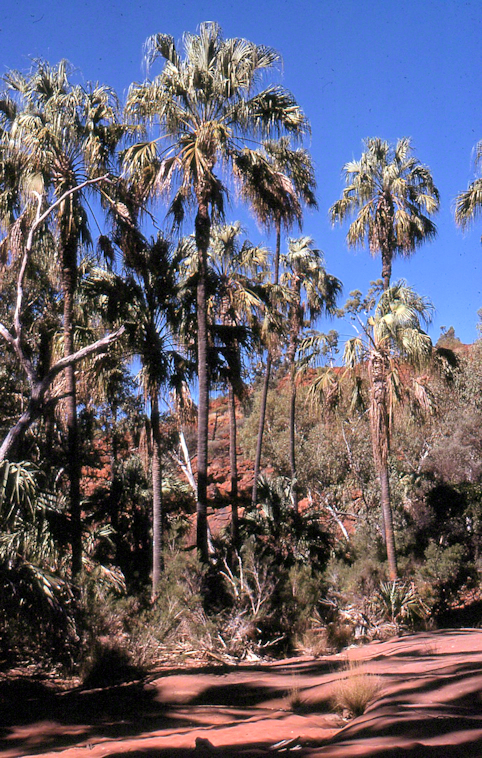
We entered the land that time had misplaced, forgotten and then found preserved in this valley. Lofty palms swayed in the breeze. Fronds of green glittered in the sun while their shadows formed graceful shapes on the iron-red cliffs. Here a cycad, spouting from the rocks, there a ghost gum jutting from those same deep red walls. This sanctuary for ancient prehistoric palms, which had existed there since the dawn of time, distracted us from my errant brother. We trundled over the stone smoothed by the running of water several millennia ago, admired the mirror reflections in the remaining pools, and breathed in the tranquility.
Then, as if the ancient palm spell was broken, a frown descended on Dad’s face. He stood up, tapped his pockets checking to feel if his keys and small change still existed, and then marched down the valley. When he’d disappeared into a gathering of palms, I asked Mr. B, ‘What’s my dad doing?’
‘I think he’s looking for your brother,’ Mr. B replied. ‘He seems to have a habit of getting lost.’
Still in the zone of swoon, I sat beside the billabong in the shade of the palm trees and changed my film. Then I stretched, and leaving Mr. B and Matt to their rest, I ambled along the stone-paved bed looking for Dad. Again, time lost relevance in the beauty and wonder of the palms: tall skinny ones, wiggly ones, short ones, clustered ones and alone ones.
I found Dad, but there was no sign of my brother. The sun had edged over the western walls of the valley casting a golden-orange glow over the opposing cliffs.
Dad huffed and puffed. ‘It’s getting late. I s’pose Rick has gone back to the Rover.’
‘Better head back, then,’ I said.
On the way, we collected Mr. B and son. They had not seen my AWOL brother either.
We waited back at the car for Rick. Dad’s concern turned to annoyance, then frustration. Dad had plans for a picnic, but as the sun sank lower, his well laid plans were becoming remote. Dad paced the sand, hands on hips, and muttering discontentedly. Trust my brother to spoil a perfect place and time for a picnic tea. The idea of proceeding with the picnic without Rick did not occur to Dad. I guess the thought that some peril had befallen him had sabotaged any appetite. Dad nervously tapped his right pocket; at least his keys hadn’t gone AWOL.
Every few minutes Dad paused in his pacing. ‘Ah—well!’ he’d say. Then sucking the warm air between his gritted teeth, he’d resume pacing.
An hour passed as we watched Dad track back and forth across the clearing.
[In 2013, the T-Team, next generation embarked on their pilgrimage to Central Australia. Purpose: to scatter Dad’s ashes in his beloved Central Australia, in Ormiston Gorge.
Over the next few weeks, I will take you on a virtual trip to the Centre and memories of that unforgettable holiday in 2013, with my brother and his family; the T-Team Next Generation.
This time, the T-K Team commence their return to Adelaide from Alice Springs.]
Back to the Big Smoke of the South
After packing up our belongings into our trusty Ford, topping up with petrol, and cash supplies, we departed Alice Springs and headed south to Adelaide. It’s amazing what one discovers retracing our steps to South Australia. In the morning sunlight, there, mini-Ulurus, mini–Kata Tjutas, and mini-Mt Conners.
At Kulgera, we shared lunch with flies. All around us, people swished at their faces. My glasses kept falling off as I fanned the flies away. In the end, I put on my sunnies. Then, when that strategy failed, we retreated into the roadhouse and had coffee in the restaurant. Self-serve for $3.
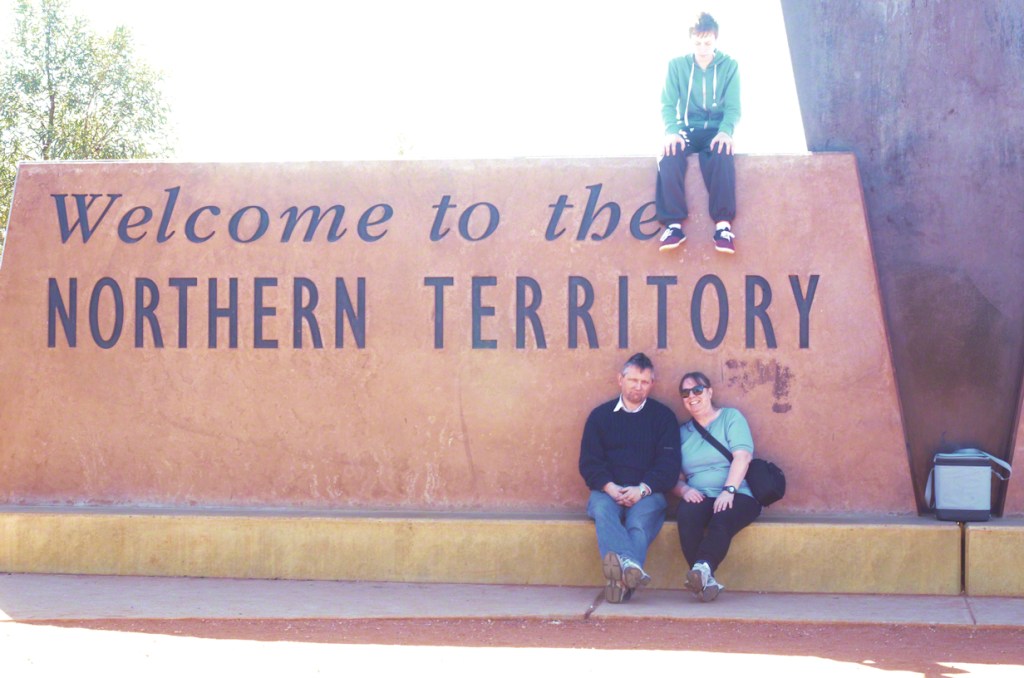
There, at the border we parked to check our itinerary of food for fruit and vegetables. Owing to the prevention of fruit fly into South Australia, fruit and vegetables had to be disposed of in the bins provided. More flies hovered around joining our forage in the back of the Ford.
A passing Northern American tourist remarked, ‘Are South Australian’s so precious?’
‘Yes, we are,’ I muttered to Anthony, ‘how else have we kept the scourge of fruit fly out of our state?’
All around us, fellow travellers hauled out their luggage from their cars or four-wheel drive vehicles and disposed of their fresh produce. None of them looked happy.
Sitting on a picnic table, a lad about Son 1’s age, and wearing a fly net, boiled up a pan of canned corn and peas on a portable gas cooker.
Nodding in their direction, I remarked to my husband, ‘Do they think canned vegetables are a problem?’
‘Quiet, Lee-Anne, they might hear you,’ Anthony snapped.
‘Maybe someone should tell them that it’s only fresh vegetables that need to be disposed of.’
Anthony shook his head. ‘Come on, let’s get going.’
After depositing the few offensive apples and oranges in the bin, we piled into the Ford and charged forth on our journey south down the Stuart Highway.
With the potatoes securely stored in the cooler hidden in the Ford, we stepped into Marla’s red brick tourist park office. Tent site? No problem. Plenty of room on the grassy park for campers.
However, fearful that the biosecurity police might emerge from under a mini-Ayers rock and ping us with a hefty fine, I was designated to cook up the potatoes and one offending onion, while Anthony pitched the 2-person tent in the middle of the verdant camping reserve. My potato dish was not exactly rösti, though.
While frying up this “contraband” fare, a familiar white van whizzed past. I stepped out of the BBQ shelter and waved to them. The white van turned around.
The T-Team joined us for our potato and onion fry. Our nephew contributed their stash of vegetables to make a stir fry. Mrs. T shared the T-team’s adventures visiting a friend’s cattle station south of Alice the past couple of days.
My older niece was not her usual cheerful self. While helping me wash the dishes in a crummy camp kitchen with little light, Rick confided in me that she may not have been happy about driving the Oodnadatta track.
‘Yeah,’ I said, ‘she must know that track is full of tacks to bust tyres.’
Rich laughed. ‘Oh, yeah! Maybe we won’t go that way…’
We waved the T-Team off on their venture south at around 8.30pm. Then Anthony crawled into the tent and began tossing out clothes, bags, and stuff into the frigid cold night.
‘What are you doing?’ I asked.
‘Where are you hiding the drink bottles?’ he cried.
‘Are they in the car?’
‘No, I’ve looked there.’
‘Sure, they’re not in the BBQ hut?’
‘No, where have you hidden them?’
‘I don’t remember, “hiding” them. They must be left somewhere,’ I said. ‘it’s too dark to look for them now, so you might just have to be satisfied with the thermos.’
With a grunt, he who is always right, shrugged on an extra coat, sat outside the tent, sipping hot chocolate from the thermos, and playing with his phone. Wrapped in my sleeping bag, I sat beside the man who had lost his water bottle, and wrote my diary by torchlight. Ours was one lonely tent in an expanse of couch grass.
Having lost the battle to mourn the temporary loss of his water bottle alone, Anthony crawled into bed at 10pm. Soon after, I followed him and in the warmth of the thermal sleeping bag, I soon fell asleep.
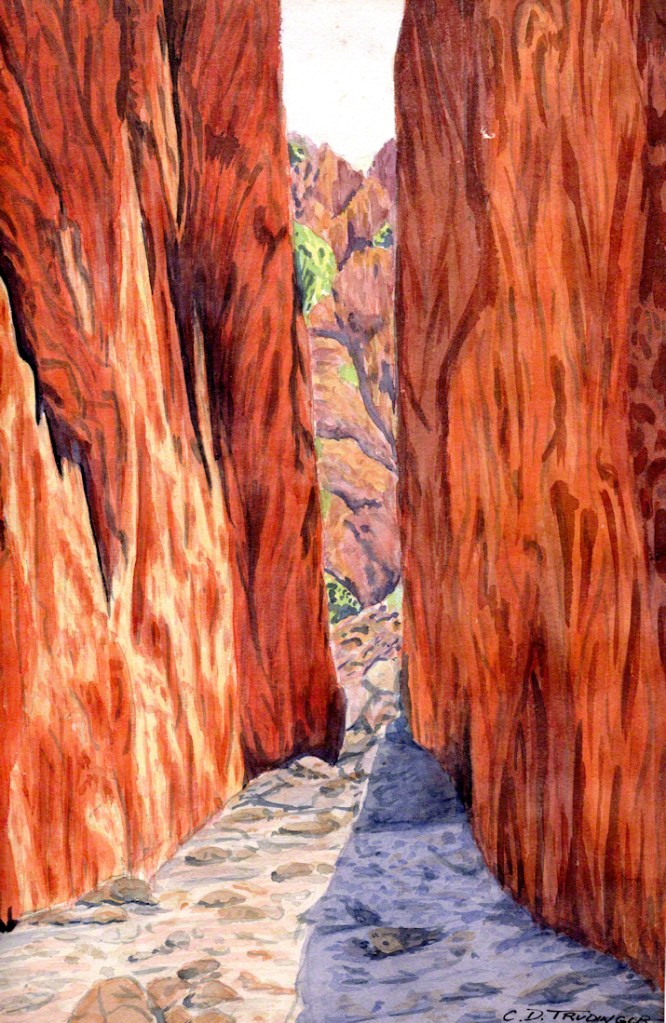
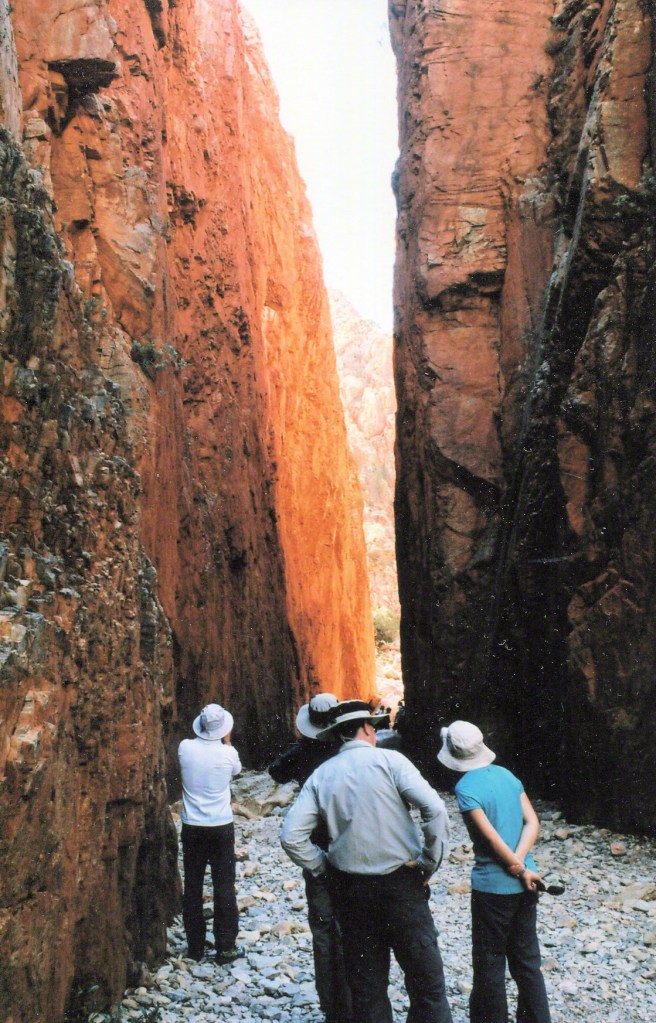
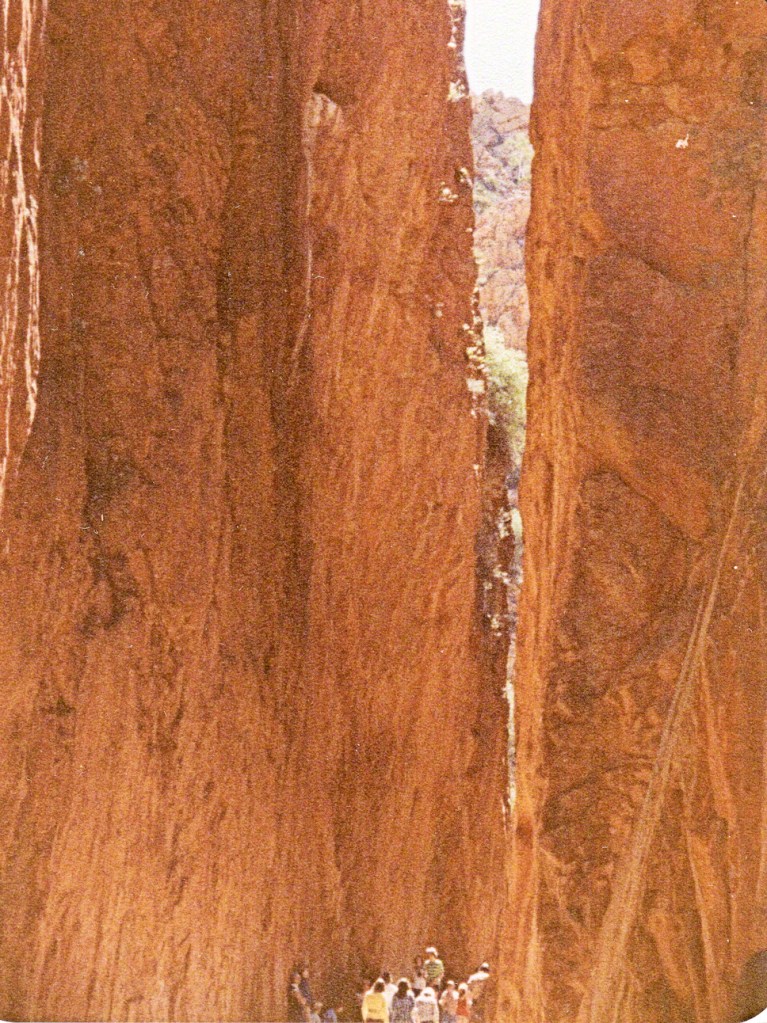
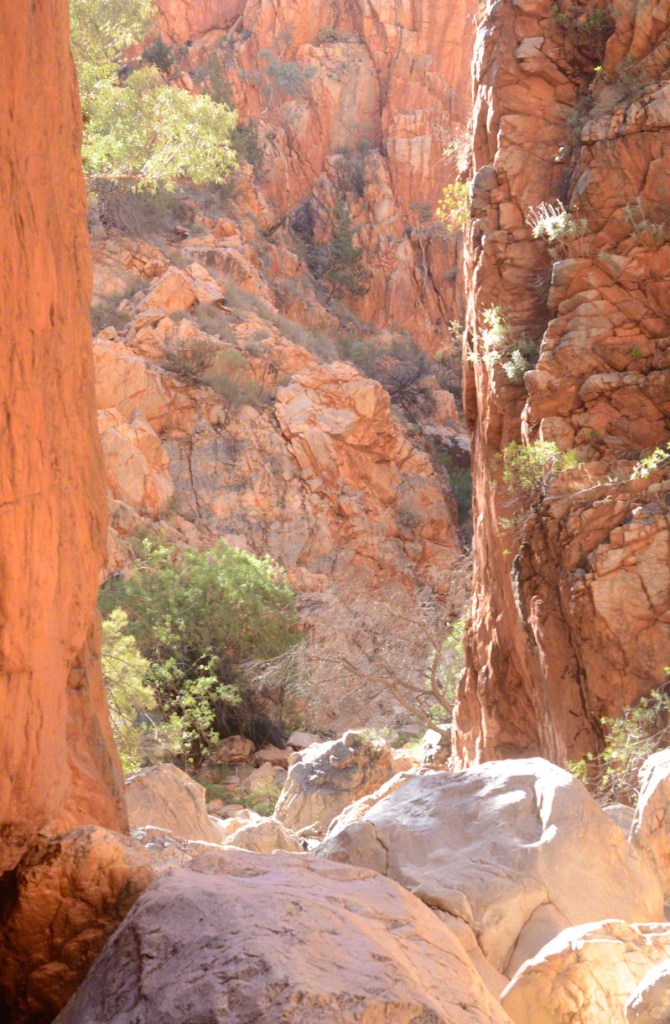
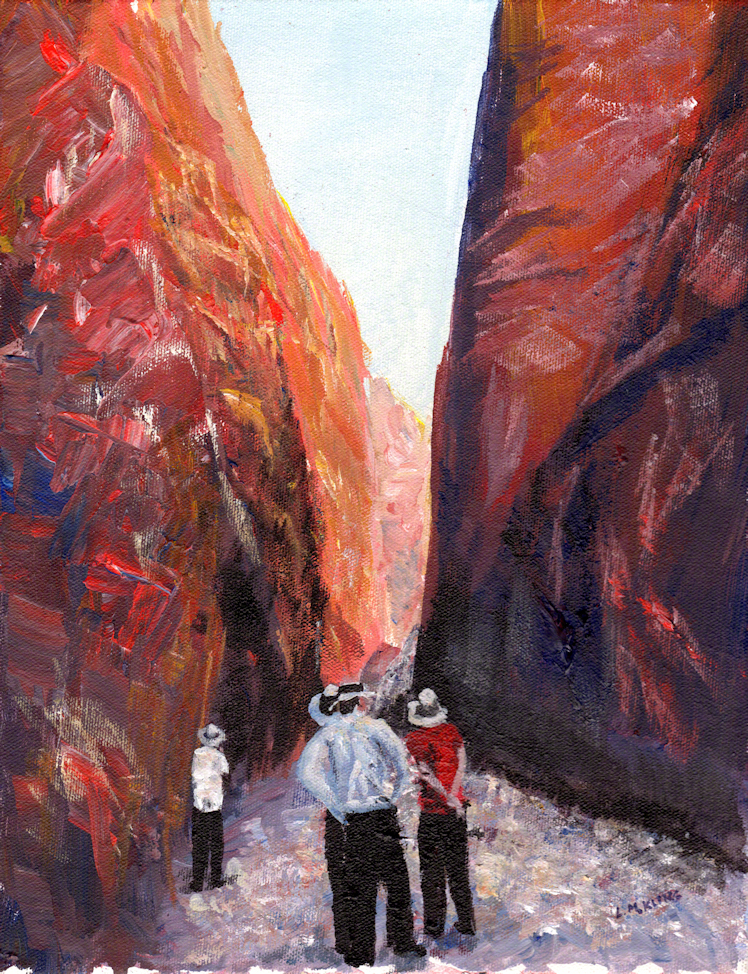
[While painting this scene of a group of older men gathering to admire the glowing walls of Standley Chasm, I was reminded of the T-Team’s trek in 1977 with Mr. B. This wealthy man used to comfort and luxury, took on the challenges of roughing it camping with the T-Team. This stunning chasm is about 50km west of Alice Springs and is one of the first of many beautiful sites to visit in the MacDonnell Ranges.]
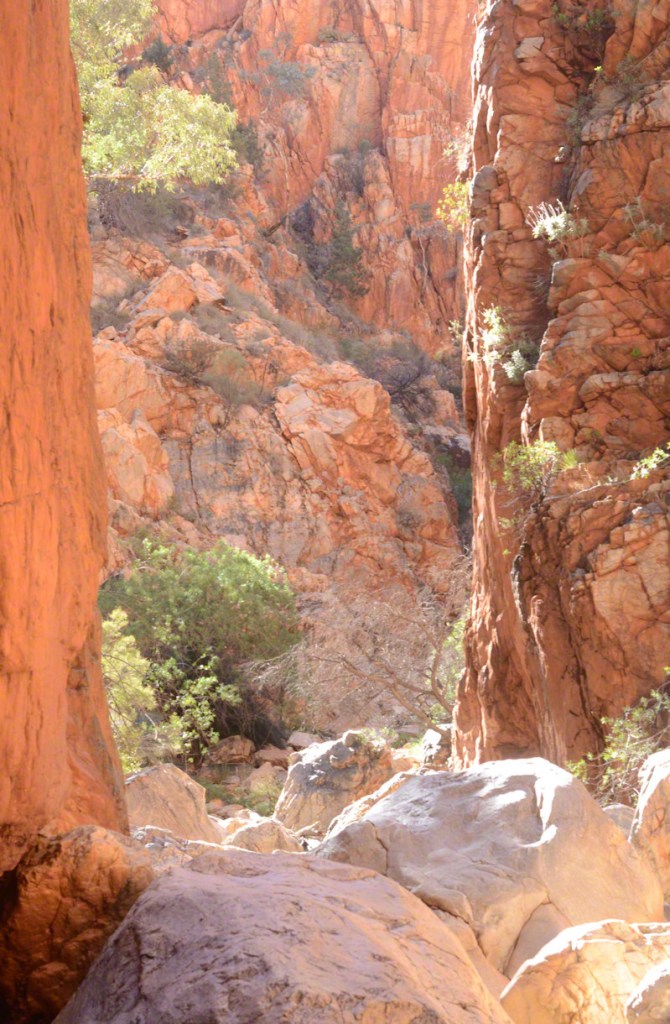
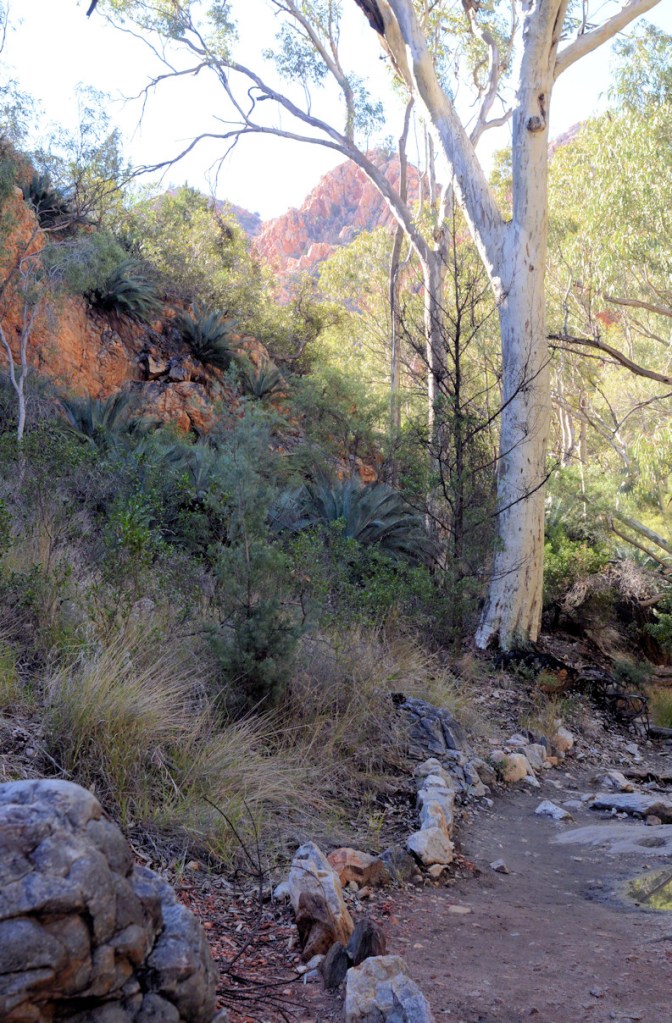
Mr. B slowed the Rover and eased it into a park joining the line of cars, land rovers, and buses awaiting their owners’ return. The T-Team piled out of the Rover and in single-file, followed Dad along the narrow track heading towards Standley Chasm. In the twists and turns of the trail that hugged the dry creek bed, I spotted ferns in the shadow of rock mounds the colour of yellow ochre, and ghost gums sprouting out of russet walls of stone. Hikers marched past us returning to the car park.
A leisurely short stroll became a race to the finish as we struggled to keep up with Dad; scrambling over boulders on the track, squeezing past more tourists going to and from the chasm, Dad snapping and cracking the verbal whip, and Mr. B moaning and groaning that “it’s not for a sheep station”.
The crowd thickened, stranding us in a jam of people, fat bottoms wobbling, parents hauling their whinging kids, and men clutching cameras to their eyes for the perfect shot. Dad checked his watch and then shifted the weight from one foot to the other.
‘Are we there yet?’ I asked.
Wrong question. Especially when asking a grumpy Dad.
‘Not yet!’ Dad barked.
‘I reckon we’re not far away,’ I said. ‘All the tourists have stopped. Must be some reason.’
Dad screwed up his nose. ‘I dunno, it doesn’t look right.’
‘Excuse me! Excuse me!’ Mr. B, one arm stretched out before him, parted the sea of people and strode through.
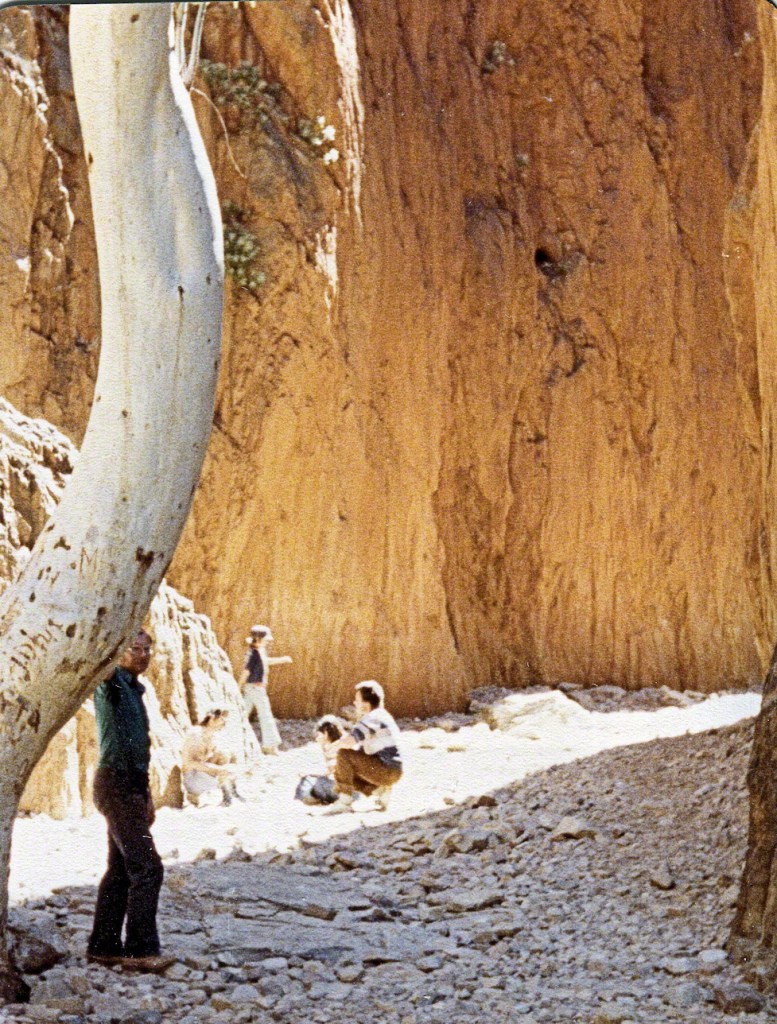
We followed in Mr. B’s wake and within twenty paces, there it glowed. Standley Chasm. Both walls in hues of gold to ochre. Dozens of people milled around its base.
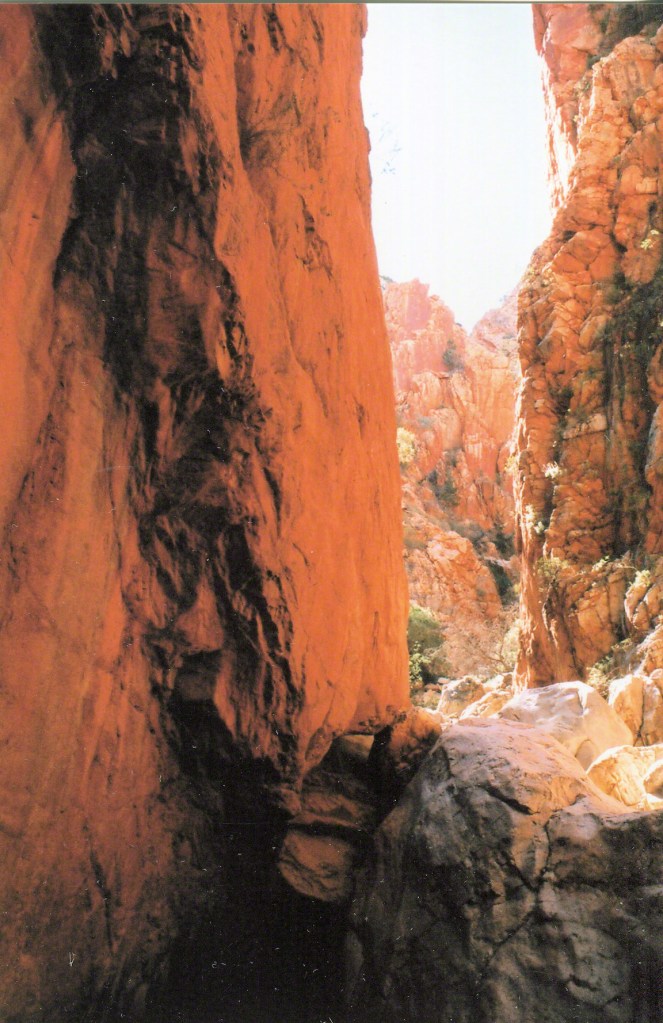
Then we waited. The tourists snapped their shots and then filtered away.
‘When’s it going to turn red?’ I asked for the fourth time.
‘Be patient,’ Dad said.
‘This is boring,’ Matt mumbled.
‘Let’s see what’s the other side.’ Richard tapped Matt on the arm. The two lads scrambled over the rocks and I watched them hop from one boulder to the next over a small waterhole.
Dad paced from one wall to the next while Mr. B photographed Standley Chasm from every angle.
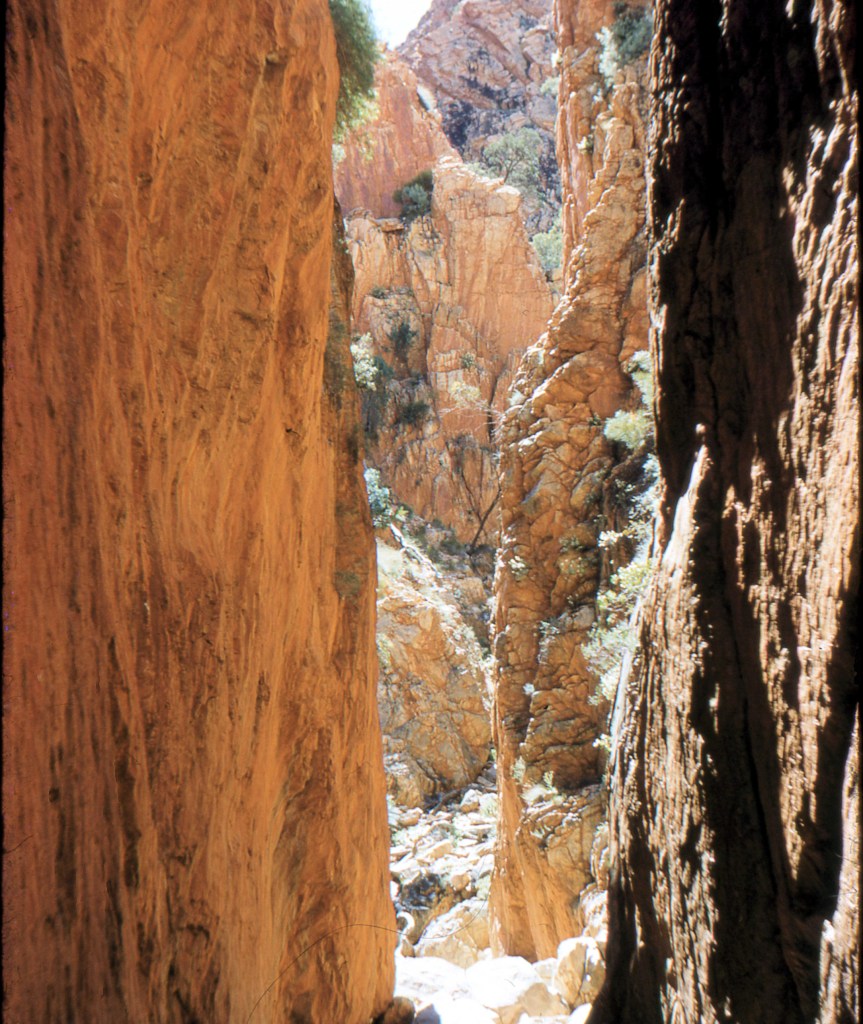
I watched mesmerized by the sunlight playing on the walls. They turned from a russet-brown on one side, gold on the other, to both glowing a bright orange. But by then, most of the tourists had left, thinking the Chasm had finished its performance for the day.
Apologies for the week of the lost blog post. Been one of those weeks in one of those months (in our family the horror month filled with birthdays). Plus, I have spent the last week editing the MAG newsletter. Check out Marion Art Group’s website if you like.
Anyway, here’s a revisit to an old favourite of mine, Mount Liebig in Central Australia.
The Quart Can
[While Mr. B and his son, Matt stayed back at camp,
three of the T-Team faced the challenge of climbing Mt. Liebig.
Extract from The T-Team with Mr B: Central Australia 1977, a prequel to Trekking With the T-Team: Central Australian Safari 1981.]
Dad parked the Rover at the foot of Mount Liebig. ‘This will be our reference point,’ he said pointing to a rocky outcrop.
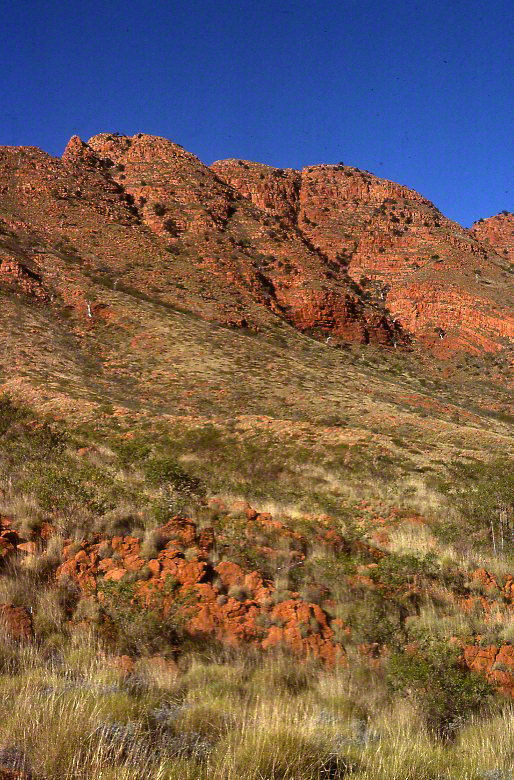
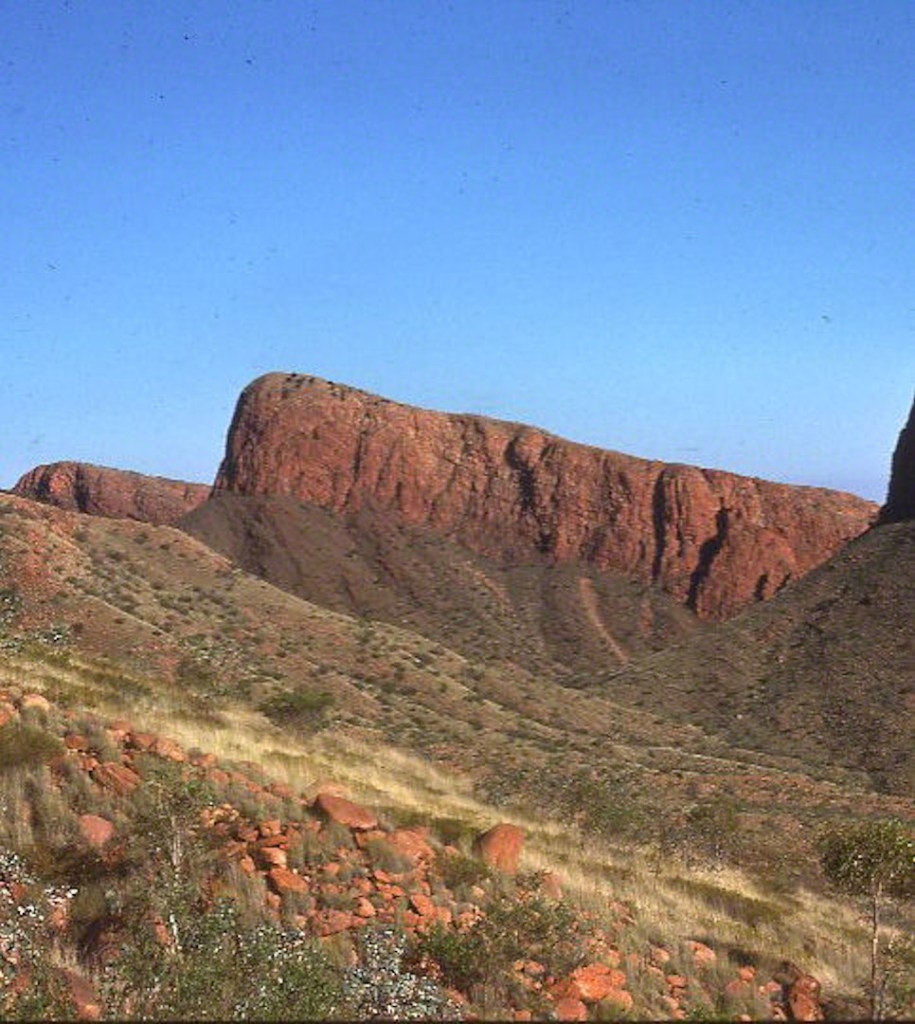
I took a photo of the mountain slopes bathed in deep orange reflecting the sunrise.
Dad hoisted the pack on his back and studied the peaks. ‘Now which one is the highest?’ He squinted. ‘I think it’s the one on the right, I’ll just check.’ He took out his binoculars and adjusted the focus. ‘Hmm, I think I see the trig.’ He lowered the binoculars. ‘Oh, yeah, you can see it without them.’
‘Where? Where?’ I grabbed the binoculars, and before I even lifted them to my eyes, I spotted the thin line on top of one of the peaks. I pointed. ‘Yeah, there it is.’ I gave the binoculars to Rick to look through.
‘Come on, we must get a wriggle on, or we’ll be hiking back in the dark,’ Dad said.
Dad’s dream to climb this mountain was to be fulfilled. Ever since he had lived and taught in Hermannsburg in the 1950’s, he had wanted to venture way out west, to conquer this mount which is 1274 metres (about 4179 feet) above sea level.
We commenced scaling the hills filled with prickly spinifex and scrambling down the valleys of loose rocks. We reached the gully leading to the peak in no time.
‘Hey, Dad, this is easy!’ I said. ‘We’ll be up and back to camp in no time.’
‘Oh, no!’ Dad moaned.
‘But, Dad, I thought you’d be pleased.’
Dad turned around and peered at the ridges we had traversed. ‘I’ve lost my quart can.’ He tottered down the slope, his gaze darting at every rock and tree. ‘I put it down to get something out of my back pack…now where did it go?’
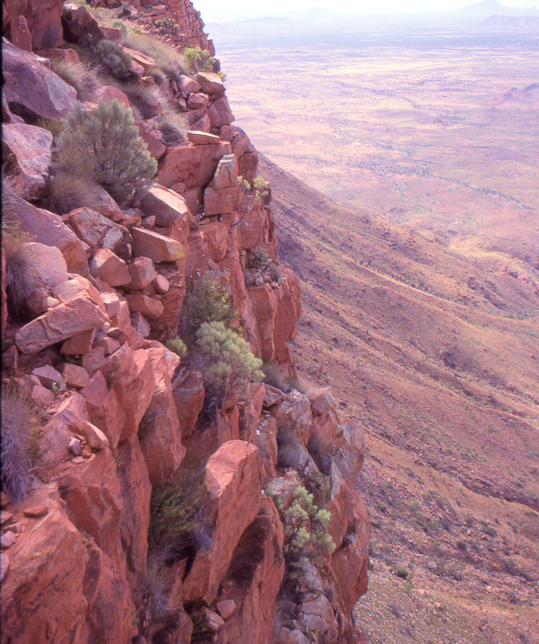
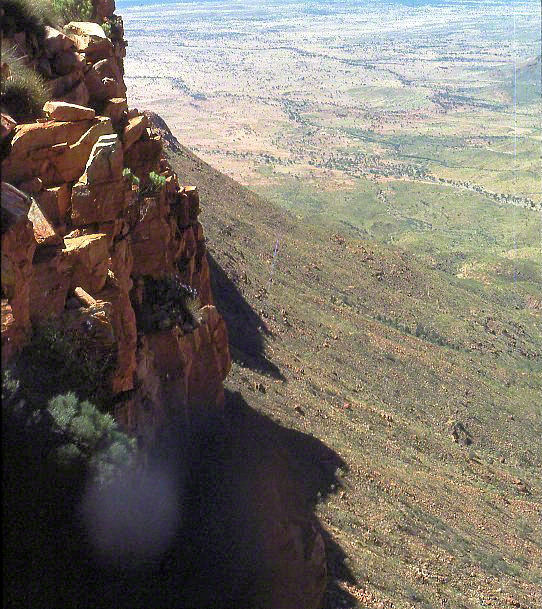
‘The other side of the slope is a two-thousand-foot drop,’ Dad remarked.
Rick and I contemplated this fact as we sucked slices of thirst-quenching lemon and gazed on the foothills sloping up to Mt. Liebig. These hills shaped like shark’s teeth, were a miniature replica of the mountain’s formation; slope on one side, and treacherous cliffs on the other. Lemons, though sour, actually tasted sweet.
Refreshed, we continued our plodding upwards. My shins ached from hiking up this steep incline. My ankles itched from spinifex needles lodged in them. And the growing number of boulders around which we had to manoeuvre, proved to be a challenge. But we pushed on.
Dad peered up at the eight-foot high rock wall. ‘Hmmm.’ He looked stumped.
‘Now what?’ I asked.
Each side of us was a wall of rock blocking our way. One side, lower than the others, led to the precipice Dad mentioned before.
After studying the walls, Rick grasped a few nooks, and then mounted the rocky barrier. He wriggled up a hollow cranny.
Dad and I waited.
The wind whistled through the gap.
‘I hope he’s alright,’ I said.
‘He’ll be fine,’ Dad replied.
‘I hope he doesn’t fall off the cliff.’
‘No, he’ll be fine. Stop worrying.’
Rick poked his head through the hole in the wall above us. ‘I’ve found a way to the top.’
He then helped Dad and me up through the hole and led us through the labyrinth of a path between the boulders to the spinifex-covered mountaintop. A cairn of stones adorned with a rusty pole and barrel marked the summit.
‘Look at that,’ Dad said, ‘It’s only eleven thirty. Let’s stay here an hour and enjoy the view. We can have an early lunch.’
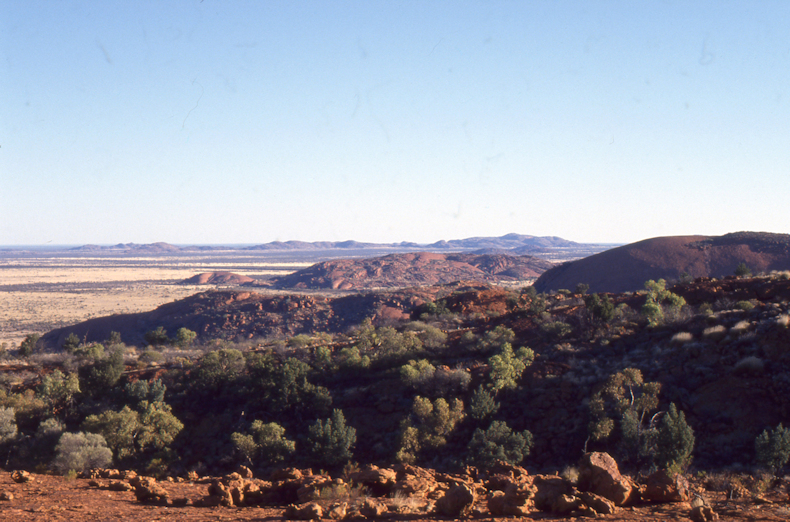
So, while enjoying our cheese and gherkin sandwiches, we sat on the cairn and feasted our eyes on the aerial view of the landscape below. The MacDonnell Ranges and Haasts Bluff far in the east were painted in hues of pink and mauve. And closer, south of the Liebig Range, Mt Palmer and her friends were clothed in shades of ochre. North, on the other side of Liebig, the land stretched out in waves of red sandy desert.
In a panic, I followed him, making sure I stayed a good distance from the cliff edge. ‘Rick? Are you alright?’ I peered down at the land below, the shrubs and trees seemed like dots. The sheer drop gave me the creeps. ‘Rick, are you still with us?’
Rick emerged from the other side of the bush. ‘Can’t you leave me to do my business in peace, Lee-Anne?’
‘Sorry.’
‘Hoy!’ Dad called.
We looked to see Dad waving at us.
‘Get back from the edge!’ Dad said. ‘We better get going. See if we can make it back to camp by two.’
We picked our way through the maze of boulders and climbed down into the gully. Rick, eager to reach the rover first, raced ahead. Dad stuck with me, offering his help as I negotiated my way down the gully.
After relishing the sweet crunch of cornflakes for breakfast, the T-Team drove back to Ormiston Gorge. We hiked through the gorge admiring the red cliffs, ghost gums and mirror reflections in the waterholes, and took less than an hour to reach the end with the view of Mt. Giles, lumpy and sapphire blue.
Settling near a waterhole framed by reeds, Dad built up a fire on the coarse sand while our family friend, TR rolled up his trousers and dipped his toes in the pool. ‘Hey!’ He pointed and did a little dance. ‘A fish! I see a fish!’
Our cousins, C1 and C2 raced over to TR. ‘Where?’ They peered into the pond. I trailed after them, hunting for fish through the plumes of muddied water near TR’s white calves.
‘There!’ TR waved his finger at the middle of the waterhole.
C1 squinted. ‘Oh, yeah.’
C2 waded into the water and peered. ‘I don’t see anything.’
Richard hunted and fossicked through the cooking equipment Dad had scattered around the campfire. ‘You got a sieve? A net? Anything?’
‘What for?’ Dad asked.
‘The fish.’
‘Ah, you know, those fish can lay dormant in the dry creek bed for years and when the rain comes, they spawn.’ Dad just had to tell us.
‘Well, this little fishy is going to be our lunch.’ Richard snapped his fat fingers together like crab claws. ‘I’ll catch it with my hands if I have to.’ He strode into the pool with such force the waters parted like the Red Sea. ‘Now where’s that fish?’ he said as he sank up to his waist.
Richard glanced, his smile faded. ‘Oh, is that all? It’s just a piddley little thing. Not enough for lunch.’ He was neck deep in the water and prepared to swim. He shot up. ‘Ouch! Something bit me!’
‘Better watch out, might be Jaws,’ I said.
‘You didn’t tell me there were yabbies.’ Richard bobbed up and down, then reached down to catch his feet. ‘Ouch! It bit me again!’
‘Why not yabbies?’ C1 said.
‘Now that’s an idea,’ Richard replied.
‘Ah! Shrimp!’ C2 waded towards his cousin. ‘I love the taste of shrimp.’
‘Hmm, yabbies,’ Richard said. ‘We used to catch yabbies all the time when we were young.’ With an explosive splash, he submerged in search of the yabby that had bitten him.
Dad, TR and I waited for the damper scones to cook and watched Richard and C1 turn bottoms up like ducks in the water in their quest for yabbies. C2 waded in the shallows of the pond, a roughly sharpened stick in hand ready to skewer any hapless water-creature.
Soon we breathed in the sweet aroma of baked scones. Dad flipped the foil wrapped balls out of the coals. ‘Lunch is ready!’ He clustered the silver spheres together using a small branch as if they were balls on a snooker table. Empty-handed the lads dragged their soaked bodies from the waterhole and schlepped to the fire place to collect their consolation prize of damper scone.
Richard held his stubby index finger and thumb in the form of the letter “C”. ‘I was this close to getting a yabby.’