[Extract from Trekking With the T-Team: Central Australian Safari 1981]
In the morning light, we beheld the beauty of Dad’s choice of a camping spot. Giant gum trees, reeds, and flowers surrounded a large jade-green pool, beckoning us to stay, enjoy, and explore. The mysteries and wonders of the place drew me to taste adventure before breakfast.
I hiked east, traversing the banks of the Neales River until I reached a fence. Hungry, I ambled back to camp, late for breakfast, but not for cold damper.
‘I honked the horn and called for you. Where were you?’ Dad snapped.
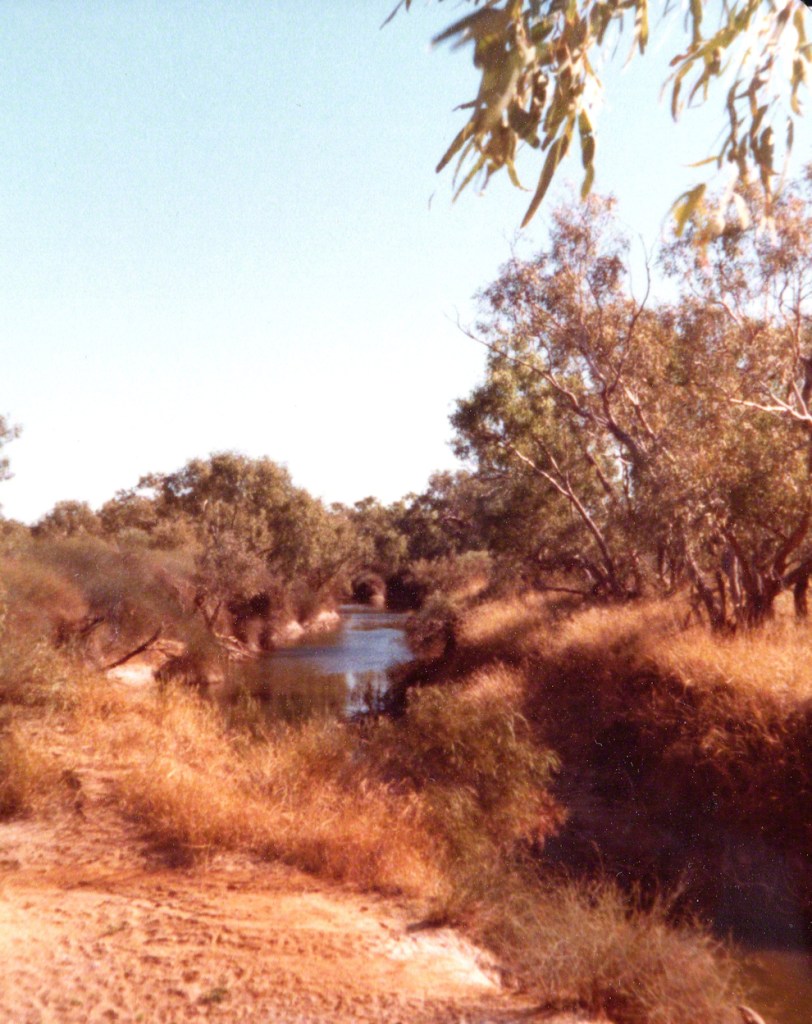
After my damper and jam, then washing dishes, I ventured west crossing the Algebuckina Bridge. The creek bed appeared all dried up; the water absorbed beneath the surface. Cracks inches wide marred the clay bed that had soaked up all the water. In the distance, I spied majestic eucalyptus trees and decided to reach that spot, before returning. No waterhole on this side.
I trekked along the sandy plain littered with spinifex bushes. When I reached the clump of gums, I examined a shallow puddle of moss, sludge and fish.
On the opposite side of the ridge rose a steep cliff. I scrambled to see what wonders lay beyond. I mounted the hill, delighted with the sight of a deep waterhole, crystal green, stretching and winding, and disappearing behind a hill. Snap went my fingers; instamatic photos capturing this moment in Algebuckina’s history.
[Extract from Trekking With the T-Team: Central Australian Safari 1981]
Car hunt all sorted with a Toyota Corolla named Levin, the T-K Team Next Gen turn their attention to sorting out the annual tax return. So, keeping the theme of the attack of the tacks which the T-Team endured on the unsealed highway back to Adelaide almost 40 years ago to the day…]
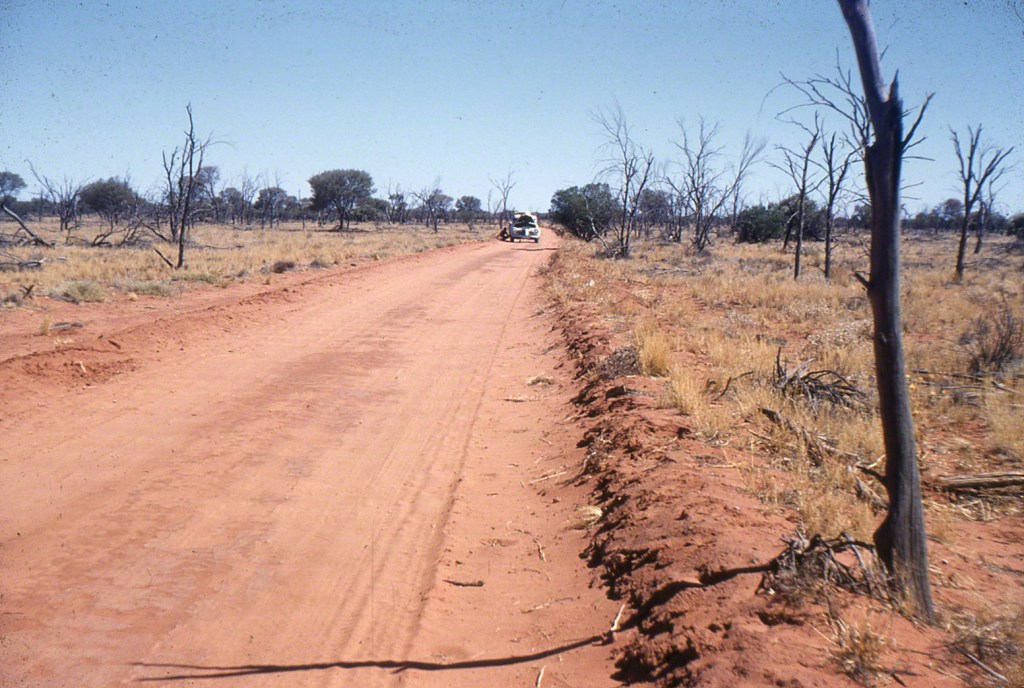
Once more we all dismounted from the Rover and once more Richard shook his head at the pathetic sight of an airless tyre, this time, the Rover’s, squashed flat on the corrugated sand. Once more we stood guard while Richard jacked up the Rover, removed the flattened lump of rubber, soaked it in a bowl of water, found the leak and commenced the ritual of repairs. And once more he swore as he ripped off the first, then the second, then the third patch in the set that wouldn’t take. Finally, he hurled the remaining patches and glue into the spinifex.
Dad gazed to the horizon and the sun fast sinking toward it. ‘What did you do that for?’
‘They’re a bunch of duds.’ Richard hunted through the tool kit for another packet of tyre patches. ‘How long did you have that set?’
‘Oh, er, um,’ Dad rubbed his moustache, and mumbled, ‘only a few years.’
‘Well, the glue was cactus.’ Richard pulled out a patch from a newer looking box, and then lighting a match, exposed the patch to the flame. After roughening the tube at the damage site, he sealed the patch over the puncture. He stuffed the tube back in the tyre. ‘Now, let’s see what we can do about the pump.’
After returning to the toolbox for some more tools, he fiddled with an electric pump, and then attached it to the Rover’s battery.
We all cheered as the pump chugged into action and filled the tyre with its much-needed air. Mission accomplished, we once again climbed back in the Rover and then raced towards Oodnadatta.
Weariness from the constant stopping and starting, and tyre-changing meant that not much conversation happened between younger cousin (C2) and me. The current corrugations that filled the cabin with a sound like heavy machinery didn’t help. I knew Dad wanted to drive through the night to reach Adelaide. No stopping now. We’d suffered enough delays, and Dad intimated he just wanted to get home, or if not home, at least to the comforts of a creek bed filled with soft sand, like Algebuckina.
However, Dad’s dream of sleeping in cushioned comfort stalled. Ninety kilometres north of Oodnadatta, another trailer tyre blow-out brought us to a complete halt. By this time night had fallen and the diagnosis was grim. We had run out of spares for the trailer.
The men stood at the scene of the tyre carnage. Richard combed the area and shining light from a torch he gathered up shreds of evidence. Dad and his nephews stared with mouths downturned at the remains of the victim, the rim with a few bits of rubber hanging off it.
‘It made quite a few sparks,’ I said. ‘Better than fireworks.’
‘This is not the time to be funny.’ Dad gazed at the gravel road languishing in darkness. ‘We’re in a lot of trouble and I’d appreciate if you could take this seriously.’ He clasped his hands and cleared his throat. I was sure he’d burst into prayer at any moment.
‘Sorry.’
Richard shone the torch in the direction of the Rover. I turned to look. The Rover listed to one side. Surely that can’t be the dip at the edge of the road.
‘Richard,’ I said walking over to the back-passenger side of the Rover. ‘What’s going on with the Rover?’
The torchlight landed on me. ‘Look, we’re—’ Dad began. The light fell on the tyre, a very flat-to-the-rim tyre. ‘Oh.’
I pointed at the tyre imitating a pancake. ‘See, I told you.’ I put my hands on my hips and sighed. ‘Just not our day. Four flat tyres in half a day. How can that be?’
After relishing the sweet crunch of cornflakes for breakfast, the T-Team drove back to Ormiston Gorge. We hiked through the gorge admiring the red cliffs, ghost gums and mirror reflections in the waterholes, and took less than an hour to reach the end with the view of Mt. Giles, lumpy and sapphire blue.
Settling near a waterhole framed by reeds, Dad built up a fire on the coarse sand while our family friend, TR rolled up his trousers and dipped his toes in the pool. ‘Hey!’ He pointed and did a little dance. ‘A fish! I see a fish!’
Our cousins, C1 and C2 raced over to TR. ‘Where?’ They peered into the pond. I trailed after them, hunting for fish through the plumes of muddied water near TR’s white calves.
‘There!’ TR waved his finger at the middle of the waterhole.
C1 squinted. ‘Oh, yeah.’
C2 waded into the water and peered. ‘I don’t see anything.’
Richard hunted and fossicked through the cooking equipment Dad had scattered around the campfire. ‘You got a sieve? A net? Anything?’
‘What for?’ Dad asked.
‘The fish.’
‘Ah, you know, those fish can lay dormant in the dry creek bed for years and when the rain comes, they spawn.’ Dad just had to tell us.
‘Well, this little fishy is going to be our lunch.’ Richard snapped his fat fingers together like crab claws. ‘I’ll catch it with my hands if I have to.’ He strode into the pool with such force the waters parted like the Red Sea. ‘Now where’s that fish?’ He said as he sank up to his waist.
Richard glanced, his smile faded. ‘Oh, is that all? It’s just a piddley little thing. Not enough for lunch.’ He was neck deep in the water and prepared to swim. He shot up. ‘Ouch! Something bit me!’
‘Better watch out, might be Jaws,’ I said.
‘You didn’t tell me there were yabbies.’ Richard bobbed up and down, then reached down to catch his feet. ‘Ouch! It bit me again!’
‘Why not yabbies?’ C1 said.
‘Now that’s an idea.’ Richard replied.
‘Ah! Shrimp!’ C2 waded towards his cousin. ‘I love the taste of shrimp.’
‘Hmm, yabbies,’ Richard said. ‘We used to catch yabbies all the time when we were young.’ With an explosive splash, he submerged in search of the yabby that had bitten him.
Dad, TR and I waited for the damper scones to cook and watched Richard and C1 turn bottoms up like ducks in the water in their quest for yabbies. C2 waded in the shallows of the pond, a roughly sharpened stick in hand ready to skewer any hapless water-creature.
Soon we breathed in the sweet aroma of baked scones. Dad flipped the foil wrapped balls out of the coals. ‘Lunch is ready!’ He clustered the silver spheres together using a small branch as if they were balls on a snooker table. Empty-handed the lads dragged their soaked bodies from the waterhole and schlepped to the fire place to collect their consolation prize of damper scone.
Richard held his stubby index finger and thumb in the form of the letter “C”. ‘I was this close to getting a yabby.’
[In 2013, the T-Team, next generation embarked on their pilgrimage to Central Australia. Purpose: to scatter Dad’s ashes in his beloved Central Australia, in Ormiston Gorge.
Over the next few weeks, I will take you on a virtual trip to the Centre and memories of that unforgettable holiday in 2013, with my brother and his family; the T-Team Next Generation.
This time, the T-K Team (my husband and I) return to Hermannsburg and catch up with friends there.]
As we powered along the sealed Larapinta Highway, I mused, what a difference some 60-70 years makes. When Mum T lived in Hermannsburg, back in the 1940’s and 50’s, the trip to Alice Springs was a long arduous half-a-day journey on a dirt track in a truck where one spent several days in Alice Springs stocking up on supplies.
As we passed the turn off to Jay creek, I said Anthony, ‘Mum told us the story of her mum (Grandma Gross) who, when the Finke flooded, had to wade through the waters to reach the other side to continue the journey to Alice Springs. She was 8-months pregnant at the time.’
‘Hard to imagine the creek flooding,’ Anthony glanced at the dip, a dry riverbed, that signalled the up-coming fork in the road leading the Hermannsburg. ‘But I know from camping in the Flinders Ranges, at the first drops of rain, you don’t hang around, you get out.’
‘Your mum and friend didn’t when they camped at Parachilna,’ I said. ‘They were stuck there on an island with the river all around them for days.’
A sign with an image of a cow, and below written, “Beware of wandering stock”, flashed by. Brumbies galloped on the side, as if racing with us. Hawks soared in the cobalt blue sky above. A lone wedge-tail eagle, having gorged on a carcass of roadkill, waddled off the road just in time, avoiding the same fate as its feed.
This time, when we arrived in Hermannsburg, we made a beeline for the FRM (finke River Mission) store where we located our friend, P. He welcomed us and gave us a tour of the store. So much bigger than in 1981; more like the size of our local IGA store in size and shelves fully stocked. It even stocked fridges and washing machines. P proudly showed us the bakery where fresh bread is made each day and he introduced us to the Indigenous workers at the store.
After settling into our P and K’s home, we spent the afternoon drinking coffee and storytelling with P and K. Storytelling continued over dinner. Much had changed since the T-team visited in 1981. The population of Hermannsburg has now grown to 600, the Finke River Mission still exists there, and the Christian community is growing. However, there remain challenges for the Indigenous community as there are in communities all over Australia, and the world. ‘It just is,’ as P stated, ‘we’re at the coal-face, being a small, isolated outback community; you see everything…’
‘Whereas,’ I concluded, ‘in the city it’s hidden by numbers, a larger population and behind the walls of our castles.’ Then I changed the subject. ‘Oh, by the way, this is the house I stayed in when the T-Team visited Hermannsburg in 1981.’
[Seven years ago, the T-Team, next generation embarked on their pilgrimage to Central Australia. Purpose: to scatter Dad’s ashes in his beloved Central Australia, in Ormiston Gorge.
Over the next few weeks, I will take you on a virtual trip to the Centre and memories of that unforgettable holiday in 2013, with my brother and his family; the T-Team Next Generation.
This time, the T-Team visit Hermannsburg, Mum T’s old stamping ground.]
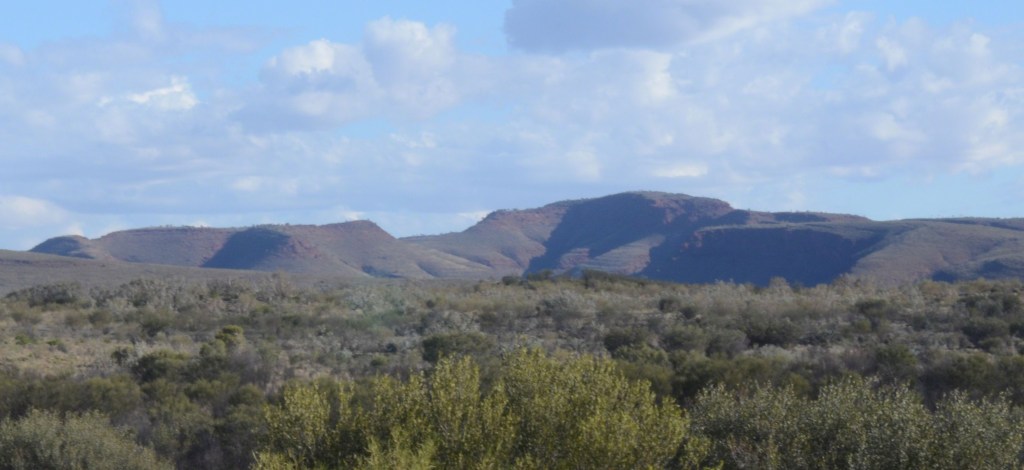
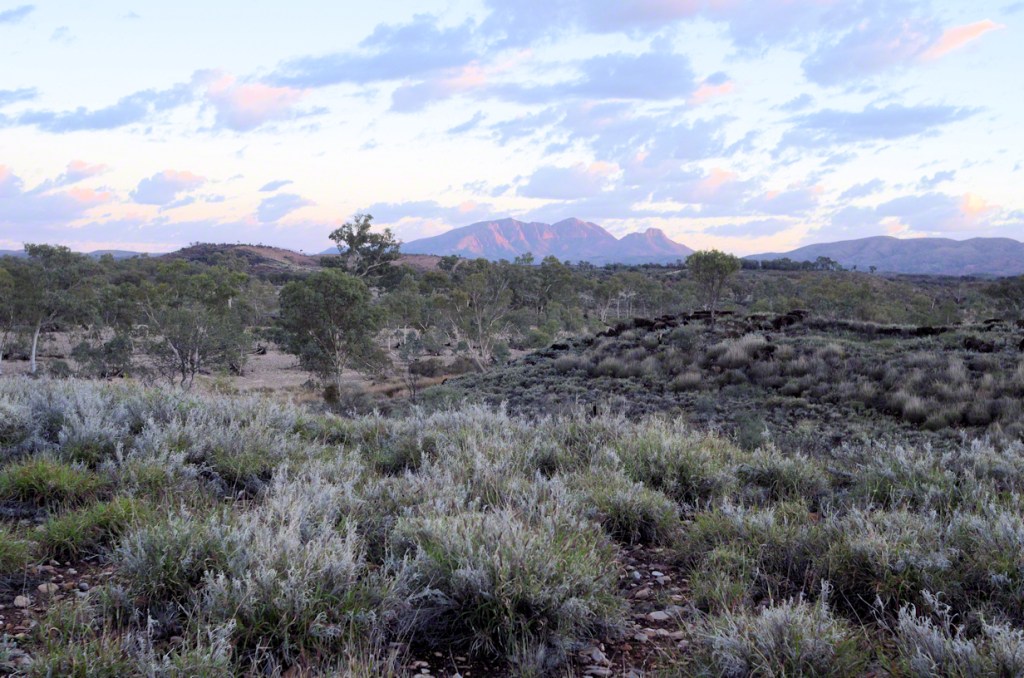
Midday, and Mt. Hermannsburg rose up above the desert scrub; just red sand dotted with tee tree bushes, spinifex and the invasive buffel grass. At regular intervals, horse poo appeared in high piles on the roadside.
I read later that buffel grass was introduced to stablise the desert soil and reduce the risk of bushfire. The problem with this grass is that it is pervasive, compromising the growth of native plant species. PIRSA (Primary Industries and Regions, South Australia) has declared “Buffel Grass under the Landscape South Australia Act 2019”.
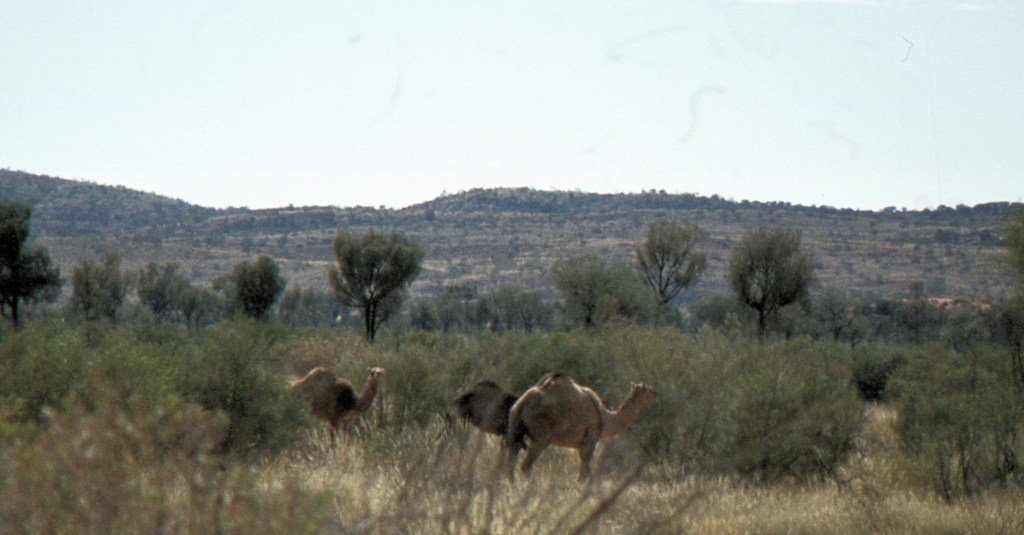
A massive animal carcass on the side of the road flitted past.
‘What’s that?’ I pointed, then placed my hand back on the steering wheel. ‘It’s too big to be a roo and too woolly to be a brumby.’
Son 2 piped up. ‘Camel?’
‘Hmmm, hate to think what happened to the vehicle that struck that camel,’ I said.
Not long after the camel carcass, we passed the memorial to Hermannsburg Mission and then a sign welcoming us to Ntaria—Hermannsburg. To our left, a supermarket, a pale brick structure languishing on the edge of a paddock near the road.
‘That’s where our friend, P, from church works,’ I announced. Our friends, P and wife, K had invited us to stay with them in Hermannsburg.
The convoy came to stop on the gravel road edge by the store.
I hopped out of the car and entered the store. Searching for P, I wandered up and down the aisles, filled with the owners of the Land, the Arunda people, but shelves empty of anything to buy. Except for the pie warmer, choc-full of pies, chips and other fast foods.
I approached the check out where an Indigenous lady served a long line of customers, who each held pies, chips, hot dogs, and burgers. I stood in line and waited my turn to purchase an answer to my question.
Finally, my turn. ‘Could you tell me where I can find P?’
The checkout lady stared past me.
‘P? I thought he worked in the supermarket,’ I said.
I waited about 10 minutes while she served a stream of customers purchasing their pies and other junk food.
So, I left.
‘Perhaps we’ll find an answer or P at the Historic Precinct,’ Mum said.
The T-Team convoy led by Mum’s hire car, then continued through Hermannsburg to the Historic Precinct. We passed a gated community. Yes, you heard right, a gated community. Houses painted in bright pastel green, yellow and pink, could be viewed through the cyclone fence, and their occupants sitting in backyards of red sand.
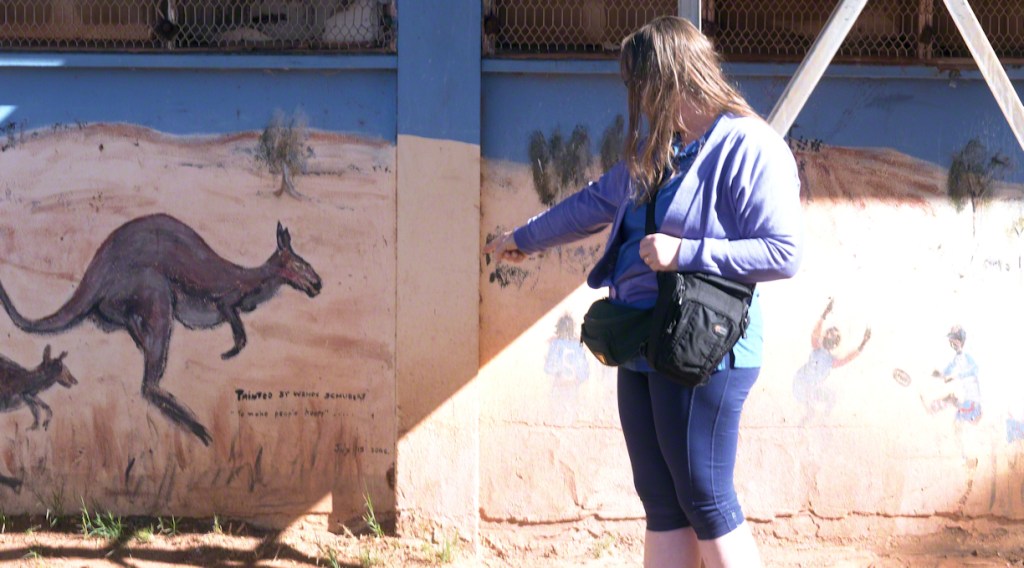
Further on, we rolled past another store. This one painted in pastel blue and decorated with a mural of native bush, mountains, and a kangaroo. Near a broken window, a faded sign, stating its identity as the “Finke River Mission” Store.
Mum waved a hand in the store’s direction. ‘I reckon P works here.’
The door appeared locked by a security gate of thick metal bars. Without stopping, or alighting from the car, I said, ‘I think it is closed on Sunday.’
A few metres on, we parked just outside the Historic Precinct. The wooden gate leading to the old buildings swung in the breeze, open. To one side, though, a formidable sign discouraged us with the words in black letters, “Closed”. Despite this sign and its statement, people wandered across the compound and in and out the buildings.
[Seven years ago, the T-Team, next generation embarked on their pilgrimage to Central Australia. Purpose: to scatter Dad’s ashes in his beloved Central Australia, in Ormiston Gorge.
Over the next few weeks, I will take you on a virtual trip to the Centre and memories of that unforgettable holiday in 2013, with my brother and his family; the T-Team Next Generation.
This time, the T-Team farewell Glen Helen, then struggle with the concept of driving in convoy.]
The sound of boots scuffling in the boys’ section of the tent woke me. I wormed my way out of the sleeping bag, careful not to wake my husband, Anthony. He still puffed out the sweet dreams while softly snoring as I crept next door to investigate.
Son 1, his face clouded in a frown greeted me. ‘Couldn’t sleep, so went for a walk,’ he snapped.
‘Best time of morning to enjoy the views.’
‘Sure you don’t have sleep apnoea? You kept me awake with your snoring all night.’
‘It’s just the cold desert air,’ I replied, then left for my own walk with views.
Captured more of Mt. Sonder at sunrise; this time in blue and mauve hues rising above helicopter landing pad. In 2010, Mum and her sister had splashed out and taken this helicopter ride over the MacDonnell Ranges. In some ways an easier way to have a birds-eye view of the ranges without all the huffing and puffing and effort climbing a mountain.
Mum had been there and done that in her youth when she climbed Mt. Sonder with my dad and other Hermannsburg friends. Mum shared just recently, that one of the friends was a rather luscious looking fellow. She puzzled why there seemed to be no photos of this chap in Dad’s slide collection of the occasion.
On my return from this venture down memory lane, I collected some firewood from an old campfire.
Anthony narrowed his eyes and growled, ‘We’re not making a fire.’
‘Okay.’
I approached my nephew who squatted by a campfire which he had lit. ‘We’re not making a fire,’ I said and then dumped my wood collection into the fire. ‘We’re not having a fire?’
My nephew laughed. ‘I was just playing with my stick and it broke and went in the fire.’
‘And my pieces of wood just fell into the fire,’ I added.
We watched the flames grow, both chuckling at our insurrection to his Kling-ship’s fire-ban.
After a toilet break, I filled a billy can with water and it made its way onto the coals. The family gathered, enjoying its warmth and relative scarcity of flies and other insects. But for some, like my younger niece, the fire failed to ward off all the flies; especially those tiny little sticky flies that crawl in one’s eyes, nose and mouth. For her, the only solution was to put a re-usable cloth shopping bag over her head.
Following breakfast by the fire that my husband said we weren’t going to have, I washed and packed up my bedding and stuff in the tent. Having done as much as I could to pack the Ford, I walked up to the restaurant with Son 2. He wanted an iced coffee. There, while Son 2 drank his iced coffee, I bought a book about Uluru, and then had a coffee with Mum. We talked with the owner and Mum shared that she had visited Ayers Rock (Uluru) in 1953.
‘We were the only ones there,’ Mum said.
‘Was Dad there that time?’ I asked.
‘Yes, but I was much younger, and we weren’t going out then.’ Mum laughed. ‘One of the ladies lost the sole of her shoe when we were climbing, and Dad gallantly lent his shoes to her and walked down the rock barefoot.’
‘Just like Richard did in 1981 with his cousin. Only they did it as a dare.’
‘Must be in the genes,’ Son 2, who had been quietly listening to the conversation, snorted.
By 10.30am, the T-Team convoy had left Glen Helen, its red cliffs, its flies and the doused and covered fire, in a distant mirage and we headed for Ormiston Gorge, again. My sister-in-law wanted to buy a souvenir magnet at the Ormiston Gorge information centre.
We parked at the turn-off, where Mum, Son 2 and I waited in Mum’s hire car for the Ford containing Anthony and Son 1 to arrive, and the T-Team in their white van to appear.
‘What’s taking them so long?’ Son 2 asked.
‘Maybe the Ford won’t start.’ A definite possibility, I thought.
‘Don’t say that,’ Mum said.
‘What about the T’s? They’re late too.’ Son 2 grumbled. ‘We’ve been waiting twenty minutes!’
I sighed. ‘Perhaps the old Ford has broken down and Richard is under the bonnet trying to fix it up.’
‘Should we go back then?’ Mum asked.
‘Yes, I think we should,’ I sighed again while starting up the engine. I rolled the car forward, performed a U-turn and then headed back to Glen Helen.
Just as we reached the road to Glen Helen, the Ford appeared, and sailed past us on its way to Ormiston Gorge.
Down the valley we travelled until we could safely do another U-Turn, at what we had coined the “U-Turn Crossing”. This was the place where a couple of nights ago, Son 1 had collected firewood while I collected photos of Glen Helen’s iron-red cliffs bathed in the golden rays of the setting sun.
Then, stepping on the accelerator, we chased the Ford. Upon catching up to the Ford, we beeped the horn and flashed the lights of our rental car.
‘What the…?’ Son 2 pointed at a white van on the opposite side of the road, heading back towards Glen Helen.
‘No,’ Mum said, ‘we’ve missed the turn off to Ormiston.’
More sighs. A brief park by the side of the road, our car with the Ford, and then exchange of information with Anthony and Son 1. Then with my brother who had earlier missed the turn off to Ormiston and had to retrace his tracks back to the Ormiston road. Then, we turned around (in our cars) and following each other, bumped our way down the rough track to the Ormiston where we waited for Mrs T to buy her fridge magnets.
Transactions done, we began our journey to Hermannsburg. This time, the T-Team in their white van, waited for us to catch up before launching into the T-Team’s convoy to Mum T’s childhood home.
Our first 40-plus degrees Celsius day, and our hills of Adelaide are menaced by bushfire. Although our home was not threatened, the fire raged on roads familiar to us; roads that we take on the “scenic route” to Hahndorf, and people we know live in those particular towns that were in danger. Fortunately, the threat of fire has been eased by drenching rain—just in time.
Such is the plight of living in the driest state in the driest continent…
So, today, as the smell of smoke filled the air and a pall of brown smoke covered the city, I recalled a time when a storm and fire threatened the T-Team.
‘Oh! I give up!’ I hauled myself out of the sleeping bag, bundled up my bedding and parka, and blundered my way to the back of the Rover. I glanced at the men comatose in sleep and oblivious to the mini cyclone engulfing them. Our central campfire blazed, flames sweeping over the clearing. The smell of burnt plastic hit my nostrils. At my feet lay the remains of a little blue bowl, my bowl. I washed my face in that basin every morning. Now what was I to do?
I knew this wind meant business, dangerous business. I rushed to Dad and told him the whole story—the wind, the sparks, the wild fire, and my little blue bowl.
‘What campfire?’ Dad smacked his lips, yawned and turned over.
‘But Dad! The fires have to go out!’ I shook my father. ‘We’ll burn to death.’
‘Oh, all right!’ Dad squirmed his way out of his layers of blankets and bedding. ‘I don’t know why you have to disturb me. I was just getting to sleep.’ He picked up the shovel and tramped over to my fire. The coals had sprung to life and tongues of flame licked at my rumpled groundsheet.
Dad shovelled several heaps of dirt over my fire. I picked up a bucket and fought my way to the creek through a wall of wind. My bucket full of water, I marched back to camp. I tossed water on the coals and with the light of my torch watched them sizzle and steam. I put rocks in the bowls and buckets as insurance against being blown away in these gale-force conditions.
I returned to my sleeping quarters with bucket half-full of water and found Dad disposing of the menacing flames of my fire. A few rebellious coals glowed with fresh gusts. So, I chucked water on these reheated stubs, quenching any urge for the embers to flare up.
Dad stepped forward and made a grab for my bucket. ‘Hey! What are you doing?’
‘All in the aid to save us from a bushfire,’ I replied.
On my trek back to the Rover, I checked the campfire. Coals glowed angry red, and blue-yellowy-green flames wobbled over the molten surface. I drowned the recalcitrant coals with water, killing any ability to resurrect with the wind once and for all, I hoped.
I carried the gas lantern with me and walking towards the Rover battled the surging torrents of wind. Dad called out, ‘Take care, Lee-Anne!’
‘Yes, Dad!’ I called back, my words getting sucked away in the storm. I put the lantern on the tucker box while sorting stuff to place under the protective weight of rocks. A fresh gust of wind whipped and roared. It cut right through me. Crash! The lantern smashed to the ground, slivers of glass smattered all over the ground. Woops! There goes the light for tonight.
I tramped back to Dad’s bed. ‘Um, Dad, I have some bad news.’
Dad sounded muffled through layers of blanket and his ski mask. ‘What now?’
‘I broke the lantern.’
‘Oh! Lee-Anne!’ Dad groaned in that tone of voice that made me feel ashamed for being so stupid as to put the lantern on a tucker box in the middle of a wild storm.
On my way back to the Rover, book bag slung over my shoulder and everyday bag in hand, I saw the flames reignite and spread their hot fingers over the tinder-dry site. I attacked the offending piece of wood, this time with a rock. The flames splayed under and around the stone with a blast of wind. Down the creek I ran, and returned with a bucket of water. I drowned the smouldering lump in a deep puddle.
Dusting my hands of residual ash, I returned to the Rover in which I’d set up my bed. Wind howled around the cabin, rocking the whole vehicle as I huddled in my layers of bedding. I looked out the window. Dad’s light from his undying campfire flickered and sent violent flames and sparks flying over his tarpaulin. I leapt out of the Rover and raced over to save Dad. There he lay, wrapped in comfort in a wad of blankets, fast asleep and unharmed. I smothered the glowing coals with a few heaps of sand.
I set my face against the wind and battled my way back to the Rover. Once more I settled into my nest of sleeping bag, blankets and parka on the narrow bench seat. I shut my eyes and tried to block out the howling winds and the Rover rocking from side to side.
Then that feeling began. I tried to ignore it. I have to pee. I crossed my legs and pretended it didn’t exist. I have to pee. The wind moaned. I’m not going out there, not in that weather. I’ve got to pee. I’ve done my dash; nature will just have to wait. This is urgent. I rocked with the Rover and tried to think of other things. I must pee, I’m busting! Once more I unwrapped myself out of mummification, forced open the Rover door against the wind and stumbled to the nearest bush down wind. I hoped I didn’t splatter my pants.
Relieved, I pushed my way back to the Rover. A faint alarm bell bleeped somewhere in the campsite. I stopped before getting into the Rover and watched Dad jerk up and out of his sleeping bag. He staggered towards Tony’s quarters. ‘Wake up!’ he yelled, his words getting sucked up by the wind.
The pile of bedding remained lifeless and unresponsive.
‘Hoy!’ Dad shouted.
No answer.
Dad knelt, with his mouth close to the hood of the sleeping bag, he shouted, ‘What’s the time?’
His friend stuck his head out the sleeping bag. ‘What?’
‘Oh, never mind,’ Dad snapped and then stomped off to bed.
Safe from the atomic explosions of wind and chill, my head burrowed deep within my sleeping bag, I prayed. I was reminded that though the world may lash us with rage and storms, God keeps his children safe. God had kept us safe.
















 Tru-Kling Creations