Late last year, we sold our Red-Orange Toyota Corolla Levin to our son and bought the Mazda from my Art and Indie Scriptorium friend, Elsie King. We have named the Mazda, Antoinette, because she has a habit of telling us how to drive. Good thing at our age. Helps avoid accidents and the “accidental” speeding fine. Perhaps the uninsured, un-Australian licensed Uber driver who crashed into Levin while my son was driving could have done with an “Antoinette” in his Uber car. Fortunately, it all happened at slow speed and although Levin was damaged, my son emerged unscathed.
My son did remark, though, “I’m glad I wasn’t riding my motorbike, or I’d have ended up in hospital.”
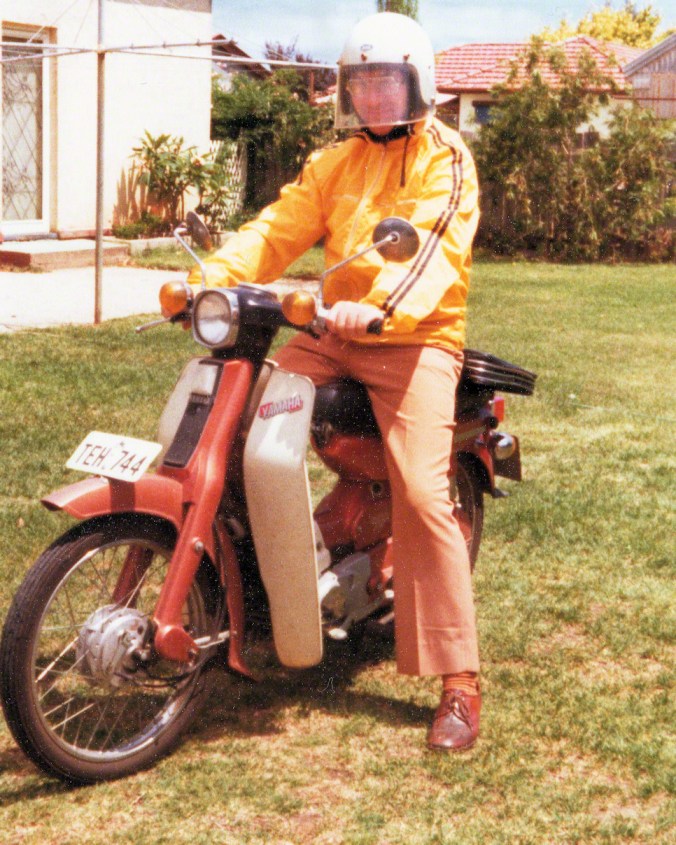
On that note, Dad’s midlife crisis vehicles keep rolling in. This time, “Putt-Putt”, the motorbike. Was this new development a reflection of the direction Dad’s midlife crisis was taking? Or was he just having a go?
So, here goes with the 100-word challenge.
Putt-Putt Pa
After lunch at Grandma’s one Sunday, my cousin showed off his prized Ducati. Inspired, Dad resolved to have a go and buy his own motorbike.
The first hint Dad was dissatisfied with his current transport arrangements was expressed in a story game, where he described the money-saving qualities of a motorbike. I pointed out dangers. My cousin’s friend had died in a motorbike accident.
Soon after, Dad came puttering down the driveway on Putt-Putt, a bright orange motorbike. From then on, for a time, Dad puttered from Somerton to work in Port Adelaide. Everyone was happy, until … the accident.
[Another fond memory from my childhood…and Dad’s catchcry, “for the time being” took a breather when, after being promoted to Deputy Principal, he bought the Holden Premier. Also, a timely piece as our recent Remembrance Day, November 11, marked the 50th anniversary of the sacking of our then prime Minister Gough Whitlam by the Governor General Sir John Kerr. I still remember where I was when that happened. At home watching the news and old Gough saying: ‘Well may we say, “God save the Queen”, because nothing will save the Governor-General.’
Anyway, a car tale from our journey to Canberra where my education in Australian politics began.]
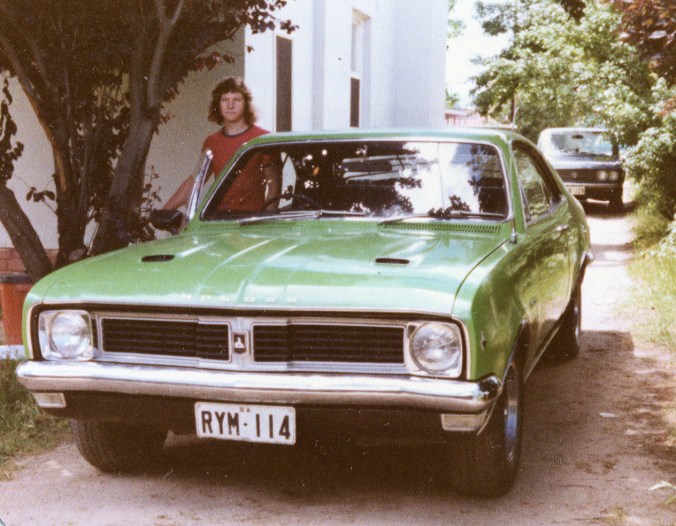
The Dream Car—Holden Premier EH, Serena (100-word challenge)
Serena, our dream family car ferried the T-Team to Canberra. In 1975, hardly a maiden for this voyage, she drove us to our destination; a comfortable, safe ride over the Hay Plains. No breakdowns. No stranded waiting for road service on the hot dusty side of the road. A smooth ride that rocked me to sleep; the vinyl with scent fresh from the caryard to us.
She mounted the snow shovelled roads to Thredbo. From her window, my first sight of snow on a brilliant sunny day, snow shining on twisted eucalypt branches.
Toilets, bathrooms, latrines, bog or “dunnies” as they’re called in Australia, have surfaced as topics of conversation in the last week. How they have changed over the centuries. How they vary from place to place, country to country. But one thing remains constant to being human. When you gotta go, you gotta go.
100-Word Challenge: When You Gotta Go
He stood up and wandered to the door.
‘Get back to your seat!’ I snapped.
‘Gotta go to the toilet, Miss.’
‘No, you don’t.’ I pointed at his desk. ‘Sit down!’
This version of Denis the Menace crossed his legs and grinned. ‘Yes, I do.’
‘You can wait.’
‘Please, Miss,’ his voice mocking, ‘I have to go.’
Sniggers rippled throughout the classroom.
I stood, pointing like a fool at his chair. Afternoon sun streamed through the dusty windows, ripening adolescent body odour.
[Have been engrossed in a murder-mystery, come thriller manuscript that I wrote in 2009, and then filed away. Wrote it so long ago I have to read it to find out what happened. So, completely forgot to post my 100-word challenge last week.
Anyway, Dad’s mid-life crisis vehicles keep rolling in. Was this new development a reflection of the direction Dad’s mid-life crisis was taking? Or was he just having a go?]
100-Word Challenge — Have a Go
After lunch at Grandma’s one Sunday, my cousin showed off his prized Ducati. Inspired, Dad resolved to have a go, and buy his own motorbike.
The first hint that Dad was dissatisfied with current transport-arrangements, was expressed in a progressive story game, where he described money-saving qualities of a motorbike. I pointed out the dangers, my cousin’s friend had died in a motorbike accident.
Soon after, Dad came puttering down the driveway on Putt-Putt, a bright orange motorbike. From then on, for a time, Dad puttered his way from Somerton to work in Port Adelaide. Everyone was happy, until…the accident.
If you’d like to polish your writing skills or find out more about our new project, a self-publishing collective, click on the link to Indie Scriptorium…
Or…
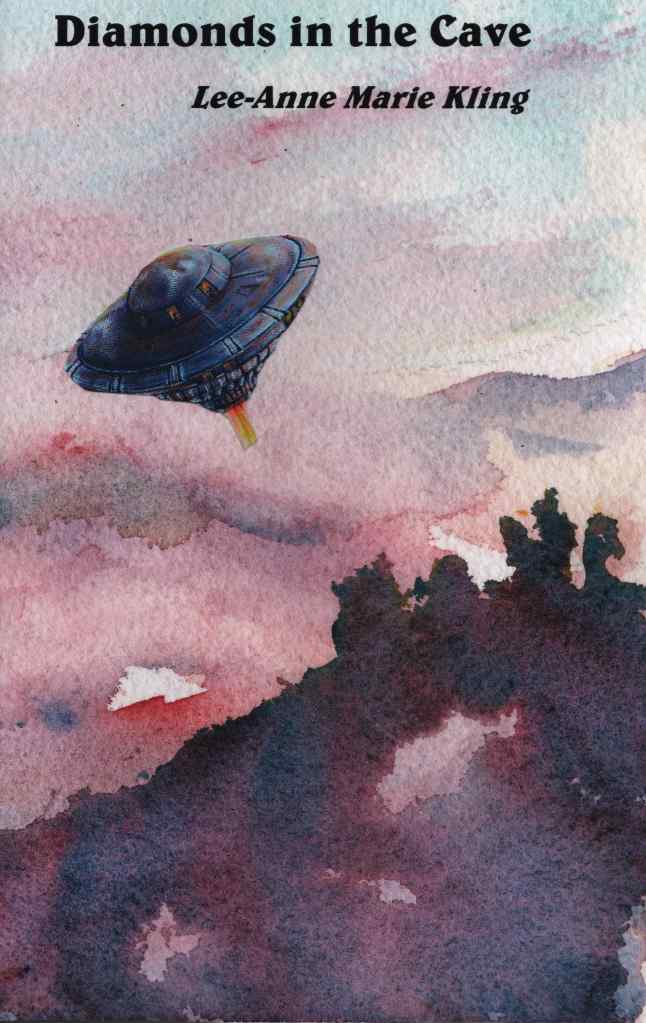
Catch up on the exploits of Boris the over-grown alien cockroach, and Minna and her team’s attempt to subdue him.
For good holiday reading click on the links below…
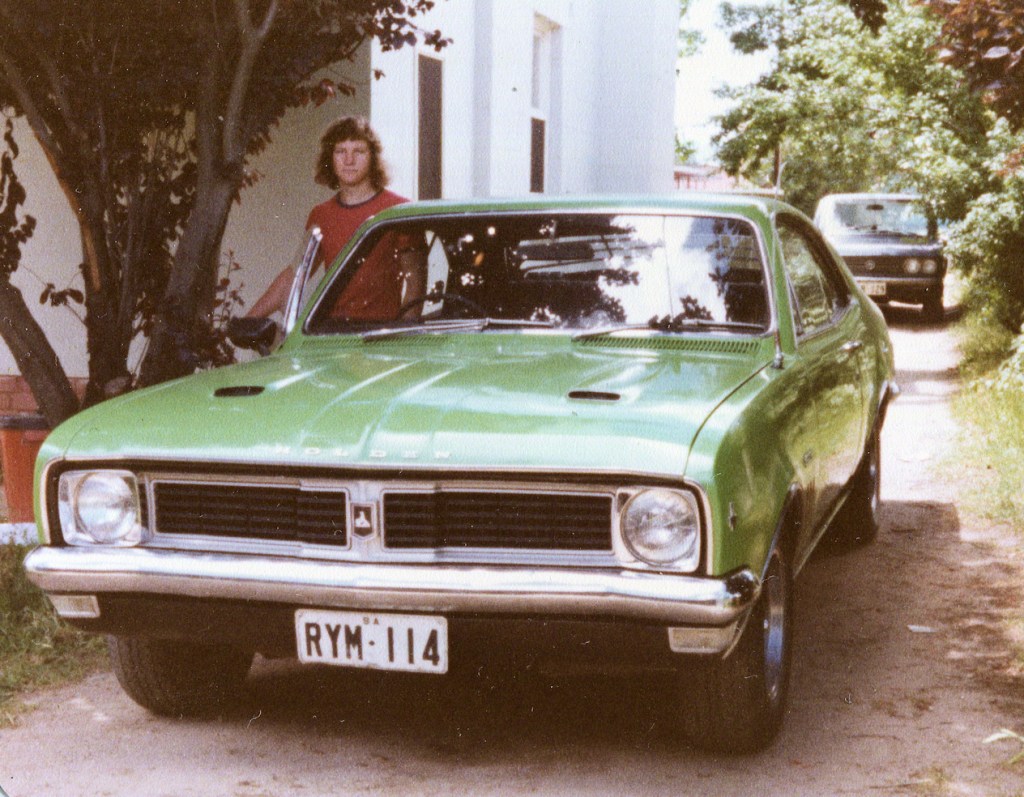
[Another fond memory from my childhood…and Dad’s catchcry, “for the time being” took a breather when, after being promoted to Deputy Principal (Primary School), he bought the Holden Premier.]
Serena, our dream family car ferried the T-Team to Canberra. In 1975, hardly a maiden for this voyage, she drove us to our destination; a comfortable, safe ride over the Hay Plains. No breakdowns. No stranded waiting for road service on the hot dusty side of the road. A smooth ride that rocked me to sleep; the vinyl with scent fresh from the caryard to us.
She mounted the snow shovelled roads to Thredbo. From her window, my first sight of snow on a brilliant sunny day, snow shining on twisted eucalypt branches.
Note: in the back of the photo, you’ll see the lurking the unfortunate successor to the Holden Premier and focus of the next week’s blog featuring my childhood family’s cars.
***
Catch up on the exploits of Boris the over-grown alien cockroach, and the mischief and mayhem he generates.
[Again, COVID, that uninvited guest has thwarted my visit to Carol’s. This time although she’s well, she’s a close contact and must isolate for 7 days. Meanwhile, I have been working on my writing and have been reflecting on what I have learnt makes for a good story.]
Unbelievable to Believable
Unbelievable, that’s what they said about my novel. Unbelievable. Is that why my first novel, Mission of the Unwilling has failed to thrive? Why there’s no feedback? Or is it a case of someone who’s not a Young Adult, and just not into Sci-Fi?
Whatever, I consider this feedback valid and believable. Over the next few months, I plan to revisit Minna’s world and her adventures at the mercy of Boris and learn from my venture into self-publishing. Nothing is wasted. The take-away from the most recent honest feedback—make my stories believable.
What does this mean for me as I refine the craft of story-telling?
My characters are real to the reader.
The setting is authentic, so that the reader can step into my constructed “world” suspending all disbelief.
The audience buy into the journey they take into that world.
But, what does “suspending disbelief” mean. I mean, really? I mean, when I revisit my stories, to me, the characters are alive, the setting an on-site movie set, and I gladly invest in the tale told. Not so for some of my readers, apparently. In truth, I’m too close to my work to view it objectively. I need and appreciate feedback from others. I’d go as far as to say that most writers benefit from a second, third, fourth or umpteenth pair of eyes to make their work the best it possibly can be.
So, from the perspective as a reader, that extra pair of eyes on other works, here’s what I’ve learnt that suspends disbelief and do some unpacking of techniques that make characters, setting and journey more believable.
Believable characters: Someone with whom you connect. You know that person. You’ve met them. You’ve had lunch them. You’ve admired them. They’ve annoyed you with their quirky habits. They’re those people you see across a crowded coffee shop and already you’ve constructed a whole story around them, by observing their posture, expressions and gestures. You invest time following what they’ll do, what will happen to them. Believable characters don’t have to be human, but they do need human qualities and personality for readers to relate to them.
Believable setting: Best woven into the forward-moving action of the story. The writer describes the setting with the five senses, what you: 1) see, 2) hear, 3) touch, 4) smell, and 5) taste. And for the world to be memorable, the author picks up something unique or odd about the place. For example, I may write of Palm Valley in Central Australia, ‘Ghost gums jut out of the tangerine rock-face, and a soft wind rustles through the prehistoric palms.’
Believable Story: You need to convince your readers that such a sequence of events can happen. A skilful writer uses the technique of cause and effect. The character makes a choice, and their actions result in consequences often leading to dilemma that must be resolved. Readers are more likely to engage with proactive characters who influence their environment and others, and who make active choices to change and grow, rather than the passive characters who have every disaster happen to them, and their problems magically solved.
Yes, pile on the misery, pile on the challenges, don’t be afraid to get your characters into strife; that’s what the reader’s looking for. But remember, the chain of events must be believable. An article by Laurence Block, Keeping Your Fiction Shipshape*, describes the relationship between storyteller and audience is like enticing readers onto a cruise ship, keeping them there, and delivering them back to port with a good satisfying end.
It’s the skill of the storyteller to convince the audience. If the characters are believable, the setting is believable, and the action believable, your readers will enjoy the ride and complete the journey you, as the storyteller, takes them on.
[Why Notre dame? Victor Hugo, the author of Hunchback of Notre-Dame, spent the first three-quarters of the book describing the setting. Useful if you visit Paris, but does nothing for moving the story forward.
Also tourists willing to invest in the journey to climb Notre-Dame by waiting several hours in the long line that stretched the length of the Cathedral. What will they see? The gargoyles (characters), a view of Paris (setting) and a climb and walk through the Cathedral (the journey).]










 Tru-Kling Creations