Oops! Almost one week into Marion Art Group’s (my art group) exhibition at the local shopping centre, and I have failed to mention it. Been too busy writing, appraising hopeful writer’s works, and transcribing a friend’s biography of her mother who lived through the horrors of World War II. Plus burrowing away in the family history rabbit hole.
I have been pondering where my art genes have come from. No mention of renown artists in my ancestry. My dad was an artist with some potential, emphasis on potential as he channeled his talents more into music than art. My maternal grandfather, Sam Gross was an amazing photographer. But as a missionary pastor in Central Australia, he was discouraged from furthering his photographic endeavours as the mission board frowned on it and said he was spending too much money on camera equipment and film.
So, in light of my predecessor’s unrealised potential and the fact that I am still using the watercolour paints and brushes my dad left behind, I will share an afternoon that we spent painting in Central Australia in 1981.
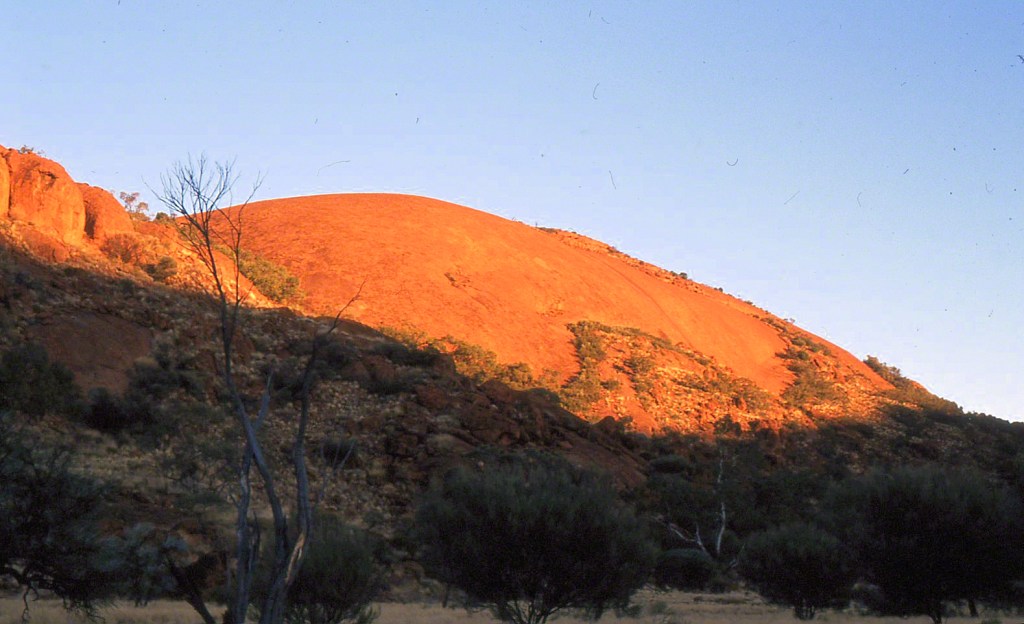
Mount Hermannsburg
My father and I sat in the dry river bed of the Finke River painting Mt Hermannsburg which towered above the river gums and spinifex. We painted our muse on site; Dad painted in watercolour and I painted in acrylic.
After a couple of hours, Dad packed up his brushes and palette and returned to the town of Hermannsburg. I stayed, in the creative zone, dibbing and dabbing, the setting sun casting shadows over the river bed and a cool breeze pricking me with goose bumps on my bare arms.
I made the final touches as the sun sank below the horizon and I was called in for tea. I signed with my maiden name, naturally, as I was only 18.
Dad’s painting and mine sat side by side on our host’s piano where all who saw, admired our work. I kept walking past and gazing at my painting. Did I really do this? Wow! Did I really?
[Eleven years ago, the T-Team, next generation embarked on their pilgrimage to Central Australia. Purpose: to scatter Dad’s ashes in his beloved Central Australia, in Ormiston Gorge.
Once every month, I will take you on a virtual trip to the Centre and memories of that unforgettable holiday in 2013, with my brother and his family; the T-Team Next Generation.
This time, for the first time in this, my third visit to Uluru, we walked part of the way around the Rock.]
Yet Another Excuse not to Climb the Rock
Wednesday, July 10, 2013
Packing—Anthony was very particular how the car and bags should be packed. He considers himself the master of packing; no one can do packing as good as he can. So, in an effort to get out of some extra work, I decided that since he considers packing his personal gift and calling, I’d allow him to pack while I prepared breakfast. Alas, my plan was not executed as well as expected.
‘Lee-Anne!’ the packing-expert called, ‘Can you come and pack your bags, please.’
It seems I’m the expert when it comes to packing my own bags. So, putting breakfast on hold, I trudged back into the tent to deal with my personal belongings.
‘Careful not to over-fill the bag,’ came the expert’s warning, ‘you might break the zip.’
He then lifted one of my bags ready to be piled in the car. ‘My goodness! What have you got in here? It weighs a tonne.’
While Anthony grumbled while playing Tetris with our luggage in the Ford station wagon, I resumed preparing breakfast while listening and watching the T-Team pack up camp in a haze of drizzle. Mrs. T barked orders organising her family into an efficient machine of packing and cleaning. Then, executing her sweeping expertise, she swept out the tent, trailer and car.
After eating, I trudged to the shared kitchen facilities where I washed the dishes. After three days at Yulara campsite, I had discovered that these facilities offered a communal kettle to boil water. Still, the T-Team had for that time, a more convenient one, courtesy of my brother’s inverter and battery-power.
The thing was, I had to boil the kettle to obtain hot water to wash the dishes. While I waited for the kettle to boil, I chatted to a mum from Sydney whose family were just finishing their holiday.
However, upon meeting up with the T-Team at the Service Station for fuel, it seems certain T-Lings had changed their parents’ minds. They would be trying one last time to climb Uluru. We agreed to meet them at the entrance to where one starts to climb the Rock.
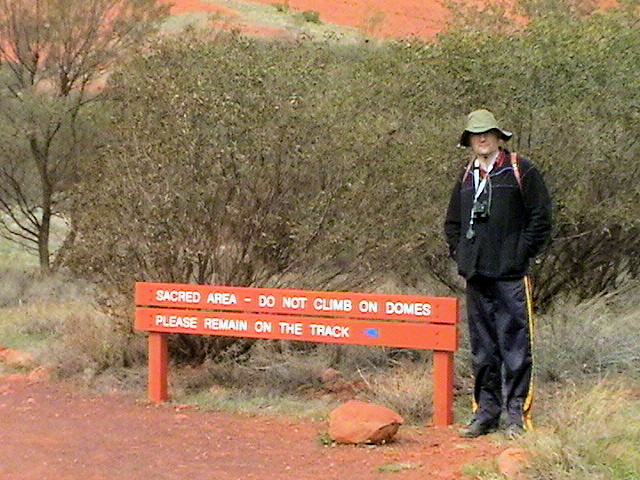
Upon arrival, Anthony and I trekked up to the gate. The sign read, “Closed due to cloud”.
While we waited for the T-Team, a ranger with a metal panel tucked under his arm, sauntered up to the sign. He unscrewed the “cloud” sign and replaced it with a “high winds” sign.
‘Well, now we know how it’s done,’ I remarked.
Anthony sighed. ‘I guess the T-Team saw that excuse and are on their way to Alice Springs.’
We walked around the “ladies’” part of the Rock. The previous day we had explored the “men’s” section. The cloud cover lifted and the sun emerged, bathing the landscape in a lemony light. Although now dry and sunny, we encountered only the occasional hiker; for most of the trek we were on our own.
We marvelled at the grandeur of the Rock, and the sense of an ancient spiritual presence.
After an hour’s walk, we returned to the Rock’s entry point. A small crowd had gathered by the gate. They watched the ranger again fiddling with the notice board.
Anthony shook his head. ‘What excuse this time?’
The ranger placed an “Open” sign on the board and unlocked the gate.
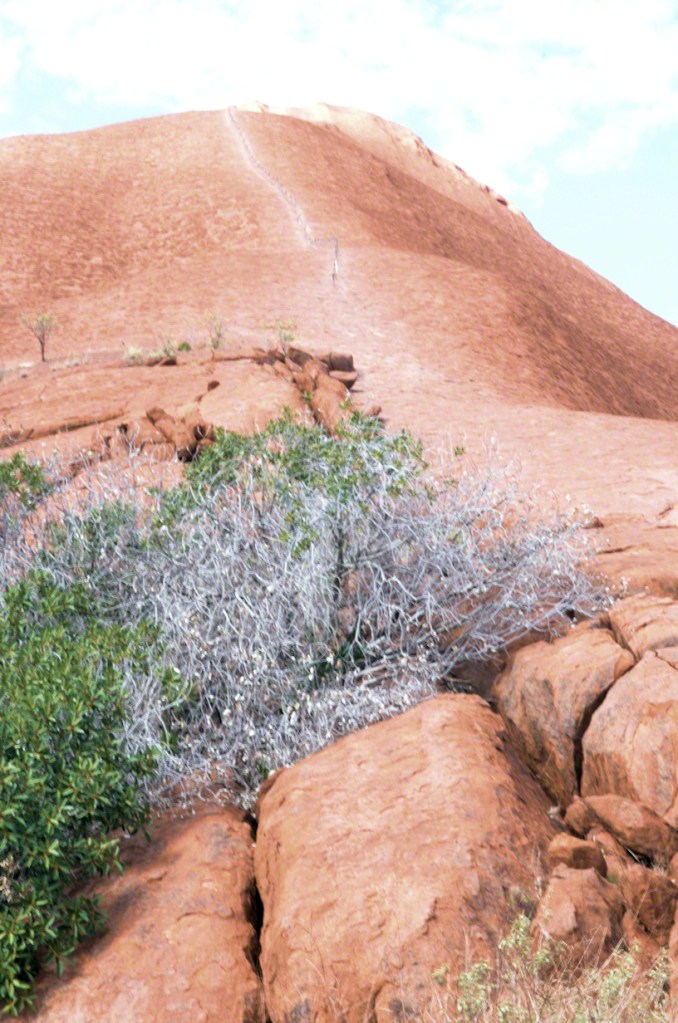
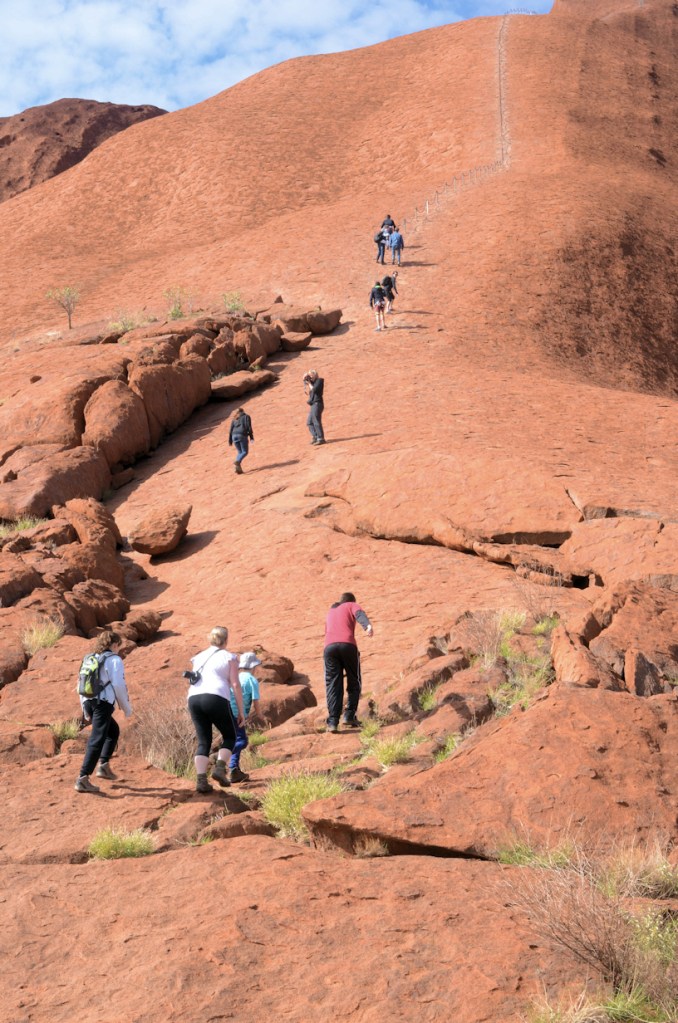
We watched dismayed as the crowd surged through and scampered up the steep incline.
‘Poor T-Team,’ I said, ‘just as they had given up, the Rock is open for business.’ Using my mobile phone, I snapped a shot of the tourists like ants inching their way up the rocky sides of Uluru. Later, I attempted to share the photo with my niece. But, it seemed my endeavour failed. Anthony had also taken photos with his phone which he then tried to share with the T-Lings. Still no success.
After another failed attempt to send a photo, this time during a stop at Curtain Springs, Anthony muttered, ‘What do you expect from a cheap mobile plan?’ He then extolled the virtues of his Telstra plan.
[to be continued…next, Adventures on way to Alice Springs]
[Eleven years ago, the T-Team, Next Generation embarked on their pilgrimage to Central Australia. Purpose: to scatter Dad’s ashes in his beloved Central Australia, in Ormiston Gorge.
Now just a teeny-weeny bit on the Family History front. I delved into some research concerning family traits. You see, the T-team pride themselves on their T-Traits (Dad stresses that the word “trait” is pronounced “tray”.) So, I decided to have a peek at what characteristics, us who are the T-Team, have that make us distinct from other families. I’ll elaborate in a future blog. But briefly, what comes to mind that aligns with the posts I read on Google, are hairline (straight but peaked up at each side of the temple), high forehead (Dad’s cousin always remarked this trait as a sign of intelligence), high cheek bones, good teeth, a penchant for puns and a certain amount of daring for adventure; hence the T-Team and their treks into the outback.
So, again, the virtual journey continues, to the Centre, Uluru and memories of that unforgettable holiday in 2013, with my brother and his family; the T-Team Next Generation.]
Marla Track
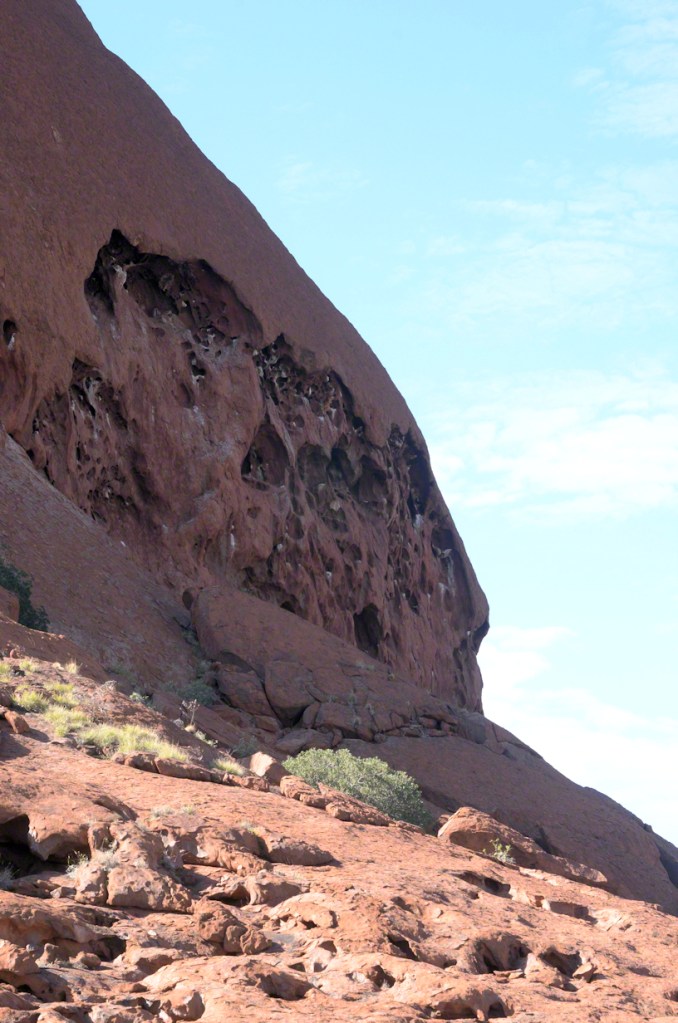
Mrs. T slept in the T-Van, while the rest of the T-Team walked the Marla Track to Kantju Gorge. There, we were awed by the caves hollowed out as if by waves crashing into them. We marvelled at the vivid red ochre paintings in rock caves carved out by the sea of time. Tourists filled these caves, spilling out the sides and edges, listening intently to the guides explaining the stories behind the artwork.
As the cloud and damp set in during the day of July 9, the T-Team congratulated themselves on completing the mission to view the sunset on the Rock the previous night. Anthony reported, ‘Alice Springs had one of its lowest temperatures ever; 8 degrees Celsius maximum.’
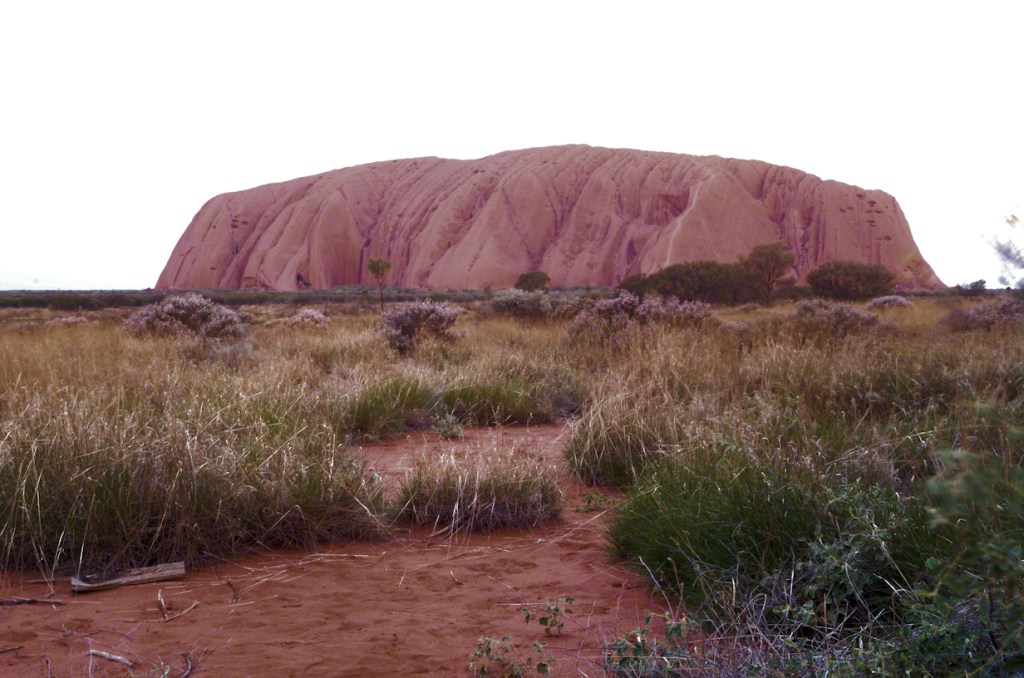
‘Wow! Just as well we saw the rock in all its glory last night,’ I added. ‘Dad always said that the Rock is at its best at sunset when there are clouds to the West.’
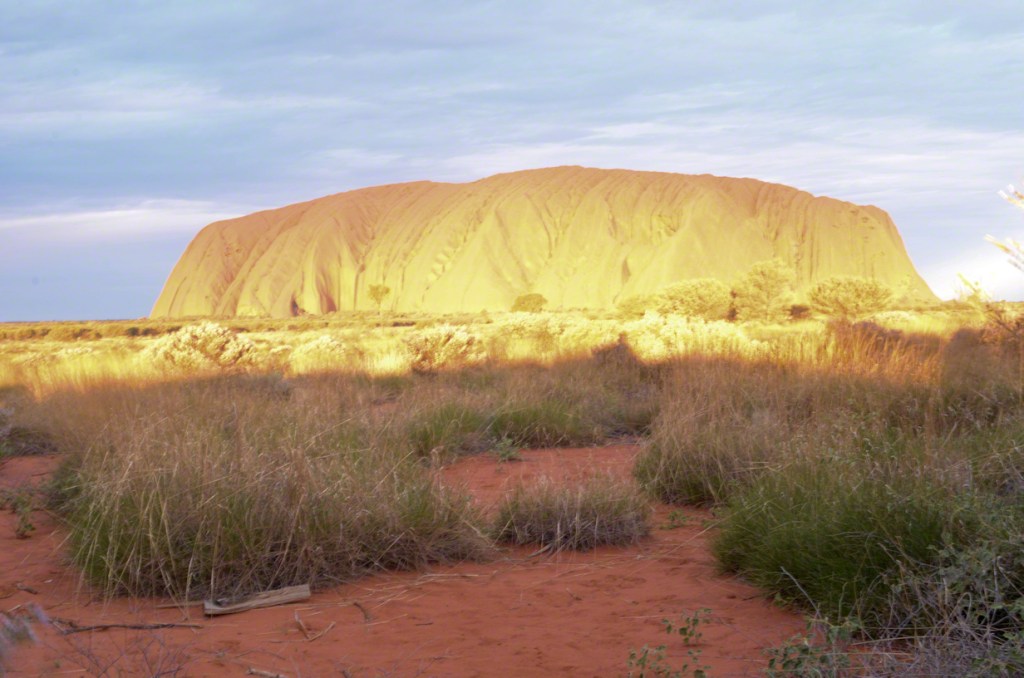
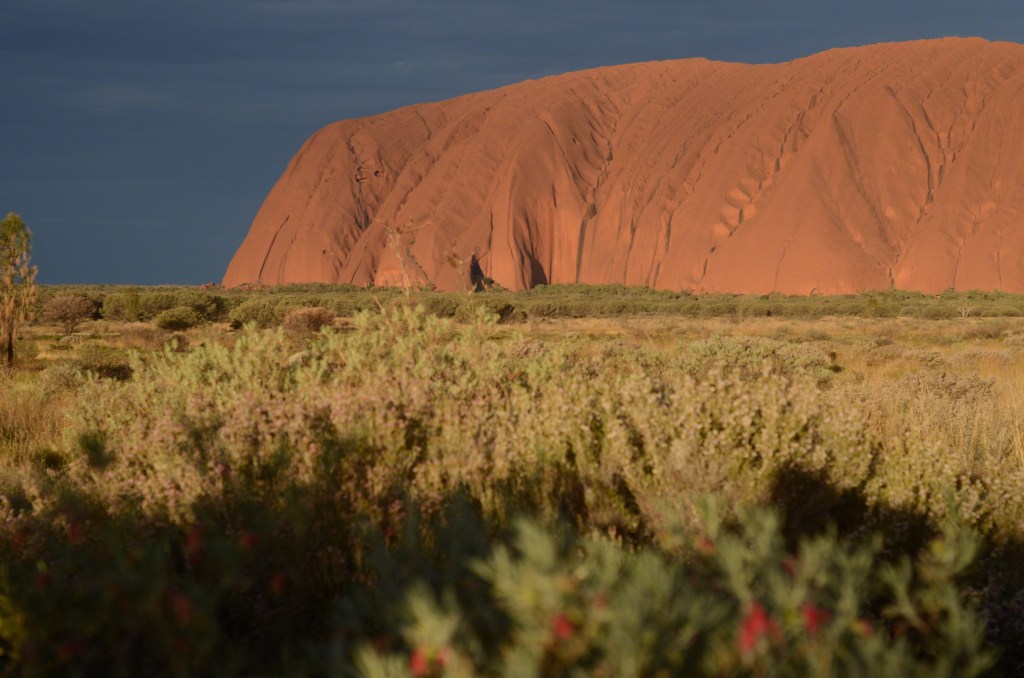
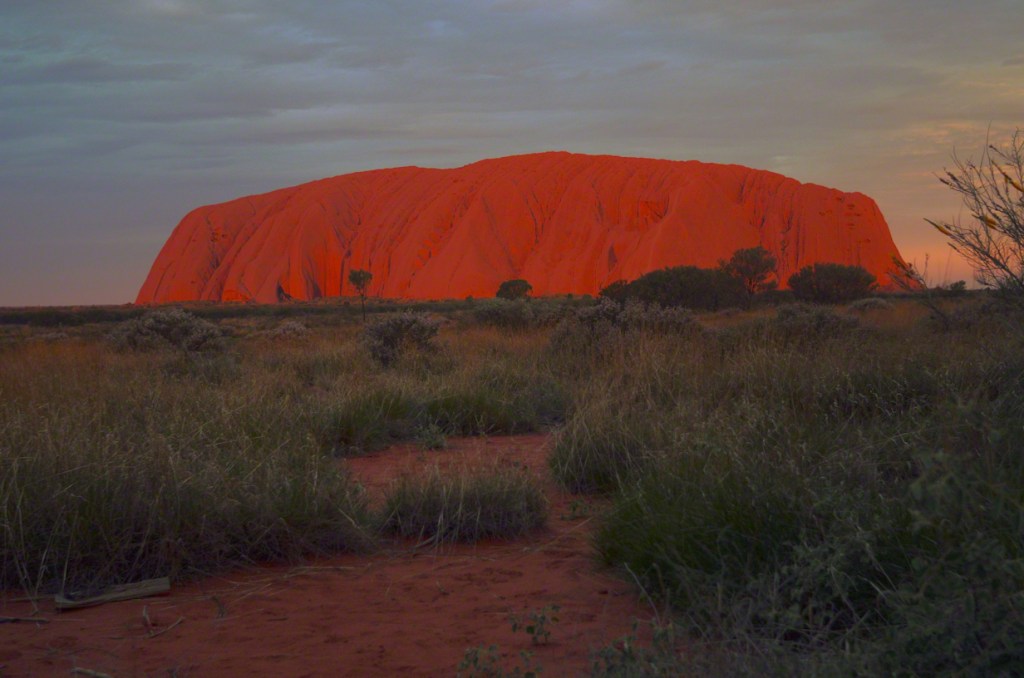
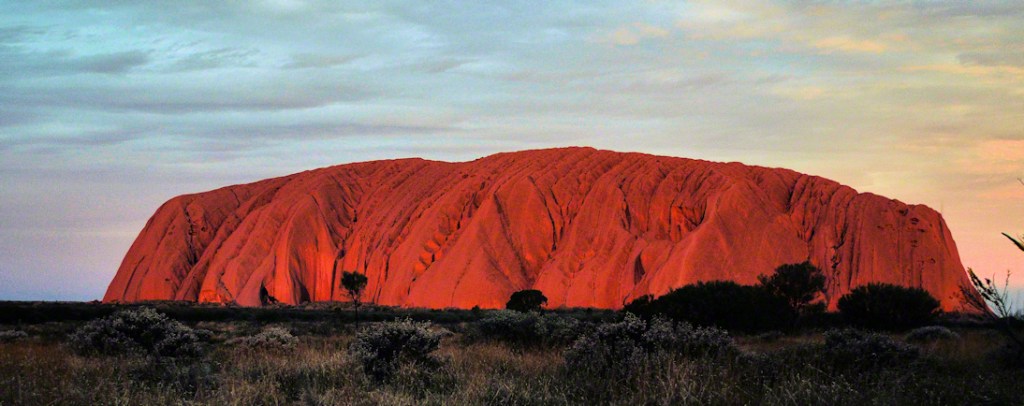
The ever-changing colours of the massif amazed me; golden, then orange, then tangerine…until a rich deep red with the golden grasses glowing in the foreground.
And, with the photoshop features on my digital camera, I was able to make my image of Uluru, almost “chocolate box” quality. Not cheating, just capturing how I actually saw the famous Rock.
And on that night, as I stood transfixed, taking photo after photo of the Rock, Mrs. T called out, ‘Hey! Look the other way!’
We turned.
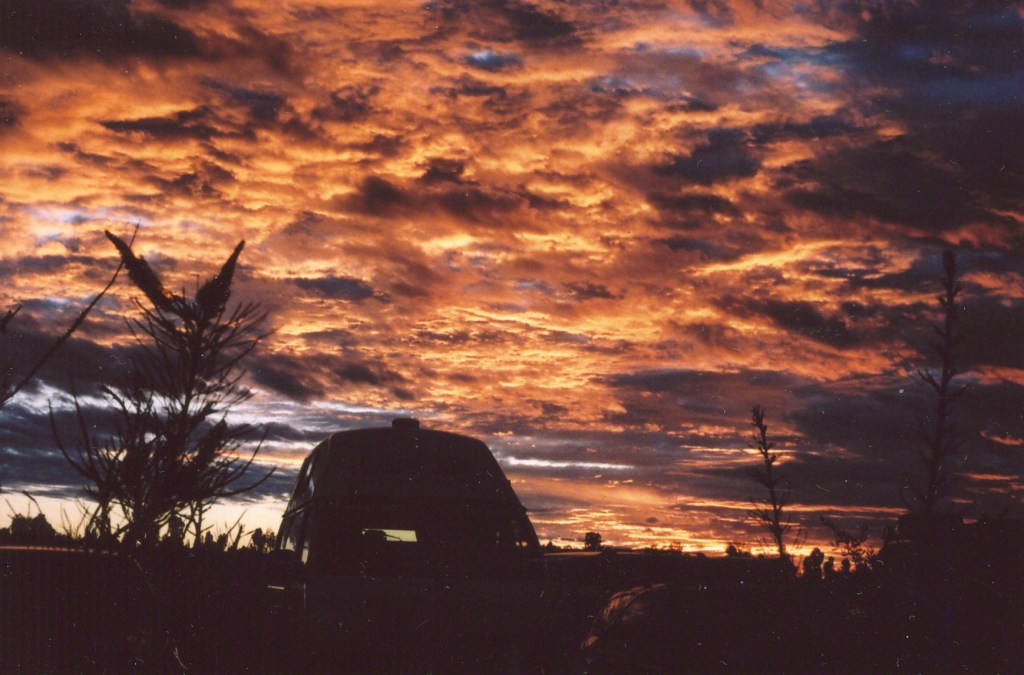
‘Wow!’ I exclaimed. ‘What a show!’ The expanse of sky painted in every hue from yellow to crimson; the sun’s parting gift as it sank from this evening’s horizon.
Evening, and I used our portable camp stove to cook rice for tea. Anthony no longer complained about the use of the stove instead of the cooking facilities. Having skipped lunch, he was hungry, and he knew better than to expect the public BBQ to perform; especially considering a biting wind had sprung up.
The T-Lings, as they had done every night, planted their mobile phones at the base of the power pole which was not far from the BBQ. With cables attached, they left them there to charge up. ‘Would you look after our phones?’ they each asked, expecting me, as I was cooking, to keep an eye on their treasures.
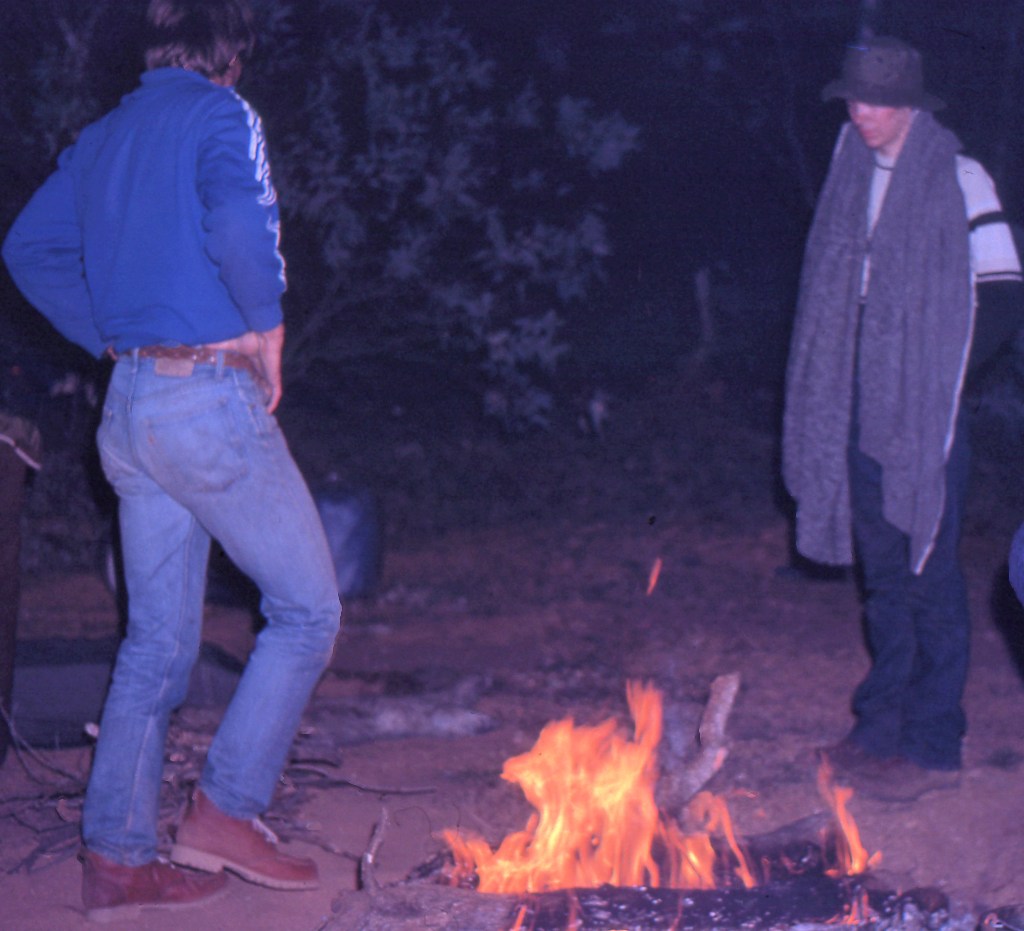
Night fell and as the wind turned bitterly cold, I made a toilet visit where I donned my thermals. On the way back from the toilet, I observed a group gathered around the communal firepit. They asked if I wanted to join, but I declined. The T-Team were playing games.
In some ways I regretted not accepting the invitation. We played card games but as the T-Crowd was too large for the small tent, I ended up playing cards outside in the cold and dark. There, half-frozen despite the best efforts of the thermal underwear, I taught my younger niece to play Patience.
Then, how pleasant it was to snuggle into our minus seven sleeping bags for sleep.
‘Oh, no!’ a T-Ling cried, then rustling. ‘Our phones!’
[Over ten years ago, the T-Team, Next Generation embarked on their pilgrimage to Central Australia. Purpose: to scatter Dad’s ashes in his beloved Central Australia, in Ormiston Gorge.
Over the next few weeks, I will take you on a virtual trip to relive and rekindle memories of our travel adventures. This time again to the Centre and memories of that unforgettable holiday in 2013, with my brother and his family; the T-Team Next Generation.]
Yulara
Sunday 7 July 2013
Creature Comforts
Anthony tore off the tarpaulin and then, armed with the foldable shovel, stomped off in the direction of the bushes.
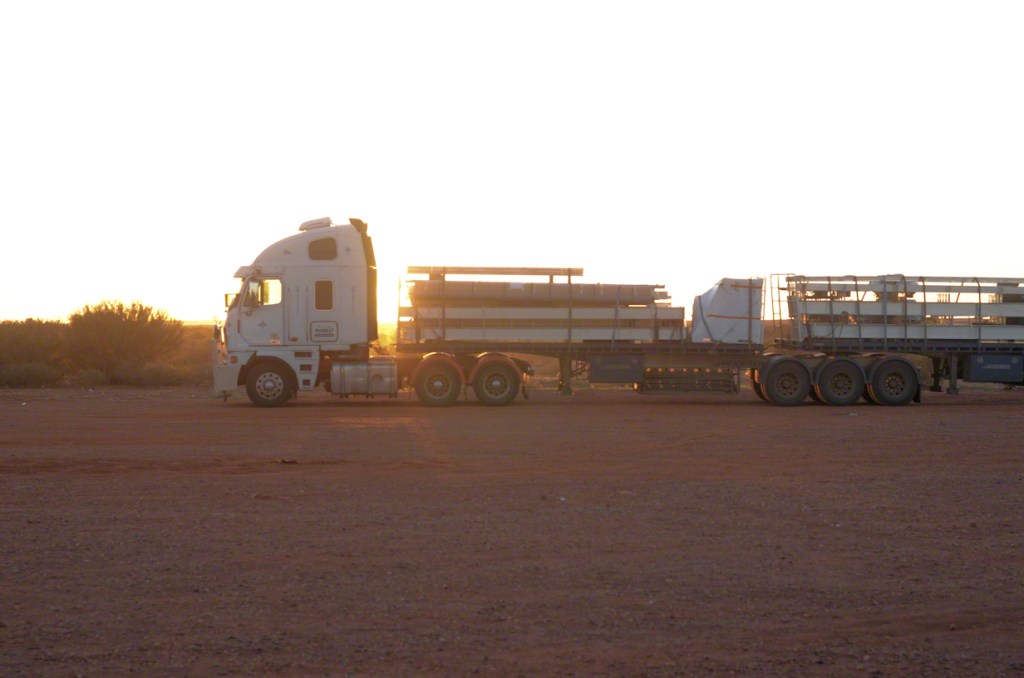
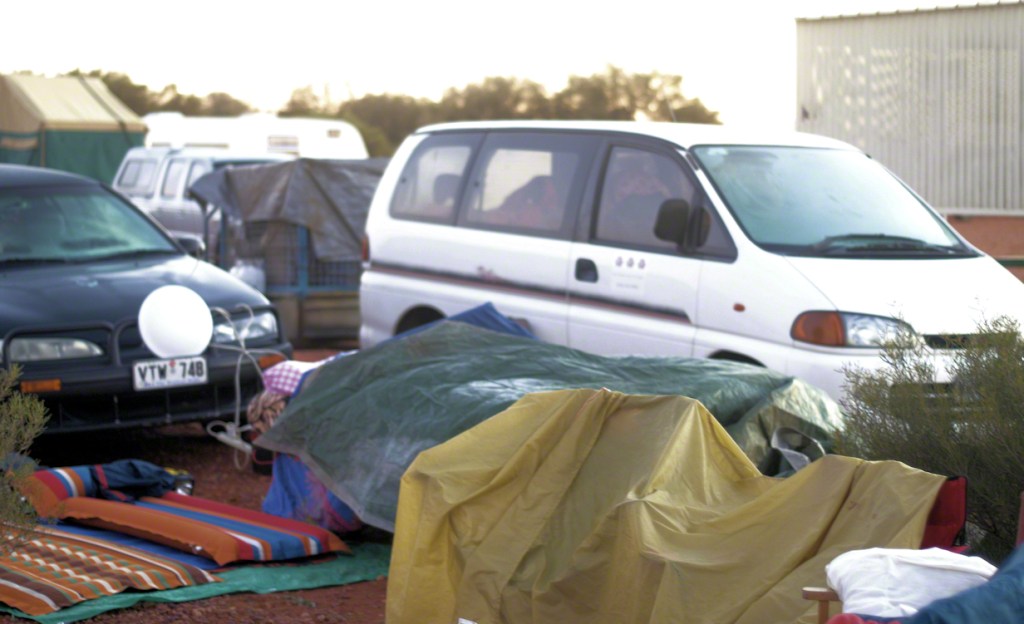
In the harsh light of morning, the scene into which we were brought under the shroud of darkness last night, was revealed. Road trains thundered past on the nearby Sturt Highway. On the opposite side of the road, a couple of these road-monsters basked in the golden rays of the rising sun. Camper vans and caravans crowded the free camping area.
I pottered around the wire fence that protected us from the Adelaide to Darwin rail line. I did not fancy an oncoming Ghan crushing me. Toilet paper littered the stony ground, shreds of it caught in the barbed wire of the fence, and nests of it rested under the salt bush. I gingerly picked up an armful of wood scraps. Hope it wasn’t contaminated.
Anthony returned from his morning adventure; a frown fixed on his face.
‘Not good, I didn’t sleep a wink.’ He pointed his shovel at the quiet mound resembling my brother and wife. ‘I had a chorus of snorers keeping me awake all night.’ He then glared at my pitiful gathering of sticks. ‘What’s that?’
‘Sticks for a cooking fire.’
My husband rolled his eyes. ‘And where are you going to put that?’
‘Where there’s a clear space.’
‘Good luck.’ He sniffed. ‘There was nowhere even to do my business. I had to walk miles.’ Anthony loves to exaggerate. ‘I can’t believe people don’t cover their mess.’
My nephew came jogging up to us. ‘I want a fire. Where’s the campfire? It’s freezing.’
I glanced around. Spying a clear patch of ground, I announced, ‘Here, I’m getting it started now.’
‘Watch out for any poo. This place is full of it,’ Anthony said.
My nephew chuckled. ‘We’ll use it as fuel, Uncle Anthony.’
Anthony shuddered. ‘Won’t be eating anything from that fire, then.’
I bent down, then cleared stones away to create a shallow basin to make the fire. Soon a small but functional campfire crackled away. Perched on top of the coals, a billy bubbled with boiling water.
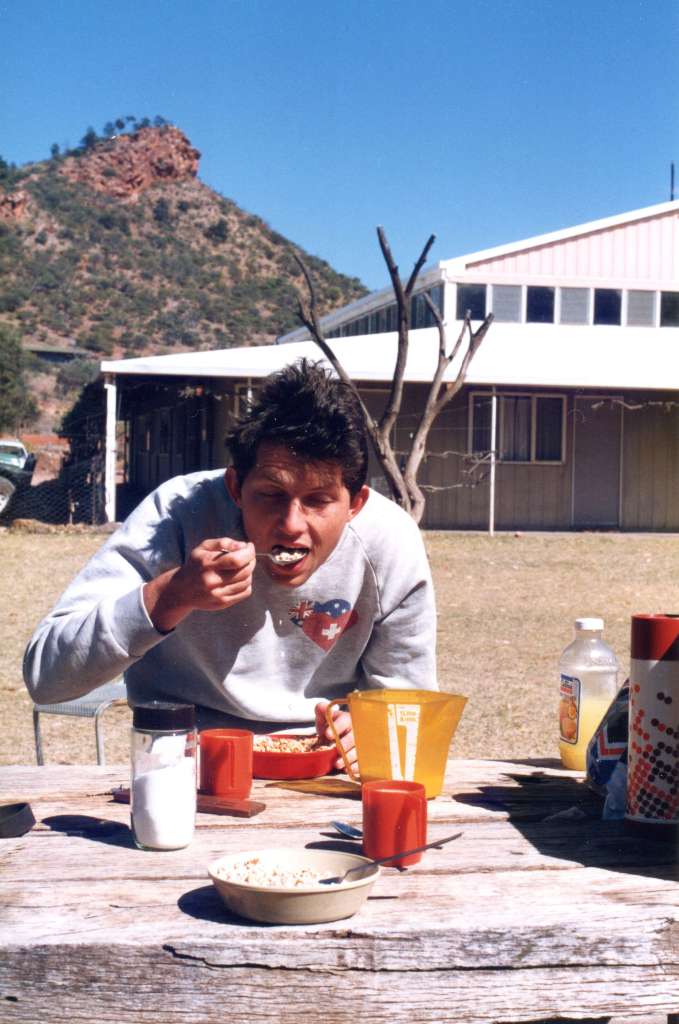
Anthony sat some distance from the fire munching on his cereal. There was no way he’d get close to the fire. After all, who know what lies beneath or nearby, on the ground in this part of the world, unregulated by OC Health and Safety.
My nephew fried eggs on a frypan on that small but adequate fire.
The free camping site slowly emptied itself of vehicles. First, the trucks disappeared. Then, the Grey nomads, and their luxury on wheels vanished. I imagined they had left once the sun had peeped over the horizon. The caravans had gone too. Just us, the not so grey T-Team stumbled around the parking bay, slowly packing up bedding, wandering beyond in search of a bush in lieu of a toilet, and then gulping down breakfast.
I picked up a stray piece of wood for the fire. A poopy looked up at me. I recoiled. ‘Ee-yew!’
To avoid the inevitable “told you so” from Anthony, my nephew and I announced the fire a success, doused it and covered the remains with dirt.
‘Time to go!’ Mrs. T yelled. ‘Next stop Marla.’
‘What?’ Richard, my brother asked. ‘That’s only about twenty kilometres away.’
‘There’s no way I’m squatting anywhere ‘round here. It’s a tip!’ his wife replied.
So, after a day of driving with the quick toilet stop at Marla, an obligatory exploration and photo stop at the South Australian—Northern Territory border, and then a petrol pause at Erldunda, we turned down the Lassiter Highway to Uluru.
We travelled in convoy on this perfect sunny day. Anthony’s mood seemed to thaw, and he was happy to take the wheel while I filmed parts of the drive with my Dad’s digital movie camera. The bold purple mesa, Mt Conner emerged above the rusty-coloured sand dunes.
We parked at the viewing station to take a photo of this spectacular landform. Some of the T-Party took advantage of the facilities. I had in mind to follow them. But as I approached the wooden huts, the stench and surrounds thick with flies buzzing, made me turn back to the car. I decided to hold on until we reached the Yulara camping ground.
We reached the Yulara Camping Ground which lies just outside the Uluru-Kata Tjuta National Park. Then, we had to wait in line to register and pay for our camping allotment.
Anthony drummed his fingers on the steering wheel and muttered, ‘Unbelievable! Hope we’re not too late.’
‘No wonder the grey nomads left early,’ I joked. ‘Anyway, I thought we’d booked.’
‘You know what thought did.’
Yep, after no sleep and all the driving, Anthony was not happy. Fortunately, though, our sites were still there and after tolerating the queues, we paid our fees and were directed to our adjoining grassy patches near the edge of Yulara. Not too distant were the toilet/shower blocks. As soon as we had parked, I made a beeline for these creature comforts.
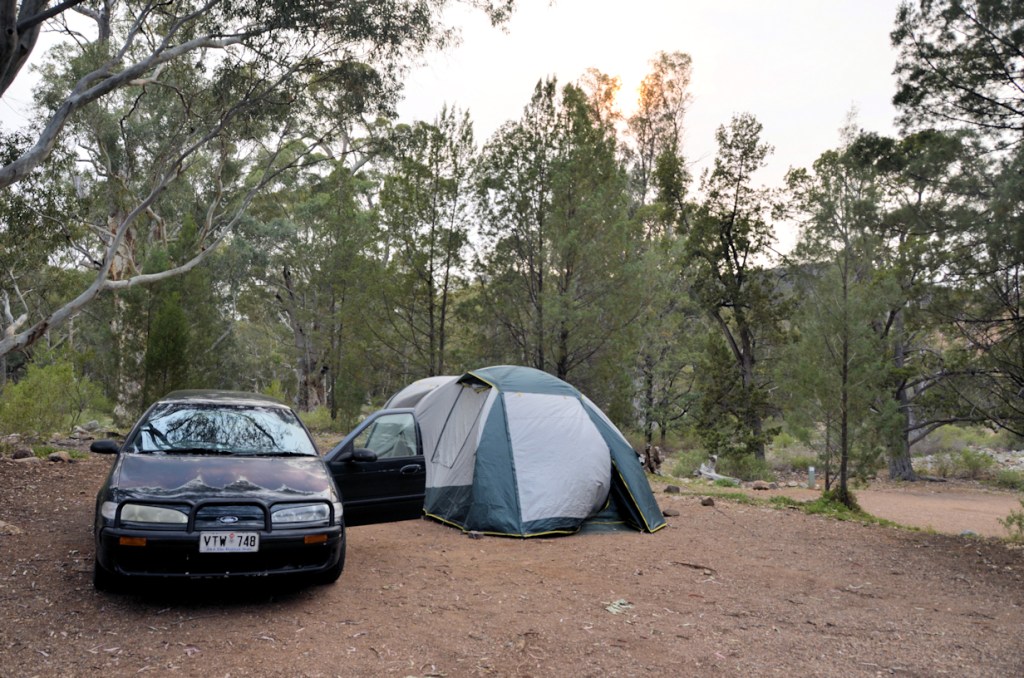
Anthony set up our barely used 4-man tent with only the bare minimum help from me. Must remember that the thick pole has to go at the front and the thin pole next in line. While Anthony hammered in the tent pegs to secure the tent, I stood holding the pole and watching my brother’s family battle in the construction of their new tent. Five of them, twisting and turning, standing and sitting, lifting walls and dropping them, labouring at snail’s pace to build their tent.
‘Amazing,’ I remarked, ‘Their tent needs five people to build it and you’ve put ours up by yourself, Anthony.’
Anthony looked over at the T-Team and grunted, ‘Well, since I put up the tent, you can cook tea.’
This I did, using our portable camp stove. Signs all about the camping ground warned that there would be consequences, a fine for making one’s own personal campfire. The BBQ facilities opposite our campsite were monopolised by other campers.
As I stirred the spaghetti sauce, Anthony walked up to me and narrowed his eyes. ‘What are you using that for? Can’t you see?’ He pointed at the now vacant BBQ stands.
‘They weren’t available when I started,’ I replied. ‘Too late now, tea is almost ready.’
Later, I tried boiling water on the stoves that Anthony preferred. I stood, hovering over the billy of water, watching and waiting for something to happen for twenty, then thirty minutes.
We waited another twenty minutes in the icy cold darkness. ‘Seems that it’s too cold for the water to boil,’ I concluded.
Anthony and I sauntered over to the T-Team’s camp. Richard invited us to play cards and enjoy a hot drink. My brother had hooked up lights and electric cooking facilities courtesy of an inverter/generator which he had brought along for the trip. My brother connected the inverter to a spare car battery which was charged as the car travelled, and voila, the T-team had light, and their own personal electric cooking facilities.
Beyond, on route to the shower block was a communal fire pit. But on our first night in Yulara, no one was taking advantage of that.
[Day 2 of the T-Team Next Gen’s pilgrimage to Central Australia to scatter Dad’s ashes…]
Mambray Creek greeted us with a picture-perfect morning; a morning that, in years to come, we could boast about to the T-Team who missed it in all its delicate beauty. Kookaburras announced the sunrise with their manic laughter. Parrots chattered in the trees. The air was calm, but not too cold. And the shower in the stone toilet block was warm and refreshing. I wondered where the MB (My Brother) component of the T-Team had camped. If they had camped. And if they’d enjoyed a warm shower in the morning.
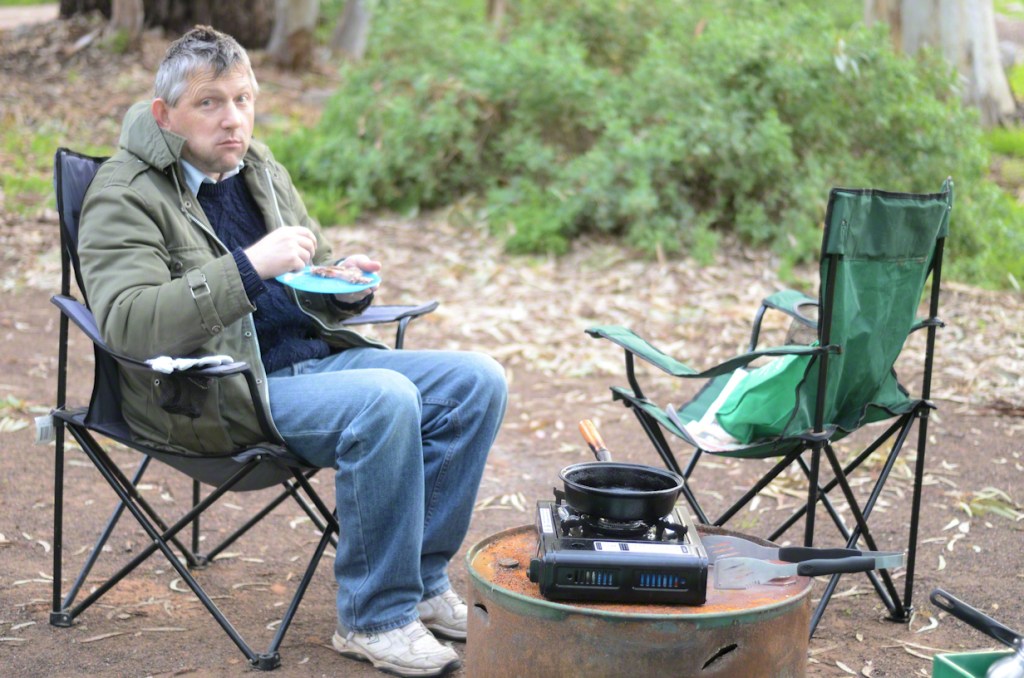
When I returned from my shower, Hubby was busy sizzling chops on the portable butane gas cooker. The aroma drew me in and soon I enjoyed lamb chop sandwich for breakfast.
On the way, we stopped in at Port Augusta where we bought those inevitable forgotten items such as a wooden board and soap. Now, if I hadn’t had a shower that morning…and if Hubby hadn’t cooked breakfast…
We then commenced the journey on the Stuart Highway, flat, straight, gibber plains each side and the white dividing line disappearing into the distance. Hubby was happy to tackle this new kind of boring.
Hubby’s phone tingled breaking the monotony at 11am. My niece informed us that the T-Team had already reached Coober Pedy.
‘They must’ve driven most of the night,’ Hubby remarked.
I had visions of MB and co not sleeping until they were on the outskirts of Coober Pedy.
As the phone reception was seriously patchy, the bare amount of information was exchanged. Arrangements were made to meet at the monument when we arrived. They would be spending the day at Coober Pedy, enjoying the sights and attractions of this mining town.
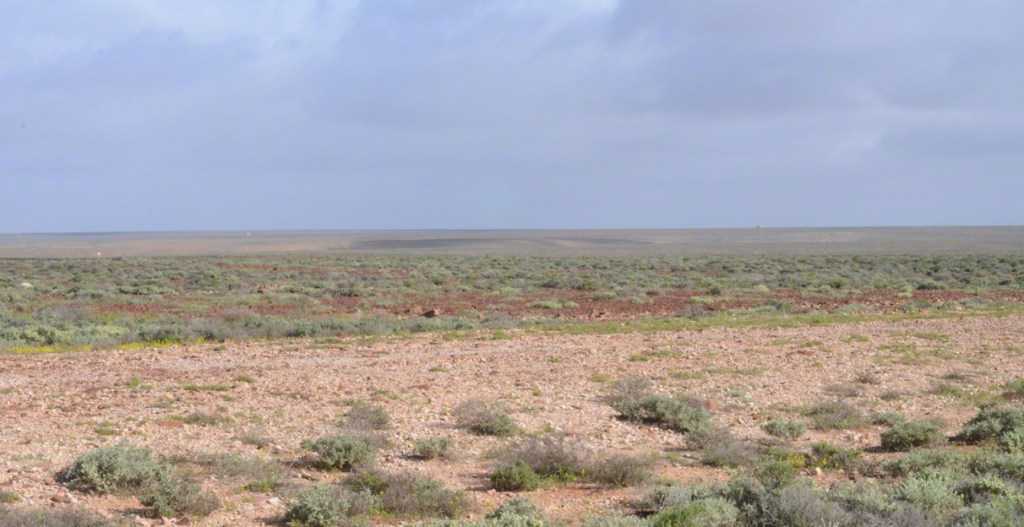
We continued our trek towards Coober Pedy, obeying the speed limit of 100km per hour. The Gibber Plains sparkled like silver. I took some photos of the gibber when we had a short break.
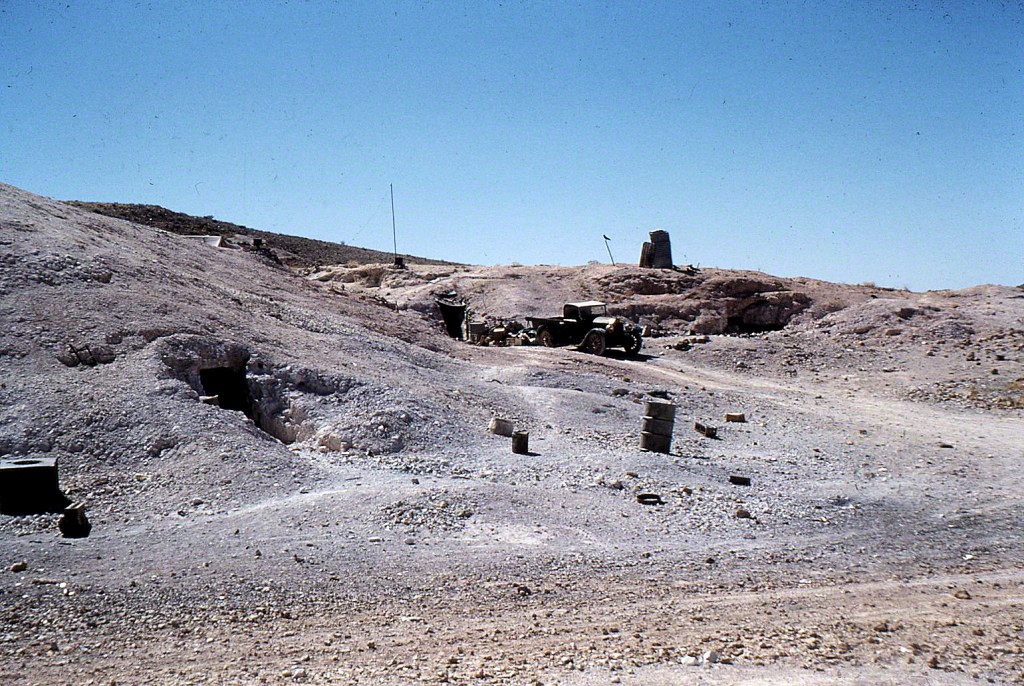
Six hours after the T-Team had called us, we arrived in Coober Pedy. In an effort to find the agreed monument, we took a scenic tour of Coober Pedy and its grid of streets. No Monument. No T-Team.
‘What does this monument look like?’ Hubby asked.
I shrugged. ‘Like a monument.’ I had a vague recollection from my youth and the T-Team’s trek with Mr. B in 1977. MB and I had our photos taken by this so-called monument, or on this monument. But finding something that resembled the fuzzy memory in my mind? Nup, not today.
I rang my niece. ‘Where are you?’
‘We’re at the playground with the giant tyres,’ she replied. ‘You can’t miss it. It’s the first thing you see when you enter Coober Pedy.’
‘We’re having a barbeque!’ Mrs. T yelled.
‘Where are they?’ Hubby asked.
‘The playground near the entry of Coober Pedy,’ I said, ‘We must’ve driven right past them.’
‘How could you miss them?’ Hubby snapped. ‘Are you blind?’
‘Must’ve been in a parallel universe,’ I muttered. Sure, there was no one there when we drove into the town.
Hubby wound his way through the straight streets to the playground with the tyres. He glanced at the giant tyre structure. ‘Did you mean this monument?’
‘I don’t know, but obviously the MB did.’ I pointed. ‘There they are.’
MB was fiddling with the barbeque hotplates while Mrs. T stood behind him with a packet of sausages. The T-ling girls played on the swings, while the boy sat in the van, eyes glued to his iPad. A sign near the picnic area warned that the barbeque was only to be used during daylight. The sun hovered just above the horizon.
Over sizzling sausages, Mrs. T apologised for deserting us. But she just wanted to reach Coober Pedy and spend the day there. We had planned to explore Coober Pedy on our way back, after spending a night camping there. However, Mrs. T had a sense that plans at the end of the trip may not work out and wanted to get Coober Pedy in on the way up to Central Australia.
‘We parked in some parking bay, just outside of the town,’ MB said.
‘It was terrible!’ the younger niece said. ‘We were all cramped in the van, and we got no sleep at all.’
‘Mum kept kicking me in the head,’ my nephew cried.
‘You were snoring!’ Mrs. T bit back.
‘No, I wasn’t. You were!’ Nephew laughed. ‘I was just imitating you.’
‘Yeah, the kids were pretty cranky that we didn’t stay at Mambray Creek,’ MB whispered to me.
‘Yeah, but, who wanted to have KFC at Port Augusta? Hmm?’ Mrs. T didn’t miss a trick. ‘I wasn’t going to go backwards once we had takeaway and had gone as far as Port Augusta.’
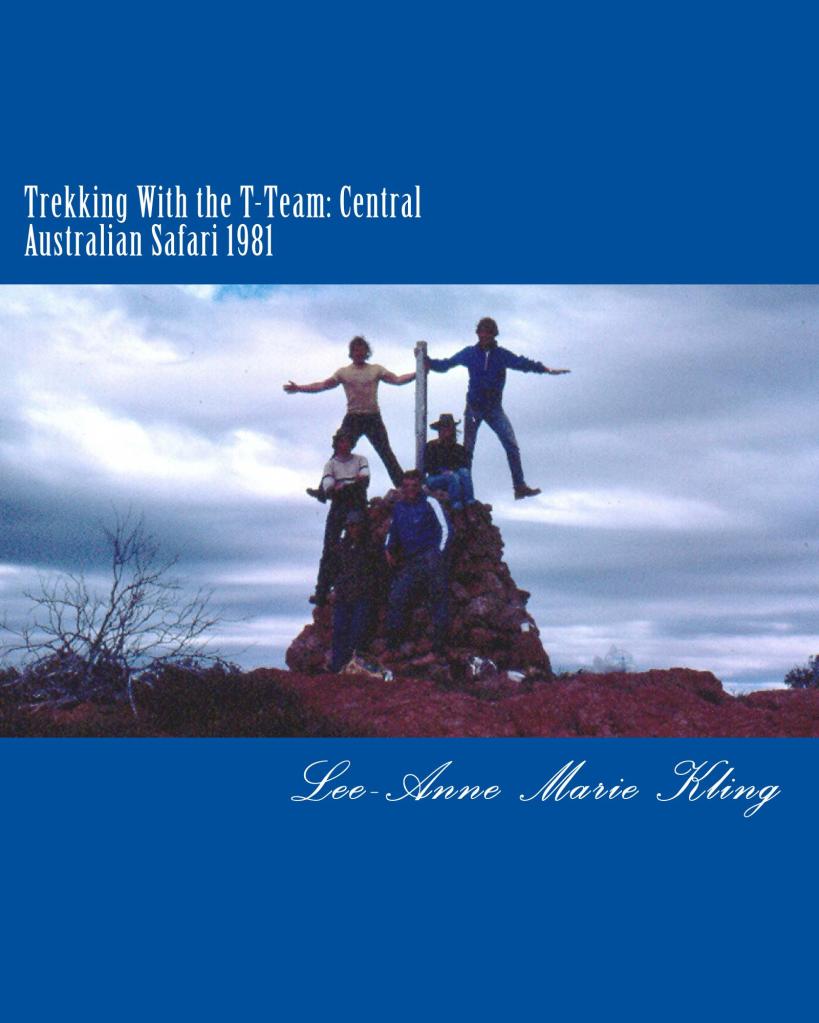
In darkness we drove endless kilometres to some elusive free parking bay. Mrs. T’s dream was to sleep under the stars, just as the T-Team in 1981 had done. In the pitch blackness of night, about 9 – 10pm, we settled in a spare patch in an already crowded free parking area.
On the unforgiving stony surface, MB and wife constructed their questionable number of star accommodation of raised camp bed, piles of doonas topped with a tarpaulin. A little distance from them, actually, right next door, Hubby and I arranged our bedding on that rocky ground covered by tarpaulin then blow-up mattress. We had no camp bed, but we had our minus five sleeping bags in which to wrap ourselves. We also covered our swaddled selves with another tarpaulin. Hubby grumbled about this, but he had no choice; the ground was too hard to hammer tent pins in.
About quarter to 7 we arrived at the station and there was the whole station out to meet us, black and white, big and little, and such a noise too, it sounded just like a whole lot of parrots or galahs. Then the truck came to a standstill and Sam got out and had to shake hands all around. I had to stay in the truck on account of the measles. I could only talk to them from a distance. It was just like a dream and to see all the natives running to and fro, reminded me of the movie films which Lou Borgelt had taken in New Guinea.
Well, after all the greetings were over we were taken across to our new home, which by the way isn’t very new, it’s one of the oldest houses on the station. Mrs Albrecht was going to have us over there for the first few days for meals, but through this measles business we decided it was best if we stayed isolated for a while so as not to infect the natives. Mrs Albrecht sent us over our tea, then, and such a huge tea, too, and we did full justice to it, too.
And now began our life on the station. But so far we haven’t seen very much of it, I haven’t been out of the place at all, Sam has gone to the other places more, but we keep away as much as possible. And now, last weekend, Ruth gets the German Measles, she was fairly miserable, but is alright again now, except for a cough. Now it means we have to stay isolated for another 10 days or so, in case Marie gets them. It is a real nuisance, because we can’t get to anything properly. The only advantage it has is that we can get things a bit straight around the place.
Such a lot wants doing, the doors don’t fit, and the floors need doing, and the garden has to be made. These last two days Sam has had 2 natives helping him with all sorts of odd jobs, yesterday and today they dug the front garden and this morning we planted the lawn and tomorrow I want to put in some flowers.
The first 2 days we were here were terribly windy and dusty and hot. The dust came in everywhere, it was just like a real dusty day in the mallee. Our box of goods was supposed to come out the same day that we got out here, but it didn’t come Wednesday, we waited Thursday, and still didn’t come. By this time Missionary Albrecht was getting worried, he thought the thing might have tipped over. Friday morning we got a wire to say they couldn’t get it off the truck in Alice Springs. They had been trying to get the wire through since Tuesday but the weather had been too bad, they couldn’t get it through. So Sam had to pack up an go into Alice Springs and there saw to the unloading. Eventually on Sunday afternoon the lorry arrived and was duly unpacked, of course the natives were very interested in everything, especially the piano.
So far I haven’t any house girls yet, as soon as we are out of quarantine I will get two. Mrs Albrecht has been baking my bread for me until I get the girls. Milk I have brought over every morning, also cream and from that I make my own butter, but unfortunately I am not a good hand at it yet. There are some nice vegetables in our garden, which is quite a big one, we have over 20 date palms in it, 4 orange trees and 3 figs and quite a number of vines. This last week we had about an inch of rain which was quite nice for the gardens and settled the dust.
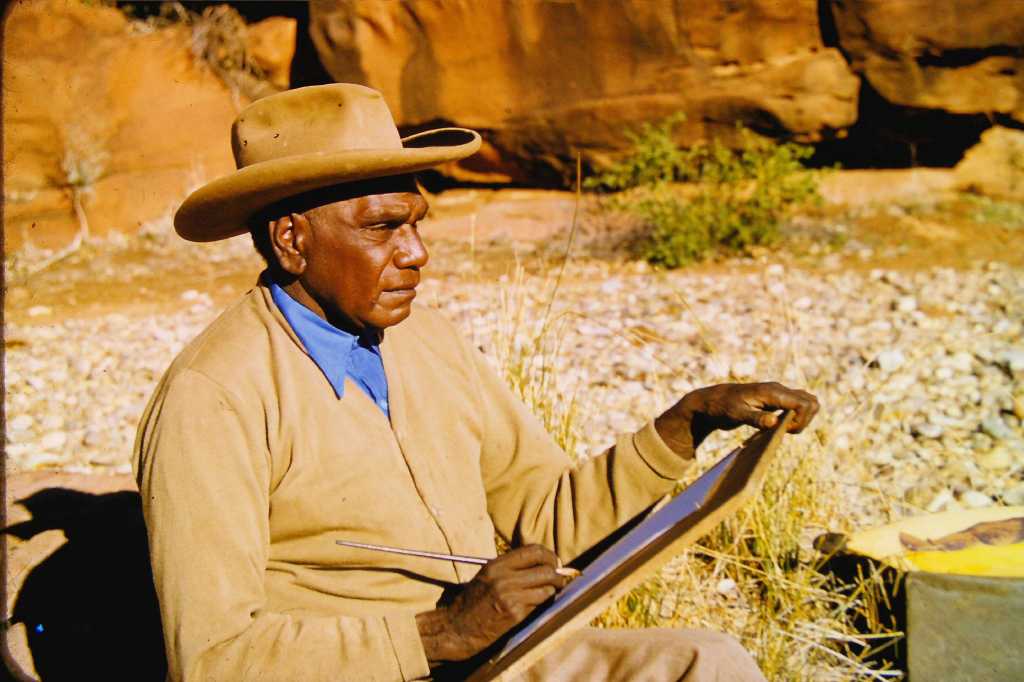
I am afraid it will take me quite a while to get to know all the natives and all their names too. I know Albert, the artist, by sight, of course, he always wears an overcoat and is quite proud of his appearance. I also know,
Manasse the leather worker, also Herbert and Ferdinand the two Sam had helping him. Of the women, I think the only one I know by name is,
Cecelia, an older woman who always wears a red dress. Some of the children are lifted up so that they look over the fence to watch the children play and when we come out they scoot. Some of their attire is pretty weird too. One little chap wears his father’s shirt, it reaches nearly to the ground and has to have the sleeves rolled up. Another little girl has her big sister’s dress on, and every time she runs she has to hold it up or she would fall over it. Another little chap has a “has been” shirt on, his father’s, it’s only strips now. Most of the men wear hats, some felt, some harvester hats. The boys that Sam has have straw hats on but they look as though the mice have been at them. Yesterday morning the one came along with feathers sticking out of the holes, I don’t know if he had visited the fowl-house or not.
Letters from our forebears give us today a rich picture of them, their personalities and their lives. As it’s my maternal grandmother’s birthday tomorrow (March 16), I am sharing the first part of a circular letter written by Elsa of the family’s relocation from the Murray Riverland to the desert Centre of Australia back in October 1939. My grandpa, Sam, Elsa’s husband had been called to be a missionary pastor in Hermannsburg, Northern Territory. Note the timing of this adventure. World War Two had just broken out, but no mention in this letter.
Well, here we are at Hermannsburg at last, our long journey is at an end. We have a home again, although till now our goods haven’t arrived – we are anxiously waiting for them to be able to pack away our things – but – this is the land of ‘wait-a-while’ – so we will just have to wait until they come.
We had a very pleasant journey up from Adelaide. Went as far as Port Augusta in my father’s car, after having stayed overnight at a cousin’s place in Murraytown. It was very nice going up by car, it saved changing twice and with all our luggage it would have been quite a picnic. We had arranged to meet Karl in Port Augusta, but when we arrived there we discovered he had German Measles, so we could only speak to him from the other side of the room; he was in bed, and he couldn’t even come to see us off, which was quite disappointing.
Anyhow, at 4.30am on Thursday 28th we steamed out of the Port Augusta station. We had sleeping berths, the children and I with 2 other ladies in the one compartment, 4 berths in each, and Sam & 3 other men in the next compartment. During the day we were mostly alone in Sam’s compartment, the other men went on the other part of the train and just came back to sleep. It was very nice because then the children had room to romp around a bit. The sleeping berths were very comfortable, 2 at the top and 2 at the bottom. We all had bottom ones, Ruth & Marie in one, I in the other one and Margaret between in her basket. During the day the beds are just ordinary seats and for the night they put the back-leans down and it makes a comfortable bed. The children stood the travelling very well, they were very excited of course to go in the train. The end of the second day (Friday) they got a bit tired of it, but soon got over that. The only one who didn’t enjoy it too much was Margaret, she was running a temperature most of the time and was particularly grizzly on Saturday afternoon. The next morning we could see why – she had German Measles, but the rash didn’t last long, and now she is just about right again. Now we are wondering if Ruth and Marie will get it, they have colds, so we are keeping ourselves isolated out here, we don’t want to give it to the natives, they always get things so much worse than the whites. One of the ladies in our compartment had them too, she was very miserable, was in bed for most of the trip.
Well, to go on with our trip. From Port Augusta to Oodnadatta, which we reached at 9 o’clock on Friday night, there wasn’t much to see, flat deserty-looking country, a lot of it covered with stones, not nice smooth ones, were like broken bits, it makes a person wonder where they all came from — no hills, just these plains covered with stones. We also passed a lake, but that looked as dreary and dead-looking as all the rest of the country. That was to Oodnadatta, when it was night. But when we woke the next morning it was different, grass and trees and ranges and wild flowers. One advantage about this trip is, that they stop at every station or siding, sometimes there are just one or 2 houses, other places a few more. One place we stopped at, Anna Creek, by name, the 2 or 3 railway houses had lovely gardens and lawns, such a contrast to all the surrounding country. We saw something similar at Rumbalara , where the police station is. At this place we had to wait for nearly 2 hours as our engine had broken something and they had to steam up another one. This long stay enabled us to see some of the wild flowers growing along the line. They are altogether different to the ones in the south, and such a variety, too, and they appeared to be past their best too. It must be a wonderful sight when they are all out. This delay at Rumbalara made us late, of course, at Alice Springs. We arrived there at quarter to 5 instead of 2.15. Missionary Albrecht arrived to meet us a few minutes after the train was in, and took us and our host of luggage to Johannsens, where we slept.
After we had had tea Missionary Albrecht took us out to the little church which they have in Alice Springs. It was presented by Mr Materne of Nuriootpa as a Thank offering. It is a nice little church with a fairly large vestry and a sleep-out, so that anyone coming in from the mission station has somewhere to stay. At the church we met some of the natives of Alice Springs, they are being cared for by the evangelist Martin, who holds services twice every Sunday, when there is no missionary there and also gives baptismal instruction. He is a very fine man. Here the children met the first natives. They had seen some from the train already and were greatly excited. To our amazement they weren’t at all afraid of them, and not any more shy, if as shy, as with white children. They shook hands with them much to the natives delight.
The next day services were held there, in the morning it was in Arunda, but during the service Missionary Albrecht welcomed Sam and he then spoke a few words to them in English. In the afternoon Sam conducted the service and preached the sermon, in English of course. There were about 60 natives there for the services, not as many as usual so they said, some were away working. Several whites came to the afternoon service, Johannsens and others. Unfortunately I wasn’t able to go as Margaret was sick, I was so sorry I had to miss it.
On Monday Sam and Missionary Albrecht had quite a lot of business to see to, and then on Tuesday morning we set off for Hermannsburg at about 11 o’clock, Sam and Marie on the back of the loaded truck with a native man, and Missionary Albrecht and Ruth, Margaret and I in the front seat. It was a fairly hot day but not unpleasant. We called in at “The Jay”, 25 miles from “The Alice”, the home of Mr & Mrs T. Strehlow. They persuaded us to stay there for dinner. They have a nice little home, 3 rooms, with a lovely wide verandah, made of cement bricks. They also have a refrigerator. It was just lovely to have the nice cool water and also ice cream, a real luxury way out in the bush. At about 3 o’clock we went on. It wasn’t quite so hot then. Up to the Jay the road had been fair, it had been made some time ago for the Governor General. After we left the Jay it wasn’t quite so good, it had been washed out by the heavy rains and that meant driving fairly slowly with the loaded truck. We had to cross over so many creeks and of course there were no bridges, but stones and sand instead. The truck had to pull and pant and bump to get across in some places. The scenery was quite nice though. Before we came to the Jay we were travelling right in the ranges, but after passing there the country was more open, a plain, with ranges along both sides. But there is nothing like a desert around here. It is more like one of the back roads in the mallee, only of course more creek beds to cross.
I quite forgot to mention that after we left the Jay we drove around the native camp, where blind Moses is the evangelist. These natives live in grass huts. They were very pleased see us and of course we had to shake hands all around. Then they sang a hymn, after which Missionary Albrecht offered up a prayer and they all then recited the Lord’s Prayer, all in Arunta of course. It was wonderful to think that out there in the bush, underneath the gum trees, those natives praying and singing praises to their Saviour just as the white people do in their Churches. The natives were very interested in our children, and of course our children were very interested in them too. Before we left Missionary Albrecht had to take orders for the different ones, they had a few pennies to spend, one wanted a hair clasp, another some lollies and so on. Next time somebody from here goes to Alice Springs the things have to be taken to them from the store here.
[I never actually finished the story of the T-Team, Next Generation’s adventures in Central Australia in 2013. So, here is the final chapter in the series. Next month, I will commence the journey at the beginning, as I revisit our journey to scatter my dad’s ashes in Central Australia eleven years ago.]
Woomera II and the Final Leg of our Journey
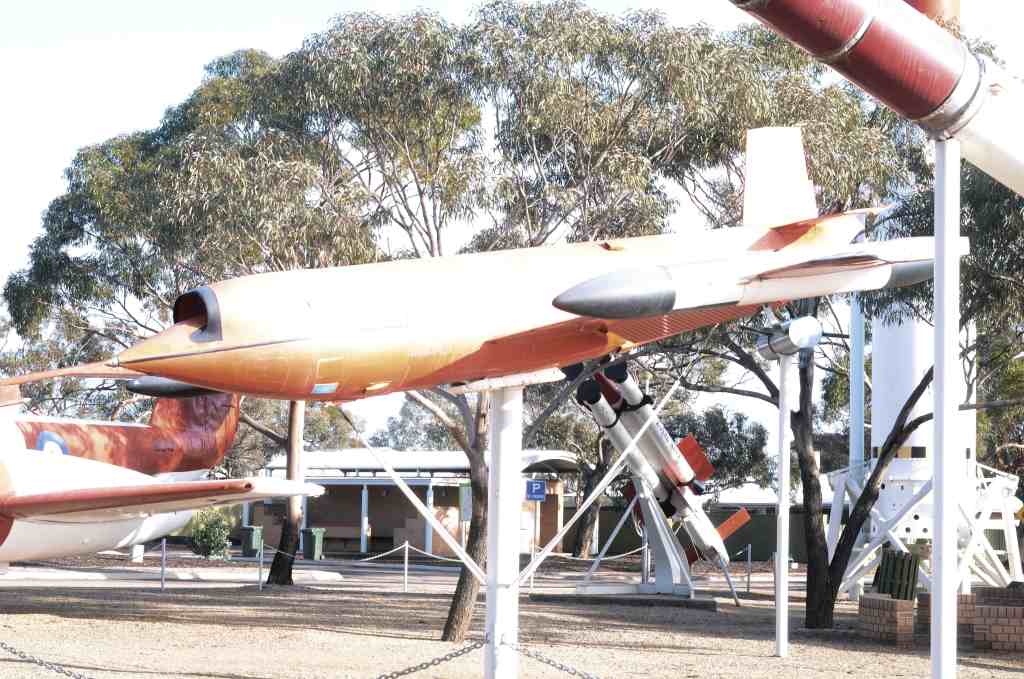
In the cool crisp morning, sun shining lemon yellow rays but not much warmth, we strolled around the Woomera Rocket Museum. Rockets of all shapes and configurations stood in the open-air, testimony of what once was. This RAAF Base and village was once a lively town in the 1950’s and 60’s, as an Anglo-Australian Cold War defence project. On this day Saturday July 20, 2013, the place seemed a mere shell of its former self, a cemetery of what once was, rockets rising like giant tombstones to the sky.
We meandered around the rockets, reading signs, eulogies from the past when threats from enemy nations was imminent. I was reminded of older friends telling me of a time when they practised drills of hiding under their school desk in the event of enemy attack.
My mother recalled when on February 19, 1942, Darwin was bombed. She was a girl in Hermannsburg at the time and whenever a plane flew over, the Aranda women would wail, fearing disaster.
Now, Hermannsburg was a mission set up by German missionaries in 1877. Although, by the 1940’s the mission was fair dinkum Australian having existed in Australia for all that time, with the advent of World War II and the conflict with Germany, the name, being German, raised the suspicions of the Allies. Hence, Mum remembers British Officers* drove into Hermannsburg to check the place out. They had to make sure there were no German spies. My grandpa, Pastor Sam Gross and his wife (my grandma) hosted these officers and put on a lovely spread of lunch for them.
After investigating any mitigating threats, the British Officers* drove away in their propeller plane satisfied that Hermannsburg was no threat. Never-the-less, they confiscated the one and only link to civilisation, the community pedal radio. Just in case they really were spies, I guess. Further, to make sure that no threat to the allies arose from this humble mission, they sent Rex Batterbee, a world War I veteran, to oversee the mission in the role of “protector of the aborigines”. As he had visited and then lived in Central Australia since the mid-1930’s, Rex taught Albert Namatjira to paint watercolours and helped him launch his career as a renowned artist.
Needless to say, in 2013, such threats of foreign enemies seemed in the distant past. But, being only 446 km from our home town, Adelaide, we were reluctant to linger amongst the rockets. Having packed, and checked out of our overnight accommodation, we were eager to start our journey home.
At a steady 90 km/h, we made progress down the highway that split the gibber plains in halves.
‘I bet the T-Team (my brother’s family) are home by now,’ I said. ‘No hanging around of taking time to look at any more places for them.’
‘Why don’t you ring them just to see where they’re at,’ my hubby said.
I texted my niece. The time was 10:30am.
“We are in Port Augusta,” she replied by text.
‘There’s no way we’ll catch up to them,’ I said, and then texted back, “Have a safe trip home.”
Clouds and rain descended on the land the further we drove south. By the time we reached Port Wakefield, the cold had seeped into the car. I put my parka on my legs to keep warm. Yet, for lunch Hubby insisted we eat alfresco in the rotunda at Port Wakefield. After all, despite his aversion to the cold, he needed to stretch his legs. Plus, it seemed no café existed in the town.
The rain and cold became more intense as we approached Adelaide. After driving through the grey, sodden streets, we arrived home, just as darkness fell at 5:30pm.
What disaster awaited us?
Hubby opened the door and we trod inside. Son 1 played a computer game on the PC in the dining/living annex. He ignored us. We tiptoed through the family room. Not too much mess and the carpet remained visible, and clean.
We found Son 2 all rugged up and cosy in his room playing World of Warcraft. He said, “Hello” and then asked for a coffee, then followed the conversation up with, “I’m hungry, what’s for tea?”
In the kitchen, as I prepared a drink, I noticed the dishes had been done and the cats fed. I thanked Son 1 for the effort. He took all the glory and remarked that his brother had done nothing.
The Aftermath
There’s always casualties that follow every holiday. And this one was no different. Two paintings which I had planned to exhibit in the upcoming Marion Art Group exhibition had gone AWOL. I’d like to think they were stolen…but I reckon they would be found in some odd place sometime in the future.
Eleven years hence as I write this final chapter, I wonder what paintings they were.
Oh, and the other casualty, Hubby, who proudly exalted that he had taken thousands of photos of the Central Australian trip on his mobile phone, can no longer find where those photos went. It would seem those photos went AWOL too.
As for the T-Team, they actually arrived home after us, having spent a night at Port Germaine. They decided to treat themselves after roughing it for the past two weeks.
Note: *My mum, Mrs. T checked this and questioned whether they were British. She thinks they were more likely to be Australian. However, I have read a letter written by these officers and the words they used made them sound British. When I find the letter, I will investigate the background of the visiting officers and plan to write a more detailed account of my grandparent’s experience.
Christmas Holidays are approaching. For me it’s been party time this week. One party after another, especially yesterday with three parties, all in one day. I’m hoping that once the rush and busyness is over, I can rest, relax and start planning our next holiday. Perhaps it’s the same for you.
In the meantime, here’s a revisit to Central Australia and the T-Team. This time when my brother and I became lost on our descent from Mt. Giles.
So, if you’ve read my books and would like to give a review on any of them, please feel free to share in the comments section of my blog.
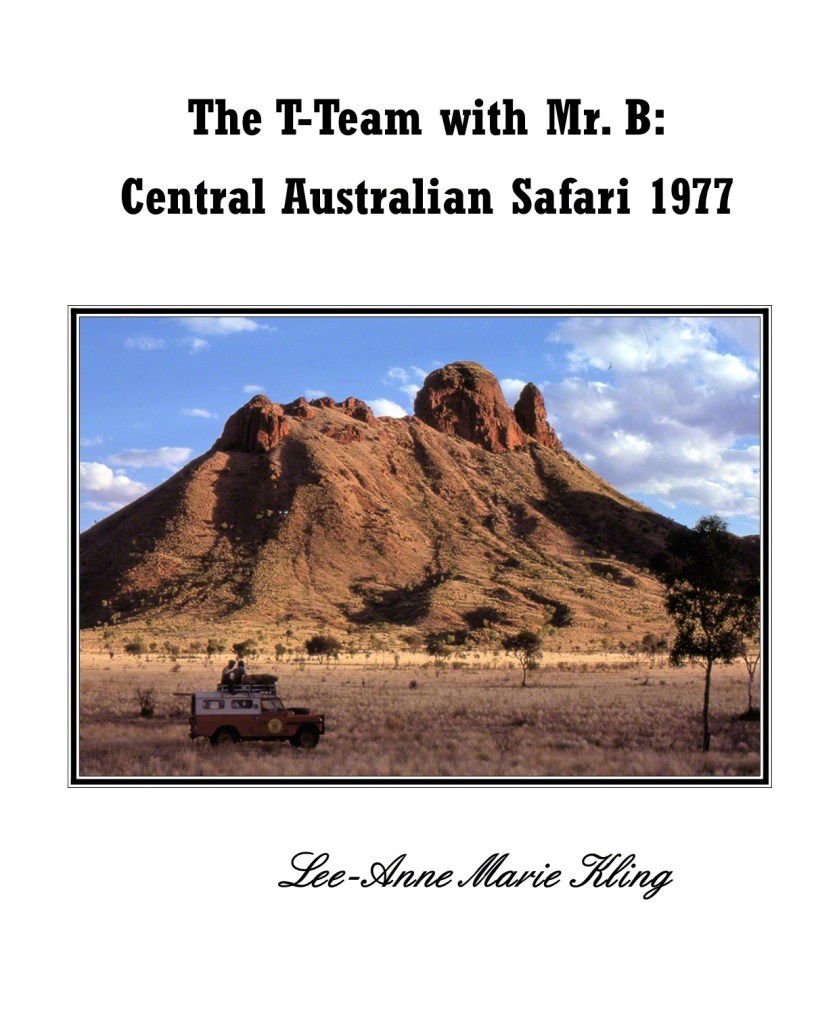
I am pleased to share a review from one of my followers, Lynne on The T-Team with Mr. Bwho writes:
“An excellent memoir that takes the reader to some of the most beautiful and remote areas of the Northern Territory. Fourteen-year-old Lee-Anne, a budding artist and writer describes the colours, sights and people with fresh eyes. Uluru, the Olgas and Hermannsburg are covered but it’s the exploration of Haast’s Bluff, Talipata Gorge and Mount Liebig, places off the popular tourist trail that make this book exceptional. All are brought alive by wonderful prose and authentic pictures in the book. Her descriptions of characters and situations provides humour and interest. A must for people who intend to visit the Red Centre.”
To whet your appetite, here is an episode from the book where Mr. B and Dad have a disagreement about lunch…]
The T-Team with Mr. B–Episode 6
Fruitless Foray
Again, we raced at 50 miles per hour along the highway boldly going where too many trucks had gone before. The graded road was a sea of corrugations. As we travelled along the road at high speed, our Land Rover juddered over the sand waves. Dad was on a mission to reach Ernabella and not even corrugations on the unsurfaced road were going to get in his way.
We paused at Indulkana, an Indigenous settlement, where we topped up the tank with petrol from one of the Gerry cans.
‘Only fifty miles or so to go to Ernabella,’ replied Dad with a sniff. He could smell his Holy Grail, and he was bent on reaching his destination. ‘Pity, there’s a school here I’d’ve liked to visit. Ah, well!’
Mr. B spread out the map on the bonnet of the Rover. He adjusted his glasses on his nose and then pointed at Indulkana. ‘Are you sure it’s only fifty miles, David?’
Dad cleared his throat and then glanced at the map. ‘Er, um, I think so.’
‘It looks a damn lot further to me. Are you sure we’ll get there? I mean to say, it’s past one o’clock and we still have to have lunch.’
‘We’ll eat when we get there.’
‘Really?’ Mr. B gazed at the fibro houses scattered like abandoned blocks in the red landscape. ‘Damn! No place to shop in this shanty town.’
I gazed at the mirage shimmering, reflecting the khaki bushes on the horizon of ochre. This tiny Indigenous settlement seemed more heat-affected and miserable than Oodnadatta. A dingo skulked across the road in search of shade. The town seemed empty—except for the flies.
I swished several of the pests from my eyes and searched for a toilet block. We had stopped, so I considered it timely to make a comfort stop. ‘Where’s the loo?’ I asked.
‘I don’t know,’ Dad said.
As far as we could see, public toilets didn’t exist in Indulkana.
A kangaroo hopped through the spinifex. Rick grabbed his rifle and aimed.
‘Hoy!’ Dad said. ‘Stop! You can’t be shooting so close to the town.’
Rick lowered his gun.
‘I say,’ Mr. B said. ‘Why don’t we go down the road a bit. We can find a few accommodating bushes for our business and the boys can do a spot of shooting. Besides, we need a break and some lunch.’
Dad sighed. ‘Very well, then.’
We piled back into the Rover and trundled several miles down the road where some trees and bushes were clumped close to the road. We all made use of the improvised “bush” facilities. Then Dad pulled out the tucker box and made a simple lunch of peanut butter sandwiches.
‘Do you want to have a go shooting?’ Rick asked me.
‘Okay,’ I replied.
My brother handed me the .22 rifle and we walked into the scrub.
Dad called after us. ‘Shoot away from the Rover, we don’t want anyone getting hurt.’
‘What do I shoot?’ I asked Rick.
‘Rabbits. Kangaroos. Birds.’
I looked at the lemon-coloured grasses dotting the red sands. ‘Where are they?’
Rick shrugged.
Matt aimed his rifle at a stump of a mulga tree. A galah had settled there. But not for long. Matt pulled the trigger and at the sound of the bullet hitting the sand, the bird fluttered into the air.
Some white cockatoos decorated the skeleton of a dead tree. I aimed and pulled the trigger. ‘Bang!’ The butt hit my shoulder and knocked me to the ground. ‘Ouch!’ I cried.
The flock of parrots squawked and scattered.
‘I wasn’t expecting that to happen,’ I said rubbing my bottom.
Rick grabbed the rifle off me. ‘Watch where you point that thing.’
‘Oh, sorry.’
Rick and Matt stalked further into the scrub in search of more prey. I was glad my hunting time was over as it was not as much fun as I thought it would be. At least no one was hurt.
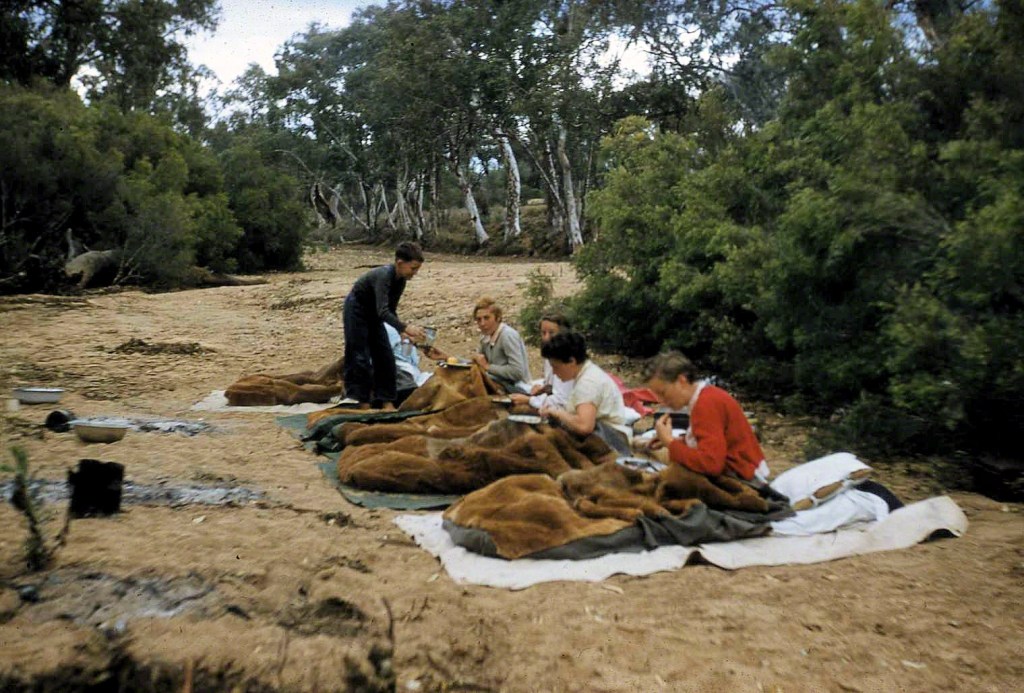
The break and the lads’ fruitless hunting foray caused the night to catch up with us. After a couple more hours of driving, we camped near Mimili. A hill close by served as adventure for us young ones in this otherwise flat desert. I climbed the small rise and explored, while the boys went shooting as usual. The hill was little more than an outcrop of rocks and I imagined, something of a smaller version of Uluru. From the top, I scanned the terrain. The setting sun’s rays caused the grasses in the plain to sparkle like gold glitter and a cool breeze hinted at the freezing night ahead. I climbed down from my vantage point and ambled back to camp. As darkness descended upon us and stars flooded the night sky, the boys returned empty-handed, except for their rifles.
While Dad stirred a billy can of stew, Mr. B warmed his idle hands by the fire, his mouth busy whining at the prospect of sleeping on a bed of stones.
Dad tapped the wooden spoon on the edge of the billy can and said, ‘We are camping in the desert, aboriginal style. What we do is make up one fire for cooking, and then have our individual fires.’
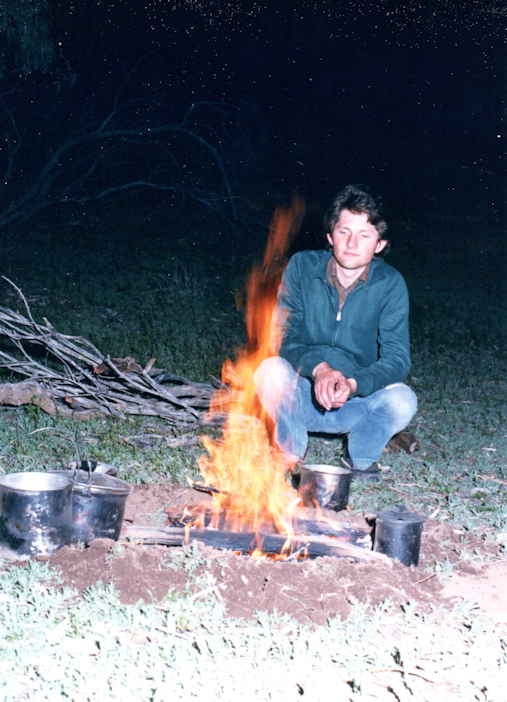
So, we did in the nights to follow. Although we all had blow-up mattresses and cotton sleeping bags, we still hunted for the softer ground, and prepared it for the bedding by clearing the area of rocks. Each of us would scout around for sticks and logs in preparation for our personal fires. By bedtime, our fires were crackling away, and we only woke from our slumber to poke the coals to keep the small flame going. Still, I slept fully clothed, as the clear nights were freezing.
But did this arrangement satisfy Mr. B? Apparently not. Every night he complained of his unsatisfactory sleeping arrangements. And his back, oh, the pain in his back. Oh, for a decent bed and a warm night’s sleep. And oh, the pain, oh, the discomfort! And then, just as he sank into a deep slumber, dawn broke with Dad clattering around the campsite preparing breakfast once again.
‘Why do we have to get up so early?’ Mr. B would ask each morning.
‘It’s my mission to get…somewhere,’ Dad would reply.























 Tru-Kling Creations