The heat is upon us here in Adelaide. Finally, summer, as I remember it, just in time for school and Australia Day which heralds the end of the summer holidays. This Australia Day will be renowned for being the hottest on record at 45 degrees Celsius.
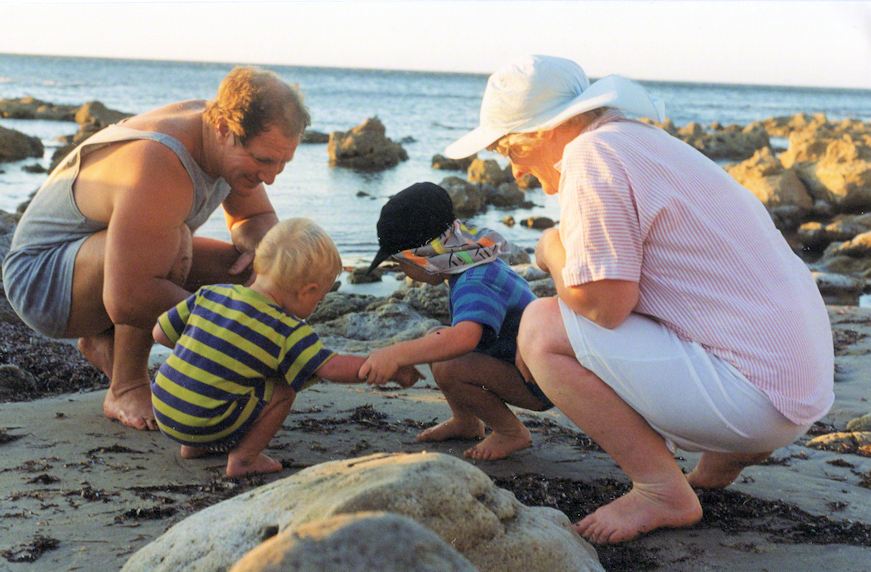
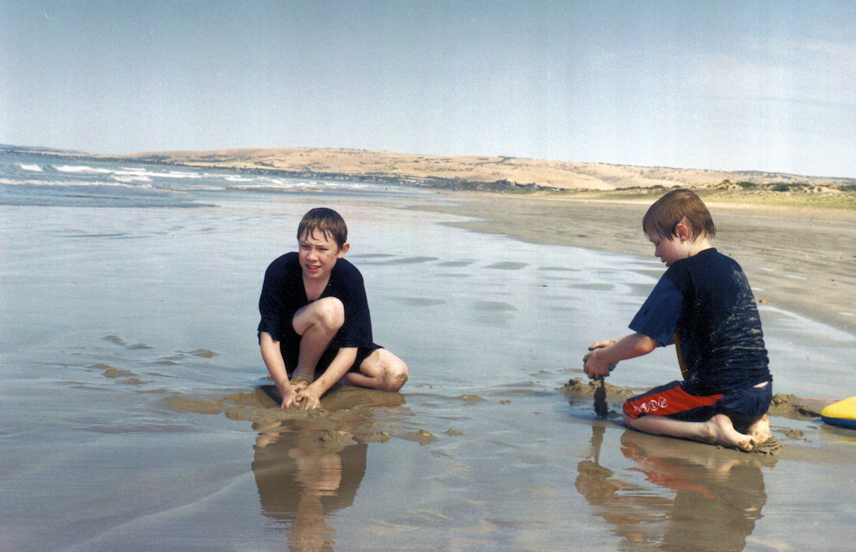
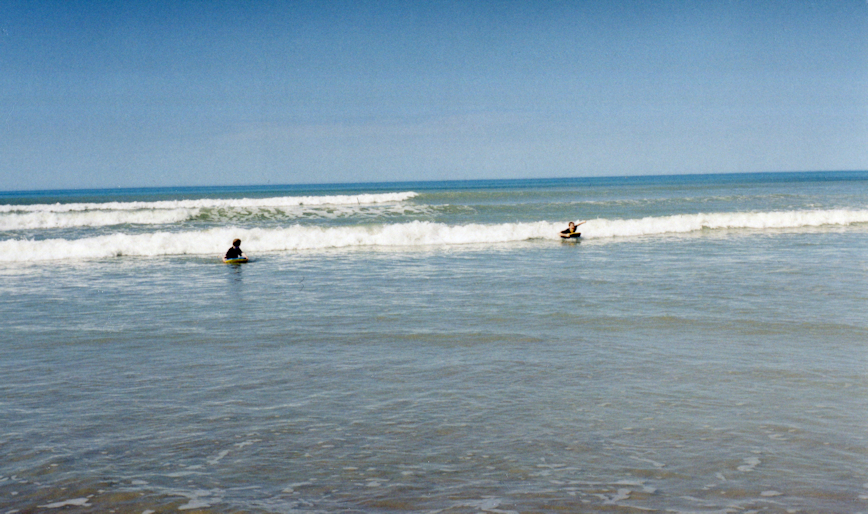
What better way to keep cool than reminisce summers spent cooling down at the beach and hunting for cockle shells at Goolwa.
[Travellers to Australia often overlook Adelaide, South Australia, as the poor cousin to the eastern states. Situated in an unfashionable corner of the globe, the city and its surrounds have the reputation of being too hot, too dry, and too awkward to visit.
Welcome to my home city and state.]
T-K Team Take on the Barossa Valley
Shortly before the Swiss relatives arrived, panic among the brothers-K set in. Yes, we were going to the Barossa Valley. But where?
My husband and his brother, P1, cobbled together a plan of the day: wine-tasting, sightseeing, a bakery for lunch, and of course, toilet stops at regular intervals.
We converged as the formidable family of ten at Williamstown, eventually in the car park next to, yes, you guessed it, after a scenic drive through the city and hills, the toilets. Most of the group needed a coffee, and although we’d been warned that on Sundays, many bakeries are closed, we found a most accommodating bakery-come-art gallery, where cappuccinos and chai teas revived us.
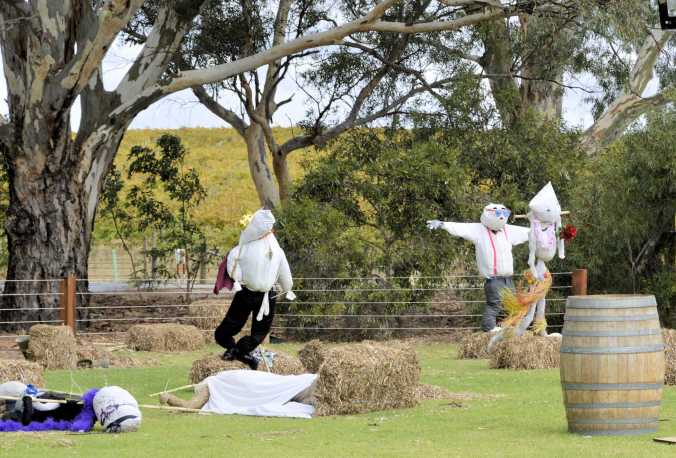
Stuffed dummies, one of whom was named Cyril, waited by the stone wall of the car park. The sign touted that they were part of a scarecrow trail that weekend. I guess they were doing their bit for tourism.
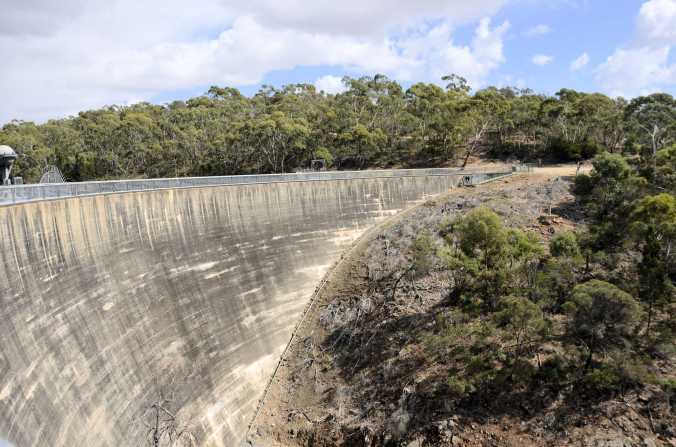
Energised, and with the help of a most cooperative mobile phone navigation app, the K-Team whisked over to the Whispering Wall, a dam holding Adelaide’s water supply. I wandered over to the wall while the others raced to the other side. My husband’s voice sounded as clear as if he were standing next to me. Eerie.
Next stop, and most important, Chateau Yaldara Winery, where we commenced our wine-sampling tour. Our Swiss visitors enjoyed their “schlucks” of Shiraz hosted by a salesgirl with a broad Barossa-Australian accent. I relished the photographic delights of the historic mansion and the feature fountain.
Every road or laneway around here leads to a winery. The Barossa produces some of the best wine in the world. Nineteenth-century migrants from Prussia-Silesia (now eastern Germany and Poland) came to South Australia and settled in the Barossa around Tanunda. Some were my ancestors.
My husband told our visitors, ‘The Barossa has some of the oldest Shiraz vines in the world, having been planted as early as 1847 by Johann Friedrich August Fiedler.’
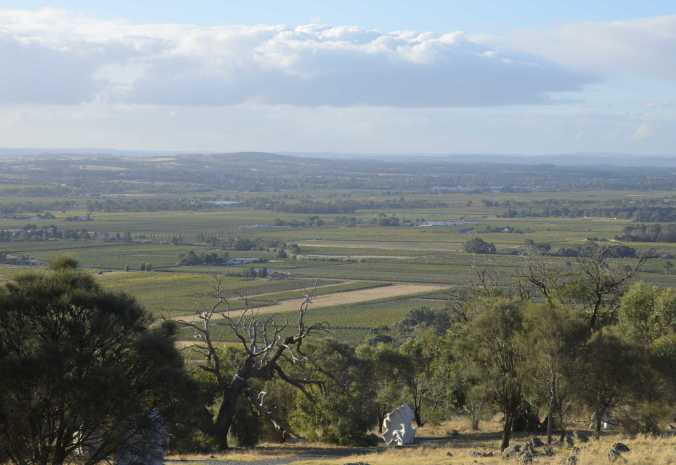
The K-Team arrived at a tourist-crowded Jacobs Creek winery. This popular winery permitted five free tastings before paying for more. Happy with five small samples, the K-Team admired the view of vineyards, leaves turning autumnal gold, and rows of vines stretching to the hills, plus a meander along the trails around the winery. Not to be outdone, scarecrows lounged in the lawns by the tennis court that sported oversized tennis balls and racquets.
After purchasing supplies for Tuesday night’s party, we tested our breath with the complimentary breathalyser. All the K-team drivers were deemed safe to drive.
So, a jolly, but not too jolly, K-Team progressed to Tanunda in search of a bakery. I spotted the Red Door Café and led the team there. A waitress guided the K-Team of 10 to the courtyard garden out the back, as inside was full. We sat at separate tables, my husband and I with our younger Swiss cousin and boyfriend next to the Kids’ corner. Most of the K-Team supped on the Café’s specialty burger. Excellent choice, as it was a late lunch that would tide us over for tea.
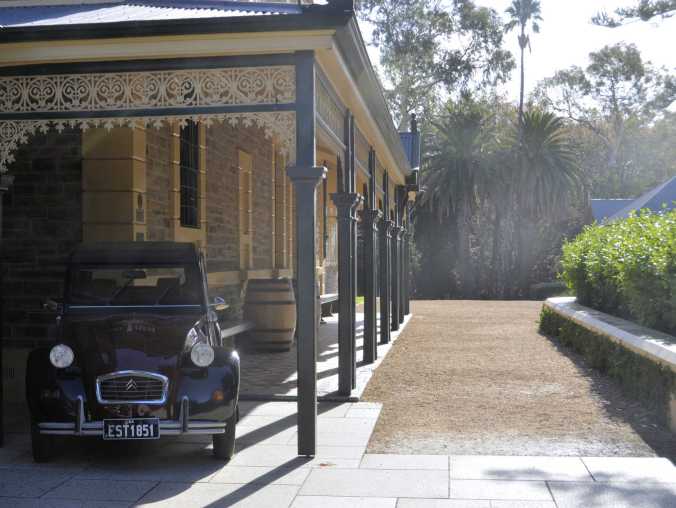
Satisfied with this most welcome and tasty lunch, the K-Team set off for Seppeltsfield Winery. After driving through kilometres of road lined with giant date palms, the K-Team arrived at the grand estate. The hall, a massive shed, actually, teemed with tasters. After more sampling and marvelling at the beautiful grounds, complete with vintage cars, we picked up our ordered wines at the designated shop.
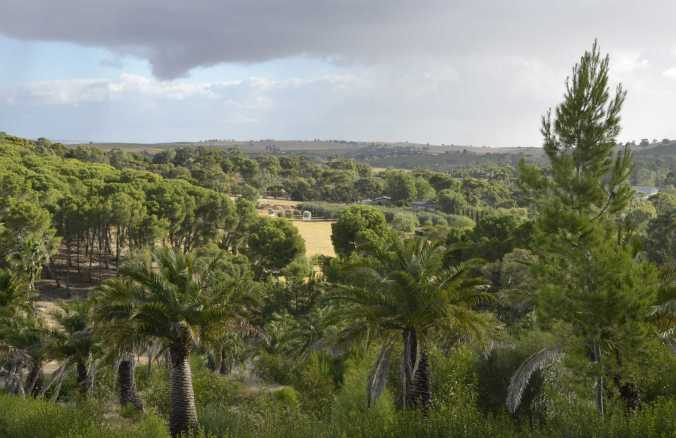
As one of the oldest wineries, the Seppelts family was so rich, they built their own family mausoleum that presided over their estate. The K-Team made an impromptu stop to climb the steps to the family monument and then absorb the breathtaking view. The sun broke through the clouds, so completing the magical scene.
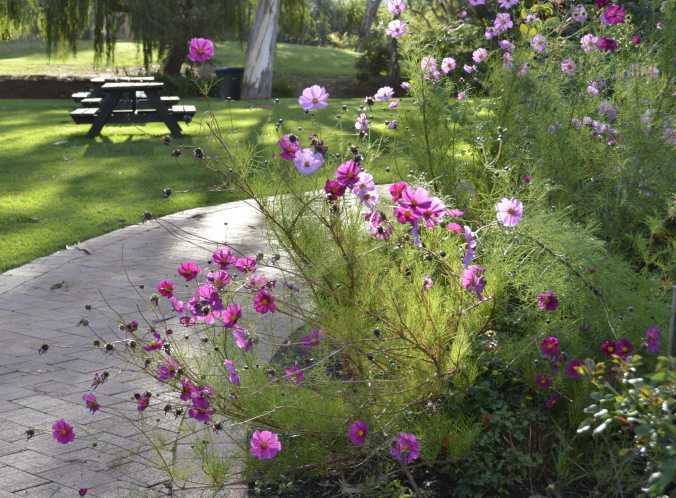
Peter Lehmann’s Winery was not far. Plenty of time, so we thought. But when we arrived, the car park appeared deserted. The owners emerged and informed the disappointed K-Team that they were closed for the day. The toilets, though, weren’t, and the K-Team made effective use of them while I took photographic advantage of the mellow tones of Peter Lehmann’s garden.
The K-Team reserved the late afternoon for Mengler’s Hill, which features an assortment of sculptures. We puzzled over the meaning of some of the international artistic offerings, but the collection seemed happy to be presiding over the Barossa. I observed that by this time, the scarecrows had slunk away and were nowhere to be seen.
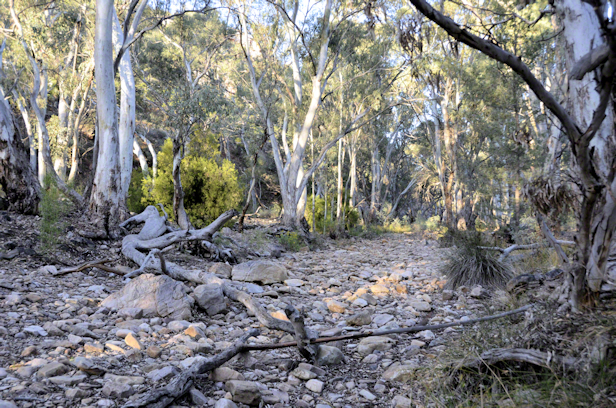
While our Swiss guests hunted for wildlife, I caught the sunlight on eucalyptus trees and the gnarled forms of branches and trunks with my camera; future subjects for paintings, I hope.
It had been a long and full day, and my husband’s mobile phone, drained of battery power and starved of tower transmissions, was by this time grumpy. As revenge for being deprived of its usual mobile-phone fixes, it became intent on leading us astray. In Angaston, when we finally arrived there after the phone’s GPS took us on a meandering scenic route, the phone demanded in a passive-aggressive voice, ‘Take the next right.’ Then, ‘Take the next right.’ Then again, ‘After thirty metres, take the next right.’
‘Hey, it’s taking us in circles,’ I said. ‘Ignore it and go straight ahead.’
The phone cut in. ‘Take the next right,’
I pointed at the sign to Adelaide. ‘No, follow the sign.’
As we drove down the highway to Gawler, the phone bleated, ‘At the first opportunity, make a U-turn.’
‘No!’ we shouted.
The phone insisted. ‘Turn left and make a U-turn.’
I filmed the phone map spinning in every direction. ‘It looks like it’s going nuts,’ I said. ‘I’m turning it off.’
I switched off the phone, and we completed the journey to Adelaide in peace.
[More than ten years ago, the T-Team, next generation embarked on their pilgrimage to Central Australia. Purpose: to scatter Dad’s ashes in his beloved Central Australia, in Ormiston Gorge.
Over the next few monthly Travel Fridays, I will take you on a virtual trip to the Centre and memories of that unforgettable holiday in 2013, with my brother and his family; the T-Team Next Generation. Then, it’s about time I put this story together into a book.]
Friday 5 July, 2013
The Convoy that Never Was
T-Team Next Generation’s convoy to Central Australia only took six hours to fragment and evaporate.
The said convoy consisted of Brother T’s family Mistubishi van containing my brother (Dad), Mrs. T (Mum), and three Teen-Lings (one boy, two girls), and Mum T’s trusty Ford Falcon Station wagon with Hubby and me. Mum T with our sons (S1 and S2) would be joining us in approximately a week’s time, flying up by plane to Alice Springs.
That was the plan.
With camping at Mambray Creek in the Flinders Ranges in mind, the T-Team Next Generation Convoy, took a recess break at Port Pirie where Mrs. T checked out a craft shop. Nearby, what appeared to be a church, was in fact a Barnacle bills Family Seafood Restaurant. Mrs. T, armed with crafting supplies, allowed the convoy to continue. But thoughts of an easy takeaway had been planted in some of the T-Team Next Generation’s minds.
Then, there was the obligatory stop at Port Germein. For Brother T and friends who frequented the Flinders Ranges, a pause in the trip at Port Germein was tradition. Although the sun was fast sinking below the horizon, we braved the brisk winter air and took a stroll up the longest jetty in the Southern hemisphere.
And so, at 6.30pm and in darkness, Hubby and I turned off to Mambray Creek…
And Brother’s team, driven by Mrs. T…didn’t.
I fumbled for my mobile and called MB. ‘What’s happening?’
‘Mrs. T’s decided to keep on going,’ my brother sighed. ‘Once she makes up her mind, you don’t argue with her. Besides, the kids want Hungry Jacks for tea a Port Augusta, they have vouchers.’
Hubby had made up his mind. We weren’t about to follow. We’d be camping at Mambray Creek and would continue our journey north fresh after a good night’s sleep. In the morning. After all, they promised to catch up with us in Coober Pedy; we had mobile phones to keep in contact, after all.
Despite the darkness, Hubby managed to set up the two-man tent in minutes. Then, although suffering the pangs of disappointment, we downed a light tea of bread, with packet soup and hot chocolate using water boiled from Hubby’s eco billy. ‘We’ll have the chops when there’s more light,’ I said, ‘in the morning.’
‘Now, to see if these minus-five sleeping bags keep us warm in the desert.’ Hubby snuggled into our co-joined sleeping bag. ‘Did I ever tell you how when camping with my family in the Flinders, I had to sleep in a cotton sleeping bag? It was freezing!’
[Slowing down after Christmas/ New Year and feeling nostalgic, this time I meander down to my childhood stamping ground, Glenelg.]
My Old Stamping Ground
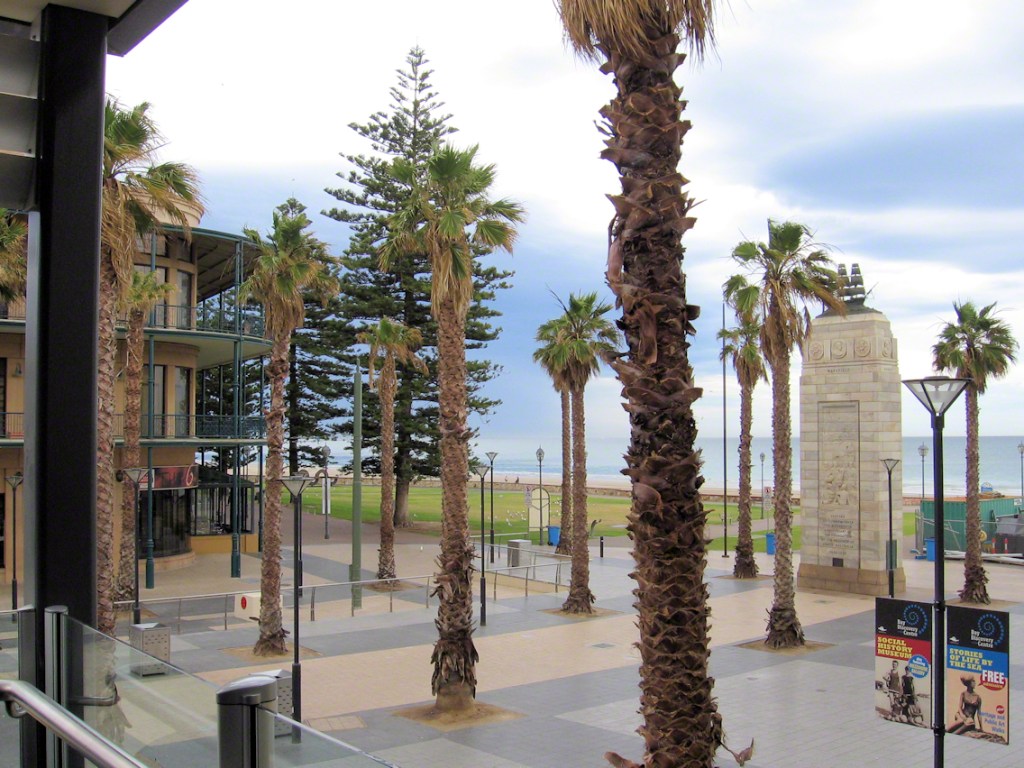
I grew up in Somerton Park which is about a ten-minute bike-ride from Glenelg. Even today, though I live in the Adelaide foothills, I go to Glenelg to shop, have coffee at the Broadway Cafe with Mum, and many times I drive through Glenelg on my way up north to Salisbury, or to the Barossa.
So, while tourists snap their memories of Glenelg frozen in time, for me images of my childhood and grown-up years remain fluid, layers in my head and marinated with the changes and experiences over the decades. Glenelg has changed; the land/seascape of my memories unrecognisable as the shops, the trams, the jetty and the coastline shift and develop. Although some places have changed, some have stayed the same.
At the tender age of one-year-old, I committed my first (and only) criminal offense at this shop; a five-finger discount of a face-washer. Mum caught me in time, and blushing, returned the stolen item, replacing it on the shelf before anyone noticed.
The gift store, a favourite of mine, provided birthday presents for me to buy for friends and knick-knacks with my pocket money.
One with its red carpet, sweeping staircase and chandeliers. It’s a Woolworths complex now. Many happy moments with family and friends watching movies, eating popcorn and occasionally rolling Jaffa’s down the carpeted aisle.
The other, halfway down Jetty Road towards the sea, disappeared in the 1980’s. I remember watching the film Heidi there, and before the movie started, the pre-film entertainer conducted a singing competition. My friend won first prize.
That cinema space became a mini shopping mall which, as a university student, I mopped every Saturday morning for $12. Today, a restaurant resides in that space.
After several years bereft of cinematic entertainment, a new cinema complex has been built off Partridge Street.
Gone: Tom the Cheaper Grocer
While Mum shopped at Toms the Grocer on Mosely Square, my brother and I hung out near the sea wall by the jetty. I loved winter when the waves crashed against the wall. Toms was sold off decades ago and today the old building houses cafés and restaurants.
At three, I crawled under the table at Charlies Café and my auntie uninvited me to her wedding reception.
When sixteen, we dined at Charlies as a youth group. The guy I was dating didn’t show. After the supper, near tears from being stood up, I waited with my friends for this guy to arrive and drive us home. There were not enough cars amongst the group to drive us all. In a flash, this guy appeared in his silver car. He glanced at us and then kept on driving down Jetty Road.
My brother had to make two trips to carry us all safely home.
Charlies is long gone. So’s that guy. I dropped him.
***
Here today Despite Time and Changes
As my friend from Youth Group was fond of saying, ‘Thank God somethings stay the same.’
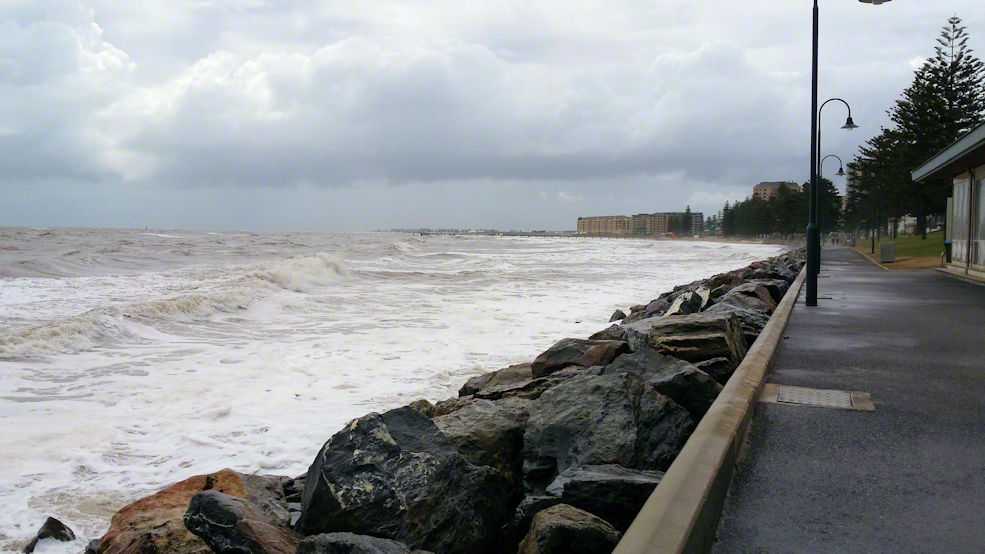
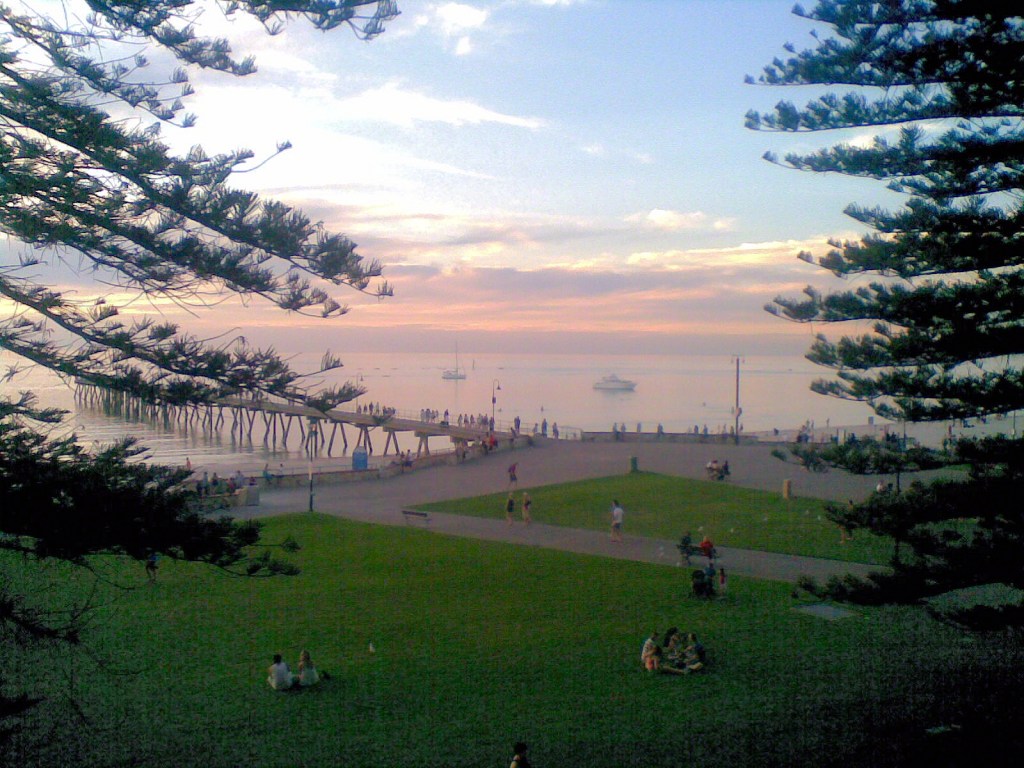
At least an updated and cemented version from one of many over the years of storms that regularly destroy the jetty. Each time the jetty is damaged by a “storm of the century”, it’s repaired or another one is built to maintain that steady icon that makes Glenelg.
Tarted up over the decades, today with tall palms and water-features. The shops, cafés and restaurants that line jetty road leading up to Moseley Square, though they change, they are still there and most importantly for the tourists, are open Sundays and public holidays.
That’s why we go to Glenelg, right? A famous dating place or hang-out for youth. In my teenage years, I followed my date around the games arcade as he sampled all the pinball machines. Yawn!
A friend sourced the sideshow for lovers and got herself into “trouble”.
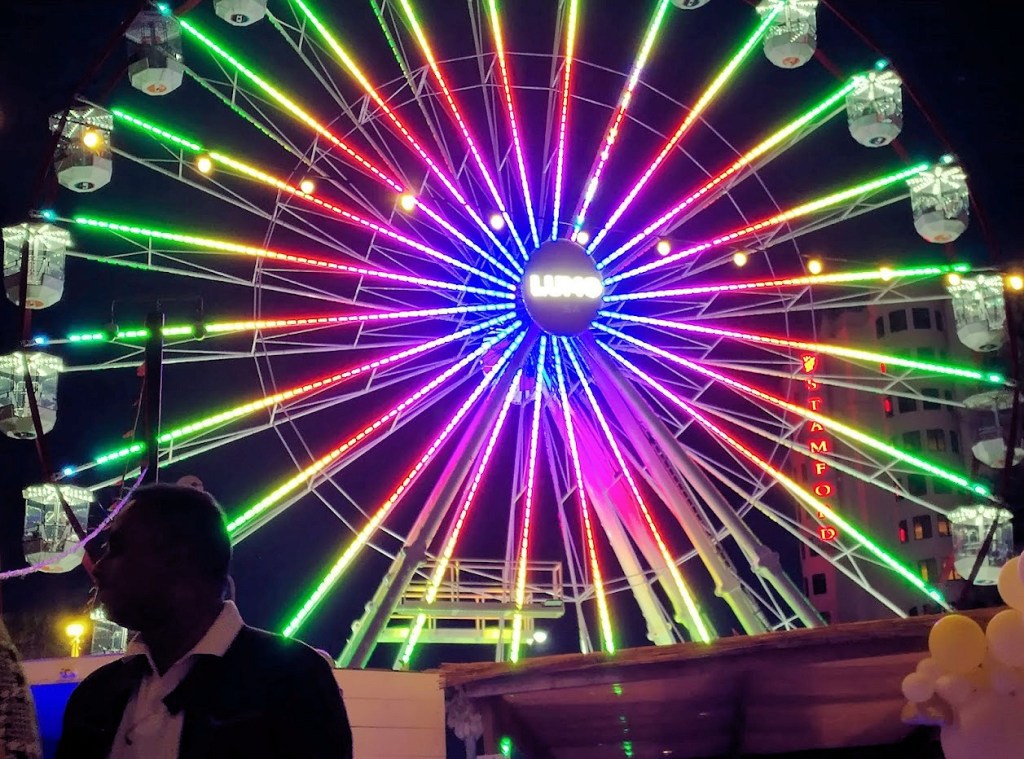
Memories of parking in the carpark in the early morning under the inert Ferris Wheel, and furtive romantic moments before the inevitable knock on the window by the local policeman.
Over the years, the sideshow alley vanished, but still near the carpark at the end of Anzac Highway, the Ferris Wheel sat idle, a skeleton of its light-garnished self. Then this carpark turned into a round-about, high-rise apartments grew along the foreshore, and the sideshow morphed into a massive brown lump called “The Magic Mountain”.
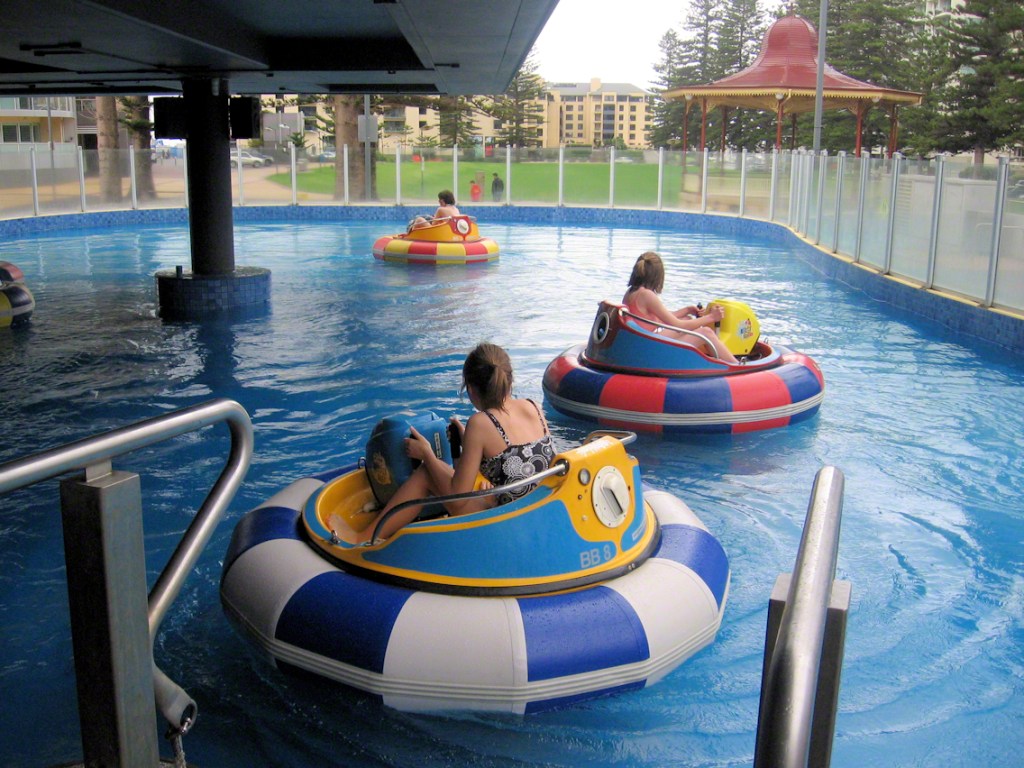
My sons enjoyed birthday parties in this mountain’s cave, chasing Pokemon, bumping in floating boats, and slipping down the waterslide.
Then the “Magic Mountain” went off, replaced by “The Beach house”. Same amusements as before without the “magic” of the mountain. The Ferris Wheel now sits in front of “The Beach house”.
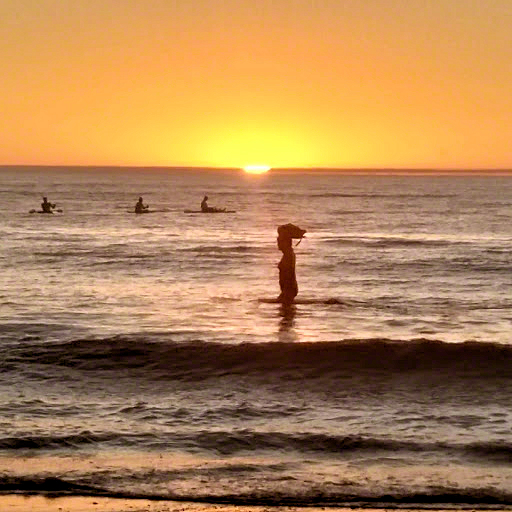
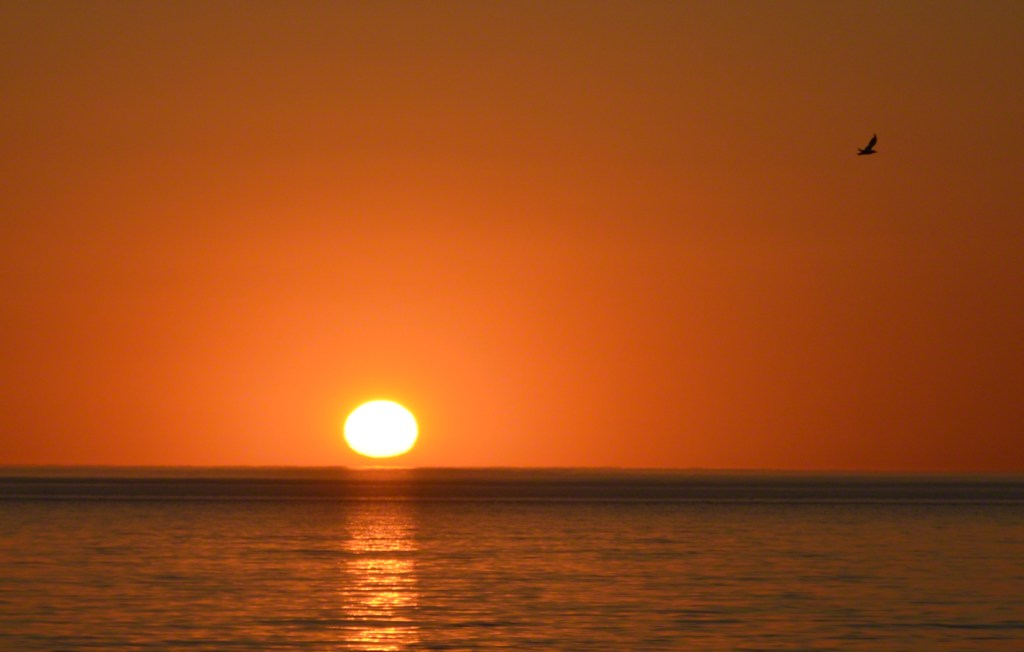
Ever faithful, ever beautiful, the setting to summers filled with family teas by the beach on the lawns, fish ‘n chips with soft drink or cheese and gherkin sandwiches with cordial. Grandparents busy themselves with crossword puzzles while Mums and Dads swim in the waves with kids by the jetty. Then after, while sitting and licking an ice-cream, families watch the sun bulge bright orange as it sinks below the horizon of sea, overhead in the cloudless sky, a plane from Perth streaks a jet-stream, and on the water, there’s a sailboat, swimmers and paddle-boarders.
And people, who walk the boardwalk, play on the sand, and frolic in the water, on a balmy summer’s evening, beam with smiles on their faces. This is the constant memory, through the decades of changes, this is the memory that stays with me of Glenelg.
I’m still trying to figure out where we went off track. Were we off track? Was I that slow that the whole trek was taking twice, perhaps three times as long as the initial map instructions suggested? Four hours they promised us. Only 8.9 km, the sign said.
Mistake number 1: The map of Alligator Gorge my dear husband had printed from the internet was then forgotten to be loaded into his backpack.
Six hours into the hike, deep in some tributary of Alligator Creek (according to the map-less husband), and no sign of the Terraces, nor the steps, nor the Narrows. Did we miss a turn off? Did we stray into a neighbouring gorge? Signs to direct our path were ominously absent. So were people…except us, the K-Team comprising of his brother P1, two Swiss relatives (Mother A and Daughter E), Hubby and me with my bung knee.
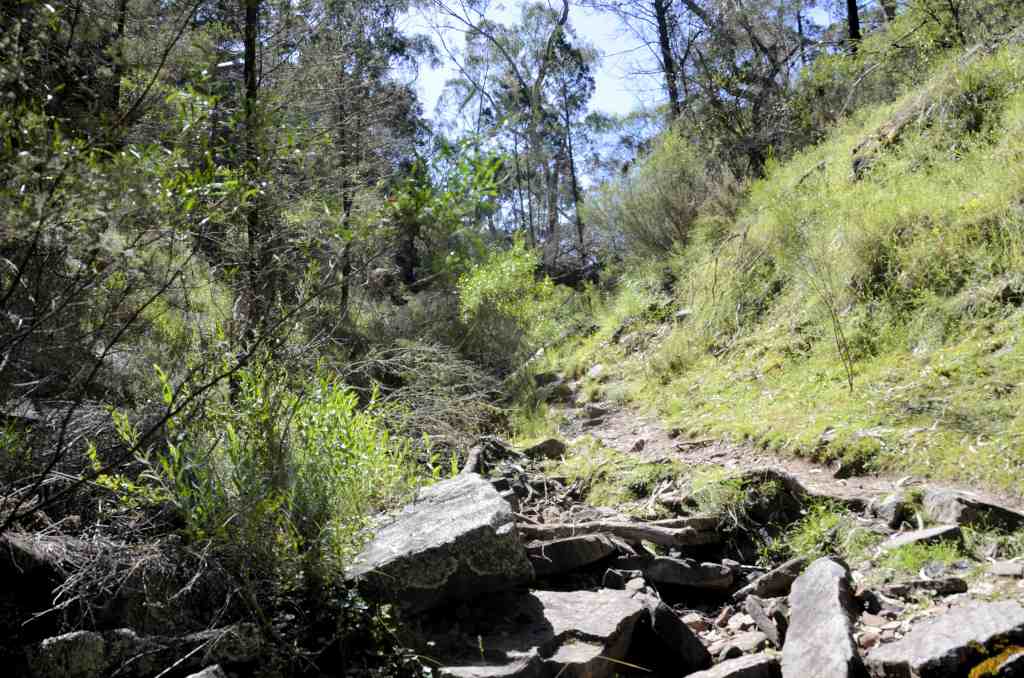
Now that we’d descended into the gully, I had kept up with the Able-Bodied four. My knee no longer hurt, but for some weird reason, although we walked along a narrow path and negotiated the stony creek, at a fair pace, we seemed to be getting nowhere fast. The red slated walls to our left, and occasionally to our right, just kept on going.
Four-thirty in the afternoon and we stopped by a bend in the dry creek.
‘I reckon if we keep on going, we’ll get there; this gorge will eventually lead us to the start of Mambray creek,’ I said. ‘What does the map say? Oh, that’s right, my hubby’s forgotten the map.’
The K-Team decided to send Hubby and E down the creek for any signs that we were on the right track. Off they went at a cracking pace now that they weren’t hampered by the “cripple” (me).
The remaining three, P1, A and me, waited in the cool of the native pine trees common in these parts of the Flinders Ranges.
P1 was not impressed with Hubby’s, much boasted and legendary navigational skills. In silence, I began to reflect. I had been this way, surely. Way back, some forty years ago with my friends from youth. The landmarks, the endless rock walls, the keeled-over gum trees, and the native pines resonated faint familiarity. Even the trek that seemed to take for eternity took me back to when our youth group had hiked from Alligator Gorge to Mambray Creek starting with the same ring route.
I had asked the same question to one of the leaders, ‘When is this going to end?’
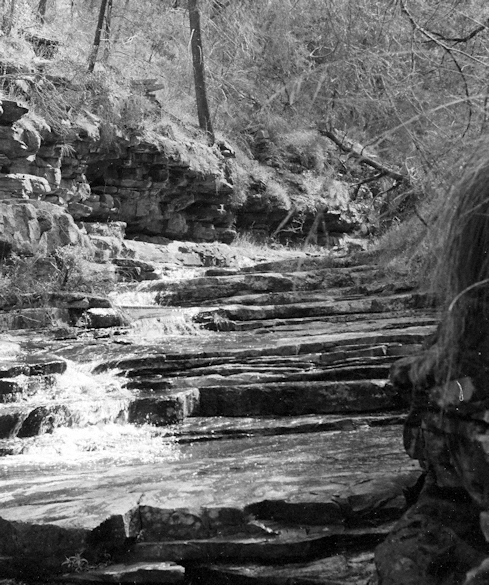
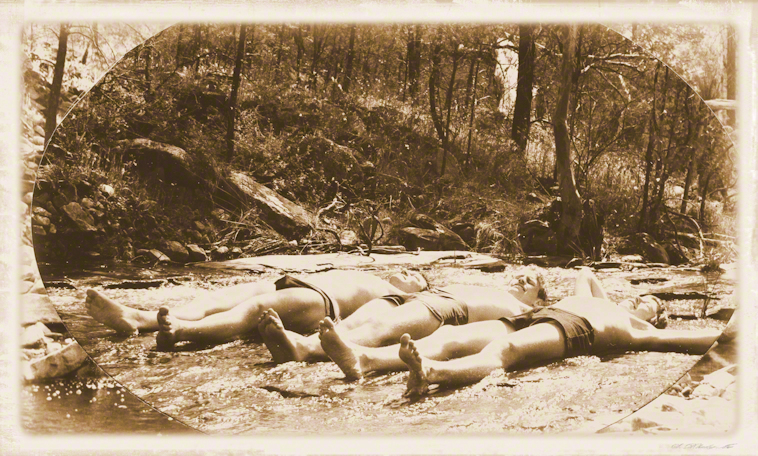
‘Soon,’ he replied and as if by magic, we reached the Terraces. My brother, and his friends lay in the creek and cooled their tired muscles.
I began to wonder if we hadn’t been swallowed up in some dimensional impasse. Had our trek led us into a parallel universe where Alligator Gorge has no Terraces nor Narrows and we’d be lost on some distant and forgotten planet? Or had we stepped into the past before the Terraces and Narrows had formed?
Either way, my phone had no signal.
Hubby and E were taking eons to return. Had some errant neutrino activity swallowed them up into another place and time?
The hike had begun in a mundane fashion. Hubby strode ahead up the fire track from the Blue Gums campground.
I marched behind the Able-Bodied K-Team like a demented zombie with trendy hiking poles. The Able-Bodied stopped at the sign, the first of many waits for their knee-challenged companion.
I glanced at the sign, and remarked, ‘This way is an8.9-kilometre ring route.’ Nothing wrong with my eyesight.
‘Yes,’ Hubby sniffed with an air of arrogance. He implied that if I didn’t like the distance, I could sit back at the car in the campground and wait for them.
Glad I didn’t.
So onwards and upwards on the fire track we trekked. Judging by the position of the hills, the terrain and the fact that we’d left the Mambray Creek-Alligator Creek junction, and behind, (Mambray Creek running to our left and Alligator Creek to our right), I summised that we were walking the route clockwise.
Hence Mistake Number 2.
So, for the next two and a half hours we (or should I say, me with the group having to make frequent stops for me) laboured up the rise. I don’t do uphill at the best of times and had to stop and rest for my breathing to catch up. The Able-Bodied with their superior fitness would wait for me, and then as soon as I caught up, they were off. Like racehorses.
On the way we encountered a couple, smiles wide on their faces, tramping down the fire track.
As they approached, I asked, ‘Are we there yet?’
‘Not far now,’ they replied.
Another couple, Grey Nomads, also with grins rivalling Alice In Wonderland’s Cheshire cat’s, passed us.
‘How far to the top and then into Alligator Gorge?’ I asked.
‘Nearly there,’ the man said.
‘But the walk is quite difficult,’ the lady said. ‘It’s more like nine kilometres.’
‘Yeah, thanks.’ I remembered the dodgy distance estimations from the previous hike 40-years ago. Seems as though nothing had changed in Alligator Gorge.
By this time, we had stopped at a Eaglehawk Dam campsite where we ate our lunch and rested for thirty-minutes. An oasis after a long hot thirsty uphill hike.
Ten minutes from the dam, we reached our goal, the long-awaited sign; the virtual “top” and fork with directions. Signs and map indicators were scarce on this ring route. One sign pointed to a path leading to Alligator Gorge, about 3.1km hence. The other to the lookout.
We opted for the gorge. After all, it was only 3km away, an hour’s walk at the most.
Confident we were on the “homeward” stretch, we trundled down the slope and into the gorge. The time, around 2pm. Now that we hiked downwards and the path appeared well-worn, I kept up with the Able-Bodied. In fact, they held up my progress by stopping to photograph lizards, flowers, and birds.
An hour and a half later, we still hadn’t reached the Terraces. Nor had we completed the circuit that would have taken us back to Blue Gums Campground. Hubby was adamant that we were in a tributary of Alligator Gorge and thus missed all the interesting features. There was talk of camping the night in this so-called tributary. After all, we did have an emergency blanket. However, the fire-danger season having commenced, we would be banned from lighting a campfire. Hubby had stressed that even lighting a match was “verboten” (forbidden).
Hubby and E emerged through the growth that glowed emerald and gold in the late afternoon sunlight.
‘The creek just goes on forever,’ Hubby said.
‘Best to go the way you know,’ I said. ‘We’ll just have to go back the way we came, to be safe.’
This we did. Uphill again, but this time steep rises. Hubby helped me negotiate the uneven path and rocky terrain. He pulled me up and over fallen logs and big boulders. He told me off for hampering the progress of the group.
‘I feel faint,’ I replied, and he softened. Besides, he needed to pace himself too. Hubby looked pale and exhausted.
Within an hour we’d reached the signpost and were hiking with happy faces down the fire track. I named the tributary we’d been lost in, “Deviation Gorge” as it had led us astray.
We arrived back at Blue Gums Campground just as the sun set at 7:30pm. The back tracking taking us just two and a half hours to complete.
Most of all, by the end of what we calculated to be a twenty-kilometre hike, my knee didn’t hurt at all. My feet did, but not my knee.
***
Friday, we revisited Alligator Gorge. This time, we parked at the more populated carpark and took the steps down into the gorge.
I wasn’t going to do the two-kilometre circuit with the Able-Bodied through the Narrows. But I just had to know, just had to discover for myself what went wrong the previous Tuesday.
So, after a slow descent owing to my knee, I hobbled over the stony creek bed and down the narrow gorge. My frequent cries of “Ouch!” heralded my presence to all and sundry. Hubby marched ahead oblivious to my defiant presence and will over pain to be there and see for myself.
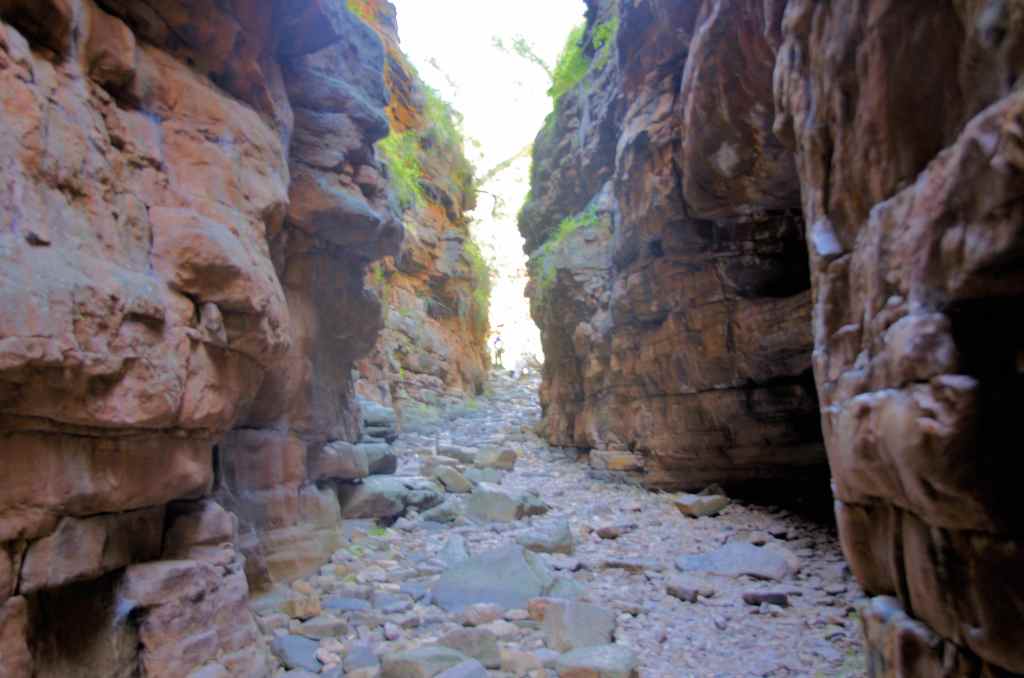
The drama of the Gorge was rewarding. Red rock walls and stunning reflections all in this ancient peaceful setting. Another pair of Grey Nomads sat in a shallow cave, absorbing the tranquillity and beauty.
Hubby and the Swiss relatives tramped through the Narrows as if it were a race.
P1 rested at the Narrows’ entrance and said, ‘I don’t know what the rush is.’
Once through and on the short, I stress, “homeward” and upward trail to the road, Hubby scolded me for holding up the group. In his estimation, “cripples” like me are not allowed to attempt the two-kilometre circuit of Alligator Gorge. ‘Now we’ll be late getting back to Adelaide,’ he warned.
Just so I wouldn’t impede the Able-Bodied further, I parked myself at Blue Gums Campground, and waited for them to return with the “royal” Toyota Hilux Carriage to pick me up.
While waiting for the Able-Bodied crew, I discovered a sign that directed the ring route in the anti-clockwise direction—through the Narrows and onto the Terraces. If only we’d ventured this way, we could have seen the most interesting parts of Alligator Gorge first and then decided to return the way we came…or not. To this date, Hubby has never witnessed the Terraces. At least we would’ve had happy, smiling faces walking down the fire track and taken less time.
[In answer to today’s prompt, I have never been to Kangaroo Island.So close and yet, so expensive to get there.One day I hope to travel there. In the meantime, I’ll continue to enjoy the beautiful beaches of Adelaide and down the Fleurieu coast.]
Sensational Sellicks Beachat Sunset
[Part 2 of the K-Team’s adventure on the Fantastic Fleurieu.]
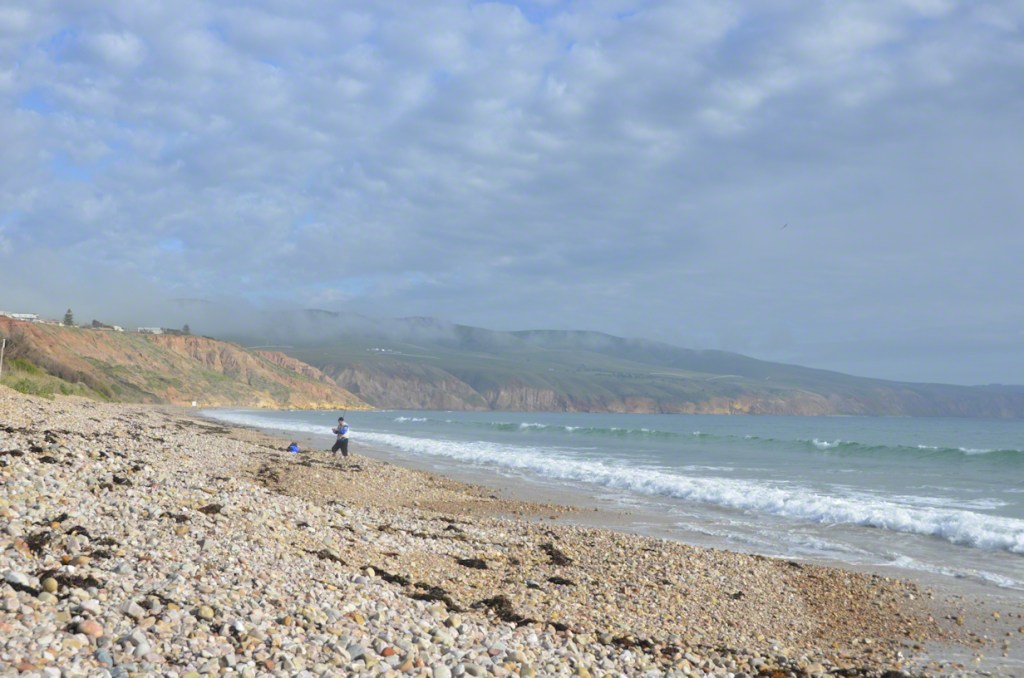
‘Let’s see Sellicks Beach at sunset,’ I said, ‘it’s a perfect day for a sunset on the cliffs.’
This time, like sheep, the K-Team heeded my voice and followed Hubby and me out from Hallett Cove, and then by car, we made a convoy up Lonsdale Road to the expressway heading for Sellicks Beach.
After the expressway, on South Road, we passed the turn-off to Victor Harbour. I looked back. ‘Um, I can see P1’s car, but where’s your other brother, M’s car?’
‘Behind P1, I think,’ Hubby said. ‘Can’t you see the car?’
I glimpsed something resembling M’s car. ‘I think so.’
He who argues with Sat Nav’s and ignores their instructions, didn’t turn where I told him to, but kept driving on the road above the cliffs. ‘Where do I turn?’ he bleated.
I indicated behind us, but not in a smooth-calm voice that the Sat Nav would have. ‘Back there!’
‘What? Why didn’t you say so?’
Huffing and puffing, Hubby manoeuvred the Ford around making a U-turn. Then he detected a car park on the same level as the road. ‘We should park there.’
‘I think he took the road to Victor Harbour,’ P1 said. ‘He seemed to disappear around the time of that turn-off.’
Hubby pursed his lips and shook his head. We waited and observed cars parked on the beach. Waves already lapped at the ramp leading to the beach. Seemed some drivers had left it a little too late to escape the beach and rising tide. Perhaps the owners planned to camp the night and fish. One four-wheel drive vehicle drove through the surf to climb the ramp back to the road.
‘Let’s have some afternoon tea while we wait,’ I said and then opened up the back of the station wagon. Before I’d finished serving coffee and hot cross buns, M’s car rolled down the ramp and parked beside P1’s car. We gathered around as M and his Swiss passengers stepped out.
It could’ve been Good Friday; most probably was. One thing was for certain, it was the Easter long weekend, when throngs of city folk in South Australia head for the outback to camp. My brother and I joined our youth group friends on a camping trip to Brachina Gorge, Flinders Ranges. Ah, those were the days!
Another thing was for sure. We had reached Brachina Gorge after a long day of driving and everyone was, let’s just say, less than civil with each other. At least no kangaroos had been slaughtered by car, no copious amounts of beer had been drunk in the car, and thus no unfortunate accidents causing us to escape the car had happened either. Not like some Easter in the future when the T-Team explored Chambers Gorge.
So, late Good Friday afternoon, we stopped in Brachina Gorge just before the track became too suspension-crunching rough.
B Calm sautéed his dehydrated rice on his personal gas cooker. He wasn’t grumpy.
I peered at the sizzling stubs of rice and deliciously smelling onion. ‘What are you doing?’ I asked.
‘Cooking,’ B Calm replied.
‘Looks good.’ I mused how B Calm could settle down and cook his dinner. The rest of the crew bumbled about the narrow sandy rise above the riverbed, searching for a decent-sized patch to plant their tents.
Storm stomped down the road that led further into the gorge and disappeared around the bend. The sun, by this time had slunk below the horizon to light up other parts of the Earth. Twilight lingered, dusting wisps of cloud in shades of crimson.
B Calm glanced in the direction of Storm’s venture. ‘He’ll be back.’
Sure enough, as the twisted bushes on the neighbouring ridge turned to ink against the fading sunset, Storm returned. ‘Still reckon this place is a dump,’ he muttered.
For the rest of us, the ancient mystery of the Brachina cliffs had convinced us to stay put. Tents lined the banks of the creek. And our small group of friends gathered around the roaring fire, sausages sizzling in frypans and billies boiling for a cup of tea. Brachina, and the campsite Rick had chosen, was more than good enough for us.
[This time, some of the T-K Team step back in time into the Mt. Painter Sanctuary, Northern Flinders Ranges, South Australia; a land offering a glimpse of prehistory…]
Late 1980’s, and my husband and I planned a honeymoon stay in Arkaroola, the town within the Mt. Painter sanctuary, Northern Flinders Ranges. When we arrived, we rolled up to the motel and presented our VISA card for payment.
‘Oh, I’m so sorry,’ said the manager, ‘we don’t take VISA. Only MasterCard.’
‘What?’ But we were counting on our VISA to cover the costs.
We scraped together the cash amount for the three-nights of accommodation and emptied our wallets of all but a few notes. Romantic dinners in the restaurant, off our menu. The longed-for Ridge-Top Tour, off our track. Then cold hard panic struck, how were we to pay for petrol when we returned to Adelaide? The amount in our tank, Dad’s four-wheel-drive vehicle that he loaned us for the holiday, may not last the journey back to Hawker. All because the town in which we chose to spend our honeymoon, was so remote, they did not deal in VISA.
We sat on our motel bed and counted our measly amount of cash. What were we going to do? It’s not like I hadn’t gone without before—on the T-Team with my Dad. Being like-minded and frugal, we dealt with the disappointment, and decided we’d cook our own meals using the barbecue facilities and not venture too far from the town. Besides, there were plenty of places to which we could hike.
I took a deep breath and picked up the book our pastor had given us as a wedding gift. Inside the front cover I discovered an envelope. ‘I wonder what this says,’ I said to my husband.
I took out the card and opened it. An orange-coloured note fluttered onto the floor. I picked it up. ‘Hey, look! Twenty dollars.’ I waved the note in my husband’s face. ‘Twenty dollars! Pastor must’ve known we’d need the money.’
‘I think God did,’ my husband said. ‘Twenty dollars makes all the difference.’
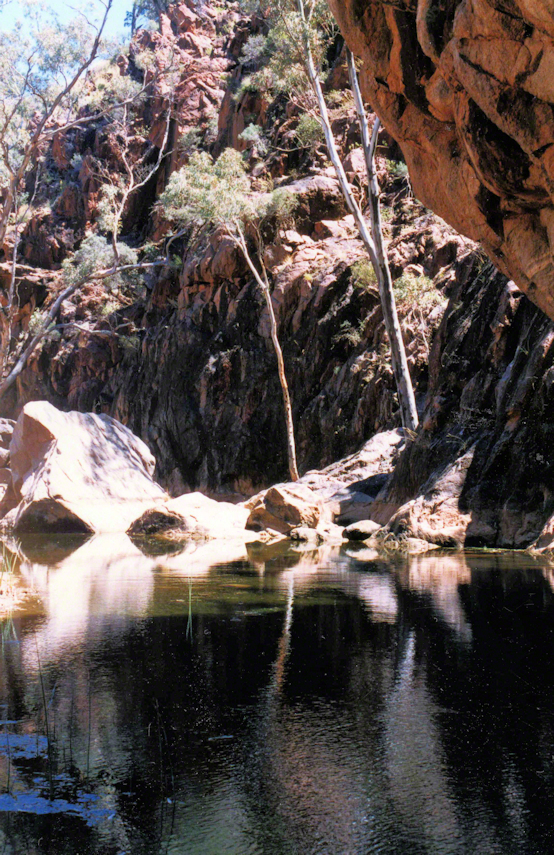
In the restaurant, and eating the cheapest meal offered, I spied a photo adorning the wall behind my beloved. A waterhole with red cliffs on one side and cool but majestic eucalypt trees on the other side. ‘Echo Camp,’ I read. ‘I want to go there.’
He who was driving, turned into the track. ‘You’re quite right. Ready for some adventure?’
‘Okay, well, it says Echo Camp’s only a few kilometres down the track.’
My husband drove up and down the track. It soon became obvious why the track was meant for “authorised” vehicles. But we were committed, and the track became so narrow, with one side rocky cliffs and the other sheer drops, we had no choice but to lurch forward, upward, downward, sideways and every-which-way. While I clutched the bar on the dashboard, my husband had fun, relishing the roller-coaster ride to Echo Camp.
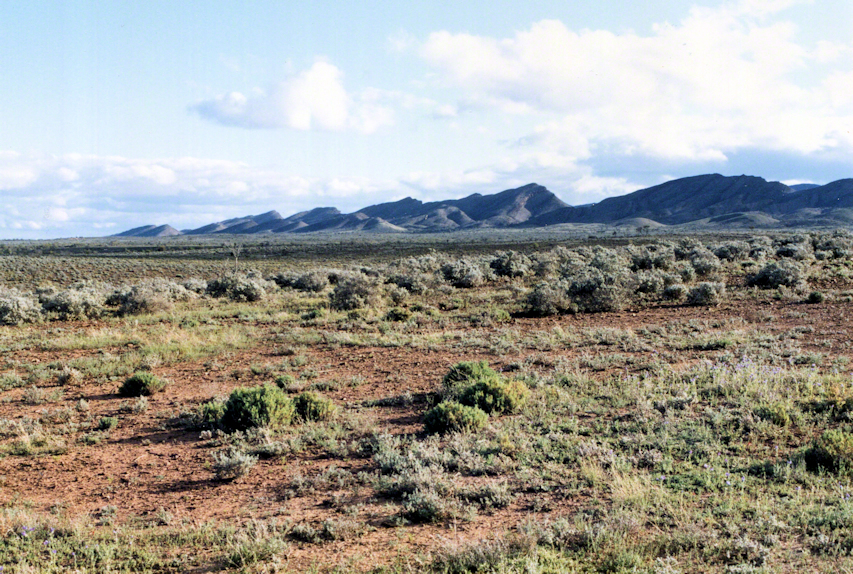
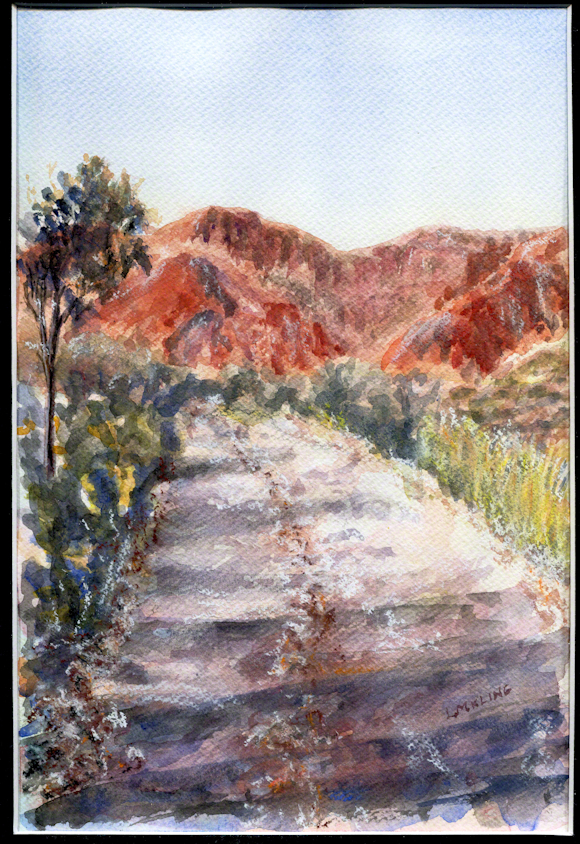
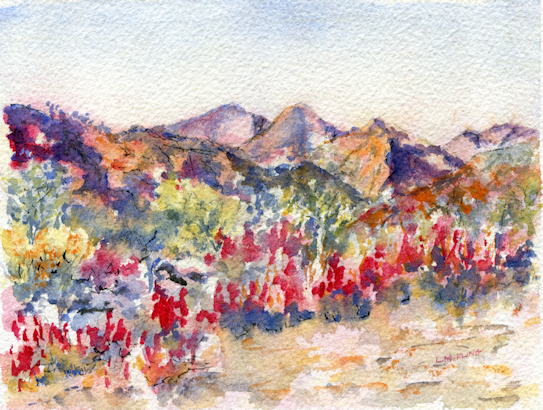
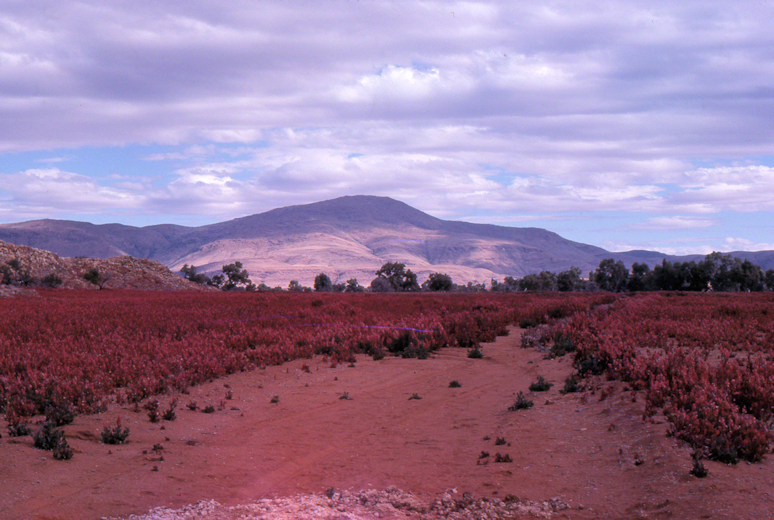
We reached a relatively flat area where we parked our four-wheel drive vehicle. The Painter Sanctuary mountains rose and dipped like waves before us. A feast for the eyes with shades of sienna, blue and mauve. I captured this beauty with my Nikon film camera.
We back tracked and found the way leading to Echo Camp. By this time, the sun hung low in the sky, so our time savouring Echo Camp was limited to no more than half an hour, wandering near the rock pool, taking photos, and enjoying the peace and silence of this land untouched by civilisation, and reserved for the “authorised” apparently.
My most recent painting of Arkaroola landscape, Dinnertime Northern Flinders is for sale at the Marion Art Group exhibition at Brighton Central. You can also check out my work on the Gallery 247 website.
Marion Art Group’s exhibition (first in three years) is to be held from Monday October 17 to Sunday October 30, Brighton Central, 525 Brighton Road, Brighton, South Australia.
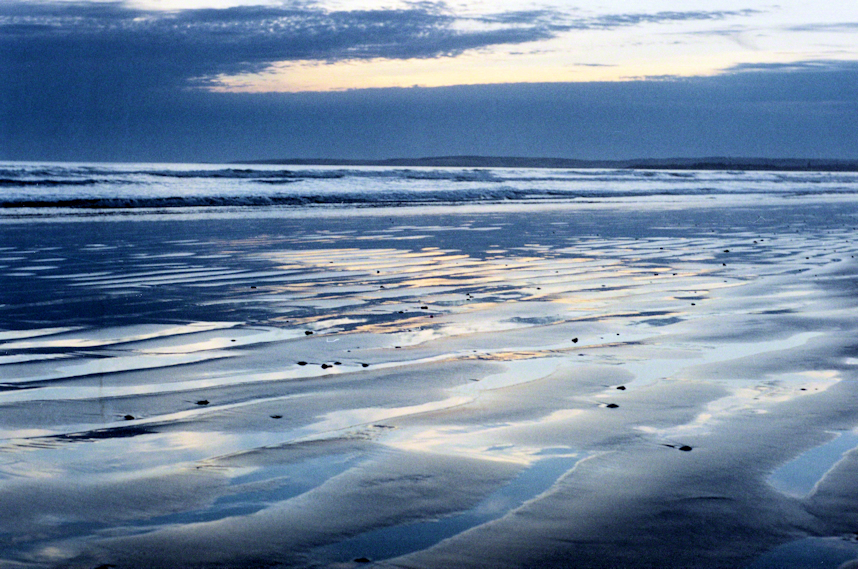
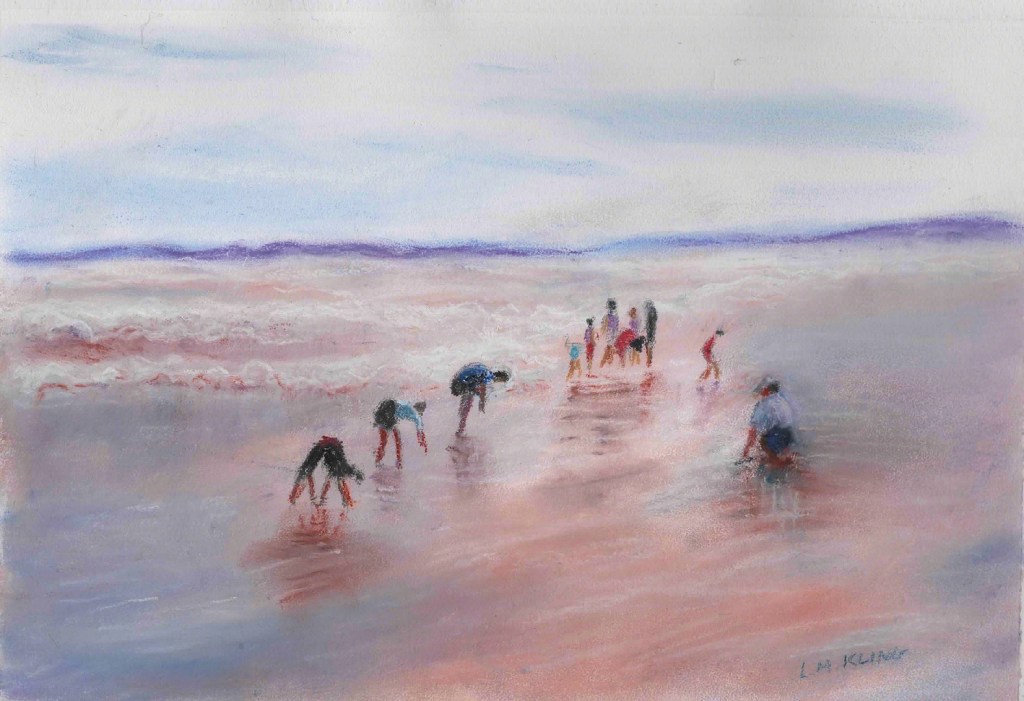
A picture, they say, tells a thousand words. So, what is Cockling at Goolwa’s story? How can the simple heel-toe dance of “cocklers” (people who dig for cockle shells), their feet sinking in soggy sand of the in-coming tide, in the flux of early summer warmth, on a remote beach south of Adelaide tell us? What story worth a thousand words? What was it about this scene that attracted me to capture it? First in photo and then several years later, on canvas in acrylic, and recently in pastel.
I think the water reflecting the sky, all silver, the people on the wet sand, a mirror, swaying and twisting for cockles captured my attention. I’d been there, on the glassy surface, watching for bubbles, grinding my heel into the bog, feeling for the sharp edges of shell and plucking out the cockles that snapped shut when exposed to air.
‘What will you do with all those cockles?’ I asked.
‘They’re for fishing,’ one of our friends said. ‘Bait for fish.’
‘Hopefully, we’ll catch a few fish and have them for dinner tonight,’ another said.
I imagined fish, fresh from the sea, thrown on the barbeque and the cockle bait inside them buried once again in our stomachs. We continued digging for cockles…family and friends, one with the ancient, outside time—nothing else matters but the cockles.
Goolwa, if I remember, has mounds of spent shells in the sand hills, monuments to generations upon generations of Indigenous Australians, their open-air kitchens and meals. Did they perform the same ritual, on the same patch of wet sand, delving for cockles to fry on their fires? A quick perusal of Google reveals they used nets to collect cockles and catch fish. They then cooked the cockles on a campfire.
We are here, they are gone, but their spirit of history lingers, reminding us, though we seem different, we are the same. We are digging, dancing and delving for our dinner. We are still, in the moment, alone in our thoughts in a forgotten corner of the world, unknown by the world, yet one with this country’s past. And God knows each one of us—each part of us, even the unknown parts of ourselves and our secrets.
What if I shared a little secret—an artist’s secret? Okay, I’ll tell you. I painted this picture in less than two hours. Now, that I’ve told you, would the painting be worth less to you? Must time be equated with worth? Sometimes I do take hours upon hours, layers upon layers, and more hours planning to get the work right. But not Cockling at Goolwa.
I love the beginning of a painting; laying the foundation, engaging my inner-natural child, the paint flowing from a thick brush on a damp canvas, colours blending, mixing as I go. One side of the brush crimson, the other blue and a dab of white. Sienna somewhere there in the foreground shadowing the sand. Mid-yellow added incrementally to shroud the distance in light grey for perspective. Then just a hint of heads of land jutting out halfway across the horizon with a suggestion of ultramarine in the grey. So simple, and sometimes, like with Cockling at Goolwa, the scene emerged before my eyes. In the world of artists, I believe the term “magic brush” or “magic hand” has been used. Um, trade secret, so don’t go spreading it around.
So, there you have it, in less than an hour, surf, sand, sky and tones in all the right places.
Now for the people, the twisting, turning people, their feet in the boggy sand. How do I paint them? I had a break and drank a cup of tea. I remember not all the children hunted for cockles. Some kids body-surfed in the shallows, some played cricket and one little boy with a wish to be hunted, or to be warm, buried all his body except his head in the sand. I found him and he broke out of his sand-grave, the sand zombie.
‘Don’t go tracking your sandy footprints into the shack,’ I said.
He washed himself off in the surf, then sat wrapped in a towel and shivering in the sun while watching the cockle hunt.
All the while the “cocklers” cockled for cockle shells. Soon the boy joined the hunt for cockles.
Then when the paint was dry, I plotted the people in with pencil and then painted them in with a finer brush.
‘I like that painting,’ a fellow member of the art group said. ‘Don’t do another thing to it. Don’t even frame it. I’ll buy it as it is. How much do you want for it?’
Paint barely dry, I took the work home, signed it and then the next week at our Christmas lunch, I delivered Cockling at Goolwa to them. The buyer showed the work to others at their table and all admired it.
What made another person connect with Cockling at Goolwa? For this person, their son and family spent many summer holidays at Goolwa, doing just that, cockling. Time out, out of time, unwinding, relaxing, happy times, happy memories, captured on canvas…in less than two hours. And I must admit, the story is slightly less than one thousand words.
But, perhaps as you look at the copy of Cockling at Goolwa, you may have a story of your own about the painting. Maybe a painting’s story is not just one person’s story, but stories from many people, one thousand words, or more…
[The last few months I have revisited The T-Team with Mr. B: Central Australian Safari 1977 which is a prequel to Trekking With the T-Team: Central Australian Safari 1981. In preparation for its release later this year, I will be sharing posts of this adventure.
In this episode,the T-Team with Mr. B scale the heights of the highest mountain in South Australia, Mt. Woodroffe. Even back in 1977, Mt. Woodroffe being on land owned by the Indigenous people, we needed permission and a guide. Don’t know what happened to the guide back then, but we had permission. The situation has changed in the 44 years since we climbed…more about that later.]
The Top of SA — Mt. Woodroffe
The sun climbed over the horizon, its rays touching the clouds in hues of red and Mount Woodroffe in pink.
In the golden light, packs on our backs we filed up the gully. The narrow creek in the hill-face gave way to the slopes leading to the summit. With no defined track except for euro (small kangaroo) ruts, we picked our way through the spinifex. Rick carried his .22 rifle in the hope of game for dinner.
‘You’ve got to watch that spinifex,’ Dad said. ‘If you get pricked by it, the needle stays inside your body for years.’
‘Years?’ I asked. ‘What does it do there?’
‘It works its way through your body and eventually it comes out through your hands or feet or somewhere.’
‘Yuck!’
‘Ouch!’ Rick screamed. ‘The spinifex just stung me.’ My brother stopped and pulled up his trouser leg to inspect the damage and then muttered, ‘Next time I’m making shin-guards.’
‘I guess one should be careful when one answers the call of nature out here,’ Mr. B said.
Matt sniggered.
I gazed at the acres of spikey bushes and decided to resist the call of nature.
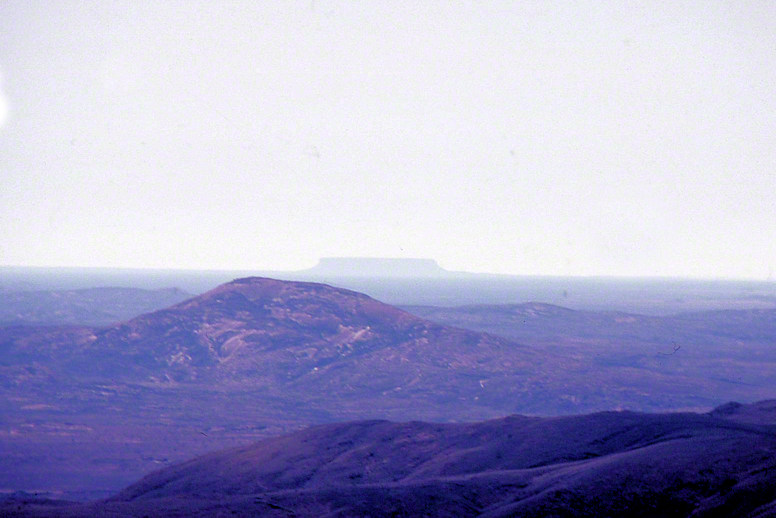
I studied the three odd-shaped purple monoliths popping up from the plain. After the strenuous hike to the top of South Australia, I gazed at the ranges resembling waves rising and falling in the sea of the desert was filled with euphoria.
‘Wow!’ I gushed. ‘Apart from spinifex, the climb was a walk in the park—a most worthwhile journey.’
Mr. B folded his arms and grunted.
Still on a high, I ran around the stone pile, snapping photos from every direction with my instamatic film camera. Then I gathered the T-Team. ‘Come on, get around the cairn. We must record this momentous occasion for posterity.’
The men followed my orders like a group of cats and refused to arrange themselves. Mr. B hung at the back of the group and snapped, ‘Hurry up! We need to eat.’
Lunch of corned beef and relish sandwiches at the top of South Australia was Dad’s reward to us for persevering. We rested for an hour on the summit taking in the warmth of the sun, the blue skies dotted with fluffy clouds and the stunning views of the Musgrave Ranges and desert.
After photos, we began to climb down those jagged rocks, carefully avoiding the spinifex. But try as he might to avoid the menacing bushes, more spikes attacked Rick’s tender legs. ‘Definitely going to wear leg guards the next time I come to Central Australia to climb mountains,’ he grumbled.
We reached a rock pool, just a puddle of slime, actually. I pulled off my shoes and emptied grass seeds and sand onto the surface of slate. Then I ripped off my socks. They looked similar to red-dusty porcupines, covered in spinifex needles. My feet itched with the silicone pricks of the spinifex. I dipped my prickle-assaulted feet in the muddy water.
‘You mean, David, old chap,’ Mr. B massaged his feet and turned to Dad, ‘we’re stuck with the prickly critters long after our climbing days are over?’
During rest at the poor excuse of a rock pool, nature called, and this time I could no longer resist. I hunted for a suitable spot, but everywhere I looked, ants scrambled about, millions of them. The longer I looked, the more ants congregated and the more desperate I became. But I had to go, ants or no ants. At least the patch was clear of spinifex. I suppose for the ants, my toilet stop might have been the first rain in weeks.
Back at camp, we began our ritual of preparing the bedding. Mr. B stomped around the creek bed until he found the softest sand. Dad grabbed the sleeping bags one by one and tossed them to each of us.
‘Argh!’ Mr. B cried.
‘What?’ Dad asked.
‘Oh, no!’ Rick moaned.
‘What?’ Dad asked.
‘Who’s been piddling on my sleeping bag?’ Rick grizzled.
‘Piddling?’ Dad stomped over to Rick.
‘It’s all wet.’
‘I say, boy, why’s my sleeping bag all wet? Couldn’t you use a bush?’ Mr. B remarked.
Matt turned away. ‘Wasn’t me.’ He unrolled his sleeping bag. ‘Oh, no, mine’s wet too.’
Rick looked at me.
‘Hey, I stopped wetting the bed years ago,’ I snapped. ‘Anyway, mine’s dry.’
‘I wasn’t going to say anything,’ Rick replied.
I raised my voice. ‘You were, you were looking at me like…’
‘There, there, cut it out,’ Dad strode over to Rick and me. He held up a bucket. ‘The washing buckets leaked on the sleeping bags.’
These days, in the days of the “new normal”, as a result of Covid, climbing Mt. Woodroffe may not be possible. I did a little Google research about it. During the times of the “old normal”, permission from the Indigenous Owners of the APY Lands was still necessary, but it seems the Mt. Woodroffe climb was part of an organised tour. To find out more, here are the links below:
[An extract from The T-Team With Mr. B: Central Australian Safari 1977; a yet to be published prequel to my travel memoir, Trekking with the T-Team: Central Australian Safari 1981, available on Amazon.












































 Tru-Kling Creations