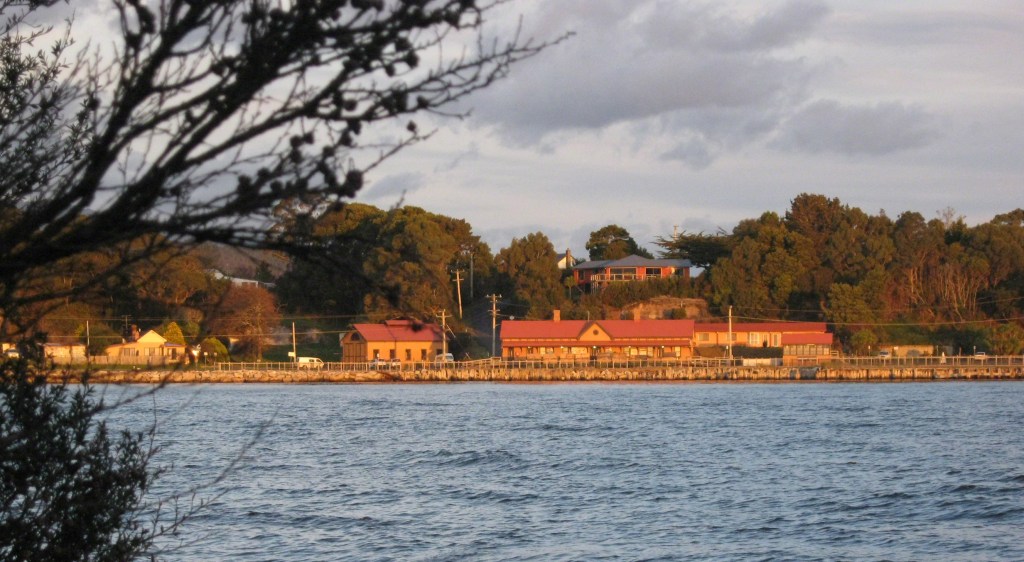
Final Trek Friday–T-Team Next Gen

Woomera, Then Home (part 2)

[I never actually finished the story of the T-Team, Next Generation’s adventures in Central Australia in 2013. So, here is the final chapter in the series. Next month, I will commence the journey at the beginning, as I revisit our journey to scatter my dad’s ashes in Central Australia eleven years ago.]

Woomera II and the Final Leg of our Journey

In the cool crisp morning, sun shining lemon yellow rays but not much warmth, we strolled around the Woomera Rocket Museum. Rockets of all shapes and configurations stood in the open-air, testimony of what once was. This RAAF Base and village was once a lively town in the 1950’s and 60’s, as an Anglo-Australian Cold War defence project. On this day Saturday July 20, 2013, the place seemed a mere shell of its former self, a cemetery of what once was, rockets rising like giant tombstones to the sky.

We meandered around the rockets, reading signs, eulogies from the past when threats from enemy nations was imminent. I was reminded of older friends telling me of a time when they practised drills of hiding under their school desk in the event of enemy attack.

*[Photo 1: Monument, A Rocket at Woomera © L.M. Kling 2013]

My mother recalled when on February 19, 1942, Darwin was bombed. She was a girl in Hermannsburg at the time and whenever a plane flew over, the Aranda women would wail, fearing disaster.

*[Photo 2: Twists and turns © L.M. Kling 2013]

Now, Hermannsburg was a mission set up by German missionaries in 1877. Although, by the 1940’s the mission was fair dinkum Australian having existed in Australia for all that time, with the advent of World War II and the conflict with Germany, the name, being German, raised the suspicions of the Allies. Hence, Mum remembers British Officers* drove into Hermannsburg to check the place out. They had to make sure there were no German spies. My grandpa, Pastor Sam Gross and his wife (my grandma) hosted these officers and put on a lovely spread of lunch for them.

[Photo 3: The Hermannsburg welcome Spread © C.D. Trudinger circa 1955]

After investigating any mitigating threats, the British Officers* drove away in their propeller plane satisfied that Hermannsburg was no threat. Never-the-less, they confiscated the one and only link to civilisation, the community pedal radio. Just in case they really were spies, I guess. Further, to make sure that no threat to the allies arose from this humble mission, they sent Rex Batterbee, a world War I veteran, to oversee the mission in the role of “protector of the aborigines”. As he had visited and then lived in Central Australia since the mid-1930’s, Rex taught Albert Namatjira to paint watercolours and helped him launch his career as a renowned artist.
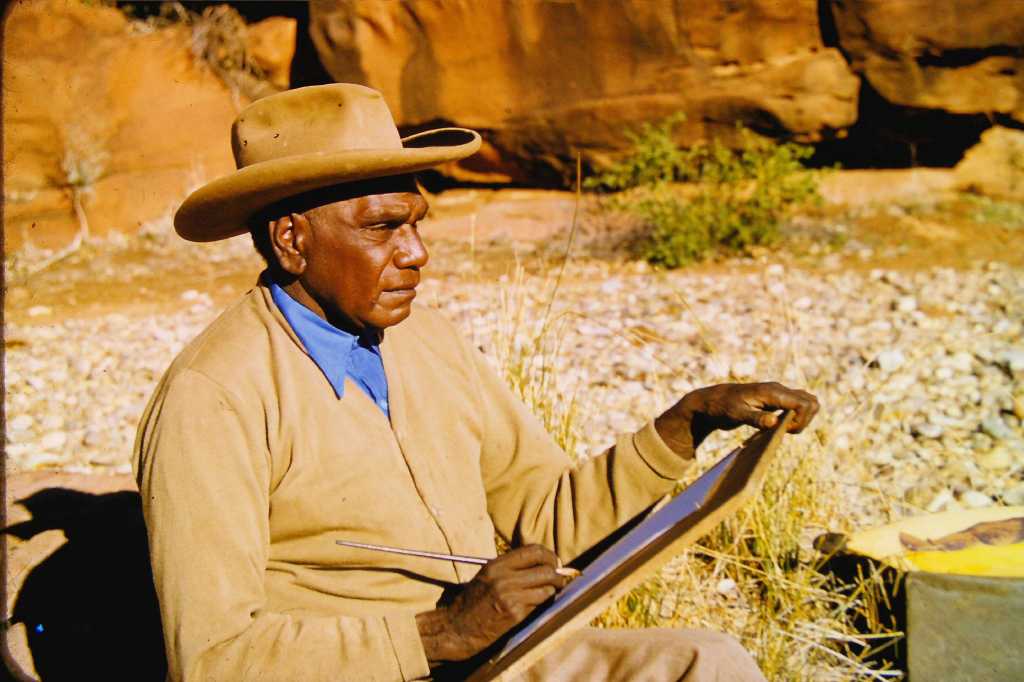
*[Photo 4: Albert Namatjira at work © S.O. Gross circa 1950]

Homeward Bound

Needless to say, in 2013, such threats of foreign enemies seemed in the distant past. But, being only 446 km from our home town, Adelaide, we were reluctant to linger amongst the rockets. Having packed, and checked out of our overnight accommodation, we were eager to start our journey home.

At a steady 90 km/h, we made progress down the highway that split the gibber plains in halves.

‘I bet the T-Team (my brother’s family) are home by now,’ I said. ‘No hanging around of taking time to look at any more places for them.’

‘Why don’t you ring them just to see where they’re at,’ my hubby said.

I texted my niece. The time was 10:30am.

“We are in Port Augusta,” she replied by text.

‘There’s no way we’ll catch up to them,’ I said, and then texted back, “Have a safe trip home.”

*[Photo 5: Off we go over the gibber plains © L.M. Kling 2013]

Clouds and rain descended on the land the further we drove south. By the time we reached Port Wakefield, the cold had seeped into the car. I put my parka on my legs to keep warm. Yet, for lunch Hubby insisted we eat alfresco in the rotunda at Port Wakefield. After all, despite his aversion to the cold, he needed to stretch his legs. Plus, it seemed no café existed in the town.

The rain and cold became more intense as we approached Adelaide. After driving through the grey, sodden streets, we arrived home, just as darkness fell at 5:30pm.

What disaster awaited us?

Hubby opened the door and we trod inside. Son 1 played a computer game on the PC in the dining/living annex. He ignored us. We tiptoed through the family room. Not too much mess and the carpet remained visible, and clean.

We found Son 2 all rugged up and cosy in his room playing World of Warcraft. He said, “Hello” and then asked for a coffee, then followed the conversation up with, “I’m hungry, what’s for tea?”

In the kitchen, as I prepared a drink, I noticed the dishes had been done and the cats fed. I thanked Son 1 for the effort. He took all the glory and remarked that his brother had done nothing.

The Aftermath

There’s always casualties that follow every holiday. And this one was no different. Two paintings which I had planned to exhibit in the upcoming Marion Art Group exhibition had gone AWOL. I’d like to think they were stolen…but I reckon they would be found in some odd place sometime in the future.

*[Painting: Dad’s resting place, Ormiston Gorge © L.M. Kling 2018]

Eleven years hence as I write this final chapter, I wonder what paintings they were.

Oh, and the other casualty, Hubby, who proudly exalted that he had taken thousands of photos of the Central Australian trip on his mobile phone, can no longer find where those photos went. It would seem those photos went AWOL too.

As for the T-Team, they actually arrived home after us, having spent a night at Port Germaine. They decided to treat themselves after roughing it for the past two weeks.
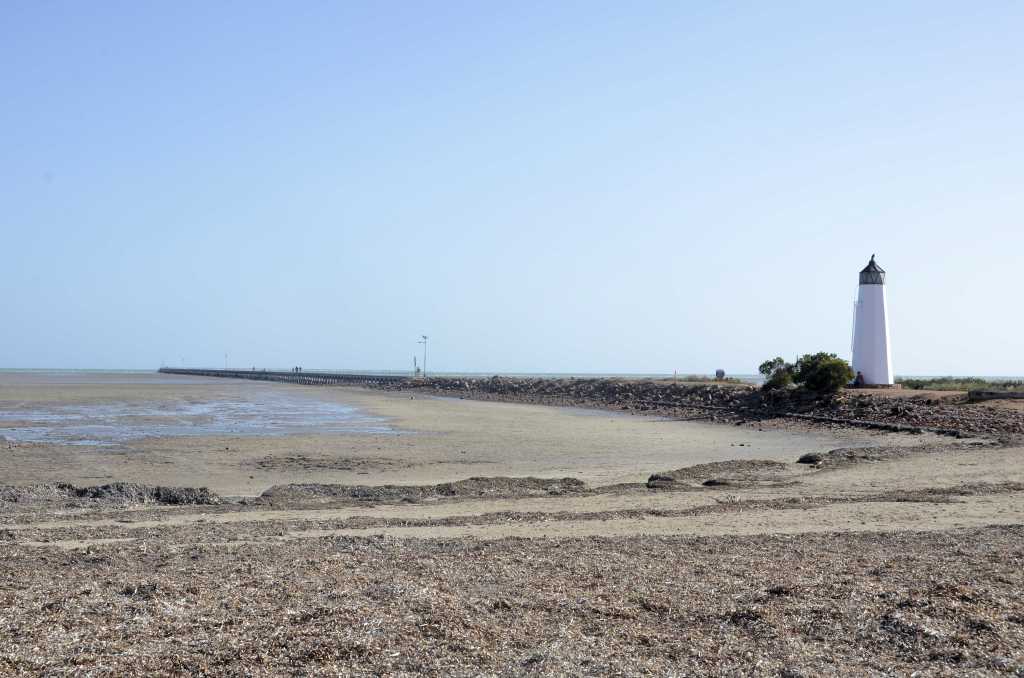
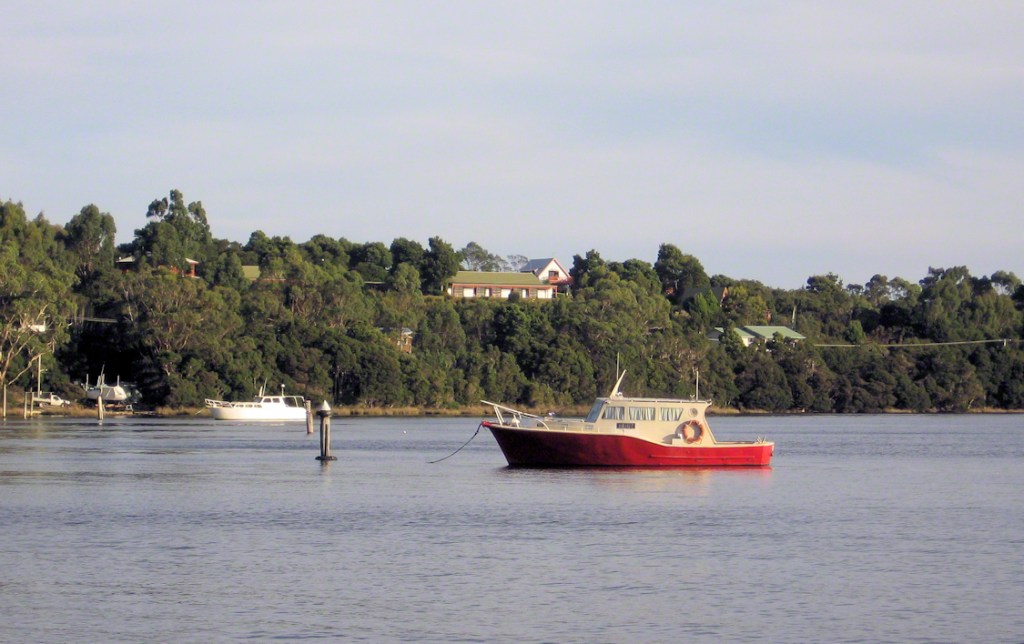
*[Photo 6: Port Germaine Jetty © L.M. Kling 2024]

***

Note: *My mum, Mrs. T checked this and questioned whether they were British. She thinks they were more likely to be Australian. However, I have read a letter written by these officers and the words they used made them sound British. When I find the letter, I will investigate the background of the visiting officers and plan to write a more detailed account of my grandparent’s experience.

© Lee-Anne Marie Kling 2024
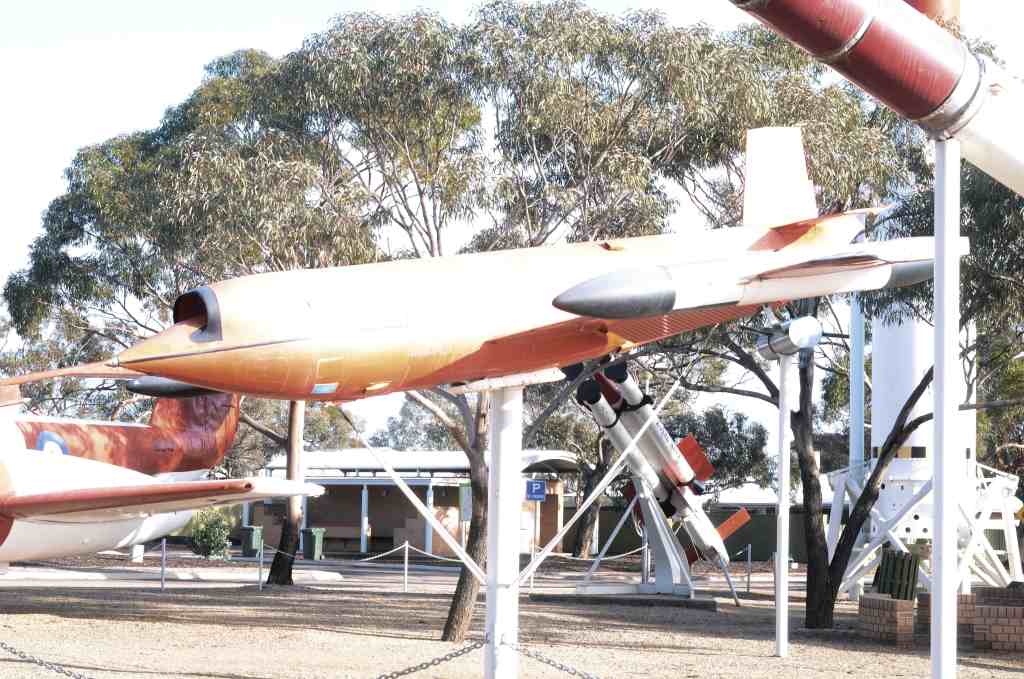
Feature Photo: Woomera Open-air Museum in the morning © L.M. Kling 2013

***

Want more? More than before?

Take a virtual trip with the T-Team and their adventures in Central Australia.

Click below on…

The T-Team with Mr. B: Central Australian Safari 1977

Trekking With the T-Team: Central Australian Safari 1981…

To download your Amazon Kindle copy of the story…

And escape in time and space to the Centre of Australia.

Family History Friday–Detective Work

In the steps of Sherlock Holmes

This last week, Hubby and I have received our DNA results. Dear Hubby received his last Friday, but mine only arrived today.

So, the last week I have been familiarising myself with the process and slowly building our family trees. Early on, I discovered a truth, you could say a “skeleton” in one of our ancestral lines. I added the details to see if anything further came up. My Heritage, call this a “smart match”. Nothing did, but I left it there.

For certain family members this truth appeared absurd, and too difficult to comprehend. Surely, that ancestor wouldn’t. Didn’t. Noone told us that. You have it all wrong, Lee-Anne.

Hence, Lee-Anne (me) being a good person only wanting the best for the family, deleted the suspect members from that branch of the family.

Then, curiosity set in. Who was that ancestor’s mother? Father? My husband suggested we go down the line to the descendants and put in a particular name.

This I did.

You wouldn’t believe it, but the same results, only this time verified by the official birth and marriage records. My original hunch had been correct. Moreover, in the spirit of Sherlock Holmes, I managed to crossmatch the added, yet odd family members with DNA and behold, a match.

Now, the reason I’m being so vague about the whole ancestral situation, which I might add, is responsible for our existence, is because out of respect for some people, the details of such conceptions are to remain private/personal; too personal to be published.

Isn’t it interesting that for people who want to protect their reputation, the unacceptable behaviour of other members of their family, ancestors or close relatives, must remain hidden, buried and plainly, not discussed. Such individuals may even be ostracised from the family.

Yet, such flawed individuals can still be, in other circles, a valued and much-loved member of the community.

My dad’s cousin, Dr. Malcolm Trudinger for instance. The story goes that he had a problem with alcohol. Legend has it that he couldn’t do surgery without a nip or two before the operation.

Malcolm’s alcohol addiction was too much for his immediate family who it would seem distanced themselves from him. Maybe it was the other way around and he felt not good enough for them. Whatever…

According to articles about Malcolm on Trove, he was regularly in trouble with the law. Infractions that in the 21st century, we’d consider a nuisance, or minor, but in the 1940’s and 50’s were serious. For example, his car engine making too much noise at night in town. Or even one time, merely driving his car late at night. Another time he was charged for making a scene at a function.

Despite these misdemeanours, as I see them (glad my brother and I didn’t live in those times—my brother loved doing “donuts” and “burnouts” in his car like in Top Gear at night with his mates in his youth), the folk on the West Coast of South Australia, loved Dr. Malcolm Trudinger. He was their hero. He once helped rescue people from a shipwreck off the coast during a storm. He cared and was always there for the sick and injured.

I remember my mother telling me the story how a person upon meeting my father, and learning his name was Trudinger, sang high praises for his cousin Malcolm. The sad thing was, that although he was still alive when Mum and Dad were first married, Mum never got to meet Malcolm.

[Photo 1: Dr. Malcolm Trudinger © photo courtesy of L.M. Kling circa 1930]

Dr. Malcolm Trudinger was such a vital part of the West coast community, they established a rose garden was in his honour after he died in the early 1960’s. We have heard that rose cultivation was his passion and his roses were prize-winning. My niece discovered the garden when she and her partner were on a road trip passing through Elliston. She couldn’t have been more chuffed having found a Trudinger with a rose garden to his name. It showed Malcolm was a loved member of the community despite his demons.

This is what, I believe, grace is all about—valuing and loving people as they are. We are all flawed. Rather than hide the imperfections, celebrate the person, their life and goodness they bring or have brought to the community. It’s our pride and wanting to look good to others that makes us cover up our sins or those of our kin. But also, we may be protecting their reputation too, which is a reasonable thing to do.

The reality is, we are all fallen and we all struggle. No one is perfect. We are all cracked pots. Yet like in the Japanese art of Kingsugu (the repairing of broken pots), there is beauty that shines out through the cracks.

And so, it is with our imperfect ancestors. When you think about it, it’s the ones whose stories are different and colourful that we find most interesting.

© Lee-Anne Marie Kling 2024

Feature Photo: Hubby as Sherlock Holmes, Reichenbach Falls © L.M. Kling 2014

***

Want more, but different?

Check out my Central Australian adventures.

Click on the links:

The T-Team with Mr. B: Central Australian Safari 1977

Trekking with the T-Team: Central Australian Safari 1981

Trekking Thursday–Franklin-Gordon River Cruise

[Last week, Hubby and I were talking to someone who had recently visited Tasmania. They went to Strahan, but for some reason didn’t do the Franklin-Gordon river cruise. We recommended that next time they go to Tassie, they revisit Strahan and do the cruise. Hence, to encourage prospective travellers to Tasmania, a re-visit in my blogs to Strahan on the West Coast of Tasmania. Ah, memories of travels with my husband, his brother (P1), and cousin from Switzerland (P2), to Tasmania; a brilliant and beautiful destination.]

K-Team Adventures—Strahan and Gordon River Cruises

An early start, just what the K-Team love. We were to board the Wilderness Cruise Boat by 8.45am. Not as early as the last time I took the cruise. Then, in 2011, I journeyed with my mother (Mrs T), for whatever reason, the ship departed much earlier than 8.45am. Fearing we’d miss the boat, Mum and I rose at the crack of dawn and ate our breakfast at a hotel opposite the wharf while watching the sun rise on the calm waters of Macquarie Harbour; an oil painting in hues of gold and pink with ducks on the jetty. Mum’s breakfast of Eggs Benedict was less than perfect; uncooked, runny and the “whites” not white. She’s never had Eggs Benedict again. I guess there had to be some compensation for the ideal weather we had that August day in 2011.

[Photo 1: Calm on Macquarie Harbour before Eggs Benedict © L.M. Kling 2011]

Not so for the K-Team in 2016. A perfect mix of personalities, no conflicts—apart from some initial altercation between my husband’s phone GPS navigator and the Kluger’s Pandora navigational system. Now that was something out of the box, so we packed away any semblance of pairing our phones with the car’s computer system and relied on the navigational system God had given us—our brains…and some forward planning with Google Maps. So, instead we had the weather as our thorn-in-the-side member of the K-Team. At least someone up there, I mean God, had been looking after us.

[Photo 2: Sign of weather come. A hiking trail in Hogarth Falls near Strahan © L.M. Kling 2016]

When we booked our cruise, the lady asked us, ‘Do you want to go on the ABT Railway up to Queenstown?’

‘How much?’ I asked.

The lady showed the prices.

‘What time does it get back?’

‘Oh, 5pm.’

‘Nah, we’re meeting my cousin at 4.30pm. So, we’ll take the cruise.’

A narrow escape. We heard that night while dining with my cousin, Kiah who at the time ran the Strahan Visitors Centre, that fallen trees on the railway track had stranded the tourists on the train for several hours. They arrived back in Strahan at 8.30pm. The next day, on the cruise, Kiah overheard some girls who had been on the train trip say they were going to write a reality TV show about bored kids.

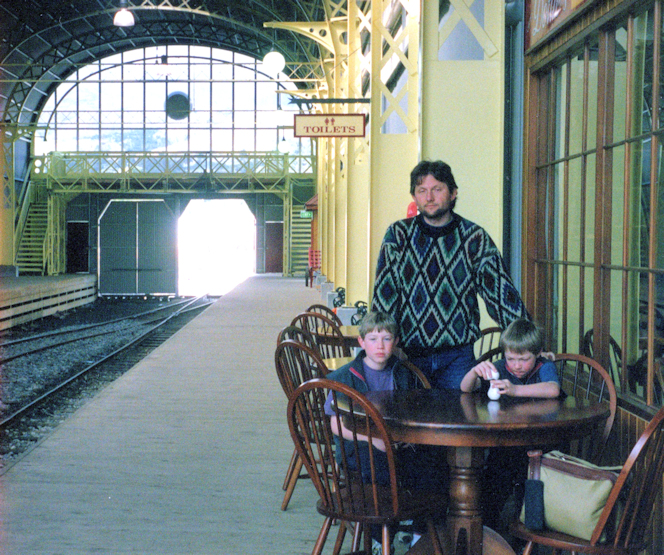
[Photo 3: Thankfully, not stranded at Queenstown; ABT Railway Station with K-Team, the younger way back when…Looks like my kids can get bored at Railway Stations too. © L.M. Kling 2001]

The cruise, definitely not boring. First a ride out through the narrow heads and into the full force of the roaring 40’s and rough seas; P2’s highlight of the Tassie Trip. Hubby was surprised I didn’t get seasick. I’d remembered to take my ginger tablets.

[Photo 4: High seas past the heads, but the birds hang on. © L.M. Kling 2016]
[Photo 5: The safety of the lighthouse © L.M. Kling 2016]
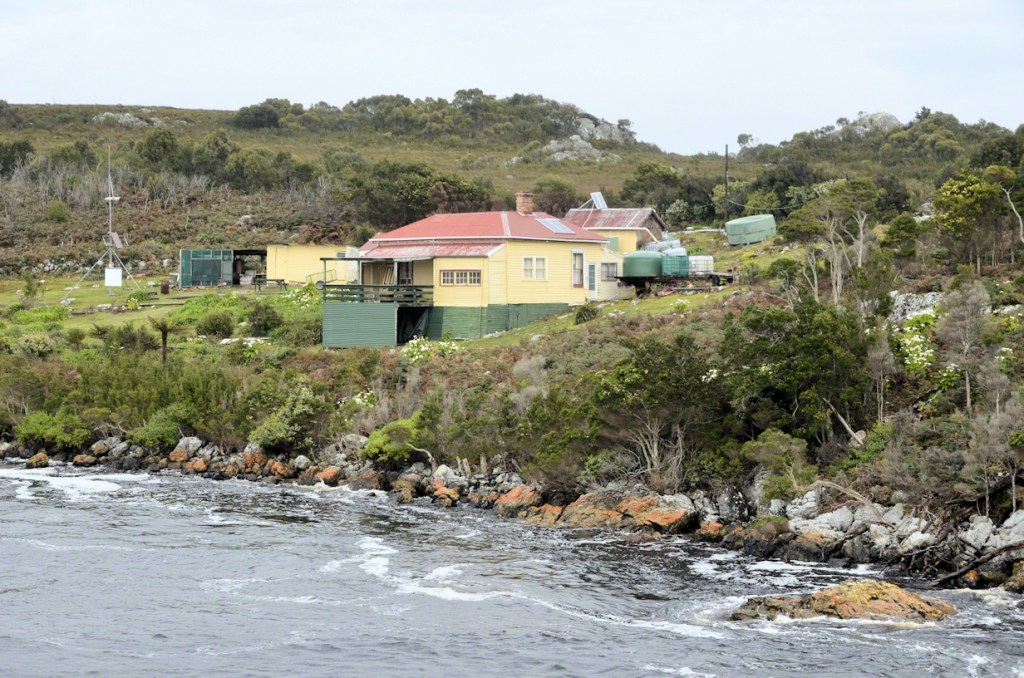
[Photo 6: The lighthouse keepers’ cottage? © L.M. Kling 2016]

Then, after returning back into the safety of the harbour, a tour of the salmon farms; big, netted rings full of fish.

[Photo 7: Salmon Farms © L.M. Kling 2016]

Kiah and her team would be our guides on Sarah Island, the worst penal colony in the whole British Empire in the early nineteenth century. We spent an hour or so on the island touring around the various sites, the tour guides giving lively and entertaining accounts of Sarah Island’s history.

[Photo 8: Sarah Island approach © L.M. Kling 2016]

Walking up the gangway, I studied the wilderness mountains jutting above the forest lining the harbour and detected the vague outline of Frenchman’s Cap, clouds shrouding it from a clear view.

[Photo 9: So different with Mrs T; Frenchman’s Cap perfect through swamped trees of Sarah Island. © M.E. Trudinger 2011]

As we raced up the river, the Captain rabbited on about Sarah Island’s convict history and then he said, ‘While we travel up the river, think about what it would’ve been like living in those times on Sarah Island as a convict.’

[Photo 9: The Lookout © L.M. Kling 2011]
[Photo 10: Mrs T contemplates while crowd listens to tour guide © L.M. Kling 2011]

I recalled the play we’d seen the night before, The Ship that Never Was; the political climate and social conditions of nineteenth century Britain that created the huge gap between the rich and the poor, unemployment and homelessness, and the solution to send shiploads of social rejects (the convicts) to Australia—the worst offenders to the most remote place on earth, Sarah Island. Yet, in all of that condemnation and hopelessness, redemption. Some of these convicts, when they received their ticket of leave (freedom), became leaders in the colony; their skills not going to waste. Treat people like they matter, give them a chance. This is how I understood David Hoy, Master Shipwright treated the convicts. I could go on, but best if you ever go to Tasmania, go to Strahan, do the cruise and see the play.

[Photo 11: Scene from the Ship that Never Was © L.M. Kling 2001]

And while we were there, clutching the mini hot water bottles loaned to us for the duration of the performance, and waiting for the play to start, the tour group we encountered the previous day, joined the audience. Some of them ended up participating in the play. So did P2 helping the ship (just a pile of wood, really) sail to close to the coast of Chile…before it…well, you’ll have to see the play to find out what happened.

[Photo 12: Perfect reflections on a perfect day up the Gordon River © L.M. Kling 2011]

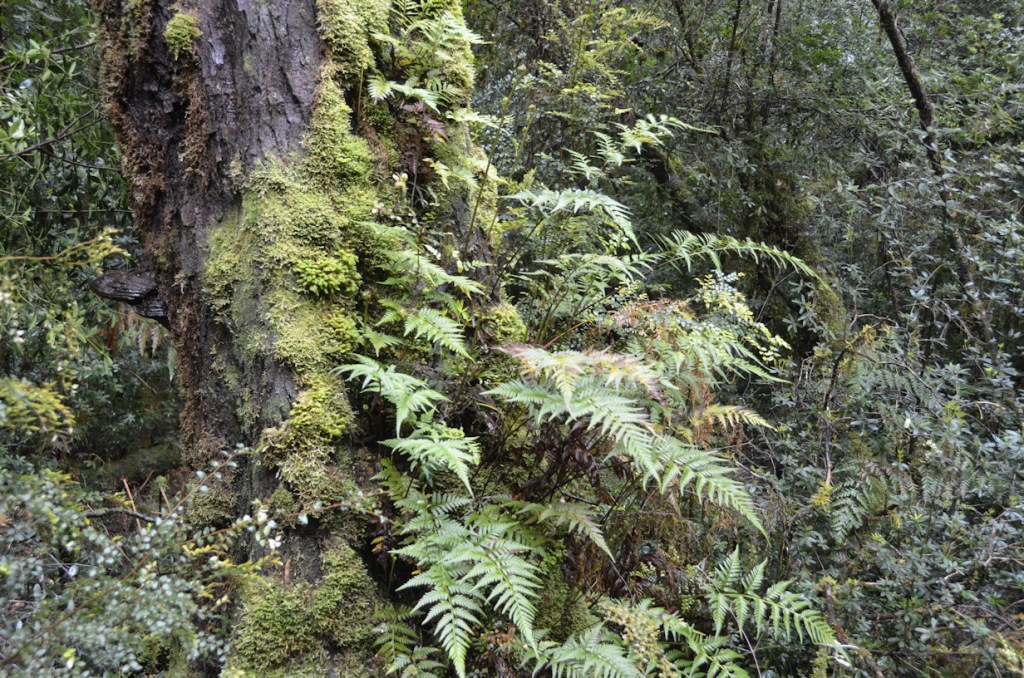
After a tasty buffet lunch of smoked salmon, cheese, bread and salad, we had a half-hour walk in the rainforest. Amazed at the variety and abundance of plant-life and how plants grow out of tree trunks and stumps. The old Huon pine stump that had been struck down by lightning a decade or so ago, was now a garden of seedlings, native laurel, moss, lichen, and ferns.

[Photo 13: New Life springs from That old Huon Pine © L.M. Kling 2016]
[Photo 14: A taste of a temperate rainforest © L.M. Kling 2011]

Then the race back to Strahan. In all we had travelled 140km on tour of the Macquarie Harbour, some way up the Gordon River and then back to Strahan.

P1 disappointed with the cloudy weather said, ‘How can I get good photos when there’s no sun?’

[Photo 15: And so, the sun sets on Strahan © L.M. Kling 2011]

‘They’re mood photos,’ I replied. Cheeky, I know, since in 2011, the sun shone on Mum and me, and I had dozens of chocolate-box photos of the Gordon River like glass reflecting perfectly vivid green forest trees. Oh, well. We were blessed that day in 2011. The western wilderness of Tasmania gets on average around 4000mm of rain a year. So more likely to get cloudy rainy days on a cruise than sunny, I guess.

Besides, did P1 have an Eggs Benedict like my mum had eaten that morning in 2011?

© Lee-Anne Marie Kling 2016; updated 2019; 2021; 2024

Feature Photo: Chocolate Box Reflections on the Gordon-Franklin River © L.M. Kling 2011

***

Want more? More than before?

Take a virtual trip with the T-Team and their adventures in Central Australia.

Click here on…

The T-Team with Mr. B: Central Australian Safari 1977

Trekking With the T-Team: Central Australian Safari 1981…

To download your Amazon Kindle copy of the story…

And escape in time and space to Centre of Australia 1981…

Family History Friday–My Rogue Ancestry

[As a child, I frequently had dreams where I was locked up in a prison cell and couldn’t get out. When, through family history research, I discovered the plight of my young (at the time) great-great Grandfather, I realised the origins, genetic or spiritual, of those dreams.]

My “Convict” History

I admire a former convict, an ancestor of mine. Okay, you may think, yeah, of course, she’s an Australian—these days they wear their convict heritage like a badge of honour.

No, actually, my great-great grandfather Friedrich Schammer lived in Silesia which is now part of East Germany or Poland today. Rubber borders, you see. His crime was trivial by our standards today in the West. But then, so were the crimes of shiploads of convicts who were transported from Britain and Ireland to Australia in the early nineteenth century. (For this reason, I have included photos from my visits to convict settlements, Port Arthur and Sarah Island, Tasmania, as my two-times great grandfather, was living his life in Silesia around the same time, in the early nineteenth century.)

[Photo 1: Port Arthur was a recipient of many convicts from Britain and Ireland © L.M. Kling 2009]

My great-great grandfather Friedrich spent less than three months in prison for this crime he did not commit, but I admire the way he handled his dire situation.

How did he get into this trouble?

According to the family history book of this particular branch of the family, in the town in which my great-great grandfather studied as a medical student in the 1820’s, the military came to power and enforced strict and arbitrary rules. I might add here that my ancestor had already endured hardship, having been orphaned as a child, suffered poverty and then, his older brother who was his guardian, died from typhus. I imagine, these events spurred him on to be a doctor.

[Copy of Portrait painting: Two-times Great Grandfather, Friedrich August Schammer courtesy of Schammer Family History © 1922. Painting circa 1850]

Anyway, in this university town of Jena, the students protested against their restrictions to their liberty by reacting against the ridiculous laws the military had brought on the town. Some of these laws were that there be no singing in the streets, no wearing of caps and waving of flags. The students protested by marching in the streets to the town square, singing and waving flags. All went smoothly and peacefully with no trouble from the authorities.

Then some of the young men, probably after drinking a few beers, became bolder as young men do tend to become. They threw rocks at windows; action that got the authorities’ attention.

[Photo 2: View from window of former café in Port Arthur © L.M. Kling 2009]

The military swooped and arrested many of the protestors. My great-great grandfather was walking past the action and was in the proverbial wrong place at the wrong time.

Arrested and tried, though otherwise of exemplary character as a good Christian belonging to the Moravian Brethren, Friedrich was convicted and sentenced to prison for six months. I might add here that I have learnt recently that in Europe, the judge or judges determine the fate of the defendant. Whereas in the United Kingdom, United States and in Australia a jury (twelve randomly selected citizens) under the decide the fate of the accused.

It seems by his account and letters, a certain beadle in town had it in for my great-great grandfather Friedrich.

[Photo 3: Captain’s Quarters up on the hill, Port Arthur © L.M. Kling 2009]

Yet Friedrich accepted his time in prison and made the best of the situation both for himself and others. He studied, enjoyed the view of the valley from his prison room (I think he was in a low security prison) and used his medical knowledge and skills to help those around him.

Great-great grandfather Friedrich’s quiet conduct and enrichment of the prison community was noticed by the authorities, and they released him less than three months into his term.

[Photo 4: A view of convicts on the other side of Friedrich’s world may or may not have enjoyed in Port Arthur © L.M. Kling 1995]

Released, Friedrich’s ordeal was not over. The university where he’d been studying banned him from returning to study there. His reputation tarnished, the villagers shunned Friedrich.

However, Friedrich did not give up. He moved to Berlin and keeping a low profile, completed his studies at The Charite University Hospital and graduated as a Doctor of Medicine. He had a heart for the poor, having been poor himself, and would treat those in need without demanding payment.

My great-great grandfather demonstrated those godly qualities I admire—justice, mercy and compassion. And perseverance, even in the face of adversity.

Philippians 2:14-15—Do everything without complaining or arguing, so that you may become blameless and pure, children of God without fault in a crooked and depraved generation, in which you shine like stars in the universe…

Feature Photo: The Cry of the Convicts, Sarah Island Ruins © Lee-Anne Marie Kling 2011

*** 

Note: Port Arthur housed what British authorities considered the worst of the convicts transported to Australia in the early to mid-nineteenth century. I visited this convict settlement in 1981, 1995 and 2009. A place well-worth visiting to learn from the mistakes made from the past (how not to treat fellow human beings). Although the place appears serene, the presence of the tortured ghosts of the convict past can still be felt.

Sarah Island situated in the Macquarie Harbour on the west coast of Tasmania, imprisoned the worst of the worst convicts transported to Australia in the early nineteenth century.

I have visited Sarah Island as part of the Gordon-Franklin River Cruise, both in 2001, and 2011. I highly recommend this cruise—a bucket list for travellers—history, wilderness, rare beauty of unspoilt rivers and rainforest and…excellent food. And not to mention entertainment. After your cruise I highly recommend that you see the historic play, The Ship that Never Was. It’s about convicts who build a ship to escape their prison island to make their way to South America. In January in 2024, this play celebrated 30 years of performances in Strahan.

© Lee-Anne Marie Kling 2016; updated 2020; 2023; 2025

Resource: History of the Schammer Family, Based on the work of Dr. A.H. Francke and J. Gemuseus, Written by Reinhold Becker, Herrnhut, 1922, Printed Gustav Winter, Herrnhut in Saxony and Translated from German by Rebecca Gnüchtel 2009

***

Virtual Travel Opportunity

For the price of a cup of coffee (takeaway, these days),

Click on the link and download your kindle copy of one of my travel memoirs,

Experience Historic Australian outback adventure with Mr. B

in

The T-Team with Mr. B: Central Australian Safari 1977

Or come on a trek with the T-Team in

Trekking with the T-Team: Central Australian Safari 1981.