[In 2013, the T-Team, next generation, embarked on their pilgrimage to Central Australia. Purpose: to scatter Dad’s ashes in his beloved Central Australia, in Ormiston Gorge.
Over the next few weeks, I will take you on a virtual trip to the Centre and memories of that unforgettable holiday in 2013, with my brother and his family, the T-Team Next Generation.
This time, the T-K Team visits Emily Gap.]
Lunch With the Ants
Our plans changed. Hubby decided we could take a risk with our fuel situation, so since we were in the vicinity of the Eastern MacDonnell Ranges, we visited Emily Gap and had lunch before refuelling the Ford.
‘After all,’ I said to Hubby, ‘it is almost two o’clock, and I’m hungry.’
He just had to reply, ‘Hungry? Unlike you, I can wait till teatime.’
‘Hmm, yet another similarity you have to my father. Only he could fast from breakfast as well as lunch.’
As we rolled into the shady climes of the Emily Gap car park, I remarked, ‘But such a lovely place to sit and have a picnic, don’t you think?’ I had already sourced some nuts and chocolate from my bag in case he disagreed with my suggestion.
‘We’ll go for a walk first to see the rock paintings and then have some lunch,’ Hubby grumbled. ‘I don’t want to walk on a full stomach.’
While Hubby marched ahead to find the rock paintings before they disappeared, I trailed behind and nibbled my nuts and chocolate. Needed reinforcements to do the walk.
Hubby vanished around a corner. A few minutes later, he appeared, jogging towards me. ‘They’re here! Come, look!’
‘Oh, yeah,’ I replied, remembering 1981 when TR baited us with some significant discovery of Indigenous art. That art turned out to be less ancient and more modern.
I followed Hubby. Around the bend, he pointed. ‘Look! There they are.’
Gazing at the entrance to a shallow cave, I said, ‘Oh, yeah! So, there are. They look like giant caterpillars.’
We spent some time examining the array of caterpillar paintings and carvings; the totem of the Easter Aranda people, we assumed.
‘I think my dad took us to Jesse Gap,’ I said as we walked back to the picnic area. ‘I’ve never seen those paintings before. When he took us out to the Eastern MacDonnell’s, all we saw was artwork of the Western kind, graffiti. When we suggested visiting Emily Gap, it was already nearly dark, and Dad thought there would only be graffiti there too. After all, we had just been to the Devil’s Marbles, after sunset, so it was getting too dark to see anything at that time.’
In the shade of the gum trees in the picnic area, we “shared” our lunch of canned tuna and buttered bread with some inch ants. Had to put our food on a rock and then move the picnic rug, but the inch ants followed us.
After lunch, we found the BP petrol station that my brother had told us about. And finally, the Ford had its fill of LP Gas. Then, on our way back to the Caravan park where we were staying for the night, we swung by the local IGA. There I bought mince, button mushrooms, two onions, shampoo and conditioner. Would you believe that the shampoo and conditioner I had brought from home had not lasted the distance of our two-week Central Australian journey?
In the golden light of late afternoon, while I helped Anthony put up the tent, I watched another family pitch theirs. The father sat in his director’s chair and directed the rest of the family, the women and children, on how to put up their tent.
But, ah, what bliss to cook tea in the light of the common kitchen. Spag Bog, and plum pudding. Dessert, hot chocolate.
Mitch’s hopes turned to practicalities as the morning dragged on while we waited for another elusive item, the alternator. I figured the alternator must be hiding in the same place the roadhouse in Dubbo must be.
By the time my watch read 8am, us four who were not mechanics, once more headed down the main road to the town centre in search of a “deli” as we in South Australia call corner shops, or a supermarket of some description.
We found a supermarket come snack bar, and treated ourselves to a meat pie, chips and Famers Union iced coffee. Just the sort of food one has for breakfast after a gruelling sleepless night. Mitch, appreciative of my mechanic brother’s efforts, brought him back the same fare as we had eaten.
Rick was leaning against the side of his precious Charger, still waiting for the elusive alternator.
A heated discussion ensued amongst the fellows. Mitch put forward that we could be using daylight to drive to Sydney.
Rick refuted that suggestion with, ‘Do you want to sleep in the car again?’
Jack began to raise his hand, but Mitch cut in. ‘No, you’re right, Rick.’
Rick went onto explain that the problem with faulty alternators is that they affect the battery. He described how in the short but slow drive to Dubbo, he drove the car in a lower gear to get the most out of the failing battery.
And so, we waited, sitting in what little shade the garage’s carpark afforded, waiting for the alternator to arrive.
Early afternoon, the sun’s heat beating down on us, Jack, Mitch, Cordelia and I again walked down to the main street for some lunch. Upon our return with stale ham sandwiches to share, Rick was hunched over under the Charger’s open bonnet.
I put my hands together in a half-hearted clap. ‘Hooray! The cavalry has arrived!’
‘No,’ Mitch had to be correct, ‘it’s the alternator.’
‘I had an idea how to repair the existing one,’ Rick said.
‘Hooray! Rick has worked out how to fix the alternator,’ I laughed.
‘You have a strange sense of humour,’ Cordelia said. ‘No wonder you find it hard to make friends, Lee-Anne.’
‘Praise the Lord!’ I raised my hands. ‘My brother can fix…’
‘Don’t make it worse,’ Cordelia said.
Perhaps she’s right, I thought, then took my sandwich pack, split from the “social police” before drifting over to Rick, to watch him as he operated on the car. Strange thing was, Mitch made a speedy dash away from Cordelia and followed me.
‘Hey, Rick,’ Mitch asked while hovering over his shoulder, ‘how long till you’re finished?’
Rick grunted in reply and swore.
I stepped back, knowing all too well not to crowd my brother when he was concentrating. Obviously, Mitch was not as aware. He leaned over Rick, blocking the sunlight from the engine. Rick poked out his tongue as he tackled a stubborn bolt.
Mitch stuck by Rick’s elbow. ‘Is that all you have to do?’
Where’s the social police now? Oh, there she is, staring at her sandwich and grimacing. She looked like a chipmunk.
I smiled observing Rick as he gritted his teeth and muttered expletives. Mitch seemed totally unaware that his attention wasn’t helping.
‘Bu#@%er!’ Rick cried.
A ping and a clunk, and the spanner dropped into the engine of no return.
‘What happened?’ Mitch asked all innocent.
Rick narrowed his eyes at his friend. ‘What do you think?’
‘Did you drop the spanner?’
‘Yes. And now I’m going to have fun getting it out.’
Mitch rubbed his hands together. ‘Can I help?’ Mitch loved to help.
A grin slowly formed on Rick’s face. ‘I think you can, Mitch.’
Mitch was dancing on the spot in anticipation. ‘How?’
‘See the engine?’
Mitch nodded. ‘Yes.’
‘I want you to find the spanner and pick it out for me.’ Rick wiped his sweaty brow. ‘This is hot and thirsty work and I need a drink and some lunch.’
‘Okay,’ Mitch said while studying the engine, ‘I can do that.’
In the shade of a scraggly bush by a low stone wall, I handed Rick a quarter of sandwich and bottle of Fanta. My brother and I sat on the wall and watched Mitch hunt for the spanner. Rick munched on his ham and relish sandwich, unperturbed by the dryness of bread and ham tasting too salty. He washed down some of the fizzy drink and then said, ‘Well, I better go and rescue Mitch.’
The sun travelled westwards, and shadows lengthened as the “quick” job took several hours to complete.
Just before the sun set, Rick rubbed his grease-covered hands on an old cloth and declared the vehicle ready for action. He hoped the battery would give us no trouble.
Once again, we piled in the car and Rick turned the ignition.
A squeak.
A sputter.
Then a roar.
The Charger puttered and shook as the engine turned over and the beast began to move out of the garage carpark.
We entered the main street, passing the store which had provided our breakfast and lunch. Closed for the night. Jack gazed at the store and sighed.
As if reading his mind and everyone else’s, Rick said, ‘We’ll need to drive for an hour or so before we stop.’
Mitch put on a brave face. ‘We’ll find a roadhouse sometime later tonight to have tea.’
We watched Dubbo’s Shell service station come roadhouse flit past as we left the town.
Sitting in the front passenger seat next to my brother who was driving, I pulled out the RAA strip map and flicked through the pages. Locating the one with Dubbo, I scanned the last few pages and calculated the distance and time to reach our destination.
‘According to the strip map, it will take us about six hours to reach Sydney,’ I said.
‘So,’ Mitch from the back replied, ‘we shall make it in time for the conference.’
‘Where, exactly is the conference?’ Jack asked.
‘Randwick Racecourse, if I remember correctly,’ Mitch said.
‘Where’s that?’ I asked.
‘Beats me,’ Rick said.
‘Do we have a map of Sydney?’ Mitch said with an edge to his voice.
Rick shrugged and planted his foot on the accelerator. The Charger roared to the highway’s maximum speed of 110 km/ph.
Cordelia who seemed to be quieter than her usual demur self (I guess she had no social mores to report on), clutched her stomach and whispered, ‘I don’t feel very well, I need to find a hospital.’
Slowing the car, Rick sighed and shook his head. ‘I guess we better go back to Dubbo.’
Tyres crunched on the gravel before he swung the car in an arc performing a seamless U-turn and headed back towards the twinkling lights of Dubbo.
Want more, but now, probably due to current world events (Again! Sigh!) too impossible to travel down under? Why not escape all the world drama, and take a virtual journey back in time and space, with the T-Team Adventures in Australia?
Have you ever played the game, “Telestrations”? It’s all the rage at the moment. It’s like “Chinese whispers” but done with pictures. Long story short, so to speak, after a picture and its associated word goes through eight people, the results can be hilarious.
Let’s just say, I had a “Telestration” moment this morning. A friend showed me a mention of a Trudinger in a book, my uncle, who conducted an orchestra–yes, so far, so good–but who also was missionary in northern Australia. Now I was confused. I don’t remember my orchestra conducting uncle being a missionary in Central Australia. My dad and his older brother were. I reckon the writer had blended the facts of the three brothers together. However, I will check with my aunt.
So, in light of the way history can be twisted and changed over time, below a post from the past …
A few months ago, I became curious about the genealogical origins of my interest in art. Was the Trudinger line responsible? Or was it another branch of the family? I did find a few Trudinger relatives with artistic talent; some were architects, others were actual artists of note. But the surprising discovery was my third cousin, the late Pierre Trüdinger who was an artist and a Marquis (French partisan) during World War II. You can read his story from the Italian Online Newsletter, Il Tirreno, here.
In the following re-blog of our European adventures of 2014, enjoy our exploration of the much-fought-over territory between the Germans and French, the Alsace, and the battle we endured with our car’s Sat-Nav.
The heat is upon us here in Adelaide. Finally, summer, as I remember it, just in time for school and Australia Day which heralds the end of the summer holidays. This Australia Day will be renowned for being the hottest on record at 45 degrees Celsius.
What better way to keep cool than reminisce summers spent cooling down at the beach and hunting for cockle shells at Goolwa.
We parked in the car park of a closed service station, which also served as a garage for car repairs. By this time, Cordelia’s request for a doctor had been forgotten. She remained silent and didn’t remind us. I wasn’t going to mention her need. She looked well enough to me when we extracted ourselves from the car and stretched our legs. She was upright and not running off to the nearest public toilet.
After a brief stamp of our legs and rubbing of our arms, Rick said, ‘We’ll need to get some sleep.’
‘How are we going to do that?’ asked Jack.
‘In the car, I guess,’ Rick replied.
Mitch herded us back into the car. ‘Come on, in we go.’
Again, we piled in. Again, Mitch crammed in the middle of us girls, while Rick and Jack reclined in semi-luxury in the front seats.
I observed that Cordelia had no complaints, and her need for a doctor remained a non-urgent issue. For now. She snuggled up to Mitch, who also made no drama of the arrangement. No sleep for me, though. I squashed myself up against the side, putting as much space between my cousin and me as humanly possible. All through the hours of darkness, I sat upright trying to sleep while Mitch twitched, and my brother snored.
In the grey light of pre-dawn, I spied Mitch pacing the gravelly clearing of the car park. How did he get out? The Charger is only a two-door car. On the other side of the back seat, Cordelia slept soundly. Rick snorted and shifted his weight in the driver’s seat while Jack lay stock still. Looked like a corpse. Then he moved.
In an effort not to disturb the three sleepers, I slowly, gingerly, silently, crawled over Rick. My brother snorted as I landed on his knees.
‘Sorry,’ I whispered. ‘Have to answer the call of nature.’
‘Why didn’t you say so,’ Rick said, smacking his lips and continuing to snore.
I pushed open the car door and crept out.
‘What are you doing?’ I asked my cousin.
‘Stretching my legs,’ he said.
‘Weren’t you comfortable?’
‘No,’ Mitch said, ‘sleeping upright and squashed up next to … next to,’ he jerked his head in the direction of the car, ‘I found it very—very … uncomfortable.’
I glanced at Cordelia sleeping like a kitten but decided not to comment on the arrangement. ‘Well, it wasn’t a Sunday School picnic for me, either. I didn’t sleep a wink.’
‘Oh, yes, you did,’ Mitch said. ‘You were snoring.’
‘No, I wasn’t, that was Rick. He always snores. Anyway, I was awake all night.’
But Mitch was adamant that I snored. Just like Rick.
‘What do we do for breakfast?’ I asked.
Mitch shrugged.
‘Perhaps there’s a roadhouse around here somewhere,’ I said. ‘I’m starving.’
Mitch, though, advised that we must wait until the others had risen before we venture into town to find a place to eat.
I gazed in the direction of the main street with the shabby buildings all monochrome, the sun’s rays yet to burst over the horizon. I hoped that there was a place to eat in this sleepy town.
‘Is this Dubbo?’ I asked.
Mitch again shrugged.
‘Looks awfully small for Dubbo.’ I remembered when our family had visited Dubbo on the way back from Canberra three years earlier. We had toured the zoo there at that time. Didn’t take much time to tour the zoo. Rather small, actually, and I went away disappointed. Still, my memory of Dubbo was that it was much bigger than this tiny collection of real estate.
‘I think so,’ Mitch replied. ‘We’re on the outskirts.’
‘Lucky, I found this garage,’ Rick said while strolling up to us.
Mitch smiled. ‘Well, that’s an answer to prayer. We won’t have to go looking for one.’
By the time the sun had peeped over the horizon, Jack and Cordelia had woken and piled out of the Charger.
While Rick commenced preparatory work on the Charger, the rest of us four ventured down the main street in search of a roadhouse. We figured that at this early hour of the day, nothing much else would be open. However, the roadhouse remained elusive, and we returned to the Charger at the garage hungry.
Upon our return, we noticed Rick and a man standing under the raised bonnet of the car. They were deep in discussion.
As we approached, the man waved at Rick and walked away towards the garage, now open.
Late last year, we sold our Red-Orange Toyota Corolla Levin to our son and bought the Mazda from my Art and Indie Scriptorium friend, Elsie King. We have named the Mazda, Antoinette, because she has a habit of telling us how to drive. Good thing at our age. Helps avoid accidents and the “accidental” speeding fine. Perhaps the uninsured, un-Australian licensed Uber driver who crashed into Levin while my son was driving could have done with an “Antoinette” in his Uber car. Fortunately, it all happened at slow speed and although Levin was damaged, my son emerged unscathed.
My son did remark, though, “I’m glad I wasn’t riding my motorbike, or I’d have ended up in hospital.”
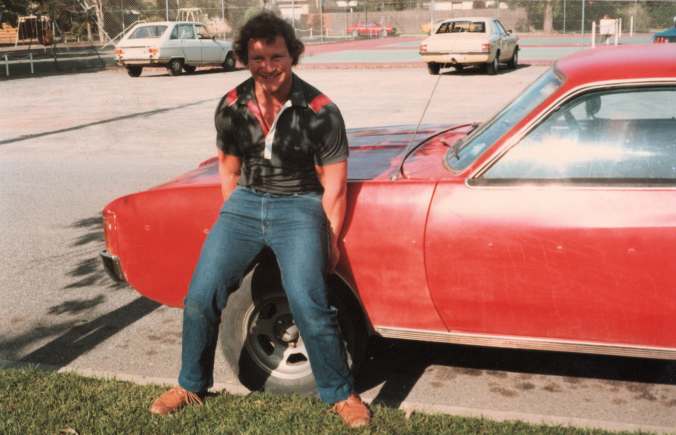
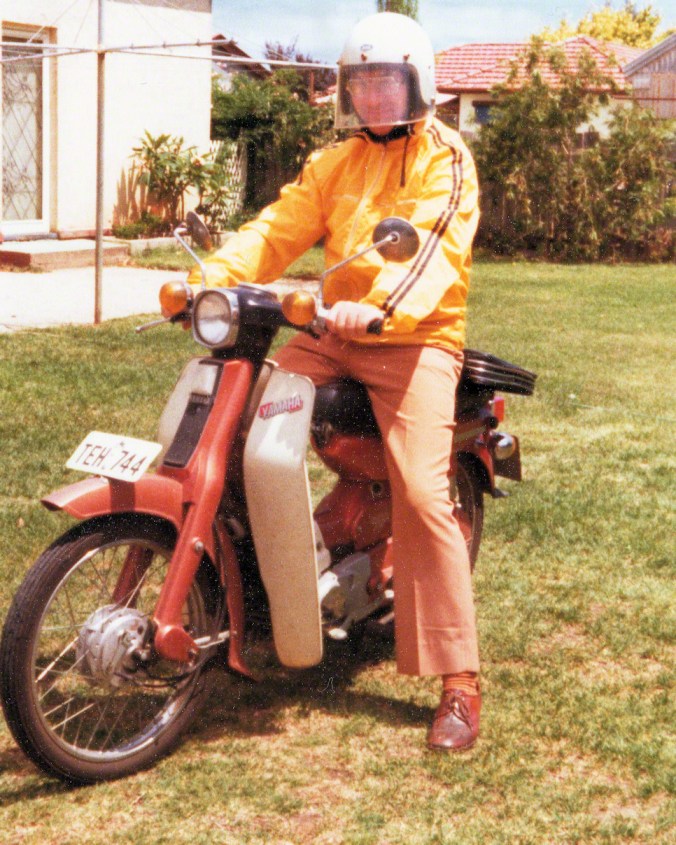
On that note, Dad’s midlife crisis vehicles keep rolling in. This time, “Putt-Putt”, the motorbike. Was this new development a reflection of the direction Dad’s midlife crisis was taking? Or was he just having a go?
So, here goes with the 100-word challenge.
Putt-Putt Pa
After lunch at Grandma’s one Sunday, my cousin showed off his prized Ducati. Inspired, Dad resolved to have a go and buy his own motorbike.
The first hint Dad was dissatisfied with his current transport arrangements was expressed in a story game, where he described the money-saving qualities of a motorbike. I pointed out dangers. My cousin’s friend had died in a motorbike accident.
Soon after, Dad came puttering down the driveway on Putt-Putt, a bright orange motorbike. From then on, for a time, Dad puttered from Somerton to work in Port Adelaide. Everyone was happy, until … the accident.
For this season, I thought I’d take some time out from cleaning and preparing for the big family gathering with my hubby’s family and reminisce about my Christmas Day fifty years ago.
I will write as written, spelling mistakes, grammar, and rather uninspiring prose, and all. My excuse, according to my diary, I wrote just before bedtime, and my mother would be coming in, hassling me to get to sleep. So, no time for perfect editing. Besides, I was notoriously a bad speller back then. So glad to have spell check on the computer these days.
From my diary entry, Christmas Thursday, 25 December 1975 (Spooky, this year Christmas fell on a Thursday):
Today Kiah and Alinta and Heidi, Peter and the other Jeshkes came to Adelaide. After going to church, I went to see Kiah and Alinta and Heidi. For dinner I ate at Grandma’s. After playing with Peter, Michael and Rich and that, I went home to get changed.
On the way home a car with a bunch of boys in it went past and one of them I think, whistled at me (or some phrase I can’t decipher). He noticed me.
Went to the Rozler’s House to celebrate Christmas.
Received Aquirilic paints, Das, Pink Annual, hankys, films, L necklace, Record Tuned On, Book.
Unpacking
This day was a significant day in the lives and times of the Gross family. All the descendants of my grandma and grandpa (Sam and Elsa Gross) gathered in Adelaide at our church’s Warradale rental homes to celebrate Christmas.
As a girl of 12, most important to me were catching up with my cousins. Lunch at Grandma’s was a weekly Sunday tradition. And it appears I joined in after the Christmas service to have lunch at Grandma’s with the cousins. Grandma, the queen of hospitality, accommodated us all; the table in the small trust home kitchen-dining room would be crammed full of people and we learnt to keep our “wings” tucked in whilst eating. Grandma could never quite master the skill and flapped her elbows about as she ate, knocking me as I attempted to guide my fork to my mouth.
Then, if there were too many guests, the children were relegated to the “kinder tisch” (kid’s table) out in the back garden if the weather was fine, or in the passageway, if not. This day, I recall being in the backyard with my younger cousins, Kiah and Alinta D, and Heidi J.
Christmas dinner, as mentioned, was at what was the recently vacated Roesler’s home. Our church, who owned the property, had kindly loaned us the house in which to spread. And spread the Gross family did.
We girls enjoyed running about, doing acrobatics and cartwheels on the front lawn while the adults loaded up their plates from the potluck buffet. Then, after our feed, the tradition, French Cricket, which is a variation of cricket, where our own legs are the “stumps,” and there are no wickets or runs to score.
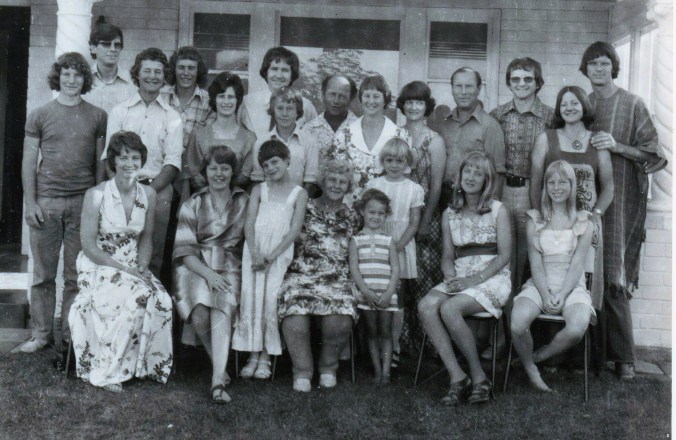
Finally, the evening progressed to photos of each family culminating in a big (Gross) family photo with me looking rather awkward, or should I say, inelegant. Comments like “you can see right up Rundle Street” haunted me for decades to come.
Then, once the sun had set and Christmas carolling done, came the opening of the Christmas presents. One by one, we unwrapped our pile of gifts and dutifully thanked each giver. Each person, from youngest to oldest, had to wait their turn. The gift unwrapping went on for hours.
Anyway, that’s all in the past now, just as Christmas is. Hope you all had a good one.
The highway, so straight, never curving to the right nor the left, was hypnotic. Again, in the late afternoon, the burning sun on the back of my neck, now sinking in the West, and the rushing of air from the open window, lulled me into a state of semi-sleep.
By increments, as sunset turned to dusk, the air cooled. I trusted Rick to keep us safe on the highway to Sydney. I noted Cordelia resting her head on Mitch’s shoulder, and then I sank into a deep, satisfying sleep.
The car slowed to a stop by the side of the road, again. Groggy from sleep and the hypnotic effect of the endless highway, we piled out of the Charger and milled around the non-functioning headlights.
Mitch peered at the offending lights. ‘Are you able to fix them, Rick?’
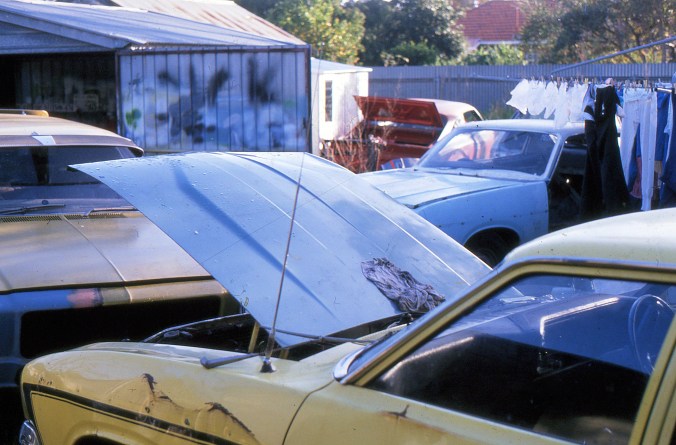
Rick pulled up the hood and, in the dim light, examined the engine. He poked around in the dark nether regions of the Charger’s insides.
Mitch hovered over Rick’s back while he prodded and poked at the parts in the dimness. ‘Do you need a torch?’
‘Do you have one, Mitch?’
Mitch shrugged. ‘I don’t…didn’t think…would you have one in the glove box?’
‘Might have, but the battery’s gone flat,’ all mumbled to the engine.
Mitch had already left to torch-hunt in the Charger’s glove box. At this time, I watched Jack busy himself sorting through luggage at the rear of the vehicle.
Cordelia sat all hunched over on her duffel bag. ‘I still don’t feel well,’ she said.
‘Are you carsick?’ I asked.
‘No, it’s worse than that,’ she answered. ‘I think I need to see a doctor.’
I gazed around the silent, darkened landscape. ‘Maybe at the next town, we can try to find one.’
Jack called, ‘Hey, I’ve found another torch.’
The feeble light of Rick’s torch wandered over the car engine.
‘It’s the alternator, it’s cactus. Needs replacing,’ Rick said. ‘We’ll need to park here for the night, and in the morning, I’ll fix it at the next town.’
Cordelia, clutching her stomach, walked up to the lads. ‘I need to see a doctor; I’m not feeling at all well.’
Mitch glanced at the girl, his eyes wide and brow furrowed. ‘Perhaps we’d better push on and find a doctor—hospital—something.’
‘How can we?’ Jack said. ‘We have no headlights. It’d be dangerous.’
‘I’m not driving without headlights,’ Rick said.
‘How far to the nearest town?’ Mitch raised his voice. ‘The girl needs help.’
‘Yeah,’ I said. ‘How far is it to Dubbo?’
Mitch grabbed the RAA strip map, Jack handed him the torch, and with the stronger light, Mitch flipped the pages and then studied the relevant page.
At Mitch’s insistence to save this damsel in distress, we piled back in the car and crawled down the highway, torches flashing back and forth from the rear windows.
After a few minutes, Rick shook his head, his curls flopping about his damp forehead. ‘It’s not working.’
‘What about,’ Mitch sighed, ‘what about, if I sit in the front and you and I shine the torches from the front.’
‘If you think it’ll make a difference,’ Rick muttered.
Mitch changed places with Rick, who was driving, and Rick moved into the front passenger seat where Jack had been sitting. Jack then bumped Cordelia into the middle and sat behind Mitch.
The car crawled a few metres with Rick and Mitch waving torches from their front positions.
I looked behind me at the expanse of the dark landscape, and the sky was filled with the Milky Way.
‘I hope the cops don’t catch us,’ I murmured.
‘What cops?’ Jack said.
The Charger slowed and then stopped.
‘It’s not working,’ Rick said.
‘But we’ve hardly moved,’ Mitch said.
‘I think it’ll be better if we don’t use the torches and I drive by the starlight.’ Rick sniffed. ‘I think my eyes will adjust. And we’ll take it slowly.’
‘I can do that,’ Mitch said.
‘No, I’ll drive.’ Rick pushed open his door and marched over to the driver’s side. ‘It’s my car. I know how to handle it.’
Mitch breathed in and out with an emphasised sigh. ‘If you insist.’
Rick forged ahead on the highway to Dubbo at a leisurely twenty miles an hour. I know it was twenty miles (not kilometres) an hour as it took us an hour to reach the outskirts of Dubbo. Mitch couldn’t resist the urge to hang his arm out with Jack’s torch, offering slim beams of light to guide Rick as he drove. Fortunately, we met no police on patrol.






 Tru-Kling Creations