[In 2013, the T-Team, next generation, embarked on their pilgrimage to Central Australia. Purpose: to scatter Dad’s ashes in his beloved Central Australia, in Ormiston Gorge.
Over the next few weeks, I will take you on a virtual trip to the Centre and memories of that unforgettable holiday in 2013, with my brother and his family, the T-Team Next Generation.
This time, the T-K Team visits Emily Gap.]
Lunch With the Ants
Our plans changed. Hubby decided we could take a risk with our fuel situation, so since we were in the vicinity of the Eastern MacDonnell Ranges, we visited Emily Gap and had lunch before refuelling the Ford.
‘After all,’ I said to Hubby, ‘it is almost two o’clock, and I’m hungry.’
He just had to reply, ‘Hungry? Unlike you, I can wait till teatime.’
‘Hmm, yet another similarity you have to my father. Only he could fast from breakfast as well as lunch.’
As we rolled into the shady climes of the Emily Gap car park, I remarked, ‘But such a lovely place to sit and have a picnic, don’t you think?’ I had already sourced some nuts and chocolate from my bag in case he disagreed with my suggestion.
‘We’ll go for a walk first to see the rock paintings and then have some lunch,’ Hubby grumbled. ‘I don’t want to walk on a full stomach.’
While Hubby marched ahead to find the rock paintings before they disappeared, I trailed behind and nibbled my nuts and chocolate. Needed reinforcements to do the walk.
Hubby vanished around a corner. A few minutes later, he appeared, jogging towards me. ‘They’re here! Come, look!’
‘Oh, yeah,’ I replied, remembering 1981 when TR baited us with some significant discovery of Indigenous art. That art turned out to be less ancient and more modern.
I followed Hubby. Around the bend, he pointed. ‘Look! There they are.’
Gazing at the entrance to a shallow cave, I said, ‘Oh, yeah! So, there are. They look like giant caterpillars.’
We spent some time examining the array of caterpillar paintings and carvings; the totem of the Easter Aranda people, we assumed.
‘I think my dad took us to Jesse Gap,’ I said as we walked back to the picnic area. ‘I’ve never seen those paintings before. When he took us out to the Eastern MacDonnell’s, all we saw was artwork of the Western kind, graffiti. When we suggested visiting Emily Gap, it was already nearly dark, and Dad thought there would only be graffiti there too. After all, we had just been to the Devil’s Marbles, after sunset, so it was getting too dark to see anything at that time.’
In the shade of the gum trees in the picnic area, we “shared” our lunch of canned tuna and buttered bread with some inch ants. Had to put our food on a rock and then move the picnic rug, but the inch ants followed us.
After lunch, we found the BP petrol station that my brother had told us about. And finally, the Ford had its fill of LP Gas. Then, on our way back to the Caravan park where we were staying for the night, we swung by the local IGA. There I bought mince, button mushrooms, two onions, shampoo and conditioner. Would you believe that the shampoo and conditioner I had brought from home had not lasted the distance of our two-week Central Australian journey?
In the golden light of late afternoon, while I helped Anthony put up the tent, I watched another family pitch theirs. The father sat in his director’s chair and directed the rest of the family, the women and children, on how to put up their tent.
But, ah, what bliss to cook tea in the light of the common kitchen. Spag Bog, and plum pudding. Dessert, hot chocolate.
[In 2013, the T-Team, next generation embarked on their pilgrimage to Central Australia. Purpose: to scatter Dad’s ashes in his beloved Central Australia, in Ormiston Gorge.
Over the next few weeks, I will take you on a virtual trip to the Centre and memories of that unforgettable holiday in 2013, with my brother and his family; the T-Team Next Generation.
This time, the T-Team go their separate ways…]
Monday Morning
After a fitful sleep and then early rise, I looked forward to coffee with mum and the boys. With the sun peeping over the horizon, shining in the watery blue winter sky and reflecting golden on the gum trees surrounding the campground, the frigid desert air slowly began to thaw.
First, though, after a warming shower and filling breakfast, the tent had to be packed up. Hubby needed my help with that. Then, he spent an eternity repacking the station wagon. While waiting, I jogged on the spot and puffed out steam of my breath into the below ten-degrees air.
As if a surgeon performing a delicate operation, he punctuated his packing with commands. ‘Bags!’ So, I passed over the bags which he grabbed and pushed into the boot of the car. Then, ‘Tent!’ I hauled over the packed tent to him. Then, ‘Esky!’ I lugged the cool box (esky) to him. Then, waving his hand while head stuck in the boot of the car, ‘Box!’
‘What box?’ I asked.
‘Kitchen box!’
‘Huh?’ I glanced at the piles of stuff still waiting a home in the Ford. Finding the green crate with breakfast cereals, bread and cans of beans, I passed that one to him.
‘No! No! No!’ he snapped and pointed at the red crate, same size but with cooking utensils. ‘That box!’
Apparently, the green crate must go under the back seat with a blanket covering it.
Finally, with Hubby’s version of luggage-tetris complete, we drove the short distance in the caravan park to mum’s cabin.
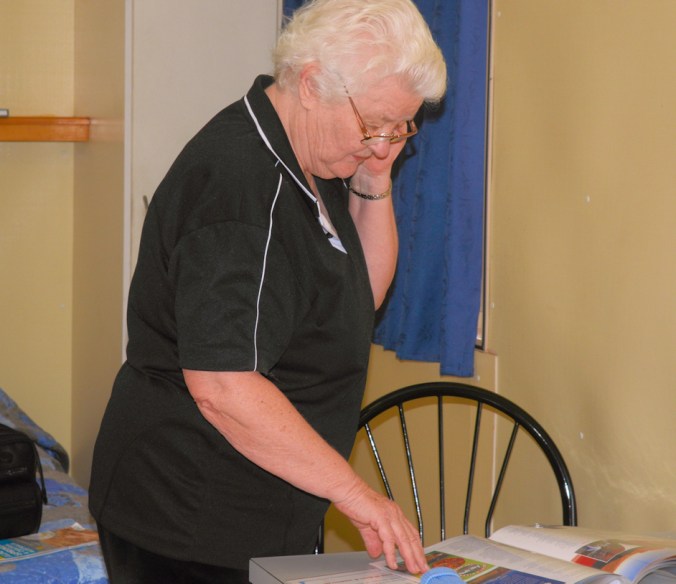
Again, we found Mum T glued to the phone. On the small pine table, she had spread out a brochure opened to camel farms. In between phone calls she muttered, ‘Mrs. T has asked me to find a camel farm for them to visit.’ She was not having much luck finding a camel farm or someone from the camel farms advertised, to answer her calls.
While Mum T remained occupied with the phone, Hubby and I popped next door to visit our boys. The first words out of their Dad’s mouth when he entered was, ‘Have you packed?’
Son 1 and 2 duly showed Dad their packed luggage waiting by the door.
Satisfied that the lads were ready to depart Alice Springs and not miss the flight, we sat down to enjoy a coffee with them.
Mum joined us. ‘Oh, by the way,’ she said over her much-needed coffee to wake up, ‘the park manager came over. They were most apologetic about the mix up yesterday. Apparently, whoever took my booking assumed the people were T’s, because when they asked them, the lady didn’t hear clearly and just nodded and said “Yes”.’
‘You mean the guy behind the counter assumed the lady was you?’ I asked to clarify.
‘Apparently, the guy asked the lady, ‘Are you Mrs. T?’ and she said, ‘Yes.’’
We shook our heads.
‘Maybe the lady who took our cabin had a hearing problem,’ I said.
‘Oh, well, it all worked out in the end,’ Mum T concluded.
After visiting the Strehlow Centre and its Art Gallery again, we travelled to the airport to see our sons safely, and in time, board the plane back to Adelaide. Then a brief stop at Woolworths for Hubby to buy some shorts, before commencing our return to Hermannsburg.
[In 2013, the T-Team, next generation embarked on their pilgrimage to Central Australia. Purpose: to scatter Dad’s ashes in his beloved Central Australia, in Ormiston Gorge.
Over the next few months, once a month, I will take you on a virtual trip to the Centre and memories of that unforgettable holiday in 2013, with my brother and his family; the T-Team Next Generation.
This time, the T-Team leave camping in the desert behind and tackle the complexities of civilisation—Alice Springs … All on a Sunday.]
Must Register
By the time our family and Mum drove the streets of Alice Springs in search of a hotel to eat, night had fallen, and a blanket of darkness surrounded us. As a convoy of Mum’s rental and the Ford, we wended through the few short streets to the nearby hotel which had been recommended by the caravan park.
Our family of five filtered through the front entrance and into an expanse of dark green carpet and pastel green walls and fronted up to the black topped counter.
‘Do you have a table for five?’ Mum T asked.
‘You need to register,’ the man at the counter said.
Anthony and I glanced at each other. ‘Register?’
‘We need to see your identification; a drivers’ licence will be okay.’
‘That’s normal for me,’ Son 1 said, ‘They always ask for my ID. They don’t believe I’m over 18.’
Son 2 snorted, ‘And here I was getting into hotels when I was under 18, no problem.’
While the boys quibbled and joked, the T-K Team, good citizens that we were, unquestioningly showed our respective licences and registered to enter the hotel.
As we sat at our designated table, we observed the predominance of people of Anglo-Saxon extraction and the lack of First Nation people. There was one Indigenous family way down the other end of the dining hall, but… They seemed happy enough.
Over dinner, roast meat, and smorgasbord, (your average fare for an Aussie hotel at that time), I mused, ‘What’s the deal with registering?’
Anthony waved a hand around the room. ‘Isn’t it obvious? Didn’t you read the sign at the entrance?’
‘What sign?’
Anthony rolled his eyes and shook his head.
Then again, I understood, without further explanation, what my husband meant.
Back at the campsite, I used the communal kitchen to prepare a hot chocolate for Anthony and me. While the kettle took its time boiling, I watched a pair of German tourists and their Australian friends Skyping on a laptop to Germany.
Then, soporific from the effects of warm chocolaty milk, hubby and I snuggled into our sleeping bags and it was lights out for us…only, it wasn’t that much light out—we still had the toilet block light beaming into our tent…all night. And on our minds wondering who were the T-Team imposters?
[Remembering my dad, Clement David Trudinger 13-1-1928—26-8-2012
Extract from Trekking with the T-Team: Central Australian Safari 1981]
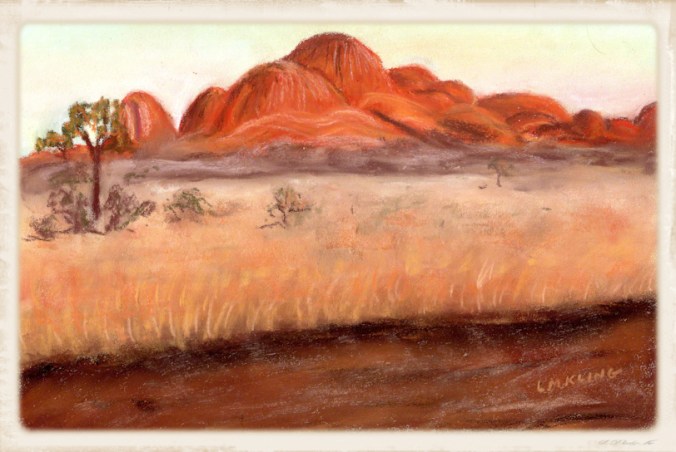
Way before the sun had even thought about rising, we gulped down our porridge and then set off for the Eastern Side of Kata Tjuta. Dad was on a mission to capture the prehistoric boulders at sunrise. We arrived at the vantage point just as the sun spread out its first tentative rays, touching the spiky tips of spinifex and crowning the bald domes with a crimson hue as if they’d been sunburnt.
I dashed a hundred metres down the track to photograph the “Kangaroo Head” basking in the sun. We stood in awe as the glow of red on the rocks deepened.
Every few minutes Dad exclaimed, ‘Ah, well, that’s it, that’s as good as it’s going to get.’ He packed the camera away, only to remark, ‘Oh, it’s getting better,’ then retrieve the camera from the bag and snap Kata Tjuta flushed with a deeper, more stunning shade of red. The rest of the T-Team, waited, took a few shots, waited, mesmerised by the conglomerate mounds of beauty, before taking more snaps of the landscape.
[Twelve years ago, the T-Team, next generation embarked on their pilgrimage to Central Australia. Purpose: to scatter Dad’s ashes in his beloved Central Australia, in Ormiston Gorge.
Over the next few months, I will take you on a virtual trip to the Centre and memories of that unforgettable holiday in 2013, with my brother and his family; the T-Team Next Generation.
This time, the T-Team farewell Glen Helen, then struggle with the concept of driving in convoy.]
Hermannsburg
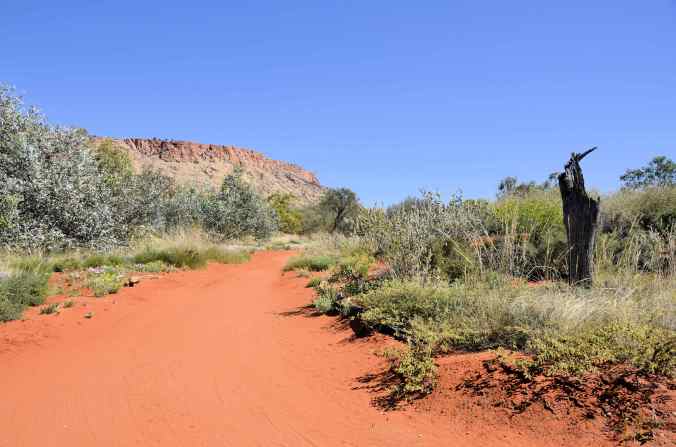
Midday, and Mt. Hermannsburg rose up above the desert scrub; just red sand dotted with tee tree bushes, spinifex and the invasive buffel grass. At regular intervals, horse poo appeared in high piles on the roadside.
I read later that buffel grass was introduced to stablise the desert soil and reduce the risk of bushfire. The problem with this grass is that it is pervasive, compromising the growth of native plant species. PIRSA (Primary Industries and Regions, South Australia) has declared “Buffel Grass under the Landscape South Australia Act 2019”.
A massive animal carcass on the side of the road flitted past.
‘What’s that?’ I pointed, then placed my hand back on the steering wheel. ‘It’s too big to be a roo and too woolly to be a brumby.’
Son 2 piped up. ‘Camel?’
‘Hmmm, hate to think what happened to the vehicle that struck that camel,’ I said.
Not long after the camel carcass, we passed the memorial to Hermannsburg Mission and then a sign welcoming us to Ntaria—Hermannsburg. To our left, a supermarket, a pale brick structure languishing on the edge of a paddock near the road.
‘That’s where our friend, P, from church works,’ I announced. Our friends, P and wife, K had invited us to stay with them in Hermannsburg.
The convoy came to stop on the gravel road edge by the store.
I hopped out of the car and entered the store. Searching for P, I wandered up and down the aisles, filled with the owners of the Land, the Arunda people, but shelves empty of anything to buy. Except for the pie warmer, choc-full of pies, chips and other fast foods.
I approached the check out where an Indigenous lady served a long line of customers, who each held pies, chips, hot dogs, and burgers. I stood in line and waited my turn to purchase an answer to my question.
Finally, my turn. ‘Could you tell me where I can find P?’
The checkout lady stared past me.
‘P? I thought he worked in the supermarket,’ I said.
I waited about 10 minutes while she served a stream of customers purchasing their pies and other junk food.
So, I left.
‘Perhaps we’ll find an answer or P at the Historic Precinct,’ Mum said.
The T-Team convoy led by Mum’s hire car, then continued through Hermannsburg to the Historic Precinct. We passed a gated community. Yes, you heard right, a gated community. Houses painted in bright pastel green, yellow and pink, could be viewed through the cyclone fence, and their occupants sitting in backyards of red sand.
Further on, we rolled past another store. This one painted in pastel blue and decorated with a mural of native bush, mountains, and a kangaroo. Near a broken window, a faded sign, stating its identity as the “Finke River Mission” Store.
Mum waved a hand in the store’s direction. ‘I reckon P works here.’
The door appeared locked by a security gate of thick metal bars. Without stopping, or alighting from the car, I said, ‘I think it is closed on Sunday.’
A few metres on, we parked just outside the Historic Precinct. The wooden gate leading to the old buildings swung in the breeze, open. To one side, though, a formidable sign discouraged us with the words in black letters, “Closed”. Despite this sign and its statement, people wandered across the compound and in and out the buildings.
[In 2013, the T-Team, next generation embarked on their pilgrimage to Central Australia. Purpose: to scatter Dad’s ashes in his beloved Central Australia, in Ormiston Gorge. Over the next few months, I will take you on a virtual trip to the Centre and memories of that unforgettable holiday, with my brother and his family; the T-Team Next Generation. This time, the T-Team gather and multiply as we greet our adult sons and our mother (Mum T also known as Mrs T senior) for the day, and the expanded T-Team of us set off to camp at Glen Helen.]
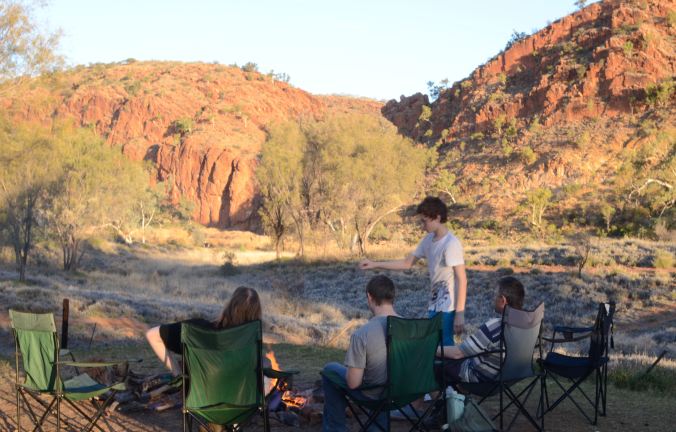
The T-children wanted a campfire. My brother had promised them a campfire. But bushfires in the past year had made campfires, even in the middle of winter in the middle of Australia, almost extinct. On our trip up north this time, each camping ground up until Glen Helen, had restricted fires, and denied the children the pleasure of a campfire. That’s not to say the T-Team Next Generation missed out entirely of some sort of fire to cook our food. We did spend one night in one of those free parking “camps” 30 kilometres south of Marla where we attempted to make a campfire. However, the area was so well picked over for firewood, the few sticks we did scrounge together barely made enough flames to boil a billy. So, no satisfaction regarding campfires. That is, until Glen Helen.
Even far out in the bush, the Glen Helen camping grounds had strict conditions and regulations controlling the operation of campfires. In the Glen Helen camping grounds, there was a designated place for the fire, and we had to provide our own wood. Again, dead wood around the immediate camping site was scarce.
So as the sun sank towards the Western horizon, golden rays blessing the cliffs in hues of pink and scarlet, and the humps of spinifex glowing like lumps of gold, my son and I set out in Mum’s Ford station wagon, down the road in search of a creek offering dead branches for firewood.
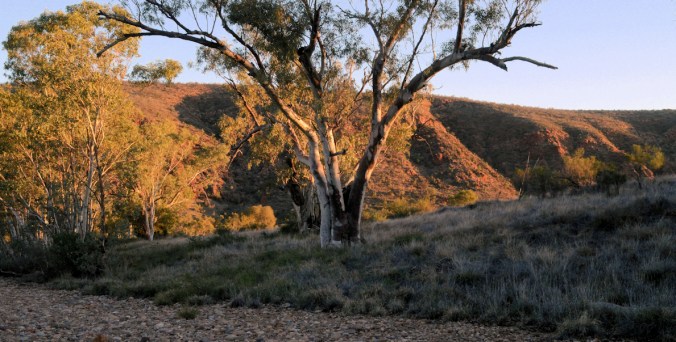
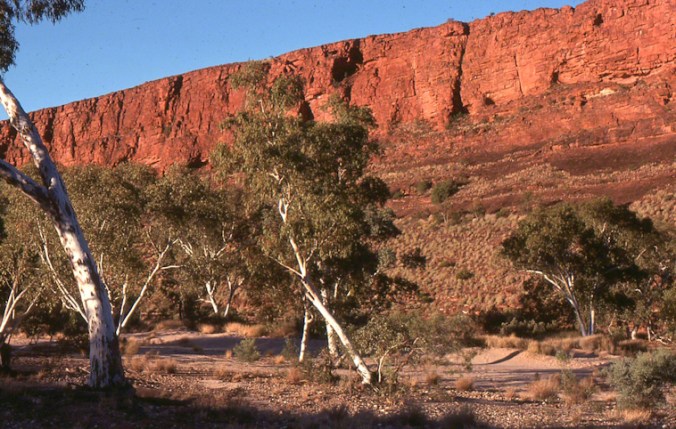
As the setting sun deepened the walls of the gorge into hues of crimson, I hobbled down the dry creek filled with smooth rounded river stones. Hard to imagine the creek gushing with water in flood, rushing over those stones, smoothing them to the size and consistency of bocci balls threatening to twist my ankles.
With my camera, a constant companion and permanent fixture hanging from my neck, my focus was not only on dry sticks and logs, but on the scenery. While my son snapped off armfuls of tinder from uprooted river gums that had become casualties of former flooding, I collected snapshots in time of the setting sun, blood-red cliffs, ancient eucalypts towering above the banks and the dry river-bed of stones. Night stole the thin grey-blue light of dusk. With the station wagon stacked full of wood for the fire, and my camera’s memory card full of brilliant photos for my art, we returned to camp.
What joy the T-Team Next Generation family had. Well, apart from their schnitzels that had gone off. Thankfully, we were able to share the extra and expensive lamb chops we had bought the day before at the supermarket. We gathered around the fire. The fire that cooked our dinner, then warmed us and the conversation late into the cloud-free night frozen with a sky packed full of stars.
In the past, a fire would burn slowly all night, keeping animals away from camp. The rules of the camping ground forbade that strategy. Conscious that the local fauna may come foraging, my husband packed away all the foodstuffs and loose items back in Mum T’s station wagon.
Some of the T-Lings were not so concerned about the threat of such animals. During the night, though, a half-full cereal packet would prove fair game for a roving dingo.
So, stories told, marshmallows burnt and eaten, most of the T-Team Next Gen retreated to their tents and snuggled into their sleeping bags. Mum T had gone to her cabin way before the rest of us. She hoped to rise early, with my help, to catch the sunrise on Mt. Sonder.
My brother and his son stayed chatting around the campfire. A dingo howled. Freaky. An eerie haunting cry. My nephew was sure he’d come face-to-face with the dingo when he’d taken a trip to the toilets. I left my brother and his son to their conversation around the fire and with the responsibility of waking mum before dawn, I headed to the tent to join my husband and sleep.
[Day 2 of the T-Team Next Gen’s pilgrimage to Central Australia to scatter Dad’s ashes…]
Mambray Creek greeted us with a picture-perfect morning; a morning that, in years to come, we could boast about to the T-Team who missed it in all its delicate beauty. Kookaburras announced the sunrise with their manic laughter. Parrots chattered in the trees. The air was calm, but not too cold. And the shower in the stone toilet block was warm and refreshing. I wondered where the MB (My Brother) component of the T-Team had camped. If they had camped. And if they’d enjoyed a warm shower in the morning.
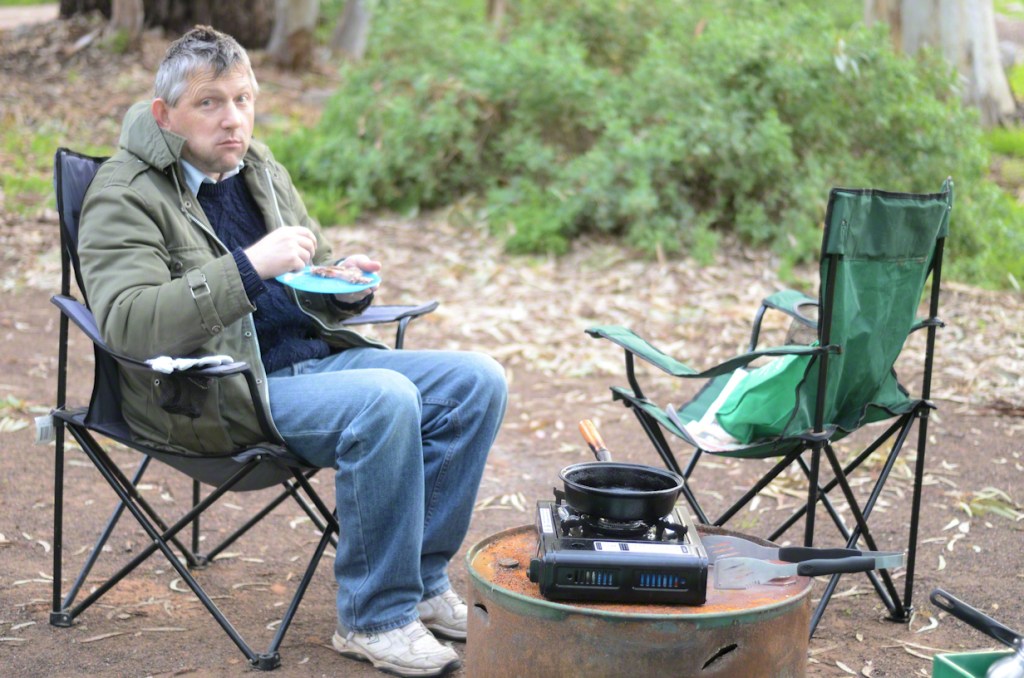
When I returned from my shower, Hubby was busy sizzling chops on the portable butane gas cooker. The aroma drew me in and soon I enjoyed lamb chop sandwich for breakfast.
On the way, we stopped in at Port Augusta where we bought those inevitable forgotten items such as a wooden board and soap. Now, if I hadn’t had a shower that morning…and if Hubby hadn’t cooked breakfast…
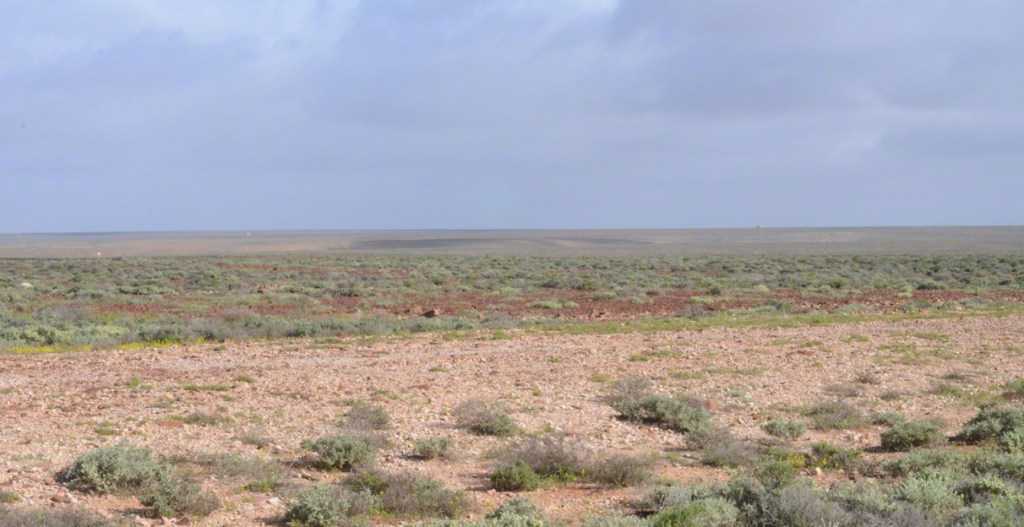
We then commenced the journey on the Stuart Highway, flat, straight, gibber plains each side and the white dividing line disappearing into the distance. Hubby was happy to tackle this new kind of boring.
Hubby’s phone tingled breaking the monotony at 11am. My niece informed us that the T-Team had already reached Coober Pedy.
‘They must’ve driven most of the night,’ Hubby remarked.
I had visions of MB and co not sleeping until they were on the outskirts of Coober Pedy.
As the phone reception was seriously patchy, the bare amount of information was exchanged. Arrangements were made to meet at the monument when we arrived. They would be spending the day at Coober Pedy, enjoying the sights and attractions of this mining town.
We continued our trek towards Coober Pedy, obeying the speed limit of 100km per hour. The Gibber Plains sparkled like silver. I took some photos of the gibber when we had a short break.
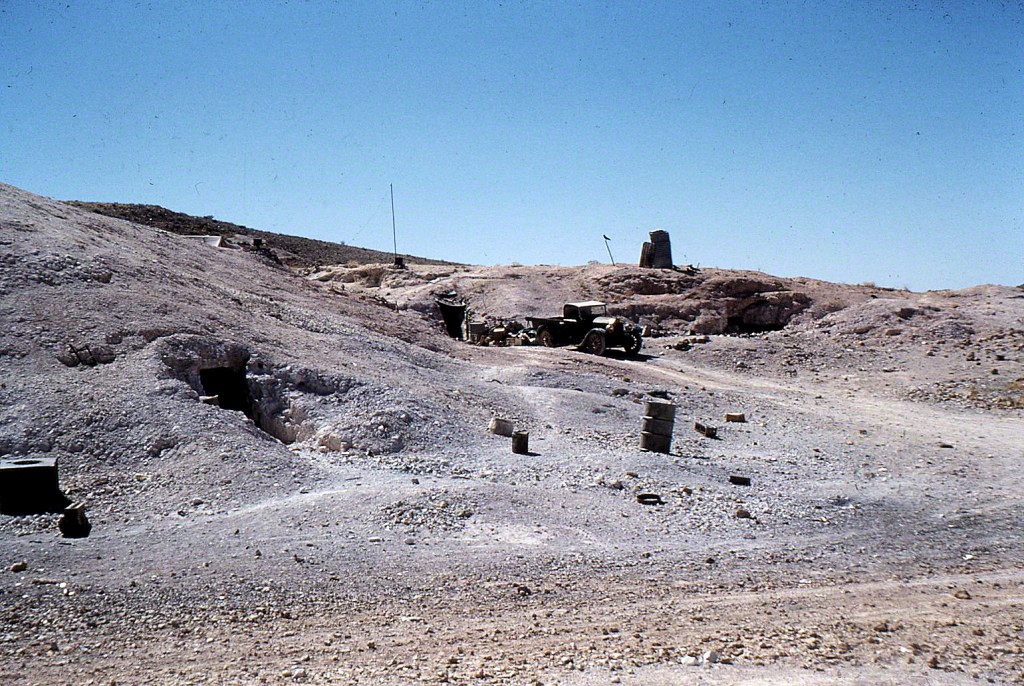
Six hours after the T-Team had called us, we arrived in Coober Pedy. In an effort to find the agreed monument, we took a scenic tour of Coober Pedy and its grid of streets. No Monument. No T-Team.
‘What does this monument look like?’ Hubby asked.
I shrugged. ‘Like a monument.’ I had a vague recollection from my youth and the T-Team’s trek with Mr. B in 1977. MB and I had our photos taken by this so-called monument, or on this monument. But finding something that resembled the fuzzy memory in my mind? Nup, not today.
I rang my niece. ‘Where are you?’
‘We’re at the playground with the giant tyres,’ she replied. ‘You can’t miss it. It’s the first thing you see when you enter Coober Pedy.’
‘We’re having a barbeque!’ Mrs. T yelled.
‘Where are they?’ Hubby asked.
‘The playground near the entry of Coober Pedy,’ I said, ‘We must’ve driven right past them.’
‘How could you miss them?’ Hubby snapped. ‘Are you blind?’
‘Must’ve been in a parallel universe,’ I muttered. Sure, there was no one there when we drove into the town.
Hubby wound his way through the straight streets to the playground with the tyres. He glanced at the giant tyre structure. ‘Did you mean this monument?’
‘I don’t know, but obviously the MB did.’ I pointed. ‘There they are.’
MB was fiddling with the barbeque hotplates while Mrs. T stood behind him with a packet of sausages. The T-ling girls played on the swings, while the boy sat in the van, eyes glued to his iPad. A sign near the picnic area warned that the barbeque was only to be used during daylight. The sun hovered just above the horizon.
Over sizzling sausages, Mrs. T apologised for deserting us. But she just wanted to reach Coober Pedy and spend the day there. We had planned to explore Coober Pedy on our way back, after spending a night camping there. However, Mrs. T had a sense that plans at the end of the trip may not work out and wanted to get Coober Pedy in on the way up to Central Australia.
‘We parked in some parking bay, just outside of the town,’ MB said.
‘It was terrible!’ the younger niece said. ‘We were all cramped in the van, and we got no sleep at all.’
‘Mum kept kicking me in the head,’ my nephew cried.
‘You were snoring!’ Mrs. T bit back.
‘No, I wasn’t. You were!’ Nephew laughed. ‘I was just imitating you.’
‘Yeah, the kids were pretty cranky that we didn’t stay at Mambray Creek,’ MB whispered to me.
‘Yeah, but, who wanted to have KFC at Port Augusta? Hmm?’ Mrs. T didn’t miss a trick. ‘I wasn’t going to go backwards once we had takeaway and had gone as far as Port Augusta.’
In darkness we drove endless kilometres to some elusive free parking bay. Mrs. T’s dream was to sleep under the stars, just as the T-Team in 1981 had done. In the pitch blackness of night, about 9 – 10pm, we settled in a spare patch in an already crowded free parking area.
On the unforgiving stony surface, MB and wife constructed their questionable number of star accommodation of raised camp bed, piles of doonas topped with a tarpaulin. A little distance from them, actually, right next door, Hubby and I arranged our bedding on that rocky ground covered by tarpaulin then blow-up mattress. We had no camp bed, but we had our minus five sleeping bags in which to wrap ourselves. We also covered our swaddled selves with another tarpaulin. Hubby grumbled about this, but he had no choice; the ground was too hard to hammer tent pins in.
Christmas Holidays are approaching. For me it’s been party time this week. One party after another, especially yesterday with three parties, all in one day. I’m hoping that once the rush and busyness is over, I can rest, relax and start planning our next holiday. Perhaps it’s the same for you.
In the meantime, here’s a revisit to Central Australia and the T-Team. This time when my brother and I became lost on our descent from Mt. Giles.
So, if you’ve read my books and would like to give a review on any of them, please feel free to share in the comments section of my blog.
I am pleased to share a review from one of my followers, Lynne on The T-Team with Mr. Bwho writes:
“An excellent memoir that takes the reader to some of the most beautiful and remote areas of the Northern Territory. Fourteen-year-old Lee-Anne, a budding artist and writer describes the colours, sights and people with fresh eyes. Uluru, the Olgas and Hermannsburg are covered but it’s the exploration of Haast’s Bluff, Talipata Gorge and Mount Liebig, places off the popular tourist trail that make this book exceptional. All are brought alive by wonderful prose and authentic pictures in the book. Her descriptions of characters and situations provides humour and interest. A must for people who intend to visit the Red Centre.”
To whet your appetite, here is an episode from the book where Mr. B and Dad have a disagreement about lunch…]
The T-Team with Mr. B–Episode 6
Fruitless Foray
Again, we raced at 50 miles per hour along the highway boldly going where too many trucks had gone before. The graded road was a sea of corrugations. As we travelled along the road at high speed, our Land Rover juddered over the sand waves. Dad was on a mission to reach Ernabella and not even corrugations on the unsurfaced road were going to get in his way.
We paused at Indulkana, an Indigenous settlement, where we topped up the tank with petrol from one of the Gerry cans.
‘Only fifty miles or so to go to Ernabella,’ replied Dad with a sniff. He could smell his Holy Grail, and he was bent on reaching his destination. ‘Pity, there’s a school here I’d’ve liked to visit. Ah, well!’
Mr. B spread out the map on the bonnet of the Rover. He adjusted his glasses on his nose and then pointed at Indulkana. ‘Are you sure it’s only fifty miles, David?’
Dad cleared his throat and then glanced at the map. ‘Er, um, I think so.’
‘It looks a damn lot further to me. Are you sure we’ll get there? I mean to say, it’s past one o’clock and we still have to have lunch.’
‘We’ll eat when we get there.’
‘Really?’ Mr. B gazed at the fibro houses scattered like abandoned blocks in the red landscape. ‘Damn! No place to shop in this shanty town.’
I gazed at the mirage shimmering, reflecting the khaki bushes on the horizon of ochre. This tiny Indigenous settlement seemed more heat-affected and miserable than Oodnadatta. A dingo skulked across the road in search of shade. The town seemed empty—except for the flies.
I swished several of the pests from my eyes and searched for a toilet block. We had stopped, so I considered it timely to make a comfort stop. ‘Where’s the loo?’ I asked.
‘I don’t know,’ Dad said.
As far as we could see, public toilets didn’t exist in Indulkana.
A kangaroo hopped through the spinifex. Rick grabbed his rifle and aimed.
‘Hoy!’ Dad said. ‘Stop! You can’t be shooting so close to the town.’
Rick lowered his gun.
‘I say,’ Mr. B said. ‘Why don’t we go down the road a bit. We can find a few accommodating bushes for our business and the boys can do a spot of shooting. Besides, we need a break and some lunch.’
Dad sighed. ‘Very well, then.’
We piled back into the Rover and trundled several miles down the road where some trees and bushes were clumped close to the road. We all made use of the improvised “bush” facilities. Then Dad pulled out the tucker box and made a simple lunch of peanut butter sandwiches.
‘Do you want to have a go shooting?’ Rick asked me.
‘Okay,’ I replied.
My brother handed me the .22 rifle and we walked into the scrub.
Dad called after us. ‘Shoot away from the Rover, we don’t want anyone getting hurt.’
‘What do I shoot?’ I asked Rick.
‘Rabbits. Kangaroos. Birds.’
I looked at the lemon-coloured grasses dotting the red sands. ‘Where are they?’
Rick shrugged.
Matt aimed his rifle at a stump of a mulga tree. A galah had settled there. But not for long. Matt pulled the trigger and at the sound of the bullet hitting the sand, the bird fluttered into the air.
Some white cockatoos decorated the skeleton of a dead tree. I aimed and pulled the trigger. ‘Bang!’ The butt hit my shoulder and knocked me to the ground. ‘Ouch!’ I cried.
The flock of parrots squawked and scattered.
‘I wasn’t expecting that to happen,’ I said rubbing my bottom.
Rick grabbed the rifle off me. ‘Watch where you point that thing.’
‘Oh, sorry.’
Rick and Matt stalked further into the scrub in search of more prey. I was glad my hunting time was over as it was not as much fun as I thought it would be. At least no one was hurt.
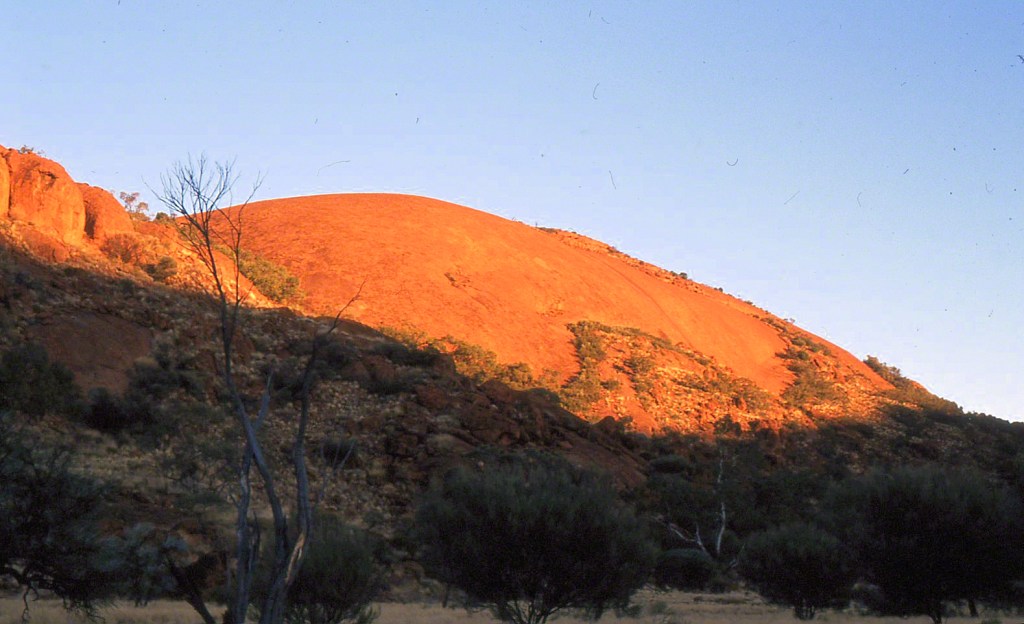
The break and the lads’ fruitless hunting foray caused the night to catch up with us. After a couple more hours of driving, we camped near Mimili. A hill close by served as adventure for us young ones in this otherwise flat desert. I climbed the small rise and explored, while the boys went shooting as usual. The hill was little more than an outcrop of rocks and I imagined, something of a smaller version of Uluru. From the top, I scanned the terrain. The setting sun’s rays caused the grasses in the plain to sparkle like gold glitter and a cool breeze hinted at the freezing night ahead. I climbed down from my vantage point and ambled back to camp. As darkness descended upon us and stars flooded the night sky, the boys returned empty-handed, except for their rifles.
While Dad stirred a billy can of stew, Mr. B warmed his idle hands by the fire, his mouth busy whining at the prospect of sleeping on a bed of stones.
Dad tapped the wooden spoon on the edge of the billy can and said, ‘We are camping in the desert, aboriginal style. What we do is make up one fire for cooking, and then have our individual fires.’
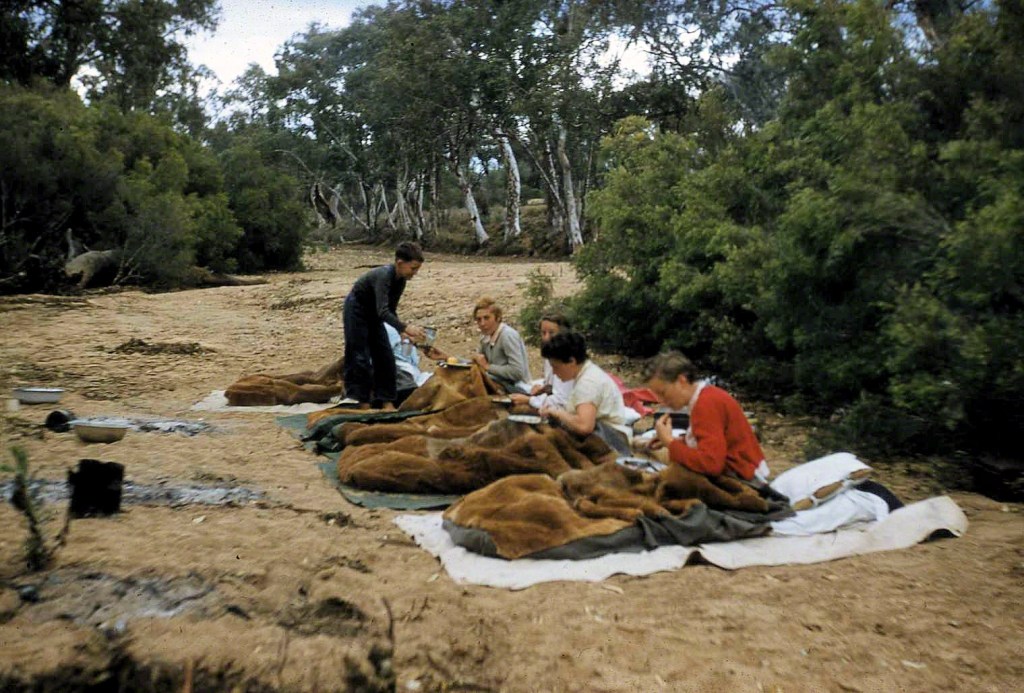
So, we did in the nights to follow. Although we all had blow-up mattresses and cotton sleeping bags, we still hunted for the softer ground, and prepared it for the bedding by clearing the area of rocks. Each of us would scout around for sticks and logs in preparation for our personal fires. By bedtime, our fires were crackling away, and we only woke from our slumber to poke the coals to keep the small flame going. Still, I slept fully clothed, as the clear nights were freezing.
But did this arrangement satisfy Mr. B? Apparently not. Every night he complained of his unsatisfactory sleeping arrangements. And his back, oh, the pain in his back. Oh, for a decent bed and a warm night’s sleep. And oh, the pain, oh, the discomfort! And then, just as he sank into a deep slumber, dawn broke with Dad clattering around the campsite preparing breakfast once again.
‘Why do we have to get up so early?’ Mr. B would ask each morning.
‘It’s my mission to get…somewhere,’ Dad would reply.
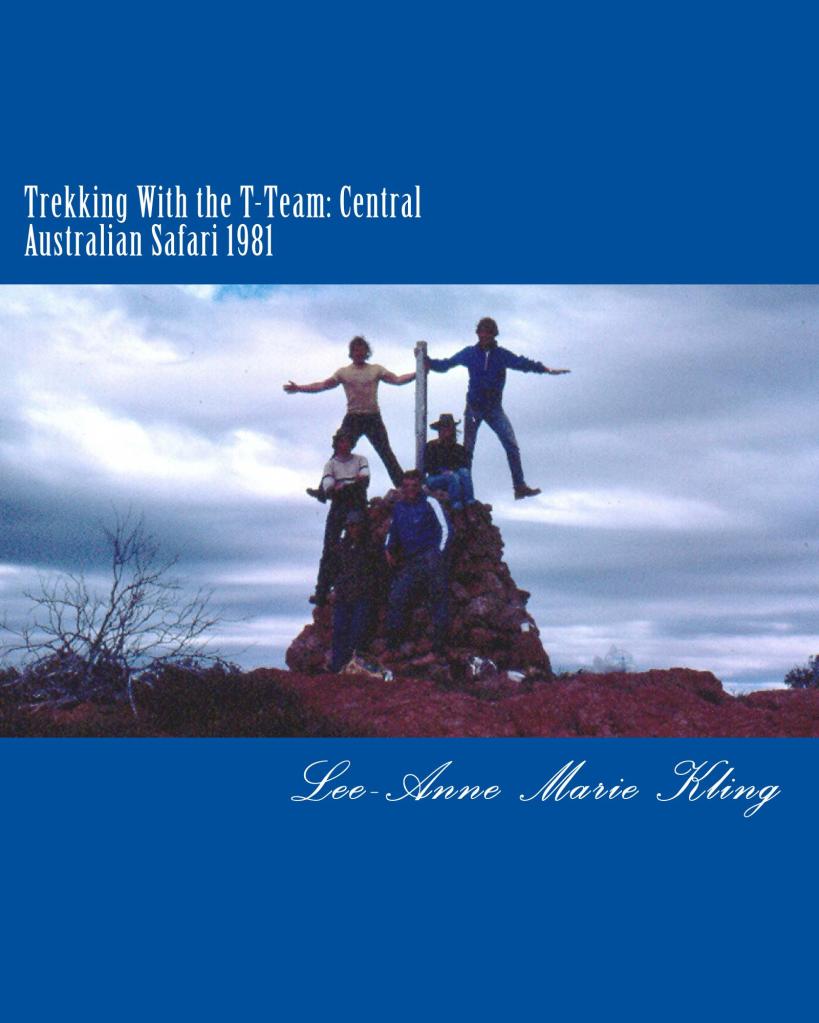
[The T-Team with Mr. B— Dad’s friend Mr. Banks and his son, Matt, joined Dad, my brother (Rick) and me on this journey of adventure. I guess Dad had some reservations how I would cope…But it soon became clear that the question was, how would Mr. B, a middle-aged man who was used to a life of luxury, cope?]
We stopped in at Fregon, another Indigenous settlement much like Mimili; a row of tin sheds and deserted. Then at about 2.30pm we arrived at Ernabella.
A teacher friend of Dad’s invited us into his home for refreshments and each of us had a hot shower. I enjoyed the warm cascade of water on me. My treat for the week. Below rivers of red mud spun into the drain hole of the bath. I scrubbed my hair with shampoo. The soap refused to lather. I scrubbed and scrubbed.
‘Lee-Anne!’ Dad called. ‘Don’t take all day, the boys need a wash too.’
‘Oh, alright.’ I turned off the tap. I guess the boys did need to wash, probably more than me. They were getting quite ripe at close quarters in the Rover. After all, it had almost been a week since we had a proper wash.
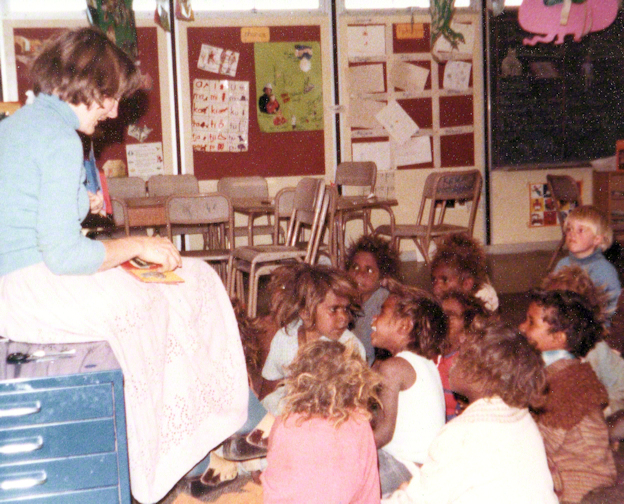
All showered and smelling sweet again with soap and deodorant, we trailed after Dad who gave us a tour of the settlement, including the school. Ernabella lies at the foot of the Musgrave Ranges, south of the South Australian and Northern Territory border. The land belongs to the Pitjantjara people. The mostly prefabricated buildings were neatly arranged around a random collection of unsealed roads.
Dad guided us around the school which appeared empty. We followed him circling the white building. ‘Must be closed,’ Dad said.
‘School holidays, I guess,’ I remarked.
Dad scanned the transportable blocks and then screwed up his nose. ‘We need to find someone to fix up the trailer.’
We walked through the settlement. The white buildings stood sentinel to the roads void of human activity and traffic. The crunching of stones under our feet was magnified by a town suffering from a bad case of abandonment.
‘Where are all the people?’ Mr. B asked.
‘Wow! The place is tidy and look how clean the streets, are,’ I said.
‘Except for the gravel,’ Richard mumbled.
Matt sniggered.
We wandered after Dad who was having a hard time finding someone to fix our trailer. Anyone…No one seemed to be around. I wondered if Ernabella was a ghost town.
Mr. B suggested we wait by the store that seemed closed and suffering a severe case of neglect. This we did.
‘The reason the settlement is so tidy,’ Dad explained, ‘is because everybody, I mean the aborigines, have a job to do here. They don’t get their welfare payment unless they do their job. They probably have someone cleaning the streets of rubbish and all sorts of other jobs.’
‘Not the store, apparently,’ Mr. B said.
‘Ah, well, they have to get the stock from down south, from Adelaide. Perhaps they’ve run out.’ Dad coughed.
Dad strode to meet the man and he guided him to the trailer still perched on top of the Rover.
While the trailer was being repaired, I climbed a hill. I figured the trailer would take ages to be fixed so I had time to sun bake. I wanted a tan. Treading up the hill, I noticed Matt running after me.
I stood and sighed. Great! Just when I wanted space to myself.
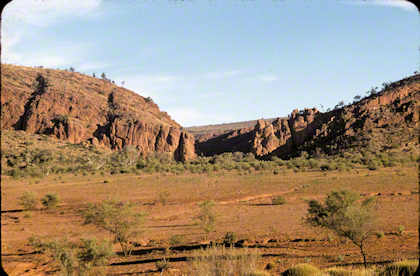
I photographed Matt proudly holding a corroboree stick. The Musgrave Ranges behind were cast in hues of gold from the rays of the late afternoon sun. When we had descended the hill and found Dad, he told us that the “mountain” we had climbed was named “Mount Trudinger” after his brother who had been a teacher in Ernabella.
Near evening, we visited an Indigenous pastor. As the Musgrave Ranges is sacred to the Pitjantjatjara People, Dad and the pastor discussed the possibility of getting a couple of guides to be our companions as we climbed Mt. Woodroffe.
For the night we camped in Two Mile Creek which is not far from Ernabella. Dad conceded to camp not alongside, but right in the dry creek bed on the soft sand. This arrangement made Mr. B very happy. ‘For once I get to sleep on soft sand,’ he said.
‘Just remember, if we have even a hint of rain, we pack up and go to higher ground,’ Dad answered.
Mr B chuckled. ‘No chance of that, the weather’s been as dry as the bones of that deceased camel we saw on the side of the road.’
‘The water comes rushing down if there’s a storm,’ Dad said.
‘Oh, of course, Captain.’ Mr B then turned over and snored.
Rick muttered, ‘The only storm will be if Mr B doesn’t get a good night’s sleep.’





















 Tru-Kling Creations