Friday already? It’s been a busy time planning another travel adventure, this time a family wedding later in the year. So, memories of our Tasmanian journey way back in 2009, and a hike around Dove Lake on a perfect summer’s day.
A few months ago, I became curious about the genealogical origins of my interest in art. Was the Trudinger line responsible? Or was it another branch of the family? I did find a few Trudinger relatives with artistic talent; some were architects, others were actual artists of note. But the surprising discovery was my third cousin, the late Pierre Trüdinger who was an artist and a Marquis (French partisan) during World War II. You can read his story from the Italian Online Newsletter, Il Tirreno, here.
In the following re-blog of our European adventures of 2014, enjoy our exploration of the much-fought-over territory between the Germans and French, the Alsace, and the battle we endured with our car’s Sat-Nav.
The heat is upon us here in Adelaide. Finally, summer, as I remember it, just in time for school and Australia Day which heralds the end of the summer holidays. This Australia Day will be renowned for being the hottest on record at 45 degrees Celsius.
What better way to keep cool than reminisce summers spent cooling down at the beach and hunting for cockle shells at Goolwa.
[Travellers to Australia often overlook Adelaide, South Australia, as the poor cousin to the eastern states. Situated in an unfashionable corner of the globe, the city and its surrounds have the reputation of being too hot, too dry, and too awkward to visit.
Welcome to my home city and state.]
T-K Team Take on the Barossa Valley
Shortly before the Swiss relatives arrived, panic among the brothers-K set in. Yes, we were going to the Barossa Valley. But where?
My husband and his brother, P1, cobbled together a plan of the day: wine-tasting, sightseeing, a bakery for lunch, and of course, toilet stops at regular intervals.
We converged as the formidable family of ten at Williamstown, eventually in the car park next to, yes, you guessed it, after a scenic drive through the city and hills, the toilets. Most of the group needed a coffee, and although we’d been warned that on Sundays, many bakeries are closed, we found a most accommodating bakery-come-art gallery, where cappuccinos and chai teas revived us.
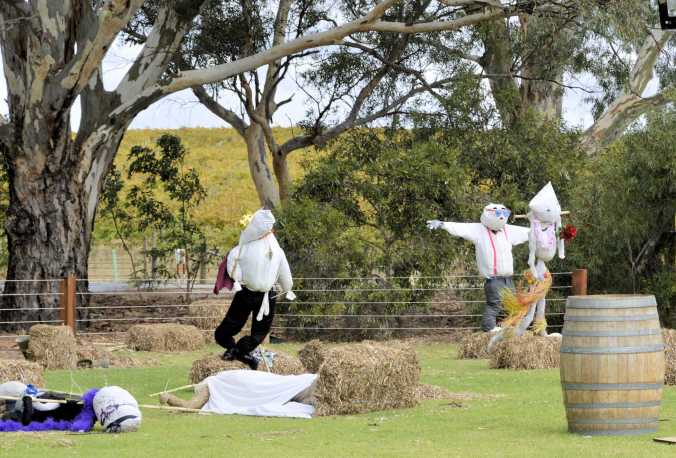
Stuffed dummies, one of whom was named Cyril, waited by the stone wall of the car park. The sign touted that they were part of a scarecrow trail that weekend. I guess they were doing their bit for tourism.
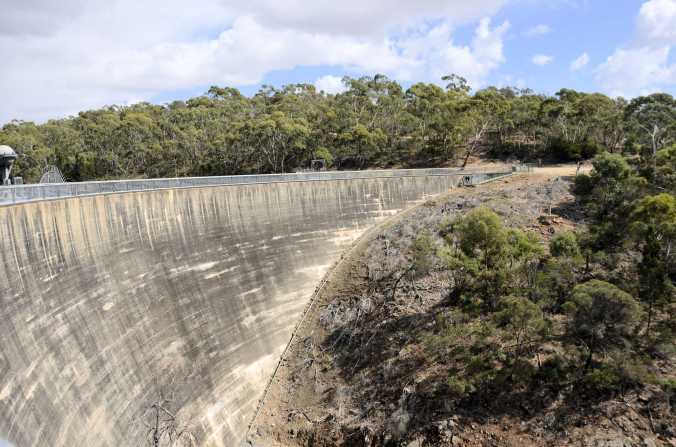
Energised, and with the help of a most cooperative mobile phone navigation app, the K-Team whisked over to the Whispering Wall, a dam holding Adelaide’s water supply. I wandered over to the wall while the others raced to the other side. My husband’s voice sounded as clear as if he were standing next to me. Eerie.
Next stop, and most important, Chateau Yaldara Winery, where we commenced our wine-sampling tour. Our Swiss visitors enjoyed their “schlucks” of Shiraz hosted by a salesgirl with a broad Barossa-Australian accent. I relished the photographic delights of the historic mansion and the feature fountain.
Every road or laneway around here leads to a winery. The Barossa produces some of the best wine in the world. Nineteenth-century migrants from Prussia-Silesia (now eastern Germany and Poland) came to South Australia and settled in the Barossa around Tanunda. Some were my ancestors.
My husband told our visitors, ‘The Barossa has some of the oldest Shiraz vines in the world, having been planted as early as 1847 by Johann Friedrich August Fiedler.’
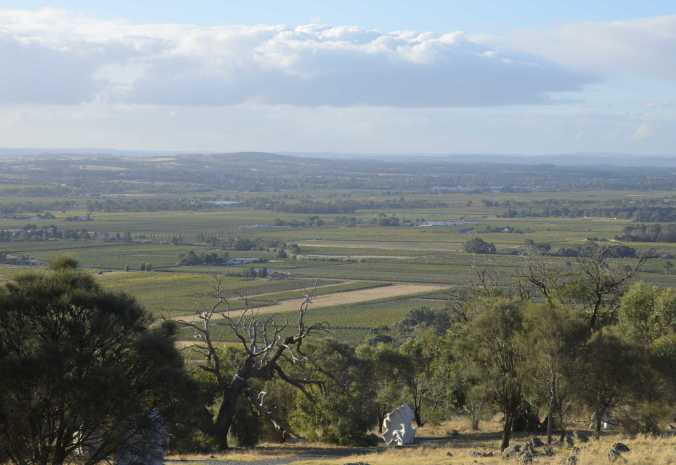
The K-Team arrived at a tourist-crowded Jacobs Creek winery. This popular winery permitted five free tastings before paying for more. Happy with five small samples, the K-Team admired the view of vineyards, leaves turning autumnal gold, and rows of vines stretching to the hills, plus a meander along the trails around the winery. Not to be outdone, scarecrows lounged in the lawns by the tennis court that sported oversized tennis balls and racquets.
After purchasing supplies for Tuesday night’s party, we tested our breath with the complimentary breathalyser. All the K-team drivers were deemed safe to drive.
So, a jolly, but not too jolly, K-Team progressed to Tanunda in search of a bakery. I spotted the Red Door Café and led the team there. A waitress guided the K-Team of 10 to the courtyard garden out the back, as inside was full. We sat at separate tables, my husband and I with our younger Swiss cousin and boyfriend next to the Kids’ corner. Most of the K-Team supped on the Café’s specialty burger. Excellent choice, as it was a late lunch that would tide us over for tea.
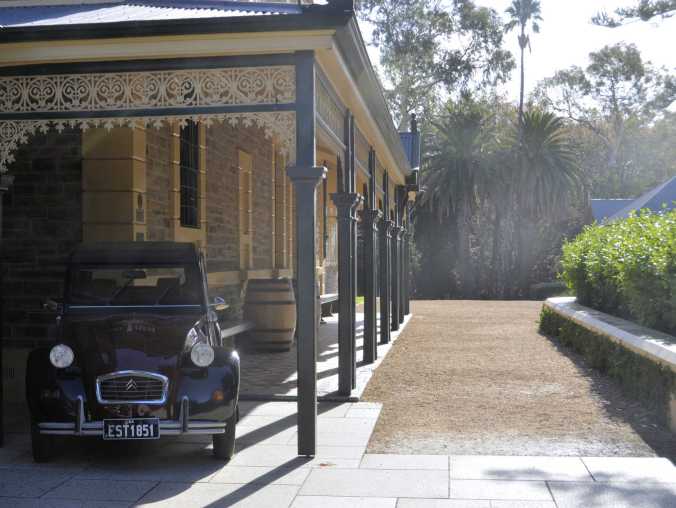
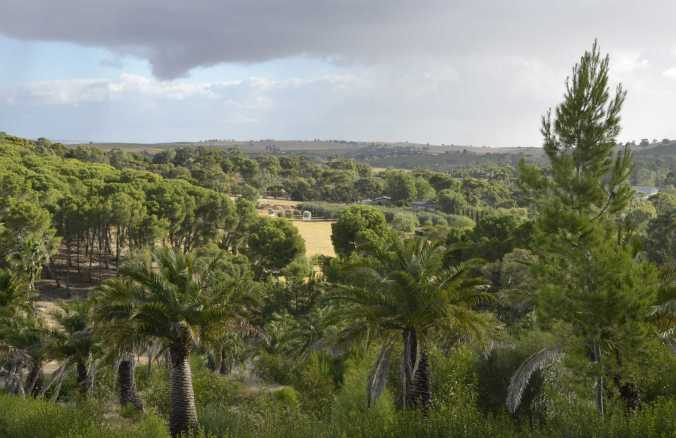
Satisfied with this most welcome and tasty lunch, the K-Team set off for Seppeltsfield Winery. After driving through kilometres of road lined with giant date palms, the K-Team arrived at the grand estate. The hall, a massive shed, actually, teemed with tasters. After more sampling and marvelling at the beautiful grounds, complete with vintage cars, we picked up our ordered wines at the designated shop.
As one of the oldest wineries, the Seppelts family was so rich, they built their own family mausoleum that presided over their estate. The K-Team made an impromptu stop to climb the steps to the family monument and then absorb the breathtaking view. The sun broke through the clouds, so completing the magical scene.
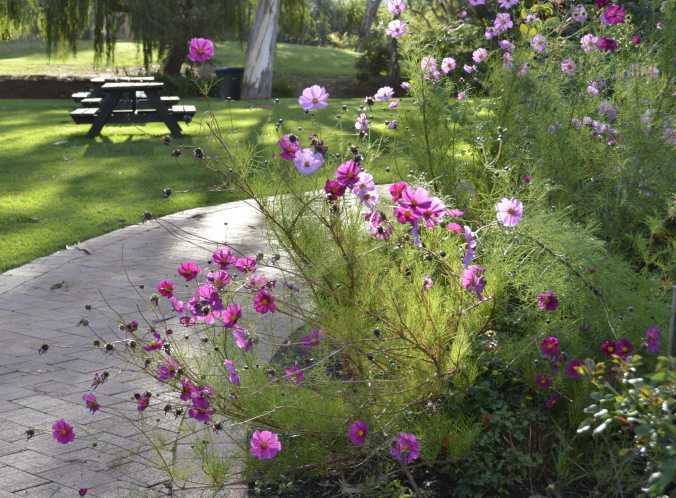
Peter Lehmann’s Winery was not far. Plenty of time, so we thought. But when we arrived, the car park appeared deserted. The owners emerged and informed the disappointed K-Team that they were closed for the day. The toilets, though, weren’t, and the K-Team made effective use of them while I took photographic advantage of the mellow tones of Peter Lehmann’s garden.
The K-Team reserved the late afternoon for Mengler’s Hill, which features an assortment of sculptures. We puzzled over the meaning of some of the international artistic offerings, but the collection seemed happy to be presiding over the Barossa. I observed that by this time, the scarecrows had slunk away and were nowhere to be seen.
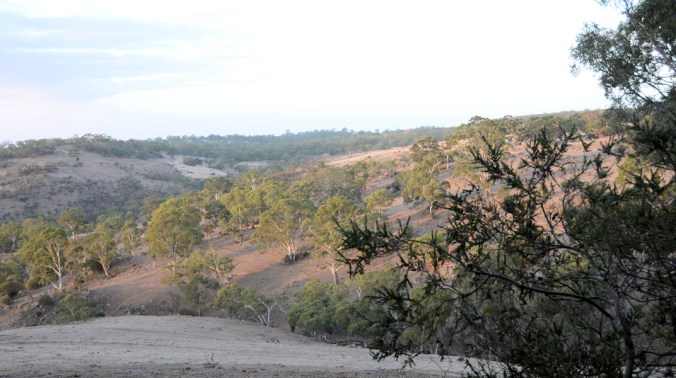
While our Swiss guests hunted for wildlife, I caught the sunlight on eucalyptus trees and the gnarled forms of branches and trunks with my camera; future subjects for paintings, I hope.
It had been a long and full day, and my husband’s mobile phone, drained of battery power and starved of tower transmissions, was by this time grumpy. As revenge for being deprived of its usual mobile-phone fixes, it became intent on leading us astray. In Angaston, when we finally arrived there after the phone’s GPS took us on a meandering scenic route, the phone demanded in a passive-aggressive voice, ‘Take the next right.’ Then, ‘Take the next right.’ Then again, ‘After thirty metres, take the next right.’
‘Hey, it’s taking us in circles,’ I said. ‘Ignore it and go straight ahead.’
The phone cut in. ‘Take the next right,’
I pointed at the sign to Adelaide. ‘No, follow the sign.’
As we drove down the highway to Gawler, the phone bleated, ‘At the first opportunity, make a U-turn.’
‘No!’ we shouted.
The phone insisted. ‘Turn left and make a U-turn.’
I filmed the phone map spinning in every direction. ‘It looks like it’s going nuts,’ I said. ‘I’m turning it off.’
I switched off the phone, and we completed the journey to Adelaide in peace.
The T-Team with Mr B — In 1977 Dad’s friend Mr Banks and his son, Matt (not their real names), joined Dad, my brother (Rick) and me on this journey of adventure. I guess Dad had some reservations how I would cope… But it soon became clear that the question was, how would Mr. B who was used to a life of luxury cope? And how would the T-Team cope with him?]
Secret Men’s Business
Mangaruka
Dad scraped up the last few oats at the bottom of his metal bowl and then said, ‘I’ve asked our guides to take us to a place which is very special to them.’
‘What? The Gosse Range?’ I piped up. ‘Are we going to that meteorite site?’
‘Better, than that.’ Dad’s mouth did his signature cat-with-bird-in-the-mouth expression. Then he explained that after discussion with our Indigenous guides, they had agreed to take the scenic route via Mangaruka Gorge; the entry to a sacred site. While Mr. B groaned at the prospect of hiking up yet another gorge, my father allayed his friend’s concerns by saying that we would only travel to the gorge’s entrance, and if we had time, just explore the beginnings of it.
Mr. B grumbled, ‘But we don’t want to be searching for a camp near Talipata in the dark.’
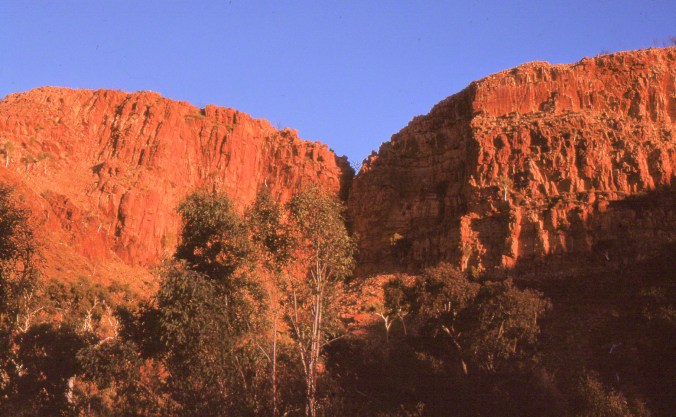
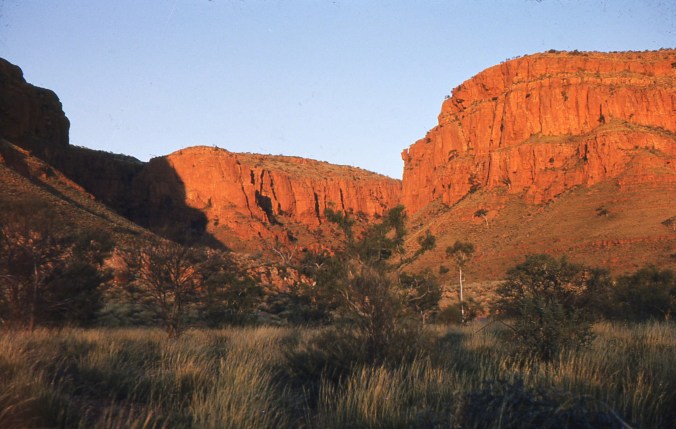
‘Don’t worry,’ Dad patted Mr. B on his rounded shoulder, ‘Talipata is not far from there. Besides, the cliffs of Mangaruka at sunset are stunning, especially with the ghost gums set against them.’
I remembered the exact image Dad was dreaming about. On lazy afternoons at my Grandma’s home, I used to rummage through photos and slides from her family’s time in Central Australia. My grandfather was, in my opinion, an amazing photographer. In one corner of Grandma’s bookshelf in the back room, rested a pile photo prints that were kept in pristine condition encased in special cardboard like a card; the best of Grandpa’s work. One scene that I have painted was a ghost gum, it’s white trunk against the deep purple cliffs of Mangaruka Gorge. Another slide that impressed me was the same scene with the ghost gum at sunset. No wonder Dad wanted to stop there on our way to Talipata.
After having breakfast, we packed up and drove out into the wild west. The dirt road exemplified that rugged feel.
At Haasts Bluff station we filled up with petrol, water, and supplies to last us in this virgin land. We were going where not many people, except the Indigenous, had gone before. Upon entering the land belonging to these people; there would be no shops, no houses, and no roads. To salute our departure from civilisation, we bought something to eat and drink. I ate a meat pie.
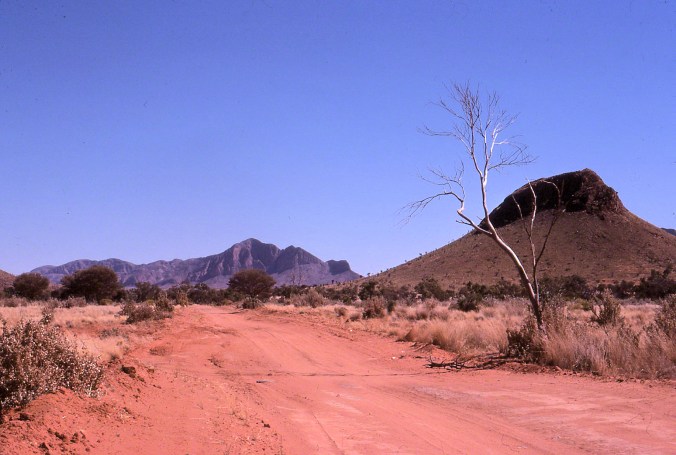
Our guides directed us off the narrow, yet graded road onto an almost invisible track. One sat on the bonnet of the Rover and directed our venture into the desert. We bumped and crawled along faded wheel ruts until a small range emerged through the low dunes and the folds and creases in the flat-topped hill, formed a gorge. We had reached Mungaraka Gorge.
Dad slowed the Land Rover, parking it just before some soft sand that threatened to engulf its wheels. The T-Team stepped out of the vehicle to be greeted by a welcoming party of small pesky flies. They were most unwelcome.
Swishing the pests away from his nose, eyes and mouth, Dad said, ‘Mungaraka, I reckon the name of the place has something to do with flies.’
‘Certainly a feature of the place,’ Mr. B sniffed. ‘Oh, darn it! I just got one up my nose.’
Richard, my brother clapped.
Mr. B glared at him.
With eyes wide, Richard looked at Mr. B. He then examined his palms. ‘Twenty.’ He flicked the flattened black flecks from his hands and then clapped again.
Mr. B then turned to his son, Matt. ‘Don’t even think about killing tha flies, ma son. They have germs. You don’t want germs, ma boy.’
‘No, Dad.’ Matt pulled his cap over his eyes, turned away and strolled down the track towards Mangaruka.
Dad, who had been laying out a spread of food on the tarpaulin, stopped preparations and ran after the boy. ‘Hoy! Matt! Wait! Lunch first, then the gorge.’
Richard laughed. ‘And for extra protein—flies.’
Lunch became a battle of hasty bites of cheese and gherkin sandwiches while trying to avoid the added bits of protein of flies that were only too willing to add flavour to our meal. After, we sipped our billy tea probably flavoured with the odd thirsty fly.
Our guides sat apart from us, and, unperturbed by our uninvited swarm of guests, they ate their bread and murmured quietly to each other. Dad perched on the tucker box and watched them.
I gulped down my last drop of tea. ‘Well, aren’t we going to explore the gorge?’
Dad stood up. ‘Right, let’s go.’
‘What about our guides?’ I asked.
‘Oh, they won’t be going. Mangaruka’s sacred to the Arunda, so they won’t go near it.’
‘What? Are they afraid of the place, Dad?’
‘It’s more complicated than that. They keep sacred stones called “Tjuringa” there in a cave. And they are afraid of spirits there.’
‘Can we go there?’
‘Sorry, Lee-Anne, girls are not allowed. Nor us. Not them. Only the elders. So, we’ll only go to the entrance of the gorge.’
Mangaruka held no ghost for us, only flies. Dad, Mr. B and Matt, and I walked up to the entrance of the gorge. Richard stayed behind to keep our two guides company. On the rocky slopes in the gorge, a smooth brown and white stone caught my eye.
‘Girls not allowed,’ Mr. B added, and then called out to Matt who had scampered further up the gorge. ‘Come on son, time to go back.’
On our return, I tried to take a photo of us all in front of this gorge, but our aboriginal companions refused. In the end, Dad took a photo of me in front of Mungaraka. Dad would have like to stay longer to wait for the rocks to turn red, but we had to move on.
Last Sunday, it happened again! I went down to Brighton Central to help set up for our Marion Art Group exhibition. When I came home, Hubby met me at the front door.
‘You left the laundry door open,’ he said.
‘Oh, no! Is Lily okay?’ my only thoughts were for our new cat Lily. Had she escaped and run off never to be seen again?
‘Come and have a look,’ Hubby said.
As we crept up the passageway, Hubby added, ‘Lily’s locked inside.’
Still baffled, I followed him to the family room.
Hubby pointed. ‘What can you see?’
Tufts of fur littered the floor.
‘Gracie came in through the open laundry door and had a fight with Lily,’ Hubby explained. ‘She’s currently under our bed. I had to pick Lily up and remove her from guarding Gracie.’
I examined the mass of fur. ‘From the looks of it, Lily won.’
We eventually extracted Gracie from under our bed, and she returned to her owners next door. Sheepishly. Reluctantly.
I think she secretly enjoyed her tussle with Lily.
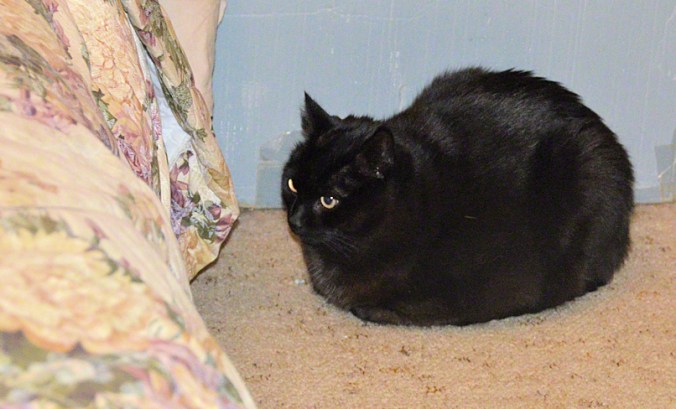
All the while, our elderly gent cat Storm kept out of it and watched from the safety of the couch.
Here’s an earlier story of one fine autumn morning, a long time ago.
Chaos in Cat-Central
I gazed out the kitchen window one Saturday morning. The sun shone on every blade of the many weeds in our garden, and the neighbour’s cat sat on our discarded toilet near the back fence. I had the beginnings of a nasturtium garden in those old toilets. Can’t have the cat digging up my seeds.
‘What’s that about?’ I muttered and went inside to investigate.
Holly, our tabby, crouched in a tense ball in the passage facing the bathroom entrance. In the freshly cleaned bathroom, Holly’s nemesis, the black and white cat (BW) snarled at her.
Holly’s puffed-up tail twitched, and she hissed at her enemy.
BW emitted a low, menacing growl.
The pussies peered at each other, a slow, silent, Mexican stand-off of the feline kind.
I nudged my foot at the interloper. She launched at it, claws dragging through my ankle’s exposed skin.
Holly screamed like a banshee and pounced on BW. Fused in a ball of fury, the cats rolled around the tiles, tufts of fur flying out, littering our floor.
My son joined the human audience of the furious feline fight.
I glanced in his room.
Storm, our black cat, shuddered on top of the bunk, his green eyes glowing from his dark face. No way was he going to join in the fray.
I ran to the kitchen and grabbed a broom. While the cats thrashed about, I closed all the doors, except the one leading to the outside through the laundry. Then I poked the broom at the feral ball of furs. The cats flew apart. BW attacked the broom. I shook her off, and she glared at the brush-end, hissing and spitting at it. I pushed the broom at her. She scratched it. Then sped into the bathroom.
I yelled to my son, ‘Get another broom.’
He stared at the black and white intruder that hissed and spat. ‘Where?’
I moved Holly out into the family room and then grabbed the Swish broom from the laundry. I gave it to my son.
As mother and son, we, both armed with brooms, guided BW as if shuttling a hockey puck. We nudged the wild ball, shunting her through the passage, through the laundry, and then out the back door.
The cat bolted down the path and scrambled over the fence.
I slammed the door shut and, with a sigh, began sweeping up the aftermath of fur bits from the bathroom. I picked up shards of cat claw, another casualty of the clash of cats.
‘Hey, look, cat claws,’ I said.
‘That cat was feral,’ my son replied.
I swept my eyes over the bathroom and noticed chocolaty nuggets in the corner. I took a closer look.
‘Oh, no! Cat poo!’ I cried and then collected the poo scoop. I shovelled up the mess. As I scanned the bathroom, I discovered more souvenirs of the feline fight.
‘Oh, Holly, did you have to?’ I said to Holly, who crouched in the corner of the family room.
‘Don’t blame Holly,’ my son said. ‘It had to be the neighbour’s cat, didn’t you say that cat was on the toilet in our garden and you chased her away? It’s that cat’s revenge.’
***
I later heard from a neighbour, that a huge cat, a Jabber-the-Hut of a cat, ruled the neighbourhood with his paw of iron claws. It is for this reason, cats migrated to our backyard. Our land was a haven to them.
If you’re in Adelaide, check out our Marion Art Group exhibition in the mall at Brighton Central Shopping Centre (Corner of Edwards Street and Brighton Road, Brighton). Displaying wonderful and affordable paintings you can buy and take home—a great idea as Christmas presents. On until Saturday, October 25.
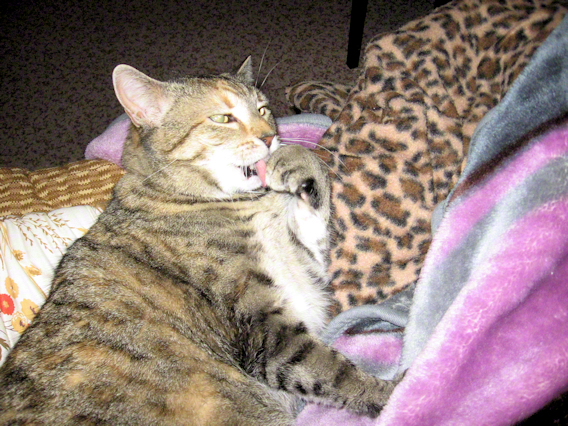
My Schrodinger’s Cat pastel painting inspired by the photo is there too.
***
Want more? Dreaming of travel down under?
Why not take a virtual journey with the T-Team Adventures in Australia?
[Remembering my dad, Clement David Trudinger 13-1-1928—26-8-2012
Extract from Trekking with the T-Team: Central Australian Safari 1981]
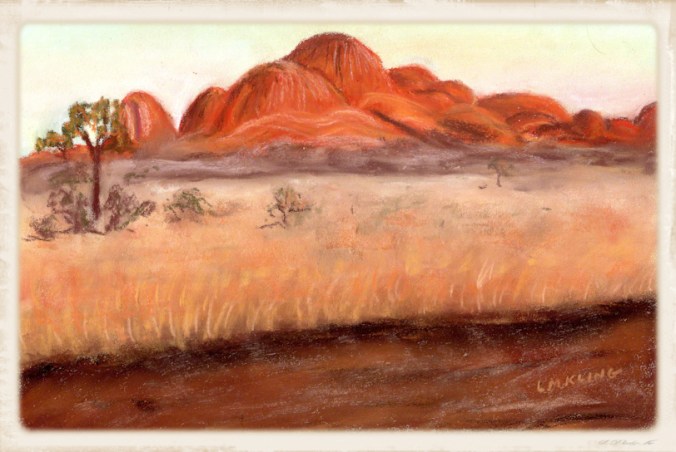
Way before the sun had even thought about rising, we gulped down our porridge and then set off for the Eastern Side of Kata Tjuta. Dad was on a mission to capture the prehistoric boulders at sunrise. We arrived at the vantage point just as the sun spread out its first tentative rays, touching the spiky tips of spinifex and crowning the bald domes with a crimson hue as if they’d been sunburnt.
I dashed a hundred metres down the track to photograph the “Kangaroo Head” basking in the sun. We stood in awe as the glow of red on the rocks deepened.
Every few minutes Dad exclaimed, ‘Ah, well, that’s it, that’s as good as it’s going to get.’ He packed the camera away, only to remark, ‘Oh, it’s getting better,’ then retrieve the camera from the bag and snap Kata Tjuta flushed with a deeper, more stunning shade of red. The rest of the T-Team, waited, took a few shots, waited, mesmerised by the conglomerate mounds of beauty, before taking more snaps of the landscape.
Virtual Trekking Behind the Art: Ocean Beach Tasmania
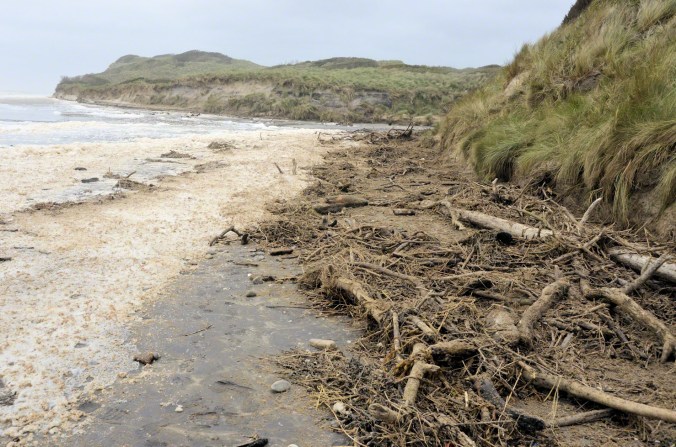
[In the last few weeks, after months of drought, rain. And, almost a month after storms and extra high tides, more extra high tides last Tuesday. So, in memory of the cold stormy weather, here’s an old piece of calm from our Tasmanian travels.]
Ocean Beach lies on the West Coast of Tasmania near Strahan. The wild winds of the roaring forties (between the 40-and 50-degrees latitude) attack the coast with relentless ferocity.
In 2001 I visited Ocean Beach with my family to see the mutton birds coming home to roost for the night. I had barely stepped out of the car before the biting cold wind blasted me and I made a hasty retreat back into the car. No view of mutton birds that evening. Result, no photos.
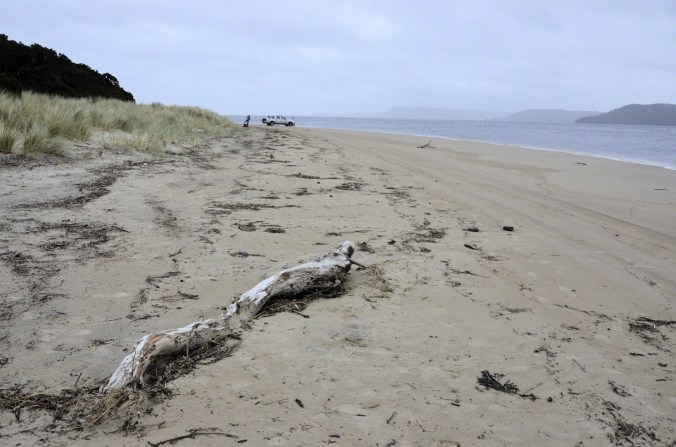
Ten years later, my mum and I visited Ocean Beach. While the East Coast was inundated with floods, Ocean Beach that afternoon was calm. We explored the beach, taking many photos of this rare state of the beach.
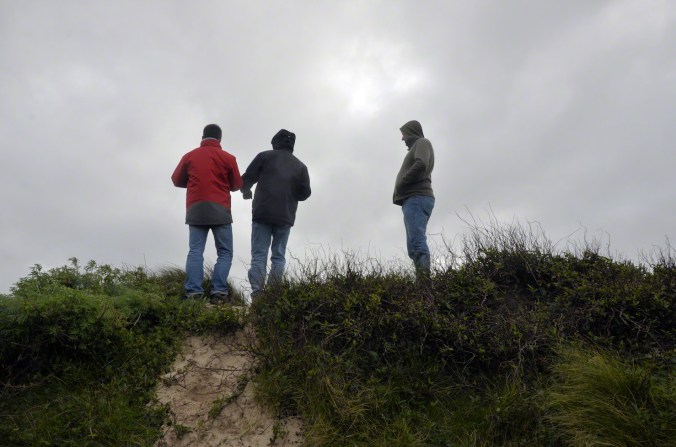
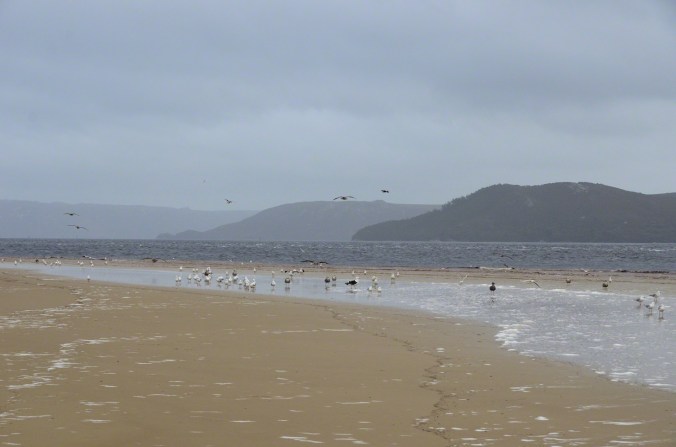
October 2016, the K-Team ventured onto the sands of Ocean Beach on perhaps a not-so-calm day; calm enough though, that we were able to walk along the beach. Not being satisfied with just an obligatory few metres up and down, my husband led us way up the estuary where we spotted a variety of birds, some fishermen, and the lighthouse sitting out there near the heads. Gotta get our money’s worth. After all, he’d seen the potential from the dizzy distance of the cruise boat as it sailed past the heads of Macquarie Harbour. I think if we’d allowed him, we’d still be walking along the coast somewhere around Tasmania.
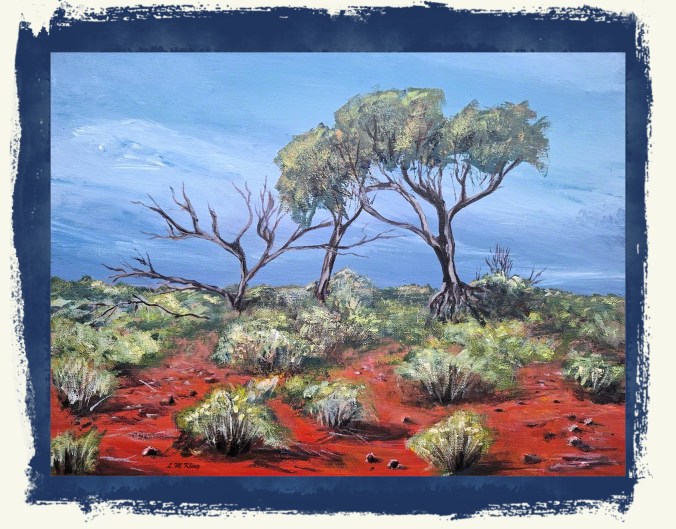
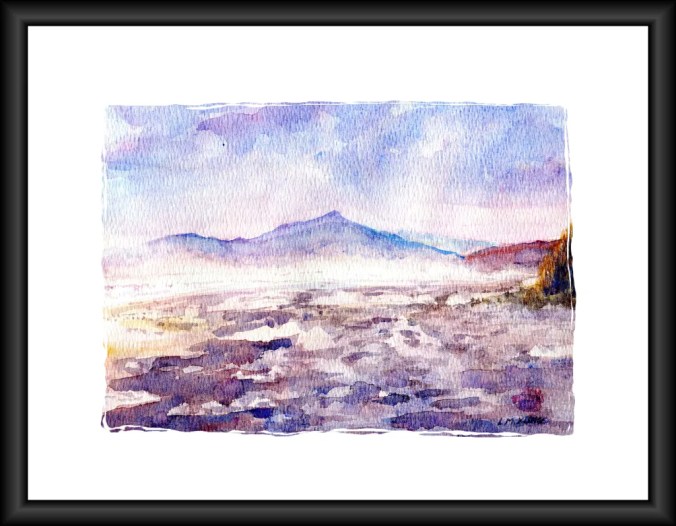
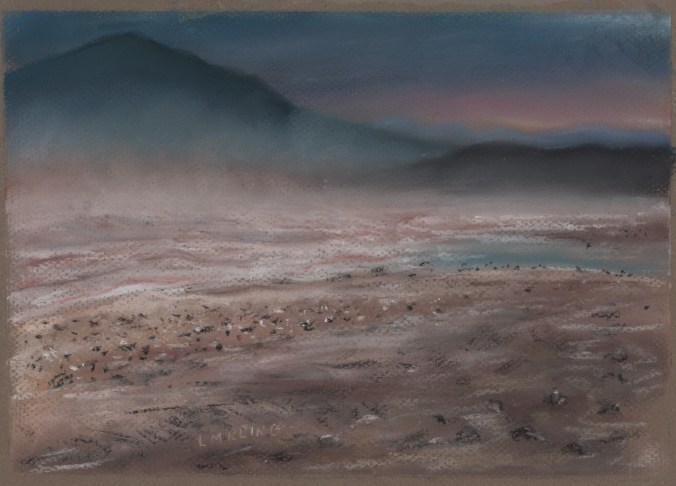
Oh, dear! I must’ve been deep in the rabbit-hole of painting yesterday. See what I painted in one sunny mid-winter’s afternoon, yesterday. Anyway, being what was intended to be Family History Friday for Tru-Kling Creations, went down a rabbit-hole and ended up somewhere else.
Check out the re-blog of the story of my great-great grandfather from Silesia.

























 Tru-Kling Creations