Winter holidays are nearly here, and the school year is in full swing in Australia. With it, memories of the way things were way back when I was at school, in the 1970s. Those were the days …
Our Sensei, the Avenger
Timmy hunched over his desk, sobbing.
Luke laughed at him. Simmo slid back on his chair sneering. Bruce barked in the small skinny lad’s ear.
I watched, guarding my books from being flung out of the window, again.
Those boys!
Our Sensei marched into the classroom. We stood.
His face turned crimson. He thumped the blackboard. ‘Da’me Yo! Bad! Very Bad!’
Sensei swooped on Bruce and Simmo. Grasping their shirt collars, one in each hand, he clonked their heads together, forcing them to look at Timmy.
‘Look what you have done! You made him cry! Bad! Very Bad! Dame Yo!’
Would you like to join in the 100-word challenge? If you have a story you’d like to share, drop me a line in the comment box. The one requirement: the story must be exactly 100-words.
***
Relax and find time to read more of the adventures of Holly and Minna and their war against the fiend you love to hate; an overgrown alien cockroach, Boris.
Carl August Trudinger was a successful businessman, a wool merchant in Bradford, Yorkshire. He owned a beautiful mansion on a sprawling property in Chevin Grange, Guiseley. So, what made him move all the way around the world to Adelaide, South Australia, with his wife and twelve children? Was he in love with the Utopian dream that Adelaide offered in the mid-1800s? Or was he on a mission?
Part 1
Family
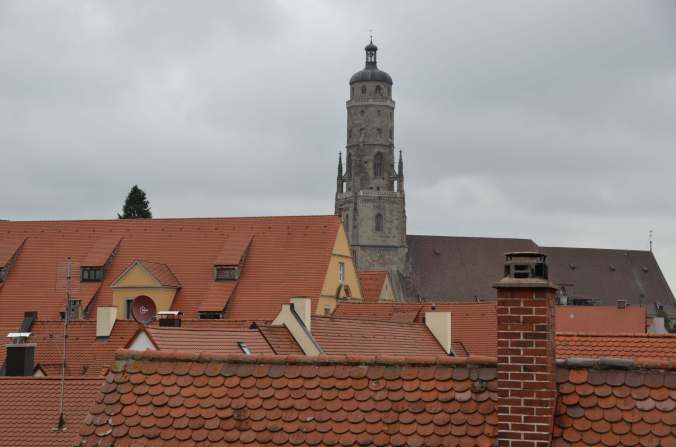
Although he’d been naturalised as a British citizen, Carl August was born in Nördlingen, Bavaria, on February 8, 1839. Built on a meteorite crater, the houses have diamonds in their stonework. The town is one of the few remaining to have a complete wall around it. And to give you a picture of the town, remember Willy Wonka and the Chocolate Factory? The red rooves of the Altstadt Nördlingen are what you see in the last scene of the film as the main characters rise above in the balloon.
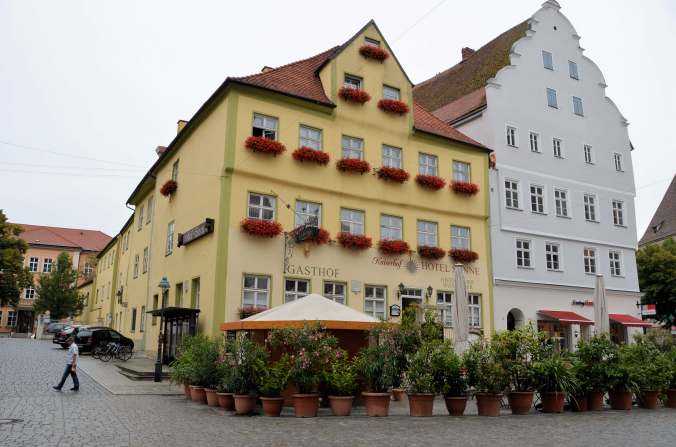
Born to a large, well-to-do family, my great-grandfather was the fourth child (third son) of Gottlob August Trüdinger and Helen Salome T (née Erdlen). He had three younger siblings, the youngest born when he was eleven. The Trüdinger family had become key figures in the Nördlingen community, Carl August’s grandfather, Georg, having been mayor of the town. One branch of the family owned the regal, high-end Kaiser Hof Hotel Sonne, where royalty used to stay when visiting the town, and also, more importantly, the famous author, Goethe.
However, Carl August’s father, Gottlob, was a linen weaver, as was Carl August’s grandfather, Georg, who was not only a master linen weaver, as mentioned before, but also the mayor of the town. Linen weaving wasn’t any ordinary job, but one that earned good money, enough to buy a hotel at some point in the late 1700s.
So, for all intents and purposes, the Trüdinger family in Nördlingen had a high social standing. Did I mention there’s a road named after the family?
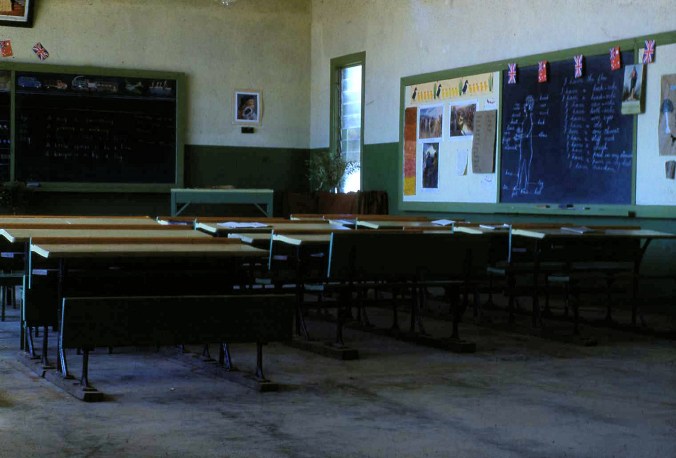
That being said, not much information exists about Carl August’s childhood and growing-up years. As a boy, he would’ve been educated in the local school. I was able to access some photos of a school in Bavaria from the mid-1800s and was surprised to see it looked exactly like the school set up at the Hermannsburg Mission in the Northern Territory, Australia. Carl August would have sat at a heavy wooden desk in a room painted green, with a blackboard at the front of the class. From what I’ve read of this era, in Germany, teachers were strict, and students disciplined harshly if they misbehaved.
However, I believe Carl August was a model student who had a passion for learning. But I could be wrong. He was the middle child after all. One thing about the Trudinger family, I can say from my research, is that they were, and still are, highly intelligent and creative. Many of Carl August’s relatives and descendants have become prominent and successful in their fields of expertise: a renowned architect in St. Gallen, Switzerland, plus university professors, doctors, businessmen, artists, and accomplished musicians.
Speaking of music, as this has played such a significant role in our family, I imagine music was central to Carl August growing up. Nördlingen is famous for its music and currently, its choir, which came to perform at Bethlehem Lutheran Church in Adelaide in 2017.
As far as his religious affiliations go, I remember asking my dad’s cousin about whether Carl August was Catholic or Lutheran. She was certain that he was Lutheran, or as in German one would say, Evangelisch.
He probably attended the Daniel Cathedral as a member of the congregation. It’s just over the road from the Kaiser Hof Hotel Sonne, owned by the extended Trudinger family for around 200-years.
Another pivotal moment for Carl August would have been the establishment of the railway network in 1849. In my mind’s eye, I can see the excitement, the fascination for the ten-year-old Carl August as the first steam train rolled into town.
Carl August followed in the family tradition of textile making and selling. Most, but not all, of his siblings followed their father in the textile trade. The oldest brother, Friedrich, became a farmer.
As a young man in his early 20s, around 1865, he moved to England, settling in Bradford, Yorkshire, where he worked under the supervision of his uncle, Philipp Trudinger, from Basel, Switzerland, as a wool merchant. I reckon, to be successful in this merchant trade, Carl August would have been socially aware, interested in people, and a good salesperson.
However, my great-grandfather is reported to have had strong opinions; he was passionate about politics and justice. According to another family member who has researched Carl August, as with many of his fellow countrymen, he didn’t like the direction Bavaria was going and the influence of Otto von Bismarck, who planned to unite all the different kingdoms of Germany into one country. Bavaria was one of the last kingdoms to join Germany. When we visited Germany in 2014, my German cousin’s husband joked that, when World War I ended, Bavarian troops were still marching, and the same was true at the end of World War II.
Hence, the reason Carl August moved to Bradford, England. There, he became a wool merchant and became a British Citizen.
The Bradford Wool Exchange was built between 1864 and 1867. Bradford, with all its industries: mining, milling, ironworks, and textiles, had become one of the most polluted cities in England. It was also growing at a cracking pace. A canal had been dug from Leeds to Liverpool to enhance the transport of goods, and in 1850, the Bradford Railway Exchange was established. Bradford had become the hub of industry.
To adapt to his new social and cultural environment and fit in, Carl August changed the spelling of his name to Trudinger, the umlauts over the “u” being dropped, as they don’t exist in English.
Love and Marriage
While in Yorkshire, he met Clara Theresa Schammer, who lived in the area with the local Moravian Brethren community—the Little Horton Moravian Brethren Fellowship. Clara Theresa was a teacher there, probably at the school Little Horton Moravian community provided. This makes more sense than the Schammer Family history account, where they met in Kleinwalka, Saxony.
According to my father’s cousin, Margaret Trudinger, the two met at a dance. Another truth is stranger than fiction moment, there. From my understanding of Evangelical Lutherans from Bavaria, Germany, back in the mid-nineteenth century, dancing was verboten (forbidden). Or was it? Same for the Moravian Brethren, I would’ve thought.
Then again, maybe I’m incorrect. My Grandpa Gross, Pastor Sam Gross (a United Evangelical Lutheran, great-grandfather migrated from Prussia in 1853) danced. His younger sister, Helen, whom I met, said he was a great dancer. But then, upon becoming a pastor, Sam gave up dancing and forbade his wife and children from dancing. He claimed dancing was from the devil, representing vertically, a horizontal act reserved for the bedroom.
Could Karl August’s and Clara Theresa’s theology on dancing have been different back in 1866 when they met? Most likely.
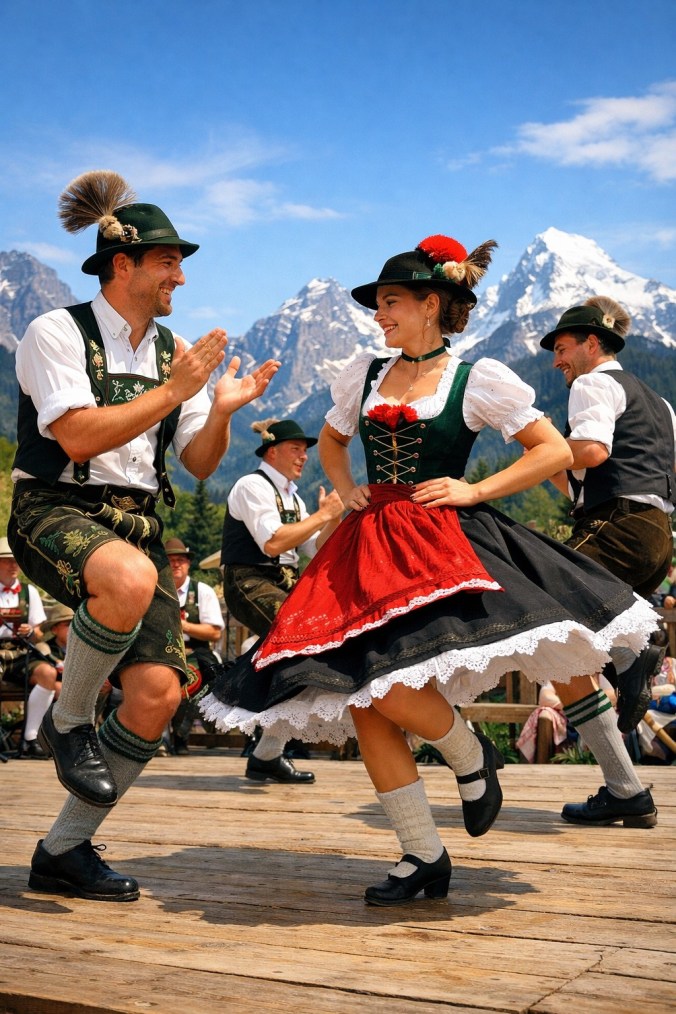
According to a commentary on Yorkshire, where Captain Cook grew up, dancing was an integral part of life. Carl August would’ve grown up with the traditional Bavarian dancing, called Schuhplattler, where the men dress in leder hosen and the girls in their dirndls. Dancing happened in the town square during festivals. Acrobatics were a highlight of the dance, as well as plenty of foot stamping and knee slapping by the men.
*[Photo 5: Traditional Bavarian Festival Dancing AI-generated]
In Saxony, where Clara Theresa was born, waltzing had become fashionable, although folk dancing still existed. I imagine her grandmother, having grown up in Lausanne, the French part of Switzerland, and being from nobility, would’ve been partial to the waltz.
How did the meeting of Carl August and Clara Theresa in Yorkshire at a dance occur? Was she attracted to Carl’s acrobatics on the dance floor? Or were they both unfamiliar with the English dance moves and retreated to the outdoors for fresh air, where they bumped into each other? Or was it “Some Enchanted Evening” where their eyes met across a crowded room?
However it happened, Carl August and Clara Theresa were married in Herrnhut, Saxony, on September 30, 1867. Then they returned to Yorkshire to live. Twelve children followed in quick succession, in the early years of their marriage, one per year.
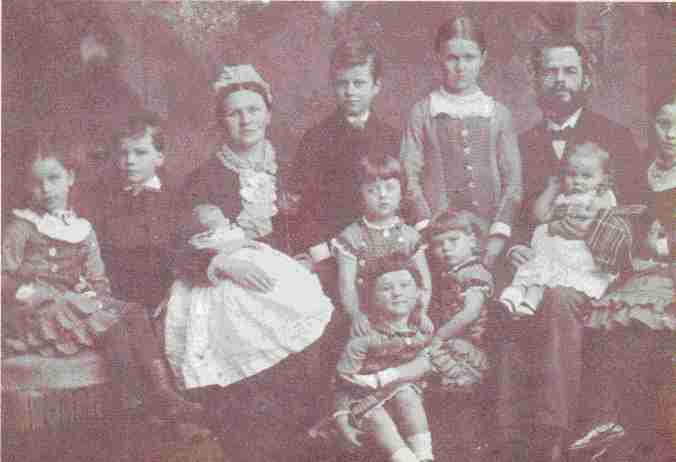
*[Photo 6: Carl August and his young growing family circa 1881 courtesy L.M. Kling collection]
They started married life in a row house on Claremont Terrace, Bradford. With a younger brother, Rudolf August Trudinger, and a maid or two, plus the children, they outgrew their increasingly cramped dwellings. Within ten years, Carl August and his brother had become British citizens, and they’d moved to Chevin Grange, Guiseley, West Riding, Yorkshire. One of the reasons they moved to the countryside was the pollution in Bradford city. So bad was the pollution that many children died from diseases such as cholera and typhoid. Not sure where Rudolf had gone, but a cousin from Basel had taken his place on the farm. I might add here that the farm still exists and is currently for sale for nearly 2 million pounds. So, I gather the wool trade had treated Carl August very well.
Very well, indeed.
In 1878, his wife, Clara Theresa, advertised for a maid to come and cook for them. So, they were doing well enough to afford servants to help with the running of the household.
One interesting fact revealed through a legal report in the London Daily News, February 2, 1878, Carl August is listed as the administrator of the deceased estate of John Conrad von Mandach, who, incidentally, died intestate. As John Conrad von Mandach’s family were big retail businessmen from Schaffhausen, Switzerland, being a wool merchant, Carl would’ve had connections with them. To be an administrator of this important man’s estate, Carl August would have been well regarded in his community as a trustworthy person who could sort out this unfortunate situation for John Conrad’s widow and young family. John Conrad’s son was only 8 years old.
While in Bradford, the Trudinger family had been worshipping at Little Horton Moravian Church, a fifteen-minute walk from their first home.
But when they moved to the farm, it would’ve been too far to walk to church. They may have caught the train or used their horse and buggy to get there.
But this is not where the story ends. Within the next few years, Carl August and his growing family will travel sixteen thousand kilometres to Adelaide, South Australia.
Next week, find out what made them travel to the “ends of the earth” to live in Australia and what happens next for Carl August and his family.
Late last year, we sold our Red-Orange Toyota Corolla Levin to our son and bought the Mazda from my Art and Indie Scriptorium friend, Elsie King. We have named the Mazda, Antoinette, because she has a habit of telling us how to drive. Good thing at our age. Helps avoid accidents and the “accidental” speeding fine. Perhaps the uninsured, un-Australian licensed Uber driver who crashed into Levin while my son was driving could have done with an “Antoinette” in his Uber car. Fortunately, it all happened at slow speed and although Levin was damaged, my son emerged unscathed.
My son did remark, though, “I’m glad I wasn’t riding my motorbike, or I’d have ended up in hospital.”
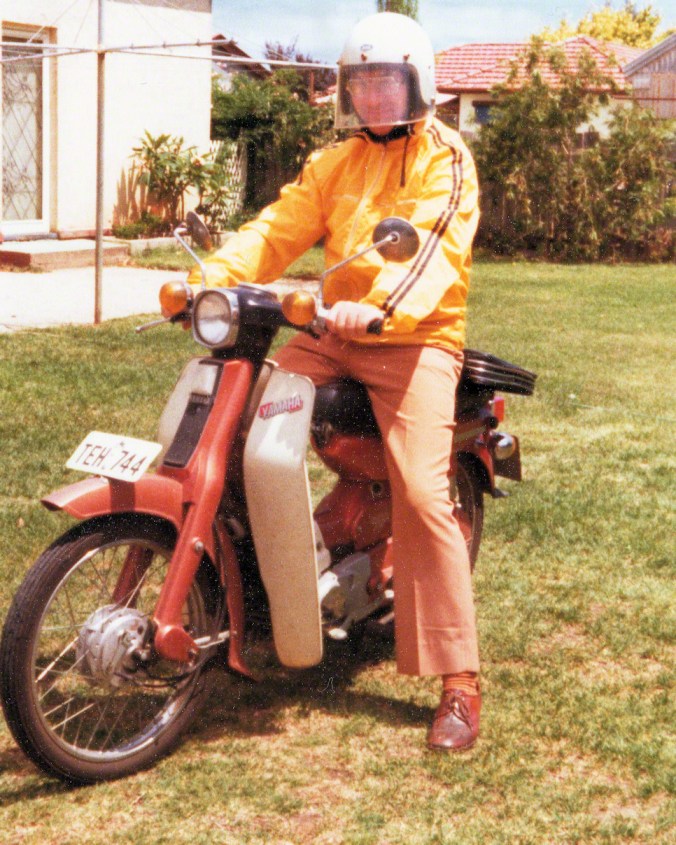
On that note, Dad’s midlife crisis vehicles keep rolling in. This time, “Putt-Putt”, the motorbike. Was this new development a reflection of the direction Dad’s midlife crisis was taking? Or was he just having a go?
So, here goes with the 100-word challenge.
Putt-Putt Pa
After lunch at Grandma’s one Sunday, my cousin showed off his prized Ducati. Inspired, Dad resolved to have a go and buy his own motorbike.
The first hint Dad was dissatisfied with his current transport arrangements was expressed in a story game, where he described the money-saving qualities of a motorbike. I pointed out dangers. My cousin’s friend had died in a motorbike accident.
Soon after, Dad came puttering down the driveway on Putt-Putt, a bright orange motorbike. From then on, for a time, Dad puttered from Somerton to work in Port Adelaide. Everyone was happy, until … the accident.
For this season, I thought I’d take some time out from cleaning and preparing for the big family gathering with my hubby’s family and reminisce about my Christmas Day fifty years ago.
I will write as written, spelling mistakes, grammar, and rather uninspiring prose, and all. My excuse, according to my diary, I wrote just before bedtime, and my mother would be coming in, hassling me to get to sleep. So, no time for perfect editing. Besides, I was notoriously a bad speller back then. So glad to have spell check on the computer these days.
From my diary entry, Christmas Thursday, 25 December 1975 (Spooky, this year Christmas fell on a Thursday):
Today Kiah and Alinta and Heidi, Peter and the other Jeshkes came to Adelaide. After going to church, I went to see Kiah and Alinta and Heidi. For dinner I ate at Grandma’s. After playing with Peter, Michael and Rich and that, I went home to get changed.
On the way home a car with a bunch of boys in it went past and one of them I think, whistled at me (or some phrase I can’t decipher). He noticed me.
Went to the Rozler’s House to celebrate Christmas.
Received Aquirilic paints, Das, Pink Annual, hankys, films, L necklace, Record Tuned On, Book.
Unpacking
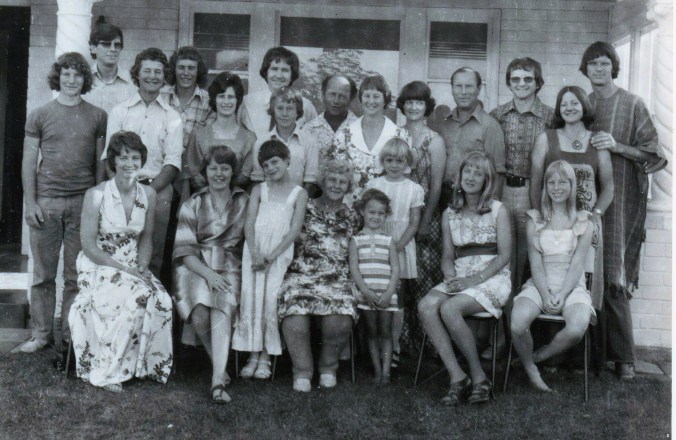
This day was a significant day in the lives and times of the Gross family. All the descendants of my grandma and grandpa (Sam and Elsa Gross) gathered in Adelaide at our church’s Warradale rental homes to celebrate Christmas.
As a girl of 12, most important to me were catching up with my cousins. Lunch at Grandma’s was a weekly Sunday tradition. And it appears I joined in after the Christmas service to have lunch at Grandma’s with the cousins. Grandma, the queen of hospitality, accommodated us all; the table in the small trust home kitchen-dining room would be crammed full of people and we learnt to keep our “wings” tucked in whilst eating. Grandma could never quite master the skill and flapped her elbows about as she ate, knocking me as I attempted to guide my fork to my mouth.
Then, if there were too many guests, the children were relegated to the “kinder tisch” (kid’s table) out in the back garden if the weather was fine, or in the passageway, if not. This day, I recall being in the backyard with my younger cousins, Kiah and Alinta D, and Heidi J.
Christmas dinner, as mentioned, was at what was the recently vacated Roesler’s home. Our church, who owned the property, had kindly loaned us the house in which to spread. And spread the Gross family did.
We girls enjoyed running about, doing acrobatics and cartwheels on the front lawn while the adults loaded up their plates from the potluck buffet. Then, after our feed, the tradition, French Cricket, which is a variation of cricket, where our own legs are the “stumps,” and there are no wickets or runs to score.
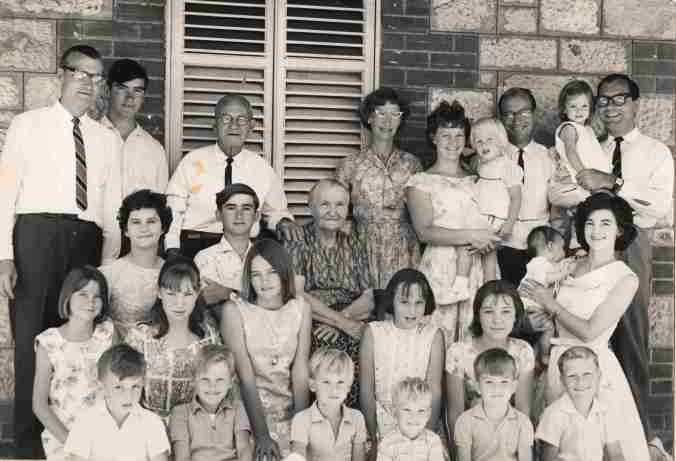
Finally, the evening progressed to photos of each family culminating in a big (Gross) family photo with me looking rather awkward, or should I say, inelegant. Comments like “you can see right up Rundle Street” haunted me for decades to come.
Then, once the sun had set and Christmas carolling done, came the opening of the Christmas presents. One by one, we unwrapped our pile of gifts and dutifully thanked each giver. Each person, from youngest to oldest, had to wait their turn. The gift unwrapping went on for hours.
Anyway, that’s all in the past now, just as Christmas is. Hope you all had a good one.
Toilets, bathrooms, latrines, bog or “dunnies” as they’re called in Australia, have surfaced as topics of conversation in the last week. How they have changed over the centuries. How they vary from place to place, country to country. But one thing remains constant to being human. When you gotta go, you gotta go.
100-Word Challenge: When You Gotta Go
He stood up and wandered to the door.
‘Get back to your seat!’ I snapped.
‘Gotta go to the toilet, Miss.’
‘No, you don’t.’ I pointed at his desk. ‘Sit down!’
This version of Denis the Menace crossed his legs and grinned. ‘Yes, I do.’
‘You can wait.’
‘Please, Miss,’ his voice mocking, ‘I have to go.’
Sniggers rippled throughout the classroom.
I stood, pointing like a fool at his chair. Afternoon sun streamed through the dusty windows, ripening adolescent body odour.
In the previous tale, I mentioned a certain friend attached pride to the superiority of the Aussie farmer—a pragmatic soul, jack-of-all-trades and survivor of harsh outback conditions. So, with pride, I wrote about my maternal grandfather, Sam Gross.
My paternal grandfather was none of that. He was a “city slicker” as the “cockies” called them, born and bred in the city and not the farm.
Ronald Trudinger was the first in his family to be born in Australia in August 1886.
His father, Karl August Trudinger, was born in Nördlingen, Bavaria, while his mother, Clara Theresa, was born in Kleinwalka, Saxony. His parents first emigrated to Bradford, Yorkshire, where they lived for about twenty years and became British citizens. They didn’t like Bismarck and his ideas of unifying Germany. The first twelve of Karl’s and Clara’s children were born in England.
Karl August was a textile merchant; hence, living in towns or cities worked best for him. Ronald’s mother, Clara Theresa, grew up in the Moravian Brethren community in Saxony. Faith in God and education were her values. She had yearned to be a missionary, but that door was closed to her at the time. As a result, she prayed for her children that they would become missionaries. Eight out of her thirteen offspring did.
One of them was my grandpa, Ronald, who became a missionary in Sudan.
So, although he wasn’t the venerated Aussie icon of tough “cocky” farmer, his calling was different but just as valuable. He became an intrepid missionary in Sudan, based in Melut on the White Nile. He spent decades translating the New Testament into Dinka and other African languages.
How thankful I am to My Heritage and the links to news articles matching Dr. Ronald Trudinger—100 at least. In the early 1900s until the late 1950s, he appeared as a local celebrity, especially in church circles. His deputation talks on the “Soudan” and the Muslims, and the risks and challenges the family faced in Africa, particularly during the War in the 1940s, were a source of fascination, if not entertainment, for the public of that time.
Ronald Trudinger grew up in Norwood, a suburb of Adelaide, South Australia. From what I can gather, again from various news articles about the family, he may have lived in Kapunda and Broken Hill. His father, new to Australia and a merchant, had to go to where the work was. When they first arrived in Australia, according to Ronald’s birth certificate, his father was a greengrocer. Humble beginnings after being a wool merchant in Yorkshire.
A few years later, news reports have Karl August working in a jewellery store in Kapunda. Then, as I mentioned, there was a time the family was in Broken Hill, where Ronald’s eleven-year-old older sister died of typhus.
Eventually, so the family narrative goes, they settled in Marryatville, a subdivision/estate in Norwood, and father, Karl August, teamed up with a Mr. Zimmermann to manage a textile store in Adelaide city. While his father supported the family as a merchant, and some of his older siblings set off for China as missionaries with China Inland Mission, Ronald became highly educated, attending Adelaide University and becoming a Doctor of Medicine.
As a child, Ronald was exceptionally gifted, and by the age of four he was reading the Bible, and at five, Homer’s Odyssey, so my father says. Apart from these fragments of information passed down the generations by word of mouth, Ronald’s childhood remains a mystery.
News reports at the time have helped fill in some of the gaps in Ronald’s interests as he grew up. One of these was tennis competition reports. Although Ronald was born with one arm shorter than the other, he still enjoyed a hit of tennis and played in competition. He was described as a fierce competitor.
Ronald grew up in a God-fearing family, and from all the Sunday School prizes he won (recorded in the local newspapers), I imagine he came to faith in his Lord Jesus as a young child. His family attended Maylands Presbyterian Church. Although they were from a Moravian Brethren background, there was no such church in Adelaide. There was one in Bethany in the Barossa—too far to travel from Norwood. Anyway, the family probably chose a church and congregation that would support missionaries. When Ronald began his missionary work, he and Lina joined the Burnside Christian Church, which faithfully supported their work in Sudan.
Meanwhile, back at the family home base in Norwood, youthful Ronald Trudinger enjoyed evenings with the family playing games—a tradition passed down to the current generation of the T-Team. This never included playing cards, as such cards were deemed “sinful” and associated with gambling. Games my father taught us were taught to him by his maiden aunts, who had learnt them from their parents. A parlour card game called “Chook Chook” was certainly one game the Trudinger family had and loved playing. “Chook Chook” is all about egg farming, teaching the player the different breeds of chickens, trading and negotiating, and accounting. Other games that Ronald would’ve been familiar with were word games and story games, which his mother created for the education of her children.
My father remembers his dad’s fondness for chess. Even in my grandpa’s old age, my father never could beat his dad at chess. Another relative recalled Ronald taught her mother to play the piano. So, I gather another of Ronald’s interests was music, a love which he passed down to his children.
After completing his Bachelor of Science degree from 1908 to 1912, Ronald studied to become a Doctor of Medicine at the University of Adelaide. The University student magazine has him attending the Evangelical Union Christian group there, which would become EU, the Christian group I joined eighty years later.
While at university, Ronald won awards and scholarships for his outstanding results. He even won a scholarship to study tropical infectious diseases in Queensland.
During this time, around 1908, he met a young nurse called Lina Hoopmann. They fell in love and privately became engaged. However, they had to wait many years before they were able to marry. She was Lutheran, and he was not. Her father, a staunch Lutheran minister, refused to give his blessing for the union; he called Ronald a heretic as he wasn’t Lutheran and had come from a Moravian Brethren heritage.
So, they had to wait until Lina was 30. She would’ve been legally able to marry without her father’s consent at this time. I doubt, though, being God-fearing folk, they would’ve shown such dishonour and break the third commandment to honour thy parents. I imagine that her father finally gave his blessing, and the marriage went ahead on December 11, 1917. That being said, the family photo of the wedding doesn’t have Lina’s father present. I’d like to give him the benefit of the doubt that he took the photo.
Others of Lina’s family, such as her sister Dora, had no problem with the Trudinger family. In her diary, she enjoyed many visits to the Trudinger’s in Norwood. Plus, she was overjoyed when Ronald and Lina became engaged and then were able to marry.
From 1912, Ronald commenced his calling to be a missionary doctor in Sudan. He returned on furlough in 1917 to marry Lina. Ronald worked as a doctor at the Royal Adelaide Hospital during this time. By 1918, Ronald, together with his wife, had returned to Sudan. His first two children, Ronald Martin and Agnes Dora, were born in Africa.
In 1927, Ronald and Lina, with Ron junior (9) and Agnes (7), returned to Australia on furlough. They came back for their children to start their education in Australia.
This time, Ron accepted work as a physician and locum in Macclesfield, taking on the challenging task of coronial duties, including being a witness for a high-profile murder case.
My dad, Clement David Trudinger, was born on January 13, 1928, in Norwood. By May 1929, Ronald and Lina, with their young baby son, were on the ship steaming back to Sudan. Dad’s younger brother Leonhard Paul was born in Melut, Sudan.
As with their first two children, the younger sons must return to live with their maiden aunts in Adelaide for their education. Ronald and Lina returned to Adelaide, South Australia, in 1935. The plan was to stay a year, and then off to Sudan once again. However, it didn’t go as planned. Agnes, their daughter, became gravely ill with meningitis early in 1936. She survived but had to learn to walk and talk again.
Consequently, later in 1936, Ronald set off for Sudan alone after Agnes had recovered.
In Agnes’s memoir, their mum took the boys to live with her family in Yorktown for a year in 1938 while their dad was away on mission in Sudan.
In 1939, Lina joined her husband in Sudan while my dad and Paul stayed with the maiden aunts. During the war years, from 1939 to 1944, Ronald and Lina were on mission in Sudan.
The values of this era were self-sacrifice and obeying God’s calling before family. Plus they considered their children’s educational needs would be better served in Adelaide, South Australia rather than Sudan. Hence, Ronald’s and Lina’s decision to once more venture back to Sudan without their children—a decision the future wives of David and Paul (the dear aunts preferred David to Clement, and Paul to Leonhard), had an issue with. David, Clement by nature, and just that little bit older, took the separation from his mother with a stiff upper lip and in his stride. Dad had fond memories of staying with his maiden aunts. But Paul, being younger, was more of a feisty character and suffered from a sense of abandonment as a child.
Ronald then took two more mission trips to Sudan; 1946 to 1950, then 1951 to 1954. During his time on furlough in 1950, he visited Ernabella where his eldest son Ron was teaching the Pitjantjatjara people, and also Hermannsburg where my Grandpa Sam Gross was pastor at the time. This was before my dad and mum had met each other. It shows the connections in Christian circles and across denominations.
Lina stayed in Adelaide for the 1946 —1950 stint to Sudan but joined Ronald for his final 1951—1954 visit.
In 1954, Ronald had “retired” from the mission field and had taken up a position as a doctor at Hillcrest Psychiatric Hospital. He made an indelible impression there, remembered fondly by former patients.
Even in his golden years of real retirement, furthering the cause of Christ remained the driving force of his life. He never stopped witnessing and sharing the gospel whenever the Lord provided opportunities. In the last years of his life, after his dear wife died, he moved up to Alice Springs to manage a Christian bookshop.
However, this venture didn’t last as he became ill with leukemia. He returned to Adelaide and moved into a flat in the Lutheran Homes Retirement village in Payneham.
Illness didn’t stop him from being a missionary on home soil. In the months before he died, he bought an Italian dictionary so that he could share God’s love and the good news of salvation with his Italian gardener.
I remember my grandpa as a kind man who had a smile with his one remaining tooth in his mouth. He would make a joke about the Trudinger trait (pronounced tray) of twiddling thumbs. He taught my brother Richard to make bird calls with a leaf.
By the time I was born, Ronald and Lina were living in Walsall Street, Kensington Park, in the Norwood area. At three, I remember getting bored with all the people around for a big T-Team family gathering. I went off exploring, and mum found me sleeping under the bed on a pair of shoes.
I know where I was when Grandpa died. I was five. We were in the FJ Holden driving up to “see” Grandpa. Well, I thought we were. Then Dad announced that Grandpa had died. I was confused why we’d been going to see Grandpa if he had died. Hadn’t he gone to Heaven? After all, he was one of the most God-loving people I knew. Upon reflection, perhaps Dad needed to visit Grandpa’s flat to sort out some paperwork with the Lutheran Homes.
Ronald Trudinger died December 21, 1968. He had lived a full and productive life and with his missionary heart had spread the good news of Jesus Christ, his Lord and Saviour.
Water and Theft are the prevailing themes this week. On Tuesday I was rudely awoken from my slumber by Hubby rampaging through the bedroom in search of his transport pass. With a sigh, I got up and helped in the search. After scouring the house, Hubby looked online and discovered someone had used his card the previous Sunday. Not him. The card had indeed been stolen. Hence the process of cancelling the card and transferring the funds to a new one. I’d like to see the disappointed expression on the face of whoever nicked the card when they try to use it next.
Meanwhile, Adelaide’s seawaters have been plagued by a nasty algal-bloom; the worst in the world—ever in all history, apparently. Dead sea creatures have been washing up on shore in apocalyptic proportions. Mum’s neighbour is putting in a swimming pool. No swimming in the beach waters this summer, or many to come. Mum and I lunched by the beach at Glenelg curious to see how discoloured the water would be and how many dead fish and other creatures we’d spot on the shore. We’re still alive. Didn’t notice any discolouration of the sea. Saw some birds skimming the water and diving for fish. Good luck to them, I say.
August is almost over, and Adelaide has been enjoying the SALA festival, I thought this cheeky little piece, a 100-word challenge might fit the bill, so to speak. The actual incident of imagined “water-theft” took place several years ago, but I believe the gallery involved still takes their rules very seriously.
100-word Challenge
Stolen…Almost
‘Where can we get some water?’ my friend asked.
I pointed at the casket of spring water languishing in the gallery. ‘There’s some just there.’ A glass wall confined the well-watered and wined gallery guests. We had been guests, but this gallery was devoid of seats. We wanted to sit. And eat.
‘Sign there bans wine not water.’
I stowed into gallery, collected cups of water and walked to the door.
‘Where do you think you’re going?’ self-appointed wine-police snapped.
I placed the stolen water back on the table and left.
Transubstantiation. My first virtual miracle; turning water into wine.
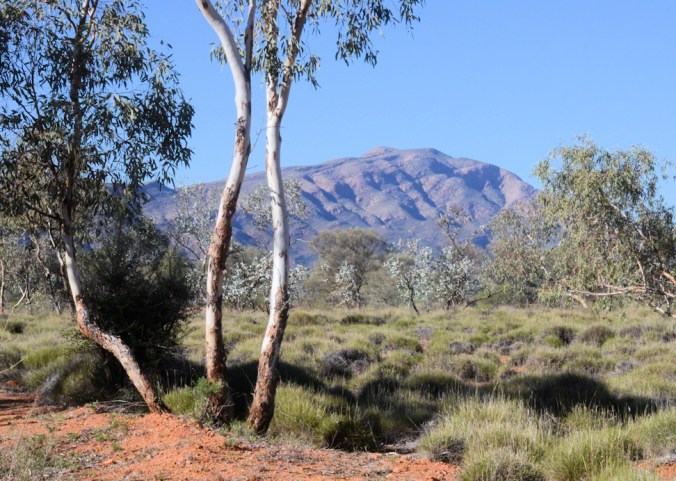
[In 2013, the T-Team, next generation embarked on their pilgrimage to Central Australia. Purpose: to scatter Dad’s ashes in his beloved Central Australia, in Ormiston Gorge.
One Friday a month, I will take you on a virtual trip to the Centre and memories of that unforgettable holiday in 2013, with my brother and his family; the T-Team Next Generation.
This time, the T-Team leave camping in the desert behind and tackle the complexities of civilisation—Alice Springs … All on a Sunday.]
Imposters
Less than one hour later after leaving Hermannsburg, we checked into the Stuart Caravan Park on the edge of Alice Springs. The reception, cast in long shadows, signalled the fast-approaching night and uncertainty that comes with not booking a site. Would there be one for us?
Fair point. Why book a cabin and campsite if you can stay with friends and save money?
‘Looks like someone impersonated our mum and snaffled up her cabin,’ I said.
‘Mmm! That’s a bit rough,’ Mrs T said, ‘Hope she can get her money back. She can stay with us if she likes.’
I looked to Mum T. ‘You can stay with the T-Team at their friend’s.’
Mum T smiled. ‘It’s okay, the manager has given me another cabin free of charge.’
Glad that we had decided to return to Alice Springs and had been there to support Mum. Still, rather ironic that, Mum, who had been the first to book her cabin way back in March or April to ensure she had a booking and not miss out, was the one who almost did. Still, she got hers free.
In the golden tones of late afternoon, Anthony and I set up our tent and then took a leisurely stroll around the caravan park and onto mum’s cabin. Fortunately, her cabin was near our sons’. On the way we “happened” to pass the cabin containing the fake T-Team. There they sat, out on the front porch, an elderly couple and a younger couple. Didn’t appear to be your average criminal type or distant relatives even.
Visited the boys’ cabin. Son 1 and 2 had settled in for the night, happy with the comfort that the rooms afforded. Son 1 particularly pleased that he wouldn’t have to hear our snoring.
Son 2 however asked, ‘What are we doing for tea?’
‘Maybe we can go to a hotel to eat,’ I said.
My husband frowned. ‘What? Are we made of money?’
‘You want to cook?’ I questioned. ‘Anyway, it’s Mum’s and the boys’ last night up here, they leave for Adelaide tomorrow.’
Anthony sighed, ‘Oh, alright!’
Sprinted over to mum’s cabin and knocked on the door. Mum, holding the phone, ushered me in. Then I stood in the small lounge area while Mum sat at the tiny wooden table, phone glued to her ear.
I waited.
Mum, with phone at her ear and silent, waited.
‘What…?’ I began.
Mum batted her free hand at me to be quiet.
So, I waited.
And waited.
Might as well do something while waiting for goodness knows what. Must be something to do with the imposters, I thought.
‘Yes…’ finally, mum gets a response, ‘yes, right…nine o’clock tomorrow…be there half an hour before…no, we don’t have any luggage; only hand luggage…Right, thank you.’
‘Not news about the T-Team imposters, then?’ I laughed.
‘No, just had to do the check in with Qantas for the boys’ return trip tomorrow,’ Mum replied.
Only then, was I able to discuss with mum about going out for tea. Of course, the suggestion was fine by her.
Oh, dear! I must’ve been deep in the rabbit-hole of painting yesterday. See what I painted in one sunny mid-winter’s afternoon, yesterday. Anyway, being what was intended to be Family History Friday for Tru-Kling Creations, went down a rabbit-hole and ended up somewhere else.
Check out the re-blog of the story of my great-great grandfather from Silesia.

















 Tru-Kling Creations