Here I was, merrily thinking the exhibition at Brighton Central finished on Saturday. Then my art and writing friend informed me it’s Sunday. So, there you go, a bonus day. If you have time and are in Adelaide, head down to Brighton Foodland, corner of Edward Street and Brighton Road, to view this brilliant display of artwork. Again, Marion Art Group (MAG) has done well, paintings selling like hotcakes at times.
So come, treat yourself, and have a look.
Meanwhile, click on the link below and read my story behind one of my paintings, Ghost gum, Western MacDonnell’s.
[In 2013, the T-Team, next generation embarked on their pilgrimage to Central Australia. Purpose: to scatter Dad’s ashes in his beloved Central Australia, in Ormiston Gorge.
Once every month, I will take you on a virtual trip to the Centre and memories of that unforgettable holiday in 2013, with my brother and his family; the T-Team Next Generation.
This time, a crazy robot toilet incarcerates me.]
The Trucks of Terror
Morning and the dawning realisation why this campsite may not have been popular. Anthony stomped around the tent, grumbling.
‘I got no sleep last night,’ he snapped. ‘Kept getting woken up by those trucks rumbling all night. And their lights. Just as I drifted off to sleep. Those lights shining into our tent.’
‘Will you be alright to drive?’ I asked.
‘Why wouldn’t I be?’ he sniffed. Anthony was a man, after all, and infallible.
We moved like snails, packing up. I loaded the Ford’s rear with stuff. Next minute, Anthony was there unloading and repacking. Must do it right, even on the last leg of our journey.
While he played his version of luggage-tetris, I wandered off to the BBQ hut to check for any forgotten items that might lurk there. And behold, sitting rather smugly in a rather obvious position on the bench next to the BBQ facilities was Anthony’s water bottle. You just have to wonder whether the water bottle had legs and hid when we were searching for it the previous night. Then, when it realised that it might be left behind, it positioned itself in the fail-safe position to be found. The water bottle is not the first item to “hide” from me and then “reappear” in a place where I have looked a dozen times before …
There was much rejoicing over the lost water bottle that was found.
Owing to Anthony’s meticulous care in packing, we were the last to leave the campsite.
As we travelled the long monotonous stretch, I slept a bit, wrote in my diary a bit, and then stared out the window at the red earth, gibber plains, and twisted corkwood trees.
‘That’s okay, blame it on the trucks that kept us awake all night.’
‘I swear that there was a truck that shone its lights straight into our tent.’
‘Yeah, it seemed that way,’ I replied. ‘Perhaps we can stay at Woomera in a cabin tonight and get a decent night’s sleep.’
‘Yeah, why not!’
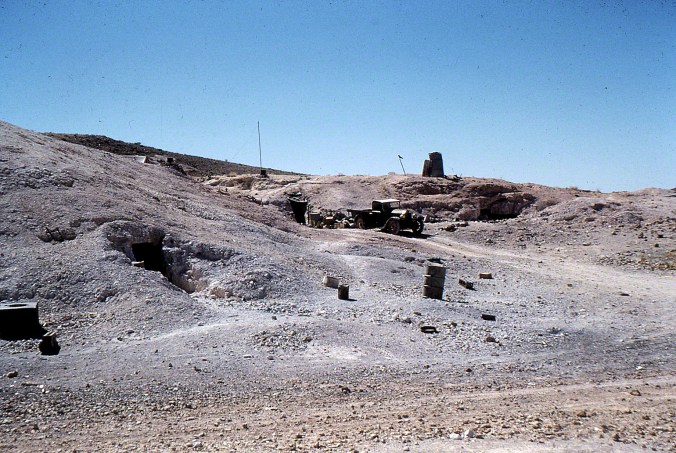
Around two o’clock, the landscape evolved from flat and stone scattered to low-lying hills pockmarked with what appeared to be giant rabbit holes. Signs warned visitors to beware of mineshafts.
‘And where do you suggest?’ Anthony glanced at me and then gazed at the mineshaft-littered hill face.
‘A service-station? Or a pub?’
‘And where’s the service station?’
A tour of Coober Pedy yielded no service stations that we could find. And he who wanted to save money and eat a picnic lunch was not willing to enter a pub for the loo in case it entrapped us into eating in there.
‘What about the playground and BBQ area where we had tea with the T-Team on the way up to Central Australia?’ Anthony suggested.
Bad suggestion …
But, at the time, I agreed. Lunch and loo visit in one hit.
2. Chaos in the Can at Coober Pedy
We settled down at a picnic table near the automated toilets. Anthony prepared the sandwiches while I dashed into the “robot” dunny to do my deed.
While I sat on the tin throne, country and western-come-Hawaiian music clanged away. Did I detect a banjo while the toilet roll unfurled itself for me? No button to flush. Oh, well. Once I washed my hands, the toilet duly flushed. Then, I placed my hands under the air-dryer. As usual, I am invisible to this universe and the cohort of air-dryers that belong to it. The air-dryer refused to acknowledge me and blow air on my wet hands. Oh, well, I’ll dry my hands with my own towel from the car that exists quite happily in my universe.
I step to the sliding door and press the large blue button. The music volume increased. But the doors did not oblige. I pressed the blue button again. Nothing. Just the demented music. Becoming more demented.
I read the instructions. And pressed the blue button again.
Nothing.
I hit the button.
Kicked the door.
I sat down by the stubborn, un-sliding door.
And waited.
Instructions said I must vacate this automated, locked-down establishment in ten minutes. As if to press its point, the “robot’ toilet ramped up the annoyance level of the music.
What’s worse, I had entered this pongy prison without my mobile phone. Or jumper. It was cold in there.
Anthony called from the outside. ‘What’s going on?’
‘I’m trapped,’ I replied. ‘The toilet won’t open.’
‘Have you tried to push the button?’
‘Yes, a million times.’
‘Well, you must’ve done something wrong.’
I noted that the blue button had written on it “touch free” and then I figured, That’s why the toilet’s incarcerated me. Touching it must’ve broken its rules. ‘Has it been ten minutes yet?’
‘Not yet.’
Then, the blue button, which I’m meant to push for my release from this demented can, the button that has “touch free” displayed on it, lit up and vibrated. But the door refused to budge.
I pushed the door. No joy. It stayed locked, and the not-so-ambient music went on and on like some crazy organ-grinder.
I was starting to imagine a security guy in some dug-out office in the middle of Coober Pedy laughing at this old jailbird (me) … when …
A voice from above warned, ‘You have exceeded your stay; you must exit immediately.’
‘Not that I haven’t wanted to,’ I snapped back. Pushed the vibrating bright button, yet again. Pulled the door. Still as stubborn as.
‘You have exceeded your stay. You must exit immediately.’ Followed by the crazy music.
I rolled my eyes. ‘I wish.’
Watched the door. Hoping. Praying it would open.
‘You have exceeded your stay. You must exit immediately.’
I waited and watched. ‘You might need to call the police or emergency services to release me,’ I told Anthony.
As if it heard my warning to call the authorities, the door slid open. I leapt out. ‘Yay! I’m free! I’m free!’ I jumped and danced in front of a rather unimpressed husband. ‘I’m never going to be in one of those things again! I thought it was never going to open!’
‘Come on, let’s have lunch,’ Anthony snipped, ‘We’ve already wasted twenty-five minutes.’
‘Not before I get my jumper, I’m freezing. You don’t know how cold it was in there. I’m never going into a toilet without my mobile phone or a jumper. Ever.’
As we munched on our sandwiches, a brisk wind chilled us to the bone, even with an extra layer of clothing on. A little indigenous boy scampered into the evil “robot’ toilet. Less than a minute later, he exited. Anthony then went into the same crazy “can” and was out in two minutes.
‘How did you do that?’ I asked.
Anthony replied smugly, ‘I pressed the blue button.’
‘So did I, a dozen times.’
‘You must’ve done something wrong.’
‘Just my luck, I had to be incarcerated by the toilet.’
So, out on parole from the Cooper Pedy “jerry can”, we escaped this town and headed for Woomera.
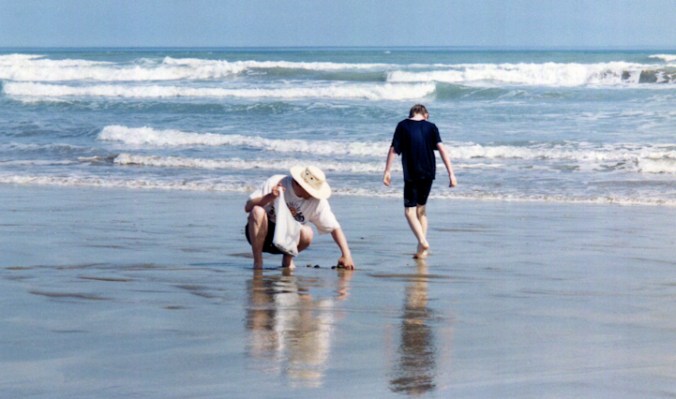
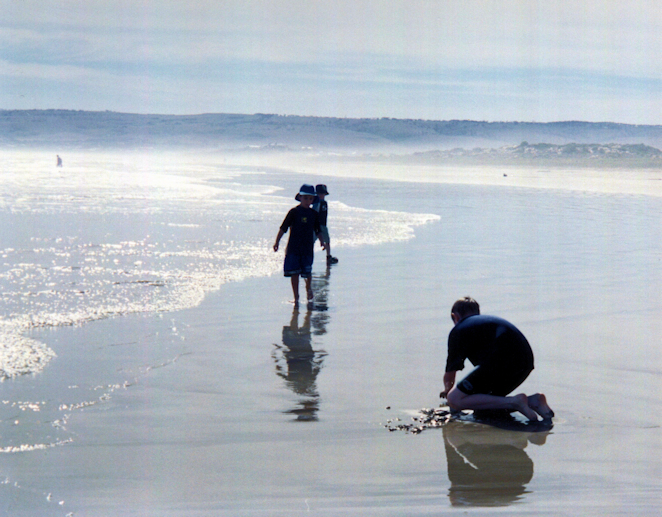
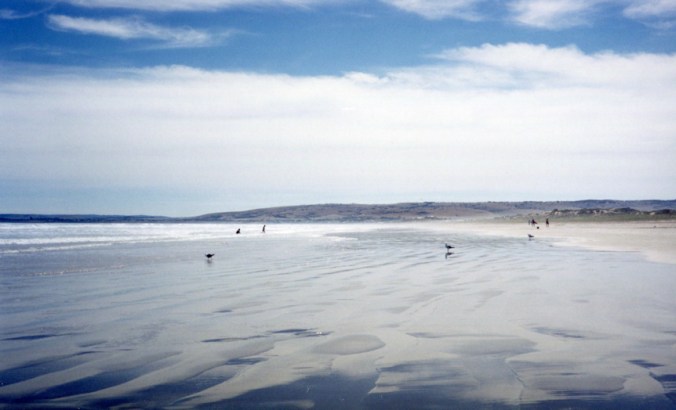
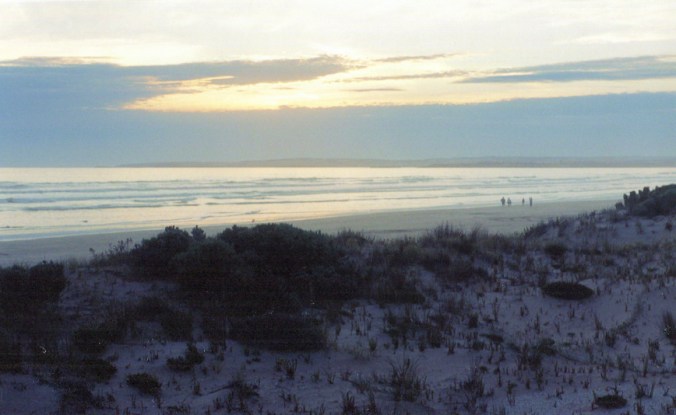
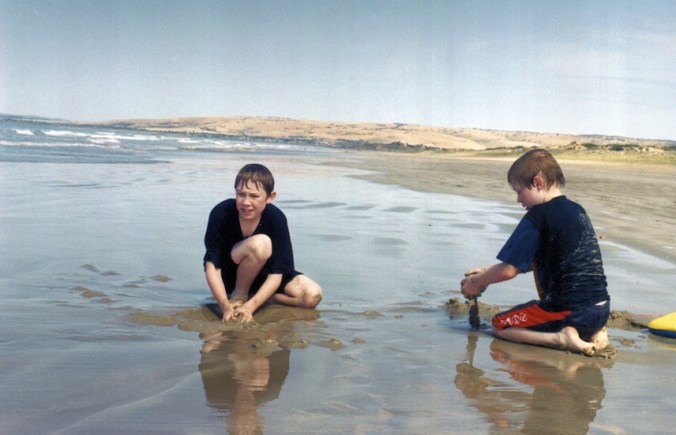
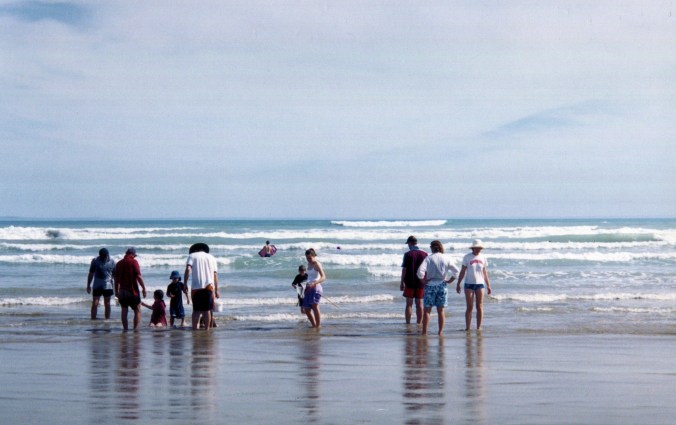
[Marion Art Group is holding an exhibition at Brighton Central Shopping Centre (Brighton Road, South Brighton), May 18-30, 2026. One of my artworks to be displayed, Cockling at Goolwa in Pastel, revisits the K-Team’s journey down “memory” highway, 100 kilometres south of Adelaide to Goolwa Beach on the far-flung edges of the Fleurieu Peninsula. Remembering our time with friends 24-years ago searching for cockle shells in the sand.]
Cockling at Goolwa
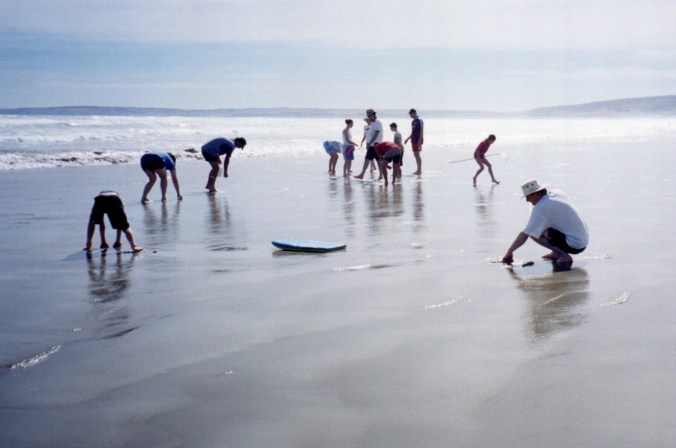
A picture, they say, tells a thousand words. So, what is Cockling at Goolwa’s story? How can the simple heel-toe dance of “cocklers” (people who dig for cockle shells), their feet sinking in the soggy sand of the incoming tide, in the flux of early summer warmth, on a remote beach south of Adelaide, tell us? What story is worth a thousand words? What was it about this scene that attracted me to capture it? First in photo and then several years later, on canvas in acrylic, and then recently in pastel.
I think the water reflecting the sky, all silver, the people on the wet sand, a mirror, swaying and twisting for cockles captured my attention. I’d been there, on the glassy surface, watching for bubbles, grinding my heel into the bog, feeling for the sharp edges of shell and plucking out the cockles that snapped shut when exposed to air.
‘What will you do with all those cockles?’ I asked.
‘They’re for fishing,’ one of our friends said. ‘Bait for fish.’
‘Hopefully, we’ll catch a few fish and have them for dinner tonight,’ another said.
I imagined fish, fresh from the sea, thrown on the barbeque and the cockle bait inside them buried once again in our stomachs. We continued digging for cockles…family and friends, one with the ancient, outside time—nothing else matters but the cockles.
Goolwa, if I remember, has mounds of spent shells in the sand hills, monuments to generations upon generations of Indigenous Australians, their open-air kitchens and meals. Did they perform the same ritual, on the same patch of wet sand, delving for cockles to fry on their fires? A quick perusal of Google reveals they used nets to collect cockles and catch fish. They then cooked the cockles on a campfire.
We are here, they are gone, but their spirit of history lingers, reminding us, though we seem different, we are the same. We are digging, dancing, and delving for our dinner. We are still, in the moment, alone in our thoughts in a forgotten corner of the world, unknown by the world, yet one with this country’s past. And God knows each one of us—each part of us, even the unknown parts of ourselves and our secrets.
What if I shared a little secret—an artist’s secret? Okay, I’ll tell you. I painted this picture in less than two hours. Now that I’ve told you, would the painting be worth less to you? Must time be equated with worth? Sometimes I do take hours upon hours, layers upon layers, and more hours planning to get the work right. But not Cockling at Goolwa.
I love the beginning of a painting; laying the foundation, engaging my inner-natural child, the paint flowing from a thick brush on a damp canvas, colours blending, mixing as I go. One side of the brush is crimson, the other blue, and a dab of white. Sienna is somewhere there in the foreground, shadowing the sand. Mid-yellow was added incrementally to shroud the distance in light grey for perspective. Then just a hint of heads of land jutting out halfway across the horizon with a suggestion of ultramarine in the grey. So simple, and sometimes, like with Cockling at Goolwa, the scene emerged before my eyes. In the world of artists, I believe the term “magic brush” or “magic hand” has been used. Um, trade secret, so don’t go spreading it around.
So, there you have it, in less than an hour, surf, sand, sky, and tones in all the right places.
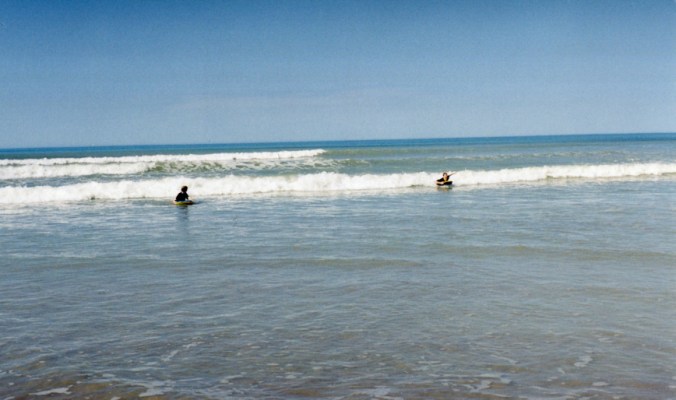
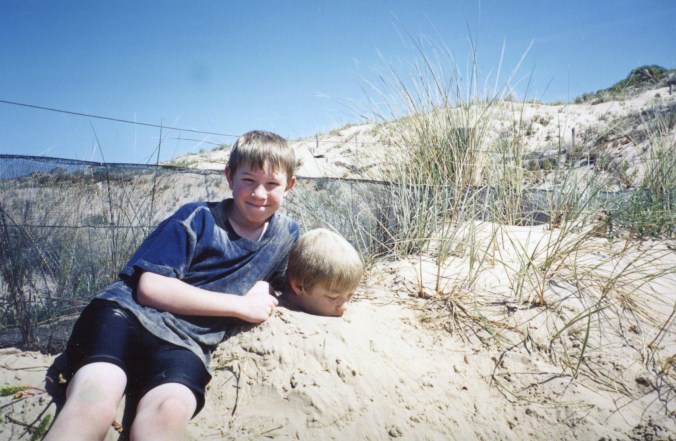
Now for the people, the twisting, turning people, their feet in the boggy sand. How do I paint them? I had a break and drank a cup of tea. I remember not all the children hunted for cockles. Some kids body-surfed in the shallows, some played cricket, and one little boy with a wish to be hunted, or to be warm, buried all his body except his head in the sand. I found him, and he broke out of his sand-grave, the sand zombie.
‘Don’t go tracking your sandy footprints into the shack,’ I said.
He washed himself off in the surf, then sat wrapped in a towel and shivering in the sun while watching the cockle hunt.
All the while, the “cocklers” cockled for cockle shells. Soon, the boy joined the hunt for cockles.
Then, when the paint was dry, I plotted the people in with a pencil and then painted them in with a finer brush.
‘I like that painting,’ a fellow member of the art group said. ‘Don’t do another thing to it. Don’t even frame it. I’ll buy it as it is. How much do you want for it?’
Paint barely dry, I took the work home, signed it, and then the next week at our Christmas lunch, I delivered Cockling at Goolwa to them. The buyer showed the work to others at their table, and all admired it.
What made another person connect with Cockling at Goolwa? For this person, their son and family spent many summer holidays at Goolwa, doing just that, cockling. Time out, out of time, unwinding, relaxing, happy times, happy memories, captured on canvas…in less than two hours. And I must admit, the story is slightly less than one thousand words.
But perhaps as you look at the copy of Cockling at Goolwa, you may have a story of your own about the painting. Maybe a painting’s story is not just one person’s story, but stories from many people, one thousand words, or more…
As far as conferences went, not a bad one. Lots of singing, worshipping God, that is, lectures, Bible Study, eating, and meeting new friends and old friends too. Our accommodation was down Anzac Parade, about five kilometres, halfway to the beach. I shared a small apartment with Rick and Dad. Dad drove me back and forth from the conference centre at Randwick. Not sure what Cordelia did, but I think she connected with other members of her family who attended the conference and stayed with them. Rick, I think, ferried Mitch and Jack to and from the conference centre.
This arrangement becomes relevant later in the week of the conference.
One session that stands out was the one on relationships.
Rick and I sat side by side in the front row.
This will be interesting, I thought. Maybe I’ll get some tips on how to get a boyfriend and be popular like Cordelia.
‘So,’ the speaker said, ‘How many of you have had a boyfriend or girlfriend?’
Everyone, including me, raised their hands. Everyone, that is, except my brother Rick.
‘What? You’ve never had a girlfriend, Laddie?’
‘Nope?’
The speaker pointed at me. ‘What about that lovely girl next to you?’
Towards the end of the conference, one more event stood out.
Dad told me to wait for him at the hostel apartment where we were staying. After lunch, we had an afternoon of free time before the final worship session.
I returned to the apartment for lunch with my brother and friends, eager to catch up on some rest and lose myself in a book. Maybe some journal writing, which had been neglected in all the activity and excitement of the conference.
However, upon my return to the dreary grey corridors of the hostel, my door was locked. Oh, well, Dad said he won’t be long.
I had nothing with me. All my supplies of entertainment and comfort were locked away in the apartment.
So, I sat.
For hours.
After two hours, I began to sniff.
Then snivel.
Then finally, cry.
A lady poked her head out of a nearby door. ‘Are you all right?’
I wiped my eyes. ‘Yeah, I’m fine.’
She retreated into her apartment.
I looked at my watch. Five o’clock! I’d been waiting for almost three hours for Dad.
Convinced that he’s forgotten me and I’d be waiting for another five hours with that lady sticking her nose in my business every so often, I stood up. Stiffening my lip in grim determination, I marched out of the hostel and strode up Anzac Parade.
Along the cracked pavement. Past long neglected houses. And cared-for ones. Over busy roads at the lights. Narrowly escaping any impact with red-light-running cars. In the humidity. Under light rain. Taking a wide berth around the many hotels. And leering drunks who spilled out onto the footpath. In the ever-fading light that faded into dusk.
Five kilometres and forty minutes later, I entered the conference centre. The session where all had gathered was concluding with prayers. All in a circle holding hands. I slipped in the circle.
The boy next to me squeezed my hand.
Oh, he’s just being kind to poor little old me, I thought. After all, if even my father forgets me …
After over tea and biscuits, my miffed Dad asked, ‘Where were you?’
‘What do you mean? I waited three hours,’ I retorted.
‘Couldn’t you be patient?’
‘Not when I couldn’t get into the room,’ I said. There was a limit to my patience.
‘I went to pick you up, and you weren’t there,’ Dad said. ‘I told you to wait.’
‘And what time was that?’
‘Oh, er, um, about …’ Dad’s voice faded, ‘about five.’
‘Well, I was there at five, and I didn’t see you.’ I sniffed. ‘So, I walked.’
‘But don’t you know how dangerous it was to walk here?’ Dad is showing so much concern after forgetting me for the whole afternoon.
‘I’m here, aren’t I?’ I replied. ‘I prayed, and God protected me.’
‘He did. Praise the Lord,’ Dad said, and then wagged a finger at me. ‘But don’t you ever do that again.’
Our return to the less crowded and more sedate city of Adelaide was serene and uneventful, as was the fair city itself. Especially at the time in 1979.
A few highlights. Mostly, in fact, all are associated with the Blue Mountains. We had missed the beauty and wonder of the mountains on our journey to Sydney, so Rick endeavoured to show us these mountains in daytime on our trek home.
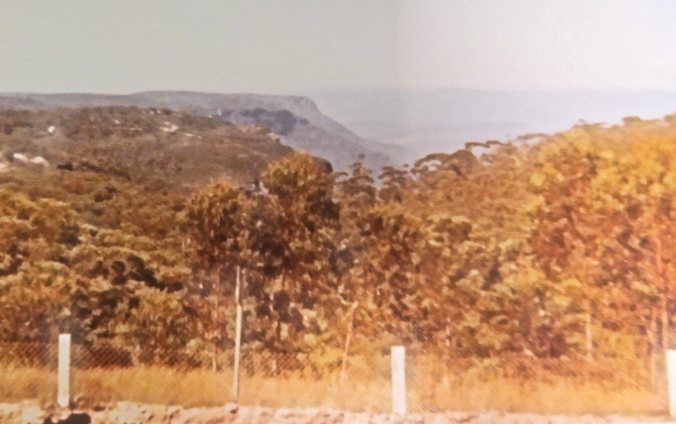
At the lookout to the Three Sisters, we lunched and admired the majesty of God’s creation. Even Rick, using his Polaroid camera, took photos of us admiring the scene. He was taken with the layers of misty blues and subtle greens cascading down into the depths, while the cliff tomes forming the Three Sisters presided over the valley.
I burst out in song, and Cordelia joined in.
After a chorus, Cordelia said, ‘You should try out for the worship band.’
‘Me?’
‘You have such a sweet voice, although it does need to be stronger.’
On the drive home, I considered the prospect of trying out for the band. Perhaps singing in front of the church would make me more popular with the boys. Like Cordelia. But in the end, I decided against it. Too hard. Too much of a challenge for plain old me. After all, the worship band was a highly coveted affair, where lead singers jealously guarded their position. I’d never have a chance. Sweet voice, but not a strong voice, would never cut it.
Back at school, I continued my enjoyment of music, singing in the choir. But I’d always secretly envy the soloists with their stand-out song voices. The stars, with their melodic, strong notes, capture the audience’s focus on them alone.
Instead, in the new year of 1979, my passion turned to art … and writing. These were the gifts God had given me.
[This account is based on a true story, but the names of the people have been changed, to protect the not-so-innocent…yada, yada, yada…so truth be told, it’s fiction to entertain.]
Neighbours to Entertain
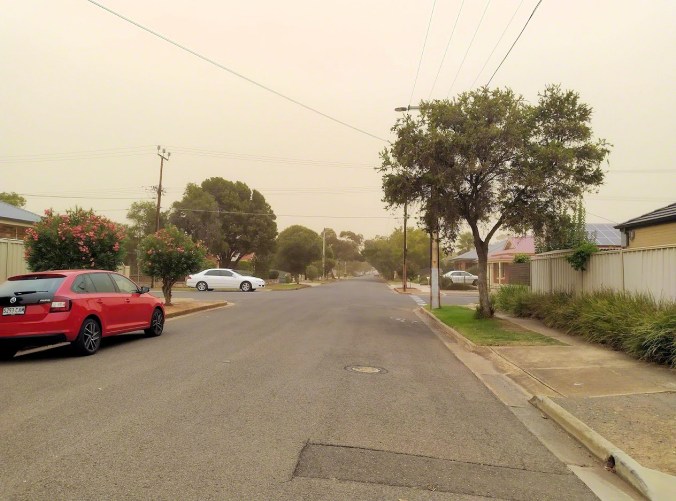
Gliding home in her Toyota, Mum waved at the children gathered in the street around the corner from her place. Karl, her younger teenage son, scowled, ‘Why did you do that?’
‘Just being friendly, love.’
‘Stop being friendly. It’s embarrassing!’
‘Just changing the culture, you know, trying to make this community more friendly.’
‘We should just keep to ourselves,’ Karl muttered. He slouched in the passenger’s seat and pulled his hoodie over his eyes.
‘Now, remember to let your brother, Phillip, in if he comes home before me,’ Mum said.
Karl mumbled a reply that Mum hoped resembled the affirmative in “Karl-ish”.
The mother dropped her sulking son home and tootled off to her hair appointment in a nearby shopping centre. The hairdresser was very chatty, filling Mum in on all the latest gossip and then emptying her purse of cash. Mum didn’t trust credit cards; she always paid in cash. After shopping at the local supermarket, she loaded her environmentally-friendly cloth bags filled with groceries into the trunk of her car and sailed back home.
She pulled up the driveway and observed Ned, who lived across the road, leaning against his fence and peering over at his neighbours. “Never trust a man in brown trousers,” her friend used to say when she spotted the man lurking in his garden. Ned was wearing the said trousers and a dirty white singlet that day.
‘I wonder what he’s up to?’ Mum murmured as she dragged the groceries out of the trunk.
Shouting echoed across the road.
Mum placed her loads down and then ducked behind the acacia bush. She watched through the lattice of leaves and listened. JP, the father of the young family next door to Ned, raged at a pot-bellied man.
Mum frowned. ‘Poor JP, still in his pyjamas. Hmm, he doesn’t look happy. Wonder what Potbelly did to wake him up?’
JP jabbed his finger at Potbelly. ‘Get out of my home!’ he yelled. ‘I’m a shift-worker! You’re disturbing my sleep!’
Potbelly edged backwards up the drive as JP drove him up there with his finger-jabbing.
JP’s daughter darted around Potbelly. She waved her arms around and pleaded, ‘Please! Listen, Mister…’
‘Get inside!’ her father snapped. Then back to Potbelly. ‘What gives you the right to come knocking on my door—waking me up. Did I mention that? How dare you accuse…Rah! Rah! Rah!’
Three more children emerged from the shadows and joined the dance around Potbelly, squeaking their protests. The grown men, as if bulls, launched at each other, locked horns with words, and flailed arms on the edge of blows.
Mum darted to her carport door where she watched, willing their fists to cuff. She breathed out. ‘More exciting than television.’
One boy, maybe a friend of JP’s son, lifted a mobile phone to his ear. The men, angry eyes only for each other, ranted.
JP bellowed at his kids, then, steering them into the house.
Mum sighed and then crept around the back of her home, entering through the rear door. Pushing aside the living room curtain, she observed the continuing drama.
Mobile-boy’s mum rolled up in her little red Honda sedan. Voices now muted by the intervening glass, Potbelly, his face the colour of beetroot, railed at her. He pointed at the boy. Clutching his mobile, the boy ran the back of his hand over his eyes, and his shoulders shuddered. His mother raked her fingers through her dark curls. JP’s boy and girl stepped out of their home. They stood on each side of “Mobile-boy”, placing their arms around him.
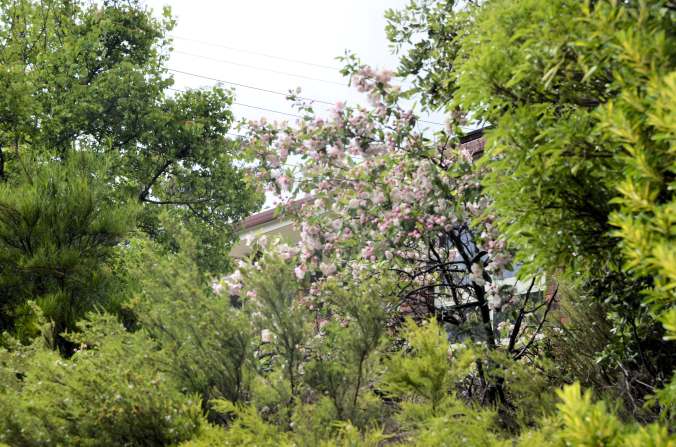
‘Mmm, this looks interesting,’ Mum said, and on the pretext of taking out the clothes-washing, slid out the back door. Instead of heading for the clothesline, she wandered down to the side gate and poked her head over it. ‘They can’t see me, but I can hear them,’ she whispered while catching glimpses of the action through the shifting apple tree branches in the breeze.
‘But we can’t find it!’ JP’s boy bawled.
‘We’re sorry, we didn’t mean it,’ JP’s daughter bowed before Potbelly, whose elbows jutted out as he bore down on his victim.
Mum moved her head left and right. ‘Trust the bush to be in the way.’ She then scuttled around the backyard and out to the carport again. ‘Darn! What happened?’
Potbelly and Mobile-boy’s mum were shaking hands. Then he shook the hands of another parent, a man.
‘Must’ve turned up when I wasn’t looking,’ Mum murmured before returning to the backyard. She disappeared into her home to continue on with her life and dinner.
Pot-belly’s voice boomed. Mum dashed back outside to her stake-out position behind the carport door.
‘You see,’ Potbelly said to Ned, who still leaned up against his neighbour’s fence, ‘I saw them by my car. Fiddling with the wheel. By the time I got there, to them, they had run off, and my hubcap was gone. It’s a Porsche, ya know. I chased them and caught up with them here. I want my hubcap back!’
Mrs. Mobile-boy-mum spoke, but the wind caught her words and blew them away. She pointed at JP’s carport door. Then the children and Mrs. Mobile-boy-mum rolled it up, revealing the way to JP’s backyard.
Ned eased himself off the fence and followed the procession into the backyard of interest.
‘I wonder if they found the hubcaps?’ Mum said.
‘Wha?’
Mum turned. Karl towered over her, his arms folded across his chest of a black windcheater.
‘What’re you doing, Mum?’
‘Er, um … just looking for the … I thought I heard … there was a disturbance … just checking it out …’
Karl tossed his head and flicked the dark fringe from his face. ‘You’ve been spying again, haven’t you?’
Mum glanced across the road. Ned and Potbelly had resumed their station leaning against the fence and mumbling in low tones.
Karl’s brother, Phil, backpack loaded with university books, strolled up the driveway. He threw a look behind him. ‘What’s up with those two? What’s with the glares?’
All was calm, all was quiet. Karl had slept contentedly while his mum, dad and brother ventured down to some local hills spring festival. Karl smiled, pleased that his demand for his family to stay in their own little box, out of neighbours’ way, had been obeyed … And that he didn’t have to take any more drastic action.
‘Thank goodness nothing came of Mum’s spying,’ he said, smacking his lips. He patted the shiny hubcap under his bed, sighed, and then drifted into the dreamy entertainment of his childhood lost.
He was glad he’d been friendly to the neighbourhood kids the other day.




 Tru-Kling Creations