Water and Theft are the prevailing themes this week. On Tuesday I was rudely awoken from my slumber by Hubby rampaging through the bedroom in search of his transport pass. With a sigh, I got up and helped in the search. After scouring the house, Hubby looked online and discovered someone had used his card the previous Sunday. Not him. The card had indeed been stolen. Hence the process of cancelling the card and transferring the funds to a new one. I’d like to see the disappointed expression on the face of whoever nicked the card when they try to use it next.
Meanwhile, Adelaide’s seawaters have been plagued by a nasty algal-bloom; the worst in the world—ever in all history, apparently. Dead sea creatures have been washing up on shore in apocalyptic proportions. Mum’s neighbour is putting in a swimming pool. No swimming in the beach waters this summer, or many to come. Mum and I lunched by the beach at Glenelg curious to see how discoloured the water would be and how many dead fish and other creatures we’d spot on the shore. We’re still alive. Didn’t notice any discolouration of the sea. Saw some birds skimming the water and diving for fish. Good luck to them, I say.
August is almost over, and Adelaide has been enjoying the SALA festival, I thought this cheeky little piece, a 100-word challenge might fit the bill, so to speak. The actual incident of imagined “water-theft” took place several years ago, but I believe the gallery involved still takes their rules very seriously.
100-word Challenge
Stolen…Almost
‘Where can we get some water?’ my friend asked.
I pointed at the casket of spring water languishing in the gallery. ‘There’s some just there.’ A glass wall confined the well-watered and wined gallery guests. We had been guests, but this gallery was devoid of seats. We wanted to sit. And eat.
‘Sign there bans wine not water.’
I stowed into gallery, collected cups of water and walked to the door.
‘Where do you think you’re going?’ self-appointed wine-police snapped.
I placed the stolen water back on the table and left.
Transubstantiation. My first virtual miracle; turning water into wine.
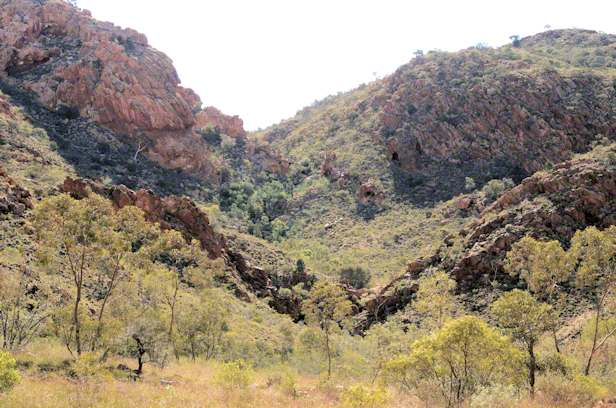
[In 2013, the T-Team, next generation embarked on their pilgrimage to Central Australia. Purpose: to scatter Dad’s ashes in his beloved Central Australia, in Ormiston Gorge.
Over the next few months, I will take you on a virtual trip to the Centre and memories of that unforgettable holiday, with my brother and his family; the T-Team Next Generation.
This time, the T-Team explore historic Hermannsburg, but fail to find any ghosts.]
Mystery in Historic Hermannsburg
We checked out the old school room. Mum reminisced the terrors of teaching the fellow missionary kids who were barely younger than her. They just refused to listen or obey her. Some were constantly daydreaming and never did their lessons. Mum vowed never to teach again. She escaped this teaching fate by getting married…to Dad.
T-Tummies began to grumble and so, the T-Team Next Gen decided to head for the Precinct Café which had been the Manse of the Hermannsburg Missionary Supervisor.
As we investigated the old rooms that had been converted into a souvenir shop and tea rooms, Mum said, ‘This is the room Dad and I stayed after we got married.’ I took a photo of Mum in that room which was now filled with souvenir clothes and hats.
Finally, Mum and I approached the counter and asked the young Arunda lady serving, if we could have a table for our party of ten.
She guided us to some tables on the porch where we could sit. Along the way, Mum mentioned to her that she used to live in the house. From that moment on, this lady could not do enough for us, making sure we had the best slices of apple strudel and helping us with the self-serve tea and coffee.
When she had left us to serve someone else, Mum whispered to me, ‘I think she is GW’s (an elder) granddaughter.’
Later, as we were leaving to explore more of the village, the girl who had served us ran up to the T-Team to continue the conversation with us about the Hermannsburg of old and answer any of our questions about Hermannsburg today.
Then, she had a question for us. ‘Have you seen or sensed any ghosts?’
We shook our collective heads. ‘No, we haven’t.’
‘Apparently, some people have seen a girl in period clothing, circa 1900. And some have seen an old man in this café. The young girl plays with my children,’ the lady who served us said.
I tried to think back to my previous visits to Hermannsburg. Can’t recall any ghosts then…just dreams of the olden days, way back when…And the pioneer missionaries and Afghans trekking across the desert on horses and camels.
More exploration of the Historic Precinct where Mum walked us through her childhood. First, her old home and the porch converted into a bedroom in which she slept. Now, the home is “renovated” into an art gallery. Her room fetches up to something like one thousand dollars a night for an authentic experience of yesteryear’s accommodation. To think, I did that virtually for free in the 1970’s…not her room, but…
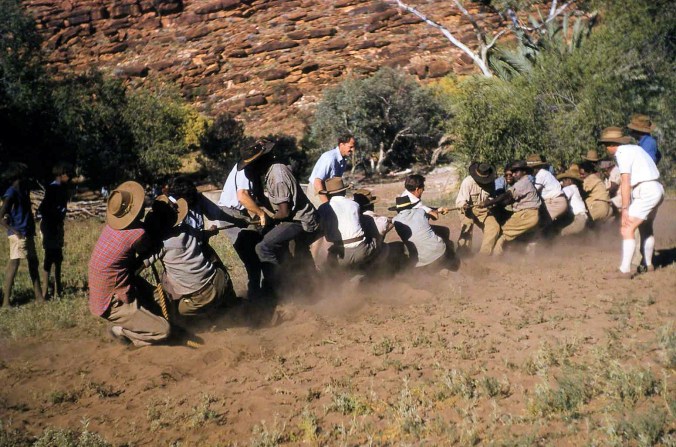
Then, the native girls’ quarters and the native boys’ quarters. Once upon a time, one hundred years ago, they were locked in at night, so they wouldn’t escape and get up to mischief.
Then the huge shed; a museum of machinery and long-forgotten technology, for butchering cattle, and tanning of kangaroo skins. Outside, my niece sat on an old tractor.
While the T-Team Next Gen rested at a picnic table by the morgue, and Anthony filled the water canteens, Mum shared how, as a child, she and her sisters played funerals. ‘We’d dance around the table pinching our noses.’ Apparently, back then, funerals were a regular occurrence. Mum added, ‘The most eerie experience was the wailing by the Arunda when someone died. Sent shivers down my spine.’
Meanwhile Anthony battled with the nearby water pump which was situated just behind the Historic church building.
Mum glanced over and remarked, ‘Last time we visited in 2010, we were told about this competition Hermannsburg and another mission were in for who had the holiest water. Someone had drunk the water from this other mission where the water had bubbled up to the surface through the sand and was healed. So, then, Hermannsburg had to out-do this other mission and also make water with healing qualities.’
Virtual Trekking Behind the Art: Ocean Beach Tasmania
[In the last few weeks, after months of drought, rain. And, almost a month after storms and extra high tides, more extra high tides last Tuesday. So, in memory of the cold stormy weather, here’s an old piece of calm from our Tasmanian travels.]
Ocean Beach lies on the West Coast of Tasmania near Strahan. The wild winds of the roaring forties (between the 40-and 50-degrees latitude) attack the coast with relentless ferocity.
In 2001 I visited Ocean Beach with my family to see the mutton birds coming home to roost for the night. I had barely stepped out of the car before the biting cold wind blasted me and I made a hasty retreat back into the car. No view of mutton birds that evening. Result, no photos.
Ten years later, my mum and I visited Ocean Beach. While the East Coast was inundated with floods, Ocean Beach that afternoon was calm. We explored the beach, taking many photos of this rare state of the beach.
October 2016, the K-Team ventured onto the sands of Ocean Beach on perhaps a not-so-calm day; calm enough though, that we were able to walk along the beach. Not being satisfied with just an obligatory few metres up and down, my husband led us way up the estuary where we spotted a variety of birds, some fishermen, and the lighthouse sitting out there near the heads. Gotta get our money’s worth. After all, he’d seen the potential from the dizzy distance of the cruise boat as it sailed past the heads of Macquarie Harbour. I think if we’d allowed him, we’d still be walking along the coast somewhere around Tasmania.
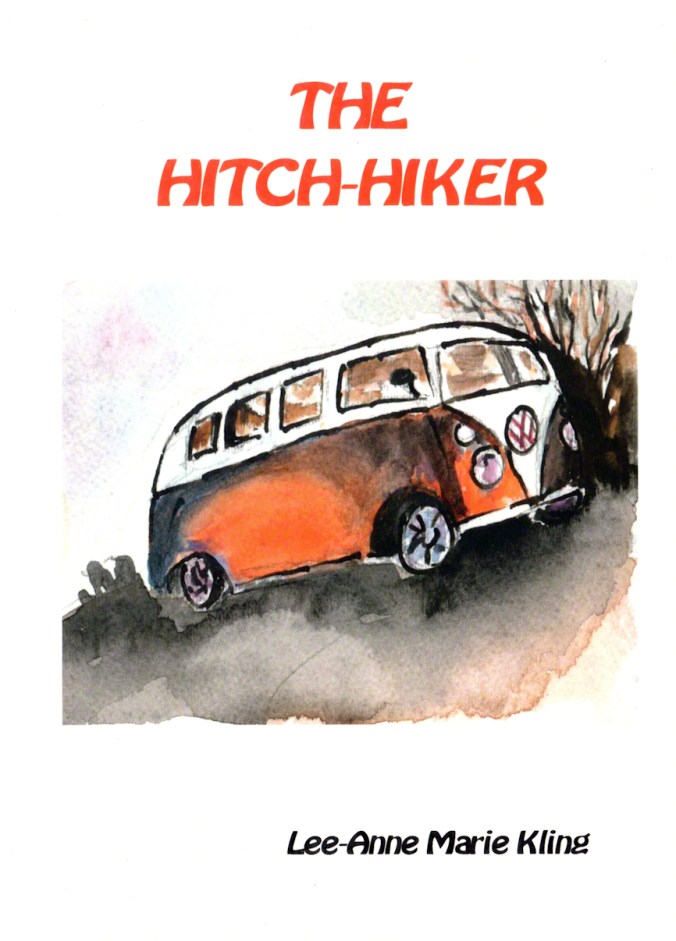
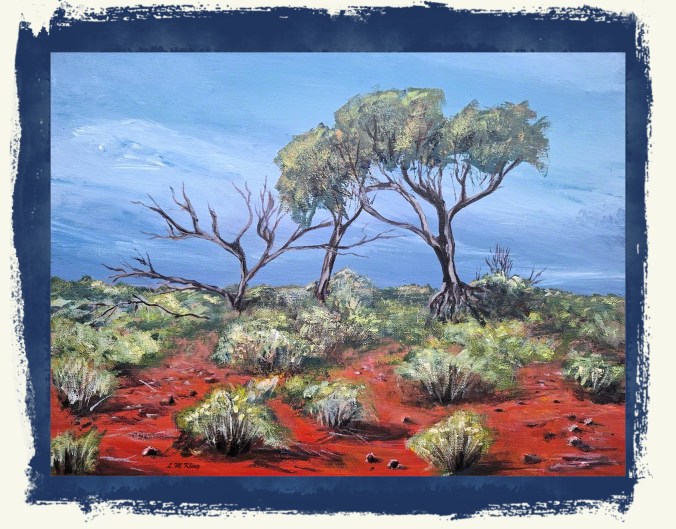
Oh, dear! I must’ve been deep in the rabbit-hole of painting yesterday. See what I painted in one sunny mid-winter’s afternoon, yesterday. Anyway, being what was intended to be Family History Friday for Tru-Kling Creations, went down a rabbit-hole and ended up somewhere else.
Check out the re-blog of the story of my great-great grandfather from Silesia.
[Twelve years ago, the T-Team, next generation embarked on their pilgrimage to Central Australia. Purpose: to scatter Dad’s ashes in his beloved Central Australia, in Ormiston Gorge.
Over the next few months, I will take you on a virtual trip to the Centre and memories of that unforgettable holiday in 2013, with my brother and his family; the T-Team Next Generation.
This time, the T-Team farewell Glen Helen, then struggle with the concept of driving in convoy.]
Hermannsburg
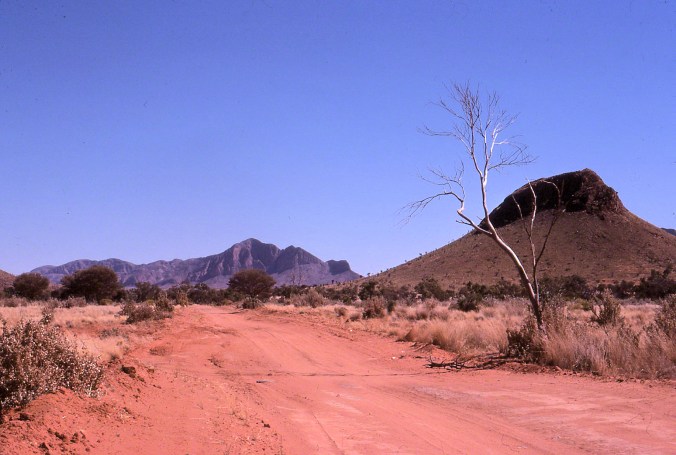
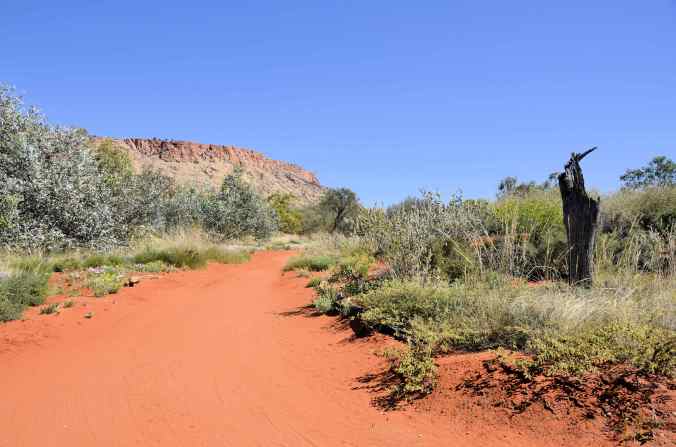
Midday, and Mt. Hermannsburg rose up above the desert scrub; just red sand dotted with tee tree bushes, spinifex and the invasive buffel grass. At regular intervals, horse poo appeared in high piles on the roadside.
I read later that buffel grass was introduced to stablise the desert soil and reduce the risk of bushfire. The problem with this grass is that it is pervasive, compromising the growth of native plant species. PIRSA (Primary Industries and Regions, South Australia) has declared “Buffel Grass under the Landscape South Australia Act 2019”.
A massive animal carcass on the side of the road flitted past.
‘What’s that?’ I pointed, then placed my hand back on the steering wheel. ‘It’s too big to be a roo and too woolly to be a brumby.’
Son 2 piped up. ‘Camel?’
‘Hmmm, hate to think what happened to the vehicle that struck that camel,’ I said.
Not long after the camel carcass, we passed the memorial to Hermannsburg Mission and then a sign welcoming us to Ntaria—Hermannsburg. To our left, a supermarket, a pale brick structure languishing on the edge of a paddock near the road.
‘That’s where our friend, P, from church works,’ I announced. Our friends, P and wife, K had invited us to stay with them in Hermannsburg.
The convoy came to stop on the gravel road edge by the store.
I hopped out of the car and entered the store. Searching for P, I wandered up and down the aisles, filled with the owners of the Land, the Arunda people, but shelves empty of anything to buy. Except for the pie warmer, choc-full of pies, chips and other fast foods.
I approached the check out where an Indigenous lady served a long line of customers, who each held pies, chips, hot dogs, and burgers. I stood in line and waited my turn to purchase an answer to my question.
Finally, my turn. ‘Could you tell me where I can find P?’
The checkout lady stared past me.
‘P? I thought he worked in the supermarket,’ I said.
I waited about 10 minutes while she served a stream of customers purchasing their pies and other junk food.
So, I left.
‘Perhaps we’ll find an answer or P at the Historic Precinct,’ Mum said.
The T-Team convoy led by Mum’s hire car, then continued through Hermannsburg to the Historic Precinct. We passed a gated community. Yes, you heard right, a gated community. Houses painted in bright pastel green, yellow and pink, could be viewed through the cyclone fence, and their occupants sitting in backyards of red sand.
Further on, we rolled past another store. This one painted in pastel blue and decorated with a mural of native bush, mountains, and a kangaroo. Near a broken window, a faded sign, stating its identity as the “Finke River Mission” Store.
Mum waved a hand in the store’s direction. ‘I reckon P works here.’
The door appeared locked by a security gate of thick metal bars. Without stopping, or alighting from the car, I said, ‘I think it is closed on Sunday.’
A few metres on, we parked just outside the Historic Precinct. The wooden gate leading to the old buildings swung in the breeze, open. To one side, though, a formidable sign discouraged us with the words in black letters, “Closed”. Despite this sign and its statement, people wandered across the compound and in and out the buildings.
For the last few years promoting my artwork has taken a back seat to my novels. About time I moved the art to the front seat again. So, for a start, here’s a story combining both memoir and art in the story behind the painting of Mt. Giles in the MacDonnell Ranges, Northern Territoryand the T-Team’s intrepid adventures climbing it.
[Twelve years ago, the T-Team, next generation embarked on their pilgrimage to Central Australia. Purpose: to scatter Dad’s ashes in his beloved Central Australia, in Ormiston Gorge. Over the next few months, I will take you on a virtual trip to the Centre and memories of that unforgettable holiday in 2013, with my brother and his family; the T-Team Next Generation. This time, the T-Team farewell Glen Helen, then struggle with the concept of driving in convoy.]
The sound of boots scuffling in the boys’ section of the tent woke me. I wormed my way out of the sleeping bag, careful not to wake Hubby. He still puffed out the sweet dreams while softly snoring while I crept next door to investigate.
Captured more of Mt. Sonder at sunrise; this time in blue and mauve hues rising above helicopter landing pad. In 2010, Mum and her sister had splashed out and taken this helicopter ride over the MacDonnell Ranges. In some ways an easier way to have a birds-eye view of the ranges without all the huffing and puffing and effort climbing a mountain.
Mum had been there and done that in her youth when she climbed Mt. Sonder with my dad and other Hermannsburg friends. Mum shared just recently, that one of the friends was a rather luscious looking fellow. She puzzled why there seemed to be no photos of this chap in Dad’s slide collection of the occasion.
On my return from this venture down memory lane, I collected some firewood from an old campfire. Hubby narrowed his eyes and growled, ‘We’re not making a fire.’
‘Okay.’
I approached my nephew who squatted by a campfire which he had lit. ‘We’re not making a fire,’ I said and then dumped my wood collection into the fire. ‘We’re not having a fire?’
My nephew laughed. ‘I was just playing with my stick and it broke and went in the fire.’
‘And my pieces of wood just fell into the fire,’ I added.
We watched the flames grow, both chuckling at our insurrection to his Lord-ship’s ban on fire.
After a toilet break, I filled a billy can with water and it made its way onto the coals. The family gathered, enjoying its warmth and relative scarcity of flies and other insects. But for some, like my younger niece, the fire failed to ward off all the flies; especially those tiny little sticky flies that crawl in one’s eyes, nose and mouth. For her, the only solution was to put a re-usable cloth shopping bag over her head.
Following breakfast by the fire that my husband said we weren’t going to have, I washed and packed up my bedding and stuff in the tent. Having done as much as I could to pack the Ford, I walked up to the restaurant with Son 2. He wanted an iced coffee. There, while Son 2 drank his iced coffee, I bought a book about Uluru, and then had a coffee with Mum. We talked with the owner and Mum shared that she had visited Ayers Rock (Uluru) in 1953.
‘We were the only ones there,’ Mum said.
‘Was Dad there that time?’ I asked.
‘Yes, but I was much younger, and we weren’t going out then.’ Mum laughed. ‘One of the ladies lost the sole of her shoe when we were climbing, and Dad gallantly lent his shoes to her and walked down the rock barefoot.’
‘Just like my brother did in 1981 with his cousin. Only they did it as a dare.’
‘Must be in the genes,’ Son 2, who had been quietly listening to the conversation, snorted.
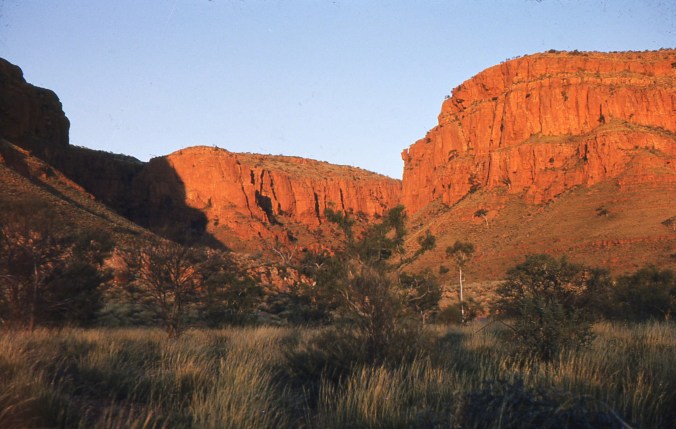
By 10.30am, the T-Team convoy had left Glen Helen, its red cliffs, its flies and the doused and covered fire in a distant mirage and we headed for Ormiston Gorge, again. My sister-in-law wanted to buy a souvenir magnet at the Ormiston Gorge information centre.
We parked at the turn-off, where Mum, Son 2 and I waited in Mum’s hire car for the Ford containing Hubby and Son 1 to arrive, and the T-Team in their white van to appear.
‘What’s taking them so long?’ Son 2 asked.
‘Maybe the Ford won’t start.’ A definite possibility, I thought.
‘Don’t say that,’ Mum said.
‘What about the T’s? They’re late too.’ Son 2 grumbled. ‘We’ve been waiting twenty minutes!’
I sighed. ‘Perhaps the Ford has broken down and brother is under the bonnet trying to fix it up.’
‘Should we go back then?’ Mum asked.
‘Yes, I think we should,’ I sighed again while starting up the engine. I rolled the car forward, performed a U-turn and then headed back to Glen Helen.
Just as we reached the road to Glen Helen, the Ford appeared and sailed past us on its way to Ormiston Gorge.
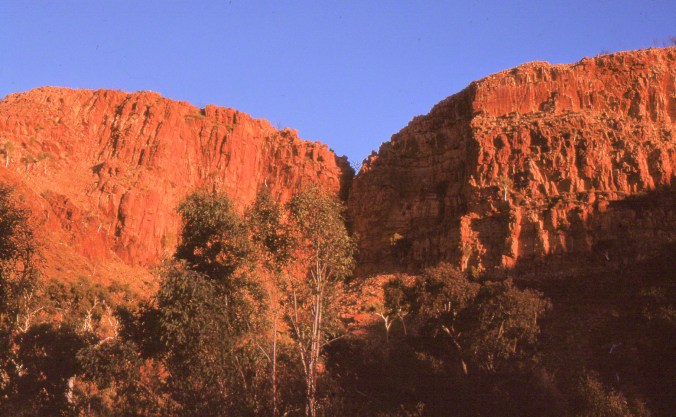
Down the valley we travelled until we could safely do a U-Turn, at what we had coined the “U-Turn Crossing”. This was the place where a couple of nights ago, Son 1 had collected firewood while I collected photos of Glen Helen’s iron-red cliffs bathed in the golden rays of the setting sun.
Then, stepping on the accelerator, we chased the Ford. Upon catching up to the Ford, we beeped the horn and flashed the lights of our rental car.
‘What the…?’ Son 2 pointed at a white van on the opposite side of the road, heading back towards Glen Helen.
‘No,’ Mum said, ‘we’ve all missed the turn off to Ormiston.’
More sighs. A brief park by the side of the road, our car with the Ford, and then exchange of information with Hubby and Son 1. Then with my brother who had also missed the turn off to Ormiston and had to retrace his tracks back. We turned around (in our cars) and in convoy, bumped our way down the rough track to the Ormiston where we waited for Mrs. T to buy her fridge magnets.
Transactions done, we began our journey to Hermannsburg. This time, the T-Team in their white van, waited for us to catch up. Again, this time in convoy, to Mum T’s childhood home.
Recently I shared how my dad relied on the Readers Digest “How to Fix” book to tackle DIY jobs. Having a double mortgage, and money being tight, Dad didn’t have much cash to splash on the “experts” in such fields as plumbing, electricity and general home maintenance.
The response met with a hint of dismissal from my older friends who prided themselves on their pedigree of farmer fathers. These, they boasted were real men, Aussie men, who fixed all things by pragmatic problem solving without the help of a book. The wisdom of their farming forebears imparted to them by osmosis, apparently.
In contrast, my father was a lesser being, a city dweller who had to refer to a book, of all things. My dad was a much-loved teacher, gifted in music, art and sport. He coached a winning football team of Indigenous players from Hermannsburg, Northern Territory in his youth, led a choir of Indigenous singers, and later school student Anklung bands for the South Australian Festival of Music. No flies on my dad. But I must admit, when it came to DIY, his forays into such exploits would rival the character Frank Spencer in the British sit-com, “Some Mothers do ’ave ‘em”. Still, I’m proud of my dad and love him. But then I realised that these superior beings who were my friend’s fathers, were from my grandparents’ era.
So, I cast my mind and research back to my two grandpas: Reverend Sam Gross (my mother’s father) and Dr. Ron Trudinger (my father’s father).
Now these friends held up their ties to the land as superior. Although both my grandfathers are highly educated with Reverend and doctor between them, I can claim a link to the land too, through my maternal grandfather, Sam. His family were farmers with I imagine generations of farmers before them from Horsham Victoria in the 1850’s and extending back to Prussia.
Sam was born in 1905 and grew up with all that practical knowhow bred into his being. I never met Sam, he died before I was born, but I remember my mum saying he was good at fixing things like cars. He could’ve been an engineer, but he became a Lutheran pastor. I reckon my brother inherited some of Sam’s traits—he’s a jack of all trades—the ideal DIY man.
As a child, Sam suffered rheumatic fever which affected his heart. Consequently, he got the education with the view of becoming a minister and wasn’t expected to continue with the farm like his brothers. The doctors told Sam he wouldn’t live past the age of thirty. But being extremely fit and maintaining his health, Sam defied those expectations.
After ordination to become a minister, and then a few years posted to Berri, in the Riverland of South Australia, Sam with his wife, Elsa (my grandma) and three young daughters (one my mother), ventured to Hermannsburg, Northern Territory. There God had called them to be missionaries to the Arrernte people.
Sam’s pragmatic skills, bred and imparted to him from generations who had lived and struggled on the land as poor subsistence farmers in Germany, then as pioneer farmers in the Victorian Western districts in Australia, came to the fore in the harsh isolated conditions in Central Australia.
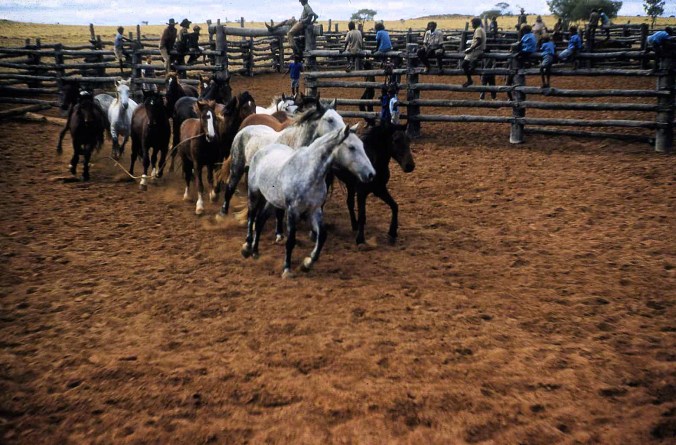
Sam had to venture to even more remote places in the desert west of the MacDonnell Ranges—Haast Bluff for instance. One trip in 1942, the truck broke down. Despite putting his mechanic hat on and trying to fix the car, an essential part of the engine was kaput and the much-needed part not available. Sam’s problem-solving prowess kicked in, donkeys were found and the car towed by donkey-power back to “civilisation”—Hermannsburg.
A year or so after their arrival in Hermannsburg, the supervising pastor, F.W. Albrecht was stuck in Adelaide as a result of the war. Hermannsburg came under suspicion, as it was a mission set up by German missionaries back in the 1880’s, and as such with ties to the Lutheran church, had a German name and tradition. The British Army being paranoid of anything that hinted of German, was suspicious of Hermannsburg. They feared German spies were hiding out there. So, they sent officers to check out Hermannsburg.
On one of these visits, without their chief, Pastor Albrecht, Sam and Elsa had to entertain these one-eyed wary characters. How did Sam survive their investigation? My mum says her father had the gift of the gab. My grandma had the gift of hospitality. In “A Straight-Out man” by F.W. Albrecht, I remember reading the Arrernte said that Sam would be alright, he’s so Aussie they won’t suspect him. Besides, the name Gross is found in England too. Also, Sam’s first language was English and when at school, he had trouble learning German. Although German was spoken at Hermannsburg and in the family, Mum can’t remember what they did when these British Intelligence Officers came, but thinks the children were kept out the way. Maybe someone took the kinder (children) on a picnic…
Sam and his family survived the officer’s interrogation. However, the pedal two-way radio was confiscated, and later Rex Batterbee was appointed to keep an eye on the mission. This Rex did and taught Albert Namatjira to paint.
There’s much more to Sam’s story. I think this post gives a glimpse into his generation and German farming ancestry, migrants making good, living in isolation, making do, thinking on one’s feet and problem-solving.
Did I mention Sam still found time to indulge (as the Mission Board put it—another saga) his passion for photography? He used these photos of Central Australia for deputations to garner support for the mission. Many of his photos are now stored in the Strehlow Centre in Alice Springs.
[In 2013, two members of the original T-Team, actually, my brother and I with our families embarked on a convoy to Central Australia in memory of our Dad…and so began the story in the making of the T-Team Next Generation that follows my memoir: Trekking with the T-Team: Central Australian Safari 1981 available on Amazon.]
A Place to Remember
‘What? A camel race? There’ll be a fight on their hands if they insist.’ Words actually spoken by Mum when confronted with even the suggestion of a change of plans. ‘We didn’t fly all the way up to Central Australia for the weekend to watch a camel race.’
Most of the T-Team, minus the one who’d made the suggestion (they were absent), nodded. ‘We are going to Ormiston Gorge, and that’s final.’
The camel race idea slid into obscurity. We spent Saturday morning lazing around at Glen Helen, fighting off flies. One T-Kid resorted to wearing a cloth shopping bag over their head while other T-members bought flynets from the store. The T-Team explored the waterhole at Glen Helen, before having lunch with the congregation of flies. Then we travelled to Ormiston Gorge.
The road to the gorge, though unsealed was in better condition than I remembered it in 1981. More tourists, I guess. No. 2 Son and I travelled with Mum (I drove), while Hubby drove the Ford with No. 1 Son, and my brother’s family piled into their van for the trip. So, we wound our way in convoy to Ormiston Gorge. 3pm and we were spoilt for choice of parks.
‘Most of the tourists have probably moved on or gone back to Alice for the camel race,’ I remarked to Mum.
I swung into a park and then we jumped out of the car.
Mum fumbled with some sealed containers. ‘Now, how shall we do this?’
‘Just divide the ashes evenly in the containers,’ I said.
She divided up the containers and began filling them with ashes.
‘They should be here soon,’ I gazed through the tee-tree bushes. ‘They were right behind us.’
‘Better not’ve gone to Alice for the camel races,’ Mum muttered.
‘I don’t think they would. The kids wanted to swim in the water-hole.’
No. 2 Son bolted. Now that we were at Ormiston, he wanted to see what it was about the place that Grandpa found so attractive.
Mum continued to doll out the ashes. Takes time to doll out ashes into containers.
No.2 Son returned. ‘They’re here, just around the corner.’
Mum and I followed him.
‘What happened to you?’ my brother’s wife, Mrs. T yelled. ‘We’ve been waiting here for ages. Could’ve gone to the store, bought souvenirs and come back.’
‘Can we swim now?’ one T-Kid asked.
‘Not yet,’ my brother replied.
Mum offered her boxes of precious cargo to them. Our T-Children weren’t sure about taking them, but Mum persuaded them. They’d be honouring Grandpa’s memory.
As the T-Team Revisited, we trooped into the gorge. In late afternoon, the cliffs rose somber and dusky-pink casting a shadow over the waterhole. The T-Kids gazed at the expanse of water and kept on walking. Just past the waterhole we climbed up a ridge. When we reached the top, Mum stumbled. Mrs T caught her and steadied her. Mum sat down with the announcement:
‘That’s it. I’m not going any further. But the rest of you can.’
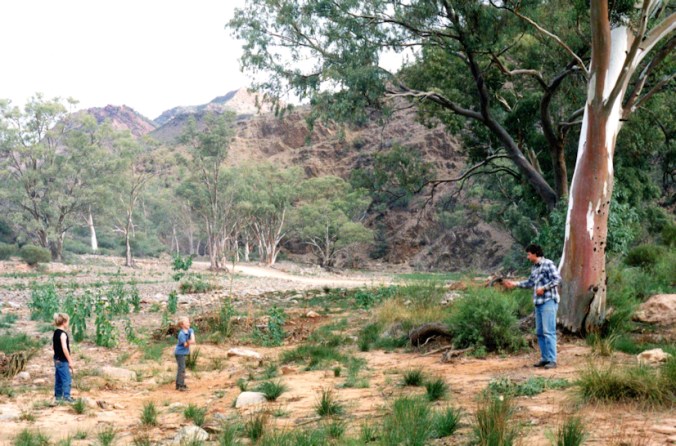
The sun caught the cliff-wall opposite, causing it to glimmer a golden orange. A ghost gum sprouting from a tumble of rocks attracted my attention. ‘I remember that tree,’ I said. ‘Dad’s favourite tree in Ormiston.’ After taking a photo, I scrambled down to the tree and scattered Dad’s ashes there.
Up and down the immediate locale of the gorge, the rest of the T-Team Revisited, wandered, silently reflecting on Dad and scattering him where he had many times trekked.
Some hikers tramped past and glanced sideways at us. The T-Team ignored them. Mum watched us from her vantage point. I climbed back up to her to check how she was.
One of the T-kids joined us. ‘The hikers asked us what we were doing, and I said we were scattering Grandpa’s ashes. They said, ‘Oh,’ and walked away all quiet. Which was awkward!’
I counted the members of the T-Team who crawled over the rocks and the other side of the rock-hole. ‘Where’s No.2 Son?’
‘I think I saw him go further down the gorge with his Dad,’ Mum said.
Down the ridge, and around the golden wall I hiked. I found No.2 Son marching towards me. ‘I want to see what’s around the bend.’
I glanced at my watch. 4pm. ‘Why not?’
We strode down the gorge and around a corner or two. Cliffs in hues of blue and purple with just the tips splashed with orange. Perfect reflections in pools.
‘What’s around the next corner?’ No.2 Son was had found his hiking mojo and was keen to explore more of Ormiston Gorge.
‘Let’s see.’
We stormed around the next corner. Ormiston with its majestic cliffs, even in shade of the late afternoon, spurred us onward to explore.
‘Let’s go on. I want to see more.’
‘Let’s.’ I’d never seen such enthusiasm from No.2 Son to explore nature.
On we tramped, the sand firm under our boots. The gorge cast in hues of mauve enticed us further. More reflections in still pools caught the sun-capped heights of the eastern cliffs.
As we dragged our feet back to Ormiston’s entrance, No. 2 Son grumbled. ‘Just as I’m getting into this exploring, Dad, you have to spoil it. You want me to get outdoors and then you call me back.’
‘It gives you a taste for another time when we’ll have more time to hike through the gorge to the Pound, okay?’ I said thinking, And perhaps climb Mt Giles one more time…
We passed the T-kids drying off from their swim in the waterhole.
MB waved from the damp depths. ‘Come on, have a dip!’
‘Too late,’ Hubby called back. ‘We have to get back to camp. I don’t want to be cooking in the dark.’
I was glad Hubby moved us on. Wasn’t in the mood for swimming. Like No. 2 Son, I yearned to explore the dreams and secrets, the twists and turns of Ormiston Gorge.