[Driving around Adelaide these days, I see many classic cars. Brings back memories of our family cars from my childhood…]
Bathsheba
After 50 years, I have discovered the significance of our Holden FC’s name.
My dad was called David. In the Bible, there’s a King David who has an illicit affair with a woman he spies in a bath on a roof top. Her name, Bathsheba. Bath-she-ba; an apt name considering the circumstances of their meeting.
Did Mum think that when Dad bought this car, this silver-pointed beauty was his “mistress’?
Similarities: Both Davids were master of their realms. Both Bathshebas, not new, used, yet beautiful. And both Bathshebas became parked in their David’s palace, in a harem, their love shared.
Having both studied English at university, the subject that comes up often when visiting Carol is about all things writing and what makes a good story. So, one of my first blog posts came to mind…to encourage and inspire all of us who are writers.
Writers’ Privilege
‘Writing is a lonely craft,’ my university tutor said.
All of us in the group nodded and I thought: Yes, a writer has to hide away in their study clacking away on their typewriter. They have to concentrate. Those were the days back in the 1980’s…
I recalled as a student, hours locked up in my bedroom, writing my essays, trying to concentrate while my family went about their business, stomping in the passageway, dishes clattering in the kitchen and the television blaring in the lounge room. Not to mention my dear brother lifting weights, and dropping the things with the inevitable clunk and thud, in the lounge room. Did I mention trying to concentrate? Yes, trying, but not succeeding. And even now, as I write this blog, can’t go five minutes without interruptions. These days, though, I write my first draft, by hand, in a quiet place at a quiet time, and then I write this blog on the computer as a second draft.
Suffice to say, the statement by my tutor all those years ago, has an element of truth. And compared to being an artist or musician, writing is a lonely craft. I belong to an art group and enjoy going each week as the hall is filled with happy chatter and my fellow artists are friendly and welcoming. And I can imagine a musician, mostly has to play and sing with others in a band, their craft has to be performed to an audience. The lonely parts of a musician’s life, from my observation, is the process of composing music. Although, many musicians collaborate when they jam together and create new songs together.
On reflection, though, my experiences over time with the process of writing as isolating, no longer resonates with me. I don’t write alone. I have my characters. I go into their world. Call me crazy, but it’s like when I was a child and had imaginary friends. Come to think of it, perhaps because I was lonely, I became a writer. Figures, hours after school, on weekends and holidays to fill. There’s only so many hours my brother, five years older than me, would share with me playing games. And friends, too weren’t with me all the time. So, books became my friends, as well as characters in the world of fantasy I conjured up. I swooned away, sitting in my cubby house, and whole days drifted by in my other life of fiction, science fiction.
As I grew up, I became used to my own space. My loneliness transformed into the joy and peace of being alone. Time to think and explore ideas, the “what if’s” of life’s path, stories of people I’ve met, my story, and also the stories of my characters. Time to express these stories, writing them down. Many of these stories remain hidden in my journal, a hand-written scrawl; a mental work-out, sorting out ideas and emotions. Some make it to a Word File on the computer, others a blog post, and a few hundred pages have ended up as works buried on the shelves of Amazon—self-published but published all the same. And for six years, now, there’s my blog, again mostly hidden in the blog-pile of the world-wide web, but more visible today than in 2015 when I started the blogging journey.
Yet, once I’ve written the first draft in quietness and peace, the craft of writing becomes a collaborative process. Good writing needs feedback, editing and proof-reading. An effective piece of work needs a second, third and numerous sets of eyes, and many minds to weed the “gremlins” that beset the plot, content, and pacing. And a keen set of eyes to comb through the text to pick up grammar and spelling issues. The computer’s spell and grammar check are not enough.
I love to go to writers’ group. I heard someone on radio say that reading is the ultimate empathy tool. When we read, we enter into another’s world and how they see the world. Exploring another’s world—how much more social can one get? This is what happens at writers’ group. We share our own world through our writing, and we explore other writer’s world as we listen to each other’s stories; a privilege and an honour to be trusted with these gems. As fellow writers we need each other to hone our skills as a writer. We need each other’s feedback. How else will we refine our craft without feedback?
Still, there is an aspect of writing that makes it a lonely existence. As writers we are modern-day prophets, proclaiming words given to us, believing these words can and will make a difference in another’s life. Hoping, the change will be for good. The word is a powerful tool; a double-edged sword. God’s Word is described as a double-edged sword. (Hebrews 4:12) There’s a saying that sticks and stones can break bones, but words cannot hurt me. Not true. Words can hurt. Words can also heal. Spoken words can sting or soothe, and then are gone, but the written word can endure and have power. People believe something is true because it’s in print. Reputations have risen and fallen on the power of the written word.
The printing press revolutionised the fifteenth century. Imagine words once written and hidden in some monastic library, then with the advent of the printed word, being duplicated and spread, and even appearing on church doors, for all to read. In our times we have witnessed the evolution of the power of the word through the internet. Need I say more—the gatekeepers of the past, by-passed, allowing all who are wanting to have a voice, freedom of written expression.
However, with freedom and power to influence, comes responsibility to use our gift and passion to write wisely and for the good of others. As a writer, I have written with good intentions to help others grow, help others see the world differently, change attitudes and effect a positive change in the world. Even so, my good intentions posted on my blog may have affected others in ways I didn’t intend. So, I have an understanding now what it means that writing can be a lonely craft as there will always be someone who doesn’t see the world as I do and may find my public interpretation of life offensive. My voice in the world-wide wilderness of the web may actually alienate me from others. So, I’m back where I started as a child, alone, with time and space to explore my world of fantasy with my characters as friends.
I guess that’s why I’m drawn to write. With fiction, it’s out there, it’s fantasy and it’s a safe platform to explore ideas, issues and ways of looking at the world, the other world of “what-ifs”, that help readers open their minds to investigate alternative attitudes and create discussion. And with fact through my travel memoirs, sharing my life and worldview, joys, challenges and faith. Through this process, I hope to bring goodness and personal growth to all who are willing to join in the journey into my world.
[The last few months I have revisited The T-Team with Mr. B: Central Australian Safari 1977 which is a prequel to Trekking With the T-Team: Central Australian Safari 1981. In preparation for its release later this year, I will be sharing posts of this adventure.
In this episode,the T-Team with Mr. B scale the heights of the highest mountain in South Australia, Mt. Woodroffe. Even back in 1977, Mt. Woodroffe being on land owned by the Indigenous people, we needed permission and a guide. Don’t know what happened to the guide back then, but we had permission. The situation has changed in the 44 years since we climbed…more about that later.]
The Top of SA — Mt. Woodroffe
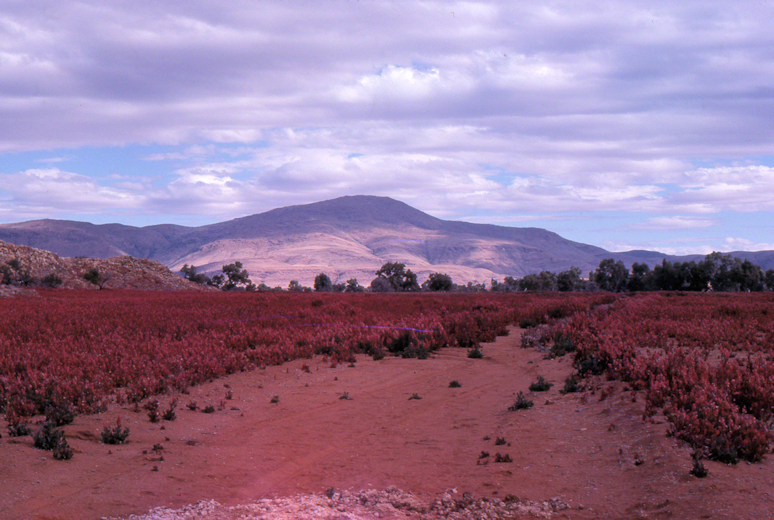
The sun climbed over the horizon, its rays touching the clouds in hues of red and Mount Woodroffe in pink.
In the golden light, packs on our backs we filed up the gully. The narrow creek in the hill-face gave way to the slopes leading to the summit. With no defined track except for euro (small kangaroo) ruts, we picked our way through the spinifex. Rick carried his .22 rifle in the hope of game for dinner.
‘You’ve got to watch that spinifex,’ Dad said. ‘If you get pricked by it, the needle stays inside your body for years.’
‘Years?’ I asked. ‘What does it do there?’
‘It works its way through your body and eventually it comes out through your hands or feet or somewhere.’
‘Yuck!’
‘Ouch!’ Rick screamed. ‘The spinifex just stung me.’ My brother stopped and pulled up his trouser leg to inspect the damage and then muttered, ‘Next time I’m making shin-guards.’
‘I guess one should be careful when one answers the call of nature out here,’ Mr. B said.
Matt sniggered.
I gazed at the acres of spikey bushes and decided to resist the call of nature.
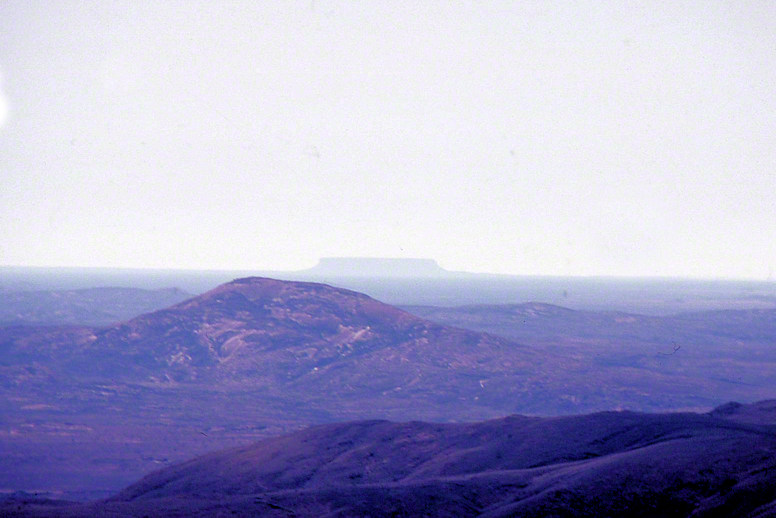
I studied the three odd-shaped purple monoliths popping up from the plain. After the strenuous hike to the top of South Australia, I gazed at the ranges resembling waves rising and falling in the sea of the desert was filled with euphoria.
‘Wow!’ I gushed. ‘Apart from spinifex, the climb was a walk in the park—a most worthwhile journey.’
Mr. B folded his arms and grunted.
Still on a high, I ran around the stone pile, snapping photos from every direction with my instamatic film camera. Then I gathered the T-Team. ‘Come on, get around the cairn. We must record this momentous occasion for posterity.’
The men followed my orders like a group of cats and refused to arrange themselves. Mr. B hung at the back of the group and snapped, ‘Hurry up! We need to eat.’
Lunch of corned beef and relish sandwiches at the top of South Australia was Dad’s reward to us for persevering. We rested for an hour on the summit taking in the warmth of the sun, the blue skies dotted with fluffy clouds and the stunning views of the Musgrave Ranges and desert.
After photos, we began to climb down those jagged rocks, carefully avoiding the spinifex. But try as he might to avoid the menacing bushes, more spikes attacked Rick’s tender legs. ‘Definitely going to wear leg guards the next time I come to Central Australia to climb mountains,’ he grumbled.
We reached a rock pool, just a puddle of slime, actually. I pulled off my shoes and emptied grass seeds and sand onto the surface of slate. Then I ripped off my socks. They looked similar to red-dusty porcupines, covered in spinifex needles. My feet itched with the silicone pricks of the spinifex. I dipped my prickle-assaulted feet in the muddy water.
‘You mean, David, old chap,’ Mr. B massaged his feet and turned to Dad, ‘we’re stuck with the prickly critters long after our climbing days are over?’
During rest at the poor excuse of a rock pool, nature called, and this time I could no longer resist. I hunted for a suitable spot, but everywhere I looked, ants scrambled about, millions of them. The longer I looked, the more ants congregated and the more desperate I became. But I had to go, ants or no ants. At least the patch was clear of spinifex. I suppose for the ants, my toilet stop might have been the first rain in weeks.
Back at camp, we began our ritual of preparing the bedding. Mr. B stomped around the creek bed until he found the softest sand. Dad grabbed the sleeping bags one by one and tossed them to each of us.
‘Argh!’ Mr. B cried.
‘What?’ Dad asked.
‘Oh, no!’ Rick moaned.
‘What?’ Dad asked.
‘Who’s been piddling on my sleeping bag?’ Rick grizzled.
‘Piddling?’ Dad stomped over to Rick.
‘It’s all wet.’
‘I say, boy, why’s my sleeping bag all wet? Couldn’t you use a bush?’ Mr. B remarked.
Matt turned away. ‘Wasn’t me.’ He unrolled his sleeping bag. ‘Oh, no, mine’s wet too.’
Rick looked at me.
‘Hey, I stopped wetting the bed years ago,’ I snapped. ‘Anyway, mine’s dry.’
‘I wasn’t going to say anything,’ Rick replied.
I raised my voice. ‘You were, you were looking at me like…’
‘There, there, cut it out,’ Dad strode over to Rick and me. He held up a bucket. ‘The washing buckets leaked on the sleeping bags.’
These days, in the days of the “new normal”, as a result of Covid, climbing Mt. Woodroffe may not be possible. I did a little Google research about it. During the times of the “old normal”, permission from the Indigenous Owners of the APY Lands was still necessary, but it seems the Mt. Woodroffe climb was part of an organised tour. To find out more, here are the links below:
[An extract from The T-Team With Mr. B: Central Australian Safari 1977; a yet to be published prequel to my travel memoir, Trekking with the T-Team: Central Australian Safari 1981, available on Amazon.
With Covid still hanging around Carol’s place and wearing out its welcome, I have drawn on a past Tuesday with Carol.
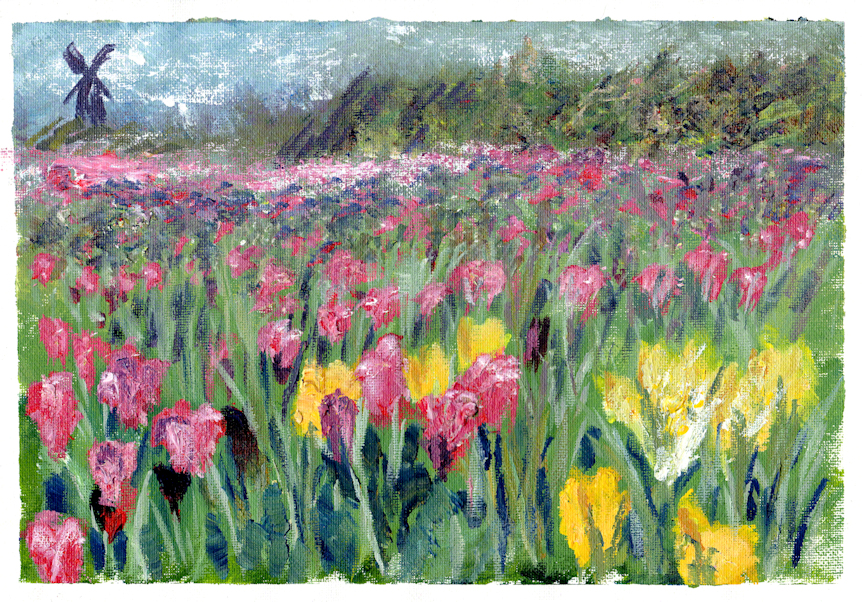
A few weeks ago, I revisited the tulip field muse. Carol and I like the Impressionists style. We had lots of fun playing with the blend of colours and keeping our paintings loose.
My past efforts painting these tulips at the Canberra Floriade, in watercolour and acrylic, have been less than impressive. Those paintings have ended up filed away in the drawer of no return or cut up and pieces used for cards.
But I’m happy with this piece. The difference, a bit of artistic license by putting a windmill in the picture and less tulips. It’s all to do with composition.
On a different note, but related, a couple of friends and I have been working on a community project—a publishing collective. We have called this endeavour, Indie Scriptorium. If you would like to find out more, check out our newly formed website and our first post by clicking here.
[The last few months I have revisited The T-Team with Mr. B: Central Australian Safari 1977 which is a prequel to Trekking With the T-Team: Central Australian Safari 1981. In preparation for its release later this year, I will be sharing posts of this adventure.
In this episode, my dad (Mr. T) brews up an unusual “stew” by accident…]
Egg Soup
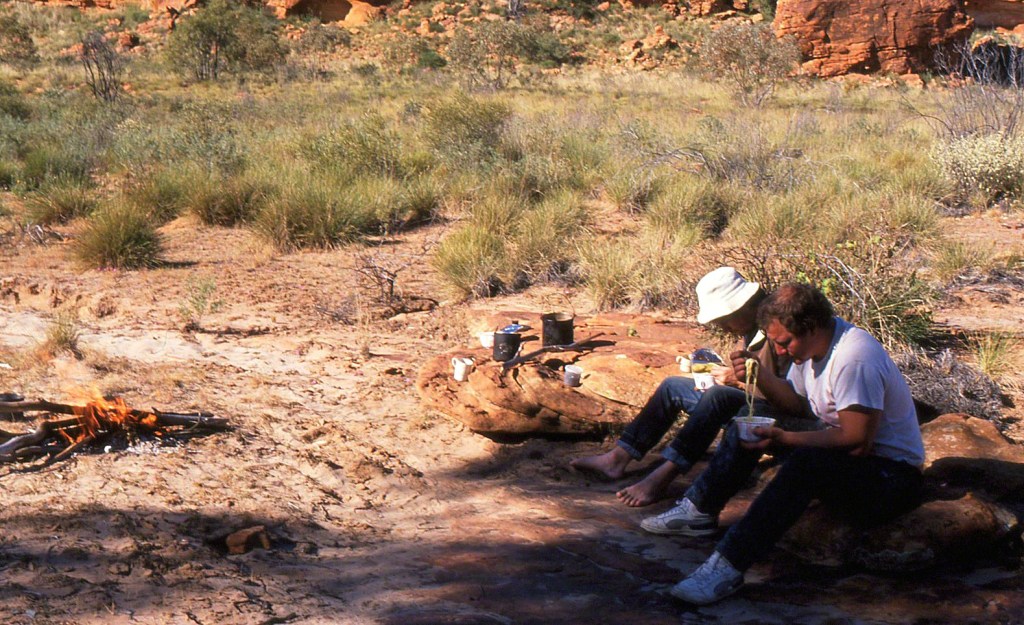
The sun lingered above the horizon as we returned from a hike to our campsite at the base of Mount Woodroffe.
‘Ah, an early tea,’ Dad said. ‘It’s always best to cook while there’s daylight. We can make an early start.’
‘Well, after that disappointing jaunt to find that damned waterhole you went on about David, I’m pooped. I’m going to have a lie down,’ Dad’s friend, Mr. B said as he slumped onto a nearby log. ‘I hope you’ve found us some nice soft sand to sleep on. I haven’t had a good night’s sleep yet on this trip.’
‘Yes, well, um,’ Dad called after him, ‘I need some help stirring the pots.’
‘Get your daughter,’ Mr. B replied, ‘I dare say, she’s a girl, that’s what she ought to be doing—cooking, I mean.’
I stopped blowing up my mattress. Uh-oh, now I have to cook and miss out on all the fun, I thought as air slowly wheezed out of the mattress.
Dad coughed. ‘Er, um, actually, I’ve asked Lee-Anne to sort out the bedding and to pump up the mattresses. And the boys, Richard and your son, Matthew, have gone out shooting, getting us some roo to cook. I have it all organised. So I would like you to stir the pot, please.’
I breathed out and then started blowing up the mattress again. Phew! Dodged that bullet.
‘Oh, very well, then,’ Mr. B said as he negotiated his path through an obstacle course of billy cans, tucker boxes and tarpaulin back to the campfire.
I thought, there is always a danger being too early and organised. So it was this evening when Dad, who prided himself as “chef-extraordinaire”, prepared scrambled eggs and soup for dinner.
I hopped over to Dad. ‘Do you need some help with dinner?’
Dad patted his pockets and shifted his weight from one foot to the other. ‘No, I have Mr. B helping me. You go and pump up the mattresses.’
‘But my jaws are sore from all the blowing,’ I said. ‘I need a break.’
‘No, I have it all covered. It’s about time Mr. B does his fair share.’
I could see from Dad’s expression, the pursing of his lips, keeping the chuckle from bursting out, Dad thought he was being really clever asking Mr. B to help stir the soup pot.
As I shuffled around the campsite sorting out my bedding, I distinctly heard Mr. B mutter, ‘My goodness this soup is awfully thick.’
Being the only female in the crew, Dad appointed me to call in the troops. I tramped through the scrub in search of the boys. My brother Richard and Matt loved to shoot with their .22 rifles. But neither were good at it. I could hear the rifles popping, but in the dimming light I failed to locate the lads. So I returned to camp.
There the men were, all of them (minus the roo for dinner), their spoons dipping in and out of their cups.
Mr. B grimaced as he put another spoonful of soup to his lips. ‘Ugh! This is awful! This is the worst feed yet!’
‘It’s alright,’ Dad said as he bustled around the campfire. His cup wobbled on a rock as he handed my portion to me. He gave the other billy a maddening stir.
‘What’s in there?’ I asked.
‘Egg, egg scramble,’ Dad said and handed me the ladle. ‘Go on, you can stir it.’
I peered in at the watery mist. ‘It’s awfully thin, are you sure?’
‘Just stir will you?’ Dad snapped. ‘I’ve got other things to do.’
‘Alright.’
I sipped my soup and stirred the pot.
Richard and Matt stood by the fire and stared at their metal mugs.
‘Come on, drink up,’ Dad commanded.
The boys dutifully slurped up their soup.
Mr. B raised his voice. ‘So what sort of soup do you call this? You know, it tastes awfully like egg. You’re sure that you didn’t mix up the billies?’
‘Oh, no, not at all!’ Dad replied.
I took another sip. The soup tasted nice. I quite liked it. Then again, anything tastes good when you are a starving teenager.
As Dad settled himself by the fire, Mr. B slavishly gulped down the remainder of his soup. ‘Well, that is the worst soup, I’ve ever had in my life. Oh, for some decent food! And a decent night’s sleep. I didn’t sleep a wink last night and my back’s aching!’ He spied his son playing with his soup. ‘Eat up, boy! Look! Tha girl’s eating hers.’
Dad began to take a spoonful of soup. ‘Hang on. This’s not right.’ He pointed at a billy sitting on the ground to the side of the fire. ‘Lee-Anne, can you just check the other billy?’
‘What for?’
‘Don’t ask, just check, would you!’
‘Okay!’ I grumbled and hobbled over to the billy sitting in the cold, the contents supposedly waiting for the frypan. I lifted the brew onto the wooden spoon. In the fading twilight, I spied water, peas, carrots and corn, but not an ounce of egg. ‘Looks like soup to me.’
Dad pushed me out the way. He had to check for himself. ‘O-oh!’
‘So we did have egg soup!’ Mr. B said, ‘I knew it.’ Even after less than a week with this pompous friend of Dad’s, I suspected this fellow would never let Dad hear the end of it. I imagined, from now on, till the end of Mr. B’s days, Dad’s culinary skills would amount to egg soup.
‘I’m so sorry,’ Dad said. ‘My mistake.’
‘I knew we were just too well organised,’ I said.
‘I won’t forget this occasion,’ Mr. B said. ‘Egg soup, what next?’
Poor Dad.
Dad boiled the correct soup and dolled it out in the dark.
We drank our portions void of conversation until an awkward “Oops!” cut through the icy air. Matt had spilt soup all over the tarpaulin.
‘Oh, Matt, did you have to?’ Mr. B said. ‘Now, clean it up and be more careful next time.’
As Mr. B harangued his son to clean up, drink up and for-heaven’s-sake be careful, and where-on-earth did you put the cup, son, we don’t want another accident, Dad sighed and ushered my brother and me to retreat to our sleeping quarters and away from Mr. B’s ire.
In the sanctuary of space away from Mr. B and son, we washed our clothes and prepared for the climb up Mt. Woodroffe the next day.
‘We need to make an early start,’ Dad said.
I reckon Dad did not want to add any more disasters to his list.
[Again, COVID, that uninvited guest has thwarted my visit to Carol’s. This time although she’s well, she’s a close contact and must isolate for 7 days. Meanwhile, I have been working on my writing and have been reflecting on what I have learnt makes for a good story.]
Unbelievable to Believable
Unbelievable, that’s what they said about my novel. Unbelievable. Is that why my first novel, Mission of the Unwilling has failed to thrive? Why there’s no feedback? Or is it a case of someone who’s not a Young Adult, and just not into Sci-Fi?
Whatever, I consider this feedback valid and believable. Over the next few months, I plan to revisit Minna’s world and her adventures at the mercy of Boris and learn from my venture into self-publishing. Nothing is wasted. The take-away from the most recent honest feedback—make my stories believable.
What does this mean for me as I refine the craft of story-telling?
My characters are real to the reader.
The setting is authentic, so that the reader can step into my constructed “world” suspending all disbelief.
The audience buy into the journey they take into that world.
But, what does “suspending disbelief” mean. I mean, really? I mean, when I revisit my stories, to me, the characters are alive, the setting an on-site movie set, and I gladly invest in the tale told. Not so for some of my readers, apparently. In truth, I’m too close to my work to view it objectively. I need and appreciate feedback from others. I’d go as far as to say that most writers benefit from a second, third, fourth or umpteenth pair of eyes to make their work the best it possibly can be.
So, from the perspective as a reader, that extra pair of eyes on other works, here’s what I’ve learnt that suspends disbelief and do some unpacking of techniques that make characters, setting and journey more believable.
Believable characters: Someone with whom you connect. You know that person. You’ve met them. You’ve had lunch them. You’ve admired them. They’ve annoyed you with their quirky habits. They’re those people you see across a crowded coffee shop and already you’ve constructed a whole story around them, by observing their posture, expressions and gestures. You invest time following what they’ll do, what will happen to them. Believable characters don’t have to be human, but they do need human qualities and personality for readers to relate to them.
Believable setting: Best woven into the forward-moving action of the story. The writer describes the setting with the five senses, what you: 1) see, 2) hear, 3) touch, 4) smell, and 5) taste. And for the world to be memorable, the author picks up something unique or odd about the place. For example, I may write of Palm Valley in Central Australia, ‘Ghost gums jut out of the tangerine rock-face, and a soft wind rustles through the prehistoric palms.’
Believable Story: You need to convince your readers that such a sequence of events can happen. A skilful writer uses the technique of cause and effect. The character makes a choice, and their actions result in consequences often leading to dilemma that must be resolved. Readers are more likely to engage with proactive characters who influence their environment and others, and who make active choices to change and grow, rather than the passive characters who have every disaster happen to them, and their problems magically solved.
Yes, pile on the misery, pile on the challenges, don’t be afraid to get your characters into strife; that’s what the reader’s looking for. But remember, the chain of events must be believable. An article by Laurence Block, Keeping Your Fiction Shipshape*, describes the relationship between storyteller and audience is like enticing readers onto a cruise ship, keeping them there, and delivering them back to port with a good satisfying end.
It’s the skill of the storyteller to convince the audience. If the characters are believable, the setting is believable, and the action believable, your readers will enjoy the ride and complete the journey you, as the storyteller, takes them on.
[Why Notre dame? Victor Hugo, the author of Hunchback of Notre-Dame, spent the first three-quarters of the book describing the setting. Useful if you visit Paris, but does nothing for moving the story forward.
Also tourists willing to invest in the journey to climb Notre-Dame by waiting several hours in the long line that stretched the length of the Cathedral. What will they see? The gargoyles (characters), a view of Paris (setting) and a climb and walk through the Cathedral (the journey).]
[Tuesdays with Carol is on hold as a certain virus has accosted a close family member and so, we are in isolation. By the way, Carol, when I informed her, was most thankful her godson (my son), needed my assistance as mum’s taxi for some shopping last Thursday. If he hadn’t, I would’ve visited her that Thursday afternoon potentially putting her at risk.
Anyway, here’s the conclusion of Bonfire on the Beach where the murder mystery begins…]
Hit and Run
With a hip flask between best friends, Fifi and Lillie slipped away, gliding along the shore and up the ramp to the road. Kangaroo-skin blanket wrapped around them, the girls perched on a seat overlooking the miniature party scene. The orange glow of the revived bonfire danced in the cove below them. While they gossiped, topic of conversation focussing on Wally, the crisp air carried the beat of The Doors and Sven’s Ford Falcon XB rumbling up the ramp.
Lillie rubbed notches in the seat. Four lines scratched into the backrest. ‘What does this mean?’
‘Some local stud’s score, I reckon.’ Fifi traced the lines. ‘Fox’s probably.’
‘Not much of a stud, then,’ Lillie scoffed, ‘Geoffrey Fox must’ve had more than four conquests. Surely.’
A roar ripped through their conversation.
‘Excellent! A drag race!’ Fifi said and tore the blanket from Lillie.
Fifi waddled to the empty patch of bitumen.
Shivering, Lillie followed and peered down the peninsula. As the headlights approached, a dull thud and a torso, arms and legs flying, altered their curiosity. One headlight wobbled; its radiance extinguished.
Fifi tottered towards the action. ‘What was that?’
‘Probably just a roo.’
‘And what roo has two legs and arms? I definitely saw two legs and arms. I’m going to have look.’
The girlfriends reached the spot. Motorbike shattered on the pavement. Body tangled around a pole, eyes glassy, staring into eternity.
Lillie’s gaze fixated on the human wreckage; mutilation mingled with man’s frailty into her memory.
Fifi dragged Lillie down the ramp. ‘Come, we can’t just stand here. We better tell the others, someone.’
Fox reclined by the fire hypnotised by the flames.
Jimmy, through a mouthful of crisps, said, ‘A good thing that Wally wasn’t there otherwise he would be raving about the grisly details till morning.’
‘It was Wally,’ Lillie said and wiped her dripping nose.
‘Oh,’ Jimmy said and popped a large curly crisp into his mouth and munched.
Unimpressed Fifi yanked at Lillie’s arm. ‘Come on, Lillie. We better see what we can do for the poor bloke.’
A group of pensioners hovered over the blood-stained sheet. Leaning up against the warped pole, a man with black rimmed glasses and bulging nose wagged his head. ‘There was nothing we could do.’
Wrapped in a lavender quilted dressing gown, a woman, hair in rollers, gawked. ‘Poor fellow. What a waste!’
Blood splatters glinted in the streetlight. Acid brewed in Lillie’s stomach. She held her throat and gulped. ‘I don’t feel so well. Let’s go back down.’
‘If you insist.’ Fifi trailed after her friend, hanging back, stopping as the ambulance arrived, watching as it ferried the latest statistic towards the red glow of Adelaide.
Back at the bonfire, Lillie nestled up to Geoffrey Fox. She didn’t want to be alone.
Later, Fox’s Kombi became the couple’s refuge and passion Lillie’s comfort.
Morning: sea watery blue, translucent. Sven emerged from his Falcon. He leant against the bonnet and nursed a jagged dent in the fender. Lillie watched banter between Sven and Jimmy through her flickering sleep-salted eyes.
‘Guess what!’ Jimmy’s mouth frothed with stale left-over beer.
‘What?’ Sven did not look up but continued to stroke and inspect a cracked headlight.
‘Some hoon killed Wally up there.’
Sven shrugged and then adjusted a pair of chipped Polaroid sunglasses on his fine pointed nose.
Crawling out of the Kombi, Lillie hobbled over to the Falcon. ‘Hey, just wait a minute. What’s Wals – How come you’re wearing Wally’s shades, Sven?’
Sven surveyed the placid blue sea. ‘Dunno, they were there, I s’pose.’ He rubbed the damage to his bonnet, frowning as flecks of red paint floated in the breeze. ‘‘Sides he wrecked mine!’
‘And your car? How did you get that dent?’
‘I dunno. Can’t help it if that stupid fatso gets in the way.’ Sven wiped his faded jeans, blotched greasy and brown, purging his hands of sand. ‘It’s what I do to people like Wally and dirty old men.’
‘What do you mean?’ Lille caught her breath and stepped back. ‘Have you done this before?’
‘Ha! Ha! Fooled you!’ Sven tossed his head back and laughed. ‘Geez, sis, you’re so gullible.’
Her brother then climbed into his Ford, spun the wheels, and flew over the firm damp shore, shrinking into the distance, towards Aldinga beach, then returning.
Lillie kicked sand into the ashes. ‘I feel sick. What are we going to do?’
Fifi squirmed in her sleeping bag. ‘Huh? What do you mean?’
‘Last night. Wally. You know.’
Poking her head from the hood, Fifi faced Lillie and narrowed her eyes. ‘Last night? Nothing happened, okay? Nothing happened. We were at Dee’s party – If anyone asks. Okay?” She turned her head to the others and enunciated each syllable. ‘Isn’t that right.’
Jimmy charged his stubby and nodded.
Fox poked his head out the Kombi’s open window. ‘Yep, Dee’s.’
‘But – but…Dee’s my worst enemy. No one will believe that I would’ve been at Dee’s,’ Lillie said and heaped more sand on the coals. ‘We can’t just – they’ll know. And the old people…up there…they saw us.’
‘Look, Lillie,’ Sven said, ‘the police are up there right now investigating. No one has come down to interview us. So, leave it alone.’
‘Look, Lillie, I’ll figure something out. Okay? Anyway, we didn’t see anything. It’s not our problem.’ Fifi scrambled from her bag and smoothed sand with her foot over the campsite. ‘Now, we better disappear.’
Sven dusted his hands of sand. ‘Best we don’t get involved.’
In silent haste, the group joined Fifi’s efforts to erase all evidence of their existence there.
As the golden orb of sun peeped over the barren slopes, the red Ford Falcon and orange Kombi made a slow procession, tyres treading with respect over the shards of glass, then pelting on the highway North to the city.
A young traffic constable Dan Hooper admired the sleek red Ford Falcon as he made his way down Main South Road towards the fatal accident scene from the previous night. Reminded him of the Mad Max film he had watched on a video player at Dee’s party the previous night.
Friedrich was sure it was his fault. He was always getting smacks or the belt from his father—usually for not polishing his boots perfectly. Or for spilling milk on the floor. But when he saw the blue line in the air, the urge to escape, was too great. This was not the first time he’d ventured beyond the thin blue line under the outhouse. He just had to go through the light—for Wilma…
Then bang. Everything went black…
Friedrich put out his hands and shuffled forward. He groped for a wall, a surface, anything to orient himself.
He tripped over some bulk. He fell onto it. It groaned.
Friedrich scrambled to his feet. His mouth went dry. It was like his heart, lungs and guts were in his mouth. Oh, no! I’m on an alien world without light and with groaning monsters.
The thing at his feet moaned. It sounded like a man.
Friedrich gulped. He knelt down. He held out his shaking hand. He touched something soft and greasy. Was that hair under his fingertips?
‘Who are you?’ he asked in his Silesian language. ‘What’s your name?’
The man-thing with hair moaned again and then mumbled what sounded like forbidden words in another language. He’d heard Joseph use such words when angry.
‘My name’s Friedrich,’ the boy said. ‘And you?’
‘Oh, the pain! The pain!’ the man-thing said in that strange language. It did sound like the tongue Joseph and Amie used. They spoke using similar sounds when they were together.
Friedrich presumed the man spoke English. But he knew few English words, so he still hoped the man understood his native language. ‘How are you?’
‘Oh, the pain! My stomach! My head!’
Friedrich traced the head, the shoulders, arms and distended stomach. ‘You’re a man, aren’t you?’ He patted the spongy surface in the middle.
The man groaned and squirmed.
‘You’re a sick man,’ Friedrich said using the word in his language “krank”.
‘Too right, I’m cranky!’ the man straightened up. He grabbed Friedrich’s wrist. ‘And who the heck are you?’
‘Huh?’
‘What?’
‘Huh? What?’
‘What? Huh?’
Friedrich shook his hand free from the man. How was he to make sense of this man in the dark? How was he to make this man understand him? Joseph and Amie could speak his native tongue, Silesian, but this man couldn’t, apparently. Friedrich rubbed his hand.
‘Who are you?’ the man asked. ‘Where the frick are we?’
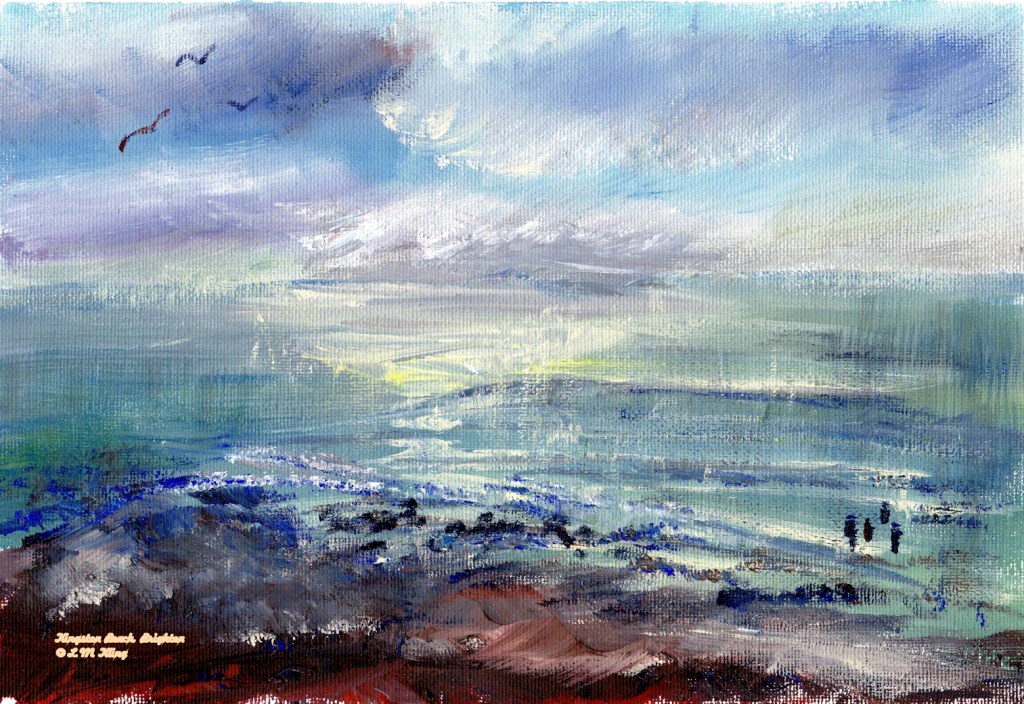
Every Tuesday, or thereabouts, I get together with my friend of over 40 years, and we paint.
This painting in acrylic of Kingston Beach, depicts one of those calm early autumnal afternoons in March. Although warm and humid, the clouds gather in the west, signalling a change, and hopefully, rain. Still, it’s a perfect balmy afternoon come evening for a birthday celebration on the lawns in the park above the beach.
Much like this painting, Carol and I start the process of painting perhaps a bit weighed down by the various dramas in our lives, but by the end of an afternoon painting, chatting, and remembering way back when we were young, we feel lighter and happier.
[I first wrote this story over thirty years ago in response to a newspaper murder mystery competition. Upon completing the story, I never submitted it for scrutiny. Since then, the tale has endured several edits and reworkings, the latest being just last week.
The story is pure fantasy but is based on real life events from my youth. Over the last 30 years the characters have evolved to become on the whole, fictional.
Note, bonfires are no longer permitted on beaches near Adelaide. However, cars are still allowed to drive on the sands of some beaches south of Adelaide, such as Sellicks Beach.]
The Uninvited
The five friends huddled in the firelight, reflecting on the ritual burning of Lillie’s matriculation Modern History textbooks and the year past. The Doors boomed in the background.
A sand-splattered blood-red Ford Falcon XB and a bright orange Kombi-van, guarded Geoffrey Fox and Lillie Hughson, Lillie’s older brother Sven and her best friend Fifi Edwards and Fifi’s brother Jimmy from any unwanted intruders.
An old man on the cliff top waved an angry fist, his threats carried away by the sharp November breeze. Sven returned the gesture shaking his fist with menace at the old man.
‘Sven!’ Lillie slapped Sven’s arm. ‘Behave yourself! You might be a brickie, but you don’t need to act like one.’
‘Nothing wrong with brickies, Lillie. Anyway, that old man, he’s probably calling for Wally,’ Fifi said while rubbing her nose. The sea air icy and stung with salt. She had moulded into Sven’s embrace. ‘Hey, Sven, you’re so cool, yet so hot.’
A burst of laughter. The tape came to a climactic end and petered out.
‘Hey, hey, have you heard this?’ Fifi wet her lips. ‘Six o’clock. The whole street was quiet, not a sound was heard. Except the occasional croak of a cricket as night fell.’ Mesmerized by the lapping waves and rhythm of Fifi’s voice, the others listened. ‘All was calm, then out of the darkness, a cry pierced the air.’
Jimmy, Fifi’s older brother shovelled a handful of salt and vinegar chips into his mouth and crunched. Lillie glared at him. He paused, chipmunk cheeked, and glued his attention to his sister Fifi.
“Wally! Wal-Wal-Waaalee! Dinner’s ready!”
The five young people roared. Jimmy’s potato chips sprayed out and fuelled the coals. Fifi pouted mimicking Wally’s mother, Mrs. Katz. Lillie joined her. Jerking her legs as if in a Monty Python sketch, Fifi broke free of Sven’s hold and walked a Wally walk, while Lillie jumped from Geoffrey Fox’s embrace and flailed her arms and danced a Wally dance.
Sounds of puttering filled the cove. ‘Who could that be?’ Lillie craned her neck over Sven’s leather clad shoulder to see bulk roaring wheels.
The girls froze, and in unison uttered, ‘Oh, no! Wally!’
More chips spluttered from Jimmy’s mouth and fuelled the coals. Sven rolled up his sleeves. Admiring his wiry yet powerful form, Fifi preened her blonde perm and sighed. ‘Just when we’re having a good time!’
Sand plopped in the flames and their faces. With a grunt his Kawasaki bike scudded, throwing Wally towards a rocky outcrop.
Wally picked himself up and dusted grains from his blubber. He advanced towards the group laughing, ‘Ho! Ho! Ho!’.
With his thumbs inserted in his tight pockets, Sven stepped towards the Wally. ‘Who invited you?’
‘Gate crasher! Gate crasher!’ Lillie and Fifi cried, hurling abuse and wads of sand.
Sven pitched his cider bottle. ‘Go home to your mummy, Wally!’
Wally dodged Sven’s missile. ‘Hey, I just wanna good time.’
‘You are not welcome here. Go away.’ Sven plucked up a rock. ‘Move it!’
‘Why not? I have every right to be here.’
‘Are you thick or something?’ Sven shook his stone-wrapped fist.
‘Did you call me thick? Did you call me thick?’
‘Yes, you moron! Now, go home!’ Sven spat and then hurled the stone, crashing it into Wally’s helmet.
‘Hey! That’s my head you hit!’ Wally raised his fists and leered at Sven. ‘You wanna fight?’
‘Be my guest, fool!’ Sven jabbed Wally’s rounded shoulder with his right fist.
‘Oh, cut it out boys!’ Fifi marched to the stoushing males, splitting the two cocks sparring in the shadows.
Uneasy truce, Wally one side of the fire, in the smoke, Sven and the rest of the group crowded on the other side. Waves crashed, the sea’s beat interrupted by the rare plop and thud of dead conversation.
Fifi nudged Lillie. ‘This is boring!’
Lillie rubbed her hands over the glowing coals. ‘Mmm. Why doesn’t Wally take the hint?’
Jimmy munched through his third bagful of chips. Chicken, this time.
Wally coughed. Wally spluttered. Wally blew his nose into a grimy handkerchief and inspected the contents. Wally sidled out of the smoke, closer to the group.
‘Oh, no you don’t!’ Sven poked the embers emitting brief flames. ‘Too crowded over here with you, Wally.’
‘Why not! I’m choking over here,’ Wally said and then cupped the rag over his mouth and insisted edging to the smokeless side.
‘Are you dense?’ Sven lunged at Wally, forcing his boot into the glowing coals. ‘Go home, Wally.’
Wrestling, the rooster and the sumo teetered at the rim of fire, toppled onto the sand crushing beer cans, steam-rolled one on top of the other singeing leather pants and denim jacket, rising from the ashes in a slow dance of boxing and fists and cuffs, and culminating in Sven’s $50 Reflecto Polaroid sunglasses flying into the fire. They melted on impact.
‘My shades! You’ve destroyed my shades!’ Sven clutched Wally’s throat. ‘Get outa here before I kill you!’
Fox who had been hanging back and watching the action, stepped up to Wally. ‘You better go Wally. Nothing personal. But you better take the hint and go.’
Fifi patted Sven on the back, ‘Come on mate, that’s enough fighting for one night. It’s only sunglasses.’
Sven loosened his grip and sauntered towards the boulders, silhouetted by the cliff-face. Wally skulked back to his bike and with a departing roar, pelted sand over the dying coals.










 Tru-Kling Creations