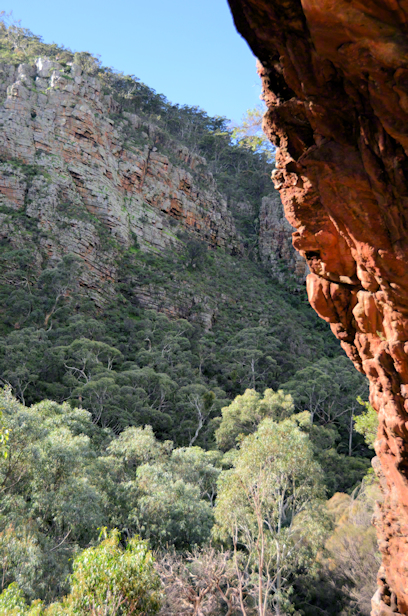
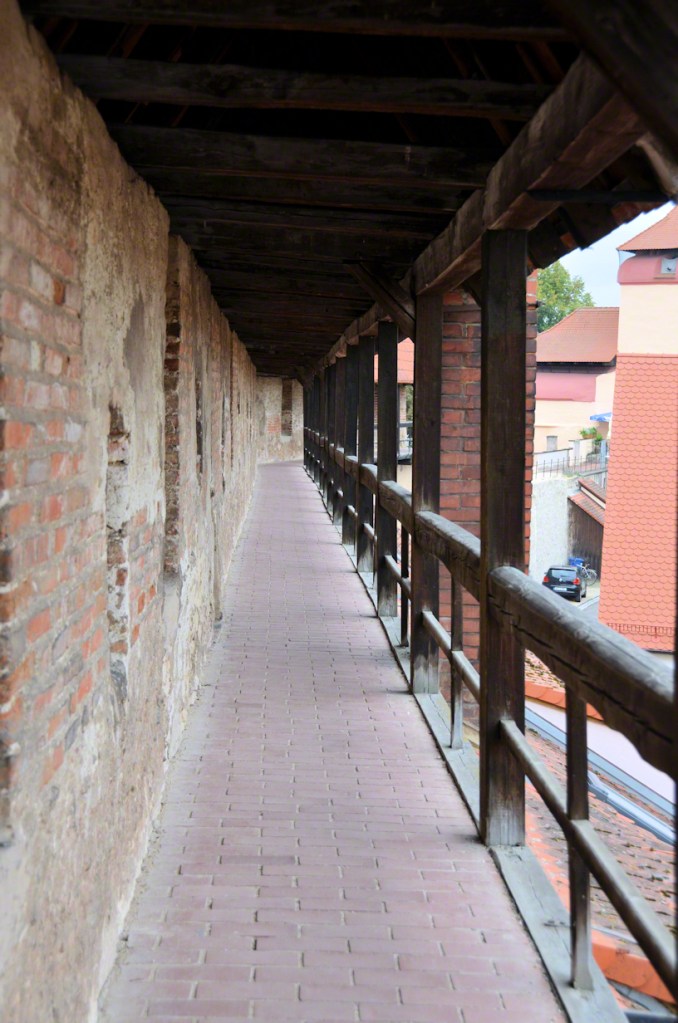
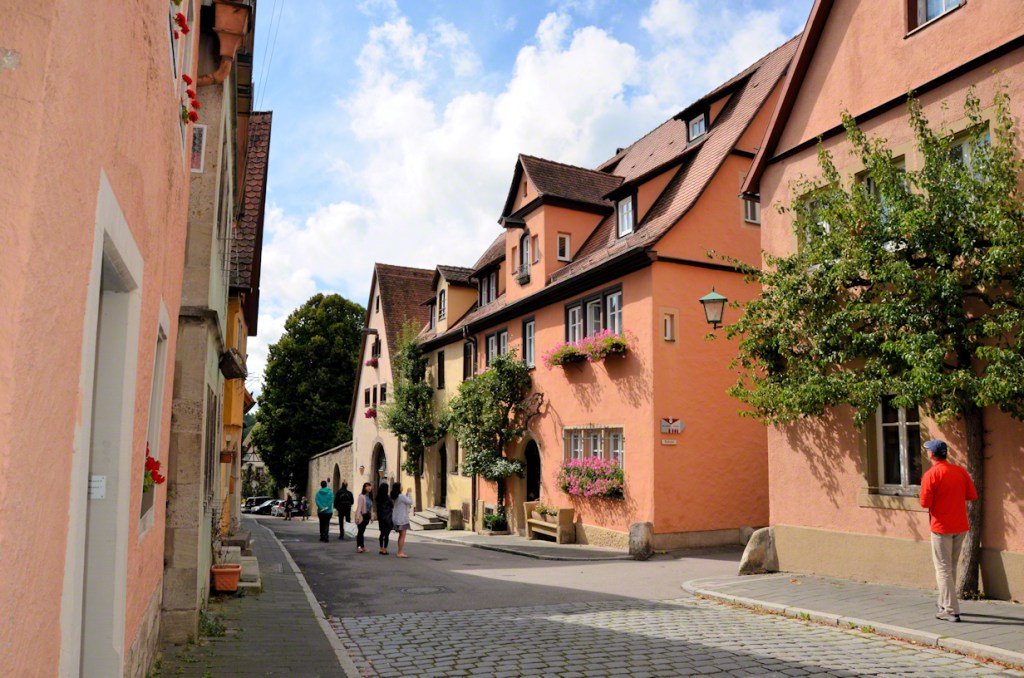
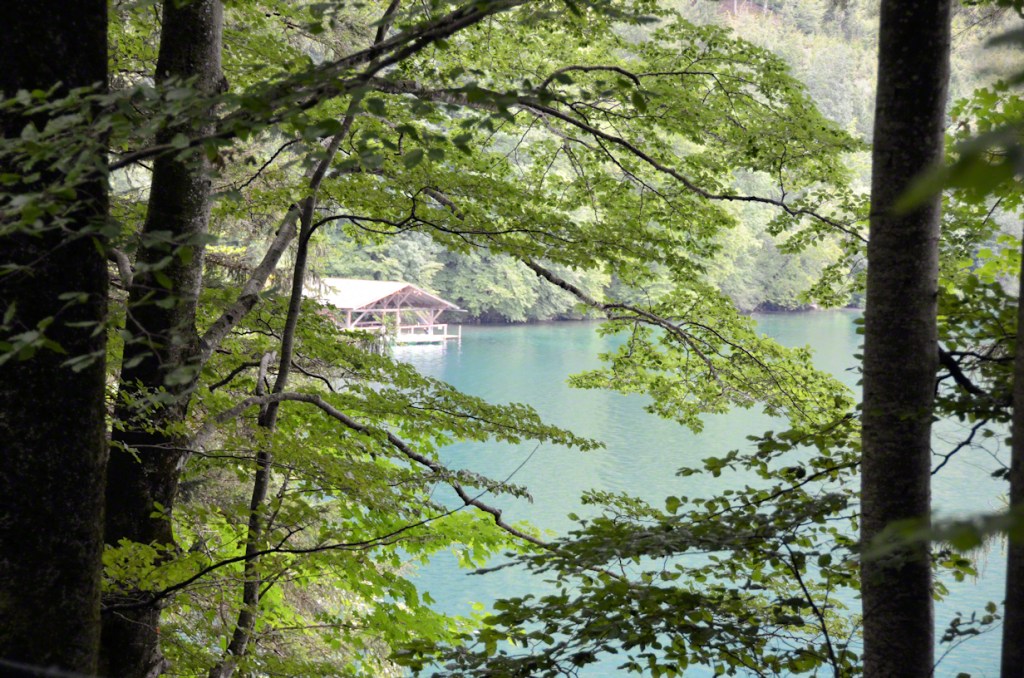
This day being a public holiday in South Australia, hubby and I took a meander around the Happy Valley Reservoir. This Reservoir has been open since last December and this is the first time we’ve entered this reserve.
Before December 2021, the reservoir was closed to the public to keep the water supply clean. However, I gather that water purification technology has advanced enough to allow the public to enjoy the ambient nature of this now recreational park.
Below are some moments captured in time from our Monday Meandering around the reservoir.
[With life returning to some semblance of normality, a post from the pre-pandemic past…]
The Kingdom of God is Like…
A dilemma many of us have faced, maybe it’s a wedding, or a party — we want to invite all our friends and family, but can we? Is it possible to have an open invitation without the situation getting out of hand?
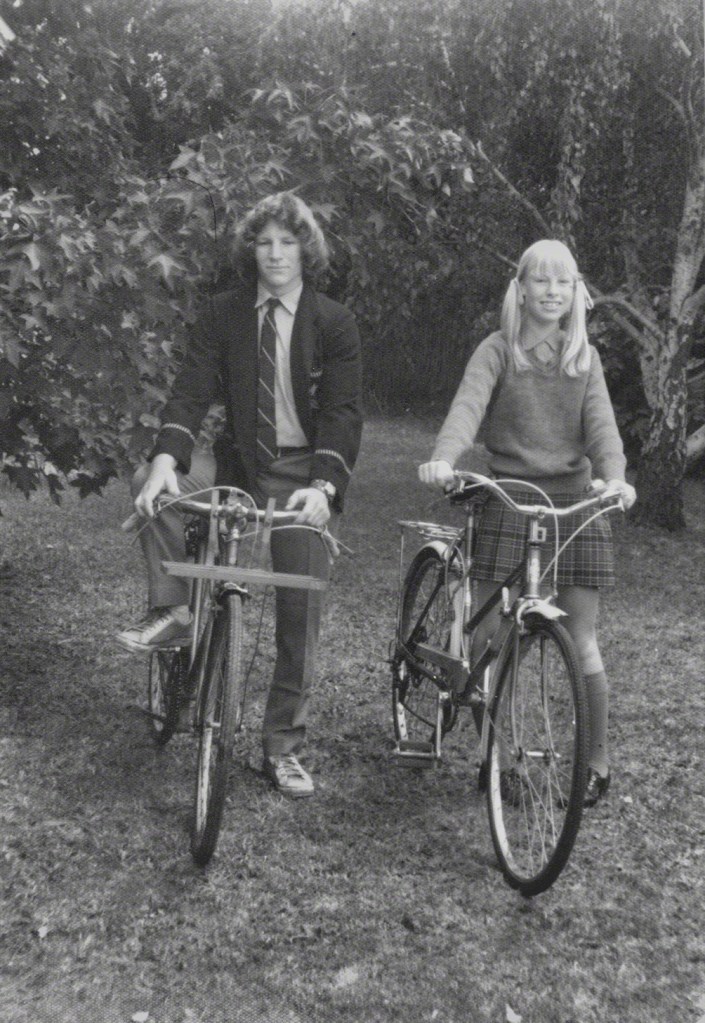
I remember as a young teenager being upset because my older brother received invitations to parties and not me. I remember standing at the kitchen counter, invitation to my brother in hand and complaining, ‘It’s not fair. I’m friends with them too. Why wasn’t I invited?’
‘Stop complaining,’ my mum would say, ‘your time will come.’
Didn’t help that our youth group friends had a saying: ‘You can’t have a party without my brother.’
Hey, I’m the sociable extrovert here! My brother’s the shy awkward type who prefers staying in his room making telescopes and short-wave radios.
So, I lived with these multiple rejections as I believed them to be…
…Until one day, I collected the mail from the letterbox. What’s this? A letter for me? I tore it open and read:
‘Dear Lee-Anne,
You’re invited to ***’s birthday party…’
Huh? I re-read the invitation. Must be a mistake. Where’s my brother’s name? Invitations always had my brother’s name attached, and occasionally my name included, especially where the youth group friends were concerned. Her invite made my teenage decade, for once, she invited me and not my brother.
But…what if there were parties or celebrations without restrictions on who’s in and who’s out? What if all who want to be invited could be invited? Are we inviting trouble if we make an event open to all?
I want to celebrate my late-Grandmother who demonstrated this openness and was successful. She looked outward at those in need of friendship and love. Her table was never too small and somehow, no matter the number of guests she had for Sunday lunch, she always made the food stretch. Something of the loaves and fishes plus Jesus’ effect. (Read in the Bible how Jesus feeds the 5000.Matthew 14:13 – 21)
So that’s all very well and good opening our homes and sharing dinner with others. But back to the party or community event idea. Is it possible to have a party without restrictions on who and how many come without fear of it getting out of control?
I believe it is possible—when we look beyond our limitations and look to God and others to enable us to achieve success; a piece of God’s Kingdom where all people are welcome, all people are valued and seen. And where those running such an event demonstrate the values of justice, mercy and compassion. With the right training, this type of event can provide a safe and caring environment.
Over the years I have participated in open-crowd events, often taking place in parks. There’s usually a variety of fun activities such as puzzles, stilts, giant snakes and ladders game, and a group game for all ages. People may join in if they want to, or just watch if they prefer. No one’s forced to join in. Even so, people from the event team connect with the on-lookers, getting to know them and by the end of the afternoon, they will be smiling and chatting with team members.
One time, two of my friends whom I’d brought along joined, for the first time, in the group game of water-balloon volleyball. They had so much fun, their faces were glowing.
‘I’m so glad I joined in,’ one said. ‘If I’d sat and watched, I would’ve regretted it. It was so much fun.’
My other friend said, ‘We enjoyed the event so much and before we knew it, the time had come to pack up and go.’
This welcoming experience, I think gives a glimpse of God’s Kingdom—it’s free and available to all who want to join in and engage with others in the community. Did I say it’s free? There is a cost—a change in our world view—a change from an inward-looking one where we are the centre of our universe, to an outward-looking one where we see others and value others and see that with others (and God) our perceived weaknesses become our strength.
We have a choice. We could stay safe in our “castle” reinforcing the walls to guard against fear and failure, and so leave others to stay isolated in their “castles”. Or we can look outwards, break out of our “castles”, reach out and connect with others making our communities better places to live.
If you’d like to polish your writing skills or find out more about our new project, a self-publishing collective, click on the link to Indie Scriptorium…
[Extract from The T-Team with Mr. B: Central Australia 1977, a prequel to Trekking With the T-Team: Central Australian Safari 1981.
The T-Team with Mr B — In 1977 Dad’s friend Mr Banks and his son, Matt (not their real names), joined Dad, my brother (Rick) and me on this journey of adventure. I guess Dad had some reservations how I would cope… But it soon became clear that the question was, how would Mr B who was used to a life of luxury cope?
And our accommodation in Hermannsburg had sent us on a tour back in time…]
Living in History
I lay in bed and gazed up at the ceiling. Wish I hadn’t. A hessian sheet hung above me, pinned to the four corners of the room and sagging in the middle. It appeared the sand from the Central desert had worked its way into the sheet, threatening to burst all over me. How long before the sheet would no longer be able to contain its weight? I sat up and swung my feet to the floor. A cockroach scuttled under the wardrobe made of oak. I shuddered. Better sand fall on me than cockroaches.
I grabbed my towel and toiletry bag, then padded out my room and down the dark hallway to the bathroom. There I gazed around the small room, sealed with green and white tiles, some broken. In the 1950’s wash basin, waist-high and looking like an enamel pastel-green pulpit, a line of rust coursed from the faucet to the drain. The matching bath suffered a permanent rusty-brown ring, a reminder of how full to fill the tub. I scanned around the room and above the bath. No shower—not even a rusty one.
I heard a knock at the door. ‘Lee-Anne, are you in there?’
‘Yes, Dad,’ I replied. ‘Where’s the shower?’
Dad opened the door and poked his head through. He screwed up his nose and swivelled his head left, right, up and down. ‘Oh, no shower. I guess you’ll have to have a bath.’
‘Oh, al-right.’
‘Hurry, though, we’re off to see Mr. C and his school.’
‘Oh.’ Last year Mr. C was my mathematics teacher. Then, in 1977, he’d taken up a position teaching the Arunta children in their camps near Hermannsburg.
I turned on the tap. Water dribbled into the bath, brown and making the pipes groan. I gazed at the tea-coloured brew pooling at the base of the tub. I like baths, normally. Not sure about this one.
‘Don’t fill it too full,’ Dad said.
‘No, Dad.’ No danger of that happening. The bath looked like it’d take an eternity to cover even to the depth of an inch.
‘Don’t take too long,’ Dad added.
‘No, Dad.’
I reached in and tested the water. Cold. I then placed my fingers under the dribble from the tap. Cold. Great! Not much water and it’s cold. Yep, I’ll have a quick wash.
I stopped the dismal flow and rushed through the motions of washing. After raking dry shampoo through my limp strands of hair, I bunched them into pig-tails and returned to my room to change.
Then I walked into the kitchen. Light through the louvers reflected dust motes drifting through the air.
Dad looked up from his bowl of porridge. ‘Oh, you’re finished already?’
‘Yep.’
I helped myself to the saucepan of porridge on the ancient stove. The cooker squatted there in the corner, brass fittings attached to afford gas to the rings on top. And lime green. I could see Hermannsburg had a theme going—shades of green. Except the table, washed with the thin coat of white paint. Perhaps it was green once, at the turn of the century.
As if taking advantage of my abbreviated bathroom visit, Dad took his sweet time. So, while we waited, Richard and I played cards, on the kitchen table.
‘Mr. B and Matt are taking their time,’ I said gathering up the cards.
‘They’re sleeping in,’ Richard laughed. ‘I think Mr. B’s exhausted.’
‘He didn’t know what he was getting himself into coming on this trip.’
Richard snorted. ‘Bet he’s never been camping in his life.’
[This Sunday morning’s sermon tackled the parable of the Lost Sheep, Luke 15;4-7. I recall an ancient post I had written way back when I first began blogging in 2015. Then today, the parable’s meaning was reinforced when I spent all afternoon searching for a document vital for our tax return. Strange how items vanish…We gave up on the paper and were able to retrieve a copy from the relevant website.
However, each person is unique. If a person goes missing, you can’t just replace them by copying them. Every year in Australia, around 38000 people go missing. Most are found within few weeks, but 2600 remain missing after three months.
The following post is a re-blog of the one I published in 2015.]
Lost Sheep
A fellow writer criticized the Mission of the Unwilling saying, ‘How can so many people go into space without others missing them on Earth?’
Good point—and I duly corrected that detail. As a part of the Intergalactic Space Force, each recruit had their explanation which they gave to family and friends why they wouldn’t be around for a while. Yes, fixed that…but—just wait a minute—did I have to do that to make the story believable?
Thousands of people around the world go missing every day…and if I think about it, I know people who have.
Sure, there’s the famous cases. Yes, Adelaide, South Australia, my hometown, is known for a few of those strange cases, both unsolved and solved. I remember as a child told not to talk to strangers…remember those children ‘round the corner? Never seen again.
But then there’s the willing missing—the ones who for whatever reason drop off the radar, leaving behind family and friends, to start their lives afresh. And they might have good reason to disappear if they’ve been the victim of an abusive relationship, or they’re a witness who needs protection.
Each community and clan deal with this jump off the radar differently. As is evident from my own observations of this current society, they are not all like my fellow writer who would make a beeline for the nearest police station when a loved one of theirs goes missing. In fact, there have been recent examples in Australia where the missing persons have met untimely permanent pushes off the radar from perpetrators who have then pretended, through text messages and the use of their bank accounts to deceive family and friends into believing their missing loved one is alive, but just doesn’t want contact. And in some cases, family and friends have believed these lies for months, years.
Isn’t this a cause for concern? Has our community become so disconnected, so focussed on the rights of the individual, we consider it a “social crime” to intrude on another’s privacy? Is society so fragmented, that when we receive a text or internet message from a loved one, saying, ‘Leave me alone,’ we accept it as gospel, as coming from the loved one, and sit back and leave them alone? Is there a problem these days speaking face to face, and treating people like they matter? Is it possible some people go missing because they feel no one cares; that they don’t matter?
In the parable of the Lost Sheep Luke 15:4-7, the shepherd leaves the ninety-nine sheep to search for the lost one. In this society, such a person who goes looking for the lost, the “Black Sheep” of the family, is labelled “crazy”. But in God’s Kingdom each person is precious. Our world may not value these “lost sheep”, but God does, and His people do. I guess in the world’s eyes, God is crazy; He loves and values every human being. And the thing about lost “sheep”, they may not know they are lost, they may not want to be found, they may feel invisible in the sea of billions of “sheep”, but God knows who they are. I reckon there’s a bit of “lost sheep” in each of us. When we make others visible, treat them like they matter, and care for each other, this is community; we find the “lost sheep” and God finds us. This is our challenge, to value and love one another and treat each person with value and respect because they matter.
I don’t know about you, but I’d rather others label me as “crazy” because I care and want to relate to real people, rather than be considered “sane” and thus disconnected, living my life only virtually through a screen.
[While painting this scene of a group of older men gathering to admire the glowing walls of Standley Chasm, I was reminded of the T-Team’s trek in 1977 with Mr. B. This wealthy man used to comfort and luxury, took on the challenges of roughing it camping with the T-Team. This stunning chasm is about 50km west of Alice Springs and is one of the first of many beautiful sites to visit in the MacDonnell Ranges.]
The T-Team With Mr B (26)
Mr. B slowed the Rover and eased it into a park joining the line of cars, land rovers, and buses awaiting their owners’ return. The T-Team piled out of the Rover and in single-file, followed Dad along the narrow track heading towards Standley Chasm. In the twists and turns of the trail that hugged the dry creek bed, I spotted ferns in the shadow of rock mounds the colour of yellow ochre, and ghost gums sprouting out of russet walls of stone. Hikers marched past us returning to the car park.
A leisurely short stroll became a race to the finish as we struggled to keep up with Dad; scrambling over boulders on the track, squeezing past more tourists going to and from the chasm, Dad snapping and cracking the verbal whip, and Mr. B moaning and groaning that “it’s not for a sheep station”.
The crowd thickened, stranding us in a jam of people, fat bottoms wobbling, parents hauling their whinging kids, and men clutching cameras to their eyes for the perfect shot. Dad checked his watch and then shifted the weight from one foot to the other.
‘Are we there yet?’ I asked.
Wrong question. Especially when asking a grumpy Dad.
‘Not yet!’ Dad barked.
‘I reckon we’re not far away,’ I said. ‘All the tourists have stopped. Must be some reason.’
Dad screwed up his nose. ‘I dunno, it doesn’t look right.’
‘Excuse me! Excuse me!’ Mr. B, one arm stretched out before him, parted the sea of people and strode through.
We followed in Mr. B’s wake and within twenty paces, there it glowed. Standley Chasm. Both walls in hues of gold to ochre. Dozens of people milled around its base.
Then we waited. The tourists snapped their shots and then filtered away.
‘When’s it going to turn red?’ I asked for the fourth time.
‘Be patient,’ Dad said.
‘This is boring,’ Matt mumbled.
‘Let’s see what’s the other side.’ Richard tapped Matt on the arm. The two lads scrambled over the rocks and I watched them hop from one boulder to the next over a small waterhole.
I watched mesmerized by the sunlight playing on the walls. They turned from a russet-brown on one side, gold on the other, to both glowing a bright orange. But by then, most of the tourists had left, thinking the Chasm had finished its performance for the day.
[Remembering my Dad, 10 years since he passed from this world to be with his heavenly father. Wonderful loving father, beautiful memories, amazing adventures…]
Happy Hunting Ground
[Picnics on special days have been a “thing” for years. Not sure when this experience happened, but it was a picnic all the same.]
Dad leaned on his shovel and with a wrinkled handkerchief patted sweat from his head displacing the few strands of hair masquerading as a “comb-over”. Then with grunts sounding as if he were puffing billy, he attacked the garden bed. With each load of soil, he groaned, puffed and wheezed, demonstrating how hard he was working. A closed cardboard box sat near the cauliflower patch, a counterbalance to the growing pile of dirt the other side of the hole Dad created.
‘Daddy, what are you doing?’ I asked strolling across the lawn to Dad.
Dad grunted some more and then flung a heap of soil into the mound behind him.
‘Daddy, why are you digging this deep hole?’
Dad stopped digging. ‘Huh?’
‘Daddy, what’s this hole for?’
‘Never you mind, Lee-Anne.’ Dad must think at six years old, I’m too young to know.
‘But Daddy, I just want to know.’
Dad tapped the box with his boot. ‘I’m sending puss to her happy hunting ground.’
‘Wilma?’ I asked. ‘But Daddy, why are you digging a hole, Daddy? Are you digging your way to Wilma’s happy hunting ground?’ I had visions of my cat chasing mice in China.
Dad glanced at the box and cleared his throat. ‘Oh, er, no, not really. Just a bit of gardening, dear. Now, run along and get ready for the picnic.’
Ah! A spring picnic at Brown Hill Creek. I loved picnics with Mummy, Daddy and Richard, my eleven year old brother. Brown Hill Creek in the Adelaide foothills had paths lined with eucalyptus trees, and a creek filled with yabbies and tadpoles for Richard and me to hunt. I imagined Brown Hill Creek as the perfect “happy hunting ground” for cats.
‘Is Brown Hill Creek Wilma’s happy hunting ground?’ I asked.
Mum, her mousy curls covered with a scarf, poked her head out the door and called from the porch, ‘Hurry up, David!’
‘Yes, dear,’ Dad said and with huffing and puffing, dug with increased speed.
I jumped up and down and flapped my arms. ‘Hooray! We’re going to Wilma’s happy hunting ground!’ Then I ran back to Mum standing in the back porch. ‘We’re going to Wilma’s happy hunting ground.’
‘Yes, well, I suppose,’ Mum said her blue eyes averting mine.
***
All the way to Brown Hill Creek, I filled the stale air in Bathsheba, our Holden car with my constant babble. As the only blonde in the family, it was my calling to be the family entertainment.
‘I bet Wilma loves it at Brown Hill Creek. There’s so many birds…Mummy, do all the cats go to our picnic park when they go to their happy hunting ground?’
‘Mmmm,’ Mum replied.
I took that response as a “yes”. ‘Mummy, why did Wilma go to her happy hunting ground? Why didn’t she want to stay with us?’
Mum sighed. ‘Wilma wanted to go. It was her time.’
‘Oh,’ I said. ‘Are dogs there too?’
‘Wouldn’t be a happy hunting ground for cats, if dogs were there too,’ Dad said.
‘Maybe dogs go somewhere else.’ I tried to think where dogs would go. ‘Like where there’s more trees, I guess.’
Richard shook his square head topped with brown curls. ‘Why do you always talk so much, Lee-Anne?’
I shrugged. ‘I don’t know.’
‘Anyway,’ Richard said, ‘Wilma is—’
‘Shh!’ Mum glared at my brother and narrowed her eyes.
‘Gee, Brown Hill Creek must be full of cats,’ Richard muttered.
‘Oh, goody, when we get there, the first thing I’m going to do, I’m going to find them all,’ I said.
Richard rolled his eyes and shook his head.
***
Clouds shrouded the sky casting Brown Hill Creek reserve in a pall of grey. Dad manoeuvred Bathsheba into the gravel carpark. Richard and I then scrambled out. While Richard checked the water-levels of the creek, I gazed up at the lofty branches of the gum trees. Was Wilma up there? The leaves rustled in the breeze.
Mum found an even patch of ground near the creek and spread the rug. Dad lugged the wicker basket loaded with cheese and gherkin sandwiches and a thermos.
‘Richard, would you help carry this?’ Dad asked as he held a bag containing a spare set of my clothes. A picnic was never complete unless I fell into the creek at least once.
I raced along the path and began calling, ‘Wilma! Wilma!’
As the distance between my family and me widened, Dad yelled, ‘Don’t go wandering off—we don’t want you getting lost—again.’
‘I’ll go with her,’ Mum said.
‘Wilma! Wilma!’ I sang.
Birds twittered in those lofty branches. I looked up and called, ‘Wilma! Wilma! Here puss, puss, puss!’
Mum took a breath and began. ‘Wilma’s in a better place than this, she’s—’
‘Hiding?’ I peered in the scrub. I parted the stubbles of grass by the side of the path. I looked behind tree trunks and logs. ‘Wilma! Come Wilma!’
My brother strode up the path and stood next to Mum. ‘You have to tell her, Mum.’
‘What?’ I asked.
‘You won’t find Wilma here,’ Richard said.
‘Wilma’s gone dear,’ Mum said.
‘Dead, Lee-Anne,’ announced Richard.
‘No! Richard, you’re wrong. Dad said Wilma went to her “happy hunting ground”, I said straining my voice.
‘Richard’s right,’ Mum said. ‘Wilma’s happy hunting ground is in heaven, not Brown Hill Creek.’
***
We ate our cheese and gherkin sandwiches in silence. If I wasn’t talking our little family usually ate in silence. Mum sat me on her lap and wrapped her arms around me as I forced small bites of sandwich past the lump in my throat. I looked at the creek frothing and bubbling from good spring rains. The yabbies and tadpoles were safe from my jar and net that day. I was in no mood to hunt them. My spare set of clothes would stay a spare set for another picnic. I decided to break the silence.
As I developed my characters from the War against Boris series, stories began to emerge. Here’s one of them.
THE CHOICE: MINNA
One of those summer days doused in grey…I ride my bike to the beach to collect shells. As I comb the surf-soaked sands, a man’s voice snaps me out of the zone.
‘Found anyone interesting?’
‘Nup, no bodies,’ I murmur.
‘That’s a shame, a nice looking lady like you.’’
I fix my sight on shards of shell and ignore him. Hate those pickup lines.
‘Oh, what’s your problem? I’m not going to bite.’
I glance at him—had to see what creep I’m dealing with. Pale, pock-marked face, thirties and just a little taller than me at 165cm. In a grubby white t-shirt and brown trousers. “Never trust a man who wears brown trousers,” my school friend Liesel always said.
‘Come on, dear, just a little conversation. Tell me, what do you want more than anything in the world.’
I shrug. ‘To leave me alone.’
‘Tell you what, you tell me and I’ll leave you alone. Deal?’
I push my bike faster trying to escape this man, but he follows me.
‘I promise, I’ll leave you alone—just tell me.’
Hopping on my bike I announce, ‘I don’t talk to strangers.’
‘I’m not going to hurt you. I bet, I bet you’re one of those girls who wants to get married, have a family. That’s what you want more than anything.’
‘If you say so, now leave me alone,’ I say and then speed from the creepy little man with his creepy questions.
‘Your desire will be arranged,’ he says as I splash my wheels through the water. He then shouts, ‘But, I might add, there will be a price.’
‘Sure, sour grapes,’ I mumble. Then pumping the pedals, I sail along the damp-packed sand where the waves meet the shore.
Then, near the ramp and having to cross sand too soft for bike wheels, I glance behind before alighting.
‘Why not?’ Adam pushed the gate. ‘I’m game if you are.’ He ran towards the historic church.
Amie hissed. ‘Get back here!’
Adam shouted. ‘But I want to see the ghost.’ His small frame blurred in the darkness.
‘You’re trespassing.’
Amie bolted past the open gate. She was trespassing too, now. She chased Adam’s retreating figure. ‘There’s no such thing as ghosts.’
She heard footsteps near the whitewashed walls of the church. She followed the footsteps and the yellow hair that shimmered in the moonless night. ‘Adam, this is not funny. Come back now!’
No answer.
Footsteps crunched on the gravel. ‘This is not a joke, Adam. Where are you?’
A cold rush of air barged past her. Hairs pricked up on the back of Amie’s neck.
‘Adam?’ Amie called. She traced her fingertips along the rough wall of the church as she worked her way to the rear. ‘Adam? Where are you?’
She thought she saw him by the little building behind the church. Was that construction a toilet block? Or did she hear someone, Walter perhaps. Was that building the morgue?
The pale stick figure drifted towards that little building and vanished into it.
The T-Team with Mr B — In 1977Dad’s friend Mr Banks and his son, Matt (not their real names), joined Dad, my brother (Rick) and me on this journey of adventure. I guess Dad had some reservations how I would cope…But it soon became clear that the question was, how would Mr B who was used to a life of luxury cope?
This time the T-Team encounter a snake…
SNAKE OF PALMER RIVER
We sailed onwards from Curtin Springs. On this stretch of road, Matt and I were the Captain and Skipper of the good ship Land Rover. We rode up and over waves of copper-coloured sand dunes, juddered along stormy corrugations, and crept through stony creek beds.
As the sun hovered above a line of gum trees in the distance, a sign to Palmer River rose out of the mirage. Crossing the dry creek bed lined with eucalypt trees, their trunks white and thick and branches covered with lush green leaves, Dad slowed the vehicle to a crawl. He then turned into the creek and drove the Rover along a track of soft sand. After travelling some distance down the dry riverbed, he stopped. The men stepped out from the Rover.
‘You’ve got no argument with me,’ Mr. B replied. He gazed around at the cream-coloured sand and shady gum trees. ‘Now why didn’t you find somewhere like this before?’
Dad shrugged.
Mr. B rubbed his hands together. ‘Right time to get the BBQ together and fire it up.’
While the older men cooked the meat, the lads ventured out to shoot some meat of their own. I followed at a safe distance. Walking over to a track that crossed the riverbed, I spotted a dark long object.
‘Hey, look at this,’ I yelled to the boys.
They stopped and turned.
‘Careful,’ Richard said.
‘Is that a snake?’ Matt asked. He raised his rifle.
I tip-toed up to the long dark creature and peered at it. A brown snake, two metres in length, lay across the track.
‘Get out the way,’ Richard said. He raised his rifle and squinted lining up the target with his “iron sight” (the bit at the end of the rifle’s nozzle that helps with the shooter’s aim).
I trod a couple of steps closer. ‘It’s not moving.’
‘What are you doing? It might strike,’ Richard shouted.
‘They’re poisonous, you know,’ Matt added.
‘It’s alright.’ I walked up to it. In two places the snake appeared to be flattened. ‘There’s tyre marks across its body. It’s dead. Very dead.’
Richard crouched down beside the effigy and then picked it up. ‘Yep, it’s dead.’
‘And some car’s the culprit,’ Matt said.
As the sun sank into the horizon, casting its tangerine magic on the trunks of the river gums, the T-Team gathered around the BBQ.
‘Well, ma boys,’ Mr B flipped a steak in the pan, ‘you got anything to add?’
Richard and Matt glanced at each other and then gazed at the pink and grey waves of sand of Palmer River.
I giggled. ‘They wanted to, but their shooting venture was fruitless.’
‘That’s a shame,’ Dad said. ‘Ah, well.’
‘We could have the snake,’ I said.
‘I don’t think so,’ Dad cleared his throat, ‘we’re not that desperate.’
So, while parrots chattered in the gum trees celebrating another brilliant day in the Centre of Australia, having escaped the boys’ efforts to shoot them, we savoured our juicy steak from Curtin Springs Station.
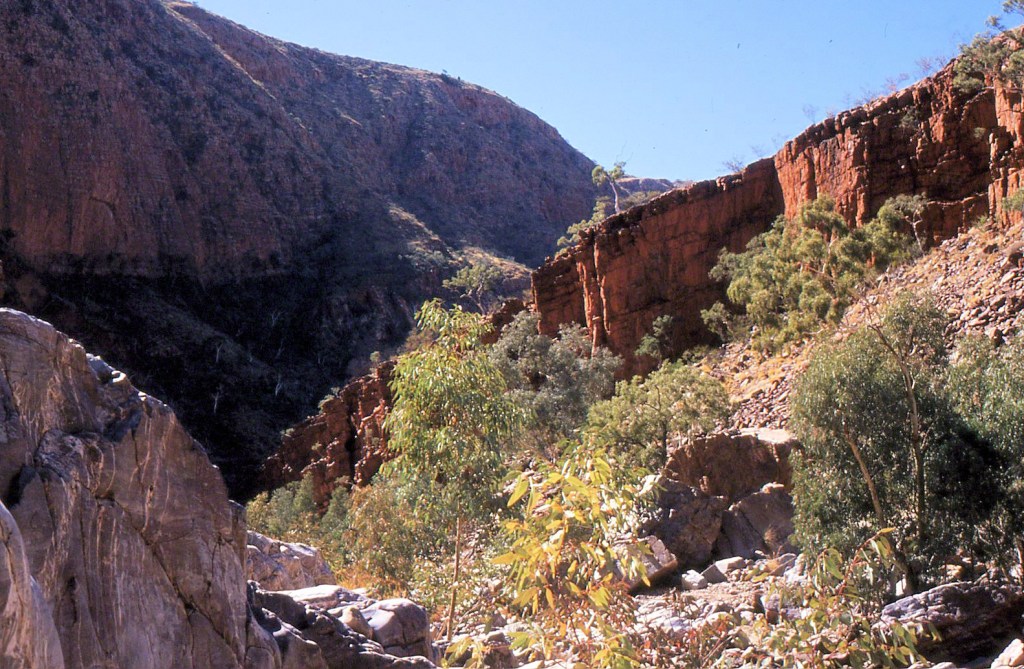
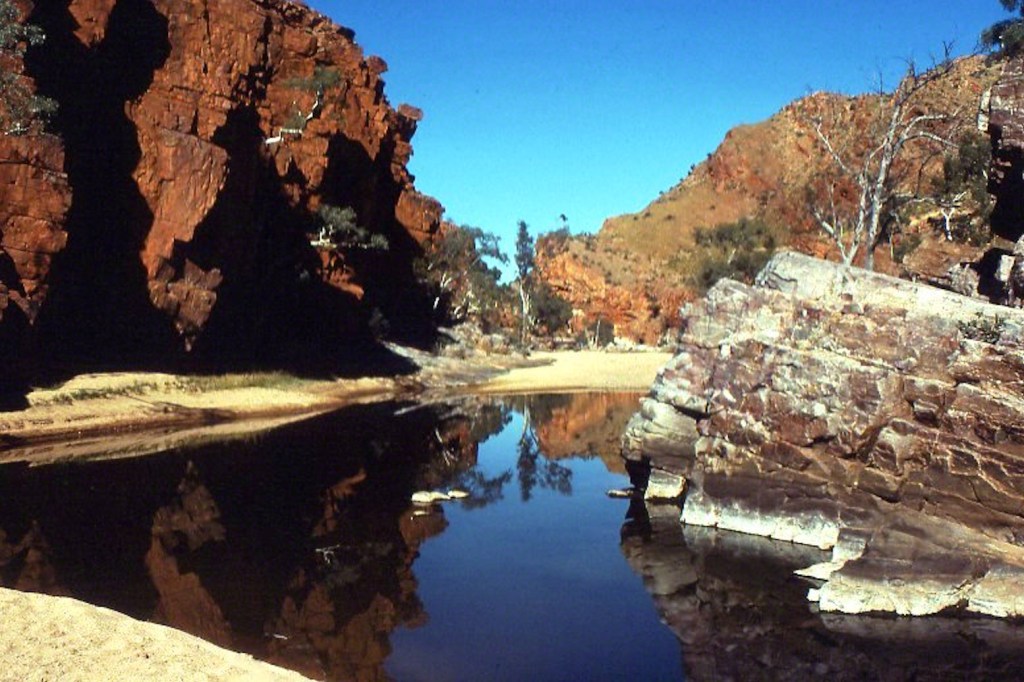
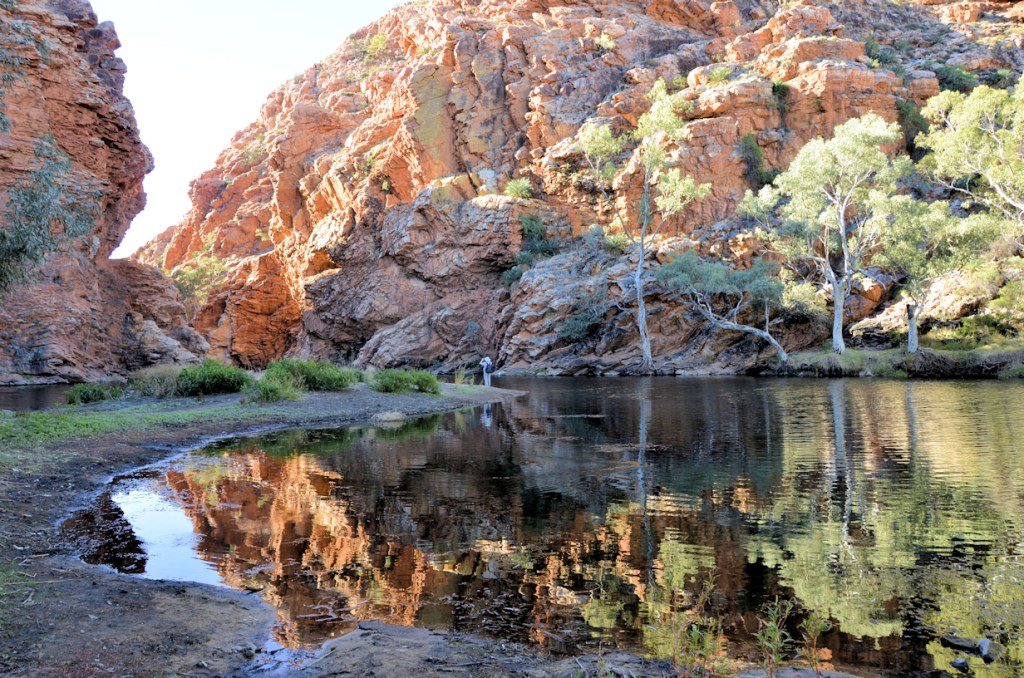
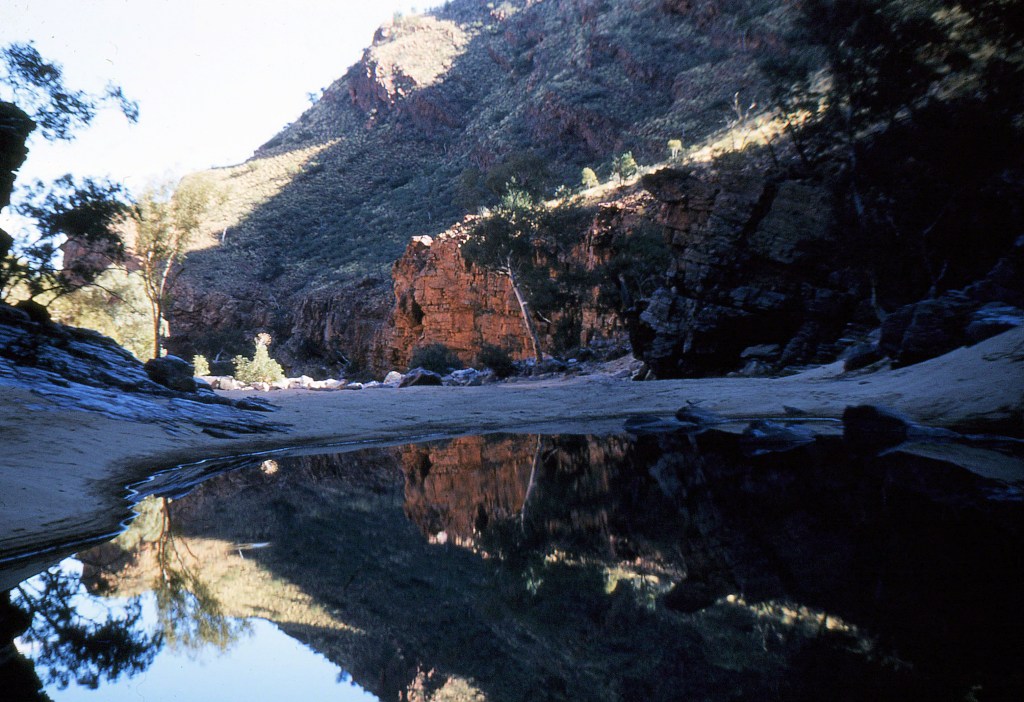
[Palmer River is a tributary of the Finke River. Some of the photos above remind me of our Palmer River campsite.]
***
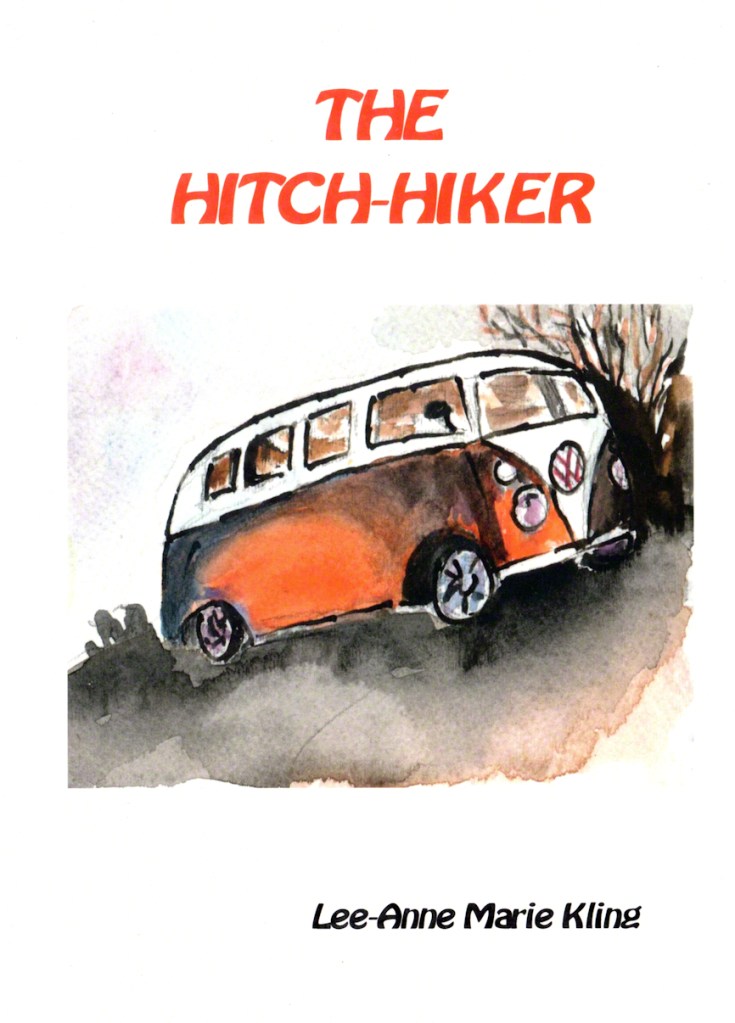
Read more of the adventures of the T-Team in my memoir, Trekking with the T-Team: Central Australian Safari 1981 available on Amazon and Kindle. Check it out, click on the link below: