[In 2013, the T-Team, Next Generation embarked on their pilgrimage to Central Australia. Purpose: to scatter Dad’s ashes in his beloved Central Australia, in Ormiston Gorge.
Over the next few months, I will take you on a virtual trip to the Centre and memories of that unforgettable holiday in 2013, with my brother and his family; the T-Team Next Generation.
This time, the T-K Team (my husband and I) return to Hermannsburg and catch up with friends there.]
Hermannsburg Here We Come
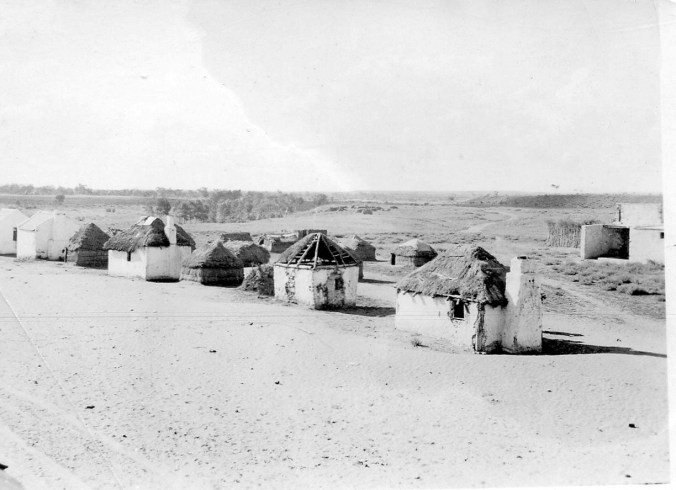
As we powered along the sealed Larapinta Highway, I mused, what a difference some 60-70 years makes. When Mum T lived in Hermannsburg, back in the 1940’s and 50’s, the trip to Alice Springs was a long arduous half-a-day journey on a dirt track in a truck where one spent several days in Alice Springs stocking up on supplies.
As we passed the turn off to Jay creek, I said to Hubby, ‘Mum told us the story of her mum (Grandma Gross) who, when the Finke flooded, had to wade through the waters to reach the other side to continue the journey to Alice Springs. She was 8-months pregnant at the time.’
‘Hard to imagine the creek flooding,’ Hubby glanced at the dip, a dry riverbed, that signalled the up-coming fork in the road leading the Hermannsburg. ‘But I know from camping in the Flinders Ranges, at the first drops of rain, you don’t hang around, you get out.’
‘Your mum and friend didn’t when they camped at Parachilna,’ I said. ‘They were stuck there on an island with the river all around them for days.’
A sign with an image of a cow, and below written, “Beware of wandering stock”, flashed by. Brumbies galloped on the side, as if racing with us. Hawks soared in the cobalt blue sky above. A lone wedge-tail eagle, having gorged on a carcass of roadkill, waddled off the road just in time, avoiding the same fate as its feed.
This time, when we arrived in Hermannsburg, we made a beeline for the FRM store where we located our friend, P. He welcomed us and gave us a tour of the store. So much bigger than in 1981; more like the size of our local IGA store in size and shelves fully stocked. It even stocked fridges and washing machines. P proudly showed us the bakery where fresh bread is made each day and he introduced us to the Indigenous workers at the store.
After settling into our P and K’s home, we spent the afternoon drinking coffee and storytelling with P and K. Storytelling continued over dinner. Much had changed since the T-team visited in 1981. The population of Hermannsburg has now grown to 600, the Finke River Mission still exists there, and the Christian community is growing. However, there remain challenges for the Indigenous community as there are in communities all over Australia, and the world. ‘It just is,’ as P stated, ‘we’re at the coal-face, being a small, isolated outback community; you see everything…’
‘Whereas,’ I concluded, ‘in the city it’s hidden by numbers, a larger population and behind the walls of our castles.’ Then I changed the subject. ‘Oh, by the way, this is the house I stayed in when the T-team visited Hermannsburg in 1981.’
The T-Team with Mr B — In 1977 Dad’s friend Mr Banks and his son, Matt (not their real names), joined Dad, my brother (Rick) and me on this journey of adventure. I guess Dad had some reservations how I would cope… But it soon became clear that the question was, how would Mr. B who was used to a life of luxury cope? And how would the T-Team cope with him?]
Secret Men’s Business
Mangaruka
Dad scraped up the last few oats at the bottom of his metal bowl and then said, ‘I’ve asked our guides to take us to a place which is very special to them.’
‘What? The Gosse Range?’ I piped up. ‘Are we going to that meteorite site?’
‘Better, than that.’ Dad’s mouth did his signature cat-with-bird-in-the-mouth expression. Then he explained that after discussion with our Indigenous guides, they had agreed to take the scenic route via Mangaruka Gorge; the entry to a sacred site. While Mr. B groaned at the prospect of hiking up yet another gorge, my father allayed his friend’s concerns by saying that we would only travel to the gorge’s entrance, and if we had time, just explore the beginnings of it.
Mr. B grumbled, ‘But we don’t want to be searching for a camp near Talipata in the dark.’
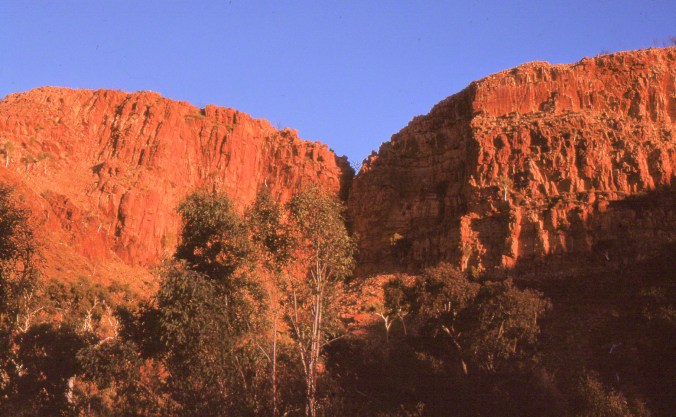
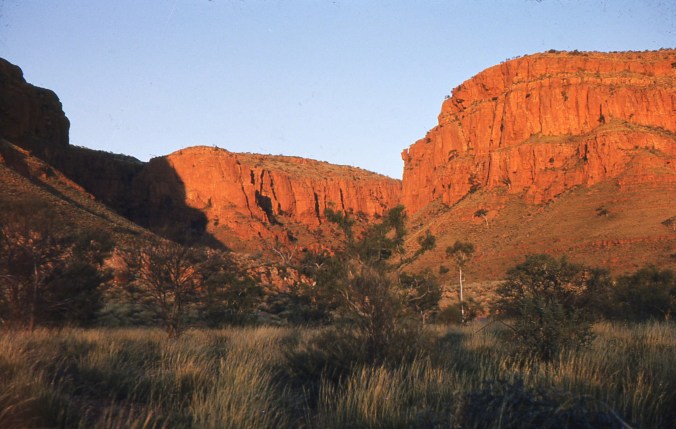
‘Don’t worry,’ Dad patted Mr. B on his rounded shoulder, ‘Talipata is not far from there. Besides, the cliffs of Mangaruka at sunset are stunning, especially with the ghost gums set against them.’
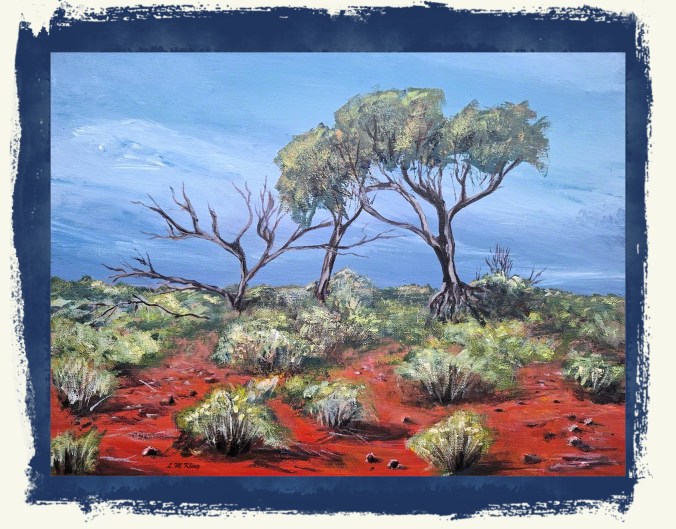
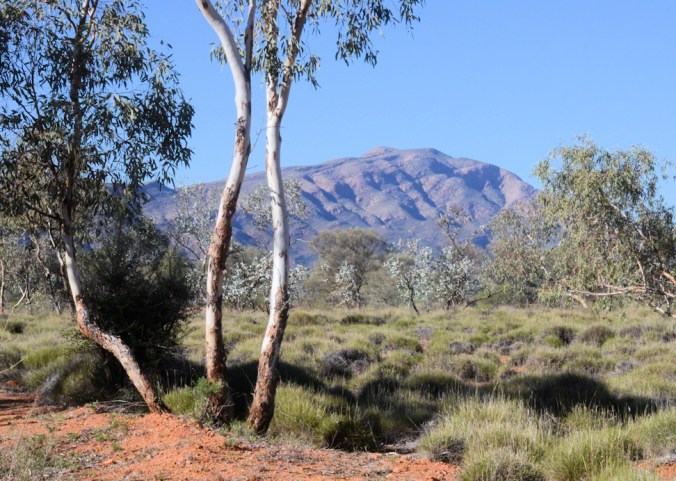
I remembered the exact image Dad was dreaming about. On lazy afternoons at my Grandma’s home, I used to rummage through photos and slides from her family’s time in Central Australia. My grandfather was, in my opinion, an amazing photographer. In one corner of Grandma’s bookshelf in the back room, rested a pile photo prints that were kept in pristine condition encased in special cardboard like a card; the best of Grandpa’s work. One scene that I have painted was a ghost gum, it’s white trunk against the deep purple cliffs of Mangaruka Gorge. Another slide that impressed me was the same scene with the ghost gum at sunset. No wonder Dad wanted to stop there on our way to Talipata.
After having breakfast, we packed up and drove out into the wild west. The dirt road exemplified that rugged feel.
At Haasts Bluff station we filled up with petrol, water, and supplies to last us in this virgin land. We were going where not many people, except the Indigenous, had gone before. Upon entering the land belonging to these people; there would be no shops, no houses, and no roads. To salute our departure from civilisation, we bought something to eat and drink. I ate a meat pie.
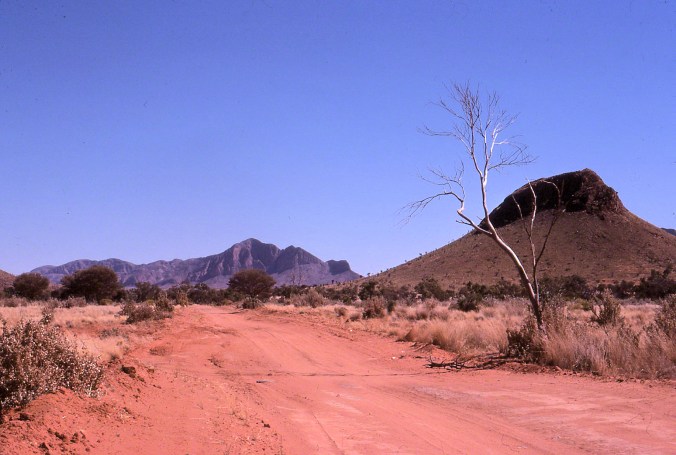
Our guides directed us off the narrow, yet graded road onto an almost invisible track. One sat on the bonnet of the Rover and directed our venture into the desert. We bumped and crawled along faded wheel ruts until a small range emerged through the low dunes and the folds and creases in the flat-topped hill, formed a gorge. We had reached Mungaraka Gorge.
Dad slowed the Land Rover, parking it just before some soft sand that threatened to engulf its wheels. The T-Team stepped out of the vehicle to be greeted by a welcoming party of small pesky flies. They were most unwelcome.
Swishing the pests away from his nose, eyes and mouth, Dad said, ‘Mungaraka, I reckon the name of the place has something to do with flies.’
‘Certainly a feature of the place,’ Mr. B sniffed. ‘Oh, darn it! I just got one up my nose.’
Richard, my brother clapped.
Mr. B glared at him.
With eyes wide, Richard looked at Mr. B. He then examined his palms. ‘Twenty.’ He flicked the flattened black flecks from his hands and then clapped again.
Mr. B then turned to his son, Matt. ‘Don’t even think about killing tha flies, ma son. They have germs. You don’t want germs, ma boy.’
‘No, Dad.’ Matt pulled his cap over his eyes, turned away and strolled down the track towards Mangaruka.
Dad, who had been laying out a spread of food on the tarpaulin, stopped preparations and ran after the boy. ‘Hoy! Matt! Wait! Lunch first, then the gorge.’
Richard laughed. ‘And for extra protein—flies.’
Lunch became a battle of hasty bites of cheese and gherkin sandwiches while trying to avoid the added bits of protein of flies that were only too willing to add flavour to our meal. After, we sipped our billy tea probably flavoured with the odd thirsty fly.
Our guides sat apart from us, and, unperturbed by our uninvited swarm of guests, they ate their bread and murmured quietly to each other. Dad perched on the tucker box and watched them.
I gulped down my last drop of tea. ‘Well, aren’t we going to explore the gorge?’
Dad stood up. ‘Right, let’s go.’
‘What about our guides?’ I asked.
‘Oh, they won’t be going. Mangaruka’s sacred to the Arunda, so they won’t go near it.’
‘What? Are they afraid of the place, Dad?’
‘It’s more complicated than that. They keep sacred stones called “Tjuringa” there in a cave. And they are afraid of spirits there.’
‘Can we go there?’
‘Sorry, Lee-Anne, girls are not allowed. Nor us. Not them. Only the elders. So, we’ll only go to the entrance of the gorge.’
Mangaruka held no ghost for us, only flies. Dad, Mr. B and Matt, and I walked up to the entrance of the gorge. Richard stayed behind to keep our two guides company. On the rocky slopes in the gorge, a smooth brown and white stone caught my eye.
‘Girls not allowed,’ Mr. B added, and then called out to Matt who had scampered further up the gorge. ‘Come on son, time to go back.’
On our return, I tried to take a photo of us all in front of this gorge, but our aboriginal companions refused. In the end, Dad took a photo of me in front of Mungaraka. Dad would have like to stay longer to wait for the rocks to turn red, but we had to move on.
[In 2013, the T-Team, next generation embarked on their pilgrimage to Central Australia. Purpose: to scatter Dad’s ashes in his beloved Central Australia, in Ormiston Gorge.
Over the next few weeks, I will take you on a virtual trip to the Centre and memories of that unforgettable holiday in 2013, with my brother and his family; the T-Team Next Generation.
This time, the T-Team go their separate ways…]
Monday Morning
After a fitful sleep and then early rise, I looked forward to coffee with mum and the boys. With the sun peeping over the horizon, shining in the watery blue winter sky and reflecting golden on the gum trees surrounding the campground, the frigid desert air slowly began to thaw.
First, though, after a warming shower and filling breakfast, the tent had to be packed up. Hubby needed my help with that. Then, he spent an eternity repacking the station wagon. While waiting, I jogged on the spot and puffed out steam of my breath into the below ten-degrees air.
As if a surgeon performing a delicate operation, he punctuated his packing with commands. ‘Bags!’ So, I passed over the bags which he grabbed and pushed into the boot of the car. Then, ‘Tent!’ I hauled over the packed tent to him. Then, ‘Esky!’ I lugged the cool box (esky) to him. Then, waving his hand while head stuck in the boot of the car, ‘Box!’
‘What box?’ I asked.
‘Kitchen box!’
‘Huh?’ I glanced at the piles of stuff still waiting a home in the Ford. Finding the green crate with breakfast cereals, bread and cans of beans, I passed that one to him.
‘No! No! No!’ he snapped and pointed at the red crate, same size but with cooking utensils. ‘That box!’
Apparently, the green crate must go under the back seat with a blanket covering it.
Finally, with Hubby’s version of luggage-tetris complete, we drove the short distance in the caravan park to mum’s cabin.
Again, we found Mum T glued to the phone. On the small pine table, she had spread out a brochure opened to camel farms. In between phone calls she muttered, ‘Mrs. T has asked me to find a camel farm for them to visit.’ She was not having much luck finding a camel farm or someone from the camel farms advertised, to answer her calls.
While Mum T remained occupied with the phone, Hubby and I popped next door to visit our boys. The first words out of their Dad’s mouth when he entered was, ‘Have you packed?’
Son 1 and 2 duly showed Dad their packed luggage waiting by the door.
Satisfied that the lads were ready to depart Alice Springs and not miss the flight, we sat down to enjoy a coffee with them.
Mum joined us. ‘Oh, by the way,’ she said over her much-needed coffee to wake up, ‘the park manager came over. They were most apologetic about the mix up yesterday. Apparently, whoever took my booking assumed the people were T’s, because when they asked them, the lady didn’t hear clearly and just nodded and said “Yes”.’
‘You mean the guy behind the counter assumed the lady was you?’ I asked to clarify.
‘Apparently, the guy asked the lady, ‘Are you Mrs. T?’ and she said, ‘Yes.’’
We shook our heads.
‘Maybe the lady who took our cabin had a hearing problem,’ I said.
‘Oh, well, it all worked out in the end,’ Mum T concluded.
After visiting the Strehlow Centre and its Art Gallery again, we travelled to the airport to see our sons safely, and in time, board the plane back to Adelaide. Then a brief stop at Woolworths for Hubby to buy some shorts, before commencing our return to Hermannsburg.
[In 2013, the T-Team, next generation embarked on their pilgrimage to Central Australia. Purpose: to scatter Dad’s ashes in his beloved Central Australia, in Ormiston Gorge.
Over the next few months, once a month, I will take you on a virtual trip to the Centre and memories of that unforgettable holiday in 2013, with my brother and his family; the T-Team Next Generation.
This time, the T-Team leave camping in the desert behind and tackle the complexities of civilisation—Alice Springs … All on a Sunday.]
Must Register
By the time our family and Mum drove the streets of Alice Springs in search of a hotel to eat, night had fallen, and a blanket of darkness surrounded us. As a convoy of Mum’s rental and the Ford, we wended through the few short streets to the nearby hotel which had been recommended by the caravan park.
Our family of five filtered through the front entrance and into an expanse of dark green carpet and pastel green walls and fronted up to the black topped counter.
‘Do you have a table for five?’ Mum T asked.
‘You need to register,’ the man at the counter said.
Anthony and I glanced at each other. ‘Register?’
‘We need to see your identification; a drivers’ licence will be okay.’
‘That’s normal for me,’ Son 1 said, ‘They always ask for my ID. They don’t believe I’m over 18.’
Son 2 snorted, ‘And here I was getting into hotels when I was under 18, no problem.’
While the boys quibbled and joked, the T-K Team, good citizens that we were, unquestioningly showed our respective licences and registered to enter the hotel.
As we sat at our designated table, we observed the predominance of people of Anglo-Saxon extraction and the lack of First Nation people. There was one Indigenous family way down the other end of the dining hall, but… They seemed happy enough.
Over dinner, roast meat, and smorgasbord, (your average fare for an Aussie hotel at that time), I mused, ‘What’s the deal with registering?’
Anthony waved a hand around the room. ‘Isn’t it obvious? Didn’t you read the sign at the entrance?’
‘What sign?’
Anthony rolled his eyes and shook his head.
Then again, I understood, without further explanation, what my husband meant.
Back at the campsite, I used the communal kitchen to prepare a hot chocolate for Anthony and me. While the kettle took its time boiling, I watched a pair of German tourists and their Australian friends Skyping on a laptop to Germany.
Then, soporific from the effects of warm chocolaty milk, hubby and I snuggled into our sleeping bags and it was lights out for us…only, it wasn’t that much light out—we still had the toilet block light beaming into our tent…all night. And on our minds wondering who were the T-Team imposters?
[Remembering my dad, Clement David Trudinger 13-1-1928—26-8-2012
Extract from Trekking with the T-Team: Central Australian Safari 1981]
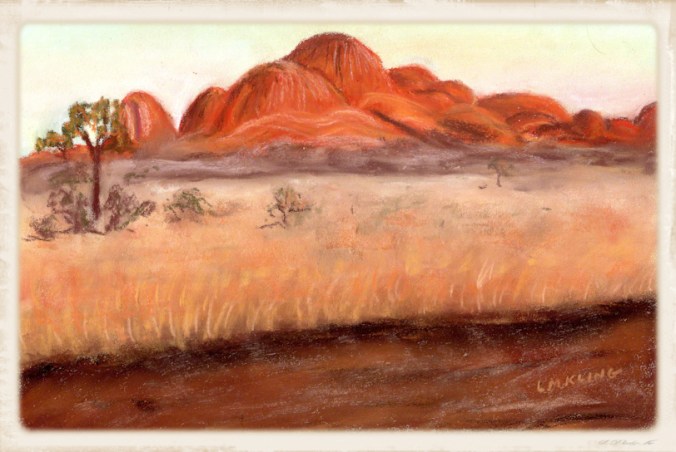
Way before the sun had even thought about rising, we gulped down our porridge and then set off for the Eastern Side of Kata Tjuta. Dad was on a mission to capture the prehistoric boulders at sunrise. We arrived at the vantage point just as the sun spread out its first tentative rays, touching the spiky tips of spinifex and crowning the bald domes with a crimson hue as if they’d been sunburnt.
I dashed a hundred metres down the track to photograph the “Kangaroo Head” basking in the sun. We stood in awe as the glow of red on the rocks deepened.
Every few minutes Dad exclaimed, ‘Ah, well, that’s it, that’s as good as it’s going to get.’ He packed the camera away, only to remark, ‘Oh, it’s getting better,’ then retrieve the camera from the bag and snap Kata Tjuta flushed with a deeper, more stunning shade of red. The rest of the T-Team, waited, took a few shots, waited, mesmerised by the conglomerate mounds of beauty, before taking more snaps of the landscape.
[In 2013, the T-Team, next generation embarked on their pilgrimage to Central Australia. Purpose: to scatter Dad’s ashes in his beloved Central Australia, in Ormiston Gorge.
One Friday a month, I will take you on a virtual trip to the Centre and memories of that unforgettable holiday in 2013, with my brother and his family; the T-Team Next Generation.
This time, the T-Team leave camping in the desert behind and tackle the complexities of civilisation—Alice Springs … All on a Sunday.]
Imposters
Less than one hour later after leaving Hermannsburg, we checked into the Stuart Caravan Park on the edge of Alice Springs. The reception, cast in long shadows, signalled the fast-approaching night and uncertainty that comes with not booking a site. Would there be one for us?
Fair point. Why book a cabin and campsite if you can stay with friends and save money?
‘Looks like someone impersonated our mum and snaffled up her cabin,’ I said.
‘Mmm! That’s a bit rough,’ Mrs T said, ‘Hope she can get her money back. She can stay with us if she likes.’
I looked to Mum T. ‘You can stay with the T-Team at their friend’s.’
Mum T smiled. ‘It’s okay, the manager has given me another cabin free of charge.’
Glad that we had decided to return to Alice Springs and had been there to support Mum. Still, rather ironic that, Mum, who had been the first to book her cabin way back in March or April to ensure she had a booking and not miss out, was the one who almost did. Still, she got hers free.
In the golden tones of late afternoon, Anthony and I set up our tent and then took a leisurely stroll around the caravan park and onto mum’s cabin. Fortunately, her cabin was near our sons’. On the way we “happened” to pass the cabin containing the fake T-Team. There they sat, out on the front porch, an elderly couple and a younger couple. Didn’t appear to be your average criminal type or distant relatives even.
Visited the boys’ cabin. Son 1 and 2 had settled in for the night, happy with the comfort that the rooms afforded. Son 1 particularly pleased that he wouldn’t have to hear our snoring.
Son 2 however asked, ‘What are we doing for tea?’
‘Maybe we can go to a hotel to eat,’ I said.
My husband frowned. ‘What? Are we made of money?’
‘You want to cook?’ I questioned. ‘Anyway, it’s Mum’s and the boys’ last night up here, they leave for Adelaide tomorrow.’
Anthony sighed, ‘Oh, alright!’
Sprinted over to mum’s cabin and knocked on the door. Mum, holding the phone, ushered me in. Then I stood in the small lounge area while Mum sat at the tiny wooden table, phone glued to her ear.
I waited.
Mum, with phone at her ear and silent, waited.
‘What…?’ I began.
Mum batted her free hand at me to be quiet.
So, I waited.
And waited.
Might as well do something while waiting for goodness knows what. Must be something to do with the imposters, I thought.
‘Yes…’ finally, mum gets a response, ‘yes, right…nine o’clock tomorrow…be there half an hour before…no, we don’t have any luggage; only hand luggage…Right, thank you.’
‘Not news about the T-Team imposters, then?’ I laughed.
‘No, just had to do the check in with Qantas for the boys’ return trip tomorrow,’ Mum replied.
Only then, was I able to discuss with mum about going out for tea. Of course, the suggestion was fine by her.
[In 2013, the T-Team, next generation embarked on their pilgrimage to Central Australia. Purpose: to scatter Dad’s ashes in his beloved Central Australia, in Ormiston Gorge.
Over the next few months, I will take you on a virtual trip to the Centre and memories of that unforgettable holiday, with my brother and his family; the T-Team Next Generation.
This time, the T-Team explore historic Hermannsburg, but fail to find any ghosts.]
Mystery in Historic Hermannsburg
We checked out the old school room. Mum reminisced the terrors of teaching the fellow missionary kids who were barely younger than her. They just refused to listen or obey her. Some were constantly daydreaming and never did their lessons. Mum vowed never to teach again. She escaped this teaching fate by getting married…to Dad.
T-Tummies began to grumble and so, the T-Team Next Gen decided to head for the Precinct Café which had been the Manse of the Hermannsburg Missionary Supervisor.
As we investigated the old rooms that had been converted into a souvenir shop and tea rooms, Mum said, ‘This is the room Dad and I stayed after we got married.’ I took a photo of Mum in that room which was now filled with souvenir clothes and hats.
Finally, Mum and I approached the counter and asked the young Arunda lady serving, if we could have a table for our party of ten.
She guided us to some tables on the porch where we could sit. Along the way, Mum mentioned to her that she used to live in the house. From that moment on, this lady could not do enough for us, making sure we had the best slices of apple strudel and helping us with the self-serve tea and coffee.
When she had left us to serve someone else, Mum whispered to me, ‘I think she is GW’s (an elder) granddaughter.’
Later, as we were leaving to explore more of the village, the girl who had served us ran up to the T-Team to continue the conversation with us about the Hermannsburg of old and answer any of our questions about Hermannsburg today.
Then, she had a question for us. ‘Have you seen or sensed any ghosts?’
We shook our collective heads. ‘No, we haven’t.’
‘Apparently, some people have seen a girl in period clothing, circa 1900. And some have seen an old man in this café. The young girl plays with my children,’ the lady who served us said.
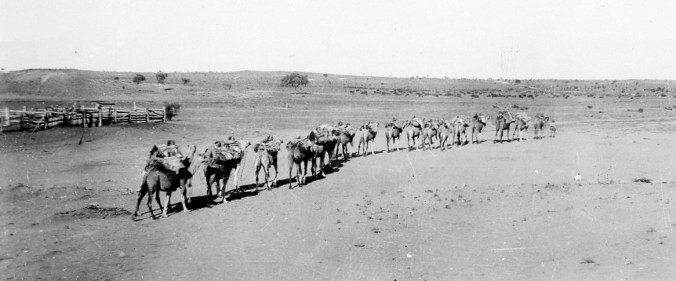
I tried to think back to my previous visits to Hermannsburg. Can’t recall any ghosts then…just dreams of the olden days, way back when…And the pioneer missionaries and Afghans trekking across the desert on horses and camels.
More exploration of the Historic Precinct where Mum walked us through her childhood. First, her old home and the porch converted into a bedroom in which she slept. Now, the home is “renovated” into an art gallery. Her room fetches up to something like one thousand dollars a night for an authentic experience of yesteryear’s accommodation. To think, I did that virtually for free in the 1970’s…not her room, but…
Then, the native girls’ quarters and the native boys’ quarters. Once upon a time, one hundred years ago, they were locked in at night, so they wouldn’t escape and get up to mischief.
Then the huge shed; a museum of machinery and long-forgotten technology, for butchering cattle, and tanning of kangaroo skins. Outside, my niece sat on an old tractor.
While the T-Team Next Gen rested at a picnic table by the morgue, and Anthony filled the water canteens, Mum shared how, as a child, she and her sisters played funerals. ‘We’d dance around the table pinching our noses.’ Apparently, back then, funerals were a regular occurrence. Mum added, ‘The most eerie experience was the wailing by the Arunda when someone died. Sent shivers down my spine.’
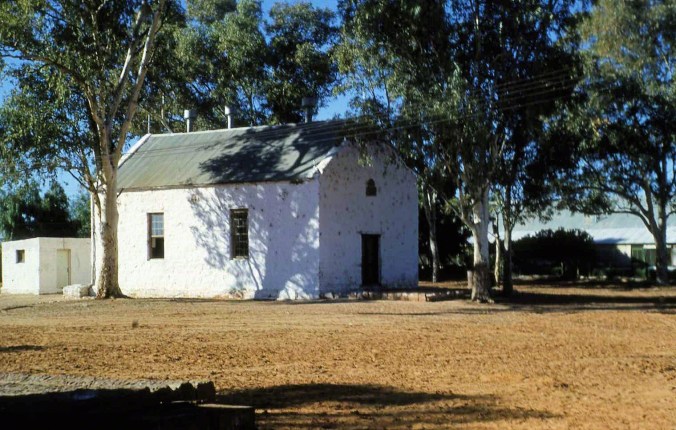
Meanwhile Anthony battled with the nearby water pump which was situated just behind the Historic church building.
Mum glanced over and remarked, ‘Last time we visited in 2010, we were told about this competition Hermannsburg and another mission were in for who had the holiest water. Someone had drunk the water from this other mission where the water had bubbled up to the surface through the sand and was healed. So, then, Hermannsburg had to out-do this other mission and also make water with healing qualities.’
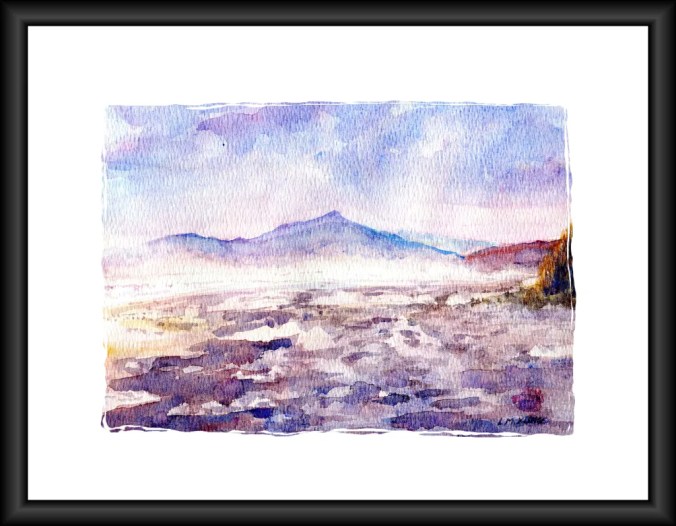
Virtual Trekking Behind the Art: Ocean Beach Tasmania
[In the last few weeks, after months of drought, rain. And, almost a month after storms and extra high tides, more extra high tides last Tuesday. So, in memory of the cold stormy weather, here’s an old piece of calm from our Tasmanian travels.]
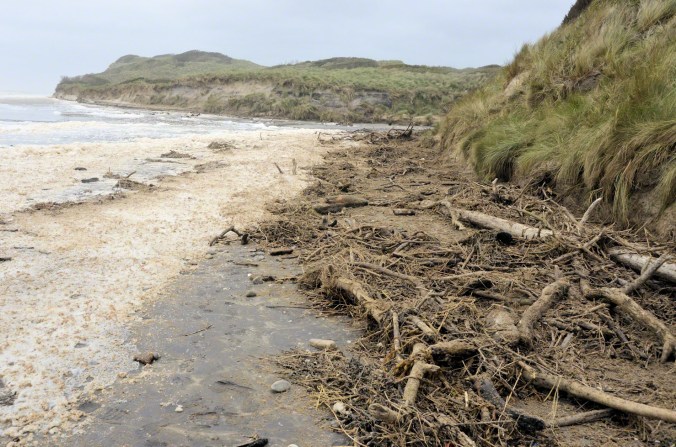
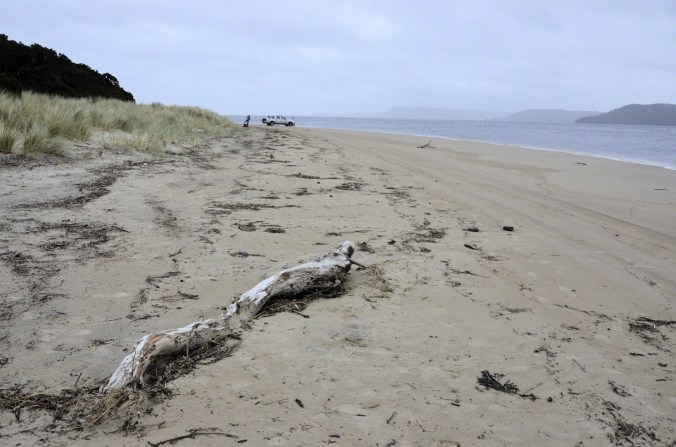
Ocean Beach lies on the West Coast of Tasmania near Strahan. The wild winds of the roaring forties (between the 40-and 50-degrees latitude) attack the coast with relentless ferocity.
In 2001 I visited Ocean Beach with my family to see the mutton birds coming home to roost for the night. I had barely stepped out of the car before the biting cold wind blasted me and I made a hasty retreat back into the car. No view of mutton birds that evening. Result, no photos.
Ten years later, my mum and I visited Ocean Beach. While the East Coast was inundated with floods, Ocean Beach that afternoon was calm. We explored the beach, taking many photos of this rare state of the beach.
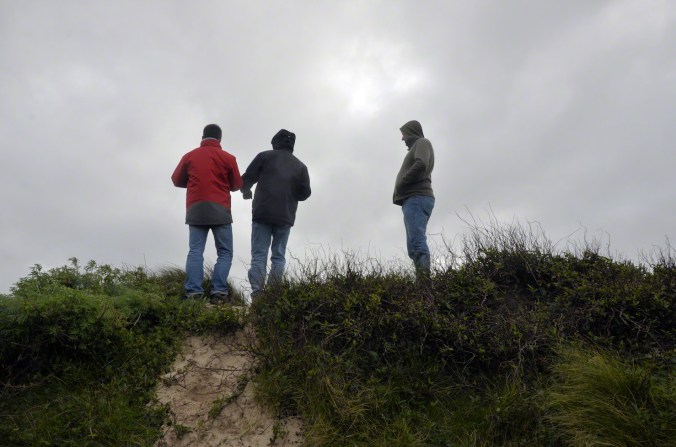
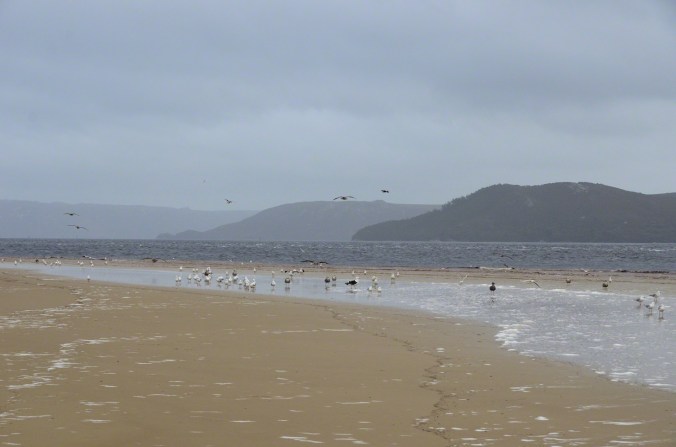
October 2016, the K-Team ventured onto the sands of Ocean Beach on perhaps a not-so-calm day; calm enough though, that we were able to walk along the beach. Not being satisfied with just an obligatory few metres up and down, my husband led us way up the estuary where we spotted a variety of birds, some fishermen, and the lighthouse sitting out there near the heads. Gotta get our money’s worth. After all, he’d seen the potential from the dizzy distance of the cruise boat as it sailed past the heads of Macquarie Harbour. I think if we’d allowed him, we’d still be walking along the coast somewhere around Tasmania.
[Twelve years ago, the T-Team, next generation embarked on their pilgrimage to Central Australia. Purpose: to scatter Dad’s ashes in his beloved Central Australia, in Ormiston Gorge.
Over the next few months, I will take you on a virtual trip to the Centre and memories of that unforgettable holiday in 2013, with my brother and his family; the T-Team Next Generation.
This time, the T-Team farewell Glen Helen, then struggle with the concept of driving in convoy.]
Hermannsburg
Midday, and Mt. Hermannsburg rose up above the desert scrub; just red sand dotted with tee tree bushes, spinifex and the invasive buffel grass. At regular intervals, horse poo appeared in high piles on the roadside.
I read later that buffel grass was introduced to stablise the desert soil and reduce the risk of bushfire. The problem with this grass is that it is pervasive, compromising the growth of native plant species. PIRSA (Primary Industries and Regions, South Australia) has declared “Buffel Grass under the Landscape South Australia Act 2019”.
A massive animal carcass on the side of the road flitted past.
‘What’s that?’ I pointed, then placed my hand back on the steering wheel. ‘It’s too big to be a roo and too woolly to be a brumby.’
Son 2 piped up. ‘Camel?’
‘Hmmm, hate to think what happened to the vehicle that struck that camel,’ I said.
Not long after the camel carcass, we passed the memorial to Hermannsburg Mission and then a sign welcoming us to Ntaria—Hermannsburg. To our left, a supermarket, a pale brick structure languishing on the edge of a paddock near the road.
‘That’s where our friend, P, from church works,’ I announced. Our friends, P and wife, K had invited us to stay with them in Hermannsburg.
The convoy came to stop on the gravel road edge by the store.
I hopped out of the car and entered the store. Searching for P, I wandered up and down the aisles, filled with the owners of the Land, the Arunda people, but shelves empty of anything to buy. Except for the pie warmer, choc-full of pies, chips and other fast foods.
I approached the check out where an Indigenous lady served a long line of customers, who each held pies, chips, hot dogs, and burgers. I stood in line and waited my turn to purchase an answer to my question.
Finally, my turn. ‘Could you tell me where I can find P?’
The checkout lady stared past me.
‘P? I thought he worked in the supermarket,’ I said.
I waited about 10 minutes while she served a stream of customers purchasing their pies and other junk food.
So, I left.
‘Perhaps we’ll find an answer or P at the Historic Precinct,’ Mum said.
The T-Team convoy led by Mum’s hire car, then continued through Hermannsburg to the Historic Precinct. We passed a gated community. Yes, you heard right, a gated community. Houses painted in bright pastel green, yellow and pink, could be viewed through the cyclone fence, and their occupants sitting in backyards of red sand.
Further on, we rolled past another store. This one painted in pastel blue and decorated with a mural of native bush, mountains, and a kangaroo. Near a broken window, a faded sign, stating its identity as the “Finke River Mission” Store.
Mum waved a hand in the store’s direction. ‘I reckon P works here.’
The door appeared locked by a security gate of thick metal bars. Without stopping, or alighting from the car, I said, ‘I think it is closed on Sunday.’
A few metres on, we parked just outside the Historic Precinct. The wooden gate leading to the old buildings swung in the breeze, open. To one side, though, a formidable sign discouraged us with the words in black letters, “Closed”. Despite this sign and its statement, people wandered across the compound and in and out the buildings.


























 Tru-Kling Creations