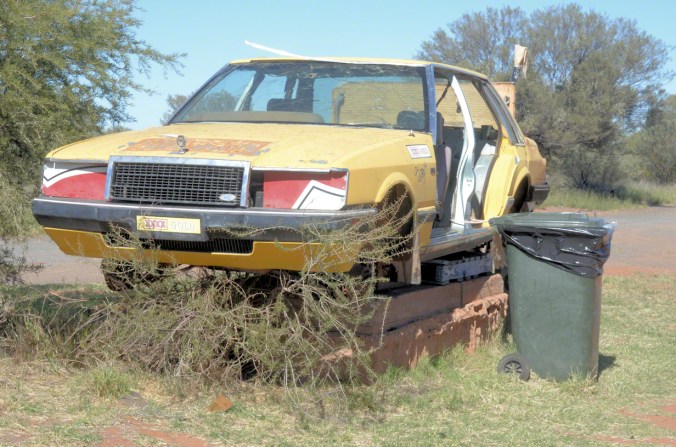
My dad’s midlife crisis took a turn … for the worse. The Mazda. Not sure what type this less-than-trustworthy steed was; suffice it to say, he purchased it for a bargain, as it had a damaged rear end. So, the Mazda became the butt of many car jokes from my friends.
Not to be confused with our current Mazda, whom we call Antoinette; a most wonderful car to drive. She even reminds me when I’m speeding, with a stern, “You are going over the speed limit.” She chimes with teeny-weeny orange cars on the rearview mirrors when I attempt to change lanes, and, lo and behold, there’s a car I haven’t seen. She chirps when I’m about to back out, and a car is passing. And the dear Nanny car virtually screams if I get anywhere near another car. Oh, and every morning she reminds me with beeping and a red dot on the image of my car in the rear cam that I’m too close to the garage door. She’s doing a good job of keeping my hubby out of his task of backseat-driving and making sure she doesn’t end up like my dad’s old Mazda.
The plight of our old Mazda must have become legend in the world of Mazdas, passed down from generation to generation along the Mazda factory assembly line. And so we come to 2018, when Antoinette was born, with her abundant safety features, hopefully never to experience the shame of Dad’s old metal “bargain” with the battered rear bumper from 50-years ago.
Hence, here’s the poem …
A reblog, in memory of my dad’s much-maligned Mazda.
An Ode to the Mazda
Now every time the battle-axe we release, We pray: Keep our Mazda running from police Particularly today.
Grant us all green lights, for our brakes may fail, And may thy Mazda’s effervescent light shine forth At both head and tail.
Forgive us our blinkers, our wipers, the lot, As we forgive those who are enemies and gripers Of the Mazda we’ve got.
For my Northern Hemisphere readers, it’s still the Summer Holiday time. Time to read more on the war against the fiend you love to hate: an overgrown alien cockroach, Boris.
[In 2013, the T-Team, next generation, embarked on their pilgrimage to Central Australia. Purpose: to scatter Dad’s ashes in his beloved Central Australia, in Ormiston Gorge.
Over the past year, I have taken you on a virtual trip to the Centre and memories of that unforgettable holiday in 2013, with my brother and his family, the T-Team Next Generation.
This time, with the trip ending, the T-K Team continues their return to Adelaide, heading for Woomera in the rain.]
Woomera
Part 1
Cheeky Campers
So, out of toilet parole we escaped Coober Pedy, destination Woomera. I drove.
‘We’re running late,’ Anthony grumbled.
‘Ah, we’ll only arrive after dark,’ I replied. ‘Let’s get a cabin in the caravan park if we can.’
‘And, if we can’t?’
‘I don’t fancy camping in this weather. We’ll sleep in the Ford if we can’t.’
‘Hmmm. I doubt we’ll be able to get a cabin; we haven’t booked.’
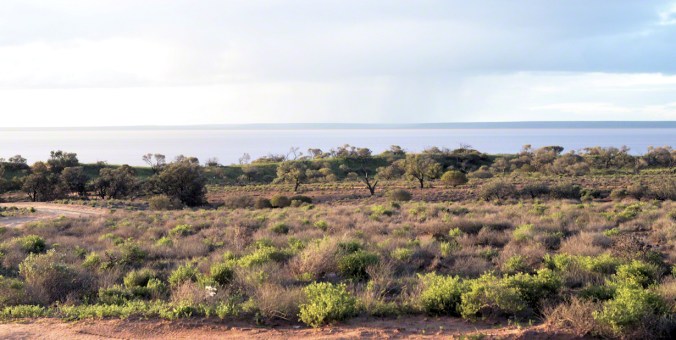
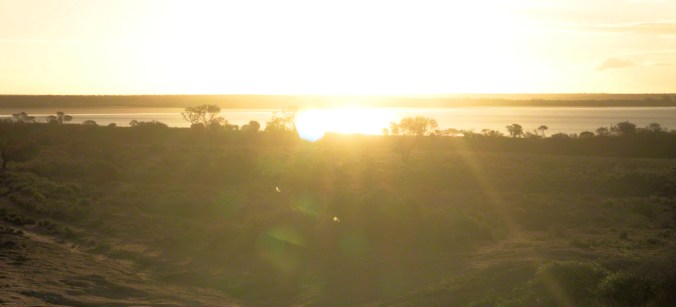
We pulled into the rest area, come viewpoint to have a break and take some photos. The sun had neared the horizon, casting the salty waters of Lake Hart in hues of pink and lemon.
Some free campers had built fires beside their campervans. One couple had pitched their tent underneath the canopy of the Information Kiosk.
Anthony glanced at the tent and then muttered, ‘Not sure if you’re allowed to do that.’
‘Perhaps a ranger will come along and tell them off.’
‘Nah, probably not.’
‘I guess we’ll never know. We’d better get a move on to Woomera to try our luck.’ I adjusted my hold of the camera. ‘After I take a few more shots while there’s a break in the clouds.’
By the time we reached Woomera, the town was shrouded in darkness, and rain fell steadily. Light still shone from the Caravan Park manager’s cabin. We entered through the unlocked sliding door and rang the bell. The manager appeared with a smile on his face.
No trouble getting a cabin. He explained that normally cabins were filled with workers from the nearby Roxby mine. But this night, there were a few vacant cabins. We were fortunate.
Ah! Luxury! After all, we needed some TLC after no sleep the night before. The simple one-room cabin with a queen-sized bed, kitchen facilities, an en suite bathroom and toilet to the side, and a television would do just fine.
I cooked pasta with canned spaghetti sauce, corn, and chopped up spam. For dessert, canned pears and custard.
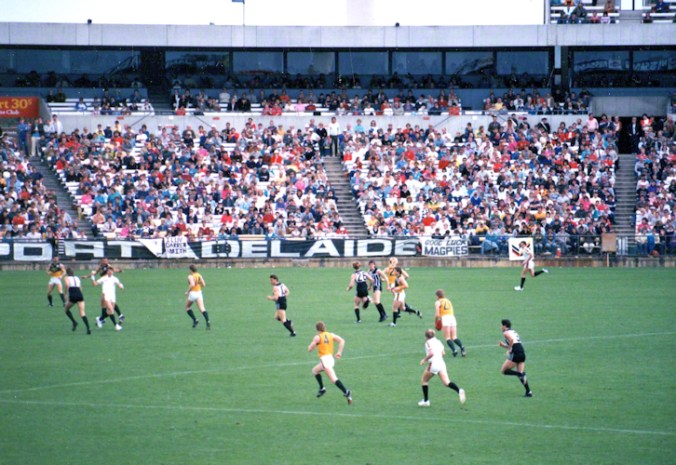
Anthony was in his element as he propped himself up on the bed and watched the football.
At 10 pm, I woke with a start. Beside me, Anthony, head bowed, snored while the football commentators bantered. ‘You’re snoring!’ I mumbled. Anthony smacked his lips and sank into the bedding.
I switched off the TV and snuggled into the warmth of the quilt and Anthony. With the sound of rain pattering on the roof, once more, we fell into a deep and satisfying sleep.
T-Team Next Generation — From Alice to Adelaide (1)
[In 2013, the T-Team, next generation embarked on their pilgrimage to Central Australia. Purpose: to scatter Dad’s ashes in his beloved Central Australia, in Ormiston Gorge.
Over the next few months, I will take you on a virtual trip to the Centre and memories of that unforgettable holiday in 2013, with my brother and his family; the T-Team Next Generation.
This time, the T-K Team commences their return to Adelaide from Alice Springs.]
Back to the Big Smoke of the South
After packing up our belongings into our trusty Ford, topping up with petrol, and cash supplies, we departed Alice Springs and headed south to Adelaide. It’s amazing what one discovers retracing our steps to South Australia. In the morning sunlight, there, mini-Ulurus, mini–Kata Tjutas, and mini-Mt Conners.
At Kulgera, we shared lunch with flies. All around us, people swished at their faces. My glasses kept falling off as I fanned the flies away. In the end, I put on my sunnies. Then, when that strategy failed, we retreated into the roadhouse and had coffee in the restaurant. Self-serve for $3.
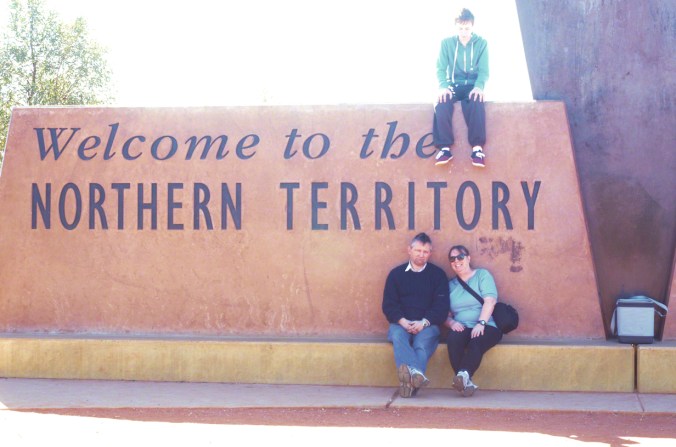
There, at the border, we parked to check our itinerary of food for fruit and vegetables. Owing to the prevention of bringing any fruit fly infestation into South Australia, fruit and vegetables had to be disposed of in the bins provided. More flies hovered around, joining our forage in the back of the Ford.
A passing Northern American tourist remarked, ‘Are South Australians so precious?’
‘Yes, we are,’ I muttered to Hubby, ‘how else have we kept the scourge of fruit fly out of our state?’
All around us, fellow travellers hauled out their luggage from their cars or four-wheel drive vehicles and disposed of their fresh produce. None of them looked happy.
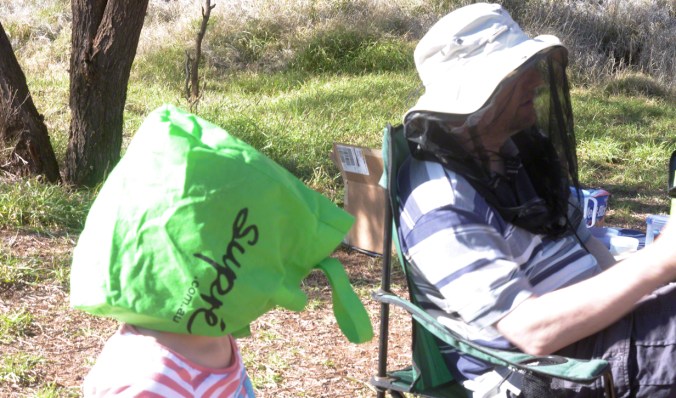
Sitting on a picnic table, a lad about Son 1’s age, and wearing a fly net, boiled up a pan of canned corn and peas on a portable gas cooker.
Nodding in their direction, I remarked to my husband, ‘Do they think canned vegetables are a problem?’
‘Quiet, Lee-Anne, they might hear you,’ my husband snapped.
‘Maybe someone should tell them that it’s only fresh vegetables that need to be disposed of.’
Hubby shook his head. ‘Come on, let’s get going.’
After depositing the few offensive apples and oranges in the bin, we piled into the Ford and charged forth on our journey south down the Stuart Highway.
With the potatoes securely stored in the cooler hidden in the Ford, we stepped into Marla’s red brick tourist park office. Tent site? No problem. Plenty of room on the grassy park for campers.
However, fearful that the biosecurity police might emerge from under a mini-Ayers rock and ping us with a hefty fine, I was designated to cook up the potatoes and one offending onion, while Anthony pitched the 2-person tent in the middle of the verdant camping reserve. My potato dish was not exactly rösti, though.
While frying up this “contraband” fare, a familiar white van whizzed past. I stepped out of the BBQ shelter and waved to them. The white van turned around.
The T-Team joined us for our potato and onion fry. Our nephew contributed their stash of vegetables to make a stir fry. Mrs. T shared the T-team’s adventures visiting a friend’s cattle station south of Alice the past couple of days.
My older niece was not her usual cheerful self. While helping me wash the dishes in a crummy camp kitchen with little light, Brother T confided in me that she may not have been happy about driving the Oodnadatta track.
‘Yeah,’ I said, ‘she must know that track is full of tacks to bust tyres.’
He laughed. ‘Oh, yeah! Maybe we won’t go that way…’
We waved the T-Team off on their venture south at around 8.30 pm. Then Hubby crawled into the tent and began tossing out clothes, bags, and stuff into the frigid frosty night.
‘What are you doing?’ I asked.
‘Where are you hiding the drink bottles?’ he cried.
‘Are they in the car?’
‘No, I’ve looked there.’
‘Sure, they’re not in the BBQ hut?’
‘No, where have you hidden them?’
‘I don’t remember, “hiding” them. They must be left somewhere,’ I said. ‘It’s too dark to look for them now, so you might just have to be satisfied with the thermos.’
With a grunt, he, who is always right, shrugged on an extra coat, sat outside the tent, sipping hot chocolate from the thermos, and playing with his phone. Wrapped in my sleeping bag, I sat beside the man who had lost his water bottle and wrote my diary by torchlight. Ours was one lonely tent in an expanse of couch grass.
Having lost the battle to mourn the temporary loss of his water bottle alone, Hubby crawled into bed at 10 pm. Soon after, I followed him, and in the warmth of the thermal sleeping bag, I soon fell asleep.
[Recently, I’ve been dipping my toes into memoir writing. This experience happened when I was about ten.]
Supernatural Snoring
I tossed and turned on my mattress. It’s so hot; not even a puff of sea breeze to cool me. My brother and I had parked our mattresses in the backyard to find cool respite on this hot summer’s night.
I turned to check on my brother.
In the moonlight, his mattress glowed white and empty. I turned away from him, glad that I had a brief window of opportunity to fall asleep undisturbed by his incessant snoring.
Rustling woke me.
Then, his snoring was back.
Peeved, I moved towards my brother to whack him on the arm and stop the constant rumbling. However, shadowy figures by the Hills Hoist clothesline caught my attention.
A young woman and a little boy were standing watching us. They were dressed in mid-nineteenth-century garb.
She wore a dark full-length dress, a white lace scarf with frills, and a hooded cape. He was dressed in a navy-blue outfit, like a sailor suit. The girl showed the boy a medallion. It looked like a fob watch or perhaps a compass.
I leaned up on one elbow to examine them. They seemed unaware I was watching them. The girl was absorbed in gazing at the device.
I wanted to say something to them, to call out, to get their attention, but my voice failed me; as if I were in a glass vacuum, and my words had no sound.
They seemed unperturbed by my brother and me sleeping there in the middle of the backyard on a hot night.
I turned back to my brother and nudged him. ‘Hey! Wake up! Look!’
Brother snorted with a start. ‘Wh-what? Huh?’
I shook my brother. ‘There’s people standing by the clothesline.’
He stared past me. ‘What? What’s by the clothesline? I don’t see anything. You must be hallucinating.’
‘But I saw them! They were right there!’ I screamed.
‘Well, they are not there now,’ my brother grunted, then rolled over and resumed snoring.
‘But I did! I saw them!’ I jumped up from the mattress and, in the moonlight, hunted around the clothesline for evidence.
I found nothing. Except for a few stray clothes pegs and a heat-stiffened rag.
A light went on in the kitchen.
‘Is everything alright?’ Mum called from inside.
‘Yes, Mum!’ we replied in unison.
Still, the visitors to our backyard had disturbed me. I packed up my bedding and ran inside to sleep in the safety of my room. Didn’t care my room was boiling.
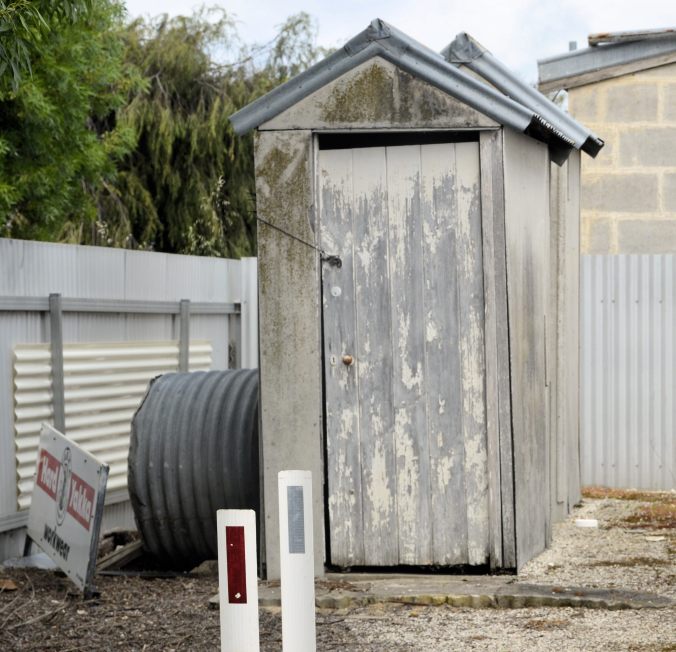
Toilets, bathrooms, latrines, or “dunnies” as they’re called in Australia, have surfaced as topics of conversation from time to time. How they have changed over the centuries. How they vary from place to place, country to country. But one thing remains constant to being human. When you gotta go, you gotta go.
And since the school year has started again in Australia, what better way to “go”.
When You Gotta Go
He stood up and wandered to the door.
‘Get back to your seat!’ I snapped.
‘Gotta go to the toilet, Miss.’
‘No, you don’t.’ I pointed at his desk. ‘Sit down!’
This version of Denis the Menace crossed his legs and grinned. ‘Yes, I do.’
‘You can wait.’
‘Please, Miss,’ his voice mocking, ‘I have to go.’
Sniggers rippled throughout the classroom.
I stood, pointing like a fool at his chair. Afternoon sun streamed through the dusty windows, ripening adolescent body odour.
For this season, I thought I’d take some time out from cleaning and preparing for the big family gathering with my hubby’s family and reminisce about my Christmas Day fifty years ago.
I will write as written, spelling mistakes, grammar, and rather uninspiring prose, and all. My excuse, according to my diary, I wrote just before bedtime, and my mother would be coming in, hassling me to get to sleep. So, no time for perfect editing. Besides, I was notoriously a bad speller back then. So glad to have spell check on the computer these days.
From my diary entry, Christmas Thursday, 25 December 1975 (Spooky, this year Christmas fell on a Thursday):
Today Kiah and Alinta and Heidi, Peter and the other Jeshkes came to Adelaide. After going to church, I went to see Kiah and Alinta and Heidi. For dinner I ate at Grandma’s. After playing with Peter, Michael and Rich and that, I went home to get changed.
On the way home a car with a bunch of boys in it went past and one of them I think, whistled at me (or some phrase I can’t decipher). He noticed me.
Went to the Rozler’s House to celebrate Christmas.
Received Aquirilic paints, Das, Pink Annual, hankys, films, L necklace, Record Tuned On, Book.
Unpacking
This day was a significant day in the lives and times of the Gross family. All the descendants of my grandma and grandpa (Sam and Elsa Gross) gathered in Adelaide at our church’s Warradale rental homes to celebrate Christmas.
As a girl of 12, most important to me were catching up with my cousins. Lunch at Grandma’s was a weekly Sunday tradition. And it appears I joined in after the Christmas service to have lunch at Grandma’s with the cousins. Grandma, the queen of hospitality, accommodated us all; the table in the small trust home kitchen-dining room would be crammed full of people and we learnt to keep our “wings” tucked in whilst eating. Grandma could never quite master the skill and flapped her elbows about as she ate, knocking me as I attempted to guide my fork to my mouth.
Then, if there were too many guests, the children were relegated to the “kinder tisch” (kid’s table) out in the back garden if the weather was fine, or in the passageway, if not. This day, I recall being in the backyard with my younger cousins, Kiah and Alinta D, and Heidi J.
Christmas dinner, as mentioned, was at what was the recently vacated Roesler’s home. Our church, who owned the property, had kindly loaned us the house in which to spread. And spread the Gross family did.
We girls enjoyed running about, doing acrobatics and cartwheels on the front lawn while the adults loaded up their plates from the potluck buffet. Then, after our feed, the tradition, French Cricket, which is a variation of cricket, where our own legs are the “stumps,” and there are no wickets or runs to score.
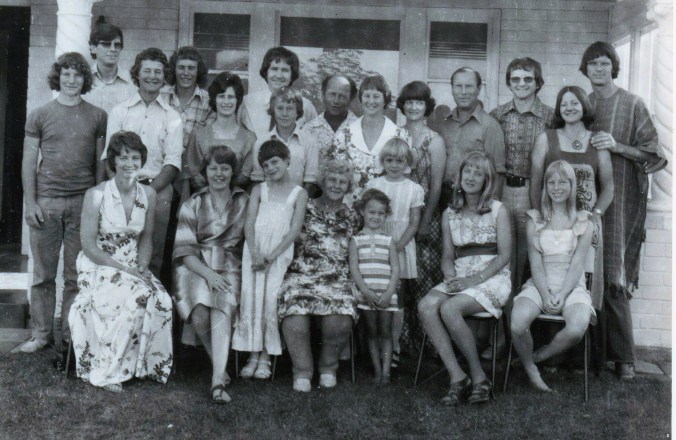
Finally, the evening progressed to photos of each family culminating in a big (Gross) family photo with me looking rather awkward, or should I say, inelegant. Comments like “you can see right up Rundle Street” haunted me for decades to come.
Then, once the sun had set and Christmas carolling done, came the opening of the Christmas presents. One by one, we unwrapped our pile of gifts and dutifully thanked each giver. Each person, from youngest to oldest, had to wait their turn. The gift unwrapping went on for hours.
Anyway, that’s all in the past now, just as Christmas is. Hope you all had a good one.
[Another fond memory from my childhood…and Dad’s catchcry, “for the time being” took a breather when, after being promoted to Deputy Principal, he bought the Holden Premier. Also, a timely piece as our recent Remembrance Day, November 11, marked the 50th anniversary of the sacking of our then prime Minister Gough Whitlam by the Governor General Sir John Kerr. I still remember where I was when that happened. At home watching the news and old Gough saying: ‘Well may we say, “God save the Queen”, because nothing will save the Governor-General.’
Anyway, a car tale from our journey to Canberra where my education in Australian politics began.]
The Dream Car—Holden Premier EH, Serena (100-word challenge)
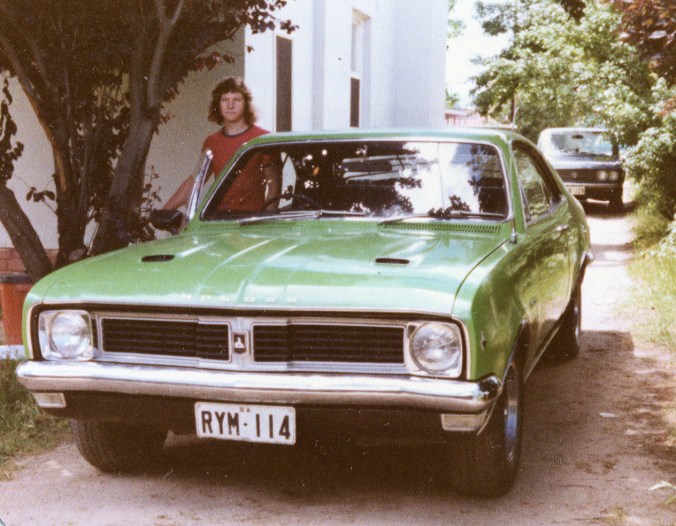
Serena, our dream family car ferried the T-Team to Canberra. In 1975, hardly a maiden for this voyage, she drove us to our destination; a comfortable, safe ride over the Hay Plains. No breakdowns. No stranded waiting for road service on the hot dusty side of the road. A smooth ride that rocked me to sleep; the vinyl with scent fresh from the caryard to us.
She mounted the snow shovelled roads to Thredbo. From her window, my first sight of snow on a brilliant sunny day, snow shining on twisted eucalypt branches.
[In 2013, the T-Team, Next Generation embarked on their pilgrimage to Central Australia. Purpose: to scatter Dad’s ashes in his beloved Central Australia, in Ormiston Gorge.
Over the next few months, I will take you on a virtual trip to the Centre and memories of that unforgettable holiday in 2013, with my brother and his family; the T-Team Next Generation.
This time, the T-K Team (my husband and I) return to Hermannsburg and catch up with friends there.]
Hermannsburg Here We Come
As we powered along the sealed Larapinta Highway, I mused, what a difference some 60-70 years makes. When Mum T lived in Hermannsburg, back in the 1940’s and 50’s, the trip to Alice Springs was a long arduous half-a-day journey on a dirt track in a truck where one spent several days in Alice Springs stocking up on supplies.
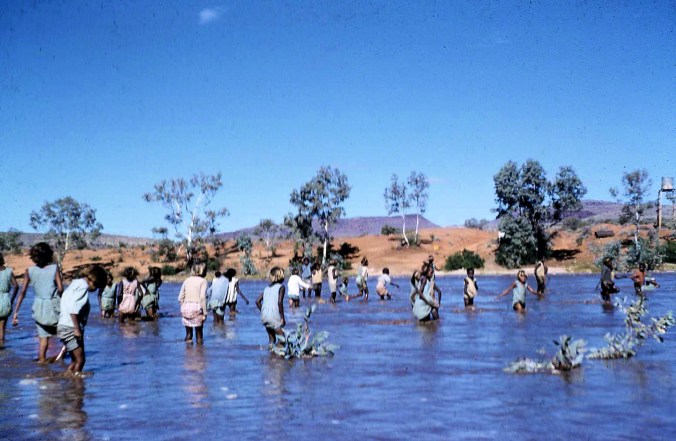
As we passed the turn off to Jay creek, I said to Hubby, ‘Mum told us the story of her mum (Grandma Gross) who, when the Finke flooded, had to wade through the waters to reach the other side to continue the journey to Alice Springs. She was 8-months pregnant at the time.’
‘Hard to imagine the creek flooding,’ Hubby glanced at the dip, a dry riverbed, that signalled the up-coming fork in the road leading the Hermannsburg. ‘But I know from camping in the Flinders Ranges, at the first drops of rain, you don’t hang around, you get out.’
‘Your mum and friend didn’t when they camped at Parachilna,’ I said. ‘They were stuck there on an island with the river all around them for days.’
A sign with an image of a cow, and below written, “Beware of wandering stock”, flashed by. Brumbies galloped on the side, as if racing with us. Hawks soared in the cobalt blue sky above. A lone wedge-tail eagle, having gorged on a carcass of roadkill, waddled off the road just in time, avoiding the same fate as its feed.
This time, when we arrived in Hermannsburg, we made a beeline for the FRM store where we located our friend, P. He welcomed us and gave us a tour of the store. So much bigger than in 1981; more like the size of our local IGA store in size and shelves fully stocked. It even stocked fridges and washing machines. P proudly showed us the bakery where fresh bread is made each day and he introduced us to the Indigenous workers at the store.
After settling into our P and K’s home, we spent the afternoon drinking coffee and storytelling with P and K. Storytelling continued over dinner. Much had changed since the T-team visited in 1981. The population of Hermannsburg has now grown to 600, the Finke River Mission still exists there, and the Christian community is growing. However, there remain challenges for the Indigenous community as there are in communities all over Australia, and the world. ‘It just is,’ as P stated, ‘we’re at the coal-face, being a small, isolated outback community; you see everything…’
‘Whereas,’ I concluded, ‘in the city it’s hidden by numbers, a larger population and behind the walls of our castles.’ Then I changed the subject. ‘Oh, by the way, this is the house I stayed in when the T-team visited Hermannsburg in 1981.’
The T-Team with Mr B — In 1977 Dad’s friend Mr Banks and his son, Matt (not their real names), joined Dad, my brother (Rick) and me on this journey of adventure. I guess Dad had some reservations how I would cope… But it soon became clear that the question was, how would Mr. B who was used to a life of luxury cope? And how would the T-Team cope with him?]
Secret Men’s Business
Mangaruka
Dad scraped up the last few oats at the bottom of his metal bowl and then said, ‘I’ve asked our guides to take us to a place which is very special to them.’
‘What? The Gosse Range?’ I piped up. ‘Are we going to that meteorite site?’
‘Better, than that.’ Dad’s mouth did his signature cat-with-bird-in-the-mouth expression. Then he explained that after discussion with our Indigenous guides, they had agreed to take the scenic route via Mangaruka Gorge; the entry to a sacred site. While Mr. B groaned at the prospect of hiking up yet another gorge, my father allayed his friend’s concerns by saying that we would only travel to the gorge’s entrance, and if we had time, just explore the beginnings of it.
Mr. B grumbled, ‘But we don’t want to be searching for a camp near Talipata in the dark.’
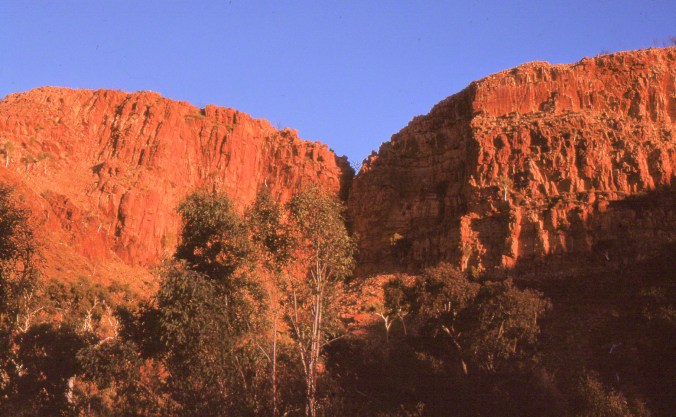
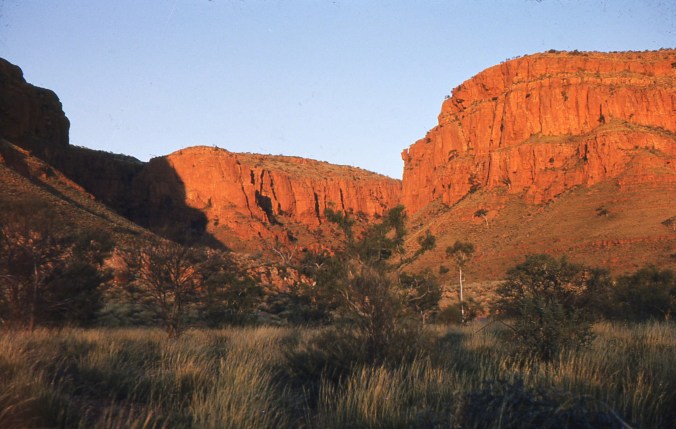
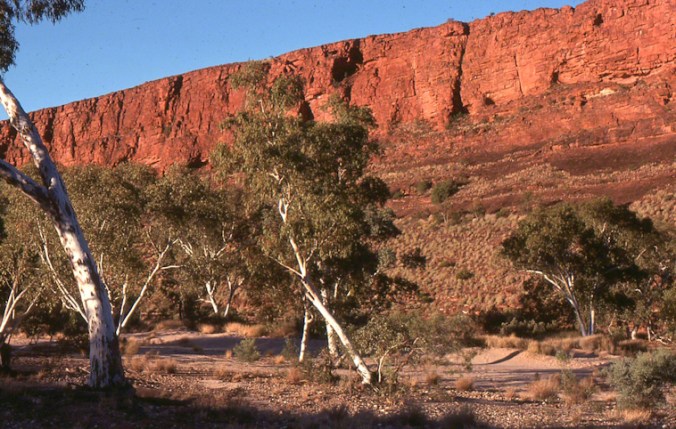
‘Don’t worry,’ Dad patted Mr. B on his rounded shoulder, ‘Talipata is not far from there. Besides, the cliffs of Mangaruka at sunset are stunning, especially with the ghost gums set against them.’
I remembered the exact image Dad was dreaming about. On lazy afternoons at my Grandma’s home, I used to rummage through photos and slides from her family’s time in Central Australia. My grandfather was, in my opinion, an amazing photographer. In one corner of Grandma’s bookshelf in the back room, rested a pile photo prints that were kept in pristine condition encased in special cardboard like a card; the best of Grandpa’s work. One scene that I have painted was a ghost gum, it’s white trunk against the deep purple cliffs of Mangaruka Gorge. Another slide that impressed me was the same scene with the ghost gum at sunset. No wonder Dad wanted to stop there on our way to Talipata.
After having breakfast, we packed up and drove out into the wild west. The dirt road exemplified that rugged feel.
At Haasts Bluff station we filled up with petrol, water, and supplies to last us in this virgin land. We were going where not many people, except the Indigenous, had gone before. Upon entering the land belonging to these people; there would be no shops, no houses, and no roads. To salute our departure from civilisation, we bought something to eat and drink. I ate a meat pie.
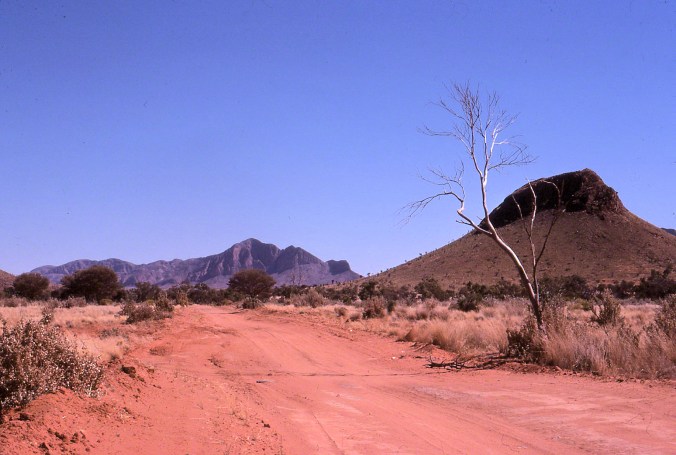
Our guides directed us off the narrow, yet graded road onto an almost invisible track. One sat on the bonnet of the Rover and directed our venture into the desert. We bumped and crawled along faded wheel ruts until a small range emerged through the low dunes and the folds and creases in the flat-topped hill, formed a gorge. We had reached Mungaraka Gorge.
Dad slowed the Land Rover, parking it just before some soft sand that threatened to engulf its wheels. The T-Team stepped out of the vehicle to be greeted by a welcoming party of small pesky flies. They were most unwelcome.
Swishing the pests away from his nose, eyes and mouth, Dad said, ‘Mungaraka, I reckon the name of the place has something to do with flies.’
‘Certainly a feature of the place,’ Mr. B sniffed. ‘Oh, darn it! I just got one up my nose.’
Richard, my brother clapped.
Mr. B glared at him.
With eyes wide, Richard looked at Mr. B. He then examined his palms. ‘Twenty.’ He flicked the flattened black flecks from his hands and then clapped again.
Mr. B then turned to his son, Matt. ‘Don’t even think about killing tha flies, ma son. They have germs. You don’t want germs, ma boy.’
‘No, Dad.’ Matt pulled his cap over his eyes, turned away and strolled down the track towards Mangaruka.
Dad, who had been laying out a spread of food on the tarpaulin, stopped preparations and ran after the boy. ‘Hoy! Matt! Wait! Lunch first, then the gorge.’
Richard laughed. ‘And for extra protein—flies.’
Lunch became a battle of hasty bites of cheese and gherkin sandwiches while trying to avoid the added bits of protein of flies that were only too willing to add flavour to our meal. After, we sipped our billy tea probably flavoured with the odd thirsty fly.
Our guides sat apart from us, and, unperturbed by our uninvited swarm of guests, they ate their bread and murmured quietly to each other. Dad perched on the tucker box and watched them.
I gulped down my last drop of tea. ‘Well, aren’t we going to explore the gorge?’
Dad stood up. ‘Right, let’s go.’
‘What about our guides?’ I asked.
‘Oh, they won’t be going. Mangaruka’s sacred to the Arunda, so they won’t go near it.’
‘What? Are they afraid of the place, Dad?’
‘It’s more complicated than that. They keep sacred stones called “Tjuringa” there in a cave. And they are afraid of spirits there.’
‘Can we go there?’
‘Sorry, Lee-Anne, girls are not allowed. Nor us. Not them. Only the elders. So, we’ll only go to the entrance of the gorge.’
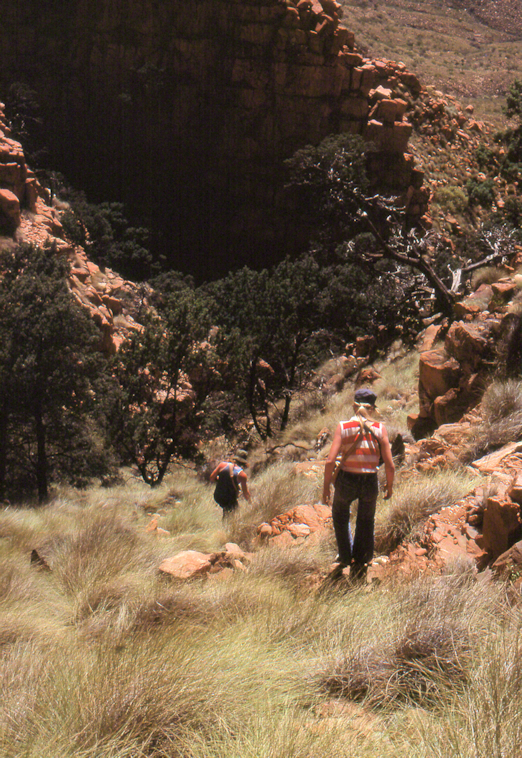
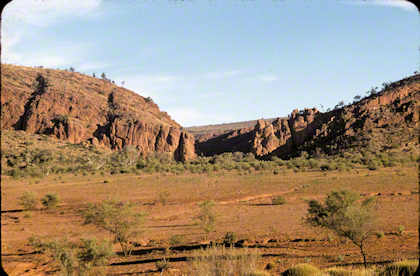
Mangaruka held no ghost for us, only flies. Dad, Mr. B and Matt, and I walked up to the entrance of the gorge. Richard stayed behind to keep our two guides company. On the rocky slopes in the gorge, a smooth brown and white stone caught my eye.
‘Girls not allowed,’ Mr. B added, and then called out to Matt who had scampered further up the gorge. ‘Come on son, time to go back.’
On our return, I tried to take a photo of us all in front of this gorge, but our aboriginal companions refused. In the end, Dad took a photo of me in front of Mungaraka. Dad would have like to stay longer to wait for the rocks to turn red, but we had to move on.
[In 2013, the T-Team, next generation embarked on their pilgrimage to Central Australia. Purpose: to scatter Dad’s ashes in his beloved Central Australia, in Ormiston Gorge. Over the next few months, I will take you on a virtual trip to the Centre and memories of that unforgettable holiday, with my brother and his family; the T-Team Next Generation. This time, the T-Team gather and multiply as we greet our adult sons and our mother (Mum T also known as Mrs T senior) for the day, and the expanded T-Team of us set off to camp at Glen Helen.]
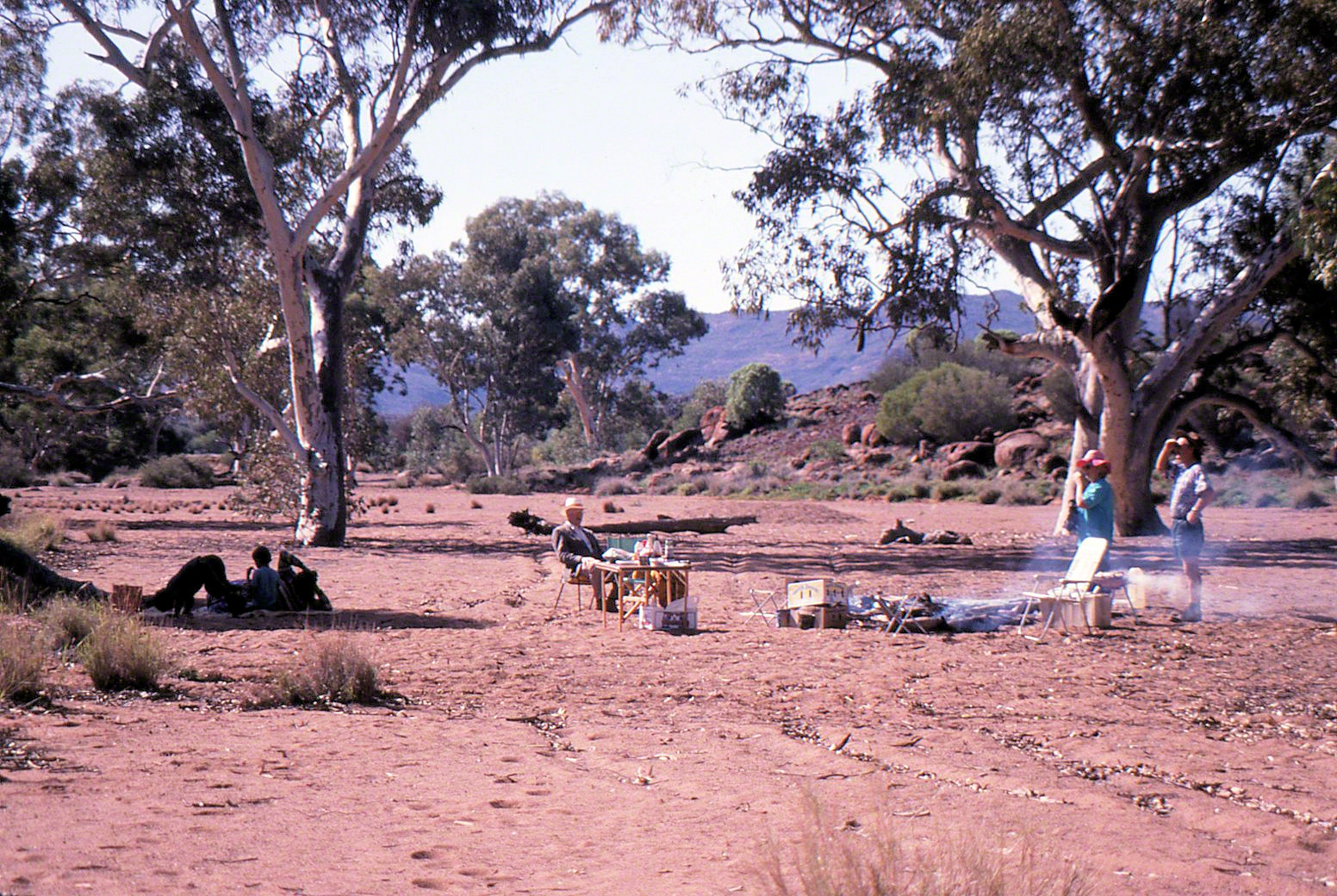
The T-children wanted a campfire. My brother had promised them a campfire. But bushfires in the past year had made campfires, even in the middle of winter in the middle of Australia, almost extinct. On our trip up north this time, each camping ground up until Glen Helen, had restricted fires, and denied the children the pleasure of a campfire. That’s not to say the T-Team Next Generation missed out entirely of some sort of fire to cook our food. We did spend one night in one of those free parking “camps” 30 kilometres south of Marla where we attempted to make a campfire. However, the area was so well picked over for firewood, the few sticks we did scrounge together barely made enough flames to boil a billy. So, no satisfaction regarding campfires. That is, until Glen Helen.
Even far out in the bush, the Glen Helen camping grounds had strict conditions and regulations controlling the operation of campfires. In the Glen Helen camping grounds, there was a designated place for the fire, and we had to provide our own wood. Again, dead wood around the immediate camping site was scarce.
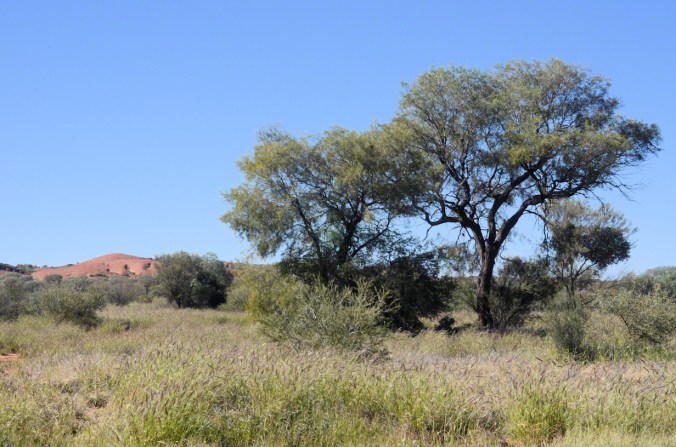
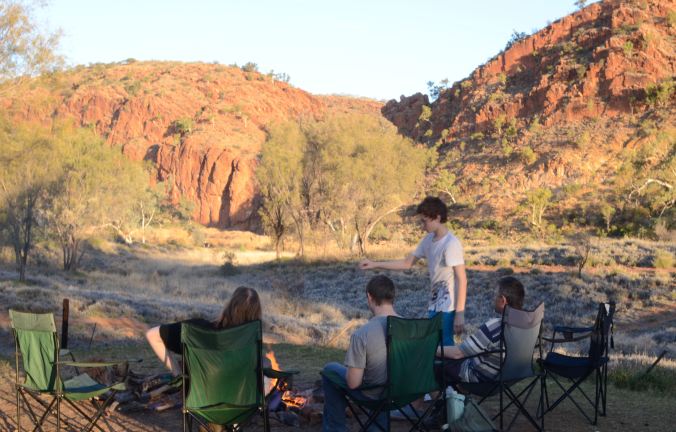
So as the sun sank towards the Western horizon, golden rays blessing the cliffs in hues of pink and scarlet, and the humps of spinifex glowing like lumps of gold, my son and I set out in Mum’s Ford station wagon, down the road in search of a creek offering dead branches for firewood.
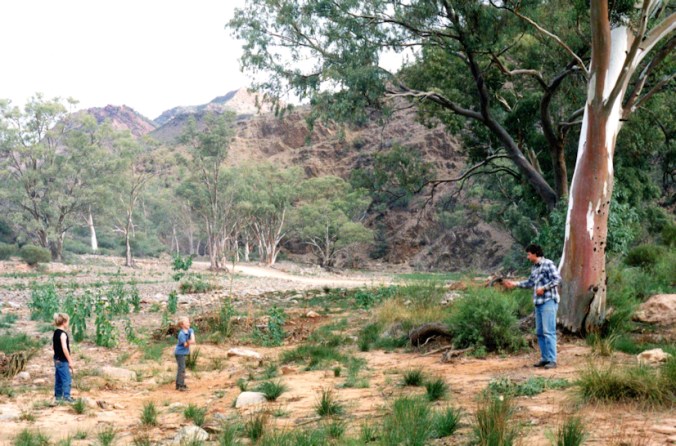
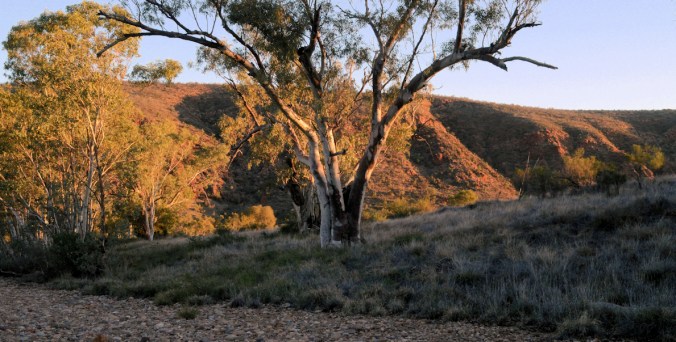
As the setting sun deepened the walls of the gorge into hues of crimson, I hobbled down the dry creek filled with smooth rounded river stones. Hard to imagine the creek gushing with water in flood, rushing over those stones, smoothing them to the size and consistency of bocci balls threatening to twist my ankles.
With my camera, a constant companion and permanent fixture hanging from my neck, my focus was not only on dry sticks and logs, but on the scenery. While my son snapped off armfuls of tinder from uprooted river gums that had become casualties of former flooding, I collected snapshots in time of the setting sun, blood-red cliffs, ancient eucalypts towering above the banks and the dry river-bed of stones. Night stole the thin grey-blue light of dusk. With the station wagon stacked full of wood for the fire, and my camera’s memory card full of brilliant photos for my art, we returned to camp.
What joy the T-Team Next Generation family had. Well, apart from their schnitzels that had gone off. Thankfully, we were able to share the extra and expensive lamb chops we had bought the day before at the supermarket. We gathered around the fire. The fire that cooked our dinner, then warmed us and the conversation late into the cloud-free night frozen with a sky packed full of stars.
In the past, a fire would burn slowly all night, keeping animals away from camp. The rules of the camping ground forbade that strategy. Conscious that the local fauna may come foraging, my husband packed away all the foodstuffs and loose items back in Mum T’s station wagon.
Some of the T-Lings were not so concerned about the threat of such animals. During the night, though, a half-full cereal packet would prove fair game for a roving dingo.
So, stories told, marshmallows burnt and eaten, most of the T-Team Next Gen retreated to their tents and snuggled into their sleeping bags. Mum T had gone to her cabin way before the rest of us. She hoped to rise early, with my help, to catch the sunrise on Mt. Sonder.
My brother and his son stayed chatting around the campfire. A dingo howled. Freaky. An eerie haunting cry. My nephew was sure he’d come face-to-face with the dingo when he’d taken a trip to the toilets. I left my brother and his son to their conversation around the fire and with the responsibility of waking mum before dawn, I headed to the tent to join my husband and sleep.
















 Tru-Kling Creations