Johann glanced back at the bug of the man settled on the tucker box. ‘Cup? You want a cup? Be my guest, they’re in the tucker box, I think.’
I sidestepped that idea and ran to the Kombi. The coke bottle, I’d use the coke bottle.
After emptying out the icky liquid, I raced to the other side of the van. I reached as far as I could on tippy toes. No use. I was just too short. I jumped. I tried climbing up the roof rack. Failed. No footholds to launch me up. I slumped on the edge of the road and cried. No one cared that we were in danger. Liesel had given up without even trying. She didn’t care. And worse, I didn’t matter. Me, a nobody. Thirsty and no one bothered to give me a drink. Aware that I was all alone, I sniffed. Nothing could make me happy, not even the smell of kangaroo steak wafting under my nose.
‘Oh, little girl, why so sad?’
I looked up to see Boris in his grey skirt towering over me. I was sick to the stomach, like I had eaten a cocktail of worms and cockroaches.
‘What is wrong my pet?’ he asked.
I shuddered but refused to answer.
‘Maybe I can help you.’
For a price, I thought.
‘Just tell me what you want more than anything in the whole wide world.’
I glared at him. Over my dead body. What is this man?
Tears blurred my view.
He extended an arm to me. ‘Anything, anything at all.’ his arm seemed so skinny; more like a tentacle than a limb.
I rubbed my eyes.
It crouched beside me. ‘Come on, you can tell me. You can trust me. I can grant you anything, any wish you have.’
I blinked.
Beside me perched a man-size cockroach. Its oily armour glistened in the golden rays of the risen sun.
‘I don’t think I need anything, Sir.’ I tried to stay cool and resisted the urge to recoil.
Its antennae twitched. ‘Anything. Just say the word. Your wish is my command.’
‘I want you to leave me alone,’ I said. All thoughts of thirst evaporated.
Its beady eyes bored through me into my soul trying to suck out all my goodness, my life. ‘My dear girl, I’d beg you to reconsider. With the gifts you possess, the universe is your oyster—if you follow me.’
I gulped. A cold breeze cut through me and as if I’d faced death itself; the Grim Reaper. I pushed myself up, and staggered from it. ‘No thanks, I’ll have none of what you offer.’
It reached out a spiny hand. ‘But you’ll—’
‘None at all.’ I dropped the bottle, and bolted to the campsite.
[This Sunday morning’s sermon tackled the parable of the Lost Sheep, Luke 15;4-7. I recall an ancient post I had written way back when I first began blogging in 2015. Then today, the parable’s meaning was reinforced when I spent all afternoon searching for a document vital for our tax return. Strange how items vanish…We gave up on the paper and were able to retrieve a copy from the relevant website.
However, each person is unique. If a person goes missing, you can’t just replace them by copying them. Every year in Australia, around 38000 people go missing. Most are found within few weeks, but 2600 remain missing after three months.
The following post is a re-blog of the one I published in 2015.]
Lost Sheep
A fellow writer criticized the Mission of the Unwilling saying, ‘How can so many people go into space without others missing them on Earth?’
Good point—and I duly corrected that detail. As a part of the Intergalactic Space Force, each recruit had their explanation which they gave to family and friends why they wouldn’t be around for a while. Yes, fixed that…but—just wait a minute—did I have to do that to make the story believable?
Thousands of people around the world go missing every day…and if I think about it, I know people who have.
Sure, there’s the famous cases. Yes, Adelaide, South Australia, my hometown, is known for a few of those strange cases, both unsolved and solved. I remember as a child told not to talk to strangers…remember those children ‘round the corner? Never seen again.
But then there’s the willing missing—the ones who for whatever reason drop off the radar, leaving behind family and friends, to start their lives afresh. And they might have good reason to disappear if they’ve been the victim of an abusive relationship, or they’re a witness who needs protection.
Each community and clan deal with this jump off the radar differently. As is evident from my own observations of this current society, they are not all like my fellow writer who would make a beeline for the nearest police station when a loved one of theirs goes missing. In fact, there have been recent examples in Australia where the missing persons have met untimely permanent pushes off the radar from perpetrators who have then pretended, through text messages and the use of their bank accounts to deceive family and friends into believing their missing loved one is alive, but just doesn’t want contact. And in some cases, family and friends have believed these lies for months, years.
Isn’t this a cause for concern? Has our community become so disconnected, so focussed on the rights of the individual, we consider it a “social crime” to intrude on another’s privacy? Is society so fragmented, that when we receive a text or internet message from a loved one, saying, ‘Leave me alone,’ we accept it as gospel, as coming from the loved one, and sit back and leave them alone? Is there a problem these days speaking face to face, and treating people like they matter? Is it possible some people go missing because they feel no one cares; that they don’t matter?
In the parable of the Lost Sheep Luke 15:4-7, the shepherd leaves the ninety-nine sheep to search for the lost one. In this society, such a person who goes looking for the lost, the “Black Sheep” of the family, is labelled “crazy”. But in God’s Kingdom each person is precious. Our world may not value these “lost sheep”, but God does, and His people do. I guess in the world’s eyes, God is crazy; He loves and values every human being. And the thing about lost “sheep”, they may not know they are lost, they may not want to be found, they may feel invisible in the sea of billions of “sheep”, but God knows who they are. I reckon there’s a bit of “lost sheep” in each of us. When we make others visible, treat them like they matter, and care for each other, this is community; we find the “lost sheep” and God finds us. This is our challenge, to value and love one another and treat each person with value and respect because they matter.
I don’t know about you, but I’d rather others label me as “crazy” because I care and want to relate to real people, rather than be considered “sane” and thus disconnected, living my life only virtually through a screen.
As I developed my characters from the War against Boris series, stories began to emerge. Here’s one of them.
THE CHOICE: MINNA
One of those summer days doused in grey…I ride my bike to the beach to collect shells. As I comb the surf-soaked sands, a man’s voice snaps me out of the zone.
‘Found anyone interesting?’
‘Nup, no bodies,’ I murmur.
‘That’s a shame, a nice looking lady like you.’’
I fix my sight on shards of shell and ignore him. Hate those pickup lines.
‘Oh, what’s your problem? I’m not going to bite.’
I glance at him—had to see what creep I’m dealing with. Pale, pock-marked face, thirties and just a little taller than me at 165cm. In a grubby white t-shirt and brown trousers. “Never trust a man who wears brown trousers,” my school friend Liesel always said.
‘Come on, dear, just a little conversation. Tell me, what do you want more than anything in the world.’
I shrug. ‘To leave me alone.’
‘Tell you what, you tell me and I’ll leave you alone. Deal?’
I push my bike faster trying to escape this man, but he follows me.
‘I promise, I’ll leave you alone—just tell me.’
Hopping on my bike I announce, ‘I don’t talk to strangers.’
‘I’m not going to hurt you. I bet, I bet you’re one of those girls who wants to get married, have a family. That’s what you want more than anything.’
‘If you say so, now leave me alone,’ I say and then speed from the creepy little man with his creepy questions.
‘Your desire will be arranged,’ he says as I splash my wheels through the water. He then shouts, ‘But, I might add, there will be a price.’
‘Sure, sour grapes,’ I mumble. Then pumping the pedals, I sail along the damp-packed sand where the waves meet the shore.
Then, near the ramp and having to cross sand too soft for bike wheels, I glance behind before alighting.
‘Why not?’ Adam pushed the gate. ‘I’m game if you are.’ He ran towards the historic church.
Amie hissed. ‘Get back here!’
Adam shouted. ‘But I want to see the ghost.’ His small frame blurred in the darkness.
‘You’re trespassing.’
Amie bolted past the open gate. She was trespassing too, now. She chased Adam’s retreating figure. ‘There’s no such thing as ghosts.’
She heard footsteps near the whitewashed walls of the church. She followed the footsteps and the yellow hair that shimmered in the moonless night. ‘Adam, this is not funny. Come back now!’
No answer.
Footsteps crunched on the gravel. ‘This is not a joke, Adam. Where are you?’
A cold rush of air barged past her. Hairs pricked up on the back of Amie’s neck.
‘Adam?’ Amie called. She traced her fingertips along the rough wall of the church as she worked her way to the rear. ‘Adam? Where are you?’
She thought she saw him by the little building behind the church. Was that construction a toilet block? Or did she hear someone, Walter perhaps. Was that building the morgue?
The pale stick figure drifted towards that little building and vanished into it.
A Story where the past and present, and vast distances in space intersect…and Boris does what he always does…
Eastern Europe, 1848
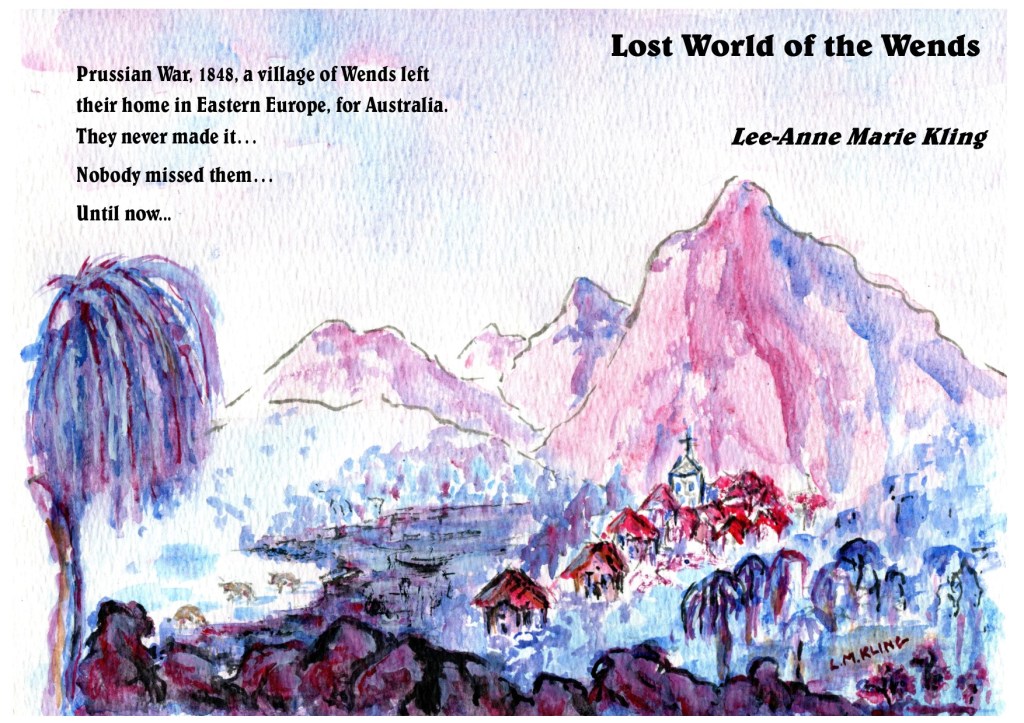
Prussian War raged, and the Wends as a village, left their homeland, with plans to set sail for Australia. From the Eastern edge of Prussia, they journeyed on a barge destined for Hamburg’s port, where they hoped to catch a cheap fare in the cargo-hold of a ship destined for the Promised Great South Land.
These villagers, never made their Australian destination. No one ever noticed, nor missed them. The neighbouring villagers assumed they had arrived in the Great Southern Land, and considered them so far away, and too distant to maintain contact. In Adelaide, also, the city for which they headed, the inhabitants were blissfully unaware of their existence. Migrating Prussians had taken their place in the over-flowing cargo-hold and were sailing across the Atlantic to Australia.
On this barge, headed by a man, Boris Roach, the Wends sang hymns of praise to God for their liberation from religious persecution, and the war. They looked to the promise of prosperity and freedom to worship God according to the Word. Their hope that their children and their descendants may thrive in their faith in the Promised Land of South Australia.
I go to the shops as I do every second day. At the checkout, the girl asks, ‘And how has your day been?’
‘Busy,’ I say.
‘That’s good,’ the girl says with a sage nod as if involved in some conspiracy to keep me on the hamster wheel of busyness.
In the Twenty-first century world “busyness” is good. Not being busy, then, is undesirable. Our Western Protestant work ethic touts, ‘Idleness is the devil’s workshop’. The state of “idleness” is to be avoided at all costs. These days, we equate idleness with boredom.
‘I’m bored,’ say your children (so did mine, when they were children many years ago, back in the good ol’ 1990’s), and terror strikes at the heart of each mother when they hear these words. Bored? We can’t have our children bored—idle—just imagine what devils will come to play if we allow boredom to fester. First, the grizzling, then, the niggling at each other, and before long, World War Three amongst the siblings and the house ends up looking like the Apocalypse.
So, in my quieter times now, I reminisce the days as a young mother, structuring each day, every hour—especially during the holidays, to avoid boredom—any strategy to avoid my tribe from becoming restless.
‘What’s wrong with a bit of boredom,’ my mother would say. ‘They need to learn to entertain themselves, you know, use their imagination. Nothing wrong with being still for a while, I say.’
Mum should know, she grew up in the Centre of Australia on a mission in the 1940’s and ‘50’s. Those were the really good ol’ days with no shopping centres, no electronic games, nor television. They did have radio, but her minister father only allowed the news to be heard from it. Heaven forbid they listen to modern music. During the War, even the radio was confiscated by the allies. So all my mum as a girl had to entertain herself were books. Even so, the Protestant work ethic was a major value in mum’s family as her mother, when she found her daughter reading would say, ‘Isn’t there some housework you should be doing?’
As expected, then, I grow up in a world that values industry, productivity and filling each day to the full. The schools I attend are hot on producing good grades, projects and students who go on to university and become wealth-producing citizens.
Then, at sixteen, I have a revelation. We sing a chorus at church, “Be Still and know I am God”.
Being still…forget the homework…forget the housework…put aside my racing head of worries…centre my thoughts on God and his greatness. Pause for a moment and remember, God is God and He’s in control.
So at sixteen, I do just as the chorus bids. I hop on my deadly treadly (bike), and pedal down to the beach. I figure that’s the best place to be still; the waves lapping the sand, the sun on my back as I comb the shore for shells. Or on a sunny afternoon, I lie in the backyard and sunbake, think and ponder.
The result? Wow! Those mountains? School and pedantic teachers going on about uniform—my socks, my hair? Boyfriends or lack of them? Life and my future? …All my concerns become molehills.
December 1979, I write a poem “Be Still”. Perhaps not the greatest work of literature, but the values stick with me…until I embark on university, work, and then a family. The poem hides in a book of my teenage missives. Ten years ago, I pull it out for a devotion. I preach being still, but I fail to apply the principles. I must keep busy. If I stop, even for a few minutes, what will others think? There’s just too much to do. Everyone’s depending on me as wife, mother, bible study leader, committee member …to produce the goods. I can’t let them down.
The culture to keep moving is ingrained. Go to meet people for the first time and they ask, ‘What do you do?’ The doing has to have a dollar sign attached to it. Not enough to do all the above as a mother. Must produce money to have status in the group. Without status, I am not heard. Ironic how the under-valued creative arts of writing and painting, though, afford status. I am creating. I am producing.
Even so, in this creative phase of my life, if I stand still, I feel guilty. Now, there are novels to write and art to produce. My “work”. I’m on the hamster wheel, but I can’t get off.
However, in all the busyness expected of me, the cogs of my life are unravelling. I drive to a cafe to meet a friend. She’s not there. I’d forgotten my mobile phone. I drive the thirty-minute return home and check my phone and then ring her. I’d gone to the wrong place. A misunderstanding. If I had taken the time to listen and ask the right questions…
The voice of my sixteen-year-old self still convicts me. ‘Be Still’.
For over forty years, I’d not been following my own advice. After the misunderstanding of the other day, I give myself permission to have time each day to rest…Time to be still…time to know God.
If you’d like to polish your writing skills or find out more about our new project, a self-publishing collective, click on the link to Indie Scriptorium…
Or…
Catch up on the exploits of Boris the over-grown alien cockroach, and Minna and her team’s attempt to subdue him.
For good holiday reading click on the links below…
[Tuesdays with Carol is on hold as a certain virus has accosted a close family member and so, we are in isolation. By the way, Carol, when I informed her, was most thankful her godson (my son), needed my assistance as mum’s taxi for some shopping last Thursday. If he hadn’t, I would’ve visited her that Thursday afternoon potentially putting her at risk.
Anyway, here’s the conclusion of Bonfire on the Beach where the murder mystery begins…]
Hit and Run
With a hip flask between best friends, Fifi and Lillie slipped away, gliding along the shore and up the ramp to the road. Kangaroo-skin blanket wrapped around them, the girls perched on a seat overlooking the miniature party scene. The orange glow of the revived bonfire danced in the cove below them. While they gossiped, topic of conversation focussing on Wally, the crisp air carried the beat of The Doors and Sven’s Ford Falcon XB rumbling up the ramp.
Lillie rubbed notches in the seat. Four lines scratched into the backrest. ‘What does this mean?’
‘Some local stud’s score, I reckon.’ Fifi traced the lines. ‘Fox’s probably.’
‘Not much of a stud, then,’ Lillie scoffed, ‘Geoffrey Fox must’ve had more than four conquests. Surely.’
A roar ripped through their conversation.
‘Excellent! A drag race!’ Fifi said and tore the blanket from Lillie.
Fifi waddled to the empty patch of bitumen.
Shivering, Lillie followed and peered down the peninsula. As the headlights approached, a dull thud and a torso, arms and legs flying, altered their curiosity. One headlight wobbled; its radiance extinguished.
Fifi tottered towards the action. ‘What was that?’
‘Probably just a roo.’
‘And what roo has two legs and arms? I definitely saw two legs and arms. I’m going to have look.’
The girlfriends reached the spot. Motorbike shattered on the pavement. Body tangled around a pole, eyes glassy, staring into eternity.
Lillie’s gaze fixated on the human wreckage; mutilation mingled with man’s frailty into her memory.
Fifi dragged Lillie down the ramp. ‘Come, we can’t just stand here. We better tell the others, someone.’
Fox reclined by the fire hypnotised by the flames.
Jimmy, through a mouthful of crisps, said, ‘A good thing that Wally wasn’t there otherwise he would be raving about the grisly details till morning.’
‘It was Wally,’ Lillie said and wiped her dripping nose.
‘Oh,’ Jimmy said and popped a large curly crisp into his mouth and munched.
Unimpressed Fifi yanked at Lillie’s arm. ‘Come on, Lillie. We better see what we can do for the poor bloke.’
A group of pensioners hovered over the blood-stained sheet. Leaning up against the warped pole, a man with black rimmed glasses and bulging nose wagged his head. ‘There was nothing we could do.’
Wrapped in a lavender quilted dressing gown, a woman, hair in rollers, gawked. ‘Poor fellow. What a waste!’
Blood splatters glinted in the streetlight. Acid brewed in Lillie’s stomach. She held her throat and gulped. ‘I don’t feel so well. Let’s go back down.’
‘If you insist.’ Fifi trailed after her friend, hanging back, stopping as the ambulance arrived, watching as it ferried the latest statistic towards the red glow of Adelaide.
Back at the bonfire, Lillie nestled up to Geoffrey Fox. She didn’t want to be alone.
Later, Fox’s Kombi became the couple’s refuge and passion Lillie’s comfort.
Morning: sea watery blue, translucent. Sven emerged from his Falcon. He leant against the bonnet and nursed a jagged dent in the fender. Lillie watched banter between Sven and Jimmy through her flickering sleep-salted eyes.
‘Guess what!’ Jimmy’s mouth frothed with stale left-over beer.
‘What?’ Sven did not look up but continued to stroke and inspect a cracked headlight.
‘Some hoon killed Wally up there.’
Sven shrugged and then adjusted a pair of chipped Polaroid sunglasses on his fine pointed nose.
Crawling out of the Kombi, Lillie hobbled over to the Falcon. ‘Hey, just wait a minute. What’s Wals – How come you’re wearing Wally’s shades, Sven?’
Sven surveyed the placid blue sea. ‘Dunno, they were there, I s’pose.’ He rubbed the damage to his bonnet, frowning as flecks of red paint floated in the breeze. ‘‘Sides he wrecked mine!’
‘And your car? How did you get that dent?’
‘I dunno. Can’t help it if that stupid fatso gets in the way.’ Sven wiped his faded jeans, blotched greasy and brown, purging his hands of sand. ‘It’s what I do to people like Wally and dirty old men.’
‘What do you mean?’ Lille caught her breath and stepped back. ‘Have you done this before?’
‘Ha! Ha! Fooled you!’ Sven tossed his head back and laughed. ‘Geez, sis, you’re so gullible.’
Her brother then climbed into his Ford, spun the wheels, and flew over the firm damp shore, shrinking into the distance, towards Aldinga beach, then returning.
Lillie kicked sand into the ashes. ‘I feel sick. What are we going to do?’
Fifi squirmed in her sleeping bag. ‘Huh? What do you mean?’
‘Last night. Wally. You know.’
Poking her head from the hood, Fifi faced Lillie and narrowed her eyes. ‘Last night? Nothing happened, okay? Nothing happened. We were at Dee’s party – If anyone asks. Okay?” She turned her head to the others and enunciated each syllable. ‘Isn’t that right.’
Jimmy charged his stubby and nodded.
Fox poked his head out the Kombi’s open window. ‘Yep, Dee’s.’
‘But – but…Dee’s my worst enemy. No one will believe that I would’ve been at Dee’s,’ Lillie said and heaped more sand on the coals. ‘We can’t just – they’ll know. And the old people…up there…they saw us.’
‘Look, Lillie,’ Sven said, ‘the police are up there right now investigating. No one has come down to interview us. So, leave it alone.’
‘Look, Lillie, I’ll figure something out. Okay? Anyway, we didn’t see anything. It’s not our problem.’ Fifi scrambled from her bag and smoothed sand with her foot over the campsite. ‘Now, we better disappear.’
Sven dusted his hands of sand. ‘Best we don’t get involved.’
In silent haste, the group joined Fifi’s efforts to erase all evidence of their existence there.
As the golden orb of sun peeped over the barren slopes, the red Ford Falcon and orange Kombi made a slow procession, tyres treading with respect over the shards of glass, then pelting on the highway North to the city.
A young traffic constable Dan Hooper admired the sleek red Ford Falcon as he made his way down Main South Road towards the fatal accident scene from the previous night. Reminded him of the Mad Max film he had watched on a video player at Dee’s party the previous night.
Friedrich was sure it was his fault. He was always getting smacks or the belt from his father—usually for not polishing his boots perfectly. Or for spilling milk on the floor. But when he saw the blue line in the air, the urge to escape, was too great. This was not the first time he’d ventured beyond the thin blue line under the outhouse. He just had to go through the light—for Wilma…
Then bang. Everything went black…
Friedrich put out his hands and shuffled forward. He groped for a wall, a surface, anything to orient himself.
He tripped over some bulk. He fell onto it. It groaned.
Friedrich scrambled to his feet. His mouth went dry. It was like his heart, lungs and guts were in his mouth. Oh, no! I’m on an alien world without light and with groaning monsters.
The thing at his feet moaned. It sounded like a man.
Friedrich gulped. He knelt down. He held out his shaking hand. He touched something soft and greasy. Was that hair under his fingertips?
‘Who are you?’ he asked in his Silesian language. ‘What’s your name?’
The man-thing with hair moaned again and then mumbled what sounded like forbidden words in another language. He’d heard Joseph use such words when angry.
‘My name’s Friedrich,’ the boy said. ‘And you?’
‘Oh, the pain! The pain!’ the man-thing said in that strange language. It did sound like the tongue Joseph and Amie used. They spoke using similar sounds when they were together.
Friedrich presumed the man spoke English. But he knew few English words, so he still hoped the man understood his native language. ‘How are you?’
‘Oh, the pain! My stomach! My head!’
Friedrich traced the head, the shoulders, arms and distended stomach. ‘You’re a man, aren’t you?’ He patted the spongy surface in the middle.
The man groaned and squirmed.
‘You’re a sick man,’ Friedrich said using the word in his language “krank”.
‘Too right, I’m cranky!’ the man straightened up. He grabbed Friedrich’s wrist. ‘And who the heck are you?’
‘Huh?’
‘What?’
‘Huh? What?’
‘What? Huh?’
Friedrich shook his hand free from the man. How was he to make sense of this man in the dark? How was he to make this man understand him? Joseph and Amie could speak his native tongue, Silesian, but this man couldn’t, apparently. Friedrich rubbed his hand.
‘Who are you?’ the man asked. ‘Where the frick are we?’
[I first wrote this story over thirty years ago in response to a newspaper murder mystery competition. Upon completing the story, I never submitted it for scrutiny. Since then, the tale has endured several edits and reworkings, the latest being just last week.
The story is pure fantasy but is based on real life events from my youth. Over the last 30 years the characters have evolved to become on the whole, fictional.
Note, bonfires are no longer permitted on beaches near Adelaide. However, cars are still allowed to drive on the sands of some beaches south of Adelaide, such as Sellicks Beach.]
The Uninvited
The five friends huddled in the firelight, reflecting on the ritual burning of Lillie’s matriculation Modern History textbooks and the year past. The Doors boomed in the background.
A sand-splattered blood-red Ford Falcon XB and a bright orange Kombi-van, guarded Geoffrey Fox and Lillie Hughson, Lillie’s older brother Sven and her best friend Fifi Edwards and Fifi’s brother Jimmy from any unwanted intruders.
An old man on the cliff top waved an angry fist, his threats carried away by the sharp November breeze. Sven returned the gesture shaking his fist with menace at the old man.
‘Sven!’ Lillie slapped Sven’s arm. ‘Behave yourself! You might be a brickie, but you don’t need to act like one.’
‘Nothing wrong with brickies, Lillie. Anyway, that old man, he’s probably calling for Wally,’ Fifi said while rubbing her nose. The sea air icy and stung with salt. She had moulded into Sven’s embrace. ‘Hey, Sven, you’re so cool, yet so hot.’
A burst of laughter. The tape came to a climactic end and petered out.
‘Hey, hey, have you heard this?’ Fifi wet her lips. ‘Six o’clock. The whole street was quiet, not a sound was heard. Except the occasional croak of a cricket as night fell.’ Mesmerized by the lapping waves and rhythm of Fifi’s voice, the others listened. ‘All was calm, then out of the darkness, a cry pierced the air.’
Jimmy, Fifi’s older brother shovelled a handful of salt and vinegar chips into his mouth and crunched. Lillie glared at him. He paused, chipmunk cheeked, and glued his attention to his sister Fifi.
“Wally! Wal-Wal-Waaalee! Dinner’s ready!”
The five young people roared. Jimmy’s potato chips sprayed out and fuelled the coals. Fifi pouted mimicking Wally’s mother, Mrs. Katz. Lillie joined her. Jerking her legs as if in a Monty Python sketch, Fifi broke free of Sven’s hold and walked a Wally walk, while Lillie jumped from Geoffrey Fox’s embrace and flailed her arms and danced a Wally dance.
Sounds of puttering filled the cove. ‘Who could that be?’ Lillie craned her neck over Sven’s leather clad shoulder to see bulk roaring wheels.
The girls froze, and in unison uttered, ‘Oh, no! Wally!’
More chips spluttered from Jimmy’s mouth and fuelled the coals. Sven rolled up his sleeves. Admiring his wiry yet powerful form, Fifi preened her blonde perm and sighed. ‘Just when we’re having a good time!’
Sand plopped in the flames and their faces. With a grunt his Kawasaki bike scudded, throwing Wally towards a rocky outcrop.
Wally picked himself up and dusted grains from his blubber. He advanced towards the group laughing, ‘Ho! Ho! Ho!’.
With his thumbs inserted in his tight pockets, Sven stepped towards the Wally. ‘Who invited you?’
‘Gate crasher! Gate crasher!’ Lillie and Fifi cried, hurling abuse and wads of sand.
Sven pitched his cider bottle. ‘Go home to your mummy, Wally!’
Wally dodged Sven’s missile. ‘Hey, I just wanna good time.’
‘You are not welcome here. Go away.’ Sven plucked up a rock. ‘Move it!’
‘Why not? I have every right to be here.’
‘Are you thick or something?’ Sven shook his stone-wrapped fist.
‘Did you call me thick? Did you call me thick?’
‘Yes, you moron! Now, go home!’ Sven spat and then hurled the stone, crashing it into Wally’s helmet.
‘Hey! That’s my head you hit!’ Wally raised his fists and leered at Sven. ‘You wanna fight?’
‘Be my guest, fool!’ Sven jabbed Wally’s rounded shoulder with his right fist.
‘Oh, cut it out boys!’ Fifi marched to the stoushing males, splitting the two cocks sparring in the shadows.
Uneasy truce, Wally one side of the fire, in the smoke, Sven and the rest of the group crowded on the other side. Waves crashed, the sea’s beat interrupted by the rare plop and thud of dead conversation.
Fifi nudged Lillie. ‘This is boring!’
Lillie rubbed her hands over the glowing coals. ‘Mmm. Why doesn’t Wally take the hint?’
Jimmy munched through his third bagful of chips. Chicken, this time.
Wally coughed. Wally spluttered. Wally blew his nose into a grimy handkerchief and inspected the contents. Wally sidled out of the smoke, closer to the group.
‘Oh, no you don’t!’ Sven poked the embers emitting brief flames. ‘Too crowded over here with you, Wally.’
‘Why not! I’m choking over here,’ Wally said and then cupped the rag over his mouth and insisted edging to the smokeless side.
‘Are you dense?’ Sven lunged at Wally, forcing his boot into the glowing coals. ‘Go home, Wally.’
Wrestling, the rooster and the sumo teetered at the rim of fire, toppled onto the sand crushing beer cans, steam-rolled one on top of the other singeing leather pants and denim jacket, rising from the ashes in a slow dance of boxing and fists and cuffs, and culminating in Sven’s $50 Reflecto Polaroid sunglasses flying into the fire. They melted on impact.
‘My shades! You’ve destroyed my shades!’ Sven clutched Wally’s throat. ‘Get outa here before I kill you!’
Fox who had been hanging back and watching the action, stepped up to Wally. ‘You better go Wally. Nothing personal. But you better take the hint and go.’
Fifi patted Sven on the back, ‘Come on mate, that’s enough fighting for one night. It’s only sunglasses.’
Sven loosened his grip and sauntered towards the boulders, silhouetted by the cliff-face. Wally skulked back to his bike and with a departing roar, pelted sand over the dying coals.




 Tru-Kling Creations