Family History Friday–Great-Grandpa T (2)

The Ancestral T-Team in Australia

1885: Emigration to Australia

According to family lore, the Trudinger family emigrated to Australia because Carl August’s business went bankrupt. But was this actually the case?

The wool industry in Yorkshire was booming well into the 1890s. Carl August and his family emigrated to Australia in 1885.

The facts are Clara Theresa and her 12 children boarded the sailboat, the Holmesdale, for Port Adelaide, South Australia, in 1885. Carl August stayed behind for a few weeks to tie up loose ends, house, business, etc., then he boarded a steamship and arrived one day before his family set foot in Port Adelaide. That kind of expenditure doesn’t, in my opinion, reflect a man whose business has gone bankrupt. But perhaps the total cost of emigrating to Australia took its toll on the finances.

They settled in the Norwood area, Carl taking up a job as a greengrocer.

The following year, on August 16, 1886, my grandfather, Ronald Trudinger, was born. He was number 13 and the last child in the Trudinger tribe.

Carl August bought the Trudinger family home in Heathpool. 5 Northumberland Street, Heathpool, became a family and community hub, where friends and family gathered and lived long after Carl August and Clara Theresa had gone to their eternal home in Heaven. Their daughters, Clara, Gertrude, and Dora, lived there until they, too, passed on to Glory. Dora, the last of the maiden aunts, passed away in 1961. And it was where my dad and his brother Paul lived with their aunts while their parents, Ron Trudinger and Lina, were missionaries in the Sudan, Africa.
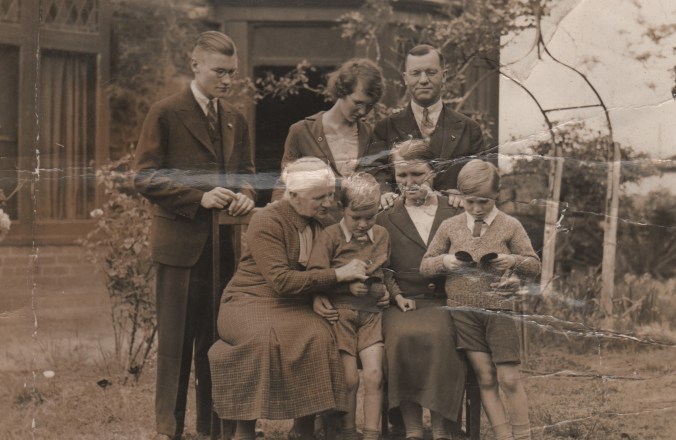
*[Photo 7:  Family gathering (Ron Trudinger (snr) and family with Aunt Clara) out in the backyard of the Trudinger home 5 Northumberland St, Heathpool, courtesy of L.M. Kling circa 1935]

The Schammer Family history states Carl August set up a textile business in Adelaide city centre, in Rundle Street, managing the chain store of Theodore Zimmermann, from Gnadenfrei. When Carl August retired, he passed this business on to his son, Oscar. By the 1920s, this store was a clothing shop on the ground level, where the Myer store now stands.

They had raised brilliant and, on the whole, God-fearing children, nine of whom ventured out into the mission field. A number of them attended university, including two of their daughters. According to the numerous news reports, they became a prominent family in Adelaide church society. Like cream, they rose to the top, a shining example for Christian families everywhere.

However, life didn’t always go smoothly for the Trudinger family in Australia.
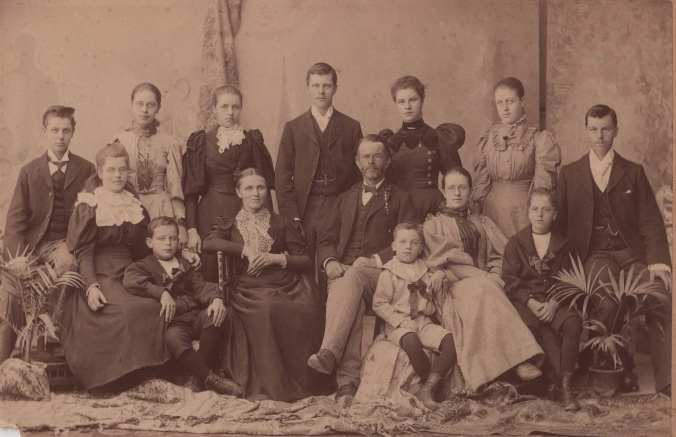
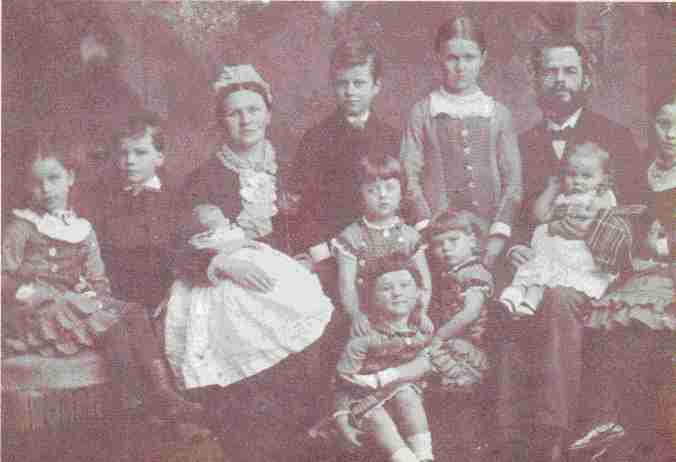
*[Photo 8: Family photo of the Trudinger family, circa 1893, courtesy of L.M. Kling]

In 1894, whilst working in Kapunda, Carl August’s son, who worked in Kapunda as a watchmaker, was almost swindled by a shady character who had a habit of passing on “rubber” cheques, you know, the ones which bounce. Fortunately, in Kapunda, the bank wasn’t too far, and my great-uncle was able to sort out the problem before the offender had escaped the town. Mr. Lehmann, the owner of dodgy cheques, was apprehended, charged, and jailed for his crimes. Another time, also while in Kapunda, which must’ve been quite a town back in the day, Carl’s son August found a vagrant sleeping on the porch doorstep of his business.

Tragedy struck the Trudingers while they were in Broken Hill in 1892. Their daughter, Elsbeth, died suddenly of typhoid at the age of eleven.

So, could there be other reasons Carl August and Clara Theresa moved to the other side of the world?

Clara Theresa had dreams of being a missionary. Dreams that remained unfulfilled. Most probably because she married a man who had been outside the Moravian Brethren fold. Although he did join the Moravian Brethren when he married Clara Theresa, it wasn’t enough for the Moravian leaders to allow Clara Theresa to become a missionary herself. Hence, she dedicated all the children she bore to God. If she couldn’t be a missionary, perhaps when they grew up, they could. And Carl August, being the easy-going, amiable person that he was, went along with his wife’s wishes.

In this light, did she see Adelaide, South Australia, established as a free city, a Utopia, as an opportunity to fulfil God’s missionary call without all those rules and regulations, encumbrances her brand of church, The Moravian Brethren, placed on individuals to be accepted into the community and to be accepted into missional service?

My hypothesis is this: Carl August and Clara Theresa made a deliberate choice to emigrate to South Australia. They may have seen it as God’s call and God’s guidance to go there. When they came to Adelaide, there was no Moravian Brethren community, so they joined the Presbyterian church. However, not so far away, in Bethany, in the Barossa Valley, there did exist a Lutheran Church influenced by the Moravian Brethren. There is no mention my great-grandparents ever attended this church. Interesting … Especially considering Carl August’s son worked in Kapunda in the 1890s.

[Photo 9: Hill of Grace Barossa Valley © L.M. Kling 2018]

I wonder if there wasn’t some hurt Clara Theresa was suffering because she so wanted to be a missionary and her church community, the Moravian Brethren, wouldn’t allow her to be. Then back to Carl August, grown-up Lutheran-Evangelisch, but despite all the Lutheran churches in Adelaide and the Barossa, he opts for the Presbyterian Church as the one he feels most comfortable in to worship.

One point I mentioned earlier, Carl August did not like Bismarck or the direction Germany was taking. In later years, according to news articles, they had disassociated themselves completely from Germany, as if they were ashamed of the country of their birth. Understandable after World War 1, I guess. Being sent to an internment camp wouldn’t have been high on their priority list.

Another fact, yet to be verified: in the early 1900s, it is said Carl August spent time away from the family in Southeast Asia, specifically the Philippines. He went there on business. In recent years, one relative reported he’d discovered Carl August had been selling arms to support the Filipinos in their war against the United States (1899-1902). There’s that passion for justice streak again.

Carl August and his wife spent decades worshipping at St. Giles Presbyterian Church. Carl August was an elder there. In 1927, the local paper, which reported their diamond wedding anniversary, also mentions Carl August was still fit enough to walk to church every Sunday morning. One article mentions the success of their long marriage was founded on never going to bed angry with each other. On the last night of Carl August’s life, he asked his wife to forgive him for saying sharp words, and of course, she forgave him.

The next morning, on July 10, 1929, at the age of 90, Carl August went to be with Jesus in Heaven. True to his humble, gentle nature, he was buried in a grave with no headstone, with his wife, who died three years later, in the West Terrace Cemetery, Adelaide, South Australia.

© Lee-Anne Marie Kling 2026

Feature Photo: Close-up of Carl August (circa 1893), courtesy of L.M. Kling

Note: If you have any information you’d like to share about Carl August or details that need correcting, please contact me in the comment section below.

***

Want more, but different?

Check out my Central Australian adventures.

Click on the links:

The T-Team with Mr. B: Central Australian Safari 1977

Trekking with the T-Team: Central Australian Safari 1981

Family History Friday–Great-Grandpa T (1)

Carl August Trudinger

Carl August Trudinger was a successful businessman, a wool merchant in Bradford, Yorkshire. He owned a beautiful mansion on a sprawling property in Chevin Grange, Guiseley. So, what made him move all the way around the world to Adelaide, South Australia, with his wife and twelve children? Was he in love with the Utopian dream that Adelaide offered in the mid-1800s? Or was he on a mission?

Part 1

Family

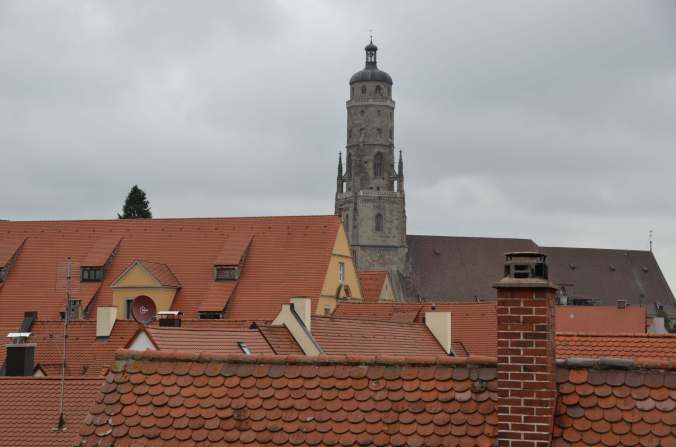
Although he’d been naturalised as a British citizen, Carl August was born in Nördlingen, Bavaria, on February 8, 1839. Built on a meteorite crater, the houses have diamonds in their stonework. The town is one of the few remaining to have a complete wall around it. And to give you a picture of the town, remember Willy Wonka and the Chocolate Factory? The red rooves of the Altstadt Nördlingen are what you see in the last scene of the film as the main characters rise above in the balloon.

*[Photo 1: The Red Roofs of Nördlingen © L.M. Kling 2014]

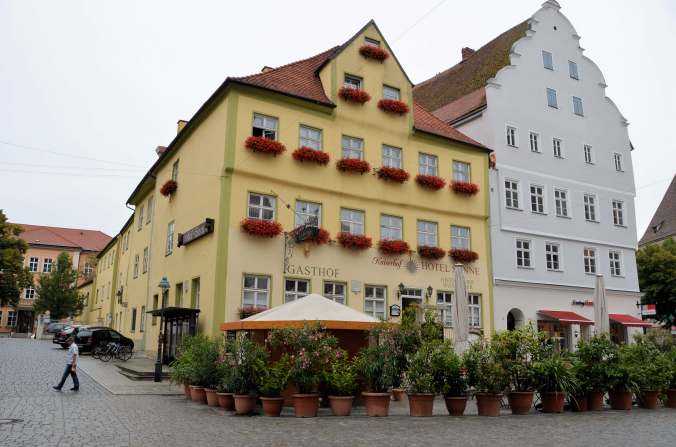
Born to a large, well-to-do family, my great-grandfather was the fourth child (third son) of Gottlob August Trüdinger and Helen Salome T (née Erdlen). He had three younger siblings, the youngest born when he was eleven. The Trüdinger family had become key figures in the Nördlingen community, Carl August’s grandfather, Georg, having been mayor of the town. One branch of the family owned the regal, high-end Kaiser Hof Hotel Sonne, where royalty used to stay when visiting the town, and also, more importantly, the famous author, Goethe.

However, Carl August’s father, Gottlob, was a linen weaver, as was Carl August’s grandfather, Georg, who was not only a master linen weaver, as mentioned before, but also the mayor of the town. Linen weaving wasn’t any ordinary job, but one that earned good money, enough to buy a hotel at some point in the late 1700s.

So, for all intents and purposes, the Trüdinger family in Nördlingen had a high social standing. Did I mention there’s a road named after the family?

*[Photo 2: The Kaiser Hof Hotel Sonne © L.M. Kling 2014]

Growing up

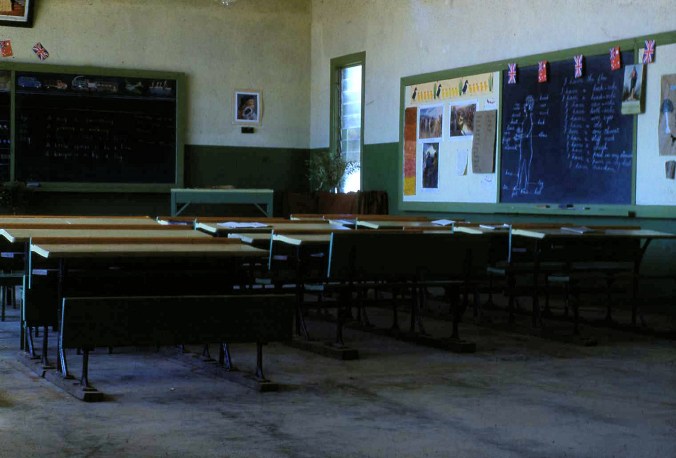
That being said, not much information exists about Carl August’s childhood and growing-up years. As a boy, he would’ve been educated in the local school. I was able to access some photos of a school in Bavaria from the mid-1800s and was surprised to see it looked exactly like the school set up at the Hermannsburg Mission in the Northern Territory, Australia. Carl August would have sat at a heavy wooden desk in a room painted green, with a blackboard at the front of the class. From what I’ve read of this era, in Germany, teachers were strict, and students disciplined harshly if they misbehaved.

However, I believe Carl August was a model student who had a passion for learning. But I could be wrong. He was the middle child after all. One thing about the Trudinger family, I can say from my research, is that they were, and still are, highly intelligent and creative. Many of Carl August’s relatives and descendants have become prominent and successful in their fields of expertise: a renowned architect in St. Gallen, Switzerland, plus university professors, doctors, businessmen, artists, and accomplished musicians.

*[Photo 3: Hermannsburg Mission school circa 1950s © C.D. Trudinger circa 1955]

Speaking of music, as this has played such a significant role in our family, I imagine music was central to Carl August growing up. Nördlingen is famous for its music and currently, its choir, which came to perform at Bethlehem Lutheran Church in Adelaide in 2017.

As far as his religious affiliations go, I remember asking my dad’s cousin about whether Carl August was Catholic or Lutheran. She was certain that he was Lutheran, or as in German one would say, Evangelisch.

He probably attended the Daniel Cathedral as a member of the congregation. It’s just over the road from the Kaiser Hof Hotel Sonne, owned by the extended Trudinger family for around 200-years.

Another pivotal moment for Carl August would have been the establishment of the railway network in 1849. In my mind’s eye, I can see the excitement, the fascination for the ten-year-old Carl August as the first steam train rolled into town.

*[Photo 4: Puffing Billy, Dandenong Ranges Victoria © L.M. Kling 1993]

Work

Carl August followed in the family tradition of textile making and selling. Most, but not all, of his siblings followed their father in the textile trade. The oldest brother, Friedrich, became a farmer.

As a young man in his early 20s, around 1865, he moved to England, settling in Bradford, Yorkshire, where he worked under the supervision of his uncle, Philipp Trudinger, from Basel, Switzerland, as a wool merchant. I reckon, to be successful in this merchant trade, Carl August would have been socially aware, interested in people, and a good salesperson.

However, my great-grandfather is reported to have had strong opinions; he was passionate about politics and justice. According to another family member who has researched Carl August, as with many of his fellow countrymen, he didn’t like the direction Bavaria was going and the influence of Otto von Bismarck, who planned to unite all the different kingdoms of Germany into one country. Bavaria was one of the last kingdoms to join Germany. When we visited Germany in 2014, my German cousin’s husband joked that, when World War I ended, Bavarian troops were still marching, and the same was true at the end of World War II.

Hence, the reason Carl August moved to Bradford, England. There, he became a wool merchant and became a British Citizen.

The Bradford Wool Exchange was built between 1864 and 1867. Bradford, with all its industries: mining, milling, ironworks, and textiles, had become one of the most polluted cities in England. It was also growing at a cracking pace. A canal had been dug from Leeds to Liverpool to enhance the transport of goods, and in 1850, the Bradford Railway Exchange was established. Bradford had become the hub of industry.

To adapt to his new social and cultural environment and fit in, Carl August changed the spelling of his name to Trudinger, the umlauts over the “u” being dropped, as they don’t exist in English.

Love and Marriage

While in Yorkshire, he met Clara Theresa Schammer, who lived in the area with the local Moravian Brethren community—the Little Horton Moravian Brethren Fellowship. Clara Theresa was a teacher there, probably at the school Little Horton Moravian community provided. This makes more sense than the Schammer Family history account, where they met in Kleinwalka, Saxony.

According to my father’s cousin, Margaret Trudinger, the two met at a dance. Another truth is stranger than fiction moment, there. From my understanding of Evangelical Lutherans from Bavaria, Germany, back in the mid-nineteenth century, dancing was verboten (forbidden). Or was it? Same for the Moravian Brethren, I would’ve thought.

Then again, maybe I’m incorrect. My Grandpa Gross, Pastor Sam Gross (a United Evangelical Lutheran, great-grandfather migrated from Prussia in 1853) danced. His younger sister, Helen, whom I met, said he was a great dancer. But then, upon becoming a pastor, Sam gave up dancing and forbade his wife and children from dancing. He claimed dancing was from the devil, representing vertically, a horizontal act reserved for the bedroom.

Could Karl August’s and Clara Theresa’s theology on dancing have been different back in 1866 when they met? Most likely.

According to a commentary on Yorkshire, where Captain Cook grew up, dancing was an integral part of life. Carl August would’ve grown up with the traditional Bavarian dancing, called Schuhplattler, where the men dress in leder hosen and the girls in their dirndls. Dancing happened in the town square during festivals. Acrobatics were a highlight of the dance, as well as plenty of foot stamping and knee slapping by the men.

*[Photo 5: Traditional Bavarian Festival Dancing AI-generated]

In Saxony, where Clara Theresa was born, waltzing had become fashionable, although folk dancing still existed. I imagine her grandmother, having grown up in Lausanne, the French part of Switzerland, and being from nobility, would’ve been partial to the waltz.

How did the meeting of Carl August and Clara Theresa in Yorkshire at a dance occur? Was she attracted to Carl’s acrobatics on the dance floor? Or were they both unfamiliar with the English dance moves and retreated to the outdoors for fresh air, where they bumped into each other? Or was it “Some Enchanted Evening” where their eyes met across a crowded room?

However it happened, Carl August and Clara Theresa were married in Herrnhut, Saxony, on September 30, 1867. Then they returned to Yorkshire to live. Twelve children followed in quick succession, in the early years of their marriage, one per year.

*[Photo 6: Carl August and his young growing family circa 1881 courtesy L.M. Kling collection]

They started married life in a row house on Claremont Terrace, Bradford. With a younger brother, Rudolf August Trudinger, and a maid or two, plus the children, they outgrew their increasingly cramped dwellings. Within ten years, Carl August and his brother had become British citizens, and they’d moved to Chevin Grange, Guiseley, West Riding, Yorkshire. One of the reasons they moved to the countryside was the pollution in Bradford city. So bad was the pollution that many children died from diseases such as cholera and typhoid. Not sure where Rudolf had gone, but a cousin from Basel had taken his place on the farm. I might add here that the farm still exists and is currently for sale for nearly 2 million pounds. So, I gather the wool trade had treated Carl August very well.

Very well, indeed.

In 1878, his wife, Clara Theresa, advertised for a maid to come and cook for them. So, they were doing well enough to afford servants to help with the running of the household.

One interesting fact revealed through a legal report in the London Daily News, February 2, 1878, Carl August is listed as the administrator of the deceased estate of John Conrad von Mandach, who, incidentally, died intestate. As John Conrad von Mandach’s family were big retail businessmen from Schaffhausen, Switzerland, being a wool merchant, Carl would’ve had connections with them. To be an administrator of this important man’s estate, Carl August would have been well regarded in his community as a trustworthy person who could sort out this unfortunate situation for John Conrad’s widow and young family. John Conrad’s son was only 8 years old.

While in Bradford, the Trudinger family had been worshipping at Little Horton Moravian Church, a fifteen-minute walk from their first home.

But when they moved to the farm, it would’ve been too far to walk to church. They may have caught the train or used their horse and buggy to get there.

But this is not where the story ends. Within the next few years, Carl August and his growing family will travel sixteen thousand kilometres to Adelaide, South Australia.

Next week, find out what made them travel to the “ends of the earth” to live in Australia and what happens next for Carl August and his family.

© Lee-Anne Marie Kling 2026

Feature Photo: Close-up of Carl August Trudinger, courtesy of L.M. Kling

***

Want more, but different?

Check out my Central Australian adventures.

Click on the links:

The T-Team with Mr. B: Central Australian Safari 1977

Trekking with the T-Team: Central Australian Safari 1981
Wednesday Wandering–Time Paradox

[As the year comes to an end, a reflection on the passing of time…Especially since I’ve noticed time slipping away from me and feeling like I accomplish less each day than I used to.]

WARPED TIME

An argument broke out between two members of our family over time—threatening a war that would rival the epic war of the Time Lords from the Dr Who series.

‘You better allow at least two hours to get from Zurich Airport to Wattwil,’ a member of our family who came from Switzerland warns.

*[Photo 1: Zurich from above © L.M. Kling 2014]

‘What? According to Google Maps, it should only take an hour,’ another family member shows their relative the map on their computer screen. ‘See? It’s only sixty kilometres—and we’ve got the freeway.’

*[Photo 2: Countryside near Wattwil © L.M. Kling 2014]

And so, a joke endures in our family that time speeds up in Switzerland, perhaps owing to the mini-black hole created by the Large Hadron Collider.

Fast forward to Zurich Airport August 2014…and we witness not time, but our relatives, fresh off the plane, stand still for an hour and a half, debating where to change Australian dollars into Swiss Francs. Is this what our relative meant when they said all goes slower in Switzerland? For them, perhaps, not us. Up until then, the only impediment to our timekeeping was a wayward Tom Tom who prefers scenic routes to the more expedient ones, and road works—the bane of summertime in Europe.

*[Photo 3: Destination Badenweiler, Black Forest after scenic tour into France © L.M. Kling 2014]

So, maybe it wasn’t the mini–Black Hole after all, but I have observed time does speed up or slow down depending on the place and activity. You may have heard the old adage: “Time flies when you’re having fun”. When I’m painting, I’m in the zone, and hours melt away, and a whole afternoon disappears into night. My son will come to me and ask, ‘When’s tea?’

‘Soon,’ I say. ‘Just need to do a few more dabs.’

Another hour slips by and my husband comes and says, ‘It’s nine o’clock, when are we eating?’

Fine then. I put down my brushes and admire my work…for another half an hour.

*[Painting 1: Somerton Beach summer sunset © L.M. Kling 2018]

Yet there are places where time slows and stretches almost into eternity. My mother and I are convinced that Magill, a suburb east of Adelaide city, is one of those places. We love our “Magill time”—a leisurely lunch, then a slow snoop at the Salvos, then the bookshop, and still time to do the grocery shopping before we pick up my son from his guitar-making workshop.

However, for my son, “Magill time” doesn’t exist. For him, the time spent on his craft vanishes into the sawdust—much like when I paint, I guess.

My son theorises that time is relative to age. When a person is young, say, one year old, they haven’t experienced much time so the time they have lived seems a long and drawn out. But for an eighty-year-old, one year is one of eighty and thus seems short in comparison.

*[Photo 4: Timeless, Morialta Falls just a few kilometres from Magill © L.M. Kling 2013]

I guess there’s something to be said that time is related to energy. Young people possess a greater amount of energy; they pack so much more into a day, and still don’t tire. Have you noticed, as you get older, young people speak faster? Or if you are younger, you wonder why older people speak so slow. What’s going on there? Young people complain about being bored and needing to fill in each minute of the day, so as not to waste time. Screen time fills in the gaps when “nothing” is happening.

*[Photo 5: Screen time Christmas © L.M. Kling 2016]

In contrast, I believe there is a phenomenon called “older people’s time”. I observed this with my aging relatives. They complain time speeds up, but from my point of view they are just slowing down. They compensate for their slow movement in time, by preparing in advance for events, and arriving early so as not to miss out. It’s not unusual for the older generation to arrive at a venue an hour early so as to be on time.

*[Photo 6: Grandpa Nap time © L.M. Kling circa 1978]

And in contrast to their youth, older people prefer to sit for hours pondering, their memories perusing their past. For them, days blend together, years vanish into a succession of Christmases. ‘Oh, dear, how time has flown,’ they say. Some think they’ve lived so long, they experienced the pre-Industrial Revolution. Not sure what’s going on there.

*[Photo 7: The good ol’ days way back when… Christmas on Mission in the Cameroons © F.W. Basedow circa 1899]

I guess at the end of the day, as in Psalm 31:15a, David says, “My(our) times are in your (God’s) hands”. We are encouraged to use our time on Earth wisely, loving and building each other up in goodness and thanking God for the time He has given us.

© Lee-Anne Marie Kling 2016; updated 2020; 2022

*Feature Photo: Seacliff Sunset © L.M. Kling 2013

***

Virtual Travel Opportunity

Download for free from Thursday, December 15 until Monday December 19

Click on the link and download your kindle copy of my travel memoir,

Trekking with the T-Team: Central Australian Safari. (Australia)

Trekking With the T-Team: Central Australian Safari (United States)

Trekking With the T-Team: Central Australian Safari (UK)

Trekking With the T-Team: Central Australian Safari (Germany]

Trekking With the T-Team: Central Australian Safari [France]

Trekking With the T-Team: Central Australian Safari (India)

Trekking With the T-Team: Central Australian Safari [Canada]

Trekking With the T-Team: Central Australian Safari [Mexico]

Trekking With the T-Team: Central Australian Safari [Italy]

Trekking With the T-Team: Central Australian Safari [Brazil]

Trekking With the T-Team: Central Australian Safari [Spain]

Trekking With the T-Team: Central Australian Safari [Japan]

Trekking With the T-Team: Central Australian Safari [Netherlands]

Monday Musings–Good Intentions

GOOD INTENTIONS

We all have our ideas how the world should run. We think we know what’s best, what’s good, and what will work. If only everyone would follow our advice, the world would be a paradise.

When I was twelve, my parents thought it best I go to a new school for my last year at primary school. That school was a feeder school to the secondary school they planned to send me.

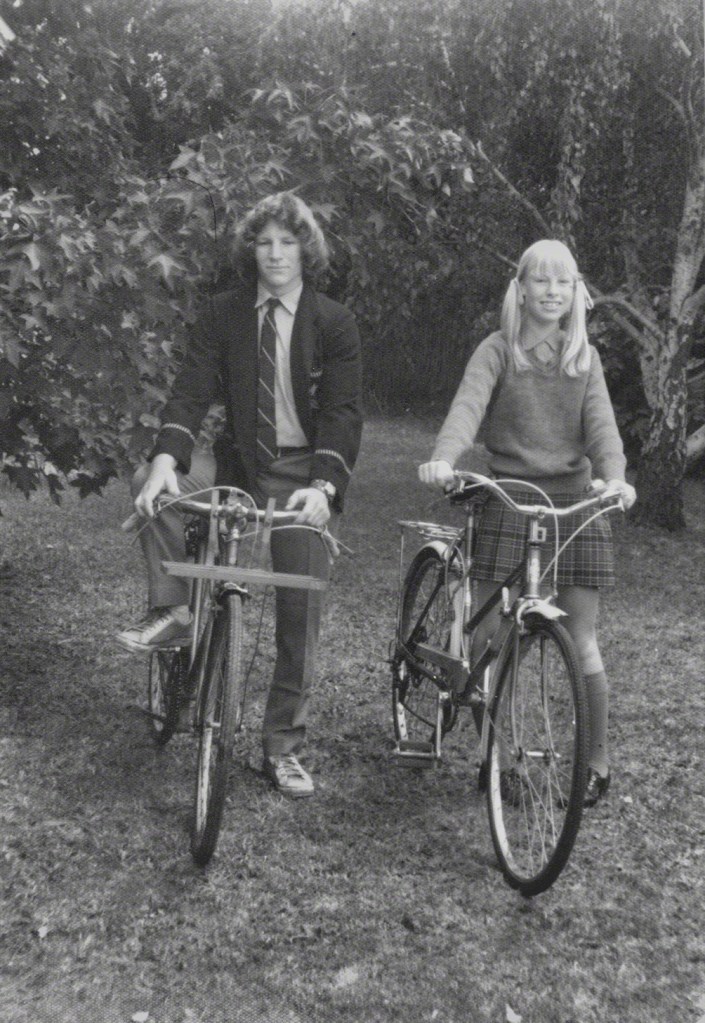
*[Photo 1: Full of hope of a new adventure © M.E. Trudinger 1975]

‘You’ll make some friends who’ll be there for you when you go to high school,’ they said.

Good intentions; a sound plan for transition…

Their plans just didn’t work out as they intended.

Two weeks into first term at that new school, I realised I’d connected with nobody. The girls in my class had formed their tight-knit friendship groups way back in Year 1, so I had no friend-prospects.

At recess, I sat alone Indian-style on the grass under a tree. Never mind, I thought, my books are my friends. I’ll read out the year. I opened my latest novel. Besides, I have plenty of friends outside of this school.

For the next few days nobody and my books kept me company at recess and lunch. What better way of dealing with loneliness of an hour by entering another world and the characters there. No different from the previous year at my old school when I ignored my friends in preference to researching dinosaurs and aliens in outer space.

*[Photo 2: One of my books, the Lost World of the Wends © L.M. Kling 2021]

Then the good intentions of the teachers came into play. The new Year 7 girl reading her books every break? Oh, no! We can’t have that! She must socialise.

So, with good intentions, the teachers denied me the joy and escape of reading. They forced me to play with my peers.

However, my peers, comfortable with their set, didn’t appreciate the teacher’s good intentions. As I followed one group into the girls’ toilets, the leader spoke up. ‘Nothing personal, but stop shadowing us.’

Fine then. I wiped the tears stinging the corners of my eyes and bit my lip. Sorry for upsetting your perfect little life. I’ll go find someone else to be my friend.

Soon after, I teamed up with a Year 6 girl. She sat on her own at lunch. I’d been kicked off the bench by the other cohort of Year 7 girls because I liked cheese and gherkin sandwiches. Rather than making a big deal of the excommunication, I wandered over to the Year 6 girl and sat beside her. She didn’t mind my choice of lunch.

*[Photo 3: Happiness is a friend, Poatina Tasmania © L.M. Kling 2010]

For the next week, we enjoyed each other’s company. We played on the monkey bars and joined others in her class playing four-square (a type of hand-tennis). For five days, my cliquey peers were happy, the teachers were happy, and I was happy. I’d found a friend.

But good things were not meant to last at this new school. The beginning of March, and just a hint of an autumn-south-westerly breezed through the classroom porches. I kicked off my shoes, pulled on my scuffs (major rule: no shoes inside the classroom), and lined up ready to enter class. The Year 6 teacher sought me out and took me aside. ‘You aren’t allowed to play with Year 6 students,’ they said. ‘It’s against the school rules.’

*[Photo 4: Beginnings of autumn © L.M. Kling 2021]

The school with good intentions had a rule: Students must only mix with students the same age as them and from their class.

So again, good intentions forced me out on my own again. I rode home that day, tears streaming down my face. I failed to understand. The injustice of it. They want me to socialise and then thwart every effort for me to do so, with all their damn rules.

With good intentions, the next day, Mum marched into the office and spoke to my teacher. With good intentions, my teacher reprimanded the girls in my class.

Made no difference. My peers wanted no part of those good intentions. And they didn’t like being told off. Not one bit. I paid for those good intentions right through secondary school, actually.

I considered making friends with some boys in my class. But after one day sitting at a table in class with them, I figured that making friends with the boys in my class wasn’t an option. Probably a rule about that too. After all, our teacher gave us a lecture on the evils of wearing bikinis…so…

[Photo 5: Beware, the bikini…modesty at Moana © R. Trudinger 1982]

For the rest of that year, I became very good at keeping out of the supervising teacher’s gaze at lunchtime and pretending to play with my peers while making sure I didn’t appear to be “shadowing” them. The bullies helped this charade by “shadowing” me. Not that I appreciated their efforts at the time. As the year wore on, I managed some illicit liaisons with my books behind the bushes, when the teachers weren’t looking.

My mum carried the burden of guilt from her good intentions of the year I lived friendlessly. But she needn’t be. My parents’ intentions were good. Though I suffered, these challenges were good for me. I learnt to persevere. I learnt that being alone doesn’t mean that I must be lonely. God was and is with me. I learnt not to quit. In short, I developed character. Besides, this school inspired me to learn the Japanese language, setting me on my future career path teaching the Japanese language, as well as travelling in Japan. And most of all, I learnt to see the kids sitting on their own and be their friend.

[Photo 6: Tokeiji, Japan © L.M. Kling 1984]

Yes, good intentions may not work out as we intended, but God can turn around our struggles, and our failures, with His best intentions for us.

“And we know that in all things God works for the good of those who love him, who have been called according to his purpose.”—Romans 8:28

© Lee-Anne Marie Kling 2016; updated 2022

*Feature Photo: Alone, in Japan © Lee-Anne Marie Kling 1985

***

Read the stories inspired by the year of living friendlessly…

Click on the link,

To download my novel

The Lost World of the Wends

Or…

Or discover how it all began in The Hitch-Hiker

And how it continues with Mission of the Unwilling

Or

Check out Indie Scriptorium, a publishing collective formed with friends,

Click on the link to my most recent post,

My Cover Journey