The Ancestral T-Team in Australia
1885: Emigration to Australia
According to family lore, the Trudinger family emigrated to Australia because Carl August’s business went bankrupt. But was this actually the case?
The wool industry in Yorkshire was booming well into the 1890s. Carl August and his family emigrated to Australia in 1885.
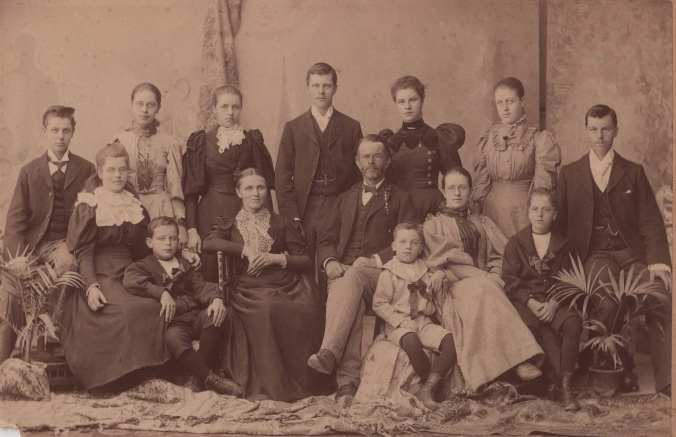
The facts are Clara Theresa and her 12 children boarded the sailboat, the Holmesdale, for Port Adelaide, South Australia, in 1885. Carl August stayed behind for a few weeks to tie up loose ends, house, business, etc., then he boarded a steamship and arrived one day before his family set foot in Port Adelaide. That kind of expenditure doesn’t, in my opinion, reflect a man whose business has gone bankrupt. But perhaps the total cost of emigrating to Australia took its toll on the finances.
They settled in the Norwood area, Carl taking up a job as a greengrocer.
The following year, on August 16, 1886, my grandfather, Ronald Trudinger, was born. He was number 13 and the last child in the Trudinger tribe.
Carl August bought the Trudinger family home in Heathpool. 5 Northumberland Street, Heathpool, became a family and community hub, where friends and family gathered and lived long after Carl August and Clara Theresa had gone to their eternal home in Heaven. Their daughters, Clara, Gertrude, and Dora, lived there until they, too, passed on to Glory. Dora, the last of the maiden aunts, passed away in 1961. And it was where my dad and his brother Paul lived with their aunts while their parents, Ron Trudinger and Lina, were missionaries in the Sudan, Africa.
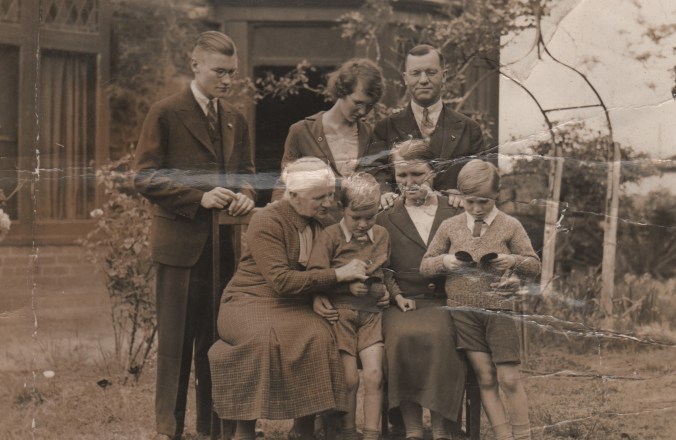
The Schammer Family history states Carl August set up a textile business in Adelaide city centre, in Rundle Street, managing the chain store of Theodore Zimmermann, from Gnadenfrei. When Carl August retired, he passed this business on to his son, Oscar. By the 1920s, this store was a clothing shop on the ground level, where the Myer store now stands.
They had raised brilliant and, on the whole, God-fearing children, nine of whom ventured out into the mission field. A number of them attended university, including two of their daughters. According to the numerous news reports, they became a prominent family in Adelaide church society. Like cream, they rose to the top, a shining example for Christian families everywhere.
However, life didn’t always go smoothly for the Trudinger family in Australia.
In 1894, whilst working in Kapunda, Carl August’s son, who worked in Kapunda as a watchmaker, was almost swindled by a shady character who had a habit of passing on “rubber” cheques, you know, the ones which bounce. Fortunately, in Kapunda, the bank wasn’t too far, and my great-uncle was able to sort out the problem before the offender had escaped the town. Mr. Lehmann, the owner of dodgy cheques, was apprehended, charged, and jailed for his crimes. Another time, also while in Kapunda, which must’ve been quite a town back in the day, Carl’s son August found a vagrant sleeping on the porch doorstep of his business.
Tragedy struck the Trudingers while they were in Broken Hill in 1892. Their daughter, Elsbeth, died suddenly of typhoid at the age of eleven.
So, could there be other reasons Carl August and Clara Theresa moved to the other side of the world?
Clara Theresa had dreams of being a missionary. Dreams that remained unfulfilled. Most probably because she married a man who had been outside the Moravian Brethren fold. Although he did join the Moravian Brethren when he married Clara Theresa, it wasn’t enough for the Moravian leaders to allow Clara Theresa to become a missionary herself. Hence, she dedicated all the children she bore to God. If she couldn’t be a missionary, perhaps when they grew up, they could. And Carl August, being the easy-going, amiable person that he was, went along with his wife’s wishes.
In this light, did she see Adelaide, South Australia, established as a free city, a Utopia, as an opportunity to fulfil God’s missionary call without all those rules and regulations, encumbrances her brand of church, The Moravian Brethren, placed on individuals to be accepted into the community and to be accepted into missional service?
My hypothesis is this: Carl August and Clara Theresa made a deliberate choice to emigrate to South Australia. They may have seen it as God’s call and God’s guidance to go there. When they came to Adelaide, there was no Moravian Brethren community, so they joined the Presbyterian church. However, not so far away, in Bethany, in the Barossa Valley, there did exist a Lutheran Church influenced by the Moravian Brethren. There is no mention my great-grandparents ever attended this church. Interesting … Especially considering Carl August’s son worked in Kapunda in the 1890s.

I wonder if there wasn’t some hurt Clara Theresa was suffering because she so wanted to be a missionary and her church community, the Moravian Brethren, wouldn’t allow her to be. Then back to Carl August, grown-up Lutheran-Evangelisch, but despite all the Lutheran churches in Adelaide and the Barossa, he opts for the Presbyterian Church as the one he feels most comfortable in to worship.
One point I mentioned earlier, Carl August did not like Bismarck or the direction Germany was taking. In later years, according to news articles, they had disassociated themselves completely from Germany, as if they were ashamed of the country of their birth. Understandable after World War 1, I guess. Being sent to an internment camp wouldn’t have been high on their priority list.
Another fact, yet to be verified: in the early 1900s, it is said Carl August spent time away from the family in Southeast Asia, specifically the Philippines. He went there on business. In recent years, one relative reported he’d discovered Carl August had been selling arms to support the Filipinos in their war against the United States (1899-1902). There’s that passion for justice streak again.
Carl August and his wife spent decades worshipping at St. Giles Presbyterian Church. Carl August was an elder there. In 1927, the local paper, which reported their diamond wedding anniversary, also mentions Carl August was still fit enough to walk to church every Sunday morning. One article mentions the success of their long marriage was founded on never going to bed angry with each other. On the last night of Carl August’s life, he asked his wife to forgive him for saying sharp words, and of course, she forgave him.
The next morning, on July 10, 1929, at the age of 90, Carl August went to be with Jesus in Heaven. True to his humble, gentle nature, he was buried in a grave with no headstone, with his wife, who died three years later, in the West Terrace Cemetery, Adelaide, South Australia.
© Lee-Anne Marie Kling 2026
Feature Photo: Close-up of Carl August (circa 1893), courtesy of L.M. Kling
Note: If you have any information you’d like to share about Carl August or details that need correcting, please contact me in the comment section below.
***
Want more, but different?
Check out my Central Australian adventures.
Click on the links:
The T-Team with Mr. B: Central Australian Safari 1977

Trekking with the T-Team: Central Australian Safari 1981


