Travelling Friday–Arkaroola

Skint at Arkaroola

[This Sunday is Hubby’s and my 39th anniversary, so, time to remember our honeymoon in the rough and tough outback. The T-K Team step back in time into the Mt. Painter Sanctuary, Northern Flinders Ranges, South Australia; a land offering a glimpse of prehistory…]

Late 1980’s, and my husband and I planned a honeymoon stay in Arkaroola, the town within the Mt. Painter sanctuary, Northern Flinders Ranges. When we arrived, we rolled up to the motel and presented our VISA card for payment.
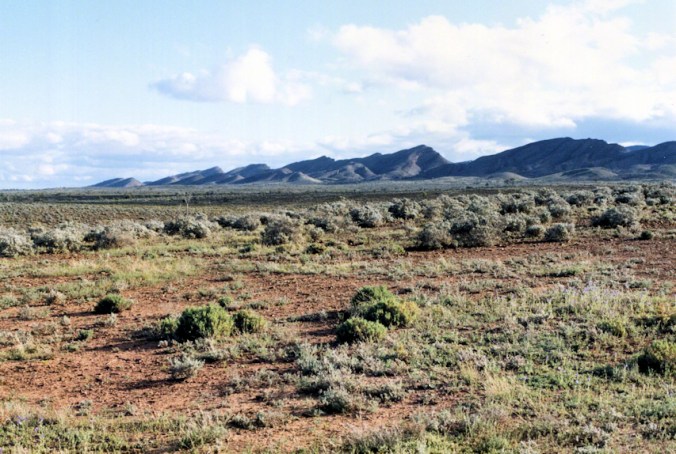
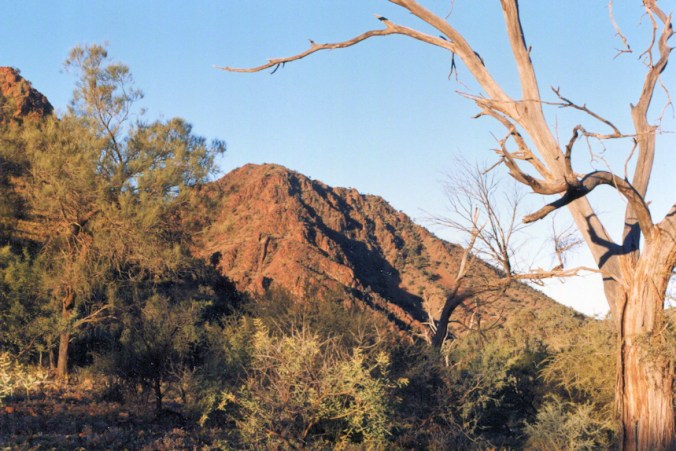
[Photo 1: Approaching Mt. Painter Sanctuary, Northern Flinders Ranges © L.M. Kling 1987]

‘Oh, I’m so sorry,’ said the manager, ‘we don’t take VISA. Only MasterCard.’

‘What?’ But we were counting on our VISA to cover the costs.

We scraped together the cash amount for the three-nights of accommodation and emptied our wallets of all but a few notes. Romantic dinners in the restaurant, off our menu. The longed-for Ridge-Top Tour, off our track. Then cold hard panic struck, how were we to pay for petrol when we returned to Adelaide? The amount in our tank, Dad’s four-wheel-drive vehicle that he loaned us for the holiday, may not last the journey back to Hawker. All because the town in which we chose to spend our honeymoon, was so remote, they did not deal in VISA.
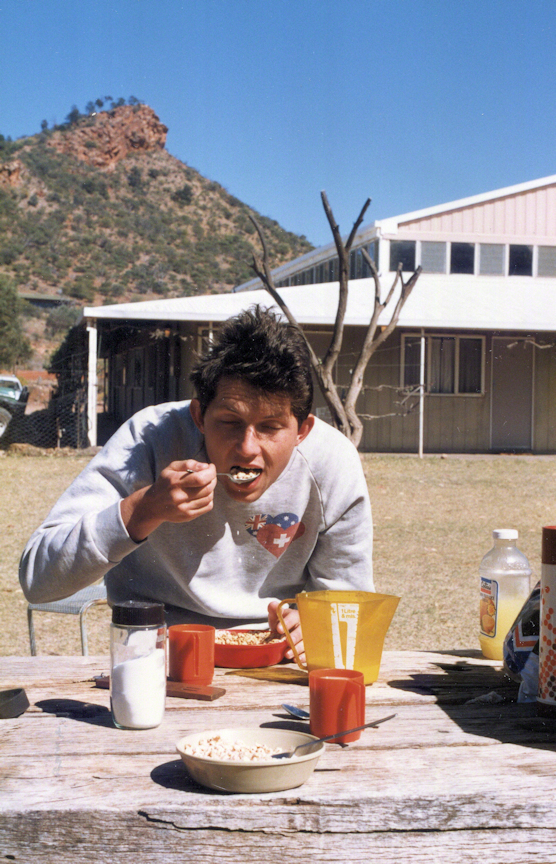
[Photo 2: Cornflakes for breakfast © L.M. Kling 1987]

We sat on our motel bed and counted our measly amount of cash. What were we going to do? It’s not like I hadn’t gone without before—on the T-Team with my Dad. Being like-minded and frugal, we dealt with the disappointment, and decided we’d cook our own meals using the barbecue facilities and not venture too far from the town. Besides, there were plenty of places to which we could hike.
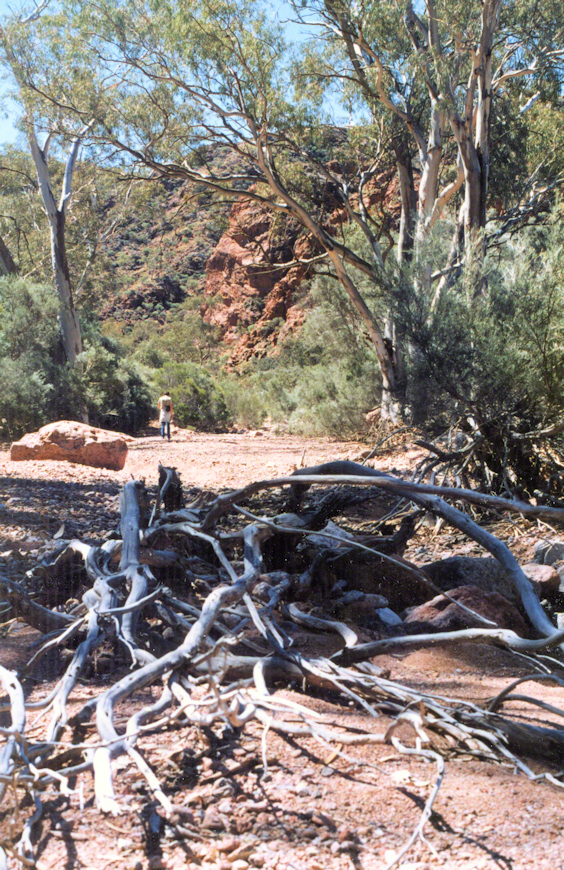
[Photo 3: Hiking up Radium Creek searching for titanite © L.M. Kling 1987]

I took a deep breath and picked up the book our pastor had given us as a wedding gift. Inside the front cover I discovered an envelope. ‘I wonder what this says,’ I said to my husband.

I took out the card and opened it. An orange-coloured note fluttered onto the floor. I picked it up. ‘Hey, look! Twenty dollars.’ I waved the note in my husband’s face. ‘Twenty dollars! Pastor must’ve known we’d need the money.’

‘I think God did,’ my husband said. ‘Twenty dollars makes all the difference.’

‘Can we do the Ridge-Top Tour?’

‘Um, perhaps not that much difference.’

‘Dinner at the restaurant?’

‘Maybe, but we still need to watch our spending.’

I sighed. ‘I know.’
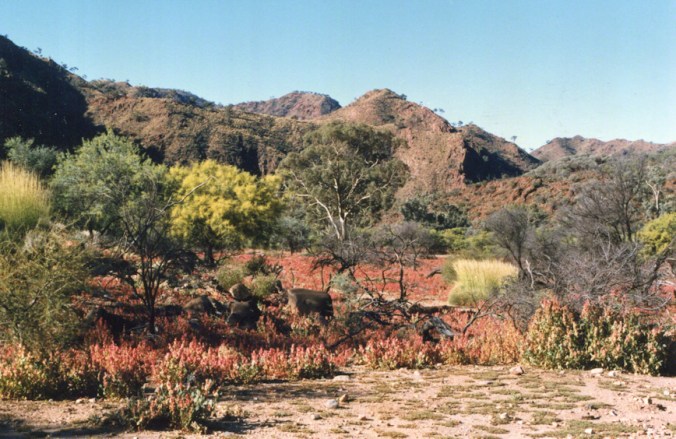
[Photo 4: Dinnertime Hill © L.M. Kling 1987]

[Photo 5: Towards sunset on Mt Painter Sanctuary mountains © L.M. Kling 1987]

In the restaurant, and eating the cheapest meal offered, I spied a photo adorning the wall behind my beloved. A waterhole with red cliffs on one side and cool but majestic eucalypt trees on the other side. ‘Echo Camp,’ I read. ‘I want to go there.’

‘Hmm, not sure, if we have to drive far.’

‘Oh, please.’

‘We’ll see.’
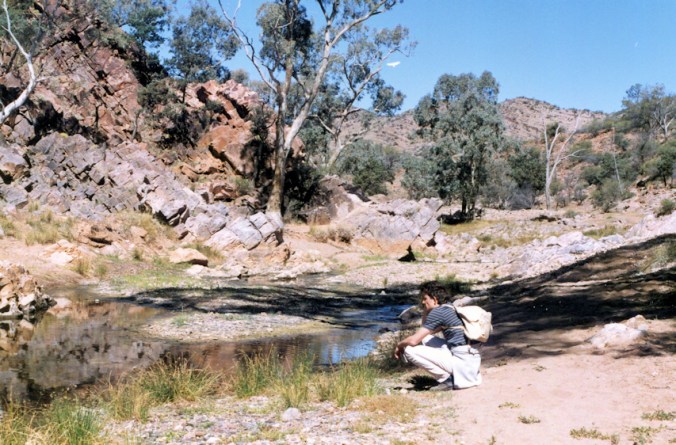
[Photo 6: Radium Creek © L.M. Kling 1987]

[Photo 7: Nooldoonooldoona © L.M. Kling 1987]

A couple of days passed, and we’d exhausted all the nearby scenic sites to which we could hike. We decided to drive up the road, but not too far.

I spotted a sign to Echo Camp, and not-too-many kilometres off the “main” road. My husband noted that the track was only for “authorised” vehicles.

‘That’s not fair,’ I said. ‘They shouldn’t tempt us with scenic places like that in the restaurant and then deny us because we’re not “authorised”.’
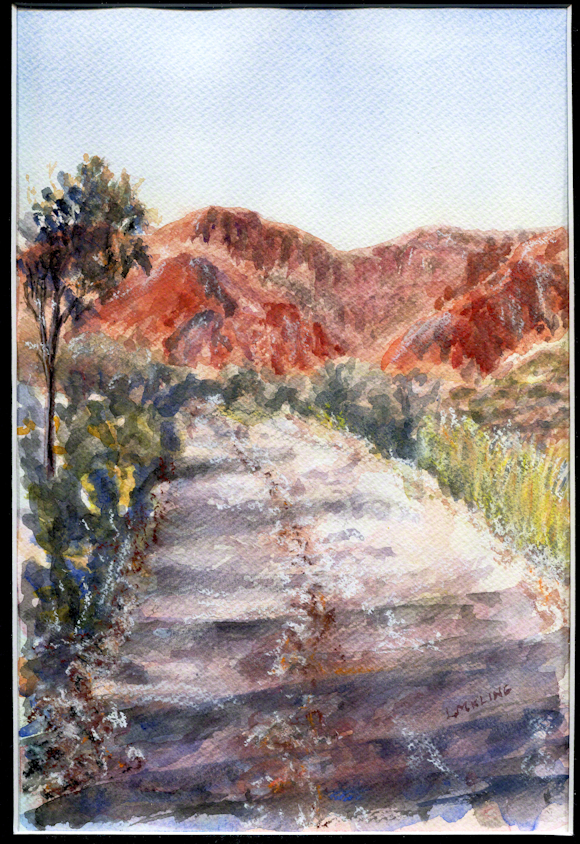
*[Painting 1: Track to Echo Camp © L.M. Kling 1987]

He who was driving, turned into the track. ‘You’re quite right. Ready for some adventure?’

‘Okay, well, it says Echo Camp’s only a few kilometres down the track.’

My husband drove up and down the track. It soon became obvious why the track was meant for “authorised” vehicles. But we were committed, and the track became so narrow, with one side rocky cliffs and the other sheer drops, we had no choice but to lurch forward, upward, downward, sideways and every-which-way. While I clutched the bar on the dashboard, my husband had fun, relishing the roller-coaster ride to Echo Camp.

We reached a relatively flat area where we parked our four-wheel drive vehicle. The Painter Sanctuary mountains rose and dipped like waves before us. A feast for the eyes with shades of sienna, blue and mauve. I captured this beauty with my Nikon film camera.
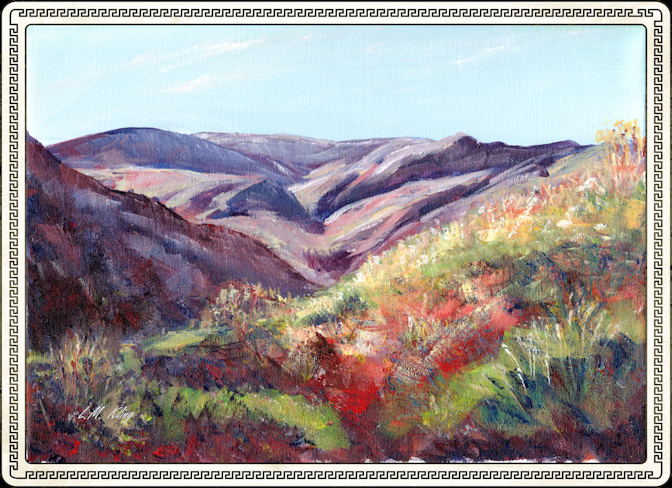
*[Painting 2: Vista of the Sanctuary © L.M. Kling 2019]

‘By the way, where’s Echo Camp from here?’ I asked.

‘Just around the corner, I think.’

‘How many kilometres have we travelled?’

‘More than the sign said, but it can’t be far.’

‘I get the feeling we missed it on the way here.’

My husband nodded. ‘I think we did. There was a fork back there, but I wasn’t sure. And the angle was too sharp to turn down.’

‘Better check out that track.’
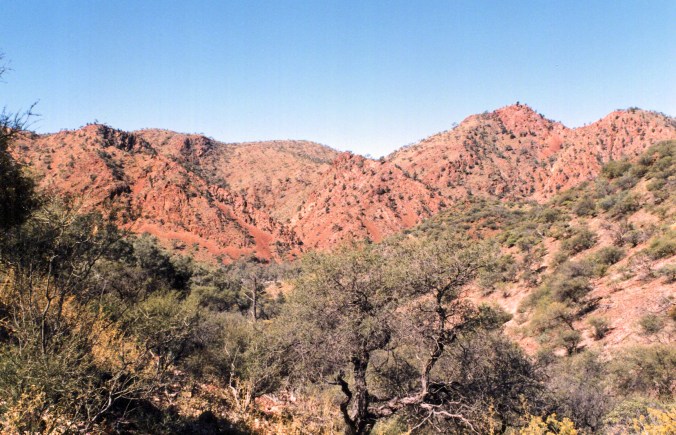
[Photo 8: Sun fast sinking on secret sanctuary © L.M. Kling 1987]

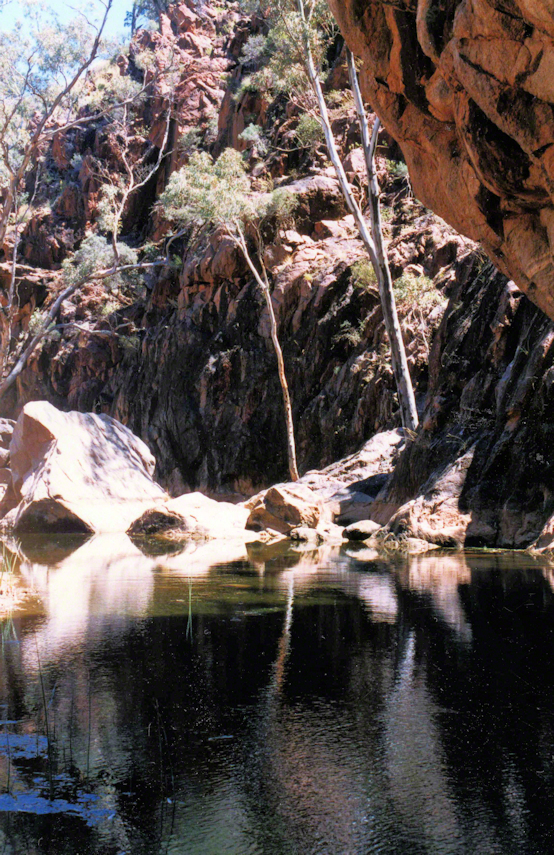
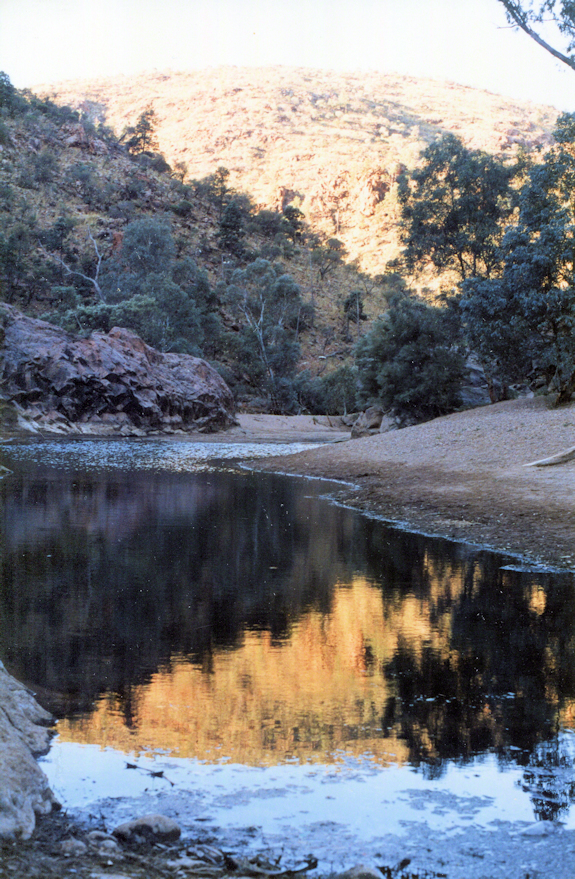
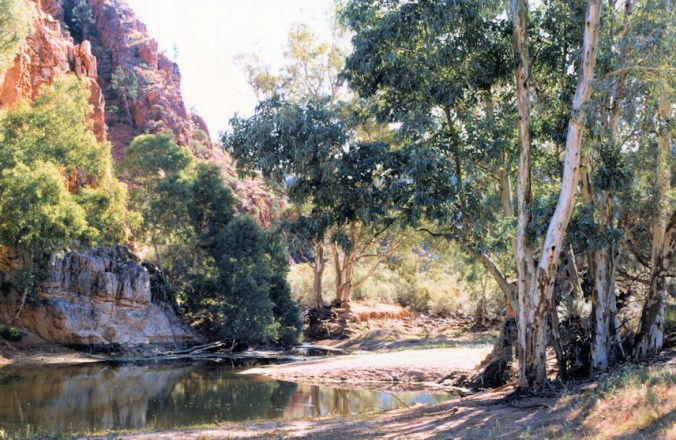
We back tracked and found the way leading to Echo Camp. By this time, the sun hung low in the sky, so our time savouring Echo Camp was limited to no more than half an hour, wandering near the rock pool, taking photos, and enjoying the peace and silence of this land untouched by civilisation, and reserved for the “authorised” apparently.

Aspects of Echo Camp
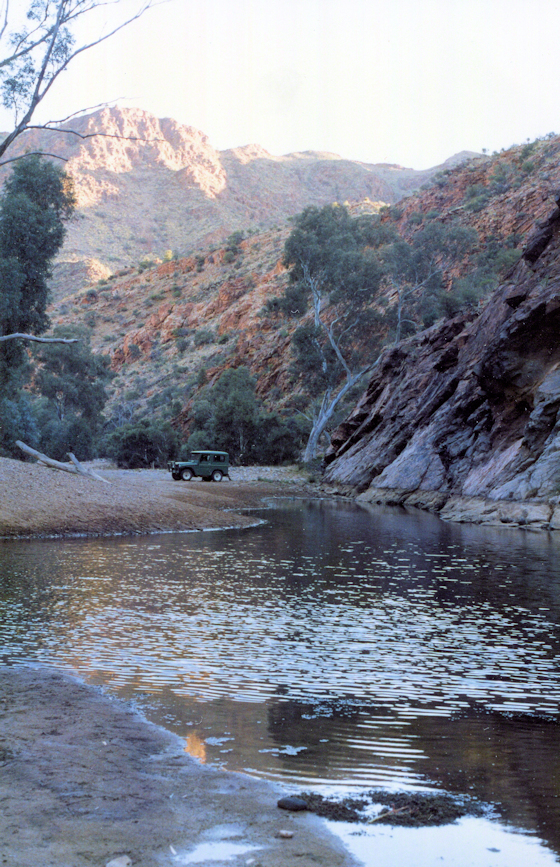
[Photo 9: Our trusty Daihatsu Four-wheel drive © L.M. Kling 1987]
[Photo 10: Reflections in the billabong © L.M. Kling 1987]
[Photo 11: Echo Camp © L.M. Kling 1987]

Then, after braving the roller-coaster road again, we crept out from the contraband track, and back into town.
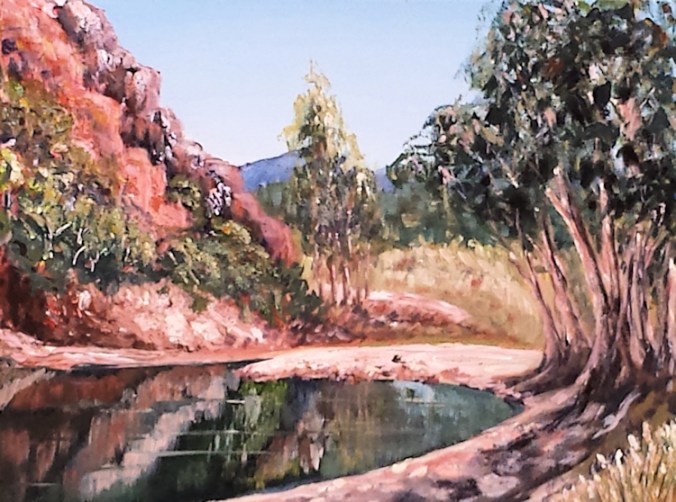
*[Painting 3: Echo Camp © L.M. Kling 2015]

***

© Lee-Anne Marie Kling 2016; updated 2019; 2022; 2026

*Feature Painting: Dinnertime Northern Flinders Ranges © Lee-Anne Marie Kling 2018

***

Want more but too expensive to travel down under? Why not take a virtual travel with the T-Team Adventures in Australia?

Check out my travel memoirs.

Click here on:

The T-Team with Mr. B: Central Australian Safari 1977

Trekking With the T-Team: Central Australian Safari 1981

And escape in time and space to Central Australia

Family History Friday–My “Convict” History

My “Convict” History

I admire a former convict, an ancestor of mine. Okay, you may think, yeah, of course, she’s an Australian—these days they wear their convict heritage like a badge of honour.

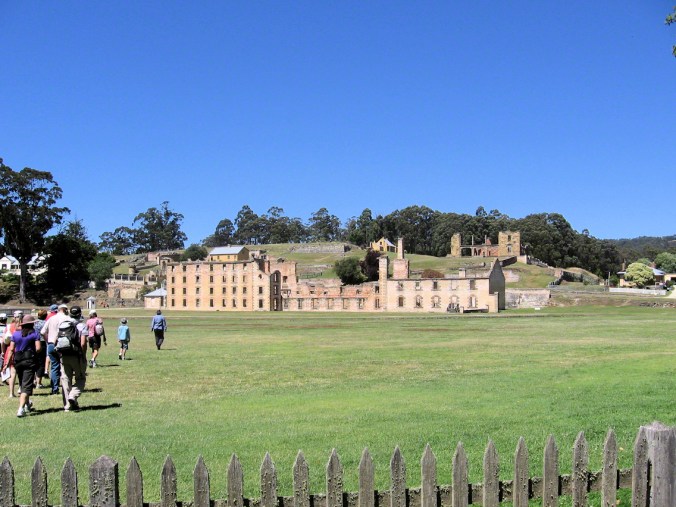
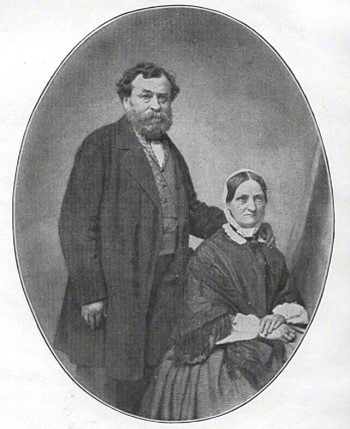
No, actually, my great-great-grandfather lived in Saxony, which is now part of East Germany or Poland today. Rubber borders, you see. His crime was trivial by our 21st Century standards in the West. But then, so were the crimes of shiploads of convicts who were transported from Britain and Ireland to Australia in the early 19th century. (For this reason, I have included photos from my visits to convict settlements, Port Arthur and Sarah Island, Tasmania, as my two-times Great-Grandfather, Friedrich August Schammer, was living his life in Silesia around the same time, in the early nineteenth century.)

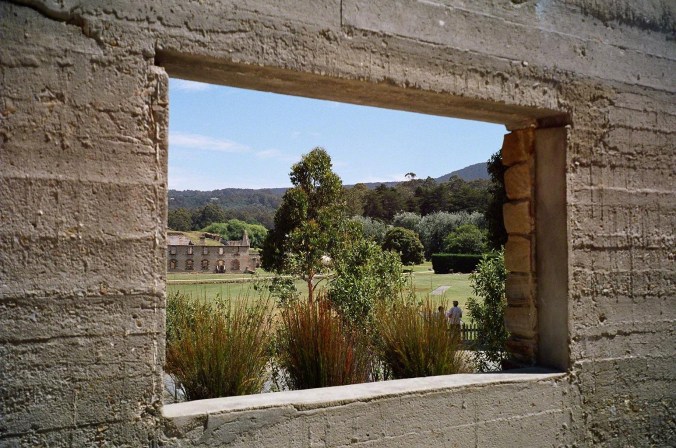
[Photo 1: Port Arthur was a recipient of many convicts from Britain and Ireland © L.M. Kling 2009]

Friedrich August spent less than three months in prison for a crime he did not commit, but I admire the way he managed his dire situation.

How did he get into this trouble?

According to the family history book, of this particular branch of the family, in the town in which Friedrich August Schammer studied as a medical student in the 1820s, the military came to power and enforced strict and arbitrary rules. I might add here that my ancestor had already endured hardship, having been orphaned as a child, suffered poverty, and then, his older brother, who was his guardian, died from typhus. I imagine these events spurred him on to be a doctor.

[Copy of Portrait painting: Two-times Great Grandfather, Friedrich August Schammer courtesy of Schammer Family History © 1922. Painting circa 1850. Painted by artist, Adolf Gottlob Zimmermann.]

Anyway, in this university town of Jena, the students protested against their restrictions on their liberty by reacting against the ridiculous laws the military had brought to the town. Some of these laws were that there be no singing in the streets, no wearing of caps, and no waving of flags. The students protested by marching in the streets to the town square, singing and waving flags. All went smoothly and peacefully with no trouble from the authorities.

Then some of the young men, probably after drinking a few beers, became bolder as young men tend to become. They threw rocks at windows, an action that got the authorities’ attention.

[Photo 2: View from window of former café in Port Arthur © L.M. Kling 2009]

The military swooped in and arrested many of the protestors. My great-great-grandfather was walking past the action and was in the proverbial wrong place at the wrong time.

Arrested and tried, though otherwise of exemplary character as a good Christian belonging to the Moravian Brethren, Friedrich was convicted and sentenced to prison for six months.

It seems by his account and letters, a certain beadle in town had it in for Friedrich August.

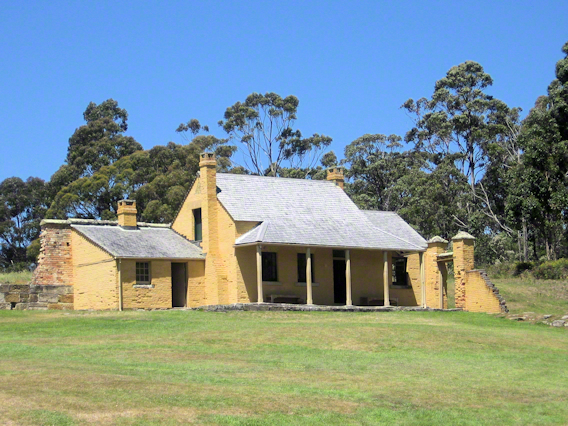
[Photo 3: Captain’s Quarters up on the hill, Port Arthur © L.M. Kling 2009]

Yet Friedrich accepted his time in prison and made the best of the situation both for himself and others. He studied, enjoyed the view of the valley from his prison room (I think he was in a low-security prison), and used his medical knowledge and skills to help those around him.

The authorities noticed great-great-grandfather Friedrich’s quiet conduct and enrichment of the prison community, and they released him less than three months into his term.

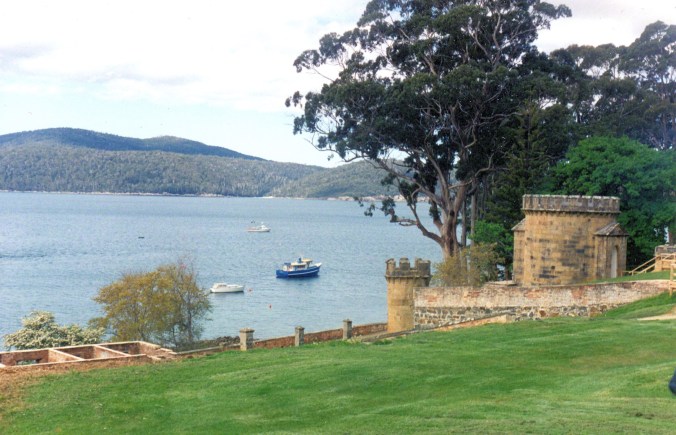
[Photo 4: A view of convicts on the other side of Friedrich’s world may or may not have enjoyed in Port Arthur © L.M. Kling 1995]

Released, Friedrich’s ordeal was not over. The university where he’d been studying banned him from returning to study there. His reputation tarnished, the villagers shunned Friedrich.

However, Friedrich did not give up. He moved to Berlin and, keeping a low profile, completed his studies at the Charité Hospital and graduated as a Doctor of Medicine. He had a heart for the poor, having been poor himself, and would treat those in need without demanding payment.

Friedrich August Schammer demonstrated those godly qualities I admire—justice, mercy, and compassion. And perseverance, even in the face of adversity.

Philippians 2:14-15—Do everything without complaining or arguing, so that you may become blameless and pure, children of God without fault in a crooked and depraved generation, in which you shine like stars in the universe…

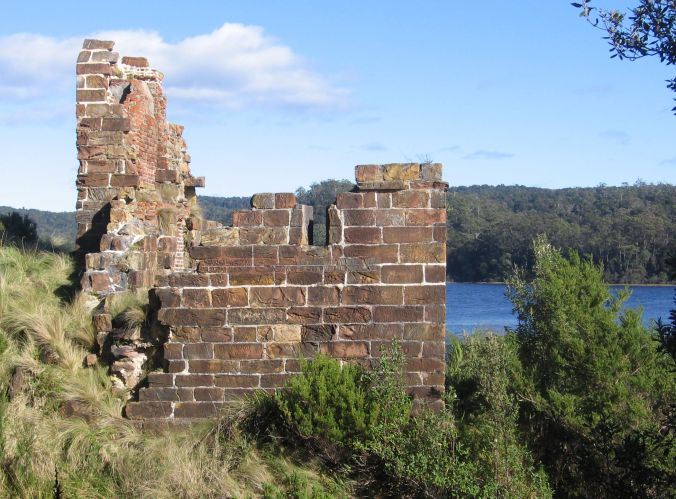
Feature Photo: The Cry of the Convicts, Sarah Island Ruins © Lee-Anne Marie Kling 2011

*** 

Note: Port Arthur housed what British authorities considered the worst of the convicts transported to Australia in the early to mid-nineteenth century. I visited this convict settlement in 1981, 1995 and 2009. A place well-worth visiting to learn from the mistakes made from the past (how not to treat fellow human beings). Although the place appears serene, the presence of the tortured ghosts of the convict past can still be felt.

Sarah Island situated in the Macquarie Harbour on the west coast of Tasmania, imprisoned the worst of the worst convicts transported to Australia in the early nineteenth century.

I have visited Sarah Island as part of the Gordon-Franklin River Cruise, both in 2001, 2011 and again in 2016. I highly recommend this cruise—a bucket list for travellers—history, wilderness, rare beauty of unspoilt rivers and rainforest and…excellent food.

© Lee-Anne Marie Kling 2016; updated 2020; 2023; 2026

***

Virtual Travel Opportunity

For the price of a cup of coffee (takeaway, these days),

Click on the link and download your kindle copy of one of my travel memoirs,

Experience Historic Australian outback adventure with Mr. B

in

The T-Team with Mr. B: Central Australian Safari 1977

Or come on a trek with the T-Team in

Trekking with the T-Team: Central Australian Safari 1981.

Backyard Tales–Molly’s Misadventure

FURRY FELINE TALES

[It’s time for my newest fur-baby to have her yearly vet check and vaccination. That will be a challenge. Just a sniff of such an adventure and Lily hides. My parents had a cat like Lily—Molly.]

[Photo 1: Where’s Lily © L.M. Kling 2024]

 But long before Lily, my parents had Molly …

Molly

Dad sipped his cappuccino, and then, licking his lips, he leaned over. ‘I have a mystery concerning Molly.’

A tram rattled past. How the three ladies in their designer clothes and ability to talk through their noses could hear their own conversation, I’ll never know. Maybe the nasal accent was just the right pitch to override the rumbling of trams, and then, added to the tram noise, the screaming of toddlers begging for their babycinos.

I waited for the tram to pass. Dad, in his mid-70s, didn’t have such a strong voice. And my hearing’s never been good. ‘What do you mean, Molly? What mystery?’

‘Er, um, I think she’s missing Mum.’

I gasped. ‘Oh, no! You haven’t lost her. Like Zorro. The last time, when Mum went to Sydney, New Year’s Eve 2000 with all the fireworks, Zorro got spooked. He was outside when the booms began, and he was off. He’s never been seen since. You don’t have a good record when it comes to cats and Mum being away.’

‘Oh, no, no, no!’ Dad said. ‘I mean, she’s been sleeping in funny places. Just the other day I found her in my underwear drawer. She was sleeping so peacefully, I left her there.’

‘How cute.’ I paused as another tram rumbled past. The ladies by the window exploded into laughter. When they quietened, I continued, ‘But you said she was missing.’

‘Oh, no, I mean, she’s …’ Dad coughed. Always does when he’s only telling the truth in part. ‘She’s … somewhere.’

‘How can you be sure? Maybe you left her out, and she’s run away.’

‘Oh, no, no, no! I put food out for her at night. Inside. And in the morning, it’s gone. She’s eating it. She’s just hiding.’

‘I see.’

‘I mean, I think she’s just found a nice little place to sleep. Where I can’t find her.’

‘I guess.’ I scraped out the last frothy bits of my cappuccino. ‘I’ll have a look for her when I come tomorrow.’

[Photo 2: There’s Lily and Feature © L.M. Kling 2025]

The next day, after school, the boys and I rolled up the driveway, piled out and then entered through the back door of my parents’ old housing-trust home. While Mum’s away, I liked to visit Dad to make sure he’s okay.

My sons raced off to the computer room, but I lingered in the kitchen where I cleared away a day’s worth of coffee cups from the dining table and stacked them on the sink.

‘Have you found Molly?’ I asked Dad.

‘No, but the food’s eaten. I think she’s hiding under the bed in the spare room, so I put the cat’s meat there, and in the morning, again it was all gone.’

I followed Dad to the spare room to witness the evidence of an empty bowl with a few morsels of dried fish flakes remaining at the bottom.

I sniffed.

A nasty, festering sort of smell lingered in the air.

Calling my eldest, I decided we should start our Molly-search in the spare room. ‘Would you help me lift the bed-base?’

My son joined me in the small room. Two single beds, a dressing table and a large wardrobe crowded the room. We manoeuvred ourselves around one bed and lifted one end. No Molly.

‘What’s the stink?’ my son asked.

‘Not sure, but it doesn’t bode well.’ I remembered the dead mouse I’d found in that very same room when I moved to Melbourne. ‘Come on, I reckon Molly might be under the other bed.’

My son and I edged around the bed and, taking hold of each side, we hoisted up one side of the base.

Molly crouched in the corner and snarled. Dried blood had matted her fur.

‘Mum! I can’t hold up the bed much longer.’

[Photo 3: Molly enjoying her new home © L.M. Kling 2006]

Reaching, I gently lifted the tortoiseshell tabby from the furthest corner under the raised bed base. Around her neck and in the pit of her front leg, the fur had been rubbed away, exposing a raw wound. Sticky ooze stained my sleeve.

My son put down the bed and dashed to the linen cupboard in the passageway, where he grabbed a towel. We wrapped Molly up in the towel and stood in the passageway.

My younger son had extracted himself from his computer game and met us in the passage with Dad. ‘What’s wrong with her?’ he asked.

‘She’s been injured; that’s why she was hiding,’ I said.

Molly narrowed her eyes at Dad and growled.

‘Wasn’t me,’ Dad said. ‘The last time I saw her, she was fine.’

‘We have to take her to the vet,’ I said.

So swaddled in the towel like a newborn, and weak from her injury, Molly rode in my arms in the car without resistance.

[Photo 4: Swaddled Storm—they really are fur-babies © L.M. Kling 2010]

At the vet, the nurse ushered us in to see the veterinary doctor without the obligatory wait. The vet-doctor, a fresh-faced man in his 30’s, unwrapped the towel from Molly.

‘Oh,’ he said with a grimace, ‘it looks like she got her collar stuck under her front leg. Must’ve been like that for a while.’

Dad blushed and coughed.

‘You didn’t notice?’ the vet-doctor said, looking straight at Dad.

‘Yeah, well,’ Dad said as he shifted around the table, ‘my wife’s gone …’

The vet’s eyes widened with that look of pity. ‘Oh, I’m sorry—’

‘No, I mean, she’s gone to Sydney—on holiday.’

‘Oh.’

We all laughed.

‘Molly is my wife’s cat. And she took to hiding when my wife went away.’

*[Photo 5:  Schroedinger’s cat. Fur-baby Spike attempting to hide © L.M. Kling (nee Trudinger) 1984]

We’d found Molly just in time. The veterinary doctor treated her with antibiotics and a stay in the animal hospital. She made a full recovery.

Not sure that Dad ever fully recovered from the wrath of Mum when she returned from Sydney to discover he’d almost lost another cat in his care.

***

In Memory of Molly who lived to the respectable old (cat) age of 18.

As the Good Book, the Bible, says in Matthew 6:26-27

“Look at the birds of the air; they do not sow or reap or store away in barns, and yet your heavenly Father feeds them. Are you not much more valuable than they? Who of you by worrying can add a single hour to his life?”

© Lee-Anne Marie Kling 2016; updated 2026

Want more, but too impossible to travel down under? Why not take a virtual journey with the T-Team Adventures in Australia?

Click here on:

The T-Team with Mr. B: Central Australian Safari 1977

 Trekking With the T-Team: Central Australian Safari 1981
And escape in time and space to Central Australia …

100-Word Challenge–Worked

… Into a Corner

All afternoon, our backyard echoed with the hum of the cement-mixer, and intermittent scraping. Dad, armed with a trowel, smoothed the cement over an area pegged to become the back patio. Metre by metre, he pasted his way back.

Mum stood on the porch, and with hands on her hips, remarked, ‘And how are you going to get out of this one?’

In an ocean of soft cement, Dad looked around him, lost. ‘Er … um … I’ll work it out.’

Tracks back to the lawn-edge smoothed, Dad stood and admired his DIY job.

Next morning, paw-prints made their way to the rainwater tank.

© L.M. Kling 2019; updated 2026

Feature Photo: Dad Concreting back Patio © M.E. Trudinger circa 1978

***

It’s the Weekend.

 Time to read more on the adventures of the war against the fiend you love to hate, an overgrown alien cockroach, Boris.

Click on the links below:

The Lost World of the Wends

The Hitch-hiker

Mission of the Unwilling

Diamonds in the Cave

 Or

Longing for more travel adventures? Dreaming of exploring Australia?

Read the T-Team’s Aussie adventures, click on the links below:

The T-Team With Mr. B: Central Australian Safari 1977

Trekking the T-Team: Central Australian Safari 1981