Every Tuesday, or thereabouts, I get together with my friend of over 40 years, and we paint.
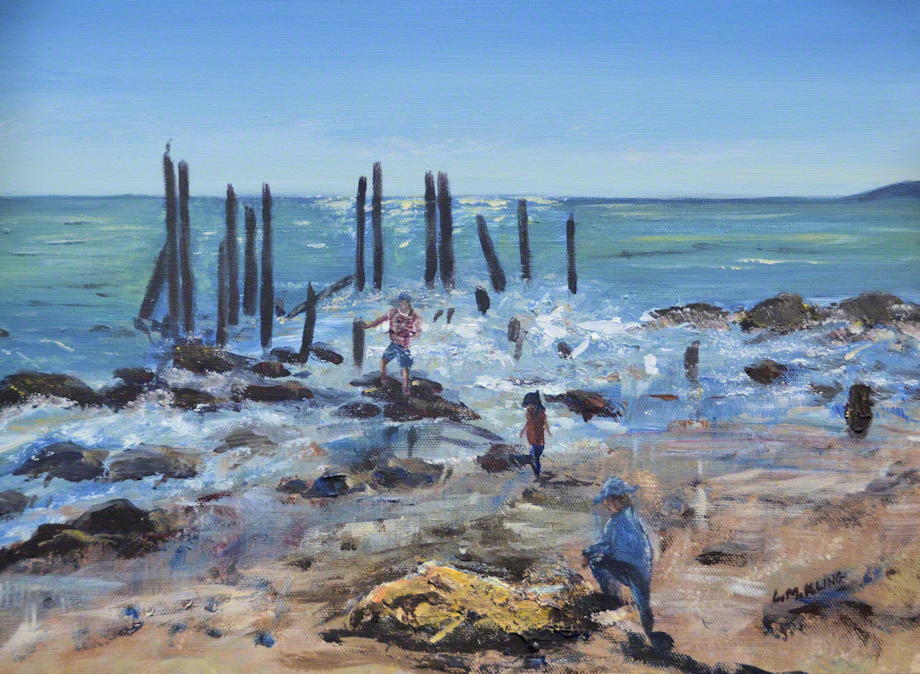
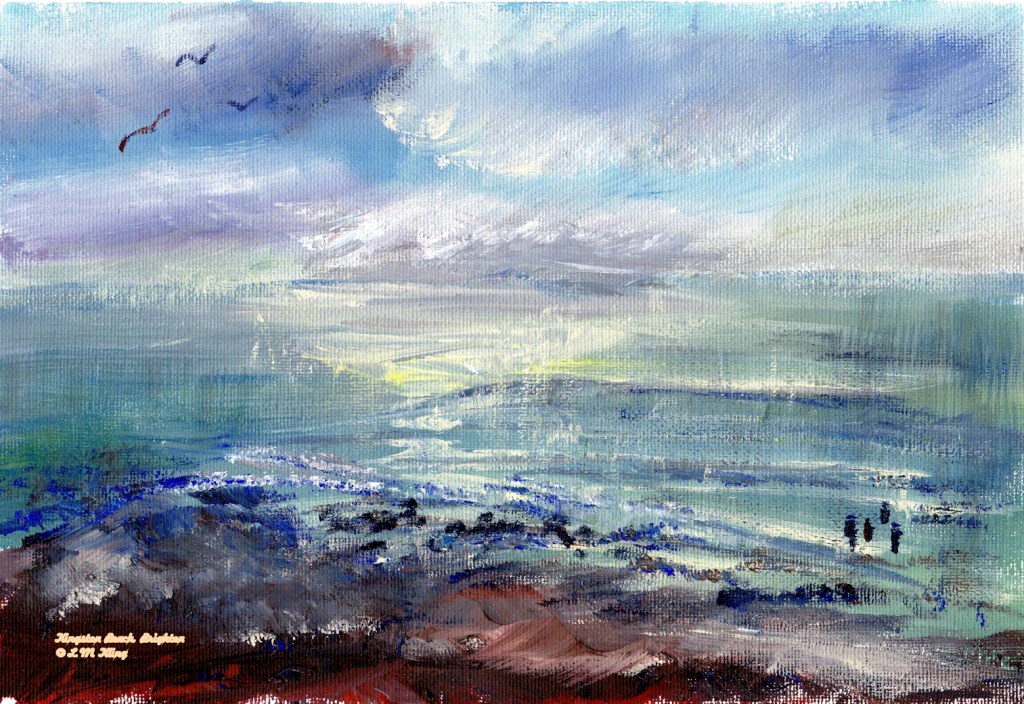
This painting in acrylic of Kingston Beach, depicts one of those calm early autumnal afternoons in March. Although warm and humid, the clouds gather in the west, signalling a change, and hopefully, rain. Still, it’s a perfect balmy afternoon come evening for a birthday celebration on the lawns in the park above the beach.
Much like this painting, Carol and I start the process of painting perhaps a bit weighed down by the various dramas in our lives, but by the end of an afternoon painting, chatting, and remembering way back when we were young, we feel lighter and happier.
All alone, I fidgeted. How long were they going to be? Where have they all gone? I edged towards the height of the gully and looked over. A loose stone skittered down the cliff. I retreated to the safety of the gully and waited. I bit my nails. Had they all fallen to their deaths? Do I join them? I stuck my head through the gap, then my shoulders, and finally my whole body. I placed my hand on the granite. How did they get up here? My height-challenged frame failed to reach the footholds and niches necessary to climb this rock wall. How did they do it? I stood on tiptoes, trying to reach a notch. Just too high. Just my luck, I’ve been left here all alone.
‘I don’t know. Splattered on the rocks at the foot of the mountain.’ I reached for my brother. ‘Where have you been? Where are the others?’
‘At the top,’ Richard, my brother said.
‘But what about me?’
‘Don’t worry, I’ll help you.’ My brother scrambled down. ‘Now climb on my shoulders and David will pull you up. Then you’ll be right. This is the hardest part.’
I did as I was told. I steadied myself on my brother’s shoulders and from there David grabbed my wrist and pulled me to the next level. Then I negotiated the rock-pile obstacle course on my own and made it to the summit of Mt Liebig a second time. My arrival recorded at 9:28am.
Older cousin (C1) perched himself on a flat stone and wrote his diary. Rick fiddled with his spinifex shin guards and muttered, ‘Fat lot of use they were.’ He picked at cunning spikes that had slipped past the guard. Younger cousin (C2) munched on an apple. Dad peeled an orange and with hearty slurps sucked its juices. David wandered around the summit, gazing at the land below, and then examining the cairn of stones.
‘We are on the right peak, aren’t we?’ Dad wiped the orange drips from his beard. He pointed at the other peak. ‘There’s a cairn of stones over there.’
‘Hmmm.’ David stroked his beard. ‘I think so. That one’s used for surveying.’ He picked up a rock and then as if by magic, extracted a rusty old can from the cavity. Without saying a word, he pulled out a roll of paper. He unfurled the paper and his eyes darted from right to left over the page.
C1 ran his finger along the top of the page. ‘The 27th of August 1981.’
Dad counted on his fingers and then said, ‘Well, fancy that! Exactly four years to the day.’
‘Must be the date to climb Mount Liebig,’ C1 said and returned to scribing in his journal.
We remained at the summit at least an hour, engraving our names with the amazing date onto a stone, and celebrating our Liebig conquest with fruitcake for morning tea.
[Note from the author: We ascended to the summit, not two weeks before that Dad had calculated, but one day before Mr. MacQueen and Smith summited. We climbed Mt Liebig on August 26, 1977. Read our adventures in the series Travelling with the T-Team: Central Australia 1977, particularly our previous venture climbing Mt. Liebig, “We almost Perished”.]
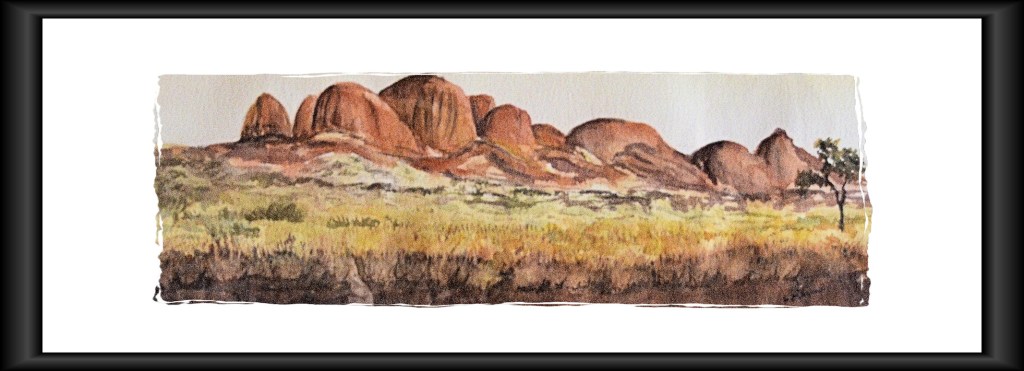
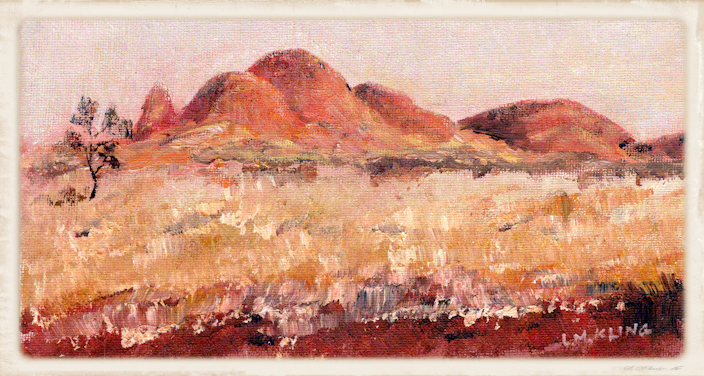
Way before the sun had even thought about rising, we gulped down our porridge and then set off for the Eastern Side of Kata Tjuta. Dad was on a mission to capture the prehistoric boulders at sunrise. We arrived at the vantage point just as the sun spread out its first tentative rays, touching the spiky tips of spinifex and crowning the bald domes with a crimson hue as if they’d been sunburnt.
I dashed a hundred metres down the track to photograph the “Kangaroo Head” basking in the sun. We stood in awe as the glow of red on the rocks deepened.
Every few minutes Dad exclaimed, ‘Ah, well, that’s it, that’s as good as it’s going to get.’ He packed the camera away, only to remark, ‘Oh, it’s getting better,’ then retrieve the camera from the bag and snap Kata Tjuta flushed with a deeper, more stunning shade of red. The rest of the T-Team, waited, took a few shots, waited, mesmerised by the conglomerate mounds of beauty, before taking more snaps of the landscape.
[While three of the T-Team faced the perils of climbing Mt. Liebig, a drama of a different, yet equally challenging kind unfolded for Mr. B and his son, Matt as they stayed back at camp.
Mr B and his son, Matt napped under the shade of a bean tree. A southerly breeze ferried through the dry creek bed, spiriting away the father’s snorts. Matt tossed and turned on his inflatable mattress that was exhausted of air resulting from a small, elusive puncture. He imagined the three others of the T-Team, beating a path through the sweltering heat and stinging spinifex in their quest to the summit of Mt. Liebig. Matt chuckled to himself. “Suckers!”
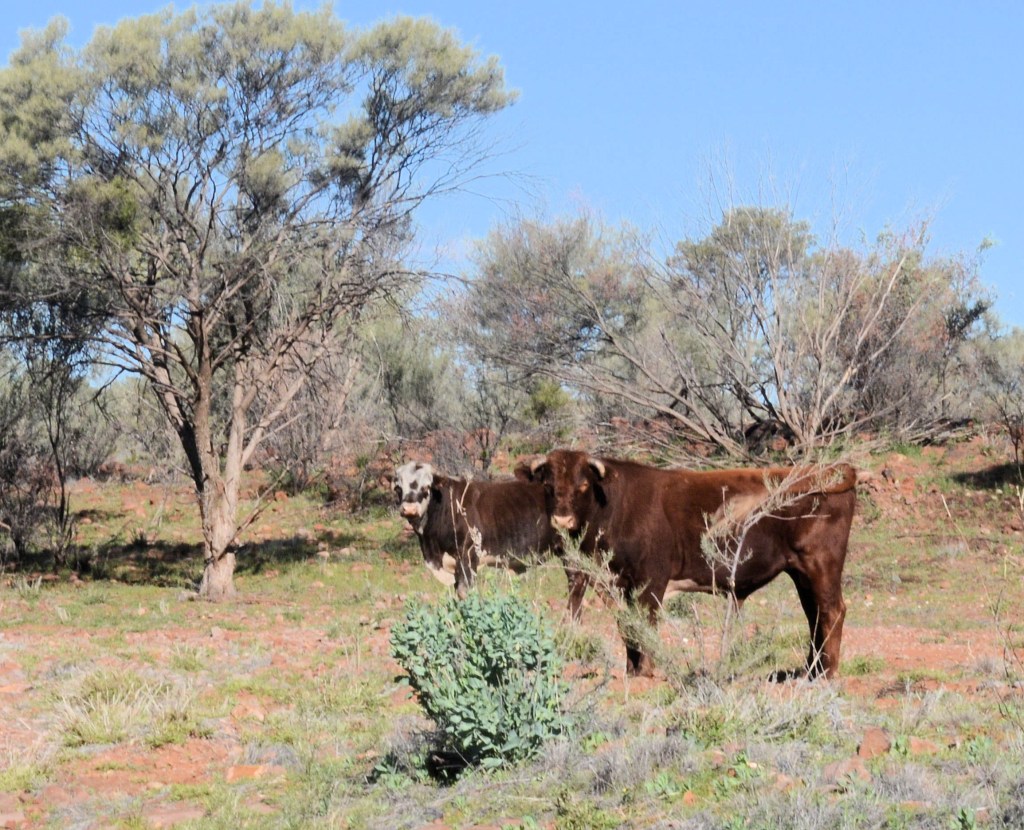
In a nearby tributary, a bull spied the T-Team’s father, son and daughter trekking in the distance, and stamped its massive hooves in the loose dry sand. Once the family had vanished, the bull trotted towards his stamping ground which possessed a gigantic bean tree as a feature in an otherwise dull bed of dust. His quest was to reclaim his territory that the humans had invaded.
“Matt, ma boy, do be careful. Don’t go too far from camp. A bull might get you.” Mr. B squinted in the direction of distant thumping, then rolled over and resumed snoring.
A monstrous brown hulk loomed through a cloud of dust.
Matt bolted upright “Dad! Dad! Th-there’s a big- ugly- brown – ugly- big – brown – ugly – b-b-bull!”
“Aw, Matt, stop kidding me.” Mr. B blinked and rubbed his eyes. “That’s enough of the jokes.” A short rumble from behind sent him scrambling to his feet. He flailed his arms while galloping. “Quick! Into the Rover. Now!”
“But Dad!” In the sweltering heat and moment, the boy froze, glued to his air mattress under the bean tree. Terrified, he witnessed his Dad bound over the dirt and fly into the empty Rover parking space and onto a thicket of spinifex. Matt winced. The massif of angry brown trod closer. It paused, pawing the ground, taunting its human prey.
After rubbing his punctured behind, Mr. B scrambled for the tarpaulin and rummaged through the baggage. “Er, d-don’t worry Matt. I-I’ll charge this bull before it s-sh-shoots — er — us.”
“But, Dad, the bull doesn’t have a gun.”
“Well, neither do we, we’ll just have to be satisfied with this boomerang and spear, till I find the damn gun.”
The bull stalked, narrowing the gap. The son clambered up the tree and gasped as his father fought with a rucksack that had entangled his legs, while he waved the pathetic weapons above his head.
“Why Matt, how can you say such a thing? Where do you think these genuine Australian artefacts are made?” With all his effort, Mr. B thrust the spear at the beast.
“Yes, Dad, sold in Australia, but made in Japan.” Matt watched as the menacing bulk of fury stomped the ground, dust billowing into a cloud around it. “Too bad the bull doesn’t know the difference.”
“Don’t be sarcastic at a time of crisis, son.” Mr. B flung the boomerang at the charging bull and ducked behind the tucker box. The projectile bounced off the bull’s hide, provoking it into a tumult of frenzy. Grunting like an eight-cylinder engine, he stormed towards its human attacker, screeching to a halt at the edge of the tarpaulin. As the bull glared down at him, Mr. B could smell its leathery breath.
With a nervous smile fixed on his face, the father edged his way to the bean tree and climbed aboard. The bull stomped and snorted around the sacred bean tree while its victims trembled in the lofty branches amongst the beans.
From this vantage point, Mr. B spotted the rifle leaning up against the tucker box. Unfortunately, the bull sat between him in the tree and the tucker box.
Hours passed.
Father and son sat in the tree.
“Dad my bottom hurts,” Matt whined.
Mr. B sighed, “The others’ll be back soon. They have a rifle.”
“But Dad! I have to go!”
“Hold on,” Mr. B snapped. Then, he spotted the missing rifle, its metal shining on the churned sand.
The sun edged to the horizon.
Mr. B bit his lip wondering if he’d be stuck up this tree forever.
“Dad! I really have to!”
Mr. B turned to his son who was now rocking.
The distant hum rang through the golden landscape. Mr. B adjusted his grip on the branch.
The hum became louder. An engine.
The bull rose and sauntered out of the campsite, then disappeared into the bush.
“Just wait, Matt,” Mr. B said. He scrambled down the tree and grabbed the rifle.
Matt’s voice floated down. “Dad, it’s too late.”
As the sun disappeared below the horizon, the rest of the T-Team returned to find Mr. B clutching a rifle and pacing the clearing. Matt remained lodged high up in the bean tree.
“As you can see, while you’ve been climbing your mountain, we’ve had a not-so-welcome visitor,” Mr. B remarked.
[While Mr. B and his son, Matt stayed back at camp,three of the T-Team faced the challenge of climbing Mt. Liebig. And finding their way down. After a successful climb (except for the lost quart can) to summit Mt. Liebig, (Read Part 1 of this adventure), the T-Team lose their way..]
We also diverged. Dad was confident that all gullies lead to the big one at the base of the slope. ‘Ah, well! We will meet Rick in the gully below,’ he assured me.
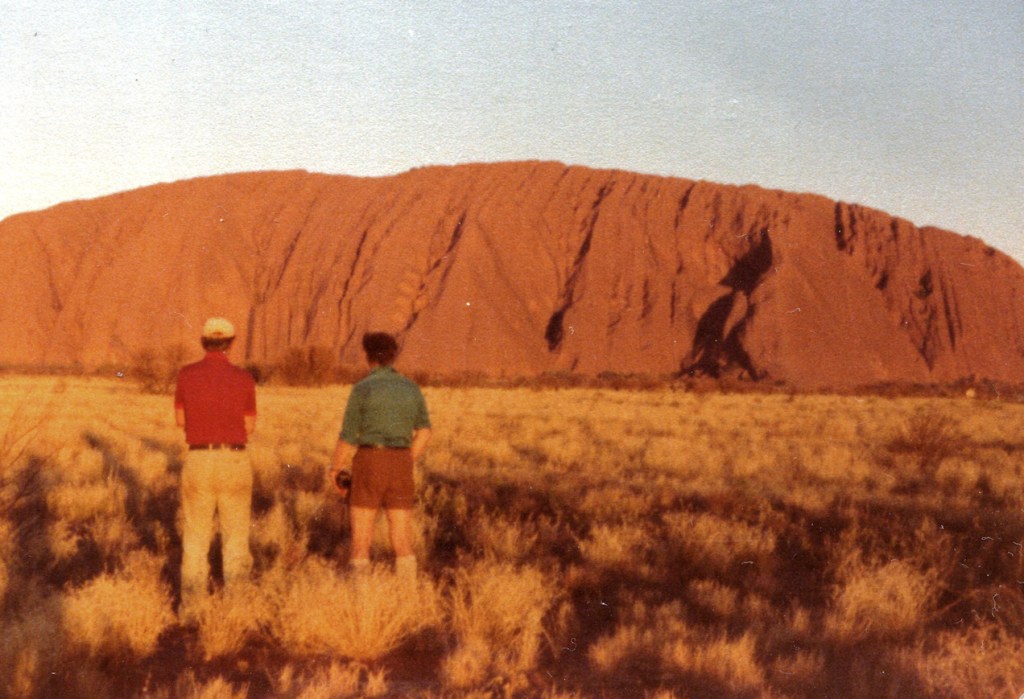
But contrary to Dad’s prediction, we did not meet Rick. I could not help thinking, this was not the first time as far as Rick was concerned. We’d already lost him in the sand dunes near Uluru. Almost.
Dad continued to search for his quart can. But that little friend Dad had cherished since the fifties, eluded him also.
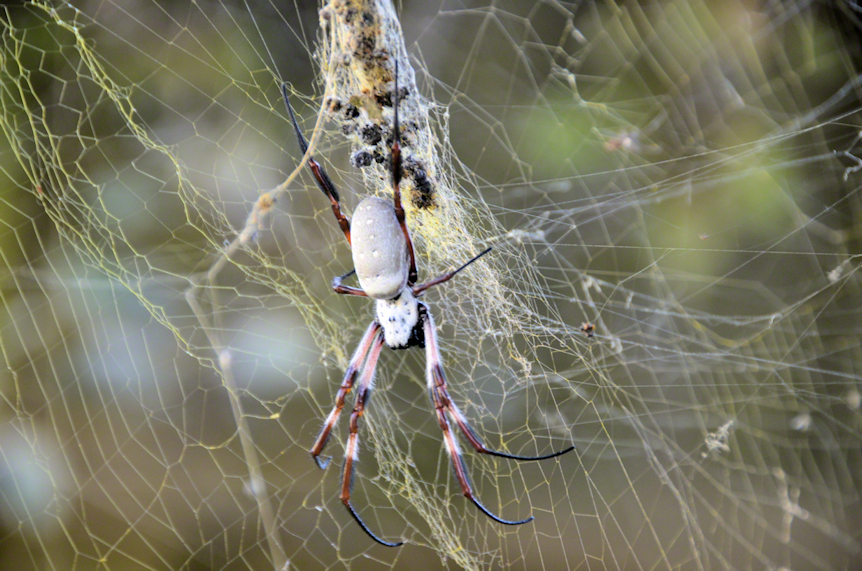
We weaved our way down the main gully for about an hour. A huge spider in a web spanning the width of the gully confronted us. The spider, the size of a small bird, appeared uninviting, so we backtracked and decided to hike up and down the ridges.
For several hours, we struggled over ridges. Up and down, we tramped, yet seemed to make little progress; the rise and dips went on forever. The sun sank low, and so did our water supplies.
The heat drained me. My tongue stuck to the roof of my mouth. But we had to ration water.
Dad slumped on a slab of rock at the bottom of a gully. ‘Drink?’
I took the canteen from him and filled my cup. Then I spooned in some Salvital. I chugged down the water as it fizzed. So refreshing!
‘Oh, Lee-Anne!’ Dad quibbled. ‘You didn’t leave much for me!’ He poured the last drops of water from his canteen into his mouth and gazed in despair at the lengthening shadows of the mountain.
‘Oh, but Dad! It’s not fair! We will never get out of this place! We are lost forever.’ I had visions of future hikers coming upon our dried-up old bones thirty years later. ‘What are we going to do?’
‘Well, um, perhaps we better pray God will help us.’ Dad bowed his head and clasped his hands. ‘Dear Lord, please help us find our way back to the truck. And forgive me for growling at Lee-Anne.’
‘Forgive me too. Help us not to run out of food and water, too.’
‘Bit late for that,’ Dad muttered. ‘Ah, well.’
We had barely finished praying, when an idea struck me. ‘Why don’t we climb up a ridge and walk along it. Surely if we go high enough, we’ll see the landmark and the land rover.’
‘Oh, I don’t know. We need to conserve our energy.’
‘Just one ridge won’t harm us.’
Dad sighed. ‘Okay, it’s worth a try.’
I raced up the hill and strode along the ridge. I climbed higher and higher. I glanced towards the east expecting, hoping, willing the Rover to appear. But with each stride, each hopeful gaze, nothing. I resolved to climb further up the slope before turning back.
After a few more steps, still nothing. With the heaviness of defeat, I turned to climb down. Then I saw it. The Land Rover sat at the base of the mountain, glistening in the last rays of the setting sun.
‘There it is!’ I jumped up and down over-reacting with excitement.
‘Praise the Lord!’ Dad’s shout echoed in the valley.
With renewed energy, we attacked the last mounds that lay between the vehicle and us.
‘Rick will probably be sitting there waiting for us wondering what has happened,’ Dad said puffing as we strode up to the land rover. ‘Can’t wait to have a few gallons of water.’
We rambled over to the rover. Dad circled the vehicle and returned to me shaking his head. ‘He’s not here.’
Been a busy week. I’m on holidays and the last week has been busier than ever.
So, capturing the memories of this find: The discovery of this “bushbaby” a baby possum that had survived the 1983 bush fires in the Adelaide Hills.
More on this story later…
“Bushbaby Survivor” painted in pastel, may be, in the next couple of weeks, exhibited at the Brews and Views cafe in the Marino Community Hall where my art group (Marion Art Group) meets for studio sessions every Monday morning.
Check out my art work page inTru-Kling Creations’Art Gallery.
Also you may like to view more of my art on Gallery247.
(c) Lee-Anne Marie Kling 2021
***
Or, if you miss the stories of Travel and Adventure in Central Australia…
Click on the link and download your kindle copy of my travel memoir,
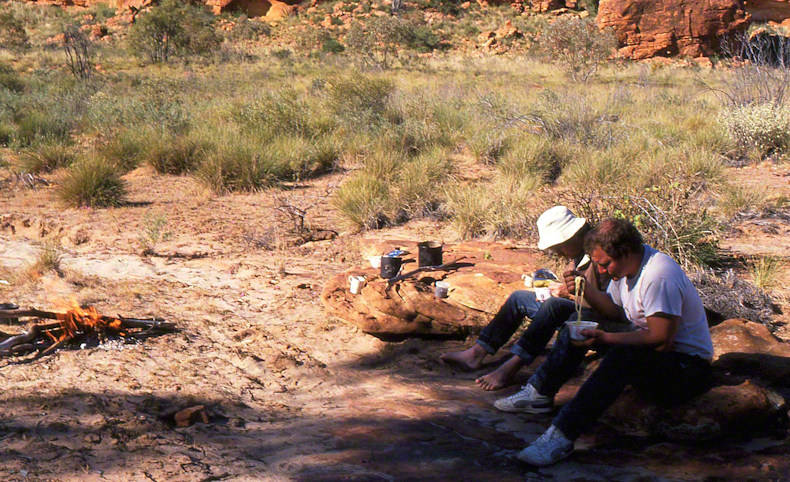
After relishing the sweet crunch of cornflakes for breakfast, the T-Team drove back to Ormiston Gorge. We hiked through the gorge admiring the red cliffs, ghost gums and mirror reflections in the waterholes, and took less than an hour to reach the end with the view of Mt. Giles, lumpy and sapphire blue.
Settling near a waterhole framed by reeds, Dad built up a fire on the coarse sand while our family friend, TR rolled up his trousers and dipped his toes in the pool. ‘Hey!’ He pointed and did a little dance. ‘A fish! I see a fish!’
Our cousins, C1 and C2 raced over to TR. ‘Where?’ They peered into the pond. I trailed after them, hunting for fish through the plumes of muddied water near TR’s white calves.
‘There!’ TR waved his finger at the middle of the waterhole.
C1 squinted. ‘Oh, yeah.’
C2 waded into the water and peered. ‘I don’t see anything.’
Richard hunted and fossicked through the cooking equipment Dad had scattered around the campfire. ‘You got a sieve? A net? Anything?’
‘What for?’ Dad asked.
‘The fish.’
‘Ah, you know, those fish can lay dormant in the dry creek bed for years and when the rain comes, they spawn.’ Dad just had to tell us.
‘Well, this little fishy is going to be our lunch.’ Richard snapped his fat fingers together like crab claws. ‘I’ll catch it with my hands if I have to.’ He strode into the pool with such force the waters parted like the Red Sea. ‘Now where’s that fish?’ He said as he sank up to his waist.
Richard glanced, his smile faded. ‘Oh, is that all? It’s just a piddley little thing. Not enough for lunch.’ He was neck deep in the water and prepared to swim. He shot up. ‘Ouch! Something bit me!’
‘Better watch out, might be Jaws,’ I said.
‘You didn’t tell me there were yabbies.’ Richard bobbed up and down, then reached down to catch his feet. ‘Ouch! It bit me again!’
‘Why not yabbies?’ C1 said.
‘Now that’s an idea.’ Richard replied.
‘Ah! Shrimp!’ C2 waded towards his cousin. ‘I love the taste of shrimp.’
‘Hmm, yabbies,’ Richard said. ‘We used to catch yabbies all the time when we were young.’ With an explosive splash, he submerged in search of the yabby that had bitten him.
Dad, TR and I waited for the damper scones to cook and watched Richard and C1 turn bottoms up like ducks in the water in their quest for yabbies. C2 waded in the shallows of the pond, a roughly sharpened stick in hand ready to skewer any hapless water-creature.
Soon we breathed in the sweet aroma of baked scones. Dad flipped the foil wrapped balls out of the coals. ‘Lunch is ready!’ He clustered the silver spheres together using a small branch as if they were balls on a snooker table. Empty-handed the lads dragged their soaked bodies from the waterhole and schlepped to the fire place to collect their consolation prize of damper scone.
Richard held his stubby index finger and thumb in the form of the letter “C”. ‘I was this close to getting a yabby.’
[While painting this scene of a group of older men gathering to admire the glowing walls of Standley Chasm, I was reminded of the T-Team’s trek in 1977 with Mr. B. This wealthy man used to comfort and luxury, took on the challenges of roughing it camping with the T-Team. This stunning chasm is about 50km west of Alice Springs and is one of the first of many beautiful sites to visit in the MacDonnell Ranges.]
Mr. B slowed the Rover and eased it into a park joining the line of cars, land rovers, and buses awaiting their owners’ return. The T-Team piled out of the Rover and in single-file, followed Dad along the narrow track heading towards Standley Chasm. In the twists and turns of the trail that hugged the dry creek bed, I spotted ferns in the shadow of rock mounds the colour of yellow ochre, and ghost gums sprouting out of russet walls of stone. Hikers marched past us returning to the car park.
A leisurely short stroll became a race to the finish as we struggled to keep up with Dad; scrambling over boulders on the track, squeezing past more tourists going to and from the chasm, Dad snapping and cracking the verbal whip, and Mr. B moaning and groaning that “it’s not for a sheep station”.
The crowd thickened, stranding us in a jam of people, fat bottoms wobbling, parents hauling their whinging kids, and men clutching cameras to their eyes for the perfect shot. Dad checked his watch and then shifted the weight from one foot to the other.
‘Are we there yet?’ I asked.
Wrong question. Especially when asking a grumpy Dad.
‘Not yet!’ Dad barked.
‘I reckon we’re not far away,’ I said. ‘All the tourists have stopped. Must be some reason.’
Dad screwed up his nose. ‘I dunno, it doesn’t look right.’
‘Excuse me! Excuse me!’ Mr. B, one arm stretched out before him, parted the sea of people and strode through.
We followed in Mr. B’s wake and within twenty paces, there it glowed. Standley Chasm. Both walls in hues of gold to ochre. Dozens of people milled around its base.
Then we waited. The tourists snapped their shots and then filtered away.
‘When’s it going to turn red?’ I asked for the fourth time.
‘Be patient,’ Dad said.
‘This is boring,’ Matt mumbled.
‘Let’s see what’s the other side.’ Richard tapped Matt on the arm. The two lads scrambled over the rocks and I watched them hop from one boulder to the next over a small waterhole.
Dad paced from one wall to the next while Mr. B photographed Standley Chasm from every angle.
I watched mesmerized by the sunlight playing on the walls. They turned from a russet-brown on one side, gold on the other, to both glowing a bright orange. But by then, most of the tourists had left, thinking the Chasm had finished its performance for the day.
Apologies for the week of the lost blog post. Been one of those weeks in one of those months (in our family the horror month filled with birthdays). Plus, I have spent the last week editing the MAG newsletter. Check out Marion Art Group’s website if you like.
Anyway, here’s a revisit to an old favourite of mine, Mount Liebig in Central Australia.
The Quart Can
[While Mr. B and his son, Matt stayed back at camp,
three of the T-Team faced the challenge of climbing Mt. Liebig.
Extract from The T-Team with Mr B: Central Australia 1977, a prequel to Trekking With the T-Team: Central Australian Safari 1981.]
Dad parked the Rover at the foot of Mount Liebig. ‘This will be our reference point,’ he said pointing to a rocky outcrop.
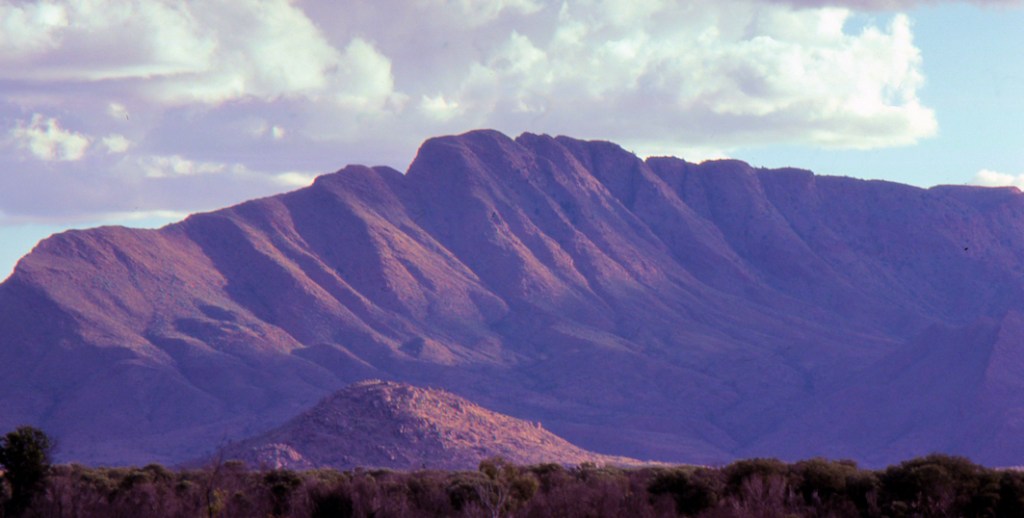
I took a photo of the mountain slopes bathed in deep orange reflecting the sunrise.
Dad hoisted the pack on his back and studied the peaks. ‘Now which one is the highest?’ He squinted. ‘I think it’s the one on the right, I’ll just check.’ He took out his binoculars and adjusted the focus. ‘Hmm, I think I see the trig.’ He lowered the binoculars. ‘Oh, yeah, you can see it without them.’
‘Where? Where?’ I grabbed the binoculars, and before I even lifted them to my eyes, I spotted the thin line on top of one of the peaks. I pointed. ‘Yeah, there it is.’ I gave the binoculars to Rick to look through.
‘Come on, we must get a wriggle on, or we’ll be hiking back in the dark,’ Dad said.
Dad’s dream to climb this mountain was to be fulfilled. Ever since he had lived and taught in Hermannsburg in the 1950’s, he had wanted to venture way out west, to conquer this mount which is 1274 metres (about 4179 feet) above sea level.
We commenced scaling the hills filled with prickly spinifex and scrambling down the valleys of loose rocks. We reached the gully leading to the peak in no time.
‘Hey, Dad, this is easy!’ I said. ‘We’ll be up and back to camp in no time.’
‘Oh, no!’ Dad moaned.
‘But, Dad, I thought you’d be pleased.’
Dad turned around and peered at the ridges we had traversed. ‘I’ve lost my quart can.’ He tottered down the slope, his gaze darting at every rock and tree. ‘I put it down to get something out of my back pack…now where did it go?’
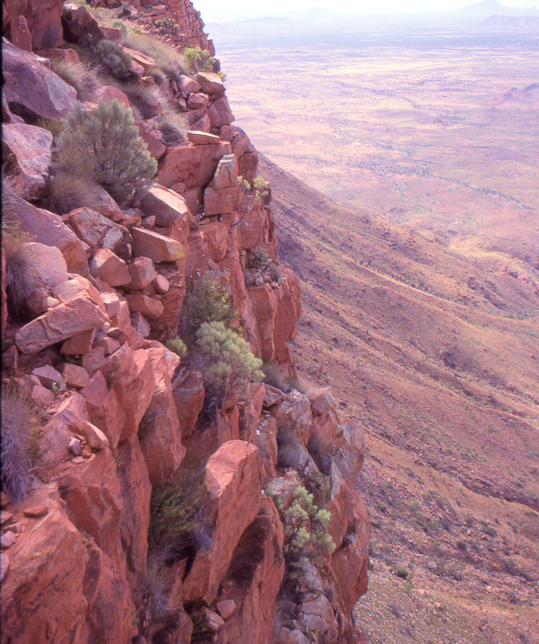
‘The other side of the slope is a two-thousand-foot drop,’ Dad remarked.
Rick and I contemplated this fact as we sucked slices of thirst-quenching lemon and gazed on the foothills sloping up to Mt. Liebig. These hills shaped like shark’s teeth, were a miniature replica of the mountain’s formation; slope on one side, and treacherous cliffs on the other. Lemons, though sour, actually tasted sweet.
Refreshed, we continued our plodding upwards. My shins ached from hiking up this steep incline. My ankles itched from spinifex needles lodged in them. And the growing number of boulders around which we had to manoeuvre, proved to be a challenge. But we pushed on.
Dad peered up at the eight-foot high rock wall. ‘Hmmm.’ He looked stumped.
‘Now what?’ I asked.
Each side of us was a wall of rock blocking our way. One side, lower than the others, led to the precipice Dad mentioned before.
After studying the walls, Rick grasped a few nooks, and then mounted the rocky barrier. He wriggled up a hollow cranny.
Dad and I waited.
The wind whistled through the gap.
‘I hope he’s alright,’ I said.
‘He’ll be fine,’ Dad replied.
‘I hope he doesn’t fall off the cliff.’
‘No, he’ll be fine. Stop worrying.’
Rick poked his head through the hole in the wall above us. ‘I’ve found a way to the top.’
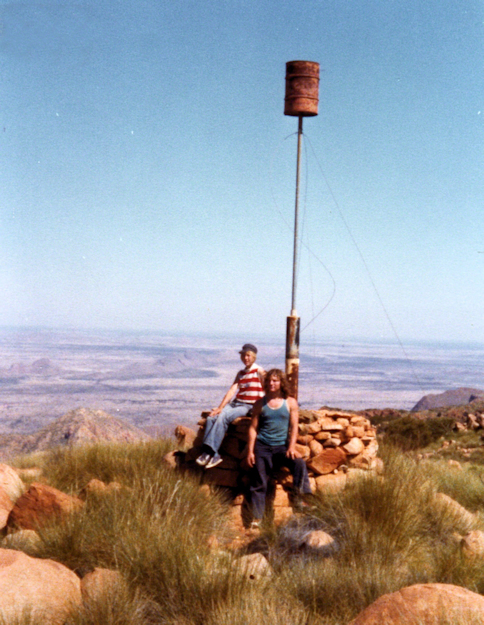
He then helped Dad and me up through the hole and led us through the labyrinth of a path between the boulders to the spinifex-covered mountaintop. A cairn of stones adorned with a rusty pole and barrel marked the summit.
‘Look at that,’ Dad said, ‘It’s only eleven thirty. Let’s stay here an hour and enjoy the view. We can have an early lunch.’
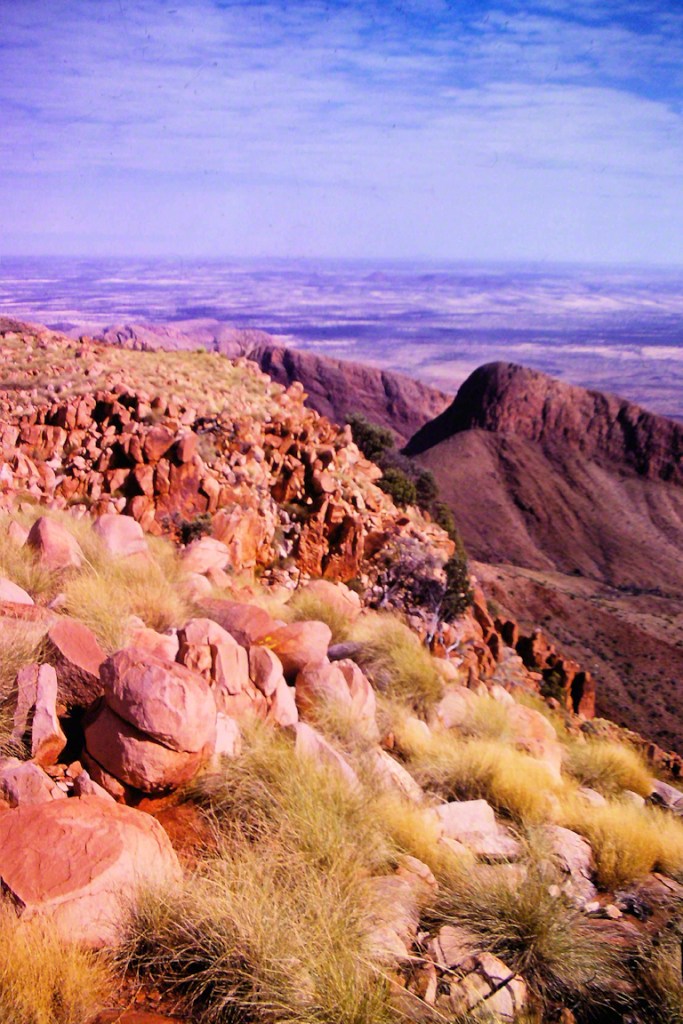
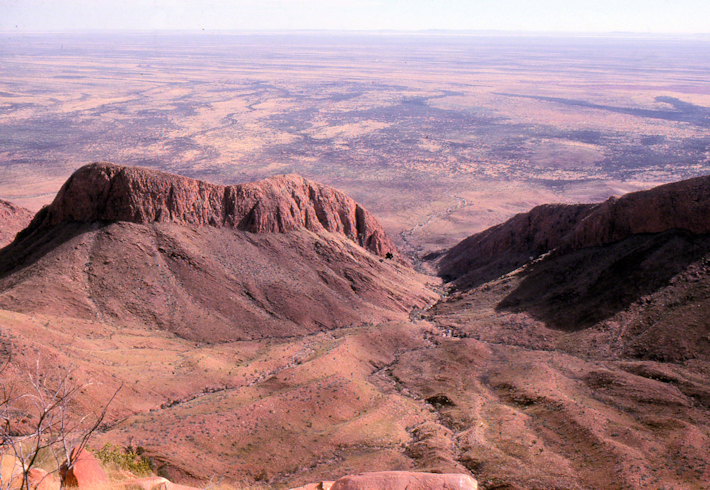
So, while enjoying our cheese and gherkin sandwiches, we sat on the cairn and feasted our eyes on the aerial view of the landscape below. The MacDonnell Ranges and Haasts Bluff far in the east were painted in hues of pink and mauve. And closer, south of the Liebig Range, Mt Palmer and her friends were clothed in shades of ochre. North, on the other side of Liebig, the land stretched out in waves of red sandy desert.
In a panic, I followed him, making sure I stayed a good distance from the cliff edge. ‘Rick? Are you alright?’ I peered down at the land below, the shrubs and trees seemed like dots. The sheer drop gave me the creeps. ‘Rick, are you still with us?’
Rick emerged from the other side of the bush. ‘Can’t you leave me to do my business in peace, Lee-Anne?’
‘Sorry.’
‘Hoy!’ Dad called.
We looked to see Dad waving at us.
‘Get back from the edge!’ Dad said. ‘We better get going. See if we can make it back to camp by two.’
We picked our way through the maze of boulders and climbed down into the gully. Rick, eager to reach the rover first, raced ahead. Dad stuck with me, offering his help as I negotiated my way down the gully.
After relishing the sweet crunch of cornflakes for breakfast, the T-Team drove back to Ormiston Gorge. We hiked through the gorge admiring the red cliffs, ghost gums and mirror reflections in the waterholes, and took less than an hour to reach the end with the view of Mt. Giles, lumpy and sapphire blue.
Settling near a waterhole framed by reeds, Dad built up a fire on the coarse sand while our family friend, TR rolled up his trousers and dipped his toes in the pool. ‘Hey!’ He pointed and did a little dance. ‘A fish! I see a fish!’
Our cousins, C1 and C2 raced over to TR. ‘Where?’ They peered into the pond. I trailed after them, hunting for fish through the plumes of muddied water near TR’s white calves.
‘There!’ TR waved his finger at the middle of the waterhole.
C1 squinted. ‘Oh, yeah.’
C2 waded into the water and peered. ‘I don’t see anything.’
Richard hunted and fossicked through the cooking equipment Dad had scattered around the campfire. ‘You got a sieve? A net? Anything?’
‘What for?’ Dad asked.
‘The fish.’
‘Ah, you know, those fish can lay dormant in the dry creek bed for years and when the rain comes, they spawn.’ Dad just had to tell us.
‘Well, this little fishy is going to be our lunch.’ Richard snapped his fat fingers together like crab claws. ‘I’ll catch it with my hands if I have to.’ He strode into the pool with such force the waters parted like the Red Sea. ‘Now where’s that fish?’ he said as he sank up to his waist.
Richard glanced, his smile faded. ‘Oh, is that all? It’s just a piddley little thing. Not enough for lunch.’ He was neck deep in the water and prepared to swim. He shot up. ‘Ouch! Something bit me!’
‘Better watch out, might be Jaws,’ I said.
‘You didn’t tell me there were yabbies.’ Richard bobbed up and down, then reached down to catch his feet. ‘Ouch! It bit me again!’
‘Why not yabbies?’ C1 said.
‘Now that’s an idea,’ Richard replied.
‘Ah! Shrimp!’ C2 waded towards his cousin. ‘I love the taste of shrimp.’
‘Hmm, yabbies,’ Richard said. ‘We used to catch yabbies all the time when we were young.’ With an explosive splash, he submerged in search of the yabby that had bitten him.
Dad, TR and I waited for the damper scones to cook and watched Richard and C1 turn bottoms up like ducks in the water in their quest for yabbies. C2 waded in the shallows of the pond, a roughly sharpened stick in hand ready to skewer any hapless water-creature.
Soon we breathed in the sweet aroma of baked scones. Dad flipped the foil wrapped balls out of the coals. ‘Lunch is ready!’ He clustered the silver spheres together using a small branch as if they were balls on a snooker table. Empty-handed the lads dragged their soaked bodies from the waterhole and schlepped to the fire place to collect their consolation prize of damper scone.
Richard held his stubby index finger and thumb in the form of the letter “C”. ‘I was this close to getting a yabby.’