Over the Easter break in 1986, Dad took my boyfriend (future husband) and me to the Gammon Ranges. Dad had gone there the previously with his photographer friend and he was keen to show us some of the scenic secrets these ranges held.
We bumped and rolled in Dad’s four-wheel drive Daihatsu down the track into the Gammon Ranges. We camped near Grindell’s Hut, backpackers’ accommodation. A murder-mystery from the early Twentieth Century involving the hut’s owner, spiced our discussion around the campfire that night. Then we set up a tent, for boyfriend, on the ground above the bank of the creek. I placed my bedding also above the creek under the stars. Dad opted for his “trillion-star” site underneath a river gum. No tent for him, either.
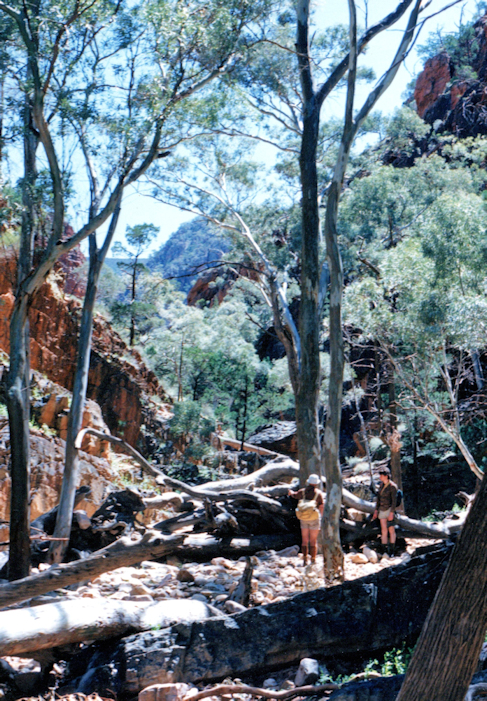
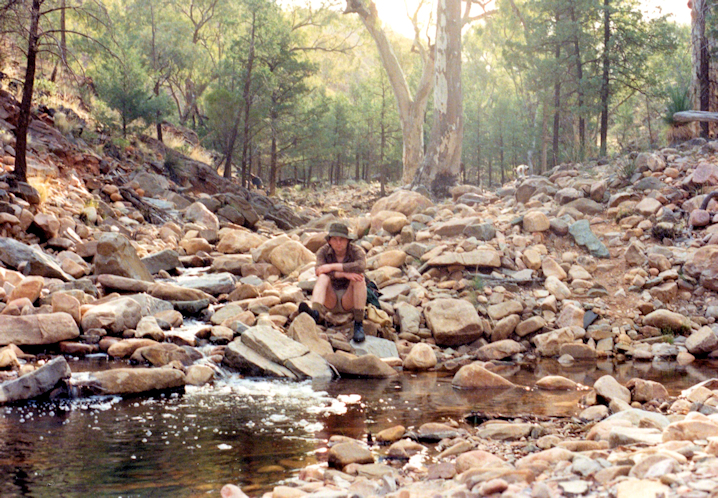
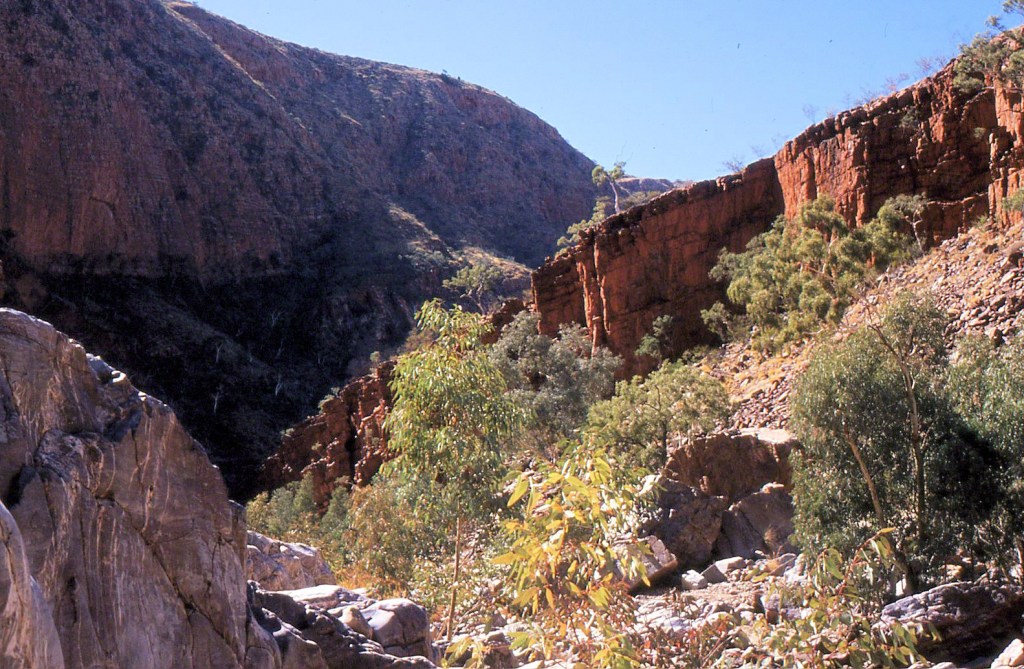
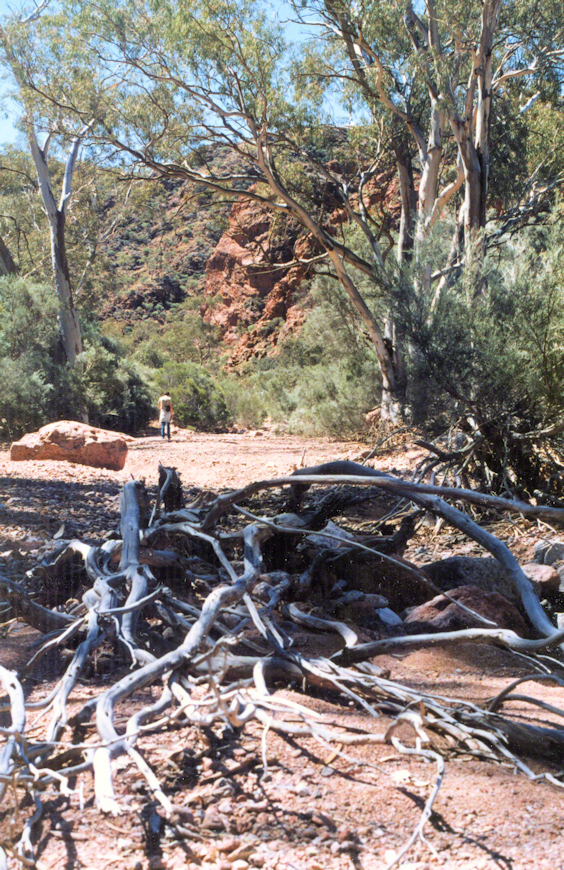
The next day Dad guided us along the Balcanoona creek bed shaded by native pines to Bunyip Chasm. After an hour or two of hobbling over rounded river stones, we arrived at a dead-end of high cliffs.
‘Come on, we better get back,’ Dad said and then started to hike back the way we came.
We trailed after Dad. Although native pine trees shaded our path, the hiking made me thirst for a waterhole in which to swim. I gazed up at the lacework of deep blue green against the sky and then, my boot caught on a rock. I stumbled. My ankle rolled and twisted. I cried out. ‘Wait!’
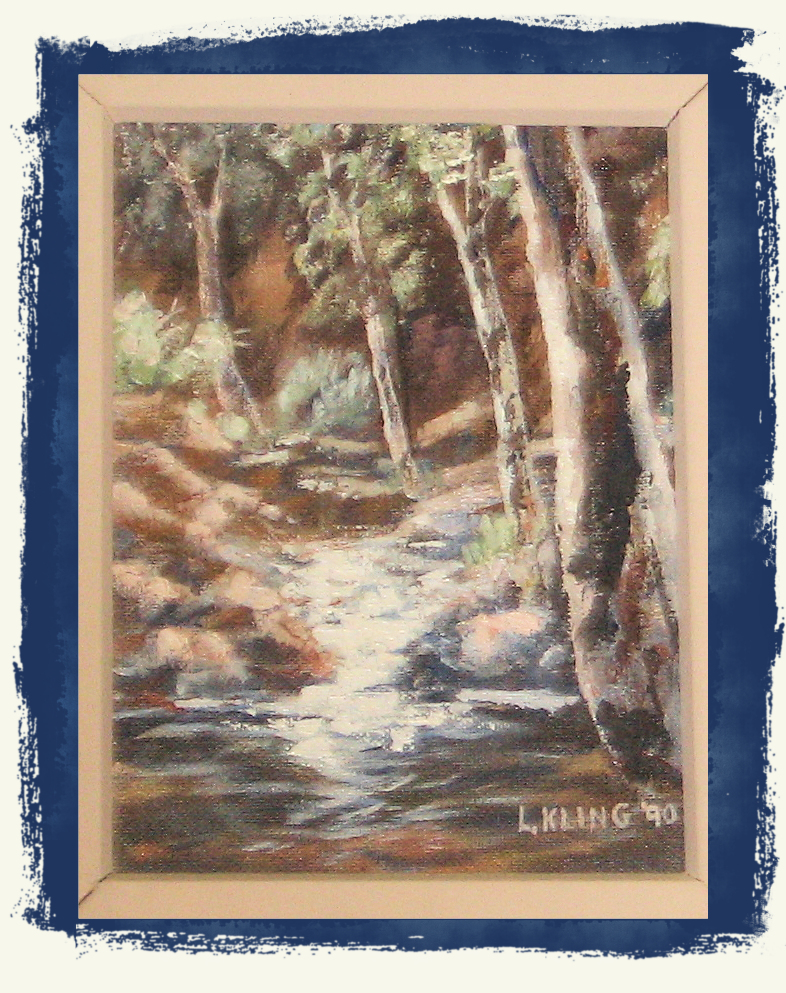
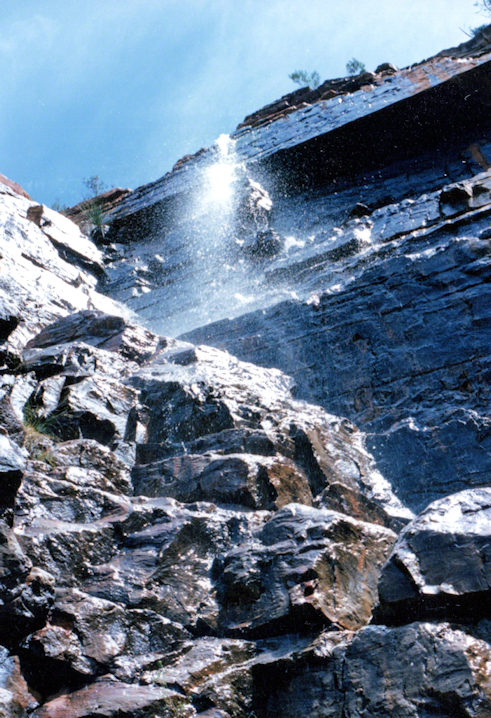
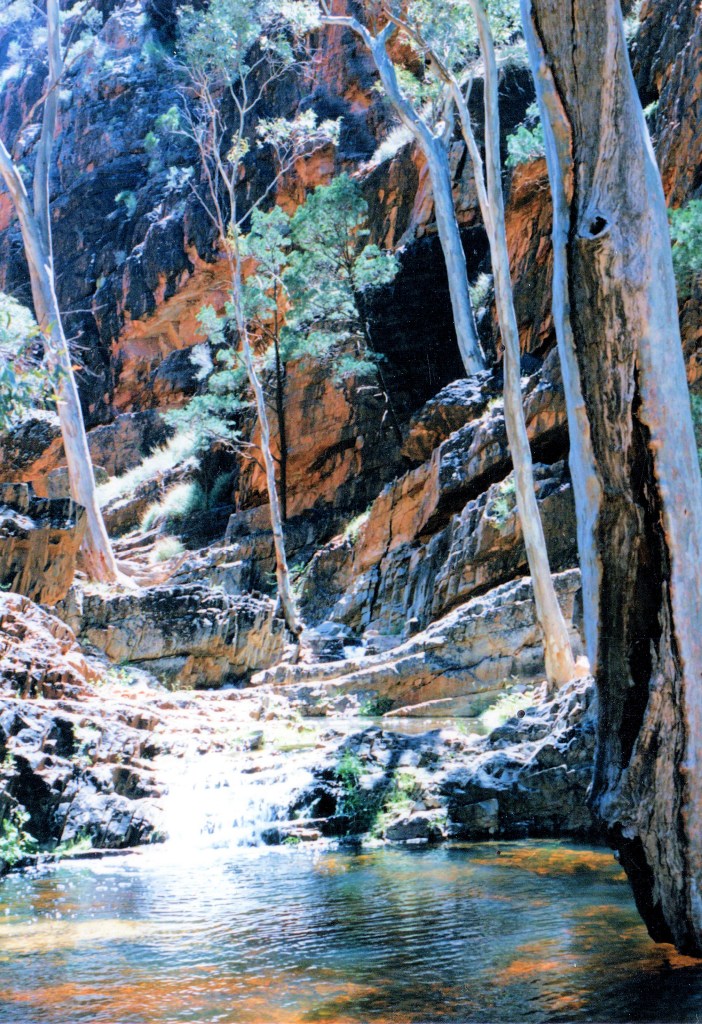
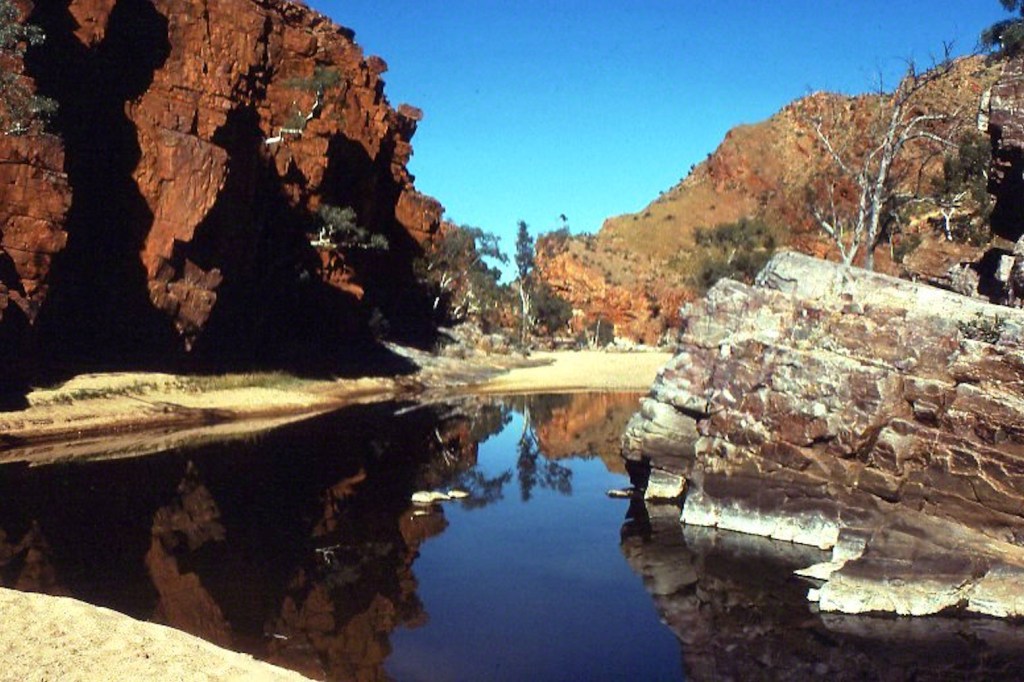
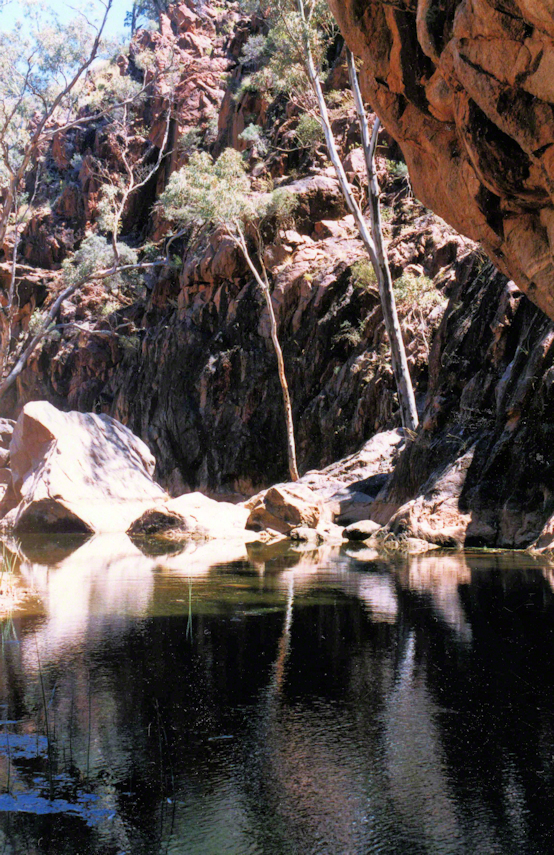
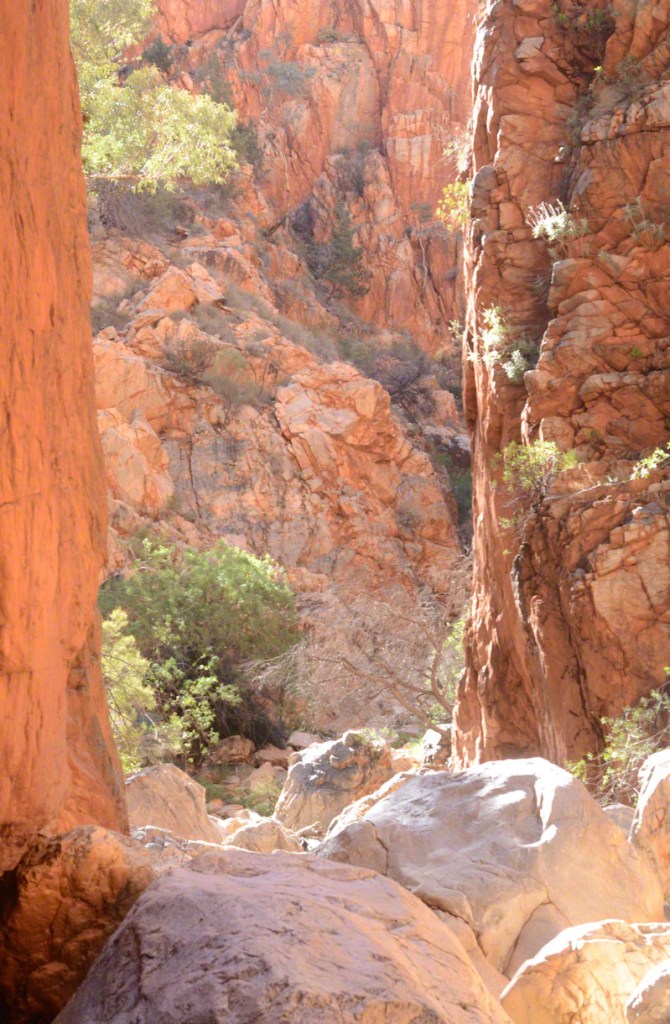
After about ten minutes, with my ankle still swollen and sore, I hobbled after the men. We climbed down a short waterfall and at the base, I looked back. The weathered trunk of an old gum tree leaned over the stream, three saplings basked in the late-afternoon sunlight against the sienna-coloured rocks, and clear water rushed and frothed over the cascading boulders and into pond mirroring the trees and rocks above.
‘Stop! Wait!’ I called to the men.
‘We have to keep on going,’ Dad said and disappeared into the distance.
Boyfriend waited while I aimed my camera at the perfect scene and snapped several shots.
Then holding hands, we hiked along the creek leading to our campsite and Dad.
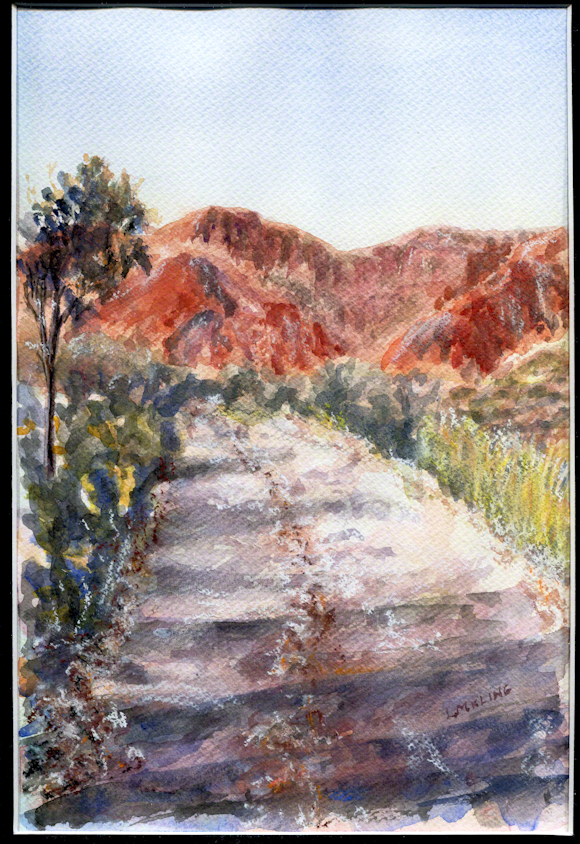
‘I’m going to paint that little waterfall,’ I said.
We walked in silence, enjoying the scenery painted just for us—the waves of pale river stones, the dappled sunlight through the pines, and a soft breeze kissing our skin.
The sun’s rays filtered through the dust motes of the church hall near the seaside. The air conditioner thrummed pumping out the sticky 40-degree Celsius heat that Monday afternoon in January.
Eloise Delaney unloaded her motley collection of watercolour palettes, colour-splattered former honey jars and 300-gsm paper framed with masking tape. She then arranged her brushes. Thick sable, round and soft, like the tip of her tabby cat, Spike’s tail. Great for that initial wash of sky, sea and sand.
She had lined up the thinner brushes in order of detail as the painting progressed. She stroked the finest brush, the one used for her flourish of a signature; the one more than 70-years old from her maternal grandfather’s collection salvaged after the bombing of his home in Nördlingen, Bavaria 1945. It was premium quality being made in Germany.
She sighed, ‘Must do this so nothing is lost.’
‘Talking to yourself already?’ a voice sang. ‘Sign of madness, ya know.’
‘Consequences of early retirement, I guess.’ Eloise laughed. ‘Least I had a social life when I was working.’
‘What do you call this?’ Eloise’s pear-shaped friend flicked a wiry lock of henna tinted hair from her freckled face. ‘Is this seat taken?’
‘Nah, go ahead. I could do with the company, Fi.’
Fifi settled herself on the plastic chair diagonally opposite Eloise, and after fumbling in her tote-bag, produced a mini flask. The thin mauve cannister wobbled on the newspaper that covered the trestle table. ‘I’m economising today; made my own brew.’
‘I’m celebrating,’ Eloise said and held up her takeaway cappuccino from the café down the road. ‘The “Rabbit hole” beareth fruit.’
Fifi pulled out her sketch pad, set of Derwent pencils and three scrunched up tissues. Then she leaned forward ‘What? Oh, your family history. Any noble? Kings and queens? Or, let me guess, some royal fruit from the other side of the royal bed?’
‘Well, actually, sort of…’ Eloise dipped her brush in the former honey pot full of water. ‘France, actually. And a bed of his ancestor’s made long, long ago.’
‘Well, I could have told you that, him being French, I mean.’ Fifi wiggled her generous behind on the chair, and then smoothed a fresh page of her sketchbook. ‘Do tell.’
El opened her mouth to spill forth all the juicy gossip about tracing her husband’s tree, a royal line stretching way back beyond Charlemagne and to Julius Caesar—all done without the help of DNA, but hours of research—when the leader stood and welcomed the small art group back from the holiday break.
Plus, there was that strange woman sitting behind them who was listening to every word El spoke. That woman, Sharon Katz, nicknamed Shatz, with the mouse-brown hair and the poisonous mushrooms (picked from the forest and dried) she foisted on El just before Christmas—insisted she take them. Lucky for El, her husband, Francis Renard, as a keen gardener and scientist, warned her of the dangers and she threw the suspect fungi into the bin. The next week, Shatz made a point of asking how El how she was feeling. All holidays El puzzled over Shatz. Had she had a run-in with this Shatz in times past while doing her duty as a police officer? Or was Shatz one of Francis’s former lovers?
‘Tell you another time,’ El whispered. ‘Probably should get Francis’ permission first.’
‘Oh, okay, then.’ Fifi sighed. ‘So, how was your Christmas?’
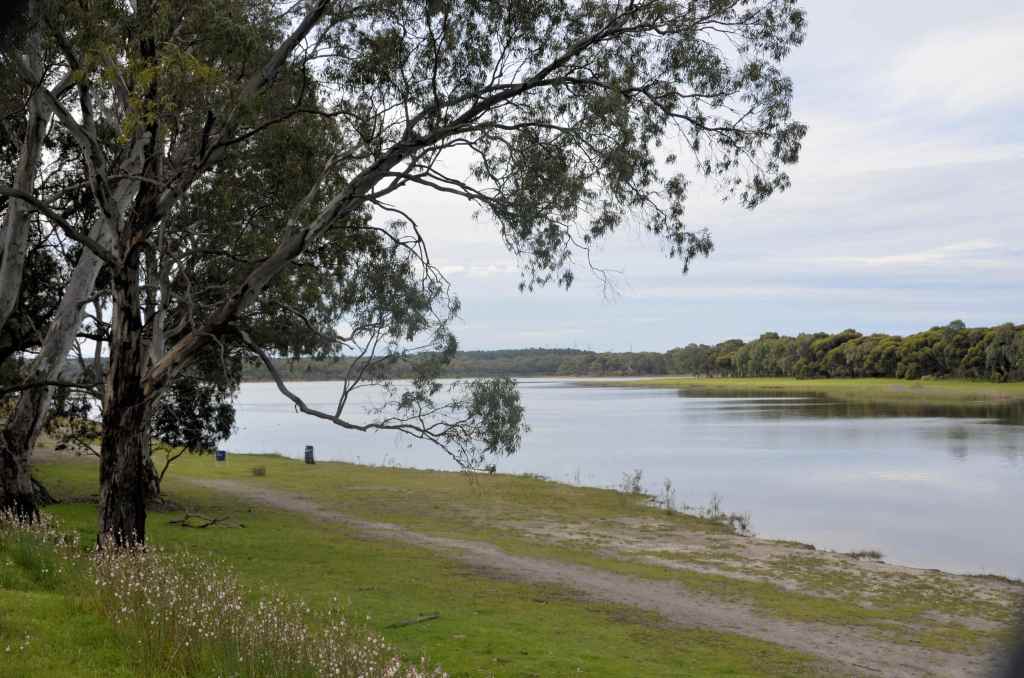
‘Meh! Glad it’s over for another year, Fi.’ Eloise smiled. ‘Francis and I had a quiet one on the actual day, then we all went to my cousin’s in Flagstaff Hill on Boxing Day. It was a disaster. You know, in the middle of Christmas lunch, which I might add, was leftovers from their Christmas day, someone, not mentioning any names, just had to bring up the latest controversy circulating on Fox News. Next thing, arguments all round. Renard and I left early and walked around the newly opened Happy Valley Reservoir. At least that part of Boxing Day was enjoyable.’
‘Well, my Christmas Day, thanks for asking, Eloise,’ Fifi’s lips tightened for a moment, ‘I don’t know why we bother and make such a fuss about the whole thing.’
‘Yeah, I know, the novelty wore off years ago. I just wish we could get back to the basics, the real meaning of Christmas and celebrate that.’
Fifi nodded. ‘Yeah, who needs another voucher? All we do is exchange money and vouchers these days. Where did the love go? Although, in my family, even with all those kids my parents had, there wasn’t much love.’
‘Really? I always envied your big family.’
Fifi sniffed. ‘If you really knew my family and what went on behind closed doors, you wouldn’t be envious.’
‘Why?’ Eloise may have been taking time out from her job as a detective, but she had not lost her inquisitive nature. ‘What went on behind closed doors?’
‘My dad, when he was around, was a pompous twat.’
‘How so?’ Eloise asked. She noticed Shatz, lifting her head, looking at them and listening again. Her curiosity annoyed El and she turned around and glared at the woman. Shatz dropped her eyes down to her sheet of paper and pretended to work on her pastel rendition of a bullfrog.
Shatz’s eavesdropping didn’t bother Fifi who continued, ‘He was hard on us kids. If we did the slightest thing wrong, he’d thrash us. Typical of his generation and background, European, you see. He thought you hit kids into submission. And, as for girls, they were to be seen, but not heard. He treated us girls like slaves.’ Fifi thumped the table. ‘I hated him.’
Fifi’s cannister of coffee toppled from the table and rolled on the floor.
Shatz picked up the cannister and handed it back to Fifi. ‘My dad was the same,’ she said before El’s frown drove her back to her seat to resume painting.
El then said, ‘He didn’t mellow in his old age?’
‘He left and…’ Fifi paused, ‘…and I was glad. Life improved after he was gone.’
Eloise studied Fifi and the freckles that danced on her face as her eyes blinked and her mouth twitched. ‘I sense that your father did more than just leave, Fi.’
Fifi’s eyes widened. ‘How did you know that?’
‘Part of the job, Fi. So, what did he really do?’
‘It was the strangest thing, Eloise.’ Fifi took a deep breath. ‘One day, my friend Lillie, and Jimmy my brother and I went for a hike up to Mount Lofty. On the way down, we did a bit of exploring. I can’t remember whose idea it was. Anyway, I go looking at this culvert. I had in mind that this hole in the side of the hill could be some disused mine and that I could find gold there. But, when I go down there, I see this body. Just bones and leathery skin over the bones like…but I recognised the boots. Those boots. I had lost count of the times those boots had kicked me…I knew it was my dad. But at the same time, I didn’t want it to be true. I just hoped they, whoever they were, were somebody else with the same type of boots.’
‘Oh, right, when was that?’ Eloise had turned over her paper and had begun to take notes with a piece of charcoal. ‘How long ago, did you say?’
‘Over forty years.’ Fifi replied softly. ‘He’s been gone since January 1978.’
‘Forty-four—exactly.’
‘How did he end up in a ditch? Near an old mine?’
Fifi shrugged. ‘Not sure, but he had enemies.’
‘I see.’
‘You see, we did report it to the police. But nothing happened. Forty years, and nothing. I mean, I know he was a creep and often rubbed people up the wrong way, but he was still my dad. And I just wanted to…you know, find out why he ended up there. Why anyone would. Dead. And no one seems to care.’
Silence for a few minutes. Fifi sipped her coffee while Eloise studied her notes. The happy chatter from fellow artists provided background noise. The air conditioner continued to thrum.
‘Mm,’ Shatz began in a soft voice, ‘my brother was killed in a motorbike…’
El turned and narrowed her eyes at Shatz. Was this woman trying to get attention? she thought.
‘Sorry,’ Shatz said. ‘But I knew Mr. Edwards, he was a real…’
‘Well, of course you did,’ Fifi huffed, ‘we went to the same church, remember?’
‘Never mind, sorry,’ Shatz mumbled.
Another pause.
After the pause, Eloise looked up. ‘Would you like me to follow this up?’
‘I don’t know.’ Fifi wiped her eye. ‘I guess. But isn’t it a bit awkward for you now that you’re…?’
‘No trouble. I can call Dan, my partner, or should I say, my ex, or whatever he is now that I’m on leave. I can still use the phone.’
‘Thanks.’
‘I’ll see what I can do. No promises. But it’s worth a try, don’t you think?’
The rest of the afternoon, Eloise and Fifi occupied their thoughts with painting and sketching. The cheerful chatter of the other artists continued, none the wiser of Fifi’s loss and childhood trauma. Except for Shatz. El wished that woman who attempted to poison her wouldn’t be so nosey and would mind her own business.
The air conditioner kept on thrumming until the rush for pack up and departure. Then as the last person locked up the building, they turned off the infernal humming machine and the heat of late afternoon in Adelaide seeped into the empty hall.
Christmas Holidays are approaching. For me it’s been party time this week. One party after another, especially yesterday with three parties, all in one day. I’m hoping that once the rush and busyness is over, I can rest, relax and start planning our next holiday. Perhaps it’s the same for you.
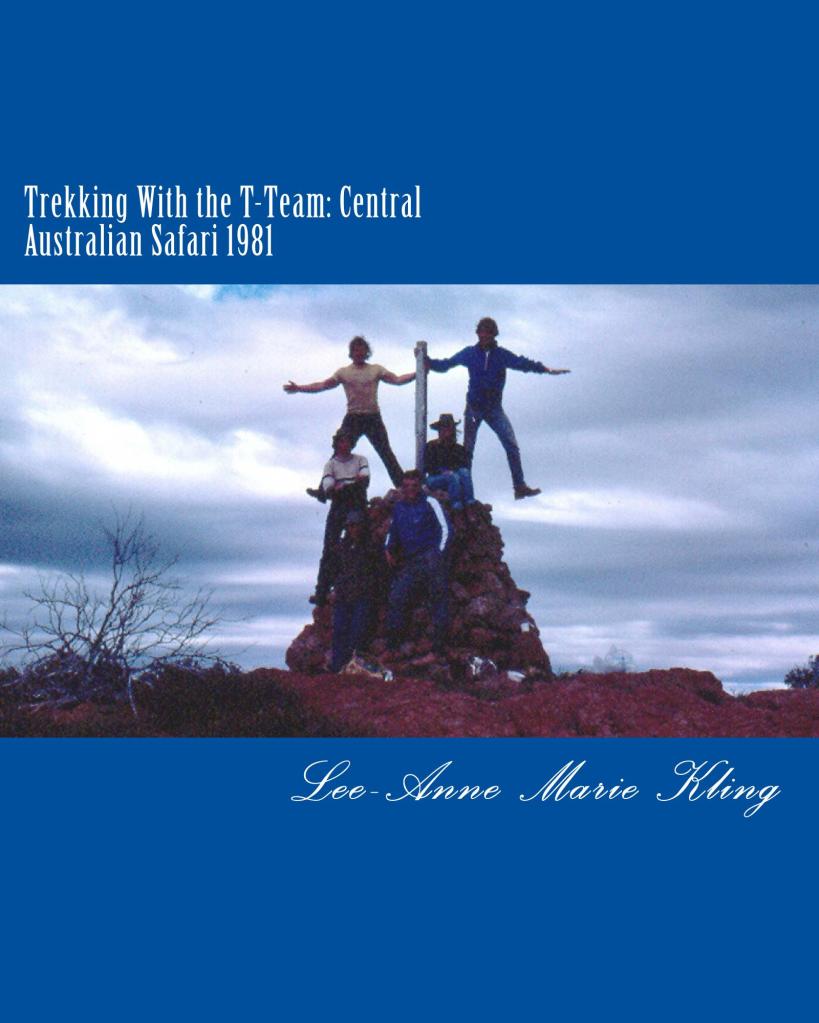
In the meantime, here’s a revisit to Central Australia and the T-Team. This time when my brother and I became lost on our descent from Mt. Giles.
In this episode, the T-Team valiantly explore as many gorges in the MacDonnell Ranges as they can…in one afternoon. The challenge, avoid the crowds of tourists while keeping Mr. B entertained.
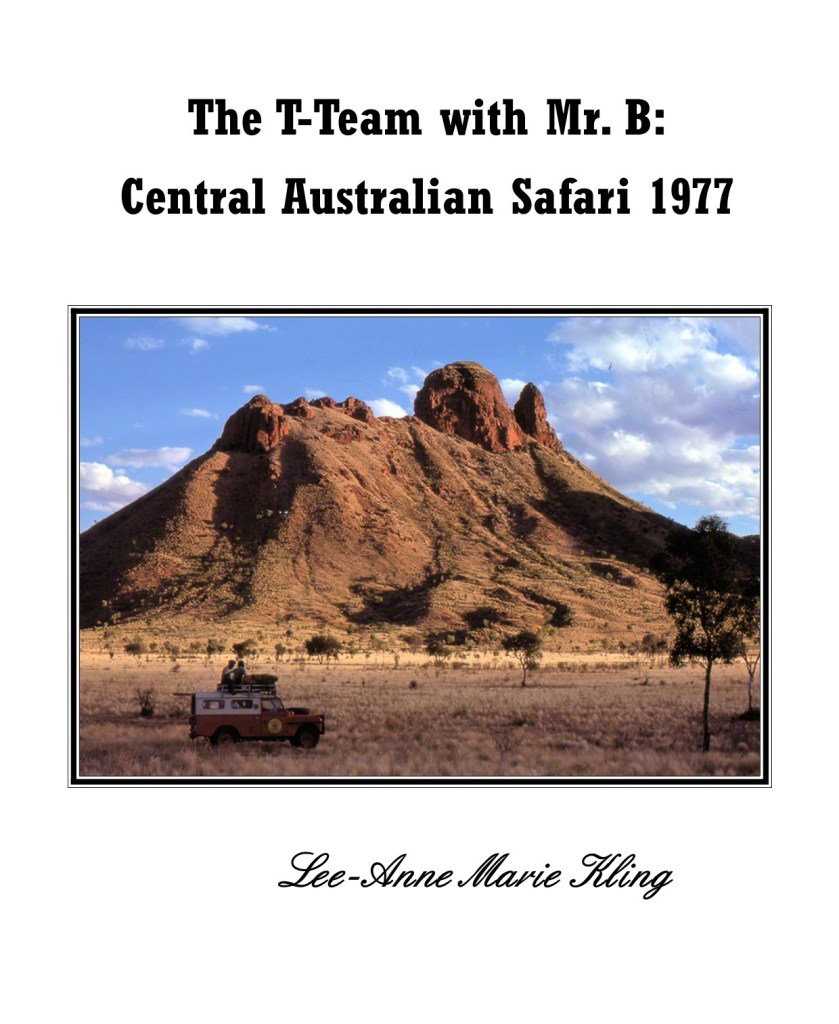
The T-Team with Mr B — In 1977 Dad’s friend Mr Banks and his son, Matt (not their real names), joined Dad, my brother (Rick) and me on this journey of adventure. I guess Dad had some reservations how I would cope… But it soon became clear that the question was, how would Mr B who was used to a life of luxury cope? And how many times would my brother lose his way in the bush?]
With our two Indigenous guides, Dad drove the Rover along the rough dirt track (probably a “short cut”) to the road that parallels the MacDonnell Ranges, Namatjira Drive. These days, the main roads are sealed, but not back then. Dust billowed into the cabin as we drove on a road that parallels the MacDonnell Ranges.
Mr. B frowned. ‘Just long enough to take a few snaps like the tourists, I expect.’
‘You sure you don’t want to start at Serpentine to our right? We could hike up while the morning’s still cool.’
‘What morning? It’s already past noon.’ Mr. B flicked his map flat. ‘Ellery Creek, I say, for lunch.’
Dad sighed, ‘Very well, then, Ellery Creek.’
Ellery Creek
After lumbering along the wider but corrugated road, Dad turned into the barely discernable trail that led to Ellery Creek. After entering the clearing for parking, we hunted for a car park. Not an easy feat as the car park was full; even the spaces in between swarmed with tourists.
Dad squeezed the Rover into what seemed the last remaining gap, and the T-Team piled out.
As he turned the Rover left so heading east towards Alice Springs, Dad smiled. Mr. B pouted and folded the map. He insisted we have lunch before we start on the hike up the gorge. Dad went one better announcing that, since it was Sunday, we’d have lunch AND a Sunday Service.
Mr. B’s response was to shake his head and mumble something not-so-polite into his red dust-stained handkerchief.
Serpentine Gorge
Less populated, Serpentine Gorge begged to be explored. Our Indigenous guides were not interested in joining us, so we bravely set off on our own adventure. To get to the narrowest part of the gorge, we had to cross a deep pool of water on our air mattresses and then walk along a rocky creek barefoot. We had forgotten to bring our shoes. Not that it concerned the men, they raced ahead leaving me behind hobbling on tender feet over sharp stones.
Then, disaster. Mud and slime replaced jagged rocks. In the shadows of gorge, I trotted on the path near creek. My heel struck a slippery puddle lurking by a pool of sludge. Next, I skated, feet flew from under me, and I landed bottom-first in the murky depths of the Serpentine Creek.
‘Ah, well,’ Dad sighed. ‘We better get back to the Rover. We need to find camp before it’s dark.’
As we hobbled back in the fading light, I mumbled, ‘Sure it’s not dark already?’
Other Gorges for Another Day
Dad endeavoured to distract me from my discomfort with descriptions of the many other gorges in the MacDonnell Ranges and tales of adventures exploring them. His stories whetted my appetite to view these wonders myself one day, on this trip, or perhaps in future journeys to Central Australia.
Virtual Trekking Behind the Art: Ocean Beach Tasmania
[This week Adelaide has endured a dramatic start to winter. After a beautiful warm weekend, storms descended upon the city with a bang of rolling thunder and constant flashes of lightning early Wednesday morning. Then the rain like an apocalyptic flood dumped on us. I walked to the bathroom and felt a damp patch on the carpet. Oh, dear, the roof is leaking …again! Still nothing like the church where I go for Bible Study. Arrived there to find the whole foyer flooded and mopping up in operation. The ceiling had collapsed under the weight of a leaking roof and had the heavens descended. Fortunately, there were still dry areas to meet. Then, that afternoon, after Writers’ group, my friend and I began our trip home in sunshine. But, ten minutes into the journey, hail pummeled my car. We quickly sought some refuge under a tree until the hailstorm passed.
So, seeking respite from the rugged week, here’s an old piece of calm from our Tasmanian travels.]
Calm on Ocean Beach
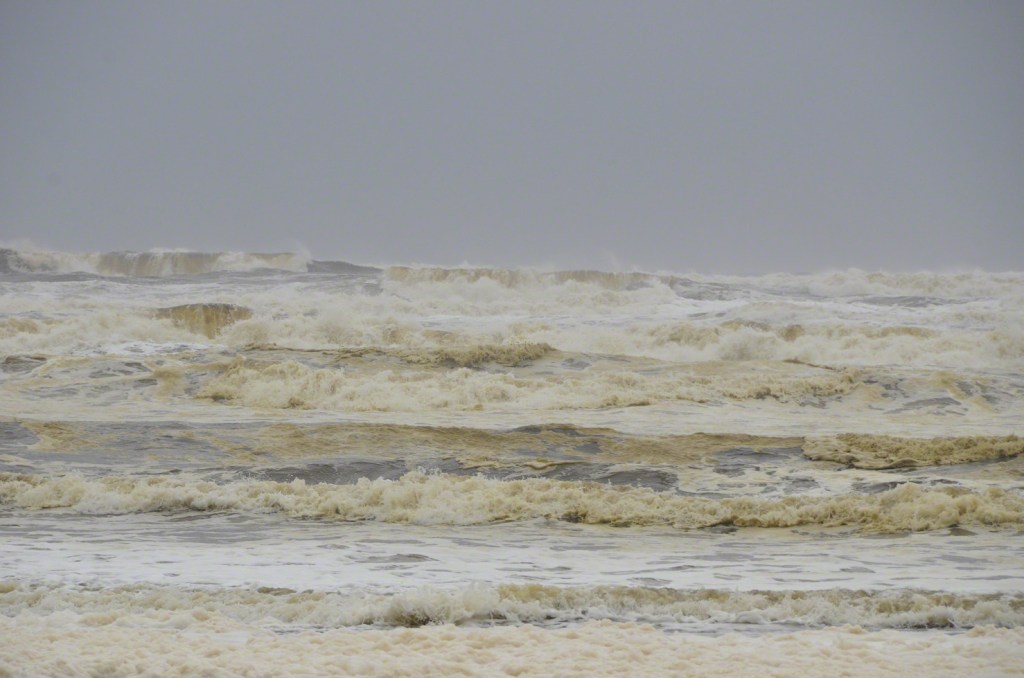
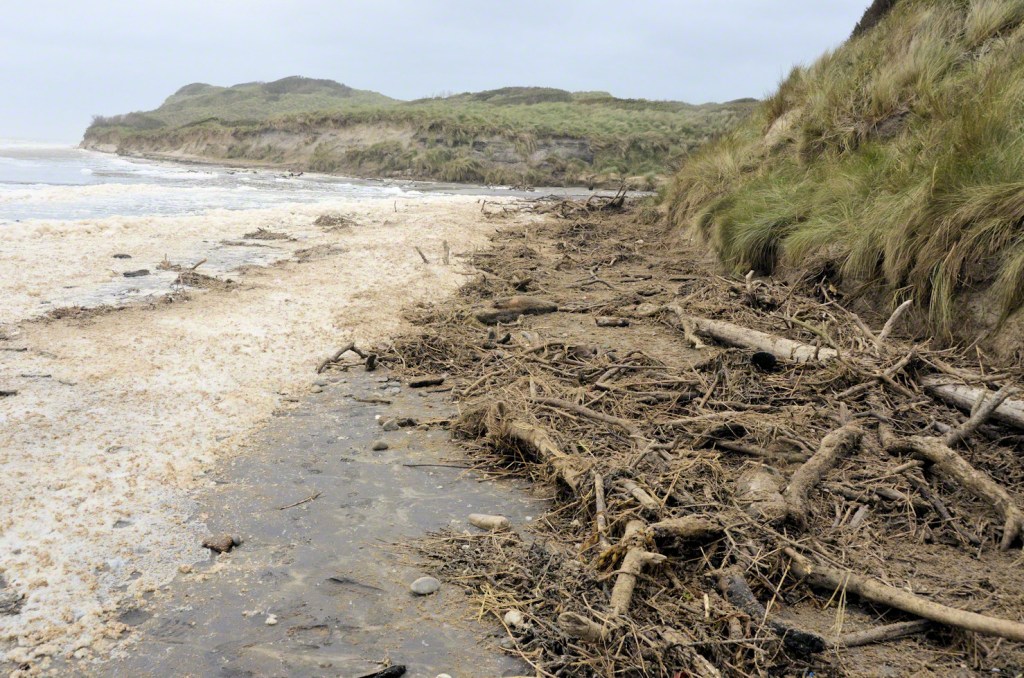
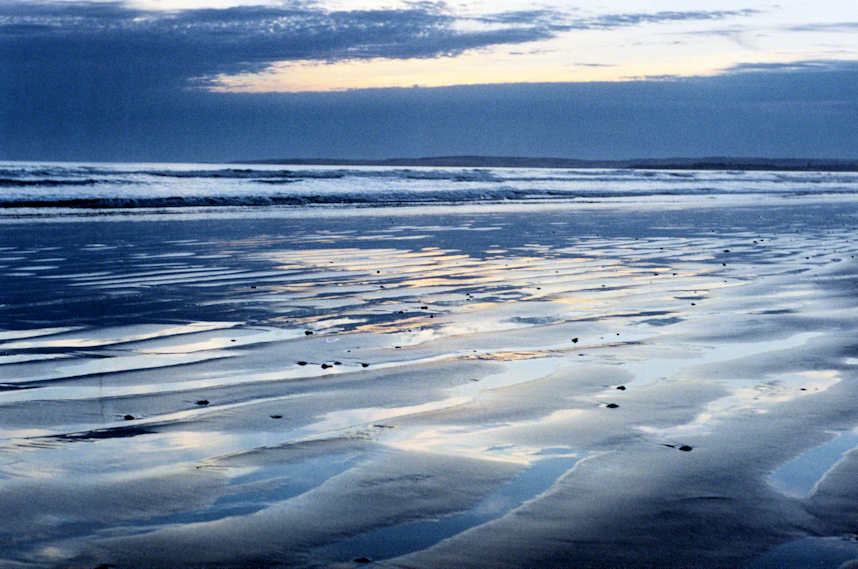
Ocean Beach lies on the West Coast of Tasmania near Strahan. The wild winds of the roaring forties (between the 40-and 50-degrees latitude) attack the coast with relentless ferocity.
In 2001 I visited Ocean Beach with my family to see the mutton birds coming home to roost for the night. I had barely stepped out of the car before the biting cold wind blasted me and I made a hasty retreat back into the car. No view of mutton birds that evening. Result, no photos.
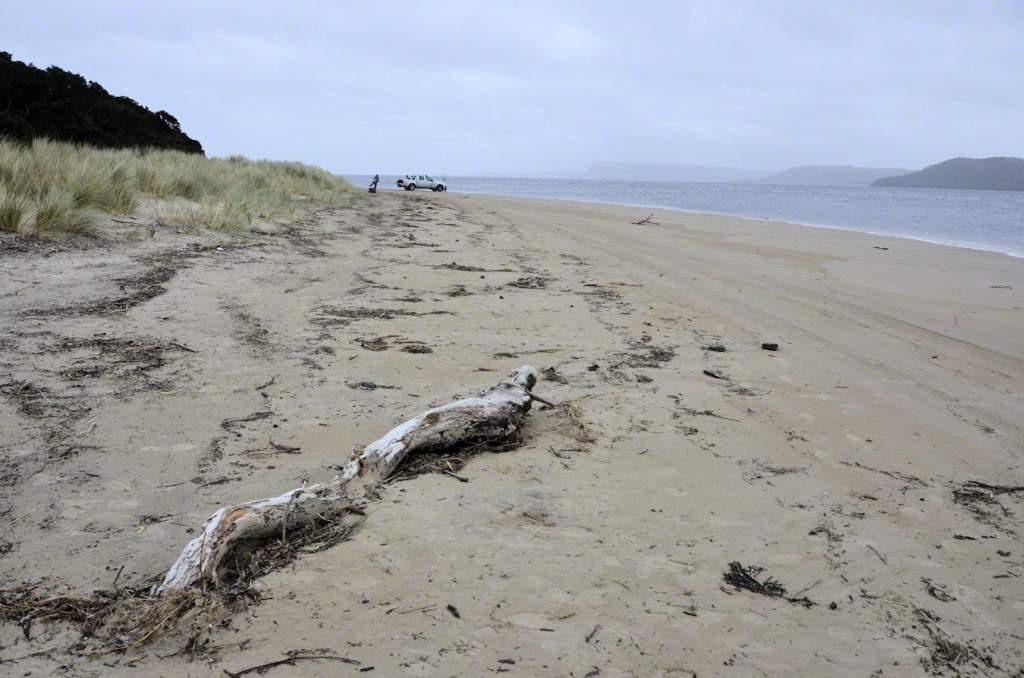
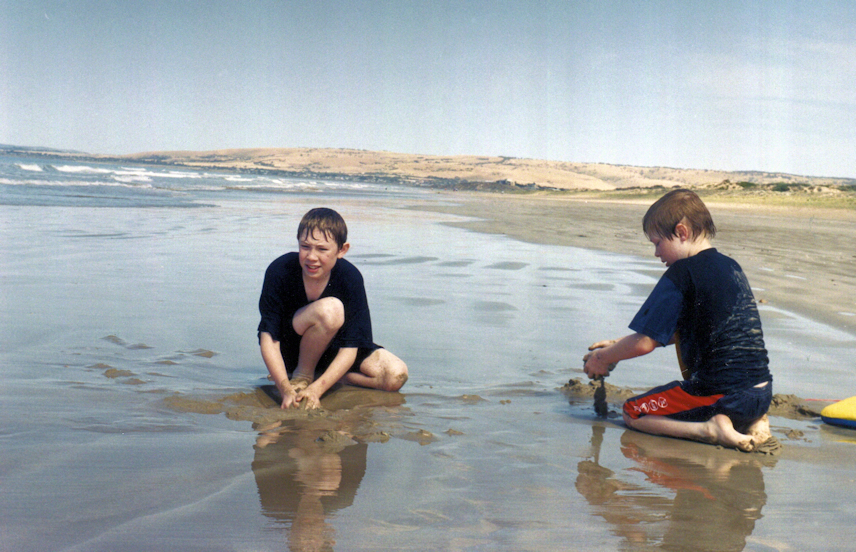
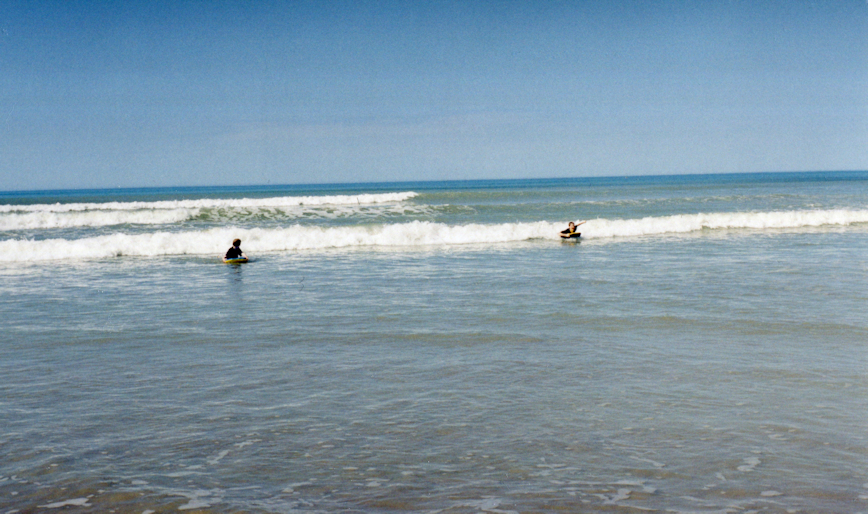
Ten years later, my mum and I visited Ocean Beach. While the East Coast was inundated with floods, Ocean Beach that afternoon was calm. We explored the beach, taking many photos of this rare state of the beach.
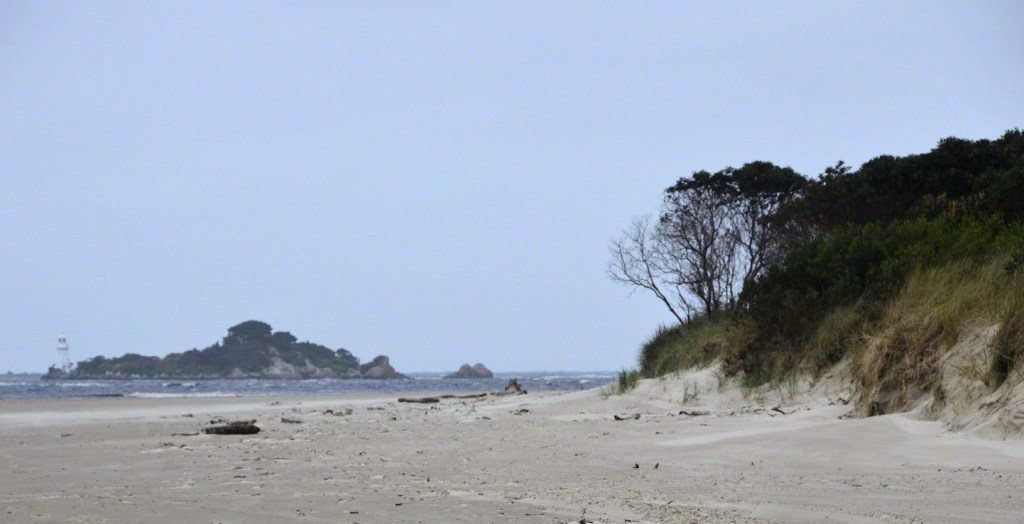
October 2016, the K-Team ventured onto the sands of Ocean Beach on perhaps a not-so-calm day; calm enough though, that we were able to walk along the beach. Not being satisfied with just an obligatory few metres up and down, my husband led us way up the estuary where we spotted a variety of birds, some fishermen, and the lighthouse sitting out there near the heads. Gotta get our money’s worth. After all, he’d seen the potential from the dizzy distance of the cruise boat as it sailed past the heads of Macquarie Harbour. I think if we’d allowed him, we’d still be walking along the coast somewhere around Tasmania.
[I have been preparing The T-Team withMr B: Central Australia 1977 to be ready for publication soon. So, below is an extract from the T-Team’s adventure.
While three of the T-Team faced the perils of climbing Mt. Liebig, a drama of a different, yet equally challenging kind unfolded for Mr. B and his son, Matt as they stayed back at camp.
Mr. B and his son, Matt napped under the shade of a bean tree. A southerly breeze ferried through the dry creek bed, spiriting away the father’s snorts. Matt tossed and turned on his inflatable mattress that was exhausted of air resulting from a small, elusive puncture. He imagined the three others of the T-Team, beating a path through the sweltering heat and stinging spinifex in their quest to the summit of Mt. Liebig. Matt chuckled to himself. “Suckers!”
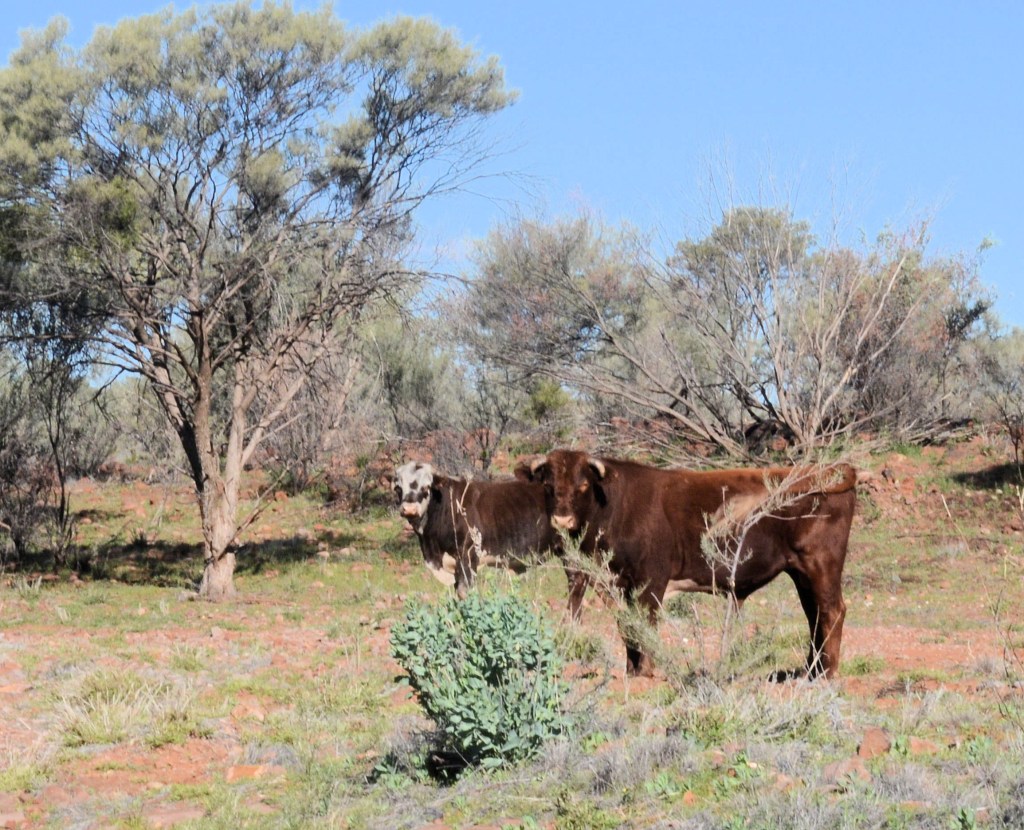
In a nearby tributary, a bull spied the T-Team’s father, son and daughter trekking in the distance, and stamped its massive hooves in the loose dry sand. Once the family had vanished, the bull trotted towards his stamping ground which possessed a gigantic bean tree as a feature in an otherwise dull bed of dust. His quest was to reclaim his territory that the humans had invaded.
“Matt, ma boy, do be careful. Don’t go too far from camp. A bull might get you.” Mr. B squinted in the direction of distant thumping, then rolled over and resumed snoring.
A monstrous brown hulk loomed through a cloud of dust.
Matt bolted upright “Dad! Dad! Th-there’s a big- ugly- brown – ugly- big – brown – ugly – b-b-bull!”
“Aw, Matt, stop kidding me.” Mr. B blinked and rubbed his eyes. “That’s enough of the jokes.” A short rumble from behind sent him scrambling to his feet. He flailed his arms while galloping. “Quick! Into the Rover. Now!”
“But Dad!” In the sweltering heat and moment, the boy froze, glued to his air mattress under the bean tree. Terrified, he witnessed his Dad bound over the dirt and fly into the empty Rover parking space and onto a thicket of spinifex. Matt winced. The massif of angry brown trod closer. It paused, pawing the ground, taunting its human prey.
After rubbing his punctured behind, Mr. B scrambled for the tarpaulin and rummaged through the baggage. “Er, d-don’t worry Matt. I-I’ll charge this bull before it s-sh-shoots — er — us.”
“But, Dad, the bull doesn’t have a gun.”
“Well, neither do we, we’ll just have to be satisfied with this boomerang and spear, till I find the damn gun.”
The bull stalked, narrowing the gap. The son clambered up the tree and gasped as his father fought with a rucksack that had entangled his legs, while he waved the pathetic weapons above his head.
“Why Matt, how can you say such a thing? Where do you think these genuine Australian artefacts are made?” With all his effort, Mr. B thrust the spear at the beast.
“Yes, Dad, sold in Australia, but made in China.” Matt watched as the menacing bulk of fury stomped the ground, dust billowing into a cloud around it. “Too bad the bull doesn’t know the difference.”
“Don’t be sarcastic at a time of crisis, son.” Mr. B flung the boomerang at the charging bull and ducked behind the tucker box. The projectile bounced off the bull’s hide, provoking it into a tumult of frenzy. Grunting like an eight-cylinder engine, he stormed towards its human attacker, screeching to a halt at the edge of the tarpaulin. As the bull glared down at him, Mr. B could smell its leathery breath.
With a nervous smile fixed on his face, the father edged his way to the bean tree and climbed aboard. The bull stomped and snorted around the sacred bean tree while its victims trembled in the lofty branches amongst the beans.
From this vantage point, Mr. B spotted the rifle leaning up against the tucker box. Unfortunately, the bull sat between him in the tree and the tucker box.
Hours passed.
Father and son sat in the tree.
“Dad my bottom hurts,” Matt whined.
Mr. B sighed, “The others’ll be back soon. They have a rifle.”
“But Dad! I have to go!”
“Hold on,” Mr. B snapped.
The sun edged to the horizon.
Mr. B bit his lip wondering if he’d be stuck up this tree forever.
“Dad! I really have to!”
Mr. B turned to his son who was now rocking.
The distant hum rang through the golden landscape. Mr. B adjusted his grip on the branch.
The hum became louder. An engine.
The bull rose and sauntered out of the campsite, then disappeared into the bush.
“Just wait, Matt,” Mr. B said. He scrambled down the tree and grabbed the rifle.
Matt’s voice floated down. “Dad, it’s too late.”
As the sun disappeared below the horizon, the rest of the T-Team returned to find Mr. B clutching a rifle and pacing the clearing. Matt remained lodged high up in the bean tree.
“As you can see, while you’ve been climbing your mountain, we’ve had a not-so-welcome visitor,” Mr. B remarked.
The pinnacle of the K-T-Y’s (K-Team, the Younger) road trip around Tasmania was Cradle Mountain. I might add here that we’d abandoned my husband (Hubby)in Poatina on a Christian Leaders Training course, while I chauffeured the younger members of our family to the scenic sights in the Central Highlands and East Coast.
So, Sunday January 18, 2009, with Cradle Mountain National Park our goal, we drove the hills, dales, twists and turns. And we fended off near-misses with drivers who apparently didn’t know which side of the road they were meant to be on.
Before entering the National Park, we had to buy The Pass. And the K-Team kids took the opportunity to have some lunch at the café in the Visitors’ Centre.
Then another wait on the sealed but narrow road. We watched the procession of cars squeeze past us as they exited the park. The boom gate took what seemed an eternity to rise. I reminded my “lambs” that good things come to those who wait. However, the only positive my 15-year-old Son 2 could muster was more atheistic zeal to preach to his captive audience.
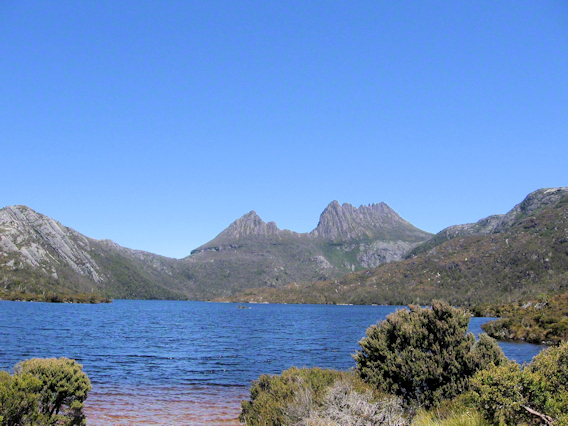
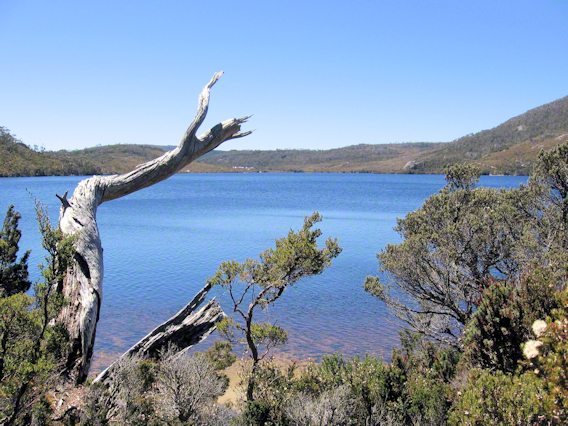
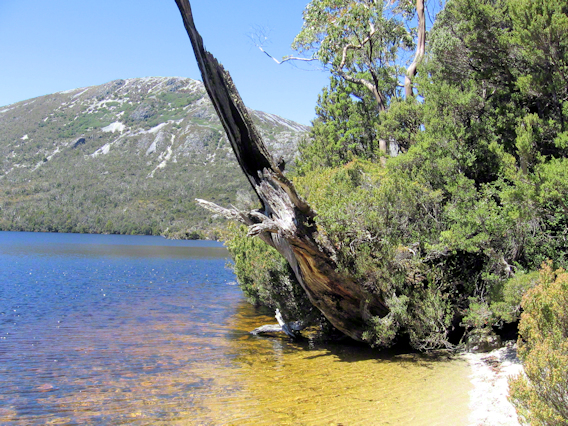
Finally, the boom gate rose, and I ferried the K-Team Young’uns to a highly sought-after carpark. We piled out of the car, sorted out backpacks, and with the sun warming our backs, commenced the hike around Dove Lake. At first, I had to drag a reluctant Son 2 to join us on this adventure, but soon, wooed by the brilliant scenery, he raced ahead to catch up to his older brother.
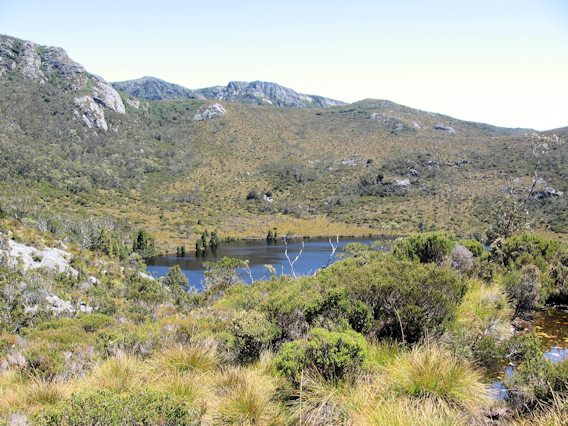
This time we hiked the opposite way around the lake from the way we did in 2001. Following the well-trodden path, a small lake emerged.
‘I don’t think so,’ I replied. ‘I remember it being bigger than this.’
A sign designated to the pond, confirmed that it wasn’t Dove Lake.
A little further on, we reached the boat house and Cradle Mountain framing the view of Dove Lake. On the shore of pebbles and sand, a photographer perched near his sturdy tripod and SLR camera with telescopic lens, while his wife, long-suffering, sat under a beach umbrella enjoying a novel.
We continued our trek around the lake. Son 2 ceased his drone about the meaninglessness of life, while Son 1 captured the beauty on the little digital camera I had lent him.
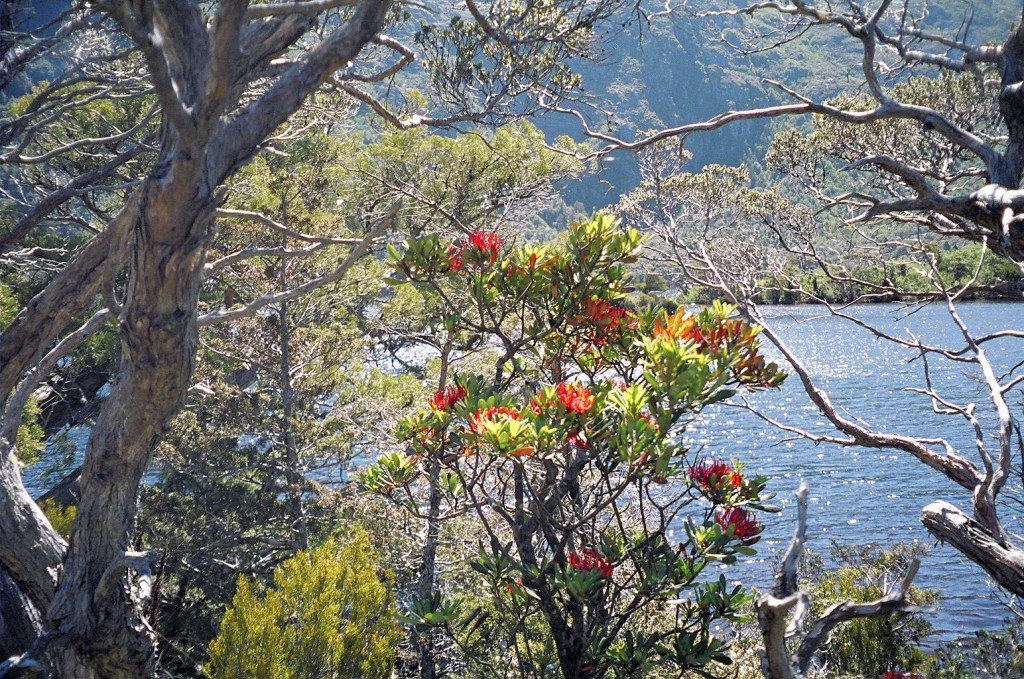
We marvelled at the sun sparkling diamonds on ripples of water.
Within an hour, the K-T-Y had reached the halfway mark. What a difference eight years make! What took more than two hours in 2001, half the time this time.
Over a hotel dinner at Deloraine, the result of the boys needing a “dunny stop” and me not wanting to cook tea that night, we reminisced the tale of two Cradle Mountain trips. And Son 2 had to admit that the hike around Dove Lake this time was not bad. And maybe, just maybe, there was a God who created this amazing world.
[This time, some of the T-K Team step back in time into the Mt. Painter Sanctuary, Northern Flinders Ranges, South Australia; a land offering a glimpse of prehistory…]
Late 1980’s, and my husband and I planned a honeymoon stay in Arkaroola, the town within the Mt. Painter sanctuary, Northern Flinders Ranges. When we arrived, we rolled up to the motel and presented our VISA card for payment.
‘Oh, I’m so sorry,’ said the manager, ‘we don’t take VISA. Only MasterCard.’
‘What?’ But we were counting on our VISA to cover the costs.
We scraped together the cash amount for the three-nights of accommodation and emptied our wallets of all but a few notes. Romantic dinners in the restaurant, off our menu. The longed-for Ridge-Top Tour, off our track. Then cold hard panic struck, how were we to pay for petrol when we returned to Adelaide? The amount in our tank, Dad’s four-wheel-drive vehicle that he loaned us for the holiday, may not last the journey back to Hawker. All because the town in which we chose to spend our honeymoon, was so remote, they did not deal in VISA.
We sat on our motel bed and counted our measly amount of cash. What were we going to do? It’s not like I hadn’t gone without before—on the T-Team with my Dad. Being like-minded and frugal, we dealt with the disappointment, and decided we’d cook our own meals using the barbecue facilities and not venture too far from the town. Besides, there were plenty of places to which we could hike.
I took a deep breath and picked up the book our pastor had given us as a wedding gift. Inside the front cover I discovered an envelope. ‘I wonder what this says,’ I said to my husband.
I took out the card and opened it. An orange-coloured note fluttered onto the floor. I picked it up. ‘Hey, look! Twenty dollars.’ I waved the note in my husband’s face. ‘Twenty dollars! Pastor must’ve known we’d need the money.’
‘I think God did,’ my husband said. ‘Twenty dollars makes all the difference.’
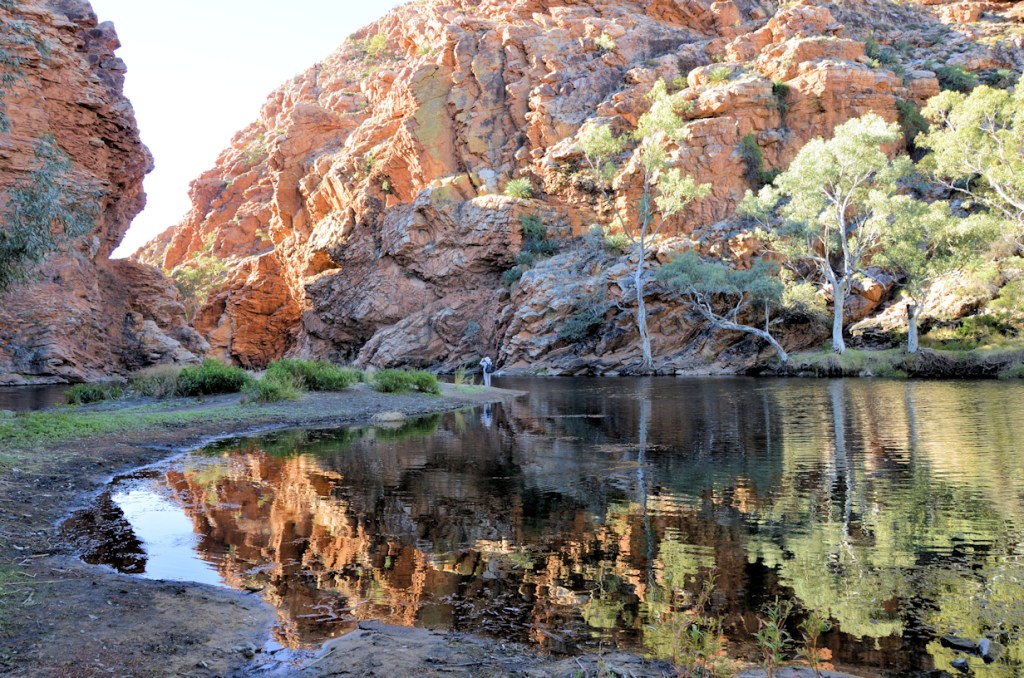
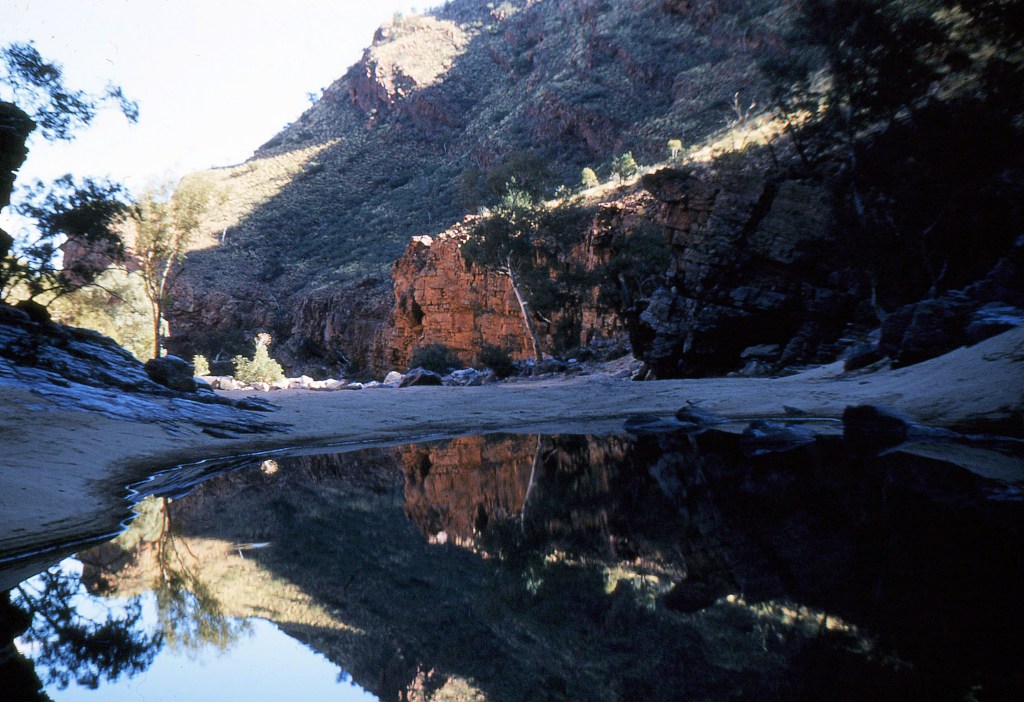
In the restaurant, and eating the cheapest meal offered, I spied a photo adorning the wall behind my beloved. A waterhole with red cliffs on one side and cool but majestic eucalypt trees on the other side. ‘Echo Camp,’ I read. ‘I want to go there.’
He who was driving, turned into the track. ‘You’re quite right. Ready for some adventure?’
‘Okay, well, it says Echo Camp’s only a few kilometres down the track.’
My husband drove up and down the track. It soon became obvious why the track was meant for “authorised” vehicles. But we were committed, and the track became so narrow, with one side rocky cliffs and the other sheer drops, we had no choice but to lurch forward, upward, downward, sideways and every-which-way. While I clutched the bar on the dashboard, my husband had fun, relishing the roller-coaster ride to Echo Camp.
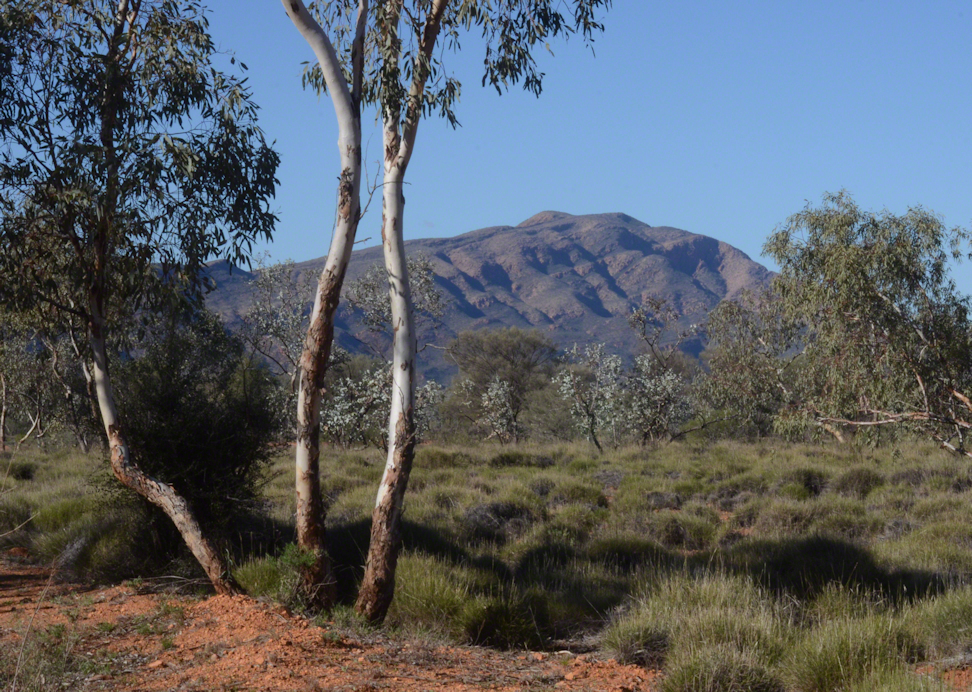
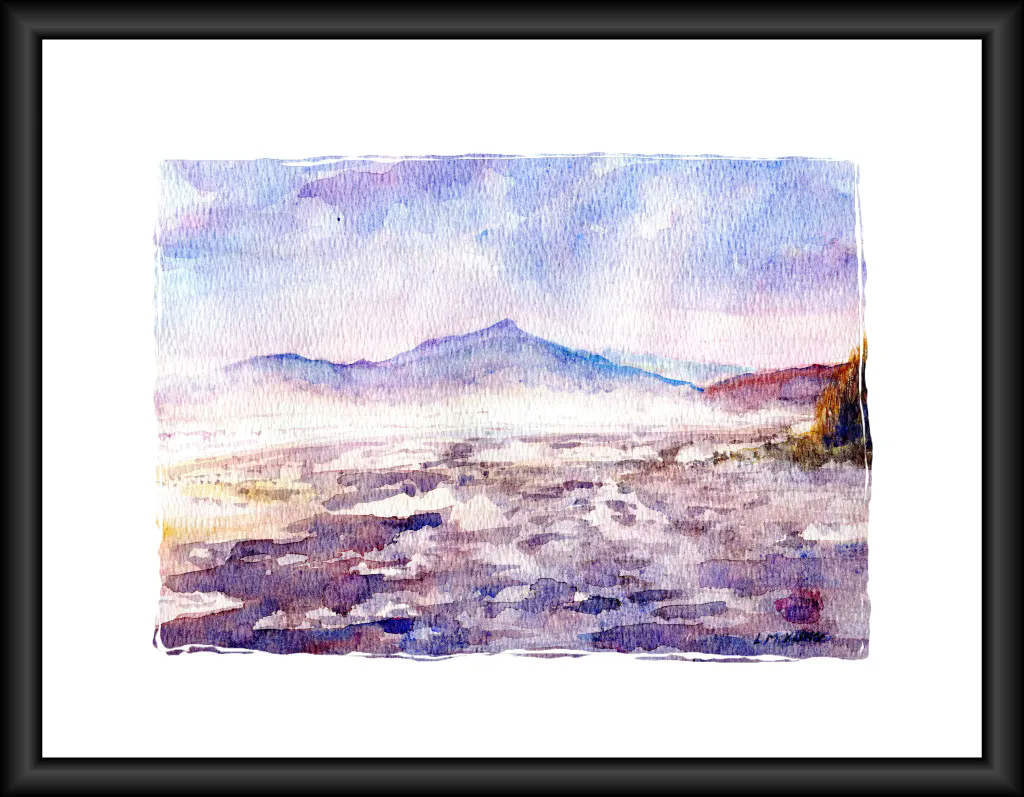
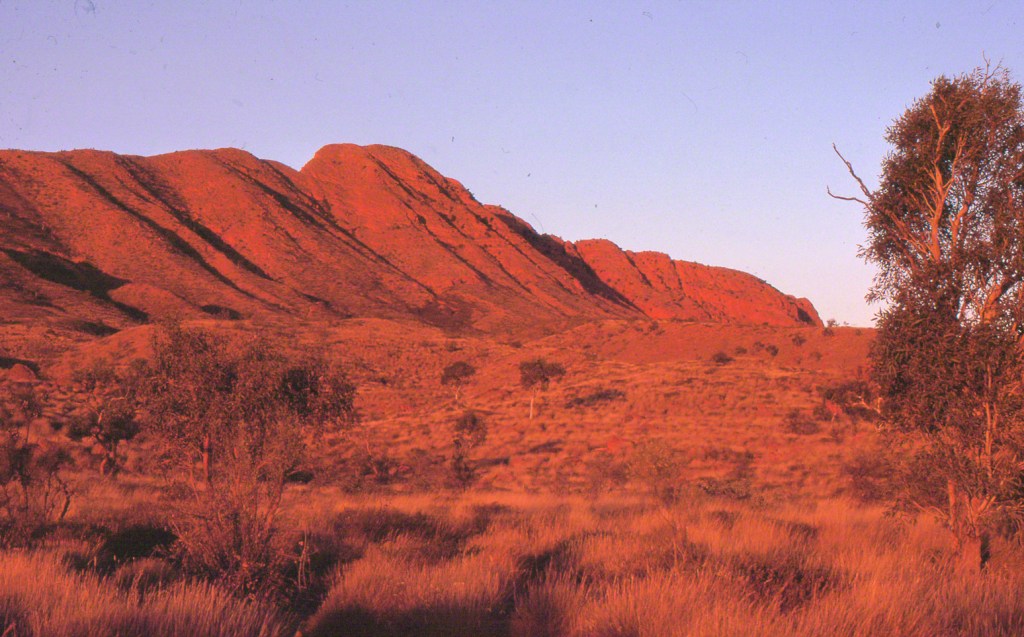
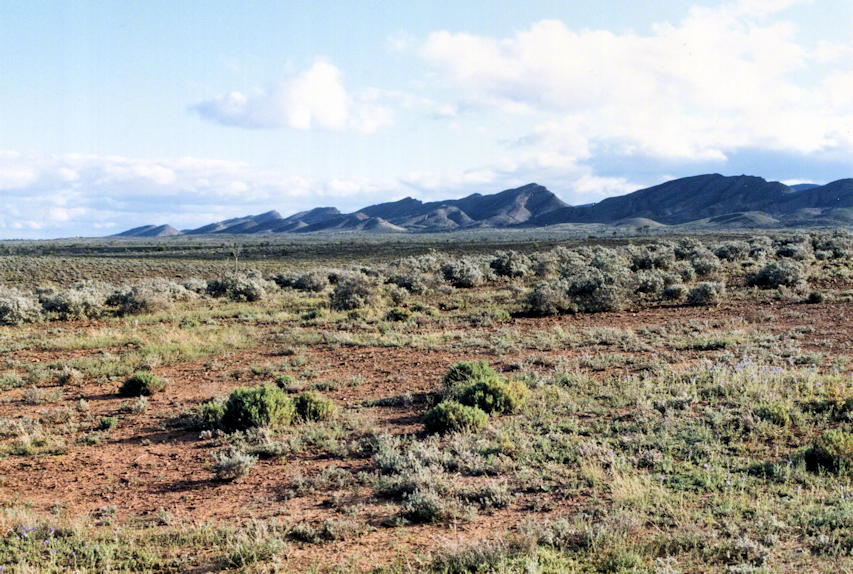
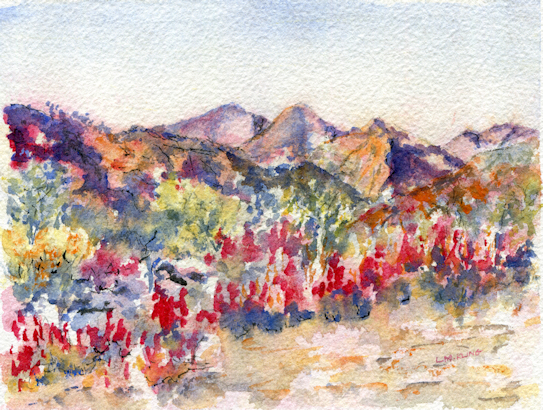
We reached a relatively flat area where we parked our four-wheel drive vehicle. The Painter Sanctuary mountains rose and dipped like waves before us. A feast for the eyes with shades of sienna, blue and mauve. I captured this beauty with my Nikon film camera.
We back tracked and found the way leading to Echo Camp. By this time, the sun hung low in the sky, so our time savouring Echo Camp was limited to no more than half an hour, wandering near the rock pool, taking photos, and enjoying the peace and silence of this land untouched by civilisation, and reserved for the “authorised” apparently.
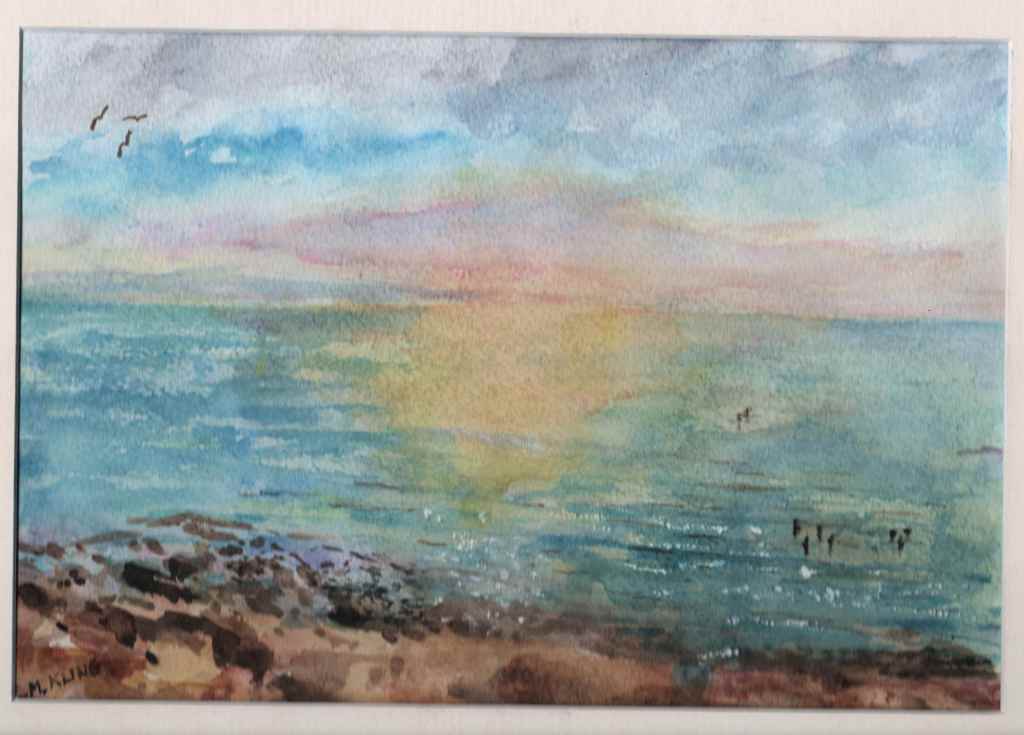
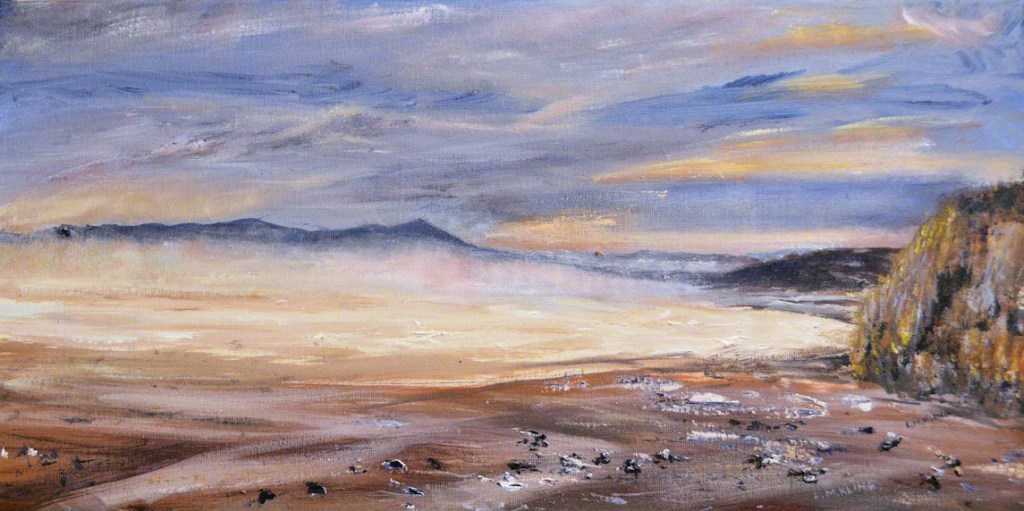
My most recent painting of Arkaroola landscape, Dinnertime Northern Flinders is for sale at the Marion Art Group exhibition at Brighton Central. You can also check out my work on the Gallery 247 website.
Marion Art Group’s exhibition (first in three years) is to be held from Monday October 17 to Sunday October 30, Brighton Central, 525 Brighton Road, Brighton, South Australia.
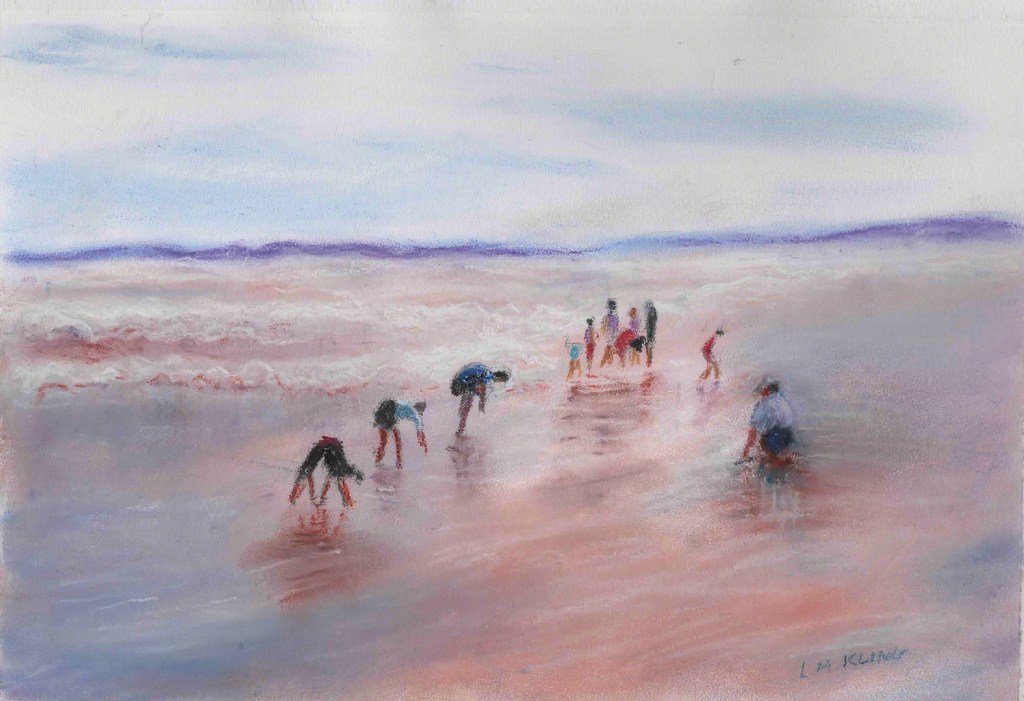
A picture, they say, tells a thousand words. So, what is Cockling at Goolwa’s story? How can the simple heel-toe dance of “cocklers” (people who dig for cockle shells), their feet sinking in soggy sand of the in-coming tide, in the flux of early summer warmth, on a remote beach south of Adelaide tell us? What story worth a thousand words? What was it about this scene that attracted me to capture it? First in photo and then several years later, on canvas in acrylic, and recently in pastel.
I think the water reflecting the sky, all silver, the people on the wet sand, a mirror, swaying and twisting for cockles captured my attention. I’d been there, on the glassy surface, watching for bubbles, grinding my heel into the bog, feeling for the sharp edges of shell and plucking out the cockles that snapped shut when exposed to air.
‘What will you do with all those cockles?’ I asked.
‘They’re for fishing,’ one of our friends said. ‘Bait for fish.’
‘Hopefully, we’ll catch a few fish and have them for dinner tonight,’ another said.
I imagined fish, fresh from the sea, thrown on the barbeque and the cockle bait inside them buried once again in our stomachs. We continued digging for cockles…family and friends, one with the ancient, outside time—nothing else matters but the cockles.
Goolwa, if I remember, has mounds of spent shells in the sand hills, monuments to generations upon generations of Indigenous Australians, their open-air kitchens and meals. Did they perform the same ritual, on the same patch of wet sand, delving for cockles to fry on their fires? A quick perusal of Google reveals they used nets to collect cockles and catch fish. They then cooked the cockles on a campfire.
We are here, they are gone, but their spirit of history lingers, reminding us, though we seem different, we are the same. We are digging, dancing and delving for our dinner. We are still, in the moment, alone in our thoughts in a forgotten corner of the world, unknown by the world, yet one with this country’s past. And God knows each one of us—each part of us, even the unknown parts of ourselves and our secrets.
What if I shared a little secret—an artist’s secret? Okay, I’ll tell you. I painted this picture in less than two hours. Now, that I’ve told you, would the painting be worth less to you? Must time be equated with worth? Sometimes I do take hours upon hours, layers upon layers, and more hours planning to get the work right. But not Cockling at Goolwa.
I love the beginning of a painting; laying the foundation, engaging my inner-natural child, the paint flowing from a thick brush on a damp canvas, colours blending, mixing as I go. One side of the brush crimson, the other blue and a dab of white. Sienna somewhere there in the foreground shadowing the sand. Mid-yellow added incrementally to shroud the distance in light grey for perspective. Then just a hint of heads of land jutting out halfway across the horizon with a suggestion of ultramarine in the grey. So simple, and sometimes, like with Cockling at Goolwa, the scene emerged before my eyes. In the world of artists, I believe the term “magic brush” or “magic hand” has been used. Um, trade secret, so don’t go spreading it around.
So, there you have it, in less than an hour, surf, sand, sky and tones in all the right places.
Now for the people, the twisting, turning people, their feet in the boggy sand. How do I paint them? I had a break and drank a cup of tea. I remember not all the children hunted for cockles. Some kids body-surfed in the shallows, some played cricket and one little boy with a wish to be hunted, or to be warm, buried all his body except his head in the sand. I found him and he broke out of his sand-grave, the sand zombie.
‘Don’t go tracking your sandy footprints into the shack,’ I said.
He washed himself off in the surf, then sat wrapped in a towel and shivering in the sun while watching the cockle hunt.
All the while the “cocklers” cockled for cockle shells. Soon the boy joined the hunt for cockles.
Then when the paint was dry, I plotted the people in with pencil and then painted them in with a finer brush.
‘I like that painting,’ a fellow member of the art group said. ‘Don’t do another thing to it. Don’t even frame it. I’ll buy it as it is. How much do you want for it?’
Paint barely dry, I took the work home, signed it and then the next week at our Christmas lunch, I delivered Cockling at Goolwa to them. The buyer showed the work to others at their table and all admired it.
What made another person connect with Cockling at Goolwa? For this person, their son and family spent many summer holidays at Goolwa, doing just that, cockling. Time out, out of time, unwinding, relaxing, happy times, happy memories, captured on canvas…in less than two hours. And I must admit, the story is slightly less than one thousand words.
But, perhaps as you look at the copy of Cockling at Goolwa, you may have a story of your own about the painting. Maybe a painting’s story is not just one person’s story, but stories from many people, one thousand words, or more…
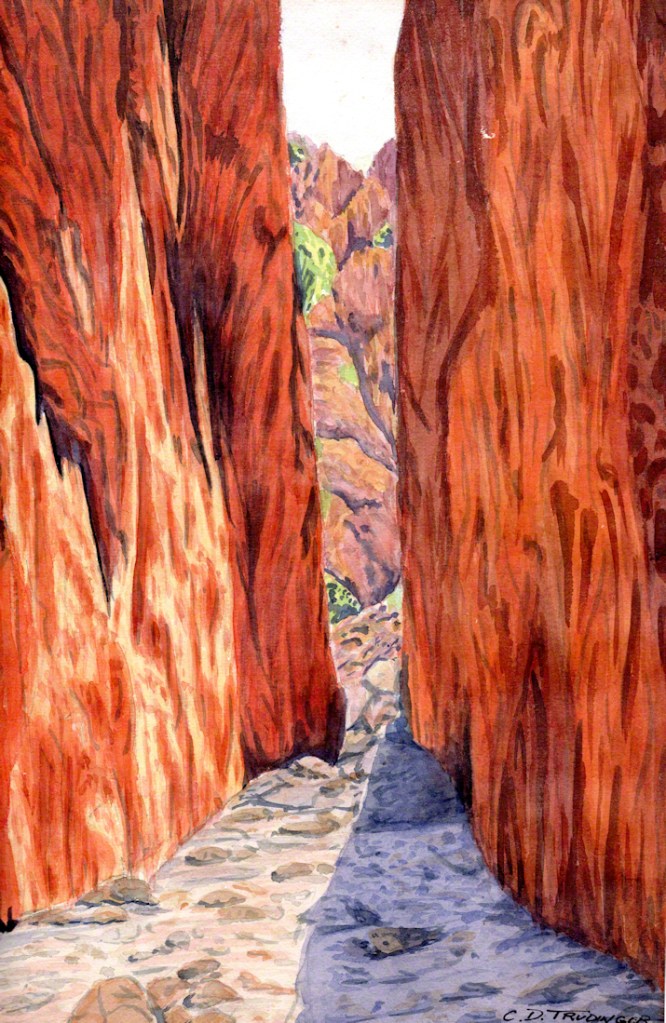
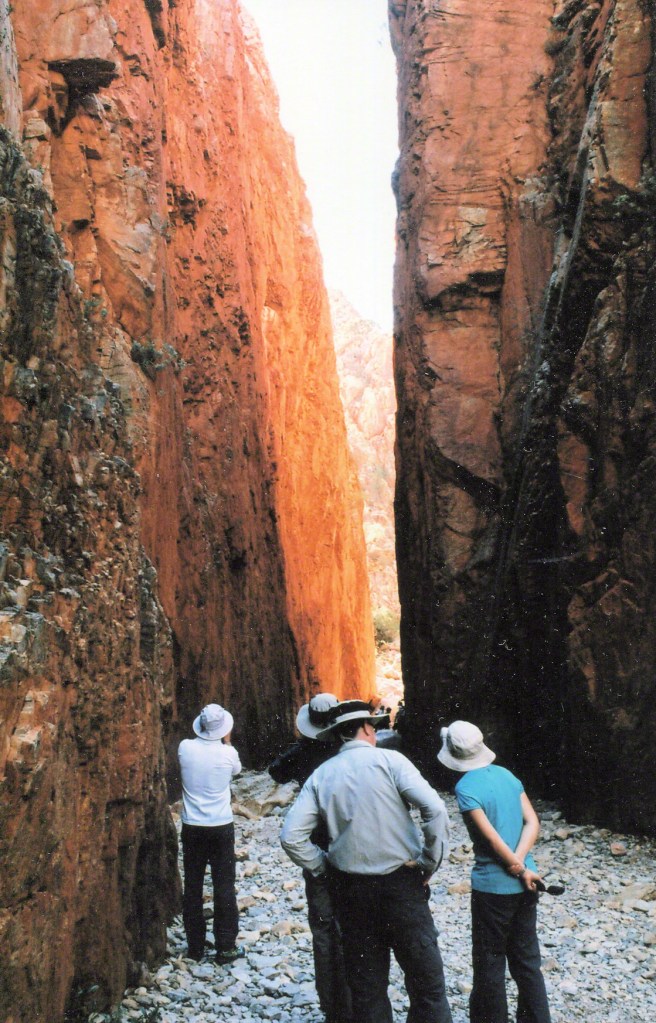
[While painting this scene of a group of older men gathering to admire the glowing walls of Standley Chasm, I was reminded of the T-Team’s trek in 1977 with Mr. B. This wealthy man used to comfort and luxury, took on the challenges of roughing it camping with the T-Team. This stunning chasm is about 50km west of Alice Springs and is one of the first of many beautiful sites to visit in the MacDonnell Ranges.]
The T-Team With Mr B (26)
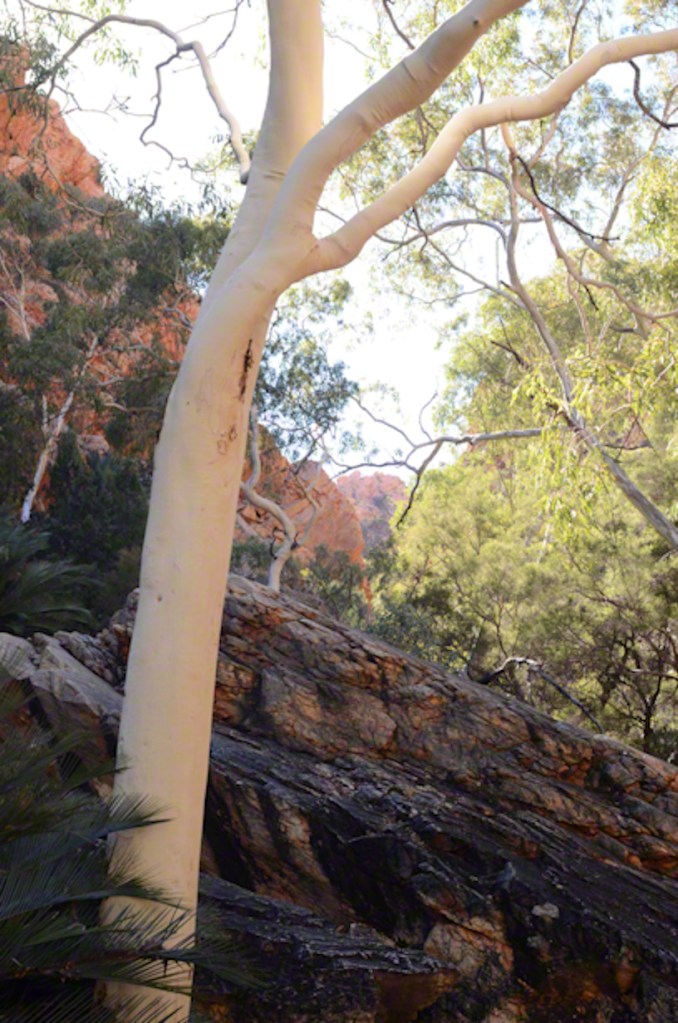
Mr. B slowed the Rover and eased it into a park joining the line of cars, land rovers, and buses awaiting their owners’ return. The T-Team piled out of the Rover and in single-file, followed Dad along the narrow track heading towards Standley Chasm. In the twists and turns of the trail that hugged the dry creek bed, I spotted ferns in the shadow of rock mounds the colour of yellow ochre, and ghost gums sprouting out of russet walls of stone. Hikers marched past us returning to the car park.
A leisurely short stroll became a race to the finish as we struggled to keep up with Dad; scrambling over boulders on the track, squeezing past more tourists going to and from the chasm, Dad snapping and cracking the verbal whip, and Mr. B moaning and groaning that “it’s not for a sheep station”.
The crowd thickened, stranding us in a jam of people, fat bottoms wobbling, parents hauling their whinging kids, and men clutching cameras to their eyes for the perfect shot. Dad checked his watch and then shifted the weight from one foot to the other.
‘Are we there yet?’ I asked.
Wrong question. Especially when asking a grumpy Dad.
‘Not yet!’ Dad barked.
‘I reckon we’re not far away,’ I said. ‘All the tourists have stopped. Must be some reason.’
Dad screwed up his nose. ‘I dunno, it doesn’t look right.’
‘Excuse me! Excuse me!’ Mr. B, one arm stretched out before him, parted the sea of people and strode through.
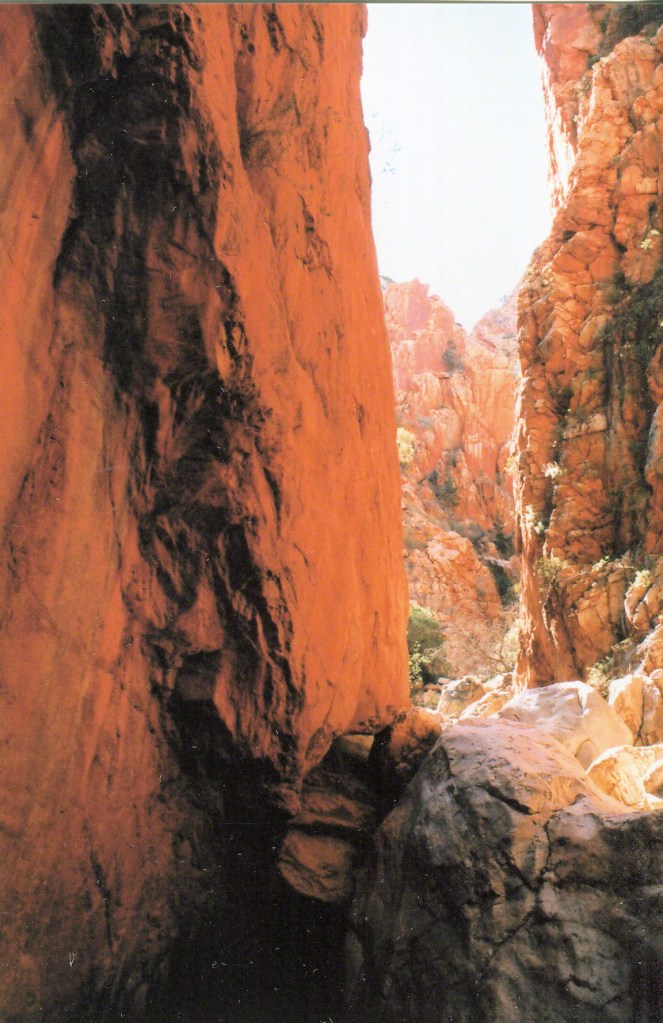
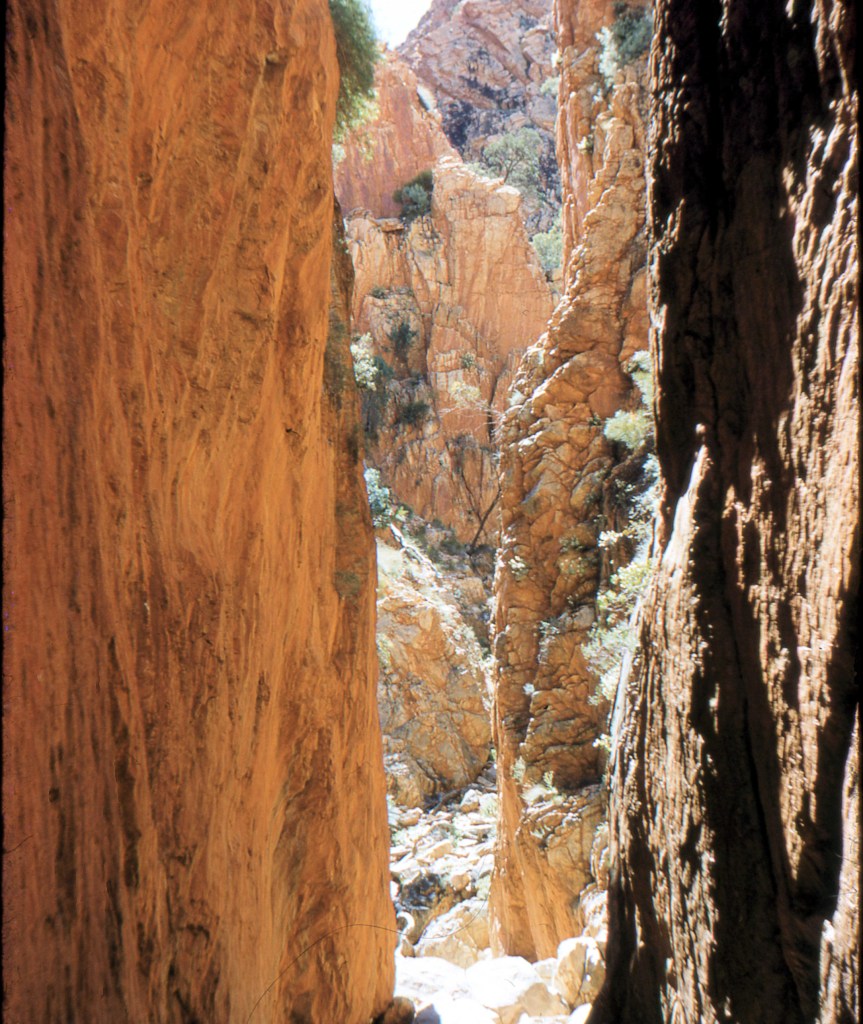
We followed in Mr. B’s wake and within twenty paces, there it glowed. Standley Chasm. Both walls in hues of gold to ochre. Dozens of people milled around its base.
Then we waited. The tourists snapped their shots and then filtered away.
‘When’s it going to turn red?’ I asked for the fourth time.
‘Be patient,’ Dad said.
‘This is boring,’ Matt mumbled.
‘Let’s see what’s the other side.’ Richard tapped Matt on the arm. The two lads scrambled over the rocks and I watched them hop from one boulder to the next over a small waterhole.
I watched mesmerized by the sunlight playing on the walls. They turned from a russet-brown on one side, gold on the other, to both glowing a bright orange. But by then, most of the tourists had left, thinking the Chasm had finished its performance for the day.